
UK Property Industry Round-Up 2025: What Developers Learned — and How to Prepare for 2026
The UK property development landscape in 2025 was defined by discipline over optimism. While the market avoided a sharp downturn, it demanded more from developers at every stage: tighter feasibility, conservative finance assumptions, and clearer exit planning.
For developers who adapted, projects progressed. For those relying on legacy assumptions, margins were quickly eroded. This round-up explores what 2025 taught developers and how to prepare for 2026.
2025 in context for developers
2025 was not a year of easy growth. Instead, it was a year of feasibility pressure. Interest rates eased only gradually, construction costs stabilised rather than fell, planning timelines remained slow, and end-buyer affordability capped sales values.
Developers who relied on structured Due diligence UK property deal analysis rather than headline GDVs were far better positioned to manage risk and protect equity.
Interest rates and development finance: relief, but no reset
The Bank of England’s base rate reductions during 2025 provided some relief, but development finance remained materially more expensive than during the pre-2022 era.
For developers, this meant:
- Finance costs remained a core feasibility driver
- Programme delays directly reduced profit
- Lenders applied stricter scrutiny to GDVs, contingencies, and exits
Rate cuts helped robust schemes, but they did not rescue marginal projects. Developers increasingly stress-tested schemes using conservative assumptions — a discipline aligned with how professional investors analyse property deals.
Build costs in 2025: stabilisation, not reversal
After years of inflation, build costs in 2025 showed signs of levelling out. However, labour, compliance, and specialist works remained expensive.
Developers responded by:
- Value-engineering at design stage
- Tightening procurement and contractor selection
- Phasing delivery to manage cashflow
The lesson was clear: cost control and programme discipline were as important as site acquisition.
Sales markets and exits: liquidity over aspiration
Residential sales activity improved modestly in 2025, but buyers remained highly price-sensitive. For developers, this translated into:
- Slower absorption rates
- Reduced tolerance for aspirational pricing
- Greater importance of layout, specification, and usability
Schemes that succeeded tended to be priced realistically from launch and aligned with local affordability. Developers who validated exits using independent property analysis avoided over-reliance on best-case scenarios.
Planning and regulation: clearer direction, persistent friction
Planning delays continued to challenge delivery timelines throughout 2025. While policy direction was clearer, local authority capacity remained constrained.
At the same time, the confirmation of Renters’ Rights reform influenced developer strategy, particularly for:
- Build-to-rent schemes
- Mixed-exit developments
- Refinance-and-hold models
Developers increasingly assessed operational and regulatory viability alongside pure sales feasibility — a shift that is likely to continue into 2026.
What 2025 taught developers
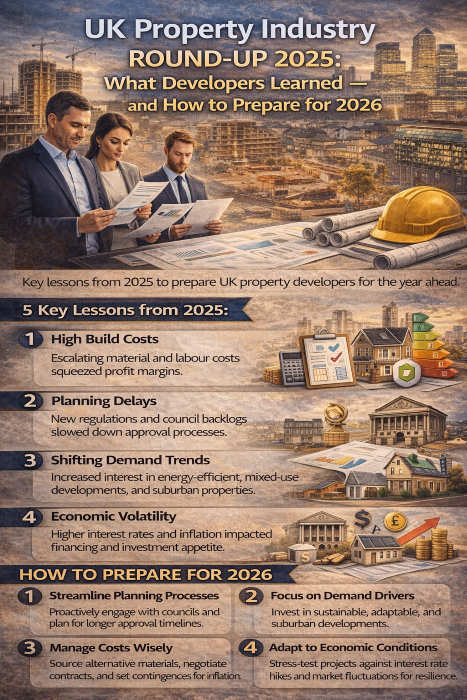
Developers who navigated 2025 successfully typically:
- Underwrote schemes conservatively
- Built realistic time and cost contingencies
- Prioritised funding certainty over leverage
- Designed schemes with multiple exit options
Those who struggled often:
- Overestimated GDVs
- Underestimated holding and finance costs
- Assumed market conditions would improve quickly
Looking ahead to 2026: what developers should focus on
1. Finance discipline will remain essential
Even if rates soften further, lenders are unlikely to relax criteria significantly. Developers should continue to expect conservative valuations and stress-tested feasibility.
2. Regulation will shape scheme design
As rental reform beds in, developers should consider long-term compliance, durability, and management costs at design stage — especially where rental exits are likely.
3. Opportunity remains, but margins must be created
2026 is unlikely to deliver a rapid rebound. Instead, it will reward developers who can:
- Create value through planning or conversion
- Acquire assets at realistic pricing
- Execute efficiently rather than rely on market uplift
2026 Landlord Checklist (For Developers Retaining or Letting Units)
For developers planning to hold, refinance, or exit into the rental market, review the following before 2026:
- ✅ Tenancy strategy — compliant with Renters’ Rights reform
- ✅ EPC and specification — future-proofed against regulation
- ✅ Operational costs — management, maintenance, voids stress-tested
- ✅ Rental affordability — achievable rents aligned with local demand
- ✅ Finance terms — refinance criteria achievable post-completion
- ✅ Documentation readiness — suitable for professional management
- ✅ Exit optionality — flexibility to sell or hold as conditions change
Final thought for developers
2025 confirmed that property development is no longer about riding the market, but about disciplined execution. Developers could no longer rely on price growth to offset weak assumptions or thin margins. This was reflected in the data itself: according to the UK House Price Index (ONS), house price growth in 2025 was modest and varied significantly by region, reinforcing the need for local, evidence-based analysis. As a result, successful developers treated each scheme as a structured business, built on realistic costs, conservative exit pricing, and robust risk management — positioning them to protect capital and identify sustainable opportunities heading into 2026 and beyond.
Platforms such as UncommonDeal exist to support this shift towards structured, data-driven decision-making across UK property development.

Koye Beckley is a UK property investor and founder of UncommonDeal, with practical experience in buy-to-let, property auctions, refurbishment projects and investment deal analysis. Through UncommonDeal, he publishes property market research, property deal sourcing and compliance guidance, investment guides and data-driven analysis to help investors evaluate buy-to-let, BRRR, flip and auction opportunities.
