
Allowable Expenses for UK Landlords: What You Can and Can’t Claim
If you earn rental income from a property in the UK, you may be able to deduct certain costs of running that property before your taxable rental profit is calculated.
So, what expenses can you claim as a landlord?
UK landlords can generally claim expenses that are incurred wholly and exclusively for the purposes of their property rental business. Common landlord allowable expenses include letting agent fees, repairs and maintenance, landlord insurance, Council Tax and utilities paid by the landlord, cleaning and gardening, accountancy fees, certain legal costs, advertising and some business travel costs.
Keeping accurate records throughout the tax year makes it much easier to understand your rental income and property expenses. Our UK Landlord Income & Expense Tracker 2026/27 helps you organise rent, expenses, cash flow and property performance in one place, using Microsoft Excel or Google Sheets.
However, not every cost associated with a rental property is an allowable expense. Property improvements, mortgage capital repayments, the purchase price of the property and many other capital costs cannot normally be deducted from rental income.
Mortgage interest also needs particular attention. The tax treatment differs depending on whether the property is owned personally or through a limited company.
This guide explains the main HMRC allowable expenses for landlords, what you cannot claim, and some of the areas where landlords can easily confuse a deductible running cost with capital expenditure.
Quick answer: An expense is generally more likely to be allowable against rental income if it relates directly to the day-to-day running, maintenance or management of your property business and is not a personal expense or capital improvement. Some costs have their own specific tax rules, so the nature of the expense matters.
What Expenses Can Landlords Claim? Quick Landlord Expenses List
The table below provides a quick overview of some of the most common expenses landlords encounter.
| Expense | Usually allowable? | What landlords should know |
|---|---|---|
| Letting agent and management fees | Yes | Generally allowable when incurred for managing or letting the rental property |
| Repairs and maintenance | Yes | Repairs are generally allowable, but improvements are normally capital expenditure |
| Buildings and contents insurance | Yes | Insurance relating to the rental business can generally be claimed |
| Council Tax | Yes, if you pay it | Can generally be claimed where the landlord is responsible for the cost |
| Water, gas and electricity | Yes, if you pay them | Costs paid by the landlord for the rental business can generally qualify |
| Cleaning and gardening | Yes | Services paid for as part of running the rental property can generally qualify |
| Accountant’s fees | Yes | Generally allowable where the fees relate to the property rental business |
| Legal fees | Depends | Some revenue-related legal costs qualify, while costs relating to capital matters usually do not |
| Advertising for tenants | Yes | Direct costs of finding tenants can generally be claimed |
| Travel and mileage | Sometimes | The journey must relate to the rental business and the relevant tax rules must be met |
| Ground rent and service charges | Yes | Generally allowable when paid as part of operating the rental property |
| Replacement furniture and appliances | Usually | Replacement of Domestic Items Relief may apply |
| Initial purchase of furniture | Usually no | The initial cost does not normally qualify for Replacement of Domestic Items Relief |
| Capital improvements | No, not against rental income | Improvements such as extensions are normally treated as capital expenditure |
| Mortgage capital repayments | No | Repaying the amount borrowed is not an allowable rental expense |
| Residential mortgage interest for an individual landlord | Special rules apply | Individual residential landlords are generally subject to the finance cost tax reduction rules |
| Qualifying finance costs for a limited company | Generally yes | Companies are subject to different rules from individual residential landlords |
| Property purchase price | No | This is capital expenditure, not a day-to-day rental expense |
| SDLT and purchase conveyancing costs | No, not against rental income | These are generally capital costs rather than allowable rental expenses |
The exact tax treatment can depend on the circumstances, so the table should be treated as a starting point rather than a substitute for tax advice.
What Are Allowable Expenses for Landlords?
An allowable expense is broadly a cost that can be deducted when calculating the taxable profit of a property rental business.
HMRC’s key principle is that the expense must be incurred wholly and exclusively for the purposes of renting out the property.
HMRC provides guidance on the allowable expenses landlords can deduct when calculating taxable rental profit, including costs such as letting agent fees, insurance, maintenance and repairs.
For example, suppose a landlord receives £15,000 in annual rental income and incurs £4,000 of qualifying allowable expenses.
Before considering any special rules that may apply, such as the residential property finance cost rules, the basic calculation would be:
Rental income: £15,000
Less allowable expenses: £4,000
Rental profit: £11,000
It is the rental profit, rather than simply the £15,000 received from tenants, that forms the starting point for calculating the landlord’s tax position.
This is why identifying and recording legitimate property expenses matters.
HMRC’s latest property rental income statistics show just how significant these expenses have become. In the 2024/25 tax year, 2.54 million unincorporated landlords declared some form of allowable property expense, equivalent to 87.7% of the unincorporated landlord population covered by HMRC’s data.
Together, they declared approximately £34.75 billion in property expenses.
UK Landlord Expenses in Numbers
HMRC’s 2026 statistics provide an unusually detailed picture of the expenses being declared by unincorporated UK landlords.
| Expense category | Landlords declaring the expense | Total declared |
|---|---|---|
| Repairs and maintenance | 66.2% | £6.41bn |
| Rent, rates and insurance | 66.1% | £3.81bn |
| Legal, management and professional fees | 61.8% | £4.16bn |
| Residential finance costs | 39.8% | £12.82bn |
| Services, including wages | 15.4% | £1.64bn |
| Other allowable expenses | 40.1% | £4.58bn |
| All allowable expenses | 87.7% claimed some expenses | £34.75bn |
Source: HMRC Property Rental Income Statistics 2026, covering Income Tax Self Assessment data for 2024/25. The figures relate to unincorporated landlords and therefore do not represent all UK property-owning companies.
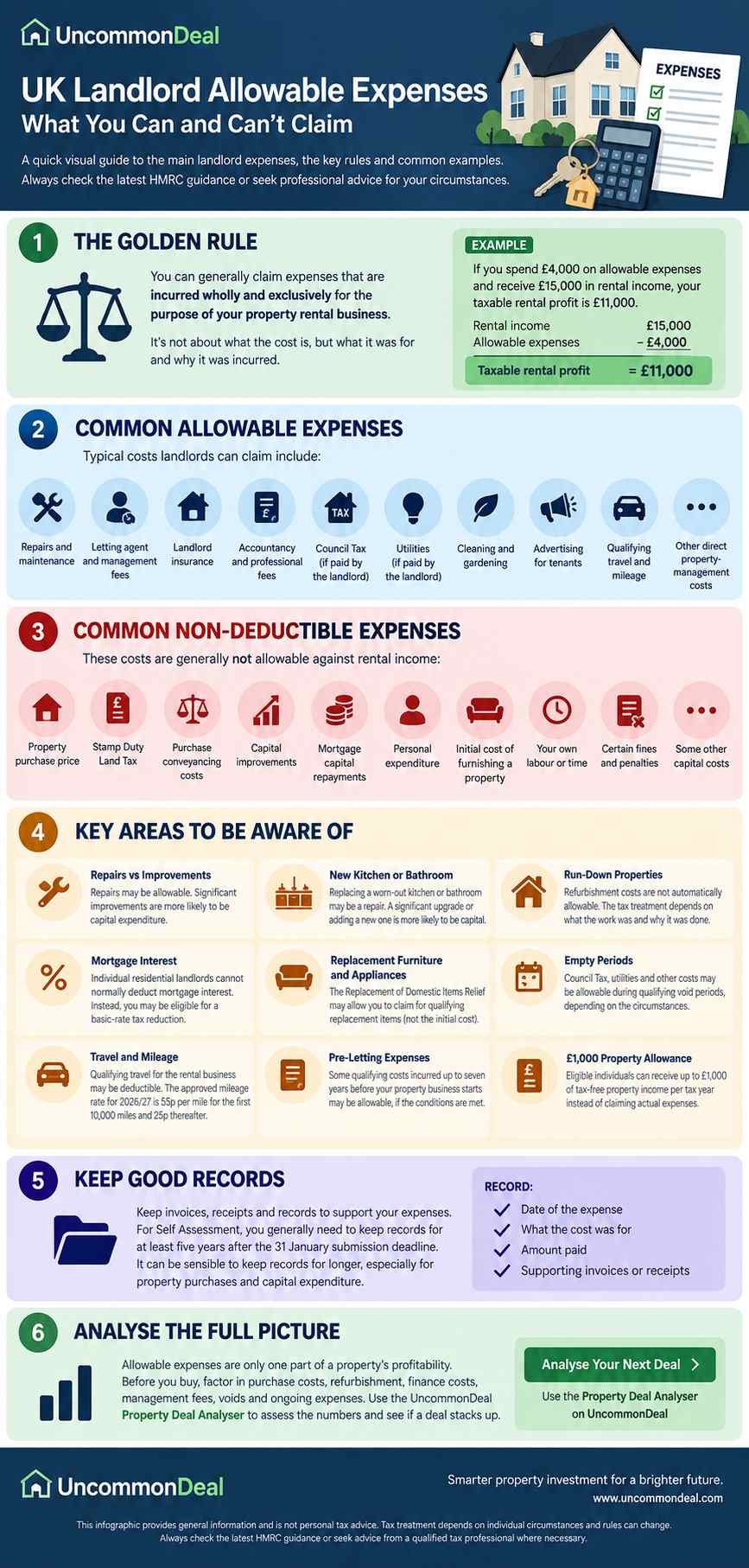
Landlord allowable expenses at a glance: common costs you may be able to claim, expenses that are not normally deductible, and key tax rules to consider.
Residential finance costs were the largest expense category by value at £12.82 billion, accounting for around 37% of the total expenses declared.
Repairs and maintenance were much more widespread. Around 66.2% of landlords declared repair and maintenance expenses, with £6.41 billion reported in total.
HMRC also reports that the average property expense declared per unincorporated landlord reached £13,700 in 2024/25, compared with £8,900 in 2020/21. That represents an increase of approximately 54% in four years.
The figures do not mean that every landlord can automatically claim these types or amounts of expenses. They do, however, demonstrate how important operating costs have become when assessing the real profitability of rental property.
The impact of these costs also varies by the property investment strategy, with buy-to-let, HMO, BRRR and other approaches carrying different levels of finance, management and operating expenditure.
The Key Rule: Revenue Expense or Capital Expense?
One of the most important distinctions for landlords is whether a cost is a revenue expense or capital expenditure.
This distinction affects whether the cost can normally be deducted from rental income.
Revenue expenses
Revenue expenses are generally costs associated with the ongoing running, maintenance and management of an existing property rental business.
Examples can include:
- repairing a leaking roof
- redecorating between tenants
- paying a letting agent
- landlord insurance
- paying a gardener or cleaner
- accountancy fees relating to the rental business
- advertising for tenants
- replacing damaged roof tiles
Subject to the relevant rules, these costs can generally be deducted when calculating rental profit.
Capital expenses
Capital expenditure generally relates to acquiring the property, substantially improving it or creating something that was not there before.
Examples can include:
- buying the property
- adding an extension
- carrying out a loft conversion
- constructing an additional floor
- major improvements beyond the original condition of the property
- certain costs associated with buying or selling the property
These costs cannot normally be deducted as day-to-day expenses from rental income.
That does not necessarily mean a capital cost has no tax relevance. Some qualifying capital expenditure may be taken into account for other tax purposes, including when calculating a capital gain following a future disposal. Different rules apply.
Repairs vs Improvements: What Can a Landlord Claim?
This is one of the most important areas to understand because spending money on a property does not automatically make the expenditure an allowable repair.
HMRC broadly treats a repair as restoring an existing asset, rather than substantially improving it beyond its original condition.
Examples of repairs that HMRC identifies as normally deductible include:
- exterior and interior painting and decorating
- damp and rot treatment
- repairing broken windows and doors
- repointing
- replacing damaged roof slates
- repairing flashing and gutters
Consider a simple example.
A storm damages several roof tiles on a rental property. The landlord pays a roofer to replace the damaged tiles and restore the roof to its previous condition.
That would normally be a repair.
Now suppose the landlord removes the existing roof and builds an additional storey on the property.
The second project is clearly doing more than restoring the existing building. It creates a significant improvement and would generally be treated as capital expenditure.
Repairs vs Improvements: Examples
| Work carried out | Likely treatment | Why |
|---|---|---|
| Repainting a rental property | Repair | Restores the existing property |
| Damp treatment | Repair | Normally remedial work |
| Replacing broken roof tiles | Repair | Restores part of the existing roof |
| Repairing a damaged door | Repair | Restores an existing item |
| Replacing damaged guttering | Repair | Maintenance of the existing property |
| Replacing an old item with a reasonable modern equivalent | May still be a repair | Modern materials or technology do not automatically make the work an improvement |
| Building an extension | Capital | Adds something new to the property |
| Adding another storey | Capital | Significantly enhances the property |
| Loft conversion | Usually capital | Creates additional usable accommodation |
| Major redevelopment | Usually capital | Goes beyond maintaining the existing asset |
There is therefore an important question to ask whenever substantial work is carried out:
Are you restoring what was already there, or are you creating or significantly improving something?
The answer can materially affect the tax treatment.
What if modern materials are better than the originals?
A common misconception is that replacing an old component with a newer modern equivalent automatically turns the expenditure into a capital improvement.
That is not necessarily the case.
Building standards, technology and commonly available materials change over time. Using a modern equivalent when repairing an older property does not automatically prevent the cost from being treated as a repair.
The important issue is the nature and extent of the work and whether the property has been substantially improved beyond what amounts to a repair.
This distinction becomes particularly important during refurbishments, where a project can contain both allowable repair expenditure and capital improvements.
Keeping detailed invoices that separate different elements of the work can therefore be valuable.
Landlord Allowable Expenses List: 13 Expenses You May Be Able to Claim
There is no single expense that applies to every landlord. The costs you can claim depend on how your property business operates, who pays each bill and the nature of the expenditure.
However, the following are some of the most common allowable expenses for landlords in the UK.
1. Letting Agent and Property Management Fees
Yes, letting agent and property management fees are generally allowable expenses where they relate directly to your rental business.
This can include fees paid to an agent for:
- finding and referencing tenants
- collecting rent
- managing the tenancy
- arranging inspections
- organising repairs and maintenance
- handling tenant enquiries
- managing check-ins and check-outs
For example, if your letting agent charges £120 per month to manage a rental property, the £1,440 annual management cost would generally be an allowable property business expense.
The same principle can apply where you use a separate property management company rather than a traditional letting agent.
However, the expense must relate to the rental business. A payment for services that are personal or unrelated to letting the property would not normally qualify simply because it was paid to a property agent or management company.
2. Repairs and Maintenance
The cost of repairing and maintaining a rental property is generally allowable, provided the work is genuinely a repair rather than a capital improvement.
Common examples can include:
- repairing a leaking roof
- fixing plumbing problems
- repairing a boiler
- replacing broken roof tiles
- fixing damaged doors or windows
- treating damp or rot
- repairing electrical faults
- redecorating between tenancies
- repairing damaged flooring
- maintaining gutters and drainage
The key question is whether the work restores or maintains the existing property rather than substantially improving it.
For example, paying £450 to repair a boiler would normally be treated very differently from spending £25,000 to build an extension.
It is also possible for a larger refurbishment project to contain both repair costs and capital expenditure.
If you are undertaking substantial works, ask contractors to provide itemised invoices rather than describing everything simply as “property refurbishment”. This can make it easier to identify what work was actually carried out and determine the appropriate tax treatment.
3. Landlord Insurance
Insurance premiums relating to your rental property business can generally be claimed as an allowable expense.
This can include qualifying premiums for:
- buildings insurance
- landlord contents insurance
- public liability cover
- rent guarantee insurance
- legal expenses insurance
- other insurance taken out specifically for the rental business
For example, if you pay £380 per year for landlord buildings insurance on a buy-to-let property, that premium would generally be deductible when calculating the property’s rental profit.
Personal insurance that is unrelated to the property business would not normally qualify.
4. Council Tax, Water, Gas and Electricity
If you are responsible for paying Council Tax or utility bills relating to your rental business, those costs can generally be allowable expenses.
Depending on the tenancy arrangement, this could include:
- Council Tax
- water charges
- gas
- electricity
Cost of a void period can make these costs more visible because rent stops while mortgage payments, Council Tax, utilities and other property expenses may continue.
In many standard single-let properties, tenants pay these bills directly. In that situation, the landlord cannot claim an expense they did not incur.
However, landlords may pay some or all of these costs in HMOs, serviced accommodation, certain bills-inclusive tenancies or during periods when a property is vacant.
For example, suppose a tenant leaves and the landlord becomes responsible for Council Tax and electricity while the property is being prepared for the next tenant. Where the costs are incurred for the purposes of the continuing rental business, they may generally be deductible, subject to the circumstances and normal tax rules.
The important principle is simple:
You can only claim an expense that you have actually incurred.
If the tenant pays the electricity supplier directly, for example, there is no electricity expense for the landlord to deduct.
5. Cleaning, Gardening and Other Property Services
Cleaning, gardening and similar services can generally be allowable where they are incurred as part of running the rental business.
Examples may include:
- end-of-tenancy cleaning
- communal-area cleaning
- gardening
- grounds maintenance
- window cleaning
- pest control
- routine property maintenance services
This can be particularly relevant for HMOs and other properties where the landlord retains responsibility for communal areas or provides services as part of the tenancy.
Again, there needs to be a genuine property-business connection.
Paying a gardener £50 to maintain the garden of your rental property is different from paying the same gardener to work at your own home.
6. Accountant and Professional Fees
Professional fees incurred wholly and exclusively for the rental business can generally be claimed, subject to some important exceptions.
Potential allowable costs include fees paid to:
- accountants
- bookkeepers
- letting agents
- property managers
- surveyors for certain revenue-related work
- other professionals providing services connected with the day-to-day rental business
For example, if an accountant charges £500 to prepare the property-business element of your Self Assessment tax return and advise on your rental accounts, that cost may generally be deductible.
However, not every professional fee is automatically allowable.
Professional costs associated with acquiring a property, disposing of it or carrying out capital improvements may instead be capital in nature.
The purpose of the professional work, rather than simply the job title of the person you paid, is what matters.
7. Legal Fees
Some legal fees can be allowable landlord expenses, but others are treated as capital costs.
This is an area where landlords should avoid assuming that every solicitor’s bill can be deducted from rental income.
Revenue-related legal expenses connected with the management of the rental business may qualify in appropriate circumstances.
Examples can include certain costs associated with:
- tenancy matters
- rent collection
- recovering qualifying debts
- dealing with breaches of tenancy
- other routine management matters
By contrast, legal costs associated with buying or selling a property are generally capital rather than day-to-day rental expenses.
For example:
Solicitor dealing with a qualifying tenancy matter: potentially a revenue expense.
Conveyancer acting on the purchase of the investment property: generally a capital cost.
Some legal costs can involve more complicated tax rules, so significant or unusual expenditure should be considered individually.
8. Advertising and Tenant-Finding Costs
The cost of advertising a rental property and finding tenants can generally be an allowable expense.
Examples may include:
- property advertising
- online letting-platform fees
- tenant-find fees
- referencing costs paid by the landlord
- photography used specifically to market the rental property
- other direct marketing costs associated with finding tenants
For example, if you pay an agent £600 for a tenant-find service, that cost would generally form part of the expenses of operating the rental business.
The same principle can apply where a landlord markets the property directly rather than using an agent.
9. Travel and Mileage
Landlords may be able to claim qualifying travel costs where the journey is made wholly and exclusively for the property rental business.
Examples might include travelling to:
- inspect a rental property
- meet a tenant for a genuine management purpose
- meet a contractor at the property
- deal with repairs
- visit an agent in connection with the rental business
However, travel expenses require more care than simply assuming every journey connected in some way with property investment is deductible.
The purpose of the journey matters, and special rules can apply depending on how the landlord operates their property business and how the travel cost is calculated.
For qualifying landlords using simplified mileage expenses, HMRC’s mileage rate for cars and goods vehicles from the 2026/27 tax year is:
| Business mileage | 2026/27 flat rate |
|---|---|
| First 10,000 qualifying miles | 55p per mile |
| Each qualifying mile above 10,000 | 25p per mile |
| Motorcycles | 24p per mile |
The rate for the first 10,000 miles increased from 45p to 55p per mile from 6 April 2026.
Example: Landlord Mileage Claim
Suppose a qualifying landlord drives 1,200 business miles during the 2026/27 tax year solely for eligible property-business journeys.
Using the 55p rate:
1,200 miles × £0.55 = £660
The potential mileage expense would therefore be £660, assuming the landlord meets the conditions for using the mileage method and the journeys qualify.
Landlords claiming business mileage should maintain appropriate records showing the date, destination, mileage and business purpose of journeys.
10. Phone, Stationery and Administrative Costs
Administrative costs can generally be claimed to the extent that they are incurred for the property rental business.
Examples may include:
- postage
- stationery
- printing
- property-management software
- accounting software
- phone calls relating to the rental business
- other direct administrative costs
Where an expense has both business and personal use, only the identifiable business element may be deductible where the rules allow an appropriate apportionment.
For example, a landlord should not normally claim their entire personal mobile-phone bill merely because they occasionally speak to tenants or contractors on the phone.
Good record-keeping is particularly useful where expenses have mixed business and personal use.
11. Ground Rent and Service Charges
Ground rent and service charges paid by a landlord can generally be allowable where they relate to the rental property business.
This is particularly relevant to landlords who own leasehold flats.
A service charge might cover costs such as:
- communal cleaning
- building maintenance
- communal lighting
- grounds maintenance
- building insurance
- management of communal areas
However, landlords should check what the service charge actually represents.
A normal recurring service charge associated with running and maintaining the building may be treated differently from a substantial one-off contribution towards capital improvements.
For example, an annual service charge covering communal cleaning and routine maintenance is different from a major works bill for a substantial improvement to the building.
12. Replacement Furniture, Appliances and Domestic Items
Landlords may be able to claim Replacement of Domestic Items Relief when replacing certain items provided for tenants.
This can potentially apply to replacement items such as:
- beds
- sofas
- tables and chairs
- carpets
- curtains
- fridges
- freezers
- washing machines
- dishwashers
- crockery
- cutlery
The important word is replacement.
The relief does not generally cover the initial cost of furnishing a property.
For example, suppose you purchase an unfurnished property and spend £700 buying a sofa before letting it for the first time.
That initial £700 sofa does not normally qualify for Replacement of Domestic Items Relief.
Three years later, the sofa is worn out and you replace it with an equivalent sofa costing £800.
Subject to the relevant conditions, the replacement cost may qualify for relief.
What if the replacement is an upgrade?
The position becomes more complicated if the new item is significantly better than the item it replaces.
Suppose the old sofa would cost £800 to replace with a modern equivalent, but the landlord chooses a premium £1,500 replacement.
The relief will generally be restricted so that the additional cost attributable to the improvement is not treated in the same way as the like-for-like replacement element.
Landlords should therefore keep evidence of both the item being replaced and the cost and specification of its replacement where the difference is significant.
13. Other Direct Costs of Running a Rental Property
There are many other costs that may potentially qualify where they are incurred wholly and exclusively for the purposes of the rental business.
Depending on the property and circumstances, these could include qualifying costs associated with:
- safety inspections
- gas safety checks
- electrical inspections
- inventory services
- tenant referencing
- property management systems
- maintenance contracts
- security services
- waste removal
- locksmith services
- compliance-related administration
The fact that an expense is not specifically named on a standard “landlord expenses list” does not automatically mean that it cannot be claimed.
Equally, paying for something connected with a property does not automatically make it deductible.
The correct tax treatment depends on what the expense was for, why it was incurred and whether it is revenue or capital in nature.
A useful starting question is:
Was this cost incurred to run, manage, maintain or repair my existing rental business, or was it incurred to acquire, improve or create a capital asset?
That distinction will resolve many landlord-expense questions, although some costs require more detailed consideration.
Can Landlords Claim Mortgage Interest?
Yes, landlords can receive tax relief for qualifying mortgage interest and other finance costs, but the way the relief works depends on how the rental property is owned.
For an individual who lets residential property, mortgage interest is generally not deducted from rental income as an ordinary allowable expense. Instead, qualifying finance costs are used to calculate a basic-rate Income Tax reduction.
Limited companies are treated differently and are not subject to the same residential property finance cost restriction.
It is also important to distinguish mortgage interest from mortgage capital repayments. Repaying the amount originally borrowed is not an allowable rental expense.
Mortgage Interest for Individual Landlords
For individual residential landlords, the rules commonly referred to as Section 24 restrict the way finance costs receive tax relief.
Since the 2020/21 tax year, individual landlords have generally been unable to deduct residential property finance costs from rental income when calculating taxable rental profit.
Instead, qualifying finance costs are used to calculate a basic-rate tax reduction, currently 20%.
Finance costs potentially covered by these rules include qualifying:
- mortgage interest
- loan interest
- interest on borrowing used to purchase furnishings for the rental property
- overdraft interest
- certain fees and incidental costs associated with obtaining or repaying property finance
This means mortgage interest should not simply be added to the ordinary landlord expenses in the same way as repairs, insurance or letting agent fees when calculating the taxable rental profit of an individual residential landlord.
How Does the 20% Mortgage Interest Tax Reduction Work?
It is often said that individual landlords simply receive “20% tax relief on mortgage interest”.
That is a useful shorthand, but it is not the complete rule.
The basic-rate tax reduction is calculated at 20% of the lowest of:
- the qualifying finance costs for the year, including relevant unused finance costs brought forward
- the property business profits for the year, after relevant brought-forward property losses
- the landlord’s adjusted total income above their Personal Allowance
This distinction matters because a landlord may not always receive a tax reduction equal to 20% of all their qualifying finance costs in that particular tax year.
Where the restriction is caused by insufficient property profits or adjusted total income, qualifying unused finance costs may potentially be carried forward for use in a later year, subject to the rules.
Example: Individual Landlord With Mortgage Interest
Consider a simplified example.
A landlord owns a residential buy-to-let property personally and receives:
Annual rental income: £18,000
During the year, the landlord has the following ordinary allowable expenses:
| Expense | Amount |
|---|---|
| Letting agent fees | £1,800 |
| Repairs and maintenance | £1,200 |
| Landlord insurance | £400 |
| Other allowable expenses | £600 |
| Total ordinary allowable expenses | £4,000 |
The landlord also pays £6,000 in qualifying mortgage interest.
For an individual residential landlord, the calculation does not normally look like this:
£18,000 rent
− £4,000 ordinary expenses
− £6,000 mortgage interest
= £8,000 taxable rental profit
Instead, the basic property profit calculation is:
£18,000 rental income − £4,000 allowable non-finance expenses = £14,000 property profit
The £6,000 mortgage interest is then considered separately under the residential finance cost rules.
Assuming the full £6,000 is the lowest of the three figures used in the statutory calculation, the potential basic-rate tax reduction would be:
£6,000 × 20% = £1,200
So, in this simplified example:
Property profit before the finance cost tax reduction: £14,000
Potential finance cost tax reduction: £1,200
The actual Income Tax payable will depend on the landlord’s wider tax position, including other income, allowances and applicable tax rates.
This is why saying that mortgage interest is simply an “allowable landlord expense” can be misleading for individual residential landlords.
Why Section 24 Can Affect Higher-Rate Taxpayers More
The finance cost restriction can be particularly significant for landlords who pay Income Tax above the basic rate.
Under the current system, qualifying residential finance costs do not reduce the rental profit used in the initial Income Tax calculation in the same way as ordinary allowable expenses.
The subsequent finance cost tax reduction is calculated using the basic rate of Income Tax.
Consider two simplified scenarios where the conditions allow the full finance costs to be used for the basic-rate reduction.
If a landlord has £10,000 of qualifying mortgage interest:
Potential finance cost tax reduction: £10,000 × 20% = £2,000
The relief does not simply become £4,000 because the landlord happens to pay 40% Income Tax.
This is one reason financing costs should be considered carefully when assessing the real after-tax return from a personally owned buy-to-let property.
Can a Limited Company Claim Mortgage Interest?
A property investment company is not subject to the same residential finance cost restriction that applies to individual Income Tax payers.
HMRC confirms that the restriction on dwelling-related finance costs does not apply to Corporation Tax customers.
Companies are instead subject to the Corporation Tax rules, including the loan relationship rules that apply to financing costs.
In practical terms, qualifying interest and finance costs incurred by a property company can generally be taken into account when calculating the company’s taxable profits, subject to the relevant Corporation Tax rules and any restrictions that may apply.
This creates an important difference between owning a rental property personally and owning it through a limited company.
| Finance cost treatment | Individual residential landlord | Limited company |
|---|---|---|
| Deduct qualifying mortgage interest directly from rental income? | Generally no | Generally available under company tax rules |
| Basic-rate finance cost tax reduction? | Yes, subject to the calculation rules | No, not the Section 24 mechanism |
| Residential finance cost restriction applies? | Yes | No |
| Mortgage capital repayment deductible? | No | No |
This does not mean that buying rental property through a limited company is automatically more tax-efficient.
Companies have their own tax consequences, and taking money out of a company can create additional personal tax considerations. Financing terms, acquisition taxes, accounting costs, future disposals and the investor’s wider circumstances also matter.
The appropriate ownership structure therefore needs to be considered as part of the overall investment and tax position rather than mortgage interest in isolation.
Can You Claim the Capital Repayment on a Buy-to-Let Mortgage?
No. The capital element of a mortgage repayment is not an allowable rental expense.
A mortgage payment can contain two very different components:
Interest: the cost charged by the lender for providing the finance.
Capital: repayment of the money originally borrowed.
Only qualifying finance costs potentially receive tax relief. Repaying the loan itself does not.
For example, suppose a landlord makes total mortgage payments of £12,000 during the year consisting of:
Mortgage interest: £7,000
Capital repayment: £5,000
The landlord cannot claim tax relief on the full £12,000 simply because that amount left their bank account.
The £7,000 interest element may qualify for the appropriate finance cost treatment.
The £5,000 capital repayment is not an allowable expense.
Landlords should therefore use their lender’s annual mortgage statement or other appropriate records to identify how much interest was actually charged during the tax year.
Does the Mortgage Have to Be Secured Against the Rental Property?
The tax treatment of interest is not determined solely by which property has been used as security for the loan.
An important consideration is the purpose for which the borrowed money was used.
For example, borrowing secured against another property may potentially have a property-business purpose if the funds are genuinely used for the rental business, subject to the relevant rules and limits.
Conversely, borrowing secured against a rental property does not automatically make all of the interest a property-business finance cost if the money was actually used for a private purpose.
This is another reason landlords should keep a clear record of:
- the amount borrowed
- what the borrowed funds were used for
- lender statements
- interest charged
- refinancing transactions
- any private use of borrowed funds
What About Remortgaging a Rental Property?
Remortgaging does not automatically prevent interest from qualifying for tax relief.
However, the purpose and amount of the borrowing matter.
Where additional funds are released from a rental property and used for personal expenditure, the tax position can be different from borrowing that remains attributable to the property rental business.
Refinancing can become particularly complicated where a property has increased substantially in value, equity is withdrawn, loans have been refinanced several times or borrowed money has been used for several different purposes.
Landlords considering significant equity release or refinancing should therefore establish the tax treatment of the borrowing rather than assuming that all interest charged by the lender will qualify.
Keep Mortgage Interest Separate From Ordinary Landlord Expenses
For individual residential landlords, it is useful to keep finance costs clearly separated from ordinary allowable expenses in your records.
For example:
Ordinary property expenses
- repairs
- insurance
- agent fees
- professional fees
- utilities paid by the landlord
- cleaning and gardening
Finance costs
- qualifying mortgage interest
- qualifying loan interest
- certain loan arrangement and finance fees
Capital repayments
- repayment of the mortgage principal
These three categories do not necessarily receive the same tax treatment.
Separating them from the outset makes it easier to calculate rental profits correctly and avoids one of the most common misunderstandings about landlord allowable expenses.
Can You Claim Expenses Before Your First Tenant Moves In?
Yes, some expenses incurred before your first tenant moves in can potentially be claimed, but only if they meet HMRC’s conditions for pre-letting expenditure.
A common misconception is that no expense can be claimed until a property starts generating rent.
HMRC provides relief for certain qualifying expenses incurred before a property rental business begins. However, this does not mean that every cost of buying, renovating or preparing a property for letting becomes an allowable expense.
The distinction between revenue expenditure and capital expenditure remains crucial.
The Seven-Year Rule for Pre-Letting Expenses
HMRC allows certain qualifying expenses incurred up to seven years before a property business starts to be treated as if they were incurred on the day the property business commenced.
For the relief to apply, the expenditure must:
- have been incurred within seven years before the property business started
- not already be allowable as a deduction for another tax purpose
- have been allowable if it had been incurred after the property business started
- meet the normal requirements for an allowable property-business expense, including being incurred wholly and exclusively for the business
- not be capital expenditure
The last condition is particularly important.
The seven-year rule does not turn capital expenditure into an allowable rental expense.
If a cost would have been capital expenditure after the property business started, it does not suddenly become a revenue expense simply because it was incurred beforehand.
When Does a Property Rental Business Start?
For a landlord letting property for the first time, HMRC says that a property business will normally begin when the first property is let.
This creates an important distinction between:
Preparatory activities: things you do while getting ready to start your first property rental business.
Property-business activities: expenditure incurred once the property business has commenced.
Suppose you buy your first buy-to-let property and incur qualifying revenue expenses before the first tenant moves in.
If those costs meet the pre-commencement rules, they may potentially be treated as incurred when your property business starts.
Once you already have an existing UK property rental business, the position can be different.
For example, if you already let one property and then purchase a second property, qualifying revenue expenditure incurred while preparing the second property for letting may form part of your existing property business rather than being treated as expenditure incurred before the business commenced.
Example: Expenses Before the First Tenant Moves In
Suppose a first-time landlord buys a property in a condition that is already suitable for letting.
Before the first tenancy begins, the landlord incurs:
- £250 for advertising and tenant-finding costs
- £300 for qualifying professional costs
- £200 for other qualifying revenue expenditure
Assume these costs were incurred wholly and exclusively for the planned rental business and would have been allowable if incurred after the letting started.
The total is:
£250 + £300 + £200 = £750
Subject to the relevant conditions, the £750 may potentially qualify as pre-commencement expenditure and be treated as incurred when the property rental business begins.
However, the answer could be very different if the landlord also spent £25,000 carrying out major works to make an uninhabitable property fit to let.
That brings us to one of the most important rules for property investors.
Bought a Run-Down Property? Refurbishment Costs Are Not Automatically Allowable
Buying a property that requires refurbishment can create a significant tax trap.
It is tempting to assume:
“I bought a rental property, spent money repairing it and then let it, so the refurbishment must be an allowable expense.”
That is not necessarily correct.
HMRC specifically identifies circumstances where the cost of repairing or refurbishing a newly acquired property can be capital expenditure rather than an allowable deduction against rental income.
Two particularly important questions are:
- Was the property in a fit state to be used in the rental business when you bought it?
- Was the purchase price substantially reduced because of the property’s dilapidated condition?
Where a property was not fit for use in the rental business until substantial works were completed, the expenditure required to put it into usable condition may form part of the capital cost of acquiring the asset in a usable state.
Similarly, where a property’s purchase price was substantially reduced because significant repairs were required, HMRC may regard the expenditure needed to put the property into good order as capital.
This is particularly important when assessing refurbishment-heavy or off-market property deals, where a low purchase price can be accompanied by substantial works and acquisition costs.
Example: Buying an Uninhabitable Property to Refurbish and Let
Consider an investor who purchases a badly neglected property for £100,000.
Comparable properties in good condition are worth considerably more.
At purchase, the property has:
- substantial roof damage
- unsafe electrical installations
- serious water damage
- a partially collapsed ceiling
- no functioning heating system
- significant internal deterioration
The property cannot reasonably be let in its existing condition.
The investor spends £35,000 putting it into a condition where it can be safely occupied and rented.
It would be dangerous to assume that the £35,000 is automatically deductible from rental income simply because some of the individual jobs might ordinarily be described as “repairs”.
The property’s condition when acquired, whether it was capable of being used in the rental business and whether its condition was reflected substantially in the purchase price can all point towards the expenditure being capital in nature.
But Repairs Immediately After Purchase Are Not Automatically Capital
There is an equally important point on the other side.
The fact that a repair is carried out shortly after purchasing a property does not, by itself, make the expenditure capital.
A newly purchased property may be perfectly capable of being let but still require routine maintenance.
For example, suppose you purchase a tenanted or readily lettable property for £180,000.
The property is fundamentally in usable condition, but you decide to:
- repaint several rooms
- replace a few damaged roof tiles
- repair a leaking tap
- fix a broken internal door
The fact that you carry out those works two weeks after completion does not automatically turn them into capital expenditure.
If they are genuine repairs and the property was already capable of being used in the rental business, the normal repairs rules may still apply.
HMRC’s approach therefore requires landlords to consider the facts surrounding the acquisition and the work, rather than applying a blanket rule that all post-purchase refurbishment is either deductible or capital.
Property Condition at Purchase Can Matter
The following comparison illustrates the distinction.
| Situation | Possible tax treatment |
|---|---|
| Property is already fit to let; landlord carries out routine repairs | Potentially allowable repairs |
| Property is fit to let but needs normal redecoration | Potentially allowable |
| A few roof tiles require replacement after purchase | Potentially allowable repair |
| Property cannot be used in the rental business until major works are completed | May be capital expenditure |
| Purchase price is substantially reduced because of serious disrepair | Works needed to put it into good order may be capital |
| Extension added before letting | Capital expenditure |
| Loft converted to create additional accommodation | Generally capital expenditure |
| Routine repairs and a new extension carried out during the same project | Potentially part revenue and part capital |
This is why the phrase “refurbishment cost” is not particularly useful for tax purposes.
A £40,000 refurbishment might contain several completely different categories of expenditure.
HMRC provides specific guidance on the distinction between repairs and capital improvements, including how expenditure on a property bought in a run-down condition should be considered.
One Refurbishment Can Contain Both Revenue and Capital Costs
A refurbishment project does not necessarily have to be classified entirely as either revenue or capital.
HMRC recognises that work carried out at the same time can contain separate capital works and revenue repairs.
For example, suppose a landlord spends £30,000 on a property and the project includes:
- repairing existing roof damage
- redecorating existing rooms
- repairing damaged plumbing
- constructing a new rear extension
- creating an additional bathroom where none existed
The extension and creation of additional accommodation may be capital expenditure.
Depending on the facts, genuine repairs to the existing property may potentially retain their revenue treatment.
Where expenditure can reasonably be separated, the costs may be apportioned between the different types of work.
This is one reason landlords carrying out substantial refurbishments should avoid accepting a contractor invoice that simply says:
“Full property refurbishment: £30,000.”
A properly itemised invoice might instead identify:
| Work | Cost |
|---|---|
| Roof repairs | £3,500 |
| Plumbing repairs | £2,000 |
| Decoration | £4,500 |
| Rear extension | £15,000 |
| New additional bathroom | £5,000 |
| Total | £30,000 |
An itemised invoice does not determine the tax treatment by itself, but it provides much better evidence of what work was actually carried out and makes it easier to assess each element correctly.
Does Buying Below Market Value Make Refurbishment Costs Capital?
Not automatically.
Buying a property cheaply does not, by itself, mean that subsequent repairs are capital expenditure.
The more relevant question is why the property was bought at that price.
There is an important difference between:
buying a property at a good price because the seller wants a quick sale
and:
paying substantially less because the property is seriously dilapidated and cannot be used in the rental business until major works are completed.
Similarly, normal wear and tear reflected in the value of a property does not automatically make subsequent repairs capital.
HMRC specifically recognises that a purchase price may simply reflect ordinary deterioration or maintenance that is due.
The facts of the transaction therefore matter.
What Happens to Refurbishment Costs That Are Capital?
A cost being classified as capital does not necessarily mean it has no future tax relevance.
Some qualifying capital expenditure may potentially be taken into account when calculating the gain on a future disposal of the property, subject to the Capital Gains Tax rules and the nature of the expenditure.
For example, certain expenditure incurred on improving an asset may potentially form part of the allowable cost when calculating a capital gain if the relevant conditions are satisfied.
However, the same expenditure cannot simply be claimed twice.
A cost that has already been deducted when calculating rental profits cannot normally also be used as an allowable capital cost when calculating a future gain.
This is another reason landlords should maintain separate records for:
- revenue repairs
- capital improvements
- acquisition costs
- finance costs
- replacement domestic items
- professional fees
Practical Tip for Landlords Buying Refurbishment Properties
If you regularly buy properties requiring work, start documenting the condition of the property before the refurbishment begins.
Useful evidence can include:
- the sales particulars
- auction catalogue
- valuation report
- survey
- dated photographs
- contractor quotations
- schedules of works
- itemised invoices
- evidence showing whether the property was occupied or lettable
- evidence explaining the purchase price
- records of which works were repairs and which were improvements
This can help establish what was purchased, its condition at acquisition, why particular works were necessary and exactly what the contractor subsequently did.
The distinction can become particularly important for investors buying auction properties, probate properties, long-term vacant homes and other refurbishment opportunities, where substantial works may be required immediately after completion.
The key principle is:
Do not assume that every refurbishment cost is an allowable landlord expense, and do not assume that every repair carried out immediately after purchase is capital. The tax treatment depends on the nature of the work and the circumstances in which the property was acquired.
What Expenses Can’t Landlords Claim?
Not every cost associated with owning a rental property can be deducted from rental income.
Some expenses are capital expenditure, some are personal costs, and others are specifically dealt with under separate tax rules.
As a general principle, landlords should not assume that an expense is allowable simply because it relates in some way to a rental property.
Here are some of the main costs that landlords cannot normally deduct as ordinary expenses from rental income.
1. The Cost of Buying the Property
You cannot claim the purchase price of a rental property as an allowable expense against rental income.
If you buy an investment property for £180,000, you cannot deduct the £180,000 from the rent you subsequently receive.
The purchase price is capital expenditure.
Instead, the acquisition cost will normally be relevant when calculating any taxable capital gain if the property is eventually sold, subject to the Capital Gains Tax rules that apply at the time.
2. Stamp Duty Land Tax
Stamp Duty Land Tax (SDLT) paid when purchasing a rental property is not an allowable expense against rental income.
The same broad principle applies to the equivalent property transaction taxes in Scotland and Wales.
SDLT is an acquisition cost rather than a day-to-day expense of running the rental business.
However, qualifying acquisition costs such as SDLT may generally be taken into account when calculating the property’s acquisition cost for Capital Gains Tax purposes when the property is eventually disposed of.
For example, if you purchase an investment property and pay £7,500 in SDLT, you cannot deduct that £7,500 from the year’s rental income simply because the property is being operated as a buy-to-let.
3. Legal and Professional Fees for Buying the Property
Legal and professional fees associated with acquiring a property are generally capital costs rather than allowable expenses against rental income.
These might include qualifying:
- conveyancing fees
- solicitor’s fees relating to the acquisition
- survey or valuation costs connected with acquiring the property
- other professional costs directly associated with purchasing the asset
This should be distinguished from professional fees incurred in the ongoing management of an existing rental business.
For example:
| Professional cost | Likely treatment |
|---|---|
| Solicitor acting on the purchase of the property | Capital |
| Accountant preparing rental-business accounts | Potentially allowable |
| Letting agent managing tenants | Potentially allowable |
| Professional fee relating to a capital improvement | Potentially capital |
| Qualifying legal cost relating to routine tenancy management | Potentially allowable |
The purpose of the expenditure matters more than the profession of the person being paid.
4. Capital Improvements
The cost of improving a property beyond a repair is not normally deductible as an ordinary expense from rental income.
Examples can include:
- building an extension
- converting a loft
- adding another storey
- constructing an additional building
- creating additional accommodation
- carrying out substantial alterations that enhance the property beyond its previous condition
Suppose a landlord spends £40,000 building a rear extension that increases the size and value of a rental property.
The £40,000 cannot simply be deducted from rental income as “repairs and maintenance”.
It is capital expenditure.
Qualifying capital improvement expenditure may instead become relevant when calculating a future capital gain, provided the applicable conditions are satisfied.
5. Mortgage Capital Repayments
The capital element of your mortgage payment cannot be claimed as a landlord expense.
This is different from qualifying mortgage interest and finance costs.
Suppose your annual mortgage payments total £14,000:
Interest charged: £8,000
Capital repaid: £6,000
The £6,000 capital repayment is not an allowable rental expense.
It represents repayment of money you previously borrowed.
The £8,000 interest element may receive the appropriate finance-cost tax treatment, depending on whether the property is held personally, through a company and the other relevant circumstances.
This is why landlords should not use the total amount leaving their bank account as their “mortgage expense” for tax purposes.
6. Personal Expenses
Private expenditure cannot be deducted simply because you are also a landlord.
The expense needs to satisfy the relevant property-business rules.
For example, you cannot normally claim:
- the cost of maintaining your own home
- personal holidays
- private meals
- ordinary personal clothing
- purely private travel
- household expenses unrelated to the rental business
Mixed-use expenses require more care.
Where an expense has an identifiable business and private element, it may sometimes be possible to claim the qualifying business proportion where the rules allow the expenditure to be appropriately apportioned.
For example, if a phone contract is genuinely used for both personal and property-business purposes, the entire bill should not automatically be treated as a landlord expense.
7. The Initial Cost of Furnishing a Rental Property
The initial cost of buying furniture, furnishings and household appliances does not normally qualify for Replacement of Domestic Items Relief.
This is an important distinction.
Suppose you purchase an unfurnished rental property and buy:
- sofa: £800
- bed: £600
- dining table: £500
- fridge: £500
- washing machine: £450
Total cost:
£2,850
You cannot normally claim the £2,850 under Replacement of Domestic Items Relief simply because the items are being provided to tenants.
The relief is designed for replacement domestic items.
If those items subsequently wear out and are replaced, the qualifying replacement cost may potentially be claimed under the relief, subject to its conditions.
8. The Improvement Element of an Upgraded Replacement
Replacement of Domestic Items Relief does not necessarily give unlimited relief when an old item is replaced with something substantially better.
Suppose an old washing machine needs replacing.
An equivalent modern replacement would cost £450, but the landlord chooses a premium model costing £800.
If the more expensive machine represents an improvement beyond a reasonable modern equivalent, the additional improvement element may not qualify.
Broadly, the relief is intended to cover the cost of replacing the old item with a modern equivalent, subject to the detailed rules.
This does not mean that every newer or more technologically advanced replacement is automatically an improvement.
Technology and product standards change over time. The relevant question is whether the new item represents a genuine improvement beyond a reasonable modern equivalent.
9. Your Own Labour
A landlord cannot normally create a deductible expense by assigning a value to their own time or labour.
Suppose you spend an entire weekend repainting your rental property.
If a decorator would have charged £800, you cannot simply record:
“My labour: £800”
and deduct that amount from your rental income.
You have not incurred an £800 labour expense.
However, qualifying materials that you actually purchase for the repair, such as paint and decorating supplies, may potentially be allowable.
Similarly, if you pay an independent contractor £800 to carry out qualifying repair work, that is an actual expense and may be deductible subject to the normal rules.
10. Fines and Penalties
Fines and penalties imposed because a landlord has broken the law are generally not allowable business expenses.
For example, a landlord should not assume that a financial penalty for failing to comply with a legal obligation becomes tax deductible merely because the offence relates to a rental property.
This principle is important because the private rented sector has numerous legal and regulatory requirements.
The fact that a penalty arises in the course of operating a property business does not automatically make it an allowable expense.
11. Costs That Have Been Reimbursed
You cannot normally claim an expense as though you ultimately bore the cost if it has been fully reimbursed.
For example, suppose a landlord initially pays £300 for work that is subsequently reimbursed in full by an insurer.
The tax treatment needs to reflect the reimbursement rather than allowing the landlord to obtain tax relief as though they had permanently borne the entire £300 cost.
Similarly, where a tenant reimburses a landlord for a particular cost, the payment and expense need to be accounted for correctly.
The principle is that landlords should report the real economic transactions rather than simply recording money leaving one bank account without considering amounts recovered.
12. Costs Unrelated to the Rental Business
An expense does not become allowable simply because a landlord paid for it from a property-business bank account.
The purpose of the expenditure matters.
For example, paying for a personal purchase using the same account that receives rent does not convert the purchase into a property-business expense.
Likewise, creating a limited company and putting personal expenditure through the company does not automatically make the cost deductible.
Bank-account treatment and tax treatment are not the same thing.
Not Allowable Against Rent Does Not Always Mean “No Tax Relief”
This distinction is important.
When landlords hear that an expense is “not allowable”, it can sound as though the expenditure has no tax relevance whatsoever.
That is not necessarily the case.
There is a major difference between:
an expense that is deductible from rental income
and
capital expenditure that may potentially be relevant when calculating a future capital gain.
Consider this simplified example.
A landlord buys a rental property for £180,000 and later spends £30,000 on a qualifying capital improvement.
Several years later, the property is sold.
The £30,000 may not have been deductible from rental income when the improvement was carried out.
However, if the expenditure satisfies the Capital Gains Tax rules for enhancement expenditure and the improvement is still reflected in the property when it is sold, it may potentially form part of the allowable expenditure used when calculating the capital gain.
The exact CGT treatment depends on the circumstances.
Rental Expense or Capital Cost? Quick Comparison
| Cost | Deduct against rental income? | Could it have other tax relevance? |
|---|---|---|
| Letting agent management fee | Usually yes | Normally treated as a revenue expense |
| Routine repair | Usually yes | Normally treated as a revenue expense |
| Landlord insurance | Usually yes | Normally treated as a revenue expense |
| Property purchase price | No | Generally relevant to acquisition cost for CGT |
| SDLT on purchase | No | May generally form part of allowable acquisition costs for CGT |
| Purchase conveyancing fees | No | May potentially form part of allowable acquisition costs for CGT |
| Qualifying capital improvement | No | May potentially qualify as enhancement expenditure for CGT |
| Mortgage capital repayment | No | Repayment of borrowing, not a property expense |
| Personal expenditure | No | Generally no property-business deduction |
| Initial domestic furniture | Not under Replacement of Domestic Items Relief | Different rules may apply depending on circumstances |
| Replacement domestic item | Potentially yes | Subject to Replacement of Domestic Items Relief |
A Simple Test Before Claiming a Landlord Expense
Before including a cost in your landlord expenses, ask:
- Did I actually incur the expense?
- Was it incurred for my property rental business?
- Is there any personal use or private element?
- Is it a running cost or a capital cost?
- If building work was involved, was it a repair or an improvement?
- Does the expense have special rules, such as mortgage interest or replacement domestic items?
- Has somebody else reimbursed me for the cost?
- Do I have evidence showing what I paid for and why?
If the answer is unclear, particularly for substantial refurbishment, finance, legal or professional costs, it can be worth checking the specific HMRC rules or obtaining advice from a qualified tax professional before making the claim.
The objective is not to claim as many expenses as possible. It is to identify every legitimate expense and apply the correct tax treatment to it.
£1,000 Property Allowance vs Claiming Actual Landlord Expenses
If you earn income from property personally, you may be entitled to the £1,000 property allowance.
The property allowance is a tax exemption of up to £1,000 per tax year for individuals with qualifying property income.
However, there is an important rule landlords need to understand:
You cannot normally use the £1,000 property allowance and also deduct your actual allowable property expenses from the same property income.
You therefore need to understand which method applies and, where you have a choice, which produces the better result.
How Does the £1,000 Property Allowance Work?
If your gross qualifying property income is £1,000 or less during the tax year, you may not have to tell HMRC about that property income, although there are exceptions.
If your qualifying property income is more than £1,000, you may be able to use what HMRC calls partial relief.
Instead of deducting your actual allowable expenses, you deduct the £1,000 property allowance from your qualifying property income.
The simplified calculation is:
Property income − £1,000 property allowance = taxable property income
This can be useful where your actual allowable expenses are relatively low.
Example 1: Property Allowance Is Better
Suppose you receive:
Gross property income: £6,000
Your actual allowable expenses are only:
£400
If you claim your actual expenses:
£6,000 − £400 = £5,600
Your taxable property income before considering any other relevant tax rules would be £5,600.
If you qualify for and choose the property allowance instead:
£6,000 − £1,000 = £5,000
In this simplified example, using the property allowance reduces the taxable amount by an additional £600.
The property allowance would therefore produce the better result.
Example 2: Actual Expenses Are Better
Now suppose another landlord receives:
Gross property income: £12,000
But has actual allowable expenses of:
£3,500
Using the property allowance:
£12,000 − £1,000 = £11,000
Using actual allowable expenses:
£12,000 − £3,500 = £8,500
In this example, claiming the actual expenses produces a taxable property profit that is £2,500 lower than using the £1,000 property allowance.
So the landlord would generally be better off claiming the actual allowable expenses, assuming they qualify and the expenses are deductible.
Property Allowance vs Actual Expenses
A simple comparison can help:
| Your situation | Potentially better approach |
|---|---|
| Qualifying property income £1,000 or less | Property allowance may provide full relief |
| Actual expenses are less than £1,000 | Property allowance may be more beneficial |
| Actual allowable expenses exceed £1,000 | Claiming actual expenses may be more beneficial |
| Significant repairs or management costs | Actual expenses are more likely to warrant consideration |
| Very low-cost property income | Property allowance may simplify the calculation |
| Property makes a tax loss | Actual expense rules need careful consideration |
This is only a starting point. Eligibility for the property allowance and the landlord’s wider tax circumstances still need to be considered.
Can I Claim £1,000 Property Allowance Plus My Expenses?
No, not against the same property income.
This is one of the most important points to understand.
The £1,000 property allowance is not an additional expense that you simply add to your normal landlord expenses.
For example, suppose you have:
Rental income: £10,000
Actual allowable expenses: £2,000
You cannot normally calculate:
£10,000 − £2,000 expenses − £1,000 property allowance = £7,000
Instead, where the rules give you the choice, you would generally compare:
Using actual expenses:
£10,000 − £2,000 = £8,000
with:
Using the property allowance:
£10,000 − £1,000 = £9,000
In this example, actual expenses provide the larger deduction.
Can Limited Companies Claim the £1,000 Property Allowance?
No. The property allowance is available to individuals, not companies.
A limited company carrying on a property rental business calculates its taxable profits under the relevant Corporation Tax rules.
This is another difference between owning rental property personally and operating through a property company.
Does Every Landlord Qualify for the Property Allowance?
No.
There are circumstances where the property allowance is unavailable or restricted.
For example, HMRC says the allowance cannot be used for property income received from:
- a company you or someone connected to you owns or controls
- a partnership where you or someone connected to you is a partner
- your employer or the employer of your spouse or civil partner
There are also restrictions involving certain other types of property income and circumstances.
Landlords should therefore check that they qualify rather than automatically deducting £1,000.
What If You Own a Property Jointly?
The property allowance applies to individuals, which can be important where property income is received jointly.
If two people jointly own a rental property, each person’s tax position needs to be considered separately according to their share of the property income and the applicable rules.
The allowance is not simply £1,000 per property.
For example, owning three rental properties does not automatically give one individual:
3 properties × £1,000 = £3,000 property allowance
The allowance is generally up to £1,000 per individual per tax year, not £1,000 for every property owned.
What If You Have More Than One Rental Property?
For Income Tax purposes, an individual’s UK property lettings will generally form part of the same UK property business.
This means you should not normally think of the property allowance as a separate £1,000 deduction for every rental property.
Suppose you personally own four qualifying rental properties.
You do not automatically receive:
4 × £1,000 = £4,000
Instead, the property allowance remains subject to the overall £1,000 annual limit for the individual.
This distinction becomes particularly important as a landlord’s portfolio grows.
What If Your Expenses Are More Than Your Rental Income?
The property allowance requires more careful consideration where a property business has substantial expenses or generates a loss.
Using the property allowance cannot create a property-business loss.
By contrast, under the normal rules, allowable expenses may in some circumstances result in a property-business loss that can potentially be carried forward and relieved against future profits from the same property business, subject to the applicable rules.
For example:
Rental income: £8,000
Allowable expenses: £10,000
Using actual expenses could potentially produce:
£8,000 − £10,000 = £2,000 property-business loss
The treatment and use of that loss would then depend on the relevant tax rules.
Using a £1,000 property allowance instead would not reproduce that £2,000 loss.
This is one reason landlords should not choose the property allowance simply because it appears easier.
Is the Property Allowance the Same as the Rent a Room Scheme?
No.
The £1,000 property allowance and Rent a Room relief are separate tax provisions.
Rent a Room relief applies in qualifying circumstances where furnished accommodation is let in your home and has its own rules and tax-free threshold.
The property allowance is a different relief for qualifying property income.
You cannot assume that both reliefs can be combined against the same income.
Should You Use the £1,000 Property Allowance?
For landlords who have a choice, a useful first comparison is:
Actual allowable expenses vs £1,000 property allowance
If your allowable expenses are significantly greater than £1,000, claiming actual expenses may produce a larger deduction.
If your actual expenses are substantially below £1,000, the property allowance may be more attractive.
But the decision should not be based solely on the current year’s headline deduction.
You should also consider:
- whether you are eligible for the allowance
- whether you have property losses
- whether finance costs are involved
- whether you have more than one source of property income
- whether the income is jointly owned
- your wider tax circumstances
The £1,000 property allowance is therefore best viewed as an alternative to deducting actual expenses, rather than an additional landlord expense.
Quick rule: Do not automatically claim the £1,000 property allowance. Compare it with your actual allowable expenses first and check that you meet the eligibility rules.
Individual Landlord vs Limited Company: Do the Same Allowable Expenses Apply?
Many of the day-to-day costs of running a rental property can potentially be deducted whether the property is owned personally or through a limited company.
However, the tax treatment is not identical.
The biggest differences concern mortgage interest and other finance costs, the £1,000 property allowance, the type of tax paid and how money is ultimately extracted from the property business.
Landlord Expenses: Individual vs Limited Company
| Expense or tax treatment | Individual landlord | Limited company |
|---|---|---|
| Repairs and maintenance | Generally deductible | Generally deductible |
| Letting agent fees | Generally deductible | Generally deductible |
| Landlord insurance | Generally deductible | Generally deductible |
| Council Tax and utilities paid by landlord | Generally deductible | Generally deductible |
| Cleaning and gardening | Generally deductible | Generally deductible |
| Property management fees | Generally deductible | Generally deductible |
| Qualifying accountancy and professional fees | Generally deductible | Generally deductible |
| Qualifying mortgage interest | Subject to residential finance cost restriction | Generally dealt with under Corporation Tax finance rules |
| Mortgage capital repayment | Not deductible | Not deductible |
| Capital improvements | Not an ordinary rental expense | Not an ordinary revenue expense |
| £1,000 property allowance | May be available | Not available |
| Main tax on rental/property profits | Income Tax | Corporation Tax |
The table provides a general overview. The actual treatment depends on the nature and purpose of the expenditure and the circumstances of the landlord or company.
Repairs and Running Costs
For ordinary property-running costs, the broad principles are often similar.
Whether a landlord owns a rental property personally or through a limited company, qualifying costs associated with running and maintaining the rental business may generally be deductible.
These can include:
- repairs and maintenance
- letting agent fees
- property management fees
- insurance
- cleaning and gardening
- utilities paid by the landlord
- qualifying professional fees
- other direct property-business costs
For example, suppose a property requires a £900 repair to an existing heating system.
If the repair is a genuine revenue expense incurred for the rental business, the fact that the property is owned through a limited company rather than personally does not automatically turn the repair into capital expenditure.
Likewise, an extension does not become a revenue repair simply because a limited company owns the property.
The nature of the expenditure remains important.
The Biggest Difference: Mortgage Interest
Mortgage interest is where the distinction becomes particularly significant.
For an individual residential landlord, qualifying finance costs are generally subject to the residential property finance cost restriction.
This means mortgage interest is not normally deducted from rental income in the same way as repairs, insurance or agent fees.
Instead, qualifying finance costs are used to calculate a basic-rate Income Tax reduction, subject to the applicable limits.
A limited company is different.
The residential finance cost restriction does not apply to Corporation Tax customers. Qualifying borrowing costs incurred by a property company are instead dealt with under the Corporation Tax rules, including the rules governing loan relationships.
This can produce a materially different tax calculation for a highly geared property.
Example: Personally Owned vs Company-Owned Property
Consider two landlords with broadly identical rental properties.
Each property generates:
Annual rent: £18,000
Each has:
Ordinary allowable running expenses: £4,000
and:
Qualifying mortgage interest: £6,000
Property owned personally
For an individual residential landlord, the simplified property-profit calculation would generally begin:
£18,000 rental income − £4,000 ordinary allowable expenses = £14,000 property profit
The £6,000 mortgage interest would then be considered separately under the residential finance cost tax-reduction rules.
Assuming the full £6,000 qualifies for the basic-rate reduction in this simplified example:
£6,000 × 20% = £1,200 potential tax reduction
Property owned through a limited company
For a limited company, qualifying finance costs are generally taken into account under the Corporation Tax rules.
In a simplified example, ignoring other adjustments:
£18,000 income − £4,000 ordinary expenses − £6,000 qualifying finance costs = £8,000
The company’s taxable profit would then be considered under the Corporation Tax rules.
This example demonstrates an important difference in how the taxable profit is calculated.
It does not demonstrate that the limited company necessarily produces the lower overall tax bill.
Why a Limited Company Is Not Automatically More Tax-Efficient
Being able to deduct qualifying finance costs at company level is only one part of the calculation.
A property company may pay Corporation Tax on its profits. If the owners then want to take those profits out personally, further tax may arise depending on how the money is extracted.
For example, taking money as:
- salary
- dividends
- pension contributions
- repayment of a director’s loan
can have different tax consequences.
There may also be differences in:
- mortgage interest rates and product availability
- accountancy and administration costs
- Stamp Duty Land Tax
- transferring an existing personally owned property into a company
- taxation when a property is sold
- inheritance and estate planning
- how profits are reinvested
Therefore, the question:
“Can a company claim mortgage interest?”
should not be confused with the much broader question:
“Should I buy my rental property through a limited company?”
They are not the same decision.
The £1,000 Property Allowance Is Not Available to Companies
Another clear difference is the £1,000 property allowance.
The allowance is available to qualifying individuals with property income.
A limited company cannot use it.
This means an individual with relatively small property income and very low expenses may potentially benefit from the allowance, while a company calculates its profits using the relevant Corporation Tax rules.
For established landlords with substantial running expenses, however, the £1,000 property allowance may be much less significant than the treatment of actual expenditure.
What About a Property Company’s Accountancy Costs?
A limited company will usually have additional accounting and compliance obligations compared with an individual landlord.
Qualifying accountancy costs incurred wholly and exclusively for the purposes of the company’s property business can generally be deductible when calculating company profits.
These may include costs associated with:
- preparing company accounts
- Corporation Tax compliance
- bookkeeping
- payroll, where relevant
- business accounting software
- other qualifying company administration
However, personal tax advice or services provided to a director or shareholder individually should not automatically be treated as a company expense simply because the individual owns the company.
The purpose of the expenditure still matters.
Can a Property Company Claim Its Own Management Costs?
A company can generally deduct qualifying costs that it genuinely incurs in operating its property business.
However, transactions between a landlord, their company and connected parties need to represent genuine arrangements and should be properly documented.
For example, if a company pays an independent letting agent to manage its rental property, that is straightforwardly different from creating an artificial charge purely to reduce taxable profit.
Payments to directors, shareholders or connected businesses can also engage other tax and company-law considerations.
Landlords operating through companies should therefore keep clear records of:
- invoices
- contracts
- management agreements
- payments
- director transactions
- loans between the director and company
- expenses paid personally on behalf of the company
Personally Paid Expenses for a Company-Owned Property
Company landlords sometimes pay property expenses from their personal bank account.
This does not necessarily mean that the expense has been lost for company tax purposes.
If a director genuinely pays a qualifying company expense personally, the transaction can potentially be recorded as money owed by the company to the director, often through the director’s loan account.
For example, suppose a director personally pays a £600 qualifying repair invoice for a property owned by their company.
Provided the £600 genuinely relates to the company’s property business and is correctly recorded, the company may potentially recognise the repair expense while also recording the amount owed to the director.
The accounting treatment needs to be correct, particularly where there are frequent transactions between the company and its directors.
Keep the Property and the Taxpayer Separate
One of the most useful principles for landlords using limited companies is to remember that the company is a separate legal and taxable entity.
If the company owns the property:
- rental income belongs to the company
- property expenses belong to the company
- the mortgage may be a company liability
- profits belong to the company until extracted or otherwise distributed
- company and personal transactions should be clearly distinguished
Using a dedicated company bank account and maintaining accurate bookkeeping can make this considerably easier.
Individual or Limited Company: Which Is Better for Landlord Expenses?
There is no universal answer.
An individual landlord may have simpler administration and may qualify for reliefs that are unavailable to a company.
A limited company may receive different treatment for qualifying finance costs and can allow profits to remain within the company for reinvestment, but companies also bring additional tax, accounting and administrative considerations.
The appropriate structure can depend on:
- the number of properties
- expected rental profits
- borrowing levels
- the investor’s other income
- whether profits will be withdrawn or reinvested
- future property purchases
- expected holding period
- exit strategy
- wider tax and estate-planning circumstances
For the purposes of landlord allowable expenses, the important point is simpler:
Many ordinary property-running expenses are potentially deductible under both ownership structures, but mortgage finance costs and some tax reliefs are treated differently. Do not assume that an expense receives identical tax treatment simply because the underlying property is the same.
Making Tax Digital for Landlords: How to Keep Records of Your Expenses
Keeping accurate records of landlord expenses has always been important, but Making Tax Digital for Income Tax (MTD) means digital record-keeping is now a legal requirement for some landlords.
Making Tax Digital for Income Tax began applying to qualifying landlords from 6 April 2026 and is being introduced in stages based on income.
Landlords within the scheme need to use compatible software to maintain digital records of their property income and expenses and send quarterly updates to HMRC.
Which Landlords Need to Use Making Tax Digital?
Whether you need to use Making Tax Digital depends on your qualifying income, not your rental profit.
HMRC defines qualifying income for this purpose as your gross income from self-employment and property before expenses and tax.
The rollout is:
| Qualifying income | When MTD for Income Tax applies |
|---|---|
| Over £50,000 in 2024/25 | From 6 April 2026 |
| Over £30,000 in 2025/26 | From 6 April 2027 |
| Over £20,000 in 2026/27 | From 6 April 2028 |
This distinction between income and profit is important.
For example, suppose a landlord receives:
Gross rental income: £55,000
and has:
Allowable expenses: £20,000
giving a rental profit of:
£35,000
For MTD purposes, the relevant starting figure is generally the £55,000 gross qualifying income, not the £35,000 profit after expenses.
What If You Have Both Rental and Self-Employment Income?
Qualifying income can include both property income and self-employment income.
The sources are considered together when determining whether the relevant MTD threshold has been exceeded.
For example:
Gross property income: £32,000
Gross self-employment income: £24,000
Total qualifying income:
£56,000
Even though neither source individually exceeds £50,000, the combined qualifying income does.
Landlords with multiple sources of qualifying income should therefore not look only at the rent received from their properties when checking whether MTD applies.
What Do Landlords Have to Do Under Making Tax Digital?
Landlords within MTD for Income Tax generally need to use compatible software to:
- create and maintain digital records of property income
- create and maintain digital records of property expenses
- send quarterly updates to HMRC
- make corrections to their digital records where necessary
- submit the required end-of-year tax information
The quarterly updates provide HMRC with summaries based on the landlord’s digital records of income and expenses.
This makes accurate expense categorisation increasingly important.
A landlord should be able to distinguish between costs such as:
Repairs and maintenance
Property management fees
Insurance
Professional fees
Finance costs
Capital expenditure
rather than treating every payment associated with a property as a generic “property expense”.
What Records Should Landlords Keep for Allowable Expenses?
Whether or not you are currently required to use MTD, good records make it considerably easier to support the expenses claimed against rental income.
Useful records can include:
- invoices
- receipts
- bank statements
- letting agent statements
- contractor invoices
- property management statements
- insurance documents
- mortgage interest statements
- service charge statements
- utility bills
- professional-fee invoices
- mileage and travel records
- tenancy-related documentation
- refurbishment schedules
- photographs and surveys where they help establish the nature of building work
The record should make it reasonably clear what was purchased, how much was paid, when it was paid and why the expense related to the rental business.
Keep Repairs and Capital Improvements Separate
This is particularly important for landlords carrying out refurbishments.
Consider a landlord who spends £25,000 on a property.
The bank statement might show only:
ABC Building Contractors: £25,000
That tells you very little about the tax treatment.
The underlying work might actually consist of:
| Work | Cost |
|---|---|
| Roof repairs | £3,000 |
| Plumbing repairs | £2,500 |
| Redecoration | £4,000 |
| New extension | £12,000 |
| Additional bathroom | £3,500 |
| Total | £25,000 |
Some elements may potentially be revenue expenditure while others may be capital.
Recording everything simply as “refurbishment: £25,000” makes it much harder to establish the correct treatment.
Where substantial works are planned, consider asking contractors for sufficiently detailed quotations and invoices showing the individual elements of the project.
Keep Mortgage Interest Separate From Mortgage Capital
Mortgage payments should also be recorded carefully.
A £1,000 monthly mortgage payment does not necessarily mean you have incurred £1,000 of finance costs.
For a repayment mortgage, part of the payment may represent:
Interest charged by the lender
and part may represent:
Repayment of the loan capital
These receive different tax treatment.
Your lender’s annual mortgage statement can help establish the amount of interest actually charged during the tax year.
Individual residential landlords should also keep qualifying finance costs separate from ordinary property expenses because of the residential finance cost tax-reduction rules discussed earlier in this guide.
Keep Records for Each Property
Where you own several rental properties, maintaining records that identify which property generated each expense can be extremely useful.
For example:
Property A:
- rent received
- repairs
- insurance
- agent fees
- service charges
Property B:
- rent received
- repairs
- insurance
- agent fees
- service charges
Some tax calculations may ultimately consider properties as part of the same UK property business, but property-level records allow you to see how each investment is actually performing.
This is useful for tax administration, but it is equally valuable for investment analysis.
A property generating £14,000 a year in rent may appear attractive until you identify that it also requires £3,000 of management and maintenance costs each year.
Record the Business Purpose of Travel
If you claim qualifying travel or mileage, simply recording the total number of miles at the end of the year may not provide a useful audit trail.
A mileage record could include:
- date
- starting point
- destination
- property visited
- purpose of the journey
- business mileage
For example:
| Date | Journey | Purpose | Business miles |
|---|---|---|---|
| 12 May | Home to rental property | Meet plumber regarding leak | 42 |
| 3 June | Home to letting agent | Tenancy management meeting | 18 |
| 17 July | Home to rental property | Property inspection | 42 |
Maintaining the record as journeys occur is generally easier than trying to reconstruct a year’s worth of travel from memory.
Digital Records Do Not Mean Throwing Away Supporting Evidence
Using accounting or property-management software does not remove the need to maintain appropriate evidence for transactions.
For example, an entry saying:
Repairs: £2,400
is much more useful when it can be connected to an invoice showing:
- contractor
- property address
- date
- work completed
- amount charged
This is especially important where the tax treatment could later depend on whether the work was a repair or capital improvement.
How Long Should Landlords Keep Their Tax Records?
Landlords who complete Self Assessment need to retain appropriate records for the period required by HMRC.
For most individuals filing their return on time, HMRC generally requires Self Assessment records to be kept for at least five years after the 31 January submission deadline for the relevant tax year.
Different circumstances can result in different retention requirements.
It can also be sensible to retain certain property records for considerably longer.
For example, documents relating to:
- the original property purchase
- SDLT
- conveyancing costs
- substantial capital improvements
- extensions
- conversions
- major refurbishment projects
may eventually be relevant when the property is sold and a Capital Gains Tax calculation is required.
A Simple Landlord Expense Record
You do not need to wait until your tax return is due before organising your property expenses.
A simple property expense record could contain:
| Date | Property | Supplier | Expense category | Description | Amount | Revenue/Capital | Evidence |
|---|---|---|---|---|---|---|---|
| 10 Apr | Property A | ABC Plumbing | Repairs | Repair leaking pipe | £220 | Revenue | Invoice |
| 22 Apr | Property A | XYZ Insurance | Insurance | Annual landlord policy | £380 | Revenue | Policy/invoice |
| 15 May | Property B | Smith Builders | Improvement | Rear extension | £18,000 | Capital | Invoice |
| 20 May | Property B | Letting Agent Ltd | Management | Monthly management fee | £120 | Revenue | Agent statement |
The Revenue/Capital column can be particularly useful for property investors undertaking refurbishment projects.
It does not determine the final tax treatment, but it encourages you to identify potentially capital expenditure rather than mixing everything together.
Why Better Expense Records Matter Beyond Tax
Accurate expense records do more than help you complete a tax return.
They show what your rental property is actually costing you.
Two properties producing the same headline rent can deliver very different returns once you account for:
- management fees
- maintenance
- insurance
- service charges
- finance costs
- void periods
- compliance costs
- recurring repairs
For property investors, this distinction matters.
Gross yield tells you what the rent looks like. Your actual expenses help tell you what the investment looks like.
Making Tax Digital increases the importance of maintaining accurate records, but good expense tracking should ultimately help landlords make better investment decisions as well as meet their tax obligations.
Landlord Allowable Expenses: A Worked Example
The easiest way to understand landlord allowable expenses is to see how they can affect the figures for a rental property.
Consider a landlord who owns a residential buy-to-let property personally.
During the tax year, the property produces:
Monthly rent: £1,250
Annual rental income: £15,000
The landlord also incurs several costs during the year.
Step 1: Identify the Ordinary Allowable Expenses
The landlord’s expenses are:
| Expense | Amount | Treatment |
|---|---|---|
| Letting agent fees | £1,500 | Allowable expense |
| Repairs and maintenance | £1,100 | Allowable expense |
| Landlord insurance | £350 | Allowable expense |
| Gas safety and electrical inspection costs | £250 | Qualifying property costs assumed allowable |
| Accountancy fees relating to rental business | £300 | Allowable expense |
| Qualifying travel costs | £200 | Allowable expense |
| Total ordinary allowable expenses | £3,700 |
Assuming all of these costs satisfy the relevant conditions, the landlord has £3,700 of ordinary allowable expenses.
The initial property-profit calculation is therefore:
£15,000 rental income − £3,700 allowable expenses = £11,300 property profit
But the landlord also has a mortgage.
Step 2: Deal With Mortgage Interest Separately
During the year, the landlord pays:
Mortgage interest: £4,500
Because the property is owned personally and is residential, the £4,500 qualifying mortgage interest is not normally deducted from the rental income in the same way as the £3,700 of ordinary expenses.
The property profit therefore remains:
£11,300
The qualifying finance costs are then considered separately under the residential property finance cost rules.
Assuming the full £4,500 qualifies for the basic-rate tax reduction in this simplified example:
£4,500 × 20% = £900
The potential finance cost tax reduction would therefore be:
£900
The landlord’s final Income Tax position will depend on their wider circumstances, including other income, allowances and the applicable tax rates.
Step 3: Do Not Deduct the Mortgage Capital Repayment
Suppose the landlord’s total mortgage payments during the year were actually:
£7,500
made up of:
Mortgage interest: £4,500
Mortgage capital repayment: £3,000
The £3,000 capital repayment is not an allowable landlord expense.
Therefore, the landlord should not calculate:
£15,000 rental income − £3,700 expenses − £7,500 mortgage payments
That would incorrectly treat the capital repayment as a deductible expense.
For tax purposes, the interest and capital elements need to be identified separately.
Step 4: What If the Landlord Also Builds an Extension?
Now suppose the landlord spends an additional:
£20,000 building a rear extension
The £20,000 should not simply be added to the £3,700 ordinary expenses.
The extension is a capital improvement.
The calculation therefore remains:
Rental income: £15,000
Ordinary allowable expenses: £3,700
Property profit before the separate finance cost treatment: £11,300
The £20,000 extension cost would instead be recorded separately as capital expenditure.
Subject to the relevant conditions, qualifying enhancement expenditure may potentially become relevant when calculating a future capital gain if the property is eventually sold.
Step 5: What If There Was a £2,000 Repair Instead?
Now change the scenario.
Instead of building an extension, suppose the landlord spends £2,000 repairing the existing roof after storm damage.
Assuming the work is a genuine repair rather than an improvement and otherwise satisfies the rules, it may potentially be an allowable revenue expense.
The ordinary allowable expenses would become:
Original expenses: £3,700
Additional roof repair: £2,000
Total allowable expenses: £5,700
The property-profit calculation would then be:
£15,000 − £5,700 = £9,300
This demonstrates why the distinction between a repair and an improvement matters.
Both involve spending money on the same rental property, but they can receive very different tax treatment.
What Does the Property Really Earn?
There is another important point for property investors.
Taxable rental profit and investment cash flow are not necessarily the same thing.
Using our original example:
Rental income: £15,000
Ordinary allowable expenses: £3,700
Mortgage interest: £4,500
Mortgage capital repayment: £3,000
From a cash-flow perspective, the landlord has paid:
£3,700 + £4,500 + £3,000 = £11,200
leaving:
£15,000 − £11,200 = £3,800
before tax and any other costs not included in the example.
However, the initial property profit for Income Tax purposes was:
£11,300
before applying the separate residential finance cost tax reduction.
Why the difference?
Because mortgage capital repayments affect cash flow but are not allowable expenses, while qualifying residential finance costs for an individual landlord are dealt with separately for Income Tax purposes.
This is a crucial distinction when analysing a buy-to-let investment.
Tax Profit vs Property Cash Flow
| Item | Tax calculation | Cash-flow calculation |
|---|---|---|
| Rental income | +£15,000 | +£15,000 |
| Ordinary allowable expenses | −£3,700 | −£3,700 |
| Mortgage interest | Separate finance-cost treatment | −£4,500 |
| Mortgage capital repayment | Not deductible | −£3,000 |
| Result before tax | £11,300 property profit before finance-cost tax reduction | £3,800 cash remaining |
The two figures answer different questions.
Taxable property profit asks:
How much property income is potentially subject to Income Tax under the relevant tax rules?
Property cash flow asks:
How much cash is actually left after money has entered and left the property business?
Neither should be confused with return on investment, which also needs to consider how much capital the investor has put into the deal.
Why Allowable Expenses Matter When Analysing a Property Deal
A property can look attractive when assessed using only its purchase price and monthly rent.
For example:
Purchase price: £180,000
Annual rent: £15,000
The headline gross yield is:
£15,000 ÷ £180,000 × 100 = 8.33%
An 8.33% gross yield may initially look attractive.
But gross yield does not account for:
- letting agent fees
- repairs and maintenance
- landlord insurance
- service charges
- compliance costs
- void periods
- finance costs
- recurring management costs
- tax
Once these costs are included, the investor’s actual return can look very different.
Before committing to a purchase, you can use our Property Deal Analyser to assess the numbers beyond the headline purchase price and rent.
This is why landlord expenses should not only be considered when completing a tax return.
They should be estimated before buying the property.
For a buy-to-let investor, the better question is not simply:
“What rent will this property achieve?”
It is:
“What will this property leave me after the realistic costs of owning, financing and operating it?”
That distinction can be the difference between buying a property with an attractive headline yield and buying one that actually produces an acceptable return.
Whether a property comes from an agent, auction, sourcer or direct-to-vendor opportunity, the full cost of the deal should be assessed before capital is committed.
Landlord Allowable Expenses Checklist: Can I Claim This Expense?
When you are unsure whether a property cost is allowable, it helps to work through a few questions before including it in your rental expenses.
Use the following checklist as a starting point.
1. Did You Actually Incur the Expense?
You can only claim costs that you have genuinely incurred.
If your tenant pays the electricity supplier directly, for example, you cannot claim the tenant’s electricity bill as your expense.
Similarly, if a cost has been fully reimbursed, the reimbursement needs to be taken into account rather than treating the original payment as though you ultimately bore the full cost.
Ask: Did I actually pay or become liable for this expense?
2. Was the Expense for Your Property Rental Business?
The expense generally needs to be incurred wholly and exclusively for the purposes of the property business.
Common examples include:
- letting agent fees
- landlord insurance
- repairs
- property management
- qualifying professional fees
- cleaning
- gardening
- qualifying travel
A personal expense does not become allowable simply because you are a landlord or because it was paid from the same bank account that receives your rent.
Ask: Why did I incur this expense, and what was its connection to my rental business?
3. Is There a Personal Element?
Some expenses may have both a business and private purpose.
For example, a mobile phone might be used for:
- speaking to tenants
- contacting contractors
- arranging property inspections
- personal calls and internet use
Where the rules permit an identifiable business element to be separated from private expenditure, only the qualifying business proportion should generally be considered.
Ask: Is this entirely a property-business expense, or does some of it relate to me personally?
4. Is It a Running Cost or a Capital Cost?
This is one of the most important questions.
A revenue expense generally relates to running, managing, maintaining or repairing the existing rental business.
A capital expense is more likely to relate to acquiring, creating or significantly improving an asset.
For example:
Letting agent fee: likely revenue.
Landlord insurance: likely revenue.
Routine roof repair: potentially revenue.
Buying the property: capital.
Building an extension: capital.
Major improvement: potentially capital.
Ask: Am I paying to operate or maintain what I already have, or am I acquiring or creating something of lasting value?
5. If Building Work Is Involved, Is It a Repair or an Improvement?
Do not assume that every contractor invoice is an allowable repair.
Consider what the property had before the work and what it has afterwards.
Replacing damaged roof tiles may be a repair.
Adding another floor to the property is an improvement.
Replacing an old component with a reasonable modern equivalent does not automatically make the expenditure capital simply because today’s product is technically better than the original.
Ask: Did the work restore the existing property, or did it substantially improve it?
6. Did You Buy the Property in a Dilapidated Condition?
Extra care is required where substantial refurbishment takes place immediately after acquisition.
The fact that work is completed shortly after buying a property does not automatically make it capital expenditure.
However, the tax treatment may be different where:
- the property was not fit for use in the rental business when acquired
- substantial work was required before it could be let
- the purchase price was substantially reduced because of the property’s dilapidated condition
Ask: Was I repairing a usable rental property, or was the expenditure necessary to put the newly acquired asset into a usable condition?
7. Does the Expense Have Its Own Tax Rules?
Some landlord costs cannot be dealt with simply by deciding whether they are “allowable”.
Special rules apply to areas including:
- residential mortgage interest
- replacement domestic items
- pre-letting expenditure
- property allowance
- capital expenditure
- mixed business and private expenditure
For example, qualifying mortgage interest for an individual residential landlord is subject to different rules from a letting agent fee.
Ask: Is there a specific HMRC rule governing this type of expenditure?
8. Is It Mortgage Interest or Mortgage Capital?
Do not record your entire mortgage payment as an expense.
A repayment mortgage normally includes:
Interest: the lender’s charge for providing the finance.
Capital repayment: repayment of the money borrowed.
The capital element is not an allowable landlord expense.
For individual residential landlords, qualifying interest is also subject to the separate residential finance cost rules.
Ask: How much of my mortgage payment was actually interest?
9. Is It the Initial Purchase or Replacement of a Domestic Item?
If you provide furniture and appliances to tenants, establish whether you are buying the item for the first time or replacing an existing item.
Replacement of Domestic Items Relief generally applies to qualifying replacement items rather than the initial cost of furnishing the property.
Ask: Am I replacing something previously provided to the tenant, or buying it for the first time?
10. Have You Chosen the £1,000 Property Allowance Instead?
If you are eligible and choose to use the £1,000 property allowance, you cannot normally also deduct your actual expenses from the same property income.
Before claiming individual expenses, establish which method you are using.
Ask: Am I claiming actual allowable expenses or using the property allowance instead?
11. Do You Have Evidence?
Finally, consider whether you could explain and support the expense if you were asked about it later.
Useful evidence can include:
- invoices
- receipts
- bank statements
- contracts
- letting agent statements
- mortgage statements
- mileage records
- contractor quotations
- schedules of works
- photographs
- surveys
For substantial building works, an itemised invoice can be particularly valuable.
Ask: Can I show what I paid, who I paid, what the payment was for and how it related to the rental business?
Quick Landlord Expense Decision Guide
If you want a faster check, use this simple sequence:
Did you incur the cost?
↓ Yes
Was it incurred for the property rental business?
↓ Yes
Is it free from, or appropriately separated from, personal use?
↓ Yes
Is it a revenue expense rather than capital expenditure?
↓ Yes
If it involves building work, is it genuinely a repair rather than an improvement?
↓ Yes
Are there any special tax rules for this particular expense?
↓ No, or they have been correctly applied
Do you have appropriate records supporting the cost?
↓ Yes
The expense may be allowable, subject to the specific tax rules and circumstances.
If you answer no or are uncertain at any stage, do not automatically claim the expense. Check the relevant HMRC guidance or obtain professional tax advice where necessary.
Keep These Five Expense Categories Separate
For practical record-keeping, it can help to classify property expenditure into five broad groups:
| Category | Examples |
|---|---|
| 1. Ordinary allowable expenses | Agent fees, insurance, qualifying repairs, cleaning, accountancy |
| 2. Finance costs | Mortgage interest, qualifying loan interest and certain finance fees |
| 3. Capital expenditure | Purchase costs, extensions, major improvements |
| 4. Replacement domestic items | Qualifying replacement furniture and appliances |
| 5. Personal/non-allowable costs | Private expenditure, mortgage capital repayments |
Not every expense will fit neatly into a category without further consideration, but separating costs in this way can prevent several common mistakes.
In particular, avoid recording every payment associated with a rental property simply as “landlord expenses”.
The more accurately you identify what you spent the money on, the easier it becomes to determine the correct tax treatment.
Frequently Asked Questions About Landlord Allowable Expenses
What Expenses Can I Claim as a Landlord?
UK landlords can generally claim qualifying costs incurred wholly and exclusively for their property rental business. These may include letting agent fees, repairs and maintenance, landlord insurance, certain legal and accountancy fees, Council Tax and utilities paid by the landlord, cleaning, gardening, advertising, qualifying travel and other direct property-management costs.
However, capital expenditure, personal costs and mortgage capital repayments are not ordinary allowable rental expenses. Individual residential landlords also have separate rules for mortgage interest and other qualifying finance costs.
What Are HMRC Allowable Expenses for Landlords?
HMRC allows landlords to deduct qualifying revenue expenses incurred for the purpose of running their property rental business.
Common examples include:
- property repairs and maintenance
- letting and management fees
- landlord insurance
- qualifying professional fees
- Council Tax paid by the landlord
- utilities paid by the landlord
- cleaning and gardening
- advertising for tenants
- qualifying travel
- other direct costs of managing the property
Whether an expense is allowable depends on what the money was spent on and why it was incurred, rather than simply whether the payment relates to a rental property.
Can Landlords Claim for Repairs?
Yes, qualifying repairs and maintenance can generally be claimed as allowable expenses.
Examples may include repairing a leaking pipe, replacing broken roof tiles, treating damp, repairing doors or windows, redecorating and repairing an existing heating system.
However, expenditure that significantly improves the property rather than repairing it may be capital expenditure instead.
Can I Claim for a New Kitchen in a Rental Property?
It depends on whether the new kitchen is a replacement or an improvement.
Replacing a worn-out kitchen with a broadly equivalent modern kitchen may potentially be treated as a repair, even if modern materials and appliances are better than the originals.
However, if the work substantially improves the property, such as significantly enlarging the kitchen or creating something materially different, some or all of the expenditure may be capital.
Where a project contains both repair and improvement work, an itemised invoice can help identify the different elements.
Can I Claim for a New Bathroom in a Rental Property?
The same repair versus improvement principle applies.
Replacing an existing worn-out bathroom with a reasonable modern equivalent may potentially qualify as a repair.
Adding an additional bathroom where one did not previously exist is more likely to be a capital improvement.
The tax treatment depends on the nature of the work rather than simply the fact that a new bathroom suite was installed.
Can Landlords Claim Mortgage Interest?
Individual residential landlords cannot normally deduct mortgage interest from rental income as an ordinary expense.
Instead, qualifying residential finance costs are generally used to calculate a basic-rate Income Tax reduction, subject to the applicable rules and limits.
Limited companies are treated differently. The residential finance cost restriction does not apply to Corporation Tax customers, and qualifying finance costs are generally dealt with under the Corporation Tax rules.
Mortgage capital repayments are not allowable expenses.
Can I Claim Letting Agent Fees?
Yes. Letting agent and property management fees incurred for the rental business are generally allowable expenses.
This can include qualifying fees for services such as:
- finding tenants
- collecting rent
- managing the tenancy
- arranging repairs
- carrying out property management
Keep the agent’s invoices and statements as part of your property records.
Can I Claim Accountant Fees as a Landlord?
Qualifying accountancy and professional fees relating to your rental business can generally be allowable.
For example, the cost of preparing rental accounts or obtaining professional advice relating directly to the property business may potentially qualify.
Fees relating to personal matters or capital transactions may receive different treatment.
Can Landlords Claim Legal Fees?
Some legal fees can be allowable, but not all legal costs receive the same tax treatment.
Qualifying legal costs relating to the normal operation of the rental business may potentially be deductible.
Legal and conveyancing fees incurred when purchasing a property are generally capital rather than ordinary rental expenses.
Always consider what the legal work was actually for.
Can I Claim Council Tax on an Empty Rental Property?
Council Tax paid by a landlord can potentially be an allowable expense where the landlord is responsible for the charge and the cost is incurred for the property rental business.
This can be relevant during qualifying void periods between tenants.
However, whether a particular cost is deductible depends on the circumstances, including whether the property business is continuing and why the property is empty.
Can Landlords Claim Travel and Mileage?
Qualifying travel undertaken wholly and exclusively for the property rental business may be deductible, subject to the relevant rules.
Examples could include qualifying journeys to:
- inspect a rental property
- meet a contractor
- deal with a repair
- meet a letting agent
- carry out property-management activities
For eligible landlords using HMRC’s mileage basis, the approved rate for cars and goods vehicles from the 2026/27 tax year is 55p per business mile for the first 10,000 miles and 25p thereafter.
Keep records showing the date, destination, purpose and mileage of qualifying journeys.
Can I Claim Expenses Before I Rent Out My Property?
Some qualifying pre-letting expenses can potentially be claimed.
Under HMRC’s pre-commencement rules, qualifying revenue expenditure incurred within the seven years before a property business starts may potentially be treated as incurred on the first day of the property business, provided the relevant conditions are met.
However, this does not turn capital expenditure into an allowable revenue expense.
This distinction is particularly important when buying a property that requires refurbishment before it can be rented.
Can I Claim Refurbishment Costs on a Buy-to-Let Property?
Sometimes, but not every refurbishment cost is an allowable rental expense.
Repairs and maintenance may potentially qualify, while improvements and other capital expenditure generally do not qualify as ordinary rental expenses.
Extra care is needed where a property is bought in a dilapidated or uninhabitable condition and substantial work is necessary before it can be used in the rental business.
Break a refurbishment budget into individual items rather than treating the entire project as one expense.
Can I Claim Furniture and Appliances for a Rental Property?
The Replacement of Domestic Items Relief may allow qualifying landlords to claim the cost of replacing certain domestic items provided for tenants.
Examples can include:
- beds
- sofas
- tables and chairs
- carpets
- curtains
- fridges
- washing machines
- kitchenware
The relief generally applies to replacement items, not the initial cost of furnishing a property.
If the replacement is a significant upgrade, the deduction may also be restricted to the cost of an equivalent modern replacement, subject to the rules.
Can I Claim My Own Labour When Repairing a Rental Property?
No. You cannot normally claim a deduction for the value of your own time or labour.
If you personally spend ten hours decorating your rental property, you cannot create an artificial labour charge and deduct it from the rental income.
However, qualifying materials and other genuine costs incurred in carrying out the work may potentially be allowable.
Can I Claim the Cost of Buying a Rental Property?
No. The purchase price of a rental property is not an allowable expense against rental income.
Other acquisition costs, such as Stamp Duty Land Tax and qualifying conveyancing costs, are also generally capital rather than ordinary rental expenses.
Some qualifying acquisition or improvement costs may instead become relevant when calculating a future capital gain on disposal.
What Is the £1,000 Property Allowance?
The property allowance provides eligible individuals with up to £1,000 of tax-free qualifying property income per tax year.
Where qualifying property income exceeds £1,000, eligible individuals may potentially deduct the £1,000 allowance instead of claiming their actual expenses.
You cannot normally claim the property allowance and also deduct actual expenses from the same property income.
It is not £1,000 per rental property.
Should I Use the £1,000 Property Allowance or Claim My Actual Expenses?
Compare the two before deciding.
If your qualifying actual expenses are only £400, using a £1,000 property allowance may potentially provide a larger deduction.
If your allowable expenses are £4,000, claiming the actual expenses may be more beneficial.
Eligibility and your wider tax circumstances still need to be considered.
What Landlord Expenses Are Not Tax Deductible?
Common costs that cannot normally be deducted as ordinary rental expenses include:
- the property purchase price
- Stamp Duty Land Tax
- purchase conveyancing costs
- mortgage capital repayments
- personal expenditure
- capital improvements
- the initial cost of furnishing a property under the Replacement of Domestic Items rules
- the value of your own labour
- certain fines and penalties
Some costs that cannot be deducted from rental income may potentially receive different tax treatment elsewhere, particularly qualifying capital expenditure when a property is sold.
How Long Should Landlords Keep Expense Receipts?
Landlords should retain sufficient records to support the income and expenses reported to HMRC.
For Self Assessment, records generally need to be retained for at least five years after the 31 January submission deadline for the relevant tax year when the return was submitted on time.
It can be sensible to keep records relating to property purchases and substantial capital expenditure for longer because they may eventually be needed when calculating Capital Gains Tax on a future sale.
Final Thoughts: Claim the Right Landlord Expenses
Understanding landlord allowable expenses can help you calculate your rental profit correctly and avoid paying more tax than necessary.
The key is to identify what each cost was actually for.
Ordinary costs of running, managing and maintaining a rental property may generally be allowable, while the cost of buying or improving a property is more likely to be capital. Mortgage capital repayments are not deductible, and individual residential landlords have separate rules for mortgage interest and other qualifying finance costs.
Keep clear records, separate repairs from improvements, and check the relevant HMRC rules where the treatment is uncertain.
Most importantly, do not wait until your tax return to think about property expenses.
Analyse the Costs Before You Buy
Allowable expenses are only one part of a property’s overall financial performance.
A deal with an attractive purchase price and headline rental yield can look very different once you account for refurbishment, management, maintenance, finance costs, voids and other ongoing expenses.
Before committing to a property investment, analyse the numbers beyond the headline rent.
Use the UncommonDeal Property Deal Analyser to assess a potential property deal, compare the numbers and understand whether the investment stacks up before you buy.
This guide provides general information and is not personal tax advice. Tax treatment depends on individual circumstances and rules can change. Check current HMRC guidance or seek advice from a qualified tax professional where necessary.

Koye Beckley is a UK property investor and founder of UncommonDeal, with practical experience in buy-to-let, property auctions, refurbishment projects and investment deal analysis. Through UncommonDeal, he publishes property market research, property deal sourcing and compliance guidance, investment guides and data-driven analysis to help investors evaluate buy-to-let, BRRR, flip and auction opportunities.