
Property Deal Analysis UK: Profit, Risk & Exit Strategy
Most property deals do not fail because the buyer picked the “wrong” area.
They fail because the deal was never properly underwritten.
The numbers looked fine on the surface, but the true costs, realistic timeframe, and exit certainty were never tested. So the margin was thin before the project even started.
This guide shows you how UK investors analyse property deals properly, using a repeatable process that protects your downside and helps you commit with confidence.
Quick note (how to use this guide)
If you only do one thing, do this: work backwards from your exit value, subtract every cost, add buffers, and only buy when the profit still survives stress.Exit certainty depends less on investor optimism and more on how deals are assessed under RICS valuation standards, which ultimately drive lender and buyer decisions.
Deal verdict in 60 seconds (quick screen)
Before you do a full spreadsheet, run this fast screen. It takes 2 minutes and saves you hours.
The 3 outcomes
- Bid: The deal works even under stress-tested assumptions.
- Caution: The deal works, but only if execution is tight and assumptions hold.
- Walk away: The margin is too thin, the exit is uncertain, or legal/planning risks are too heavy.
Fast pass/fail checks
- Can you still make money if refurb rises by 10 to 15%?
- Would the deal still work if the resale value lands 5% lower than expected?
- If holding, does the rent still work under a mortgage stress test?
- Is the exit liquid, mortgage-friendly, and realistic for the area?
- Any obvious legal, tenant, title, or planning risks that change the whole deal?
Before you commit, run the legal checks too. This guide shows what can legally go wrong and how investors verify it.
Where most deals go wrong: the deal sourcing “story” vs the deal reality
This is the part many investors skip.
A sourced deal can look amazing on paper, because deal sourcers are paid to sell the opportunity, not to protect your margin.
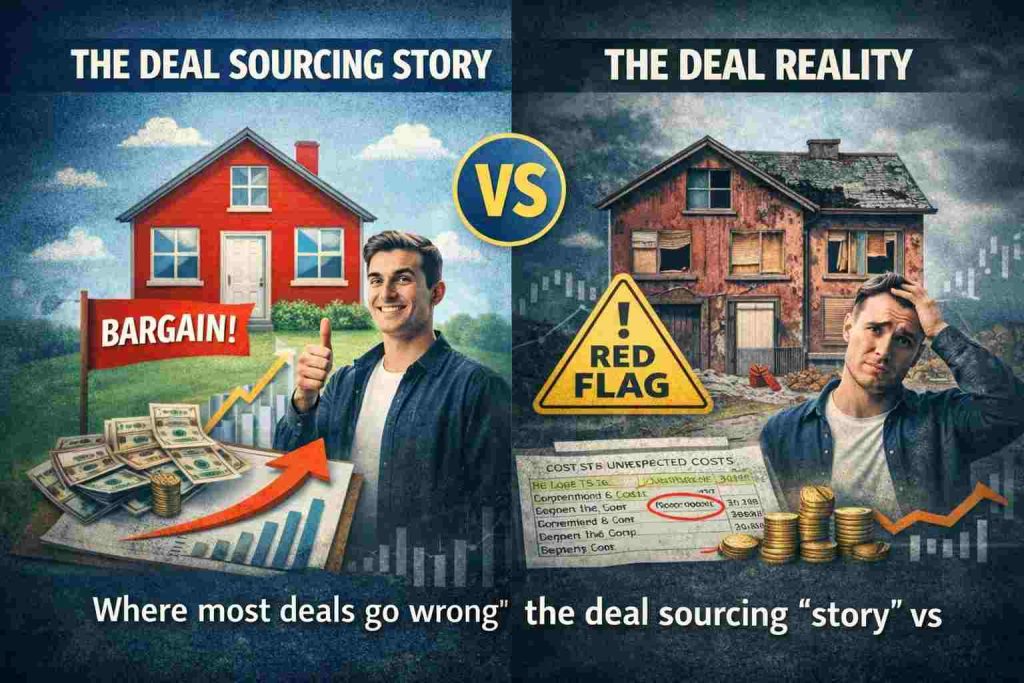
That does not mean sourcers are bad. It means you must analyse every sourced deal like you would analyse a car before buying it. You do not buy the description, you buy the condition.
Common deal sourcing angles to watch (UK)
These appear in good deals and bad deals, but they should trigger deeper checks:
- “Below market value” without true sold comparables
- “Light refurb” when the photos show major work
- “High yield” without stress-tested cashflow
- “Guaranteed rent” without contract detail
- “Flip ready” with no proof of buyer demand
- “Motivated seller” but the numbers are still thin
The sourced deal rule:
Treat every sourced deal as a lead, not as a conclusion. Your job is to prove the margin and the exit, not to believe the pitch.
If you want a deeper breakdown of sourced deal traps and how investors get burned, read this guide.
What analysing a property deal actually means (and what it is not)
Analysing property deals is not “spotting a bargain”.
It is underwriting.
You are testing whether the profit is real after you add:
- The total cost of buying and holding
- The true refurb budget, plus contingency
- Finance costs (including time delays)
- Selling costs and exit friction
- Realistic exit value, not best-case optimism
- A margin that survives stress
Most investors start with the purchase price. Professionals start with the exit, then work backwards.
Investors sourcing opportunities through auctions should also understand how different auction operators compare. Our UK Auction House Performance Index 2026 breaks down the strengths, success rates, investor suitability and market positioning of the country’s leading auction houses.
Step 1: Choose the strategy before you touch the numbers
A deal cannot be “good” in the abstract.
It is only good relative to a strategy.
A flip deal is judged by margin and speed.
A BTL deal is judged by resilience and cashflow.
A BRRR deal is judged by refinance realism.
Strategy fit checklist
- What is the plan? Flip, BTL, BRRR, HMO, or hybrid?
- What is the exit? Sell, refinance, or hold long-term?
- What is the timescale? 3 months or 12 months?
- What is the risk profile? Low effort or heavy works?
Strategy clarity rule
If you cannot explain your strategy in one sentence, you do not have numbers yet.
You have assumptions.
Quick guidance by strategy
Flip
Your risk is time, cost creep, and sale price slippage. You need a margin that survives delays.
Buy-to-let (BTL)
Your risk is stress-tested mortgage coverage, voids, repairs, and compliance costs. You need rent that stays safe even after reality hits. Yet people still keep asking how buy-to-let actually makes money.
BRRR
Your risk is the refinance outcome. If valuation lands low or rent falls short, you get stuck with too much cash left in.
HMO
Your risk is planning, licensing, and management intensity. A spreadsheet can look great until Article 4 or licensing costs crush the plan.
Step 2: Calculate the true cost (not just the purchase price)
This is where most deal profits disappear. Investors focus on the purchase price and underestimate the stack of extra costs that sit around it. By the time you add SDLT, legal fees, finance costs, holding costs, and selling fees, your “cheap deal” often isn’t cheap anymore.
For example, People focus on the £130,000 purchase price and forget the £25,000 of “small” costs that follow.
Total cost breakdown (UK deal analysis)
| Cost Category | What to Include | Common Mistake |
|---|---|---|
| Purchase Costs | Purchase price, auction fees (if any) | Ignoring buyer premiums |
| SDLT | Stamp Duty based on ownership + strategy | Using wrong band or surcharge |
| Legals and Surveys | Solicitor, searches, survey, broker | Skipping survey on risky stock |
| Refurb | Works budget + waste + snagging | Under-budgeting by 20% |
| Contingency | Buffer for surprises | Not having one at all |
| Finance | Arrangement fee, broker fee, interest | Forgetting fees and time |
| Holding Costs | Council tax, utilities, insurance | Not costing empty months |
| Compliance | EPC, EICR, licensing (if relevant) | Treating compliance as “later” |
| Selling Costs | Estate agent, legals, staging | Forgetting exit friction |
The profit killer
Many deals “work” because costs were ignored, not because the deal was strong.
If you are not counting every cost, you are not analysing. You are hoping.
A simple “true cost” mini checklist
- Refurb includes labour + materials + waste + contingency
- Finance includes fees + interest + valuation + exit fees
- Holding includes council tax + utilities + insurance
- Selling includes agent fees + conveyancing + listing costs
Step 3: Validate the exit value (GDV) without lying to yourself
This is where most investors accidentally build profit on top of optimism. They pick the highest comparable they can find, assume their property will achieve it, and then set their offer around that number. On paper it looks sensible. In reality it is how people end up paying tomorrow’s price for today’s property.
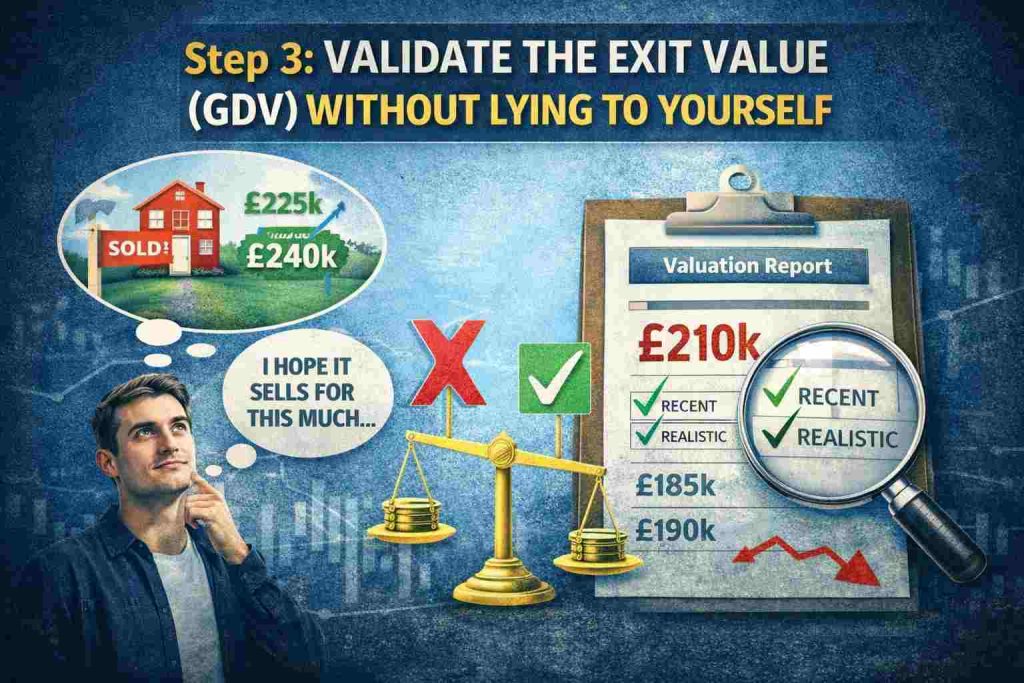
Your GDV is not a flex, it is a constraint. It should be based on evidence, not hope, and it should still stand up when the market is quiet or buyers negotiate harder. If your exit value is even slightly inflated, everything downstream breaks: your maximum bid, your finance plan, and your true risk level.
The fastest way to overpay is to base your numbers on a perfect sale price.
Exit value is not your dream number. It is the price a real buyer will actually pay in your timeframe.
How to validate GDV (the right way)
- Use sold prices, not asking prices
- Get at least 3 comparables
- Adjust for condition, layout, street quality, and finish
- Avoid outliers and “best house on the road” examples
Quick GDV reality table (use this approach)
| Scenario | GDV Value | Meaning |
|---|---|---|
| Low case | £X | Quick sale, softer market |
| Mid case | £X | Most realistic expected outcome |
| High case | £X | Best execution + strong demand |
Your underwriting should use mid-case
If the deal only works at high-case, it is not a deal. It is a gamble with good marketing.
Step 4: If you’re holding it, stress-test the rent like a lender
Buy-to-let numbers look great when you assume:
- Perfect occupancy
- Low repairs
- Cheap compliance
- Stable rates
Real portfolios survive because cashflow has buffers.
Rental underwriting (simple and realistic)
Use 3 rents:
| Rent View | Monthly Rent | What It Represents |
|---|---|---|
| Best case | £X | Optimistic letting agent quote |
| Likely | £X | Achievable rent in normal conditions |
| Stress-tested | £X | Rent after voids and cost buffers |
Cashflow reality checks
- Assume at least 1 month void per year
- Include management cost even if self-managing (your time has value)
- Add a monthly repairs allowance
- Stress test mortgage rates, not today’s “nice” rate
If you want a faster way to stress-test rental deals, use the Deal Stack-Up calculator to run the buffers automatically.
Step 5: Stress tests that protect your margin
This is the part that separates investors from gamblers. Anyone can make a deal look good with best-case assumptions. Stress tests tell you what happens when the timeline slips, costs rise, or the exit price lands slightly lower.
Stress-testing is the difference between “looks profitable” and “is safe”.
You are not predicting disaster.
You are pricing reality.
Stress tests for flips
Use at least these:
- Refurb increases by 10 to 15%
- Sale price lands 5% lower
- Project takes 2 months longer
- Bridging or finance runs longer than planned
Flip stress table (example structure)
| Stress Item | Base Case | Stress Case |
|---|---|---|
| Refurb budget | £X | £X |
| GDV | £X | £X |
| Timeline | X months | X months |
| Finance cost | £X | £X |
| Profit | £X | £X |
If your profit collapses under mild stress, the deal is thin.
Stress tests for buy-to-let
Your goal is not maximum yield.
Your goal is a deal you can hold without stress.
- Mortgage stress test
- Void and repairs reality
- Compliance cost creep
- Tenant churn risk
Stress tests for BRRR
BRRR fails when people assume the refinance is guaranteed.
Your key risks:
- Down valuation at refinance
- Rent does not meet lender stress
- Refinance takes longer than expected
- Works cost more than planned
The BRRR truth:
If the deal only works when the valuation hits your top number, it is not BRRR.
It is a cash-heavy buy-to-let in disguise.
Step 6: Calculate your maximum bid (the investor-grade way)
Maximum bid is not a guess.
It is a limit that protects your profit after all costs.
The flip maximum bid formula
Use this logic:
Maximum Bid = GDV – (All Costs + Target Profit)
Where “All Costs” includes:
- Purchase costs + SDLT
- Legal and survey
- Refurb + contingency
- Finance + holding costs
- Selling costs
Maximum bid table (use for underwriting)
| Item | Amount |
|---|---|
| GDV (mid-case) | £X |
| Total refurb + contingency | £X |
| Purchase costs + SDLT | £X |
| Finance + holding costs | £X |
| Selling costs | £X |
| Target profit | £X |
| Maximum bid | £X |
The max bid discipline:
If someone else outbids you, let them.
Your job is not to win the property.
Your job is to win the numbers.
Maximum bid for sourced deals (one extra rule)
If a deal comes from a sourcer, treat the numbers as provisional until you verify them.
That means:
- You calculate your own maximum bid
- You do not “start” from their discount claim
- You run stress tests even if their spreadsheet looks clean
The Sourced deal pricing rule
If the sourcer’s deal only works when you accept their assumptions, it is not proven.
It is pitched.
Step 7: Bid, Caution, or Walk Away (your deal verdict rules)
This is the moment the deal stops being “interesting” and becomes a decision. A verdict is not a feeling, it’s a rule based on your margin safety and exit certainty. If you cannot label the deal clearly, you will drift into overpaying. The goal is simple: make the verdict obvious before you commit money.
This is where most people lie to themselves.
They already want the property, so they downgrade the risks and stretch the numbers.
Use verdict rules that do not change based on emotion.
The verdict framework
- Bid
- Works at mid-case
- Profit survives stress
- Exit is clear and liquid
- Risks are manageable and priced in
2. Caution
- Works, but only if execution is tight
- Profit is sensitive to time and costs
- Exit depends on market strength
- You need better terms or a lower price
3. Walk away
- Only works at best-case
- Profit disappears under mild stress
- Exit is uncertain or mortgage-unfriendly
- Legal or planning risks are heavy
The Margin safety rule
Thin margins do not become thick margins later. They become problems.
Red flags that change the deal instantly
Not all risks are equal. Some problems simply reduce your profit, but others change the entire deal structure. A serious red flag can turn a mortgage-friendly exit into a cash-only resale, or add months of delay you never priced in. This is why good investors treat red flags as deal breakers, not admin.
Some issues are not “minor”.
They alter your exit, your finance, or your timeline.
Red flag checklist (high impact)
- Short leases that shrink lender options and resale demand
- Unmortgageable construction that forces cash buyers only
- Flying freehold / access issues that spook lenders
- Title restrictions / covenants that limit plans
- Sitting tenants or occupiers affecting possession and exit
- Article 4 / planning restrictions for HMOs
- EPC upgrade risk if compliance costs climb
- High service charges that crush net yield
- Flood risk or subsidence flags that reduce buyer appetite
These are exactly the checks investors run inside an auction pack or before exchange. Use this checklist to spot the auction legal pack red flags fast.
Worked example: analysing a deal properly (realistic structure)
Below is the simplest way to present a worked example without turning the article into a spreadsheet.
Example deal summary
| Item | Value |
|---|---|
| Purchase price | £X |
| Refurb budget | £X |
| Contingency | £X |
| Total costs (all-in) | £X |
| GDV low / mid / high | £X / £X / £X |
| Profit low / mid / high | £X / £X / £X |
| Maximum bid (mid-case) | £X |
| Verdict | Bid / Caution / Walk away |
If your mid-case profit is strong and still survives stress, you can bid with confidence.
If the deal only works at high-case, you already know the truth.
The 7 mistakes investors make when analysing property deals
Most investors don’t lose money because they cannot find deals. They lose money because they keep approving deals that were never properly tested. The spreadsheet looks fine, the pictures look tidy, and the numbers feel “close enough”. But property doesn’t punish you for being slightly optimistic, it punishes you for being underprepared.
These mistakes are rarely dramatic. They’re small shortcuts, missing costs, and assumptions that go unchallenged until completion. That’s why the same investor can do three deals and wonder why the profit never matches the plan. Fix the process, and the deals start behaving.
These are the classic reasons profitable-looking deals turn into “hard work for no reward”.
1) Using best-case GDV
If you underwrite to the top number, your maximum bid becomes inflated.
2) Ignoring finance fees and time
Delays are normal. Your numbers must survive them.
3) Under-budgeting refurb
Refurb is never just materials. Labour, waste, snagging, and surprises add up.
4) Not including a contingency
Contingency is not optional on old housing stock.
5) Forgetting holding costs
Empty properties still cost money every month.
6) No exit liquidity check
If your exit requires the “perfect buyer”, your deal is fragile.
7) Skipping legal reality
Title problems, planning restrictions, and occupancy risks kill deals quietly.
If you want the legal side in one place, this guide walks through the checks investors use to avoid nasty surprises.
Summary: the safe way to analyse property deals
This is the part that turns deal analysis into a repeatable habit, not a one-off effort. You do not need perfect forecasts, you need a process that stays reliable when conditions shift. If you can analyse one deal properly, you can analyse fifty, because the framework stays the same.
The aim is simple: stop buying thin deals that only work on best-case assumptions. Your analysis should protect your downside first, then reward you on the upside. When you apply the same rules every time, your decisions get faster and your results get more consistent.
Analysing property deals is not about optimism.
It is about margin safety.
If you want to stop buying thin deals, do this every time:
- Pick a strategy
- Work out the true cost
- Validate the exit value
- Stress-test the downside
- Calculate a maximum bid
- Only proceed if the deal still works at mid-case
Final rule
A good deal is one that still looks good after reality is added.
Next step
If you want to run these numbers faster, you can use:
Run the Deal Stack-Up Calculator (Free)
Get a Decision-Grade Deal Review (Paid)
FAQs
What’s the fastest way to analyse a deal?
Ans: Work backwards from mid-case exit value, subtract all costs, add buffers, and set a maximum bid.
Are sourced deals safer or riskier?
Ans: Neither by default. They are only safe once you verify the numbers, the legal position, and the exit assumptions yourself.
Why do deals fail after purchase?
Ans: Because costs, timeframes, and exit values were assumed rather than underwritten.

Koye Beckley is a UK property investor and founder of UncommonDeal, with practical experience in buy-to-let, property auctions, refurbishment projects and investment deal analysis. Through UncommonDeal, he publishes property market research, property deal sourcing and compliance guidance, investment guides and data-driven analysis to help investors evaluate buy-to-let, BRRR, flip and auction opportunities.
