Auction Completion Timescales Explained: Why 28 Days Isn’t Guaranteed
Auction completion timescales in the UK are widely misunderstood, especially the assumption that every property automatically completes within 28 days. Many buyers treat “28 days” as a fixed rule, when in reality it is simply a common default period that can be changed, shortened, extended, or made conditional by the legal pack. The difference between assumption and contract is where most auction risk lives.
At a traditional UK property auction, exchange of contracts happens immediately when the hammer falls. You pay your deposit on the day, the transaction becomes legally binding, and the completion clock starts running. What many buyers do not realise is that the clock is not controlled by the auction brochure, the estate agent, or even tradition. It is controlled by the Special Conditions of Sale inside the legal pack.
For investors, this distinction matters far more than it does for owner-occupiers. Completion timescales affect bridging finance drawdowns, lender valuation deadlines, refurbishment planning, exit strategy timing, and even whether your 10 percent deposit is at risk. If completion is delayed, accelerated, or made dependent on notice provisions, your entire funding structure can be exposed.
This article explains:
-
What the 28-day completion period really means
-
When it applies and when it does not
-
Why auction completion can be delayed
-
What happens if you cannot complete on time
-
How experienced investors protect themselves before bidding
The key point is simple: 28 days is a target, not a guarantee. And in auction property, what is written in the contract always overrides what is assumed in the room.
What is the completion period in a UK property auction?
The completion period for a UK property auction is the time between exchange and legal completion. Exchange happens immediately when the hammer falls. Completion is usually set at 20 to 28 working days, but the exact timeframe is determined by the Special Conditions of Sale and is not automatically guaranteed.
What Actually Happens When the Hammer Falls
When the auctioneer’s hammer falls, the property transaction moves faster and with far less flexibility than most buyers expect. Unlike private treaty sales, there is no cooling-off period and no renegotiation window. From that moment, the legal and financial consequences are immediate.
Understanding exactly what happens at this stage is critical because auction completion timescales are triggered here, not days later when solicitors start corresponding.
Exchange Happens Immediately
At a traditional UK property auction, exchange of contracts takes place the instant the hammer falls. There is no separate exchange appointment and no waiting for paperwork to circulate.
This creates a legally binding contract between buyer and seller on the day of the auction. You are committed to completing the purchase under the terms set out in the auction legal pack.
At that point:
-
The contract becomes legally enforceable
-
You are obligated to complete within the stated timeframe
-
The seller can pursue remedies if you fail to complete
A 10 percent deposit is normally paid immediately. This is not a holding fee. It is part payment of the purchase price and is typically non-refundable if you default. If you cannot complete, you risk losing this deposit and potentially facing further financial claims.
Completion Period Begins
The moment exchange occurs, the completion period begins to run. There is no separate trigger unless the Special Conditions state otherwise.
Most auction contracts incorporate the Standard Conditions of Sale, which commonly provide for completion within 20 to 28 working days. This is where the widely quoted “28 days” figure originates.
However, that period is only the starting framework. The exact deadline can vary depending on what the legal pack specifies. In some cases, completion is fixed to a specific calendar date. In others, it may be linked to notice provisions or additional documentation.
The key point is that the completion clock starts immediately, whether your mortgage offer is ready or not.
The Difference Between “Standard” and “Special” Conditions
Auction contracts are built on two layers:
-
Standard Conditions of Sale
-
Special Conditions of Sale
The Standard Conditions provide the general framework for how the transaction operates. They cover issues such as completion timing, interest on late completion, and notice procedures.
The Special Conditions, however, override the standard framework where they differ. This is where auction risk is usually hidden.
Special Conditions may:
-
Shorten the completion period
-
Fix completion to an exact date
-
Add daily interest penalties
-
Transfer additional legal costs to the buyer
-
Introduce notice-based completion mechanisms
This is why reviewing the legal pack before bidding is essential. If you have not studied the Special Conditions, you do not truly know your completion deadline.
For a full breakdown of what sits inside an auction pack, see your Auction Legal Pack Guide. You should also review your analysis on auction legal pack toxic clauses, where completion traps and penalty provisions are often embedded.
At auction, the brochure gives you the headline. The legal pack gives you the reality.
Why 28 Days Is Not Guaranteed
The idea that every auction property completes in 28 days is one of the most persistent myths in UK property investing. While 20 to 28 working days is common, it is not a statutory rule and it is not automatically protected. The real completion deadline is always defined by the contract, not by auction tradition.
For investors using bridging finance, short-term funding, or tight refinance timelines, misunderstanding this point can create serious capital risk. Completion timing is a contractual obligation, and contracts can vary significantly.
The Legal Pack Overrides the Brochure
Auction marketing material often states “completion in 28 days” as a headline. However, marketing descriptions do not control the transaction. The binding terms sit inside the legal pack.
The Special Conditions of Sale can:
-
Amend the completion period
-
Replace it with a fixed calendar date
-
Link completion to a notice being served
-
Introduce financial penalties for delay
If the brochure says 28 days but the Special Conditions say 20 working days, the contract wins. If the Special Conditions tie completion to notice from the seller, that notice mechanism governs the timeline.
The only completion period that matters is the one written into the contract.
Special Conditions Can Shorten or Extend Completion
Special Conditions are where timing flexibility disappears. Sellers may shorten completion to accelerate funds, particularly in distressed sales or asset disposal scenarios.
In some cases, completion may be:
-
14 or 20 working days instead of 28
-
Fixed to a specific calendar date
-
Dependent on seller documentation being provided
Conversely, certain properties may include extended completion periods, particularly where tenancies, probate, or documentation issues are involved. Either way, the 28-day assumption becomes irrelevant once bespoke terms are inserted.
Completion May Be Tied to Notice Periods
Some auction contracts use a “completion on notice” structure. Instead of specifying a fixed date, the seller serves notice once certain conditions are satisfied.
For example:
-
Completion 10 working days after notice
-
Completion 5 working days after vacant possession is confirmed
This creates uncertainty for buyers relying on mortgage drawdowns or bridging exits. If you cannot synchronise funding with the notice window, you may be exposed to penalty interest or default risk.
Delayed Searches or Seller Documentation
Although exchange has already occurred, missing documentation can still affect practical completion.
Common issues include:
-
Outstanding leasehold management packs
-
Unresolved title discrepancies
-
Missing landlord consent documents
-
Probate grants not yet issued
While the contract may allow time for these to be resolved, they can compress the effective completion window for the buyer’s solicitor and lender.
Mortgage Lender Timelines vs Auction Reality
Auction timescales are designed for speed. Mortgage lenders are designed for process control and risk mitigation. These two systems often clash.
Lender delays may arise from:
-
Valuation backlogs
-
Down-valuations requiring renegotiation
-
Title queries raised by the lender’s solicitor
-
Short lease or construction concerns
If mortgage funds are not ready by the contractual completion date, the seller is not obligated to wait. The responsibility sits entirely with the buyer.
Investors should therefore understand their auction finance options before bidding, including when cash, bridging finance or a mortgage may be suitable for meeting the contractual completion deadline.
For investors, this is where bridging finance is often used as a buffer. But even bridging cannot fix structural legal issues buried in the contract.
The conclusion is simple: 28 days only applies if the contract says it does, and even then, your finance must be aligned with that reality.
The Most Common Reasons Auction Completion Gets Delayed
Even where the contract states 20 to 28 working days, auction completion can still be disrupted. Some delays are caused by buyer funding. Others stem from legal or title complications that were either overlooked or underestimated before bidding.
The important distinction is this: delay does not pause your contractual obligation. If completion cannot take place on time and the reason sits on the buyer’s side, the financial risk escalates quickly.
Below are the most common causes of auction completion problems.
1. Title Defects Discovered Post-Auction
Sometimes defects are technically disclosed in the legal pack but not fully understood until solicitors begin detailed review.
Examples include:
-
Missing rights of access
-
Defective lease clauses
-
Absent landlord covenants
-
Unclear boundary plans
If a lender refuses to lend against the title, the buyer must either find alternative funding or risk default. The seller is not required to remedy issues that were already disclosed.
Risk typically sits with the buyer.
2. Missing Leasehold Management Packs
Leasehold auction properties frequently complete without a full management information pack ready in advance.
Delays can occur because:
-
The managing agent has not provided service charge accounts
-
Ground rent arrears need reconciliation
-
Deeds of covenant must be executed
-
Notice of transfer requirements take time to process
If lender funds are conditional on full leasehold documentation, completion may stall.
Risk depends on contract wording but often impacts the buyer’s timeline.
3. Seller Unable to Provide Vacant Possession
Auction listings sometimes state “vacant possession on completion.” However, in reality:
-
Occupiers may refuse to leave
-
Tenancies may still be active
-
Notice periods may not have expired
If the seller has contractually committed to providing vacant possession but fails to do so, completion may be delayed. However, if the legal pack shifts risk to the buyer or limits remedies, options may be restricted.
This is where reading the Special Conditions becomes critical.
4. Short Leases and Lender Refusal
Short leases are a frequent cause of last-minute funding collapse.
Common problems:
-
Lender minimum lease term not met
-
Marriage value concerns affecting valuation can also derail mortgage approval
-
Requirement for lease extension before lending
If a lender withdraws or down-values after exchange, the buyer must complete regardless. Bridging may be an emergency solution, but at significantly higher cost.
Risk sits entirely with the buyer.
5. Restrictive Covenants Requiring Consent
Some properties contain restrictive covenants that require third-party consent before certain uses or alterations.
For example:
-
Change of use restrictions
-
Subletting limitations
-
Development prohibitions
If consent is required and not already granted, this may affect funding approval or future strategy. While this may not always delay completion directly, it can create post-completion complications that impact refinance timing.
6. Bankruptcy Notices or Charging Orders
Title searches sometimes reveal:
-
Bankruptcy entries
-
Charging orders
-
Legal restrictions
If these must be discharged before completion, additional coordination may be required between solicitors and creditors.
In many cases, these are resolved mechanically on completion, but delays can arise if documentation is incomplete or creditor cooperation is slow.
7. Probate or Estate Complications
Properties sold by executors can present additional timing risk.
Delays may occur if:
-
Grant of probate has not been issued
-
Estate documentation is incomplete
-
Beneficiary approvals are pending
If probate has not formally completed, completion cannot legally take place, regardless of the contractual date.
8. Unregistered Land Complications
Unregistered land still appears at auction, particularly in older portfolios.
This introduces:
-
Title investigation delays
-
Missing historical deeds
-
Additional lender scrutiny
Lenders are often more cautious with unregistered property, which can extend approval timelines and threaten completion if funding is not already secured.
The pattern across all of these issues is consistent:
Auction completion rarely fails because of the 28-day rule itself. It fails because buyers underestimate legal complexity, overestimate lender speed, or assume disclosed risks will not affect funding.
Once exchange has taken place, time becomes contractual, not negotiable.
Can the Seller Delay Completion?
Buyers often assume that auction completion risk sits entirely on their side. In reality, sellers can also cause delay, but the legal consequences depend entirely on the contract wording. Unlike private treaty transactions, auction contracts leave very little room for negotiation once exchange has occurred.
Understanding how seller delay works is important because your remedies are defined in advance. If you do not know what the contract allows, you may assume you have leverage when you do not.
When Sellers Serve Notice to Complete
In many auction contracts, if one party fails to complete on the contractual date, the other party can serve a Notice to Complete.
This notice typically:
-
Makes time of the essence
-
Gives 10 working days to complete
-
Triggers daily interest penalties
If the seller has fulfilled their obligations and the buyer has not, the seller can serve notice and begin charging interest on the outstanding balance.
However, notice provisions can also apply where the seller is not ready to complete. For example:
-
Title documents not finalised
-
Probate not yet granted
-
Discharge of charges not prepared
The specific mechanism will depend on whether completion is fixed or notice-based under the Special Conditions.
When Sellers Fail to Comply
If the seller cannot complete on the contractual date and the delay is their responsibility, the buyer may have options, including:
-
Serving a Notice to Complete
-
Claiming contractual interest
-
Rescinding the contract in certain circumstances
However, this depends entirely on whether the seller has breached the contract. If the delay arises from something already disclosed in the legal pack, or permitted under the Special Conditions, the buyer may have limited remedies.
Auction contracts often favour the seller. The buyer’s leverage is usually narrower than expected.
Buyer’s Options If the Seller Is Late
If the seller is genuinely in default, the buyer may be entitled to:
-
Interest compensation
-
Extension of time
-
Rescission and deposit return
But these remedies are not automatic. They are governed by the Standard Conditions of Sale as modified by the Special Conditions.
From an investor perspective, even if you are legally protected, delay can still create problems:
-
Bridging interest continues to accrue
-
Contractor schedules may be disrupted
-
Refinance deadlines may be affected
-
Capital remains tied up
Legal rights do not eliminate financial impact. They only determine who is technically at fault.
The broader lesson is this: auction completion is contractual. Whether delay is caused by buyer or seller, the financial consequences depend on what was agreed before bidding, not on what feels fair afterward.
What Happens If You Cannot Complete on Time?
This is where auction risk becomes real. Once the hammer falls and exchange takes place, failure to complete is not a minor inconvenience. It is a contractual breach with potentially severe financial consequences.
In private treaty transactions, delays can often be negotiated. In auctions, the seller is legally entitled to enforce the contract. If you cannot complete on time, the legal and financial exposure can escalate quickly.
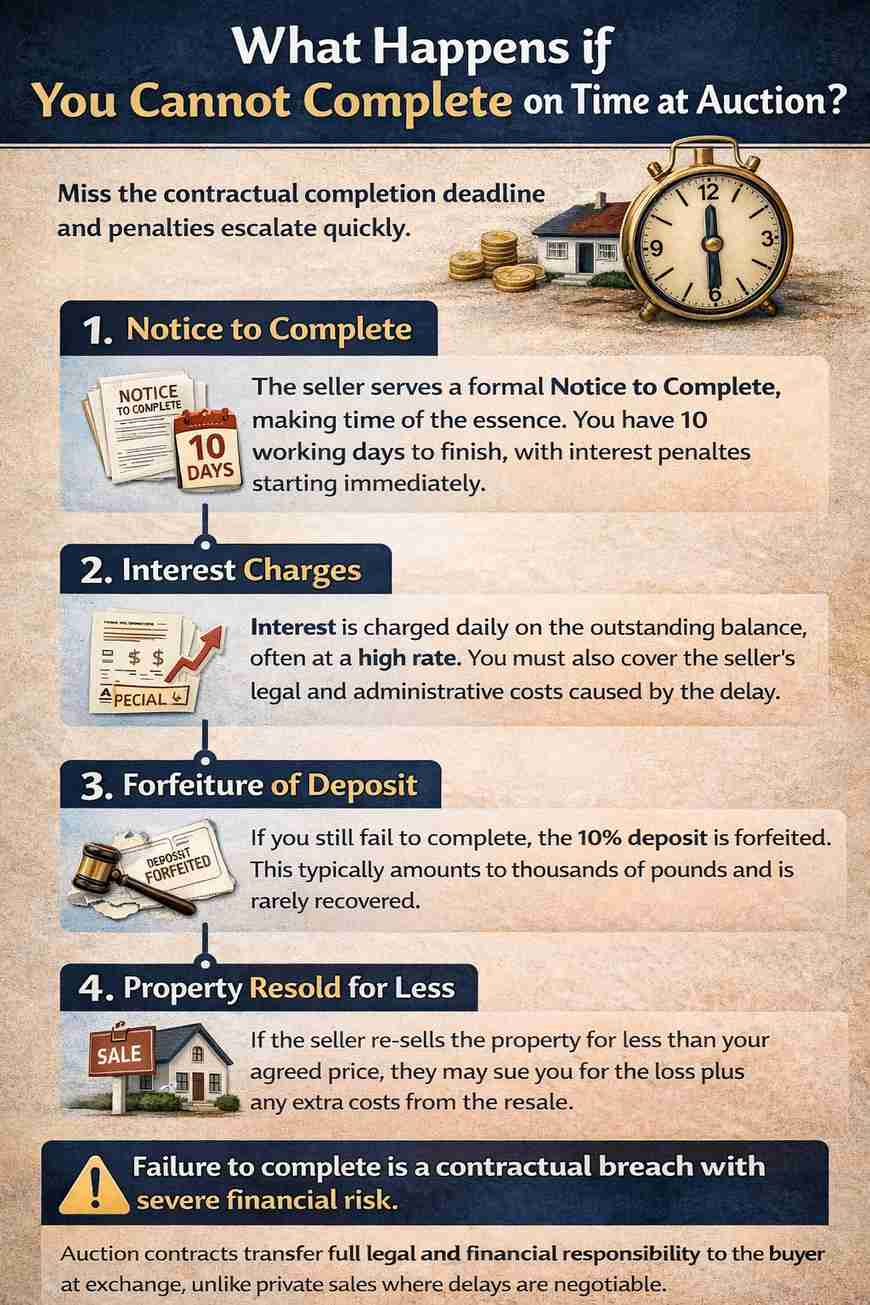
Notice to Complete Served on the Buyer
If completion does not occur on the agreed date and the buyer is at fault, the seller can usually serve a Notice to Complete.
This notice:
-
Makes time legally critical
-
Typically gives 10 working days to complete
-
Triggers daily interest charges
Interest is usually charged on the outstanding balance of the purchase price, often at a contractual rate above base rate. This can accumulate quickly, especially on higher-value purchases.
The notice period is not a negotiation window. It is a formal countdown.
Financial Penalties
During the notice period, the buyer is commonly liable for:
-
Contractual interest on the balance
-
The seller’s additional legal costs
-
Any administrative charges specified in the Special Conditions
If bridging finance is involved, you may also be paying:
-
Arrangement fees already drawn
-
Interest on partial drawdowns
-
Extension fees if funding timelines slip
The combined cost can materially reduce or eliminate projected profit.
Deposit Forfeiture
If the buyer still fails to complete after the notice period expires, the seller is usually entitled to rescind the contract.
In most auction contracts, this allows the seller to:
-
Retain the 10 percent deposit
-
Re-market the property
-
Claim further losses
The deposit is not protected by sympathy or circumstance. Once forfeited, it is rarely recoverable unless the seller was in breach.
Being Sued for Losses
Deposit loss is not necessarily the end of the exposure.
If the seller resells the property at a lower price, they may pursue the original buyer for:
-
The difference between the two sale prices
-
Additional auction fees
-
Legal costs
-
Holding costs
In extreme cases, this can result in significant financial liability well beyond the original deposit.
The key investor takeaway is simple:
Failure to complete is not just a missed deadline. It can trigger deposit loss, interest penalties, legal claims, and reputational damage with lenders and solicitors.
Auction completion timescales are unforgiving because the risk transfers fully at exchange. If finance, legal review, and strategy alignment are not secured before bidding, the 28-day window can become financially destructive rather than efficient.
Auction Completion With Bridging Finance
Bridging finance is often presented as the solution to auction speed. Because auction completion timescales are compressed, many investors assume that using a bridging lender removes the risk of missing the deadline. In reality, bridging finance reduces timing pressure but does not eliminate legal or structural risk.
Bridging is designed to match auction transactions, but it still depends on valuation, title acceptability, and lender underwriting criteria. If those elements fail, the presence of bridging finance does not protect your deposit.
Why Bridging Lenders Are Comfortable With Auction Timescales
Most bridging lenders understand that exchange occurs immediately at auction. Their processes are built around:
-
Fast valuation turnaround
-
Streamlined underwriting
-
Solicitors experienced in auction transactions
-
Short-term lending structures
Because bridging is asset-based, lenders focus heavily on property value and exit strategy rather than personal income multiples. This makes it more compatible with 20 to 28 working day completion periods.
However, “compatible” does not mean automatic.
Why Delays Still Happen
Even with bridging approved in principle, delays can occur due to:
-
Valuation down-valuations
-
Title defects identified by the lender’s solicitor
-
Short lease concerns
-
Restrictive covenants affecting exit strategy
-
Planning or building regulation irregularities
If the lender refuses to proceed after exchange, the buyer must either secure alternative funding or risk default. Bridging lenders do not waive legal concerns simply because the property was purchased at auction.
Auction speed does not override lender risk policy.
Exit Strategy Risk
Bridging is short-term capital. It assumes a clear exit, usually:
-
Refinance onto a buy-to-let mortgage
-
Sale after refurbishment
-
Lease extension followed by refinance
If legal issues delay refinance or reduce lender appetite, the bridge may need to be extended. Extensions usually involve:
-
Additional interest
-
Extension fees
-
Re-valuation costs
This compresses profit margins and increases capital exposure.
An auction property with a clean legal pack and clear title behaves very differently from one with unresolved issues, even if both complete within 28 days.
When Bridging Cannot Save a Bad Legal Pack
Bridging lenders rely on solicitors to confirm that title is acceptable security. If the legal pack contains:
-
Defective leases
-
Missing rights of access
-
Onerous covenants
-
Unclear boundaries
-
Undisclosed restrictions
the lender may decline to lend or reduce the loan-to-value.
At that point, the buyer’s completion obligation remains intact.
This is why auction completion timescales should never be analysed in isolation from legal due diligence. Speed is manageable. Structural defects are not.
For experienced investors, bridging is a timing tool, not a risk eraser. The legal pack determines viability. The funding structure only determines how quickly you can comply with the contract.
Auction Completion for Leasehold Properties
Leasehold auction properties introduce an additional layer of timing risk that many buyers underestimate. While the headline completion period may still state 20 to 28 working days, leasehold transactions often involve third parties who are not contractually bound by the auction timetable.
Managing agents, freeholders, and landlords do not accelerate their processes simply because a property was purchased at auction. If their documentation or consent is required, delays can follow, even when the buyer is ready to complete.
Management Pack Delays
Most leasehold transactions require a management information pack.
This typically includes:
-
Service charge accounts
-
Ground rent statements
-
Building insurance details
-
Planned major works information
If this pack is incomplete, outdated, or delayed, lender approval may stall. Some managing agents operate on standard response times that do not align with auction completion periods.
Even where the contract does not make the pack a strict pre-condition to completion, lenders often require full information before releasing funds.
Licence to Assign Clauses
Some leases require the buyer to obtain a Licence to Assign from the freeholder before completion.
This can involve:
-
Formal application
-
References or financial checks
-
Payment of licence fees
-
Deed execution
If the freeholder or managing agent is slow to respond, the process may not fit neatly within the 28-day window. If licence approval is a contractual requirement for completion, delay becomes highly material.
Buyers who fail to check for Licence to Assign provisions before bidding often discover the issue too late.
Freeholder Consent Issues
Beyond assignment, leases may require consent for:
-
Subletting
-
Alterations
-
Change of use
If your strategy involves refinancing, converting, or restructuring the property post-completion, these clauses can affect both lender appetite and exit timing.
While consent requirements may not always delay completion itself, they can disrupt your bridging exit or refinance timeline, increasing funding costs.
Short Lease Lender Restrictions
Short leases are one of the most common causes of auction completion stress.
Problems typically arise when:
-
The remaining lease term falls below lender minimums
-
The valuation reflects marriage value risk
-
The lender insists on lease extension prior to lending
If a mainstream lender withdraws after exchange due to lease length, the buyer must either complete in cash, use bridging at higher cost, or default.
Leasehold risk does not just affect long-term value. It directly affects the ability to complete on time.
The broader point is that leasehold auction properties are not simply “faster” versions of standard leasehold purchases. They are compressed transactions layered with third-party dependencies.
Auction completion timescales assume legal clarity. Leasehold complexity often challenges that assumption.
Auction Completion vs Private Treaty Completion
Auction completion timescales feel strict because they are strict. The structure is designed to remove negotiation after exchange. In contrast, private treaty transactions through estate agents are built around flexibility and staged commitment.
Understanding the difference is important because many first-time auction buyers confuse investor demand versus real commitment, assuming competitive bidding reflects structural safety rather than contractual obligation. That mismatch creates unnecessary risk.
Below is a practical comparison.
| Factor | Auction Purchase | Private Treaty Purchase |
|---|---|---|
| Exchange timing | Immediate at hammer fall | Weeks or months after offer accepted |
| Deposit risk | 10 percent paid immediately | Usually paid at exchange, later in process |
| Completion flexibility | Fixed by contract | Often negotiable |
| Legal pack | Prepared upfront | Compiled during conveyancing |
| Buyer leverage | Very limited post-exchange | Negotiation possible pre-exchange |
| Risk exposure | Immediate and binding | Contingent until exchange |
The structural difference is simple:
-
In private treaty sales, exchange is the risk transfer point.
-
In auctions, exchange happens first, investigation consequences follow.
Exchange Timing: Immediate vs Conditional
In a private sale, you can withdraw before exchange with minimal consequence. Surveys, lender checks, and legal investigations happen before you become legally bound.
At auction, exchange happens instantly. Any lender refusal, valuation issue, or legal defect discovered afterward becomes your problem, not the seller’s.
Completion Certainty vs Negotiation
Private treaty transactions frequently allow:
-
Completion date negotiation
-
Chain coordination
-
Extension discussions
-
Amendments before exchange
Auction contracts are rigid by design. Completion is typically fixed or tightly controlled by the Special Conditions. There is rarely room for informal delay.
Deposit and Financial Exposure
In private sales, the deposit is normally transferred at exchange, after due diligence is complete.
At auction:
-
Deposit is paid immediately
-
Legal commitment is immediate
-
Failure to complete can lead to forfeiture and legal claims
The financial exposure accelerates dramatically.
Legal Pack Prepared Upfront
One advantage of auction transactions is transparency. The legal pack is available before bidding, theoretically allowing full due diligence.
However, the speed of the process often tempts buyers to under-review documentation. In private treaty transactions, solicitors drive investigation before commitment. In auctions, investigation must happen before bidding, without the safety net of conditionality.
The Investor Takeaway
Auction speed removes flexibility. Private treaty speed removes certainty.
Auction completion timescales are strict because the contract is front-loaded. If you are prepared, auctions can be efficient. If you rely on post-offer investigation like in private treaty transactions, the 28-day window becomes unforgiving.
The structure itself is not dangerous. Misunderstanding the structure is.
How Experienced Investors Protect Themselves Before Auction
Experienced investors do not treat auction completion timescales as a surprise. They treat them as a constraint to engineer around. The difference between a smooth 28-day completion and a financial disaster is usually decided before bidding, not after the hammer falls.
Preparation is not about optimism. It is about removing variables that could threaten completion once exchange becomes legally binding.
Legal Pack Reviewed Before Bidding
Serious investors never rely on a quick skim of the legal pack.
Before bidding, they ensure:
-
Title is reviewed by a solicitor
-
Special Conditions are analysed for timing traps
-
Onerous clauses are identified
-
Completion date mechanics are confirmed
They know the exact completion obligation before committing capital. If the Special Conditions shorten completion or impose daily penalties, that risk is priced into the bid.
Auction completion timescales are contractual. The contract must be understood before the bid is placed.
Finance Approved in Principle
Finance is not arranged after auction. It is structured before.
This includes:
-
Mortgage Decision in Principle
-
Bridging terms agreed
-
Lender aware of lease length and construction type
-
Valuation timescales confirmed
If a lender’s underwriting criteria conflict with the property’s legal structure, that issue must be identified before bidding.
Bridging Pre-Agreement Where Necessary
Where mainstream lending is uncertain, experienced investors line up bridging as a contingency.
This may involve:
-
Soft credit checks completed
-
Indicative loan-to-value confirmed
-
Solicitor panels pre-identified
Bridging is treated as a backup strategy, not a panic solution after exchange.
Solicitor Instructed Before Auction
Waiting until after exchange to instruct a solicitor wastes critical days.
Experienced buyers:
-
Pre-instruct a solicitor
-
Provide ID and source-of-funds documentation in advance
-
Ensure the solicitor has reviewed the legal pack
This allows the post-auction process to begin immediately rather than losing valuable time onboarding.
Stress-Testing Worst-Case Completion Scenarios
Professional investors assume friction.
They ask:
-
What if valuation is lower than expected?
-
If lender requires additional documentation, what will my situation be?
-
What if completion is shortened to 20 working days?
-
What if bridging exit takes longer than planned?
If the deal only works under perfect timing conditions, it is not robust enough for auction.
The core difference between inexperienced and experienced auction buyers is not knowledge of the 28-day rule. It is understanding that the rule is contractual, not protective.
Preparation converts auction completion timescales from a threat into a manageable operational constraint. Without preparation, the same timeline becomes financially dangerous.
When 28 Days Really Does Apply (And When It Doesn’t)
The phrase “completion in 28 days” is not fiction. It genuinely applies in many auction contracts. The problem is that buyers treat it as universal rather than conditional.
Understanding when 28 days genuinely governs the transaction and when it does not is essential for assessing timing risk properly.
When 28 Days Typically Applies
In a standard traditional property auction:
-
Exchange takes place immediately at the hammer
-
The contract incorporates Standard Conditions of Sale
-
The Special Conditions specify completion within 20 to 28 working days
In these circumstances, 28 working days (or a close variation) genuinely governs the deadline. If finance and legal documentation are ready, completion is usually straightforward.
This structure is common for:
-
Straightforward freehold properties
-
Clean title residential assets
-
Vacant properties with no structural legal complications
Where the legal pack is clear and lender appetite is strong, the 28-day model works as designed.
When Completion Is Shorter Than 28 Days
Some auction contracts deliberately shorten the period.
You may see:
-
20 working days
-
14 working days
-
Fixed calendar completion dates
This often appears in:
-
Corporate disposals
-
Repossessions
-
Asset management sales
-
Sellers seeking accelerated capital recovery
If the Special Conditions state a shorter period, that overrides the common assumption of 28 days.
When Completion Is Tied to Notice
Some contracts use notice-based mechanisms rather than fixed calendar deadlines.
For example:
-
Completion 10 working days after notice
-
Completion 5 working days after vacant possession confirmed
In these cases, the exact completion date is uncertain at exchange. The seller controls the trigger event.
This can create synchronisation issues with:
-
Mortgage drawdowns
-
Bridging availability windows
-
Refinance planning
The timeline becomes reactive rather than fixed.
When Completion Is Extended
Less common, but still relevant, are extended completion periods.
These may apply where:
-
Tenancies are in place
-
Probate documentation is pending
-
Commercial leases require coordination
In such cases, completion might be set at 6 to 8 weeks or longer.
While this reduces immediate time pressure, it increases capital lock-up and holding risk.
Modern Method of Auction: A Different Structure
The “modern method of auction” operates differently from traditional auctions.
Instead of immediate exchange:
-
A reservation fee is paid
-
Buyers are typically given 28 days to exchange
-
A further 28 days to complete
This creates an extended 56-day structure in many cases.
However, the reservation fee is usually non-refundable. If the buyer fails to exchange, that fee is lost.
Although the timeline appears longer, the financial risk remains significant.
The key takeaway is simple:
28 days applies when the contract says it applies. If the Special Conditions modify the period, introduce notice mechanisms, or adopt a different auction format, the assumption collapses.
Auction completion timescales are not governed by tradition. They are governed by the written contract.
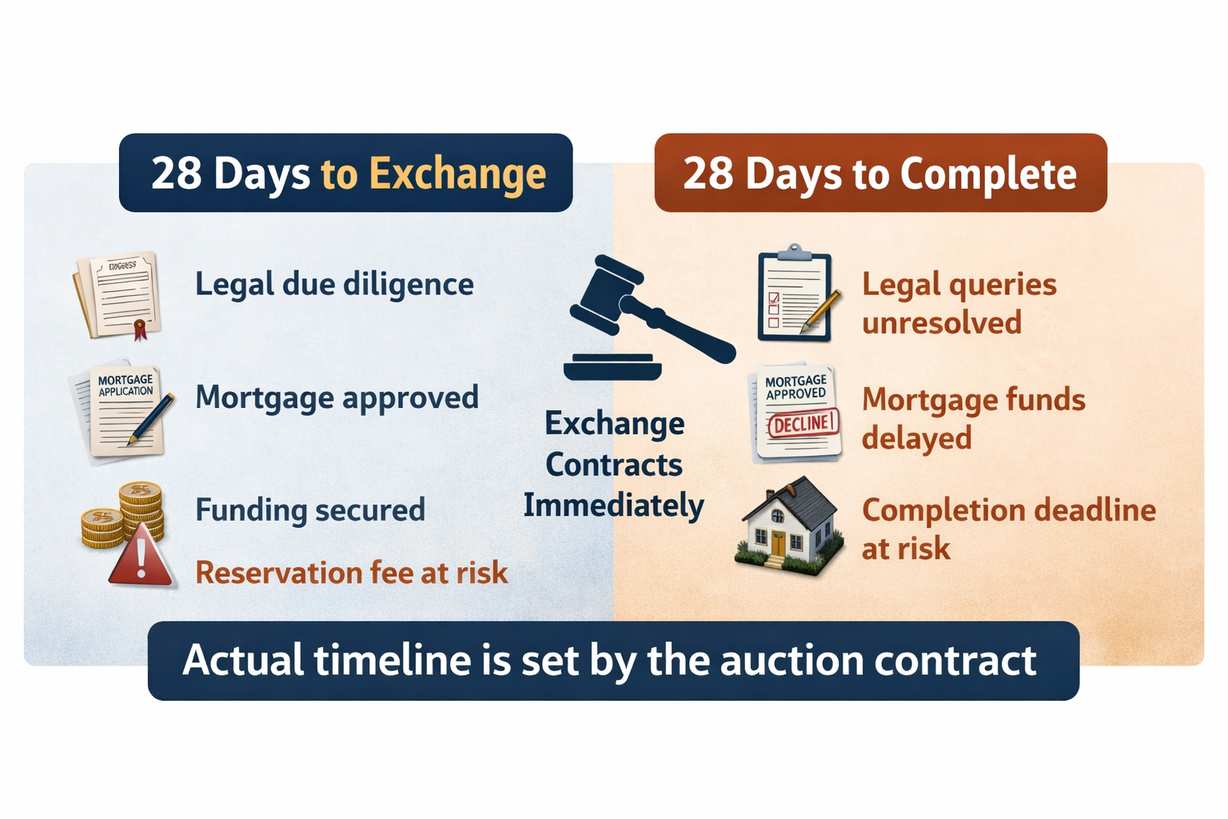
Modern Method of Auction: Different Timescales, Different Risks
The modern method of auction is frequently marketed as a “safer” or more flexible alternative to traditional auctions. Buyers are often told they have more time, lower pressure, and reduced risk. While the structure is different, the financial exposure is still significant and the completion timeline is still contractual.
The key difference is that exchange does not happen immediately at the hammer. But that does not mean the buyer is protected.
Reservation Agreement Instead of Immediate Exchange
In the modern method of auction:
-
The winning bidder signs a reservation agreement
-
A non-refundable reservation fee is paid
-
Exchange does not occur on the auction day
Instead of becoming legally bound to purchase immediately, the buyer becomes contractually bound to exchange within a specified period.
That distinction matters. However, the reservation fee is typically non-refundable, even if the buyer later withdraws.
28 Days to Exchange
Most modern auction contracts give the buyer:
-
28 days to exchange contracts
During this period, the buyer must:
-
Complete legal due diligence
-
Secure mortgage approval
-
Finalise funding arrangements
-
Resolve any outstanding legal queries
If exchange does not take place within this timeframe, the buyer usually loses the reservation fee.
The pressure is shifted rather than removed.
A Further 28 Days to Complete
After exchange, buyers are typically granted:
-
An additional 28 days to complete
This creates a common 56-day total structure:
-
28 days to exchange
-
28 days to complete
While this appears more generous than traditional auction timelines, the financial consequences of failure still apply once exchange occurs.
Non-Refundable Reservation Fee Risk
One of the most misunderstood aspects of the modern method is the reservation fee.
Key points:
-
It is usually non-refundable
-
This may not form part of the purchase price
-
It can be lost even if mortgage finance fails
Buyers sometimes assume they can “test” a deal with limited downside. In reality, the reservation fee can represent a substantial upfront exposure.
Why the Risk Profile Is Different, Not Lower
Traditional auctions compress legal commitment into one moment. The modern method spreads commitment across stages. However:
-
Legal risk still crystallises at exchange
-
Financial loss can occur earlier through reservation fees
-
Completion deadlines remain binding once contracts are exchanged
In some cases, the extended timeline creates complacency. Buyers delay solicitor instruction or lender engagement, assuming 28 days is ample time.
Auction completion timescales under the modern method are less compressed, but they are still unforgiving if preparation is weak.
The bottom line is this:
The modern method of auction changes the sequence, not the seriousness, of contractual obligation. Whether 28 days begins at the hammer or after exchange, the written agreement controls the risk.
Final Verdict: 28 Days Is a Target, Not a Promise
The phrase “completion in 28 days” has become shorthand for how UK property auctions work. But it is shorthand, not certainty. Auction completion timescales are governed by contract wording, funding readiness, and legal clarity, not by marketing convention.
When the hammer falls, exchange is immediate. From that moment, the completion deadline becomes enforceable. If the Special Conditions shorten the period, introduce notice mechanics, or impose penalty interest, those provisions override the common 28-day assumption.
For investors, the real risk is not speed. It is misalignment.
-
Legal pack not fully understood
-
Finance not fully secured
-
Leasehold complications underestimated
-
Exit strategy not stress-tested
Auctions reward preparation and punish assumption. The 28-day period works efficiently when the title is clean, funding is aligned, and documentation is complete. It becomes dangerous when buyers rely on tradition instead of contract review.
The core principle is simple: Auction completion timescales are contractual obligations, not flexible guidelines.
If you understand the contract before bidding, 28 days is manageable.
If you assume 28 days is guaranteed, it can become expensive very quickly.
Auction completion FAQ
Click a question to reveal the answer.
Is 28 days guaranteed for auction completion?
No. While 20 to 28 working days is common, the actual deadline is set by the Special Conditions of Sale in the legal pack. The contract always overrides the brochure.
Are the 28 days working days or calendar days?
Most auction contracts refer to working days, excluding weekends and bank holidays. This can extend the timeline beyond 28 calendar days.
What happens if I cannot complete on time?
The seller can serve a Notice to Complete, charge interest, and potentially rescind the contract. You may lose your 10 percent deposit and face further claims.
Can the seller delay completion?
Yes, but remedies depend on the contract. If the seller is in breach, you may claim interest or rescind. If delay is allowed under the Special Conditions, options may be limited.
Does bridging finance guarantee completion?
No. Bridging is fast but still subject to valuation and title checks. If a lender declines, your completion obligation remains.
Is the modern method of auction safer?
It offers longer timelines, typically 28 days to exchange and 28 to complete, but reservation fees are often non-refundable.

Koye Beckley is a UK property investor and founder of UncommonDeal, with practical experience in buy-to-let, property auctions, refurbishment projects and investment deal analysis. Through UncommonDeal, he publishes property market research, property deal sourcing and compliance guidance, investment guides and data-driven analysis to help investors evaluate buy-to-let, BRRR, flip and auction opportunities.