The Auction Legal Pack: 5 Toxic Clauses That Can Cost You Your Deposit.
Most buyers approach an auction legal pack believing their deposit is effectively safe.
Once the hammer falls and the deposit is paid, the assumption is that the hard part is over. The legal pack is seen as background paperwork. Any issues, if they exist at all, can be dealt with after exchange.
That belief is what causes deposit loss at auction.
In reality, the auction legal pack is not a safety net for buyers. It is a risk-transfer document designed to bind you to completion, regardless of what the paperwork contains. At the moment of exchange, you accept every clause, restriction, and special condition in full, whether you fully understand them or not.
The problem is not that buyers ignore legal packs. It’s that they misunderstand what they are reading. Most reviews focus on obvious defects and miss the clauses that look harmless but quietly make completion optional for the seller and mandatory for the buyer.
This article protects you from those clauses.
You’ll see the five toxic terms in auction legal packs that routinely force buyer default, collapse funding or exits, and turn a “successful” bid into a lost deposit. Not rare legal theory. Just the clauses that actually cost buyers real money.
What Is an Auction Legal Pack?
An auction legal pack is the set of legal documents prepared by the seller that forms the basis of the contract when a property is sold at auction.
It typically includes the title information, searches, special conditions of sale, and supporting documents that disclose known issues and define the buyer’s obligations. Once the hammer falls, the buyer is legally bound to complete the purchase on the terms contained in this pack.
Crucially, an auction legal pack is not a guarantee that the property is free from problems. Its purpose is to disclose risk in advance and transfer responsibility to the buyer, removing the right to raise objections or withdraw later.
This is why understanding what the legal pack says, and what it removes your right to challenge, matters more at auction than in any private treaty purchase; and should form part of proper property legal due diligence.
Why Auction Legal Packs Cause Deposit Loss
Auction deposit losses are rarely caused by bad luck or reckless bidding. They happen because of how auction contracts work and how risk is transferred to the buyer at the point of exchange.
Understanding this mechanism matters more than memorising individual clauses.
Exchange Happens at the Fall of the Hammer
In a UK property auction, exchange of contracts occurs immediately when the hammer falls.
There is no cooling-off period. There is no conditional exchange. The deposit you pay is not a reservation fee. It is a contractual commitment to complete on the terms set out in the auction legal pack.
From that moment:
-
The legal pack becomes binding
-
All special conditions apply
-
Withdrawal is no longer an option without penalty
If completion does not happen on the stated terms and timeline, the buyer is in default. Deposit loss is not a punishment. It is the contractual consequence.
Legal Packs Shift Risk, They Do Not Remove It
Auction legal packs are often misunderstood as a form of disclosure that protects the buyer.
They do the opposite.
The purpose of an auction legal pack is to front-load risk onto the buyer by disclosing issues in advance and then contractually removing the buyer’s right to object to them later.
If a problem is disclosed or contractually accepted, it is no longer a seller issue. It becomes the buyer’s responsibility to complete regardless.
This is why legal packs frequently include:
-
Waivers of requisitions
-
Acceptance of title “as seen”
-
Clauses limiting objections or rescission
Nothing in the pack guarantees the property is safe to buy. It only confirms that you have agreed to take it on those terms.
Why Discovering Issues Later Is Legally Irrelevant
One of the most common buyer reactions after exchange is, “I didn’t realise that was in the legal pack.”
Legally, that makes no difference.
At auction, the law assumes the buyer has:
-
Read the legal pack
-
Understood the risks
-
Priced those risks into their bid
Finding a title defect, restriction, or condition after exchange does not create a right to withdraw if the contract says you accepted it.
This is why many buyers lose deposits even when the problem is genuine, serious, and unexpected. The issue is not whether the problem exists. It’s whether the contract allows you to walk away because of it.
Inconvenience vs Default: The Critical Distinction
Not every problem in a legal pack leads to deposit loss.
Some issues are inconvenient:
-
Additional legal work
-
Extra costs
-
Delays that can be absorbed
Others make completion impossible.
Default happens when a legal, funding, or timing issue prevents completion on the contractual terms. Once default occurs:
-
The deposit is forfeited
-
Penalty interest may apply
-
The seller may pursue further losses
The clauses that cause deposit loss are not the ones that create friction. They are the ones that remove flexibility.
Why the Next Five Clauses Matter
The five clauses covered next all do the same thing in different ways.
They:
-
Eliminate buyer exit routes
-
Make completion unconditional
-
Turn manageable risk into mandatory obligation
Once these clauses are accepted at exchange, the buyer’s margin for error disappears. That is why understanding them before bidding is the difference between walking away from a bad deal and losing a deposit after winning one.
The 5 Toxic Clauses Buyers Miss in Auction Legal Packs
The clauses that cost buyers their deposit are rarely unusual, obscure, or aggressively hidden.
In most cases, they are standard-looking provisions buried in the special conditions, written in neutral legal language, and presented as routine auction wording. Buyers see them, but underestimate their impact. What looks like a minor limitation on objections is often a complete removal of the right to walk away.
The first clause is one of the most common and most damaging.
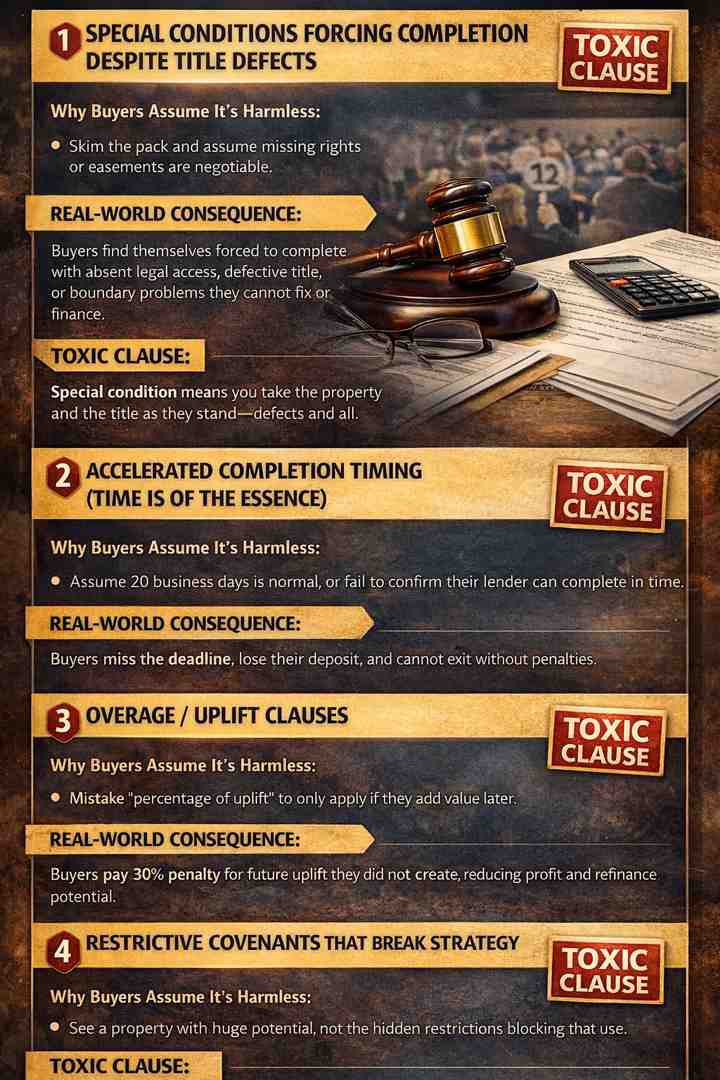
Clause 1: Special Conditions Forcing Completion Despite Title Defects
This clause appears in countless auction legal packs and is responsible for more deposit losses than almost any other.
It removes the buyer’s ability to refuse completion even when serious legal problems exist.
What the Clause Usually Says
These clauses are usually framed as waivers rather than outright warnings.
Typical wording includes:
-
The buyer shall complete notwithstanding any defect in title
-
No requisitions or objections shall be raised in respect of title matters
-
The property is sold subject to all matters disclosed or capable of discovery
On the surface, this reads like standard auction housekeeping. In reality, it is a binding acceptance of risk.
Why Buyers Assume It’s Harmless
Most buyers assume title defects fall into one of two categories.
Either they are minor technical issues that solicitors can resolve after exchange, or they are serious enough to justify withdrawal. This clause removes that second option entirely.
Because the wording is familiar and non-specific, buyers often believe it only applies to trivial issues. Few realise it can apply equally to missing rights of way, defective title, boundary problems, or historic title errors.
The Real-World Consequence
Once this clause is accepted, the buyer loses the right to refuse completion based on title quality.
If a lender declines finance because of a title defect, or a solicitor advises the title is unacceptable for the intended use, the buyer is still contractually obliged to complete. The seller is not required to fix the problem, extend time, or renegotiate.
The risk has already been transferred.
When This Becomes a Deposit-Loss Scenario
Deposit loss occurs when the defect prevents completion.
This usually happens when:
-
Mortgage finance is refused due to title issues
-
Bridging lenders impose conditions that cannot be met
-
The defect blocks the buyer’s planned use or exit
-
The issue cannot be insured or resolved within the completion period
At that point, the buyer defaults. The deposit is forfeited, regardless of whether the problem was known or fully understood at the time of bidding.
Some legal pack and/or title issues can also affect whether a lender is willing to fund the purchase, so buyers relying on borrowing should understand their auction finance options before bidding.
Who Is Most Exposed
This clause disproportionately affects:
-
Mortgage-dependent buyers
-
BRRR investors relying on refinance
-
Developers needing clean title for planning or resale
-
First-time auction buyers assuming problems can be fixed later
Cash buyers are not immune, but anyone relying on external funding or a defined exit is significantly more exposed once this clause is in play.
Clause 2: Accelerated Completion Clauses and Punitive Delay Penalties
This clause does not look like a legal trap. It looks like a timetable.
In practice, it is one of the fastest ways auction buyers end up in default, even when the deal itself looks sound.
What the Clause Usually Says
Accelerated completion clauses shorten the standard completion period and increase the cost of any delay.
Typical wording includes:
-
Completion required within 7 or 14 days of the auction
-
Time of the essence for completion
-
Daily interest charged on late completion, often well above base rate
-
Buyer to pay seller’s legal costs caused by delay
None of this looks unusual at first glance. Auctions are meant to complete quickly. Buyers expect that.
The risk sits in how little margin for error remains.
Why Buyers Assume It’s Harmless
Most buyers assume completion timing is an administrative issue, not a deal breaker, especially with typical auction completion timelines.
They expect:
-
Mortgage offers to arrive in time
-
Bridging lenders to complete once instructed
-
Funds to be transferable without friction
-
Solicitors to prioritise the file automatically
Because the property itself appears viable, buyers focus on price and upside, not timing mechanics. The clause feels procedural rather than punitive.
The Real-World Consequence
Once completion dates are accelerated, timing becomes a condition of success.
If funds are delayed for any reason, even briefly, the buyer is immediately in breach. Interest starts accruing daily. Legal costs can be added. The seller gains leverage while the buyer absorbs pressure.
Crucially, the seller has no obligation to grant extensions, even if the delay is outside the buyer’s control.
When This Becomes a Deposit-Loss Scenario
Deposit loss happens when delay turns into failure to complete.
Common triggers include:
-
Mortgage offers not issued in time
-
Bridging lenders introducing late conditions
-
Valuation or title issues slowing finance
-
Bank transfer delays or solicitor bottlenecks
-
Unexpected requirements uncovered after exchange
If completion does not happen by the contractual deadline, the buyer defaults. The deposit is forfeited, regardless of how close the buyer was to completing.
Who Is Most Exposed
This clause most often catches:
-
Buyers relying on post-auction finance approval
-
First-time auction bidders
-
Buyers using new lender relationships
-
Investors without funds already cleared and accessible
-
Anyone assuming timelines are flexible
Experienced auction buyers treat completion timing as a risk variable, not a formality. This clause punishes anyone who does not.
Clause 3: Overage, Uplift, and Clawback Clauses That Kill Exits
These clauses rarely stop a buyer from completing on day one.
Instead, they quietly poison the exit.
Overage, uplift, and clawback clauses are some of the most misunderstood provisions in auction legal packs because their impact is delayed. Buyers see them as a future accounting issue, not a deal-breaking risk. In reality, they can make a property effectively unmortgageable the moment the hammer falls.
What the Clause Usually Says
These clauses give the seller a right to share in future value increases.
Typical wording includes:
-
A percentage of uplift payable on grant of planning permission
-
Additional sums due on conversion, redevelopment, or change of use
-
Rights lasting 10, 20, or even 30 years
-
Obligations binding future owners
The clause often sounds reasonable. The seller benefits if the buyer unlocks extra value. The problem is how lenders and buyers view it.
Why Buyers Assume It’s Harmless
Most buyers assume overage only matters if they pursue development.
If the initial plan is buy-to-let, light refurbishment, or refinance, the clause feels irrelevant. Some buyers also assume they can deal with it later by negotiating, insuring, or simply ignoring it.
What they miss is that the clause exists on title from day one.
The Real-World Consequence
Many lenders will not lend on properties subject to poorly defined or open-ended overage clauses.
Even when lending is possible, conditions are often imposed:
-
Lower loan-to-value ratios
-
Retentions
-
Higher interest rates
-
Requirements for deed variation or removal
This affects not just development finance, but standard buy-to-let mortgages and refinancing strategies.
The result is an exit that no longer works on the plan the deal was priced for.
When This Becomes a Deposit-Loss Scenario
Deposit loss occurs when the buyer’s funding or exit relies on assumptions that no longer hold.
This commonly happens when:
-
Refinance is refused due to the clause
-
Bridging finance cannot be repaid on exit
-
Sale values are reduced because buyers discount the risk
-
The clause makes the property unattractive to future purchasers
If the buyer cannot complete or refinance as planned and funding collapses before completion, default follows. The deposit is lost even though the clause did not stop the bid itself.
Who Is Most Exposed
These clauses hit hardest for:
-
BRRR investors relying on refinance
-
Developers planning uplift through planning or conversion
-
Buyers structuring deals around exit value
-
Investors underestimating lender sensitivity to title complexity
Overage does not need to be exercised to cause damage. Its mere presence can be enough to break a deal.
Clause 4: Restrictive Covenants and Use Limitations That Break Strategy
This clause does not usually stop a buyer from completing.
It stops them from using the property in the way the deal was priced for.
Restrictive covenants and use limitations are some of the most dangerous clauses in auction legal packs because they do not look like legal defects. They look like historic footnotes. In reality, they can make an otherwise profitable strategy legally impossible.
What the Clause Usually Says
These clauses are often found in the title register or historic conveyances.
Common examples include:
-
Restrictions on alterations or extensions
-
Prohibitions on subdivision or conversion
-
Limits on commercial use or multiple occupation
-
Requirements for consent from a third party, often unnamed or uncontactable
The wording is often vague, outdated, or poorly explained, which is exactly why it is underestimated.
Why Buyers Assume It’s Harmless
Many buyers assume restrictive covenants are no longer enforceable.
They rely on assumptions such as:
-
The covenant is old and unlikely to be enforced
-
Planning permission overrides title restrictions
-
Other properties nearby have already breached it
-
Indemnity insurance will solve the issue
None of these assumptions guarantee protection.
The Real-World Consequence
Title restrictions operate independently of planning permission.
A property can have full planning consent and still be legally restricted from being used in that way. If enforcement action is taken, indemnity insurance may be invalidated, and lenders may withdraw support.
This creates a situation where the buyer owns a property they cannot legally use as intended.
Many of these restrictions are not obvious from marketing material and are only discoverable by examining the title register and title plan.
When This Becomes a Deposit-Loss Scenario
Deposit loss occurs when the strategy failure prevents completion or funding.
This typically happens when:
-
Lenders refuse finance due to use restrictions
-
Planned conversions or HMOs become legally blocked
-
Exit values collapse because the use is limited
-
Bridging finance cannot be redeemed on exit
If completion or refinance fails because the property cannot be used as assumed, the buyer defaults. The deposit is forfeited regardless of the buyer’s intentions.
Who Is Most Exposed
This clause most often catches:
-
Value-add investors
-
Change-of-use buyers
-
HMO and conversion investors
-
Buyers pricing deals based on assumed future use
The more the deal depends on changing how the property is used, the more dangerous this clause becomes.
Clause 5: Seller Cost Recovery Clauses That Go Beyond the Deposit
Most buyers assume the deposit is the worst-case scenario if something goes wrong.
These clauses exist to prove that assumption wrong.
Seller cost recovery clauses are designed to ensure the seller is made whole if the buyer defaults. They turn a failed completion into a financial liability that can extend well beyond the initial deposit.
What the Clause Usually Says
These clauses are typically buried in the special conditions and framed as reasonable cost recovery.
Common wording includes:
-
The buyer to pay the seller’s legal and professional costs on default
-
Buyer to cover resale or re-auction costs
-
The buyer to compensate the seller for any shortfall on resale
-
Interest and costs recoverable as a contractual debt
On paper, this sounds fair. In practice, it is open-ended.
Why Buyers Assume It’s Harmless
Buyers often believe:
-
The deposit caps their downside
-
Sellers will simply re-auction and move on
-
These clauses are rarely enforced
-
Costs will be modest even if applied
This belief usually comes from private treaty thinking, not auction reality.
At auction, enforcement is contractual, not discretionary.
The Real-World Consequence
If the buyer defaults, the seller can pursue losses as a matter of contract.
That can include:
-
Legal fees for enforcing the contract
-
Additional auction or marketing costs
-
The difference between the original sale price and the resale price
-
Interest accrued during delay
The deposit is often only the first deduction, not the final one.
When This Becomes a Deposit-Loss Scenario
Deposit loss happens immediately on default.
Additional liability follows if:
-
The resale price is lower
-
The seller incurs significant legal costs
-
The property takes time to resell
-
Market conditions move against the seller
At that point, the buyer may face legal action even after losing the deposit. The financial damage no longer stops at the auction day.
Who Is Most Exposed
These clauses hit hardest for:
-
Over-leveraged buyers
-
Buyers bidding without a clear walk-away threshold
-
Investors assuming worst case equals deposit only
-
Buyers relying on goodwill or negotiation after exchange
Once default occurs, goodwill is irrelevant. The contract governs everything.
Why These Clauses Are Rarely Flagged Before Auction
By the time most buyers realise how dangerous these clauses are, they are already contractually bound by them.
That is not an accident. It is the result of how auction sales are structured and how responsibility is divided between sellers, agents, and advisers.
Auctioneers Disclose, They Do Not Advise
Auctioneers are required to make the legal pack available. They are not required to explain it.
Their obligation is satisfied once the documents are accessible. There is no duty to highlight risk, interpret clauses, or warn buyers about commercial consequences. As long as the clause is disclosed, it is deemed accepted.
This is why phrases like “available to download” matter more legally than how clearly the risk is communicated.
Agents Focus on Sale, Not Suitability
Selling agents and auction catalogues are designed to generate demand, not assess buyer strategy.
Descriptions emphasise:
-
Price
-
Yield
-
Potential
-
Location
They rarely address whether the legal structure of the property supports the buyer’s intended use. Legal complexity does not stop a sale, but it can stop completion, which is not the agent’s contractual problem.
Quick Legal Reviews Miss Commercial Impact
Many buyers do instruct solicitors to glance at the legal pack.
The issue is scope.
A basic legal review often focuses on whether the contract is enforceable, not whether the deal is viable. A clause can be legally valid and commercially fatal at the same time.
If the solicitor is not asked to review the pack in the context of funding, exit strategy, and timescales, the most dangerous clauses remain technically acceptable and practically devastating.
Buyers Underestimate What “Standard Auction Wording†Means
One of the most common reassurances buyers give themselves is that certain clauses are “standard auction wording”.
Standard does not mean safe.
It means commonly used to shift risk. When buyers accept standard wording without understanding its impact, they unknowingly remove their own safety nets.
Why Responsibility Ultimately Sits With the Buyer
At auction, responsibility is deliberately concentrated.
The buyer chooses whether to:
-
Read the legal pack
-
Seek advice
-
Bid with or without conditions
-
Accept the risk profile
Once the hammer falls, the law assumes all of those choices were made knowingly.
This is why auction deposit losses are not treated as mistakes or misunderstandings. They are treated as contractual outcomes.
Who Is Most at Risk of Losing a Deposit at Auction
Auction deposit losses are not evenly distributed.
Certain types of buyers are far more exposed because of how they fund deals, structure exits, or interpret risk. The legal pack clauses covered earlier tend to hit these groups repeatedly.

Mortgage-Dependent Buyers
Buyers relying on mortgage finance are exposed from the outset.
Auction timescales rarely align with mortgage underwriting, and many lenders will not lend on properties with title defects, restrictive covenants, or overage clauses. Even when a mortgage offer is expected, any delay or change in terms can make completion impossible.
Once exchange has taken place, a refused or delayed mortgage is not a valid excuse. Default follows, and the deposit is lost.
BRRR and Refinance Investors
BRRR Investors planning to refinance after light refurbishment often underestimate how sensitive lenders are to legal complexity.
Clauses that appear manageable at purchase can:
-
Block refinance
-
Reduce loan-to-value
-
Trigger lender refusals
If bridging finance is used and the refinance fails, the exit collapses. In many cases, this failure happens before or shortly after completion deadlines, pushing the buyer into default.
Developers and Change-of-Use Buyers
Developers are especially vulnerable to restrictive covenants, overage clauses, and title limitations.
Deals are often priced on assumed planning outcomes or future use. If the legal pack blocks those assumptions, the economics fail immediately. Planning permission does not override title restrictions, and lenders are quick to step away when legal uncertainty exists.
A strategy failure at this level often means the buyer cannot proceed at all.
First-Time Auction Buyers
First-time buyers frequently assume auctions work like private treaty sales, just faster.
They expect:
-
Flexibility after exchange
-
Issues to be negotiable
-
Deposits to act as a temporary hold
Auctions do not work that way. These buyers are more likely to rely on assumptions rather than contractual reality, which makes them especially vulnerable to deposit loss.
Overconfident Cash Buyers
Cash buyers often believe funding risk does not apply to them.
While cash removes mortgage risk, it does not remove:
-
Title defects
-
Use restrictions
-
Contractual penalties
-
Exit constraints
If a cash buyer later realises the property cannot be used or sold as intended, walking away still triggers default. Cash reduces friction, not obligation.
Understanding who gets caught is not about labelling mistakes. It is about recognising whether your buying profile matches the risk embedded in the legal pack.
How Experienced Investors Screen Auction Legal Packs Differently
Experienced auction investors are not braver. They are stricter.
They approach legal packs with a different objective. Not to prove the deal can work, but to identify the conditions under which it must be rejected.
They Start With the Exit, Not the Price
Most buyers begin with the guide price and work forward.
Experienced investors work backwards.
Before getting excited about yield, uplift, or refurb potential, they ask:
-
Can this be refinanced?
-
Will I be able to easily resell this?
-
Can this be held without legal friction?
If the legal pack undermines the exit, the price becomes irrelevant.
They Treat Legal Packs as Risk Maps, Not Disclosures
Less experienced buyers read legal packs looking for reassurance.
Experienced investors read them looking for failure points.
They scan for:
-
Clauses that remove flexibility
-
Conditions that make completion unconditional
-
Anything that ties performance to timelines or third parties
A deal does not need to be perfect. It just needs to remain controllable. Legal packs that eliminate control are walked away from early.
They Separate Legal Validity From Commercial Viability
A critical distinction experienced investors make is this:
A clause can be legally acceptable and still commercially fatal.
They do not ask only whether a solicitor can proceed. They ask whether lenders, buyers, valuers, and insurers will accept the structure later. If the answer is unclear, the deal is discounted or rejected.
They Price Risk Aggressively or Do Not Bid at All
When risk cannot be removed, it is priced.
That pricing is not optimistic. It assumes:
-
Delays will happen
-
Costs will increase
-
Exits may be harder than planned
If the numbers do not work under those assumptions, experienced investors do not try to “make it work”. They move on.
They Know When Professional Review Is Non-Negotiable
Experienced investors do not outsource responsibility, but they do know when specialist review is required.
They seek targeted advice when:
-
Title is complex
-
Special conditions are heavily modified
-
Funding depends on clean legal structure
-
Strategy relies on future permissions or changes
The key difference is timing. This review happens before bidding, not after winning.
Experienced auction buyers do not avoid risk. They avoid irreversible risk.
Pre-Bid Auction Legal Pack Checklist (Deposit-Protection Focus)
This is not a general property legal pack guide and checklist.
It is a deposit-protection filter designed to answer one question before you bid:
“If something goes wrong, do I still have a way out?”
If the answer is no, the deal is already high risk, regardless of price.
1. Check When Exchange Happens and What You Are Locked Into
Before reading anything else, confirm:
-
Exchange occurs immediately at the fall of the hammer
-
There are no conditional or deferred exchange provisions
-
The deposit is fully at risk on default
If exchange is unconditional, every clause that follows matters more.
2. Scan the Special Conditions First (Not the Searches)
Special conditions override everything else.
Actively search for wording that:
-
Waives requisitions or objections
-
Forces completion regardless of defects
-
Limits remedies available to the buyer
-
Makes time “of the essence”
If special conditions remove flexibility, stop assuming issues can be solved later.
3. Identify Anything That Can Block Funding or Exit
Ask these questions directly:
-
Would a lender accept this title today?
-
Would a future buyer hesitate because of this clause?
-
Does this affect refinance, resale, or use?
Red flags include:
-
Overage or uplift clauses
-
Restrictive covenants tied to use or alterations
-
Missing rights, easements, or defective leases
-
Consent requirements from third parties
If your exit depends on lender approval, lender tolerance is the benchmark.
4. Confirm the Completion Deadline Is Achievable Without Hope
Hope is not a funding strategy.
Before bidding, ensure:
-
Funds are already available or fully approved
-
Valuations and underwriting are realistic within the timeline
-
Your solicitor can meet the completion date
If completion relies on “should be fine”, you are already exposed.
5. Price Risk or Walk Away, Do Not Ignore It
If risk cannot be removed, it must be priced.
That means:
-
Assuming delays, not best-case timing
-
Stress-testing finance costs
-
Discounting exit values
-
Accepting that some deals should be passed on
If pricing the risk kills the deal, the deal was never viable.
6. Know When Specialist Review Is Required
A standard legal glance is not enough when:
-
Title is complex
-
Special conditions are heavily amended
-
Strategy relies on future changes
-
Funding is sensitive to legal structure
In those cases, professional review is not an expense. It is deposit insurance.
Final Check Before You Bid
Ask yourself one last question:
“If I discovered a serious issue tomorrow, would I still be legally required to complete?”
If the answer is yes, and you are not fully comfortable with that outcome, do not bid.
Final Verdict: Auction Losses Are Legal, Not Emotional
Auction deposit losses are often blamed on nerves, inexperience, or bad luck.
In reality, they are almost always contractual.
At auction, nothing meaningful happens after the hammer falls. Every outcome is determined by what was already agreed inside the legal pack. If a buyer loses a deposit, it is not because something unexpected happened. It is because the contract required completion under conditions the buyer did not fully account for.
This is why legal packs are not just paperwork. They are risk-allocation documents.
The five clauses covered in this article all do the same thing in different ways. They remove flexibility. Eliminate exit routes. They turn manageable uncertainty into mandatory obligation. Once those clauses are accepted, the buyer’s ability to respond to problems disappears.
Experienced investors do not avoid auctions because they are risky, but because their auction buying strategy filters out irreversible risk. In other words, they avoid auctions where the risk cannot be controlled.
If you understand how auction legal packs transfer risk, and you screen them with deposit protection in mind, you stop losing money after winning bids. You start walking away from deals that were never worth winning.
At auction, discipline happens before bidding. Deposits are lost after.
FAQ: Auction Legal Packs and Deposit Risk
Can you lose your deposit at a UK property auction?
Yes. At a UK property auction, exchange happens when the hammer falls. If you fail to complete on the auction contract terms, the seller can usually keep your deposit and may also pursue additional costs depending on the special conditions.
What is an auction legal pack?
An auction legal pack is the set of legal documents provided by the seller that forms the basis of the contract at auction. It typically includes title information, searches, special conditions of sale, and supporting documents. Once you bid successfully, you are bound by what the pack contains.
Do auction legal packs protect the buyer?
Not in the way many buyers assume. Auction legal packs primarily disclose information and transfer risk to the buyer. If issues are disclosed or contractually accepted, buyers often lose the right to object or withdraw later.
What clauses in an auction legal pack are most likely to cause deposit loss?
The highest-risk clauses are usually in the special conditions and include completion required despite title defects, accelerated completion with strict penalties, overage or uplift obligations that kill refinance or resale, restrictive covenants that block intended use, and seller cost recovery clauses that increase liability after default.
Should a solicitor review the legal pack before bidding?
In many cases, yes, especially if you rely on mortgage or bridging finance, plan a conversion or change of use, or the title looks complex. The key is timing: the review must happen before bidding, not after you win.
What should I do if I spot a toxic clause before the auction?
Either price the risk into your maximum bid based on worst-case assumptions or walk away. If the clause creates an exit or funding risk you cannot control within the completion timeline, it is usually safer not to bid.

Koye Beckley is a UK property investor and founder of UncommonDeal, with practical experience in buy-to-let, property auctions, refurbishment projects and investment deal analysis. Through UncommonDeal, he publishes property market research, property deal sourcing and compliance guidance, investment guides and data-driven analysis to help investors evaluate buy-to-let, BRRR, flip and auction opportunities.


