
How Investors Lose Money on ‘Below Market Value’ Deals
Below market value (BMV) property deals are often marketed as a shortcut to safe profits. The logic sounds simple: buy cheaper than the market, reduce risk, and lock in instant equity. In reality, many UK property investors lose money on so-called BMV deals due to incorrect valuations, finance constraints, hidden costs, and weak exit demand.
A property being “below market value” does not automatically mean it is a good investment. The discount is usually based on asking prices, optimistic comparables, or assumptions that lenders, buyers, and tenants do not share. When valuations come in lower, refurb costs rise, or resale demand proves thin, the perceived bargain disappears quickly.
Why “Below Market Value” Feels Like a Cheat Code
“Below market value” is one of the most powerful phrases in UK property investing. It triggers the idea of instant equity, reduced risk, and a head start that other buyers supposedly missed. For many investors, BMV feels like a cheat code: buy cheaper than everyone else and let the numbers take care of themselves.
The problem is that BMV shortcuts analysis. When a deal is labelled “below market value”, investors often stop asking the hard questions. The focus shifts from why the property is cheap to how fast they can secure it. Valuations are taken at face value, exit assumptions become optimistic, and risks that would normally kill a deal are mentally discounted because the purchase price feels safe.
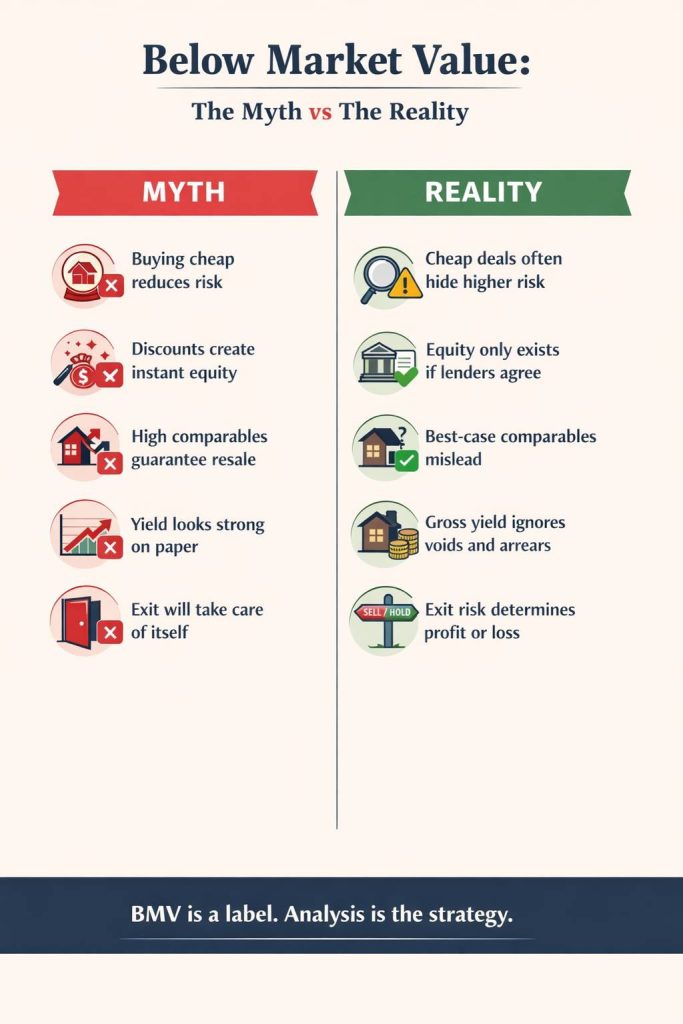
This is where the uncomfortable truth kicks in: cheap does not mean profitable. A property can be below market value and still lose money through down-valuations, finance friction, refurbishment overruns, weak rental demand, or a difficult resale market. The discount does not protect you if the fundamentals are wrong.
This article is not about finding bargains. It is about where money actually leaks in so-called BMV deals, why investors underestimate those leaks, and how a “cheap” purchase can quietly turn into an underperforming or loss-making investment.
Additionally, the article explains how investors lose money on below market value deals, the common traps hidden behind the BMV label, and how to properly assess whether a discount is real or simply a marketing hook.
What “Below Market Value” Actually Means (And Who Defines It)
Below Market Value (BMV) refers to a property purchased for less than its true open-market price, where market value is defined by completed comparable sales under normal conditions, not asking prices or assumed valuations.
In UK property investing, BMV is often claimed using subjective benchmarks, which means a deal can appear discounted on paper while offering no real financial advantage in practice.
In theory, a below market value property is one purchased for less than what it is objectively worth. In practice, there is no single agreed definition of market value, and that is where most investor mistakes begin.
“BMV” is not a regulated term. It is a comparison against a chosen benchmark, and that benchmark can change depending on who is defining it, how it is calculated, and what assumptions are being made.
In fact, much of the confusion around BMV stems from misunderstanding what market value definition actually means, which is formally defined in professional valuation standards rather than marketing language.
Estate Agent Asking Price vs Achieved Price
One of the most common BMV claims is based on estate agent asking prices. This is a weak benchmark. Asking prices reflect vendor ambition, not transaction reality. They are often inflated, adjusted downward during marketing, or never achieved at all.
A property priced £20,000 below nearby asking prices is not necessarily below market value if comparable properties are consistently selling for less than their advertised figures. Market value is established by completed sales, not listings.
Valuation Assumptions vs Lender Reality
Investors often rely on assumed valuations when underwriting BMV deals. These assumptions may come from desktop appraisals, agent opinions, or optimistic comparables that ignore condition, layout, lease length, or local demand.
Lenders do not share these assumptions. Mortgage providers apply conservative evidence-based valuations, stress-testing both resale and rental sustainability. When the lender valuation comes in lower than expected, the perceived “discount” disappears, along with the finance structure that depended on it.
Desktop Valuations vs Real Market Evidence
Desktop valuations and automated models are increasingly used to justify BMV claims, particularly in sourced deals. While useful as a starting point, they often fail to account for property-specific issues such as internal condition, access problems, structural risk, or micro-location factors.
True market value is set by what a willing buyer will pay in real conditions, not by an algorithm or a theoretical midpoint between comparables. When investors rely on abstract figures rather than evidence, the margin they think they are buying simply does not exist.
Why “BMV” Is Rarely a Fixed or Objective Number
Market value moves with time, sentiment, finance availability, and local demand. It is not static. A price that looks below market value on paper can become full market value or even overpriced once realistic assumptions are applied.
Because the benchmark is fluid, BMV is better understood as a narrative rather than a number. Without clarity on who defined the market value and how, the label is meaningless.
Key takeaway: if the benchmark used to define market value is wrong, outdated, or optimistic, the discount is imaginary.
The Valuation Trap: When Your Exit Price Never Materialises
Most losses on below market value deals start with the exit price. On paper, the numbers look fine. In reality, the valuation never shows up.
Optimistic Comparables
Investors often select the highest nearby sale as their benchmark. That choice feels safe. After all, the sale exists. However, it rarely reflects the average buyer outcome.
Comparables need context. Size, layout, condition, and timing matter. A refurbished end-of-terrace sold in a strong quarter is not the same as a tired mid-terrace selling into weaker demand. When investors anchor to best-case comparables, they build exits that only work in perfect conditions.
Ignoring Condition-Adjusted Pricing
Condition drives price more than most investors admit. Buyers pay for finish, compliance, and certainty. Lenders do the same.
Many BMV deals rely on post-refurb values that assume flawless delivery. Yet even small shortfalls reduce price sharply. Miss the spec. Overlook compliance. Delay completion. Each one narrows the buyer pool and lowers achievable value.
Price does not move linearly. A property is either competitive or it is not.
Area-Specific Ceiling Prices
Every location has a ceiling. Some are obvious. Others only appear when you try to sell.
Investors often assume price growth or stretch demand without evidence. They ignore that buyers cap what they will pay in certain streets, postcodes, or property types. When the ceiling is hit, no amount of refurbishment or staging pushes value further.
A property can be cheap relative to asking prices and still sit at the top of what the area supports.
The Gap Between Theoretical Value and Achievable Sale Price
Theoretical value lives in spreadsheets. Achievable price lives in buyer behaviour.
Valuations often assume stable demand, easy finance, and fast transactions. The real market is slower and more selective. Buyers negotiate harder. Lenders down-value. Chains collapse. Time on market increases.
Each friction reduces net proceeds. By the time the sale completes, the margin has already leaked away.
Why Investors Confuse GDV With Resale Certainty
GDV is a model output. It is not a promise.
Investors treat Gross Development Value as a fixed destination. In reality, it is a range shaped by risk, timing, and execution. When the top-end GDV becomes the base case, the deal breaks.
A valuation only matters if someone can and will pay it. Until that happens, it remains theoretical.
Finance Reality: When Lenders Don’t Care About Your Discount
Below market value means little once a lender gets involved. Banks and mortgage providers ignore how cheap you bought the property. They care about risk, evidence, and exit value.
Down-Valuations Wipe Out “Equity”
Many investors expect instant equity from a BMV purchase. Then the valuation lands lower than planned.
Lenders value conservatively. They adjust for condition, demand, and liquidity. If the valuation comes in at or near the purchase price, the paper equity disappears. In some cases, the valuation lands below the price paid. At that point, the deal starts underwater.
A discount only exists if the lender recognises it.
Loan-to-Value Is Based on the Lender’s Valuation
Loan-to-value calculations use the lender’s figure, not your purchase price.
Buy at £180,000. Expect a £220,000 value. Receive a £195,000 valuation instead. The LTV now applies to £195,000. That gap must be funded with cash.
This catches investors out repeatedly. They budget for a deposit based on the deal narrative, not the finance reality.
Refurb, Lease Length, Construction, and Title Issues
BMV properties often carry hidden finance friction.
Short leases reduce lender appetite. Non-standard construction narrows panel options. Title defects delay offers. Heavy refurb works push deals outside standard criteria.
Each issue shrinks lender choice. As options fall, terms worsen. Rates rise. Leverage drops. Cash requirements increase.
Why BMV Deals Become Cash-Heavy Unexpectedly
Finance risk compounds quickly.
A down-valuation reduces leverage. A tighter lender panel raises costs. A delayed refinance extends holding periods. Each step pulls more cash into the deal.
What started as a discounted purchase turns into a capital-intensive project. At that point, the cheap entry price no longer protects returns.
BMV does not reduce finance risk. In many cases, it exposes it.
Case Study: When a “£30,000 Below Market Value” Deal Loses Its Margin
An investor buys a two-bedroom terrace for £170,000, marketed as £30,000 below market value based on nearby sales at £200,000.
The plan is simple: light refurbishment, refinance, then hold or sell.
-
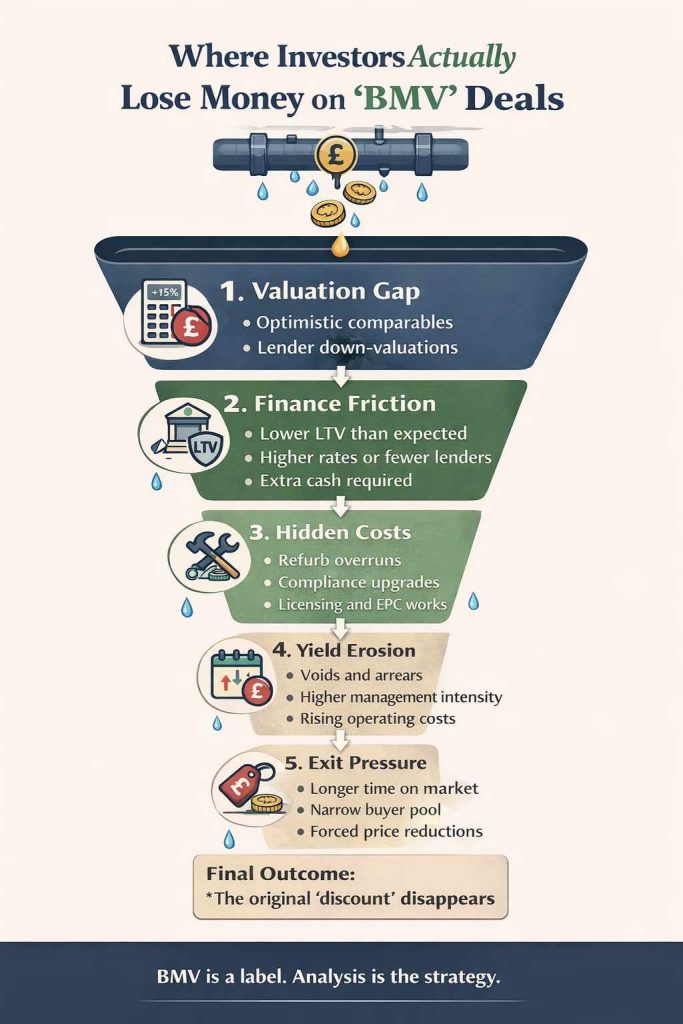
Lender valuation: The valuation comes back at £175,000, not £200,000. The valuer adjusts for condition and recent achieved prices.
The expected equity disappears immediately. - Hidden costs: Electrical upgrades, fire doors, and insulation add £12,000 beyond budget. These works improve compliance but do not lift value.
- Yield erosion: The property sits empty for two months. Once let, management costs and minor repairs reduce net yield.
- Exit pressure: The property sells for £182,000 after a longer time on market. Fees, holding costs, and finance absorb the remaining margin.
Lesson: The deal failed due to assumptions around valuation, finance, and exit, not because the purchase price was too high.
Hidden Costs That Quietly Kill BMV Margins
Most BMV deals do not fail because of one big mistake. Instead, margins bleed out through small, overlooked costs. These costs rarely appear in the headline numbers. They surface only after commitment.
Many BMV claims appear in auction property deals in the UK, where pricing looks attractive but finance, condition, and exit risk often tell a different story.
Refurb Overruns and Specification Creep
Refurb budgets drift more than investors expect.
Costs rise as soon as work starts. Materials change. Trades uncover issues. Timelines slip. Each decision adds small upgrades that feel justified in isolation. Together, they erode margin.
BMV deals often involve tired properties. That increases uncertainty. The cheaper the property, the less predictable the refurb.
Compliance Costs Discovered After Offer
Many costs appear only once due diligence begins.
Electrical reports fail. Gas systems need upgrades. Fire doors fall short. Insulation misses current standards. Each item adds unplanned spend.
Because these issues sit outside the “refurb” line, investors underestimate them. However, lenders and insurers do not.
Licensing, EPC Upgrades, and Planning Conditions
Regulatory costs hit BMV deals hard.
Licensing schemes impose fees, works, and ongoing obligations. EPC upgrades require capital and time. Planning conditions restrict use or demand extra compliance.
These costs do not improve resale value directly. Yet they consume cash and delay exits. That combination hurts returns.
Legal Pack Red Flags Investors Ignore Because “It’s Cheap”
Cheap prices lower investor scepticism.
Buyers skim legal packs instead of interrogating them. They overlook restrictive covenants, access issues, service charge risks, and title defects. Each problem looks manageable on its own.
Later, these risks surface as delays, renegotiations, or reduced buyer interest. By then, exit leverage has gone.
A low purchase price does not offset legal risk. It often masks it.Yield Illusions: When Cheap Properties Perform Poorly
Many BMV deals look attractive because of yield. The purchase price is low. The rent appears strong. On paper, the numbers impress. In practice, performance often disappoints.
Low-Demand Areas With High Voids
Cheap properties usually sit in weaker locations.
Demand is thin. Tenant turnover is high. Voids stretch longer than expected. Each empty month wipes out yield quickly.
While the headline rent stays the same, the annual income does not. Over time, voids turn a “high-yield” deal into an average one.
Tenant Quality and Arrears Risk
Lower purchase prices attract different tenant profiles.
Income stability matters. Payment behaviour matters more. In weaker markets, arrears rise faster and resolve slower. Evictions take time. Legal costs follow.
As a result, cash flow becomes volatile. Yield becomes unpredictable.
Management Intensity vs Headline Yield
High-yield properties demand more work.
Maintenance calls increase. Anti-social behaviour complaints rise. Management time expands. Agent fees often follow.
Each intervention costs money. Each problem consumes attention. The yield looks good only if you ignore the effort required to maintain it.
Why Gross Yield Hides Operational Reality
Gross yield simplifies reality too much.
It ignores voids. It ignores arrears. It ignores management costs, compliance, and wear. Yet these factors drive real returns.
A cheap property with a high gross yield can underperform a more expensive, lower-yield asset once costs are applied. Cash flow matters more than percentages.
Cheap does not guarantee income. It often magnifies risk.
Exit Risk: Cheap In Does Not Mean Easy Out
Investors focus heavily on the entry price. However, profits are made or lost on the exit. This is where many BMV deals struggle.
Liquidity Problems in Secondary Markets
Cheap properties often sit in secondary or fringe markets.
Fewer buyers operate there. Finance options are limited. Demand dries up quickly when conditions tighten. As a result, selling takes longer than expected.
In strong markets, price supports liquidity. In weaker ones, even a “cheap” property can feel expensive.
Narrow Buyer Pools
BMV properties rarely appeal to everyone.
Some only suit cash buyers. Others scare off first-time buyers or owner-occupiers. Investors may avoid them due to regulation, management intensity, or poor yields.
With fewer buyers, negotiations turn one-sided. You lose leverage fast.
Time-on-Market Risk
Time is an invisible cost.
Each extra month on the market adds holding costs. Mortgage interest runs. Service charges continue. Stress builds.
As time passes, buyers sense urgency. Offers fall. Confidence drops. Momentum disappears.
Forced Discounting on Resale
Eventually, price becomes the lever.
Investors reduce asking prices to move the property. The original BMV discount erodes. Then it reverses.
What looked like equity on purchase turns into a haircut on sale. At that point, the exit dictates the result.
Why BMV Often Locks You Into Longer Holds Than Planned
BMV deals promise flexibility. In reality, they restrict it.
Weak exits force longer holds. Longer holds increase exposure to regulation, rate changes, and maintenance. Plans shift from flip to rent, or from short-term to long-term by necessity, not choice.
Cheap entry does not guarantee optionality. Sometimes, it removes it.
The Sourcer Problem: How BMV Is Used as a Sales Tool
Below market value sells deals. That is why it appears so often in sourced opportunities. Unfortunately, it is also one of the easiest claims to make and one of the hardest to verify.
Why “Below Market Value” Is Easy to Claim and Hard to Prove
BMV has no fixed definition. No standard benchmark exists. That flexibility makes the phrase powerful.
A sourcer can claim a deal is below market value by choosing favourable comparables, optimistic assumptions, or selective data. None of this requires bad intent. However, it does mean the claim depends heavily on presentation rather than proof.
Unless the benchmark is clearly defined, BMV becomes a story, not a fact.
Anchoring Investors to Inflated Comparables
Sourcers often anchor investors to the highest nearby sales.
Once that number is planted, everything else feels cheap by comparison. The purchase price looks discounted. The margin looks protected. Risk fades into the background.
However, anchoring shifts attention away from realistic exit prices. Average outcomes matter more than peak ones. Yet most BMV pitches lean on best-case comparables.
Many investors fall into the same mistakes repeatedly, especially when relying on sourced opportunities without checking for the property deal sourcing traps UK investors miss.
Fee-First Incentives
Most sourcers earn fees on completion, not performance.
That structure matters. The incentive sits at the point of sale, not the point of exit. Once the deal completes, the risk transfers fully to the buyer.
This does not mean the deal is bad. It does mean the investor must verify every assumption independently. Blind trust is not a strategy.
Why Few BMV Claims Survive Independent Analysis
When investors strip away the marketing, many BMV claims weaken.
Valuations adjust. Finance terms tighten. Costs rise. Exit demand shrinks. By the time the numbers are stress-tested, the discount often disappears.
True BMV deals do exist. They are just rarer than advertised. The difference shows up only after proper analysis, not before.
BMV should be the conclusion of due diligence, not the starting point.
Investors often assume a sourced BMV deal offers built-in safety, but this raises a bigger question: are property sourcing deals worth it once risk and exit reality are applied?
When BMV Deals Actually Make Sense
Not all below market value deals are bad. Some work very well. The difference lies in why the discount exists and whether you can price the risk accurately.
Forced Sales With Clear Motivation
Genuine motivation creates real discounts.
Probate, divorce, repossessions, and time-critical disposals often force sellers to prioritise speed over price. In these cases, the discount reflects urgency, not hidden defects.
The key is clarity. You should understand why the seller accepts less and whether that pressure will still exist if timelines slip.
Structural Discounts You Understand and Can Price Correctly
Some properties sell cheap for structural reasons.
Short leases, unusual layouts, non-standard construction, or access issues reduce buyer demand. However, these discounts can work if you understand them and price them properly.
The risk only pays if you know who will buy the property later and at what price.
Planning or Title Risk You Can Legally Solve
Risk can create opportunity.
Planning constraints, restrictive covenants, or title defects often scare off buyers. That fear can create discounts. However, this only works if you can resolve the issue legally and cost-effectively.
Hope is not a strategy. Evidence is.
Long-Term Holds With Conservative Assumptions
Time can absorb risk.
BMV deals make more sense for long-term holds where exit timing matters less. Conservative rent assumptions, realistic maintenance budgets, and modest growth expectations provide breathing room.
In these cases, the discount improves resilience rather than fuelling speculation.
Below market value works when it reflects real, understood risk. It fails when it replaces analysis.
How to Properly Analyse a BMV Deal (Before You Commit)
A below market value deal should survive scrutiny. If it only works under perfect assumptions, it is not a deal. Proper analysis flips the process from excitement to evidence.
This is why understanding how property investors should analyse deals matters more than chasing discounts or marketing labels.
Independent Valuation Logic
Start by defining market value yourself.
Use completed sales, not asking prices. Adjust for condition, layout, tenure, and timing. Ignore the highest comparable unless you can explain why your property will outperform the average.
If the deal still works after this adjustment, you are on firmer ground.
Stress-Testing Exit Prices
Next, pressure-test the exit.
Lower the expected sale price. Extend the time on market. Add selling costs. Ask what happens if demand weakens or finance tightens.
If a small change breaks the deal, the margin was never real.
Finance-First Underwriting
Finance shapes outcomes.
Run the numbers using the lender’s likely valuation, not the purchase price. Assume conservative loan-to-value ratios. Factor in delays, fees, and higher rates.
If the deal only works with perfect leverage, it relies on luck.
Risk-Adjusted Margin Requirements
Margins should reflect risk.
BMV deals often carry extra complexity. That means they need larger buffers. Thin margins do not compensate for valuation, finance, or exit risk.
If the return does not improve after adjusting for risk, the discount is cosmetic.
Why “Looks Cheap” Is Not an Investment Thesis
Cheap is not a strategy.
A good investment works because of cash flow, resilience, and exit options. Price supports those outcomes. It does not replace them.
If your main justification is that the property feels cheap, walk away. The market rarely rewards shortcuts.
Final Verdict: BMV Is Not a Strategy, It’s a Label
Below market value sounds like a strategy. It is not. It is simply a description of price relative to a chosen benchmark.
Investors who rely less on one-off BMV deals and more on how to build a property deal pipeline tend to make calmer, better-informed decisions.
Smart investors focus on risk first. Price comes second. A cheap property with weak fundamentals carries more risk than a full-priced asset with strong demand, stable finance, and a clear exit.
This is where many investors go wrong. They rely on shortcuts. They assume discounts protect them. They treat BMV as proof of safety instead of a prompt to investigate further.
Lazy heuristics feel efficient. They save time. They also hide problems. When investors stop questioning assumptions, losses follow quietly.
Disciplined analysis does the opposite. It challenges comparables. It pressures exit prices. It prioritises finance reality. Most importantly, it demands margins that match risk.
BMV can support a good deal. It cannot replace good analysis. The investors who survive long term understand that difference.

Koye Beckley is a UK property investor and founder of UncommonDeal, with practical experience in buy-to-let, property auctions, refurbishment projects and investment deal analysis. Through UncommonDeal, he publishes property market research, property deal sourcing and compliance guidance, investment guides and data-driven analysis to help investors evaluate buy-to-let, BRRR, flip and auction opportunities.
