
The Best UK Short-Term Rental Markets for Investing in 2026: Occupancy, Revenue and Yield Analysis
The UK’s best short-term rental markets continue to attract investors despite growing regulation and increasing competition. While traditional buy-to-let remains a popular strategy, some investors are turning to serviced accommodation and holiday lets in search of higher cash flow and greater flexibility.
However, successful short-term rental investing is no longer simply about finding the highest nightly rates. Experienced investors increasingly focus on occupancy levels, annual revenue potential, local demand drivers, and regulatory risks. A property charging £180 per night may appear attractive on paper, but if it only achieves 40% occupancy, it can generate less income than a property charging £120 per night with a 75% occupancy rate.
The most profitable short-term rental markets typically combine multiple demand sources, including tourism, business travel, university visitors, major events, and contractor accommodation. These factors help create more consistent occupancy throughout the year and reduce reliance on seasonal demand.
In this guide, we analyse some of the UK’s leading short-term rental markets for 2026 using key investment metrics, including occupancy rates, average daily rates (ADR), tourism demand, affordability, and overall investment potential. Whether you are considering your first serviced accommodation property or looking to expand an existing portfolio, understanding where demand is strongest can help you make more informed investment decisions.
What Do We Mean by the Best Short-Term Rental Markets?
The best short-term rental markets are areas where investors can achieve strong occupancy, competitive nightly rates, and reliable annual revenue. The strongest UK markets typically benefit from tourism, business travel, universities, major events, and diverse sources of year-round demand.
The term “best short-term rental market” can mean different things to different investors.
For some investors, the best market is the one capable of generating the highest annual revenue. For others, the priority may be strong occupancy levels, affordable property prices, lower regulatory risk, or the potential to achieve attractive cash-on-cash returns.
A city with premium nightly rates does not automatically make it the best investment location. For example, a property generating £180 per night may produce lower annual income than a property charging £120 per night if occupancy levels are significantly lower. Likewise, a market with exceptional revenue potential may require a much larger capital investment, reducing overall returns.
In this guide, we define the best short-term rental markets as locations that offer a strong balance of:
- Consistent occupancy rates
- Competitive average daily rates (ADR)
- Strong annual revenue potential
- Multiple sources of guest demand
- Reasonable property acquisition costs
- Sustainable long-term investment prospects
Rather than focusing on a single metric, we assess each market from an investor’s perspective, considering both income potential and the practical realities of owning and operating a short-term rental property in the UK.
This approach helps identify locations that are not only popular with guests but also capable of delivering attractive risk-adjusted returns for property investors.
How We Evaluated the UK’s Best Short-Term Rental Markets
Not all short-term rental markets are created equal. A city with strong tourism may generate impressive nightly rates but suffer from seasonal demand, while another location may deliver lower nightly rates but achieve higher occupancy and more consistent annual revenue.
For this analysis, we evaluated each market using a combination of performance metrics, demand indicators, affordability considerations, and investment risks. Rather than focusing on a single factor, such as Airbnb nightly rates, we examined the broader picture to identify locations that offer the strongest overall investment potential for short-term rental operators in 2026.
Occupancy Rate
Occupancy rate measures the percentage of nights a property is booked throughout the year.
This is one of the most important indicators of short-term rental performance because it directly impacts annual revenue. A property with a lower nightly rate but high occupancy can often outperform a property charging significantly more per night but sitting empty for long periods.
Markets with consistently strong occupancy levels generally benefit from year-round demand and are less dependent on seasonal tourism.
To calculate the Occupancy Rate, you can use the following formula:
Occupancy Rate (%)
Occupancy Rate = (Booked Nights ÷ Available Nights) × 100
Example:
(270 Booked Nights ÷ 365 Available Nights) × 100
= 74% Occupancy.
Average Daily Rate (ADR)
Average Daily Rate (ADR) represents the average amount guests pay per occupied night.
Higher ADRs can significantly increase revenue, particularly in premium destinations where visitors are willing to pay more for accommodation. However, ADR should never be viewed in isolation. Investors should consider whether higher nightly rates are sustainable and supported by strong occupancy levels.
A market with an ADR of £180 may appear attractive, but if occupancy is weak, total annual income can be disappointing.
To calculate the Average Daily Rate (ADR), you can use the following formula:
Average Daily Rate (ADR)
ADR = Total Rental Revenue ÷ Number of Booked Nights
Example:
£48,600 ÷ 270 Nights
= £180 ADR
Revenue Per Available Night (RevPAN)
Revenue Per Available Night (RevPAN) combines occupancy and nightly rates into a single performance metric.
Many professional accommodation operators use RevPAN because it provides a clearer picture of actual earning potential than ADR alone. It helps investors compare markets more effectively by measuring how much revenue a property generates across all available nights, whether occupied or vacant.
In many cases, RevPAN is one of the best indicators of the overall strength of a short-term rental market.
Estimated Annual Revenue
To calculate you Estimated Annual Revenue, you can use the following formula:
Annual Revenue = Occupancy Rate × ADR × 365
Example:
74% × £180 × 365
= £48,618 Annual Revenue
This formula provides a simple estimate of annual gross revenue before operating expenses, financing costs, and taxes.
Therefore, to calculate the Revenue Per Available Night (RevPAN), you can use the following formula:
RevPAN = ADR × Occupancy Rate
Example:
£180 × 74%
= £133.20
RevPAN allows investors to compare markets by combining pricing power and occupancy into a single metric.
Tourism Demand
Tourism remains one of the primary drivers of short-term rental performance.
Locations that attract domestic and international visitors throughout the year often provide a larger pool of potential guests. We considered factors such as visitor numbers, major attractions, cultural events, sporting events, and seasonal demand patterns when assessing each market.
Cities with multiple tourism drivers generally provide more stable occupancy than locations that rely on a single attraction or seasonal visitor influx.
Investors should monitor industry trends and occupancy data through resources such as VisitBritain’s UK short-term rentals research when assessing emerging markets and demand patterns.
Business Travel Demand
Business travellers can provide an important source of year-round bookings.
Markets with strong corporate activity, conference venues, universities, research centres, and major employers often benefit from demand that extends beyond traditional tourism seasons.
Business-related stays can help maintain occupancy during quieter periods and reduce income volatility for short-term rental operators.
Property Entry Costs
High revenue potential does not always translate into the best investment opportunity.
Property acquisition costs vary significantly across the UK, and investors must consider the relationship between purchase price and expected income. In some markets, lower-cost properties may deliver stronger cash-on-cash returns than more expensive locations with higher headline revenues.
Investors seeking stronger cash-on-cash returns should also focus on identifying below-market-value opportunities and learning how to spot undervalued property on Rightmove before competing buyers recognise the potential.
For this reason, affordability and investment entry costs formed an important part of our analysis.
Regulatory Risks
The regulatory environment for short-term rentals continues to evolve across the UK.
Licensing requirements, planning restrictions, local authority controls, and limits on short-term letting can all affect profitability and long-term viability. Investors should understand not only current regulations but also the likelihood of future changes that may impact operations.
Markets with increasing regulatory scrutiny may present additional risks that need to be factored into investment decisions.
Investors should also apply the same principles used when analysing property deals in the UK to ensure that projected rental income, financing costs, operating expenses, and target returns align with their overall investment strategy.
By analysing these factors together, we can move beyond simple Airbnb rankings and identify the UK short-term rental markets that offer the strongest balance of demand, revenue potential, affordability, and long-term sustainability for investors in 2026.
UK Short-Term Rental Markets Snapshot (2026)
The UK short-term rental sector continues to grow, but it is also becoming more competitive. Rising tourism, business travel, and demand for flexible accommodation have helped support the market, while the number of available listings has increased across most regions of the country.
For investors, this means market selection is becoming increasingly important. Strong returns are still achievable, but success depends on choosing locations with healthy occupancy rates, sustainable pricing power, and multiple sources of year-round demand rather than simply following popular tourism hotspots.
Short-Term Rental Sector by the Numbers
| Metric | UK Market |
|---|---|
| Active Listings | 490,000+ |
| Typical Occupancy Rate | 52% – 65% |
| Average Daily Rate (ADR) | £120 – £170 |
| Average Annual Revenue | £20,000 – £40,000+ |
| Fastest Growing Segment | Professional Serviced Accommodation |
By August 2025, there were more than 491,000 short-term rental properties available across the UK, representing continued growth in market supply. At the same time, occupancy levels have remained relatively stable, although performance varies significantly between cities and property types.
Industry data suggests that a well-performing UK short-term rental property typically achieves occupancy rates between 55% and 65%, while professionally managed properties in strong markets can often exceed these levels. Average daily rates commonly range from £120 to £170 per night, although premium destinations can command substantially higher rates.
The market is also evolving beyond traditional Airbnb hosting. Professional serviced accommodation operators are increasingly targeting business travellers, contractors, relocation clients, and insurance stays to generate more consistent year-round occupancy. This shift is helping to reduce reliance on seasonal tourism and is creating new opportunities for investors who focus on operational excellence rather than simply owning property.
Despite growing competition, average revenues across many UK short-term rental markets continue to reach £20,000 to £40,000 per year, with top-performing locations and professionally operated properties generating substantially more. However, investors should be aware that increasing supply means not every market will deliver attractive returns, making careful analysis more important than ever.
UK Short-Term Rental Market Drivers
The growth of the UK short-term rental sector is being driven by more than just tourism. While holidaymakers remain an important source of bookings, many of today’s highest-performing short-term rental properties benefit from multiple demand streams throughout the year. Understanding these demand drivers can help investors identify markets with stronger occupancy levels and more resilient income potential.
Growth of Airbnb and Alternative Accommodation Platforms
The rapid growth of platforms such as Airbnb has transformed the short-term rental sector over the past decade. What was once largely limited to hotels, guest houses, and holiday cottages has evolved into a diverse accommodation market offering everything from city-centre apartments to luxury homes and serviced accommodation units.
Many travellers now prefer short-term rentals because they often provide more space, privacy, and flexibility than traditional hotel rooms. This shift in consumer preferences has expanded the potential customer base for property investors and created opportunities in locations that previously attracted little short-term accommodation demand.
Expansion of Booking.com and Multi-Platform Distribution
While Airbnb remains the best-known platform, many professional operators now generate bookings through multiple channels, including Booking.com, Vrbo, Expedia, and direct booking websites.
This wider distribution helps reduce reliance on a single platform and can increase occupancy levels by exposing properties to different types of travellers. In many markets, Booking.com has become particularly important for attracting international visitors, business travellers, and last-minute bookings.
For investors, the ability to market properties across multiple booking channels has significantly increased the reach and scalability of short-term rental businesses.
Growing Demand for Corporate Lets
Corporate accommodation has become one of the most attractive segments of the short-term rental market.
Businesses frequently require temporary accommodation for employees, contractors, consultants, project teams, and executives working away from home. These stays often last longer than traditional holiday bookings and can provide more predictable occupancy.
Cities with strong business activity, major infrastructure projects, financial services sectors, universities, and technology hubs often benefit from substantial corporate accommodation demand throughout the year.
Relocation and Temporary Housing Demand
An increasingly important source of demand comes from people requiring temporary accommodation during relocation periods. This includes professionals moving for work, families waiting for property purchases to complete, homeowners displaced by insurance claims, and individuals staying elsewhere during renovation projects.
These longer-duration bookings can provide more stable occupancy and predictable income than traditional holiday lets, making them particularly attractive to short-term rental operators.
Common examples include:
- Individuals moving for work
- Families waiting for property purchases to complete
- Insurance accommodation following property damage
- Temporary housing during renovations
- International professionals relocating to the UK
These guests often require accommodation for several weeks or even months, creating longer booking durations and reducing turnover costs for operators.
Major Events and Sports Tourism
Major events and sports tourism continue to play a significant role in the performance of many UK short-term rental markets. Unlike traditional tourism, which can fluctuate throughout the year, major sporting fixtures, festivals, concerts, conferences, and cultural events often create predictable periods of exceptionally strong accommodation demand.
These events can allow property operators to achieve higher occupancy rates, increase nightly pricing, and generate a disproportionate share of annual revenue within relatively short periods.
Many of the UK’s strongest short-term rental markets benefit from major events that generate spikes in accommodation demand.
Examples include:
- Edinburgh Fringe Festival
- Premier League football matches
- Concerts and entertainment events
- Business conferences
- University graduation ceremonies
- Cultural festivals
Cities that host recurring annual events often experience significant increases in occupancy and nightly rates during peak periods.
Universities and Visiting Academics
Higher education institutions generate a steady flow of visitors throughout the year, making university cities particularly attractive for short-term rental operators.
Unlike many tourism-driven markets that experience significant seasonal fluctuations, universities create recurring accommodation demand through academic events, research projects, conferences, open days, graduations, and visiting professionals. This can help support occupancy levels during periods when leisure travel demand may be weaker.
University cities can provide a surprisingly strong source of year-round accommodation demand.
Visitors may include:
- Prospective students and families
- Visiting lecturers
- Academic researchers
- Conference attendees
- Graduation guests
Markets such as Cambridge, Oxford, Manchester, Liverpool, and Edinburgh benefit from this additional demand stream, helping to support occupancy outside traditional tourism seasons.
Infrastructure Projects and Contractor Accommodation
Major infrastructure and regeneration projects can create significant demand for short-term accommodation from contractors, engineers, consultants, project managers, and specialist workers.
Unlike leisure travellers, these guests are often travelling for work and may require accommodation for several weeks or even months at a time. This can help property operators achieve more consistent occupancy levels while reducing guest turnover, cleaning costs, and marketing expenses.
Large infrastructure projects frequently create demand for short-term accommodation from contractors and specialist workers.
Examples include:
- Transport projects
- Energy developments
- Construction schemes
- Regeneration programmes
Contractor bookings can provide a stable source of mid-term occupancy and are often less seasonal than tourism-related stays.
The Rise of Professional Serviced Accommodation Operators
The UK short-term rental sector has become increasingly professionalised over the past decade. What was once dominated by occasional hosts renting out spare rooms or holiday homes is now attracting dedicated operators who manage accommodation as a business. This shift has led to higher service standards, improved guest experiences, and more sophisticated revenue management strategies across the sector.
The sector is increasingly moving away from casual hosting towards professionally managed serviced accommodation businesses.
Professional operators typically focus on:
- Consistent guest experience
- Multi-platform marketing
- Automated systems
- Dynamic pricing
- Direct booking strategies
This trend is helping to attract more business travellers, relocation clients, and longer-term guests while raising standards across the industry.
Ranking the Best UK Short-Term Rental Markets for 2026
A quick investor comparison of leading UK short-term rental markets based on occupancy, nightly rates, revenue potential and demand drivers.
1. Edinburgh
Main demand drivers: Tourism, festivals, business travel and university visitors.
Investor view: High revenue potential, but stronger regulation and higher entry costs.
2. Cambridge
Main demand drivers: University demand, research sector, corporate stays and tourism.
Investor view: Strong year-round demand, but property prices can be high.
3. Bath
Main demand drivers: Luxury tourism, weekend breaks, heritage visitors and events.
Investor view: Premium nightly rates, but affordability may limit returns.
4. Manchester
Main demand drivers: Business travel, football tourism, concerts and conferences.
Investor view: Balanced market with strong demand and wider investor appeal.
5. Liverpool
Main demand drivers: Tourism, football, universities, events and waterfront demand.
Investor view: Strong affordability and cash-on-cash return potential.
6. Bristol
Main demand drivers: Corporate stays, technology sector, tourism and events.
Investor view: Resilient demand, but entry prices are higher than some regional cities.
Short-Term Rental Revenue Comparison
| City | Occupancy | ADR | Annual Revenue Potential |
|---|---|---|---|
| Edinburgh | 74% | £180 | £45,000+ |
| Bath | 72% | £190 | £45,000+ |
| Cambridge | 73% | £170 | £40,000+ |
| Manchester | 69% | £145 | £35,000+ |
| Liverpool | 67% | £130 | £30,000+ |
| Bristol | 66% | £140 | £30,000+ |
Investors seeking a deeper understanding of booking trends and regional demand can review the latest ONS short-term lets statistics.
The Most Affordable Markets for New Investors
Many discussions about short-term rental investing focus on the highest-revenue cities, but this can overlook an important consideration: affordability. A market generating £45,000 per year may appear attractive, but if properties cost £500,000 or more, the actual return on invested capital may be less impressive than a lower-cost market generating more modest revenue.
For many new investors, the best short-term rental market is not necessarily the one producing the highest headline income. Instead, it is often the market that offers the strongest balance between acquisition costs, occupancy levels, operating expenses, and potential cash flow.
This is where regional cities can become particularly attractive. Lower purchase prices can reduce the capital required to enter the market and potentially improve overall returns relative to the amount invested.
Investors looking beyond the short-term rental sector may also wish to explore some of the best UK areas for property investment, as strong economic fundamentals and population growth can support multiple investment strategies.
Best Entry-Level Markets
| City | Typical Entry Price |
|---|---|
| Liverpool | £120,000 – £180,000 |
| Sheffield | £130,000 – £190,000 |
| Newcastle | £120,000 – £190,000 |
| Leeds | £150,000 – £220,000 |
While these markets may not always generate the same annual revenue as Edinburgh, Bath, or Cambridge, they often provide a lower barrier to entry and can produce attractive returns for investors working with limited capital.
Why Cash-on-Cash Returns Matter More Than Headline Revenue
One of the most common mistakes made by inexperienced investors is focusing solely on annual revenue figures.
For example, consider two hypothetical short-term rental properties:
- Property A generates £45,000 per year but requires a £500,000 purchase price.
- Property B generates £30,000 per year but requires a £150,000 purchase price.
At first glance, Property A appears to be the stronger investment because it generates more revenue. However, once acquisition costs, financing requirements, furnishing expenses, and cash invested are considered, Property B may produce a significantly better return on the investor’s capital.
Cash-on-cash return measures the annual cash flow generated relative to the actual cash invested in the property. This makes it a useful metric for comparing opportunities across different markets and price ranges.
For many investors, especially those building their first short-term rental portfolio, achieving a strong return on invested capital can be more important than chasing the highest possible revenue figures.
Why Regional Cities Can Offer Stronger Investor Returns
Regional markets such as Liverpool, Sheffield, Newcastle, and Leeds often benefit from several advantages:
- Lower acquisition costs
- Reduced deposit requirements
- Lower financing costs
- Growing visitor numbers
- Increasing business travel demand
- Regeneration and infrastructure investment
These factors can improve affordability while still providing access to multiple sources of accommodation demand.
In some cases, investors may find that a portfolio of two or three lower-cost properties in regional markets produces stronger overall returns than a single premium property in a more expensive city.
Affordability Should Be Part of Every Investment Decision
Revenue is only one part of the investment equation. Property prices, operating costs, financing requirements, and expected cash flow all play a role in determining the overall attractiveness of a short-term rental investment.
Investors should therefore evaluate opportunities based on total return potential rather than headline revenue alone. A market with slightly lower revenue but significantly lower entry costs may ultimately deliver a stronger cash-on-cash return and provide a more accessible route into the short-term rental sector.
The Biggest Risks Facing Short-Term Rental Investors
While short-term rentals can generate attractive returns, they also come with risks that investors should understand before entering the market. Unlike traditional buy-to-let properties, short-term rental operators must navigate changing regulations, local authority requirements, seasonal demand fluctuations, and increasing competition from other accommodation providers.
Regulatory risk has become one of the most important considerations for investors in recent years. A property that performs well today may face additional restrictions, licensing requirements, or compliance obligations in the future. Understanding the regulatory landscape is therefore just as important as analysing occupancy rates and revenue potential.
Regulation
The regulatory environment for short-term rentals varies across the UK and continues to evolve. Investors should research local rules before purchasing a property, particularly in markets where tourism, housing availability, and short-term letting activity have become politically sensitive issues.
London’s 90-Day Rule
London has one of the most well-known short-term rental restrictions in the UK.
Under current rules, entire residential properties in London can generally be used for short-term letting for up to 90 nights per calendar year without requiring planning permission for a change of use. Many online booking platforms automatically monitor this limit and may restrict bookings once the threshold has been reached.
For investors planning to operate a full-time short-term rental business, the 90-day rule can significantly affect income potential and should be factored into any investment appraisal.
Scotland’s Short-Term Let Licensing Scheme
Scotland introduced a mandatory licensing scheme for short-term lets, requiring many operators to obtain approval from their local authority before accepting guests.
The scheme aims to improve safety standards, address community concerns, and provide greater oversight of the sector. Requirements can vary between local authorities, and investors should carefully review licensing costs, application processes, and operating conditions before purchasing a property.
Cities such as Edinburgh have become particularly focused on regulating short-term accommodation due to the scale of tourism demand and housing pressures.
Local Authority Restrictions and Planning Controls
Beyond national regulations, individual councils may introduce their own restrictions affecting short-term rental properties.
Potential measures can include:
- Planning permission requirements
- Licensing schemes
- Safety compliance obligations
- Noise and nuisance controls
- Waste management requirements
- Restrictions in designated areas
Some councils have become increasingly active in monitoring short-term rental activity, particularly in locations where housing supply is under pressure or where residents have raised concerns about the impact of visitor accommodation.
Why Regulatory Due Diligence Matters
Many investors focus heavily on occupancy rates and revenue projections while overlooking regulatory risks.
However, changes to licensing requirements, planning rules, or local authority policies can directly affect the viability and profitability of a short-term rental investment. Before purchasing a property, investors should verify the latest requirements with the relevant local authority and ensure that all compliance costs have been incorporated into their financial projections.
A strong short-term rental investment is not simply one that generates high revenue. It is one that can continue operating profitably within the regulatory framework of its local market.
Increased Competition
One of the biggest challenges facing short-term rental investors is the growing level of competition across many UK markets. As the popularity of Airbnb, serviced accommodation, and holiday lets has increased, so too has the number of available properties competing for the same pool of guests.
In many cities, supply has grown faster than demand. While this does not necessarily mean the market is oversaturated, it does mean that weaker properties can struggle to maintain occupancy levels and pricing power. Investors can no longer assume that simply listing a property on Airbnb will guarantee consistent bookings.
Today’s guests have more choice than ever before. Properties are increasingly competing on factors such as:
- Location
- Property condition
- Interior design
- Guest reviews
- Amenities
- Pricing
- Response times
- Professional photography
As competition increases, professionally managed properties are often better positioned to attract bookings and maintain higher occupancy levels than properties that provide a poor guest experience.
Markets with strong underlying demand can still perform exceptionally well, but investors should pay close attention to local supply levels. A city may appear attractive based on occupancy and revenue data, yet certain neighbourhoods within that market may already have a high concentration of short-term rental properties.
The most successful operators increasingly treat short-term rentals as a business rather than a passive investment. Effective marketing, dynamic pricing, excellent guest service, and strong operational systems are becoming essential for maintaining a competitive advantage.
For investors, the key lesson is that market selection alone is no longer enough. The quality of the property and the effectiveness of its management can have a significant impact on occupancy rates, nightly rates, and overall profitability.
Seasonality
Seasonality is another important risk that short-term rental investors should consider. While some locations benefit from relatively stable year-round demand, others experience significant fluctuations in occupancy levels and nightly rates depending on the time of year.
Coastal destinations, holiday resorts, and tourism-dependent markets often perform exceptionally well during peak seasons but can experience much lower demand during quieter periods. This can result in longer vacancy periods, reduced occupancy rates, and pressure on pricing during off-peak months.
For example, a seaside property may achieve high occupancy and premium nightly rates during the summer, school holidays, and major local events. However, the same property may struggle to attract guests during winter months when visitor numbers decline significantly.
Seasonality can affect investors in several ways:
- Lower occupancy during off-peak periods
- Reduced nightly rates
- More frequent void periods
- Less predictable cash flow
- Greater reliance on peak-season performance
This is one reason why many experienced operators prefer markets with multiple demand drivers rather than relying solely on tourism. Cities that combine tourism, business travel, universities, corporate accommodation, relocation demand, and major events often experience more consistent occupancy throughout the year.
Investors should therefore look beyond peak-season performance when assessing a short-term rental opportunity. A property that achieves strong occupancy for only a few months each year may generate lower annual returns than a property with more moderate but consistent demand throughout the year.
When analysing potential investments, it is important to base financial projections on realistic year-round occupancy assumptions rather than assuming peak-season performance will continue indefinitely. Understanding how demand changes throughout the year can help investors build more accurate cash flow forecasts and avoid overly optimistic revenue expectations.
Short-Term Rental vs Buy-to-Let: Which Produces Better Returns?
One of the most common questions property investors ask is whether short-term rentals generate better returns than traditional buy-to-let properties. The answer depends on factors such as location, occupancy levels, financing costs, management capability, and investment objectives.
In many markets, short-term rentals have the potential to generate significantly higher gross income than a conventional buy-to-let property. However, higher revenue does not automatically translate into higher profits. Investors must also account for cleaning costs, utilities, furnishing expenses, platform fees, maintenance, and the additional time required to manage guest bookings.
To illustrate the difference, consider the following simplified example:
Example Profitability Comparison
| Strategy | Net Annual Income |
|---|---|
| Standard Buy-to-Let | £7,500 |
| Short-Term Rental | £12,500 |
| Difference | +67% |
In this example, the short-term rental generates approximately 67% more net income than the traditional buy-to-let property. This additional income is one of the main reasons many investors are attracted to serviced accommodation and short-term letting strategies.
However, the comparison is rarely as straightforward as it appears.
Why Short-Term Rentals Can Generate Higher Income
Short-term rentals allow operators to charge nightly rates rather than fixed monthly rents. During periods of strong demand, this can substantially increase revenue compared to a traditional tenancy.
Additional demand may come from:
- Tourists
- Business travellers
- Contractors
- Relocation clients
- Insurance accommodation bookings
- Major events and conferences
Properties located in high-demand areas can often generate significantly more income than an equivalent buy-to-let property occupying the same space.
The Trade-Off: Higher Income Requires More Management
While short-term rentals can generate higher returns, they are also more operationally intensive.
Investors may need to manage:
- Guest communication
- Check-ins and check-outs
- Cleaning schedules
- Linen changes
- Maintenance issues
- Dynamic pricing
- Booking platform management
By contrast, a traditional buy-to-let property may require relatively little day-to-day involvement once suitable tenants have been secured.
For investors seeking a more passive approach, buy-to-let may still be the preferred strategy despite potentially lower income.
Which Strategy Is Right for You?
There is no single answer that applies to every investor.
The most suitable approach often depends on your goals, available capital, desired level of involvement, and overall property investment objectives. Understanding the best property investment strategy in the UK can help investors choose between short-term rentals, buy-to-let, BRRR, property flipping, and other approaches.
A short-term rental may be more suitable if you:
- Are comfortable with active management
- Operate in a market with strong accommodation demand
- Want to maximise cash flow
- Have systems in place to manage bookings efficiently
A traditional buy-to-let may be more suitable if you:
- Prefer stable monthly income
- Want lower management involvement
- Are investing in areas with weaker short-term rental demand
- Prioritise simplicity over maximising revenue
Ultimately, the best strategy depends on the numbers behind the individual property rather than broad assumptions about the market.
Investors should carefully compare projected income, operating expenses, financing costs, occupancy assumptions, and expected returns before deciding which approach is most appropriate. Those researching potential opportunities may find it useful to review examples of buy-to-let deals, learn more about how to analyse property deals, and model different scenarios using a property deal stack-up calculator before making an investment decision.
Investors who lack the time to source opportunities themselves may choose to work with professional deal sourcers, although appropriate due diligence and a suitable deal sourcing agreement should always be in place before proceeding with any investment opportunity.
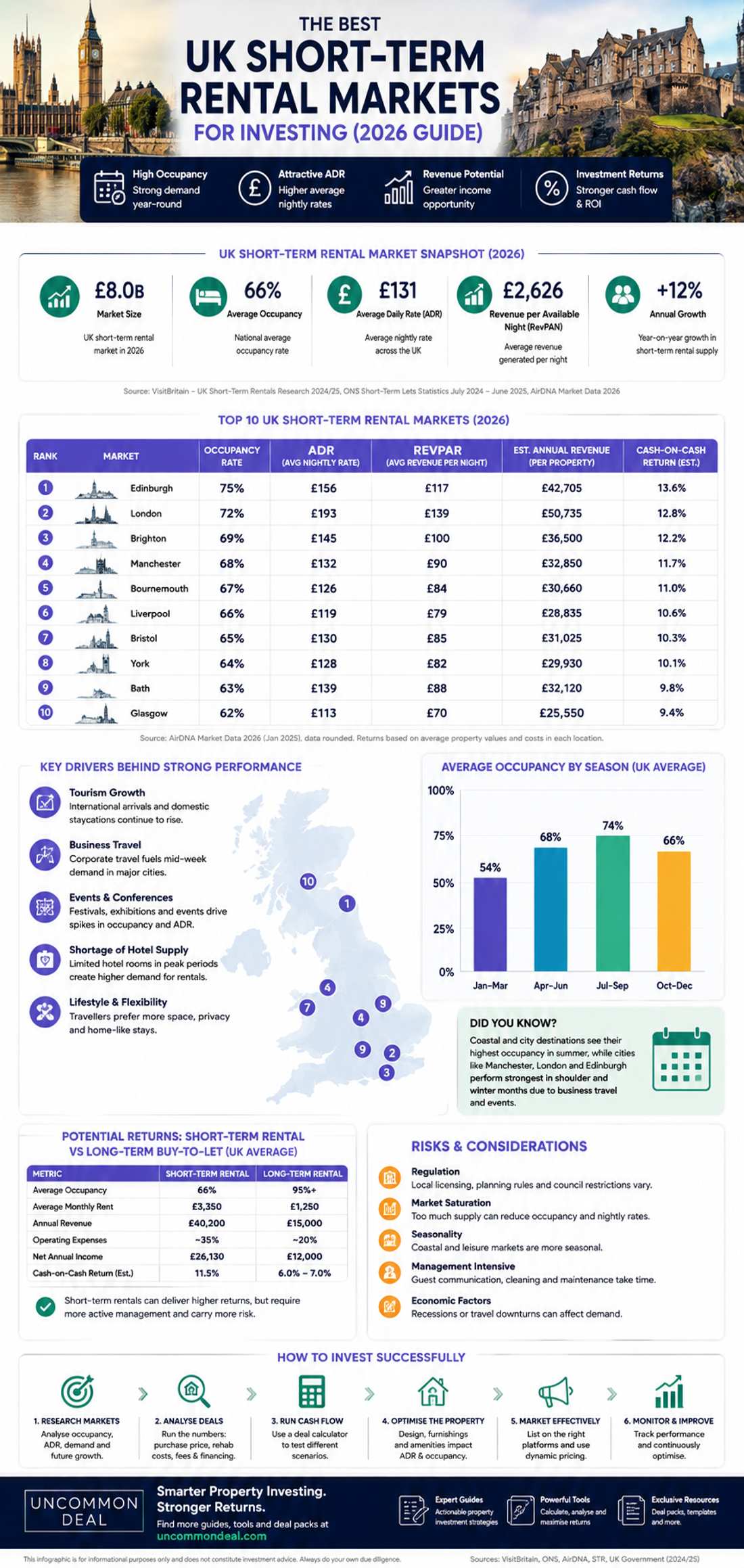
UK short-term rental markets infographic showing occupancy rates, ADR, revenue potential, top investment cities, risks, and buy-to-let comparison for 2026.
Final Verdict
There is no single “best” short-term rental markets for every investor. The right market will depend on your budget, investment objectives, risk tolerance, and preferred level of involvement. Some investors may prioritise maximum revenue potential, while others may focus on affordability, cash flow, or long-term portfolio growth.
Based on the combination of occupancy rates, average daily rates (ADR), annual revenue potential, demand diversification, and overall investment attractiveness, our rankings for 2026 are:
Our Top UK Short-Term Rental Markets for 2026
- Edinburgh
- Cambridge
- Bath
- Manchester
- Liverpool
- Bristol
Edinburgh takes the top position due to its exceptional combination of tourism demand, major events, business travel, and consistently strong occupancy levels. Cambridge follows closely behind, benefiting from year-round demand generated by its universities, research sector, corporate activity, and international visitors.
Bath remains one of the UK’s strongest premium markets, supported by high nightly rates and a well-established tourism sector. Manchester continues to perform well thanks to its diverse economy, business travel demand, sporting events, and entertainment sector.
Liverpool stands out as one of the most attractive markets for investors seeking affordability and strong cash-on-cash return potential. Meanwhile, Bristol benefits from a healthy mix of corporate demand, technology-sector growth, and tourism activity.
For investors seeking the strongest combination of occupancy, nightly rates, and year-round demand, Edinburgh, Cambridge, and Bath remain market leaders. However, investors focused on affordability and cash-on-cash returns may find Manchester and Liverpool offer a more accessible route into the short-term rental sector.
Ultimately, successful short-term rental investing is not simply about choosing the highest-ranked city. Investors should carefully evaluate local demand drivers, property acquisition costs, operating expenses, regulatory requirements, and projected returns before committing capital. The strongest opportunities are often found where market fundamentals, affordability, and operational execution come together to create sustainable long-term returns.
Frequently Asked Questions
What are the best short-term rental markets in the UK?
Some of the best short-term rental markets in the UK include Edinburgh, Cambridge, Bath, Manchester, Liverpool, and Bristol. These locations benefit from strong occupancy rates, year-round demand, and attractive revenue potential driven by tourism, business travel, universities, and major events.
Which UK city generates the highest short-term rental revenue?
Edinburgh and Bath are among the highest-performing UK short-term rental markets, with many properties capable of generating annual revenues exceeding £45,000. However, investors should also consider property prices, operating costs, and local regulations when assessing overall profitability.
Is short-term rental more profitable than buy-to-let?
Short-term rentals can generate higher income than traditional buy-to-let properties, particularly in markets with strong tourism and business travel demand. However, they also involve higher operating costs, greater management requirements, and potentially more regulatory restrictions.
What occupancy rate is considered good for a short-term rental?
Many successful UK short-term rental properties achieve occupancy rates between 55% and 75%, depending on location and demand. Properties in high-performing markets with multiple demand drivers often achieve higher occupancy levels throughout the year.
Are short-term rentals legal in the UK?
Yes, short-term rentals are generally legal in the UK, but regulations vary by location. Investors should be aware of restrictions such as London’s 90-day rule, Scotland’s licensing requirements, and any local authority regulations that may apply to their property.
What is more important: occupancy or nightly rates?
Both metrics are important, but occupancy and nightly rates should be considered together. A property charging lower nightly rates but achieving consistently high occupancy may generate more annual revenue than a property with premium pricing but frequent vacancies.
How do I analyse a short-term rental investment?
Investors should evaluate occupancy rates, average daily rates (ADR), annual revenue potential, operating expenses, financing costs, local regulations, and cash-on-cash returns. Analysing these factors together provides a more accurate picture of a property’s investment potential.

Koye Beckley is a UK property investor and founder of UncommonDeal, with practical experience in buy-to-let, property auctions, refurbishment projects and investment deal analysis. Through UncommonDeal, he publishes property market research, property deal sourcing and compliance guidance, investment guides and data-driven analysis to help investors evaluate buy-to-let, BRRR, flip and auction opportunities.