Bridging Finance vs Cash Buyer: Which Finanacial Tool is Better to Complete a Deal?
In today’s UK property market, choosing between Bridging Finance and cash buyers can determine whether a deal completes or falls apart. Each funding route offers different advantages depending on speed, risk, and strategy.
In fact, property deals don’t fail because buyers lack enthusiasm.
They fail because the funding choice doesn’t match the deal.
In the UK market today, two funding routes dominate serious transactions:
- Buying as a cash buyer
- Buying with bridging finance
Both can work brilliantly.
Both can quietly destroy returns if used for the wrong reasons.
This article rewrites and expands the discussion with real numerical case studies, plain language explanations, and practical insight drawn from how deals actually complete in the UK. It’s written for clarity, not hype, and designed to be readable for Grade 7–8, while still being detailed enough for experienced buyers.
By the end, you’ll clearly understand:
- When cash is genuinely the best option
- When bridging finance creates better outcomes
- How numbers change the answer
- How experienced buyers choose between the two
Why the Funding Choice Matters More Than the Property Itself
Most buyers obsess over:
- Purchase price
- Location
- Potential value
But funding controls:
- Speed
- Risk
- Profit
- Stress
Two identical properties can produce very different outcomes depending on how they are funded.
This is why funding is no longer a background detail.
It’s a core strategic decision.
This is why many serious buyers now rely on structured property deal analysis to test assumptions, stress-test numbers, and reduce costly mistakes before committing.
What Does “Cash Buyer” Really Mean?
A cash buyer is someone who:
- Does not rely on mortgage approval
- Can complete without lender conditions
- Has funds immediately available
Cash might come from:
- Personal savings
- Business funds
- Investor capital already raised
- Proceeds from a previous sale
The real advantage of cash is certainty, not price.
What Is Bridging Finance (In Simple Terms)?
Bridging finance is short-term property funding designed to:
- Complete quickly
- Solve timing problems
- Buy properties mortgages won’t touch
Typical terms:
- Loan length: 3–18 months
- Interest: charged monthly
- Exit: sale or refinance
Bridging is not “expensive money” by default.
It’s purpose-built money.
Speed — Who Really Completes Faster?
Cash Buyer Speed
- No lender approval
- No valuation delays
- Fewer legal hurdles
But cash buyers can still be slow if:
- Funds are spread across accounts
- Investors must approve releases
- Capital is tied up elsewhere
Bridging Finance Speed
- Decisions in days
- Completion in 7–28 days
- Ideal for auctions and distressed sellers
In practice, many deals complete faster with bridging than with disorganised cash.
This is where auction property due diligence becomes essential, helping buyers review legal packs, funding risks, and completion deadlines before bidding.
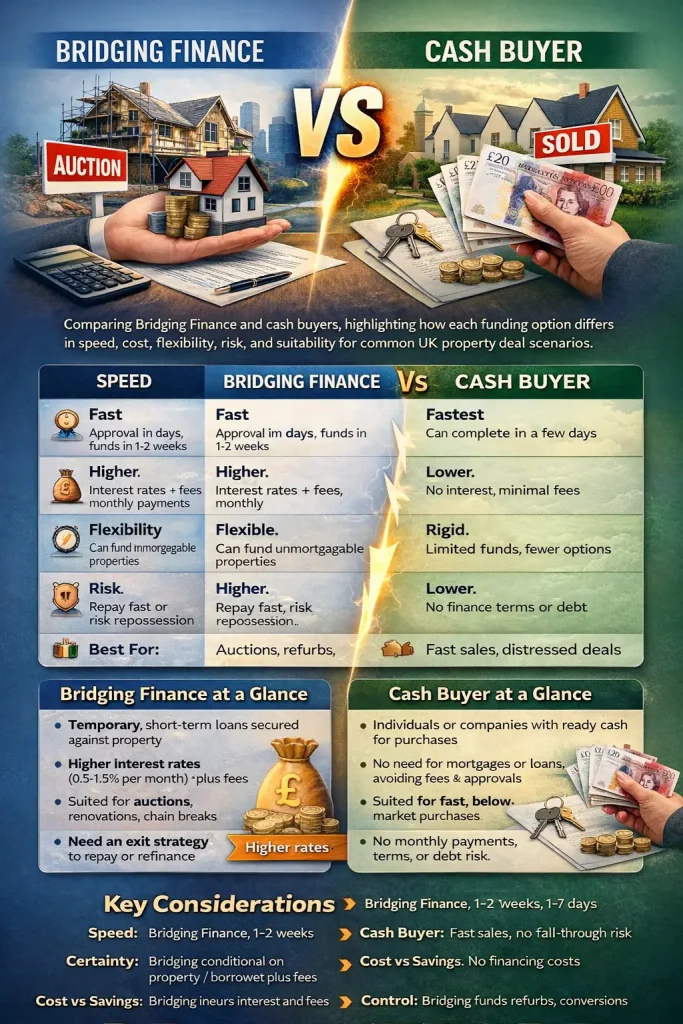
Bridging Finance vs Cash Buyers: Quick Comparison
The table below compares Bridging Finance and cash buyers across speed, cost, flexibility, and risk in UK property transactions. It helps buyers quickly see which funding option suits auctions, refurb projects, and time-sensitive deals.
| Feature | Bridging Finance | Cash Buyers |
|---|---|---|
| Speed to Complete | Very fast (7–28 days typical) | Fast if funds are readily available |
| Upfront Capital Required | Lower (deposit + fees) | High (full purchase price) |
| Interest Costs | Yes (monthly interest applies) | No interest costs |
| Flexibility | High – suits complex or unmortgageable deals | Medium – limited once capital is tied up |
| Auction Friendly | Yes – widely used for auctions | Yes – ideal for certainty |
| Refurb Projects | Well suited, often preferred | Suitable but capital intensive |
| Risk Level | Higher if exit delays | Lower financial pressure |
| Capital Efficiency | High – capital can be recycled | Low – capital fully tied up |
| Scalability | Better for portfolio growth | Slower portfolio growth |
| Best For | Value-add, auctions, BRRR strategies | Simple, low-risk purchases |
Case Study 1 — Auction Purchase (£180,000 Guide Price)
Scenario
- 3-bed terraced house
- Auction purchase
- Light refurbishment required
- Comparable value after works: £230,000
Option A: Cash Buyer
Purchase price: £185,000
Stamp duty: £6,050
Legal & auction fees: £3,000
Refurbishment: £15,000
Total cash invested = £209,050
Resale value (after 6 months): £230,000
Selling costs: £4,500
Net sale proceeds: £225,500
Profit = £16,450
Return on capital = 7.9% over 6 months
Low stress. Simple.
But capital is fully tied up.
Option B: Bridging Finance
Purchase price: £185,000
Loan at 75% LTV: £138,750
Cash deposit: £46,250
Interest (0.9% per month for 6 months): £7,500
Fees & legals: £5,000
Refurbishment: £15,000
Total cash invested = £73,750
Sale proceeds (after costs): £225,500
Loan repayment: £146,250
Net cash back: £79,250
Profit = £5,500
Lower absolute profit — but:
Return on capital = 7.5% in 6 months
The key difference?
Over £130,000 of capital stayed free.
Why Capital Efficiency Changes Everything
Cash looks better when you only look at profit.
Bridging looks better when you look at capital velocity.
If the bridged buyer repeats this deal three times a year, the annual return can exceed the cash buyer — despite higher costs.
Case Study 2 — Heavy Refurb Buy-to-Let (BRRR)
Scenario
- Purchase price: £140,000
- Unmortgageable condition
- Refurb cost: £40,000
- End value: £230,000
Cash Buyer Route
Total investment:
- Purchase: £140,000
- Refurb: £40,000
- Costs: £10,000
Total: £190,000 cash in
Refinance at 75% LTV: £172,500
Cash left in deal: £17,500
Strong outcome — but required £190k upfront.
Bridging Route
Loan: 75% of purchase = £105,000
Deposit: £35,000
Refurb funded from cash: £40,000
Interest & fees: £12,000
Total cash in: £87,000
Refinance at 75% LTV (£230k): £172,500
Loan repaid: £117,000
Cash released: £55,500
Bridging enabled:
- Lower upfront cash
- Full recycle of capital
- Same end result
This is why BRRR strategies rely heavily on bridging.
Risk — Where Each Option Can Go Wrong
Cash Buyer Risks
- Overpaying due to confidence
- Capital stuck longer than expected
- Poor returns hidden by “safety”
Bridging Finance Risks
- Delayed exit
- Rising costs
- Valuation shortfalls
Bridging doesn’t create risk.
It exposes weak assumptions.
When timelines shift or costs rise, making a clear hold vs sell decision can protect capital and prevent small issues from turning into major losses.
For impartial government-backed guidance on responsible borrowing and short-term finance considerations, visit MoneyHelper’s official money advice hub.
Case Study 3 — When Bridging Goes Wrong
Expected sale: £300,000
Actual sale: £275,000
Delay: 4 months
Extra interest: £9,600
Profit wiped out: Yes
The deal failed not because of bridging — but because:
- Exit value wasn’t stress-tested
- Time buffer was unrealistic
Cash buyers make the same mistake — they just feel it later.
If you want to understand how these numbers are pulled together in practice, you can see what a full deal analysis looks like before making your own decision.
Auctions — Where Funding Choice Is Decisive
Auction deadlines:
- 10% deposit immediately
- Completion in 28 days
Most auction properties:
- Need work
- Have legal complications
- Don’t qualify for mortgages
This makes cash and bridging the only realistic tools.
Experienced auction buyers often:
- Use bridging to complete
- Refinance or sell later
Cash is certainty.
Bridging is flexibility.
Psychological Differences (Often Overlooked)
Cash Buyers
- Feel relaxed
- Move slower
- Sometimes accept weaker deals
Bridging Users
- Monitor costs closely
- Plan exits carefully
- Act decisively
The funding method shapes behaviour — not just numbers.
Which Is “Better”? The Honest Answer
There is no universal winner.
Cash Is Better When:
- Capital is abundant
- Deal margins are strong
- Speed without leverage is enough
Bridging Is Better When:
- Speed creates opportunity
- Value can be added
- Capital needs to stretch further
Professionals don’t argue about which is better.
They ask which fits this deal.
How Smart Buyers Decide
They ask:
- What’s the realistic exit value?
- What if it takes 3 months longer?
- What if costs rise 10%?
- What capital do I want tied up?
If the deal survives those questions, the funding choice becomes obvious.
Final Thoughts — Funding Is a Tool, Not an Identity
Cash buyers aren’t conservative.
Bridging users aren’t reckless.
Both succeed — or fail — for the same reason:
decision quality.
The smartest investors:
- Analyse first
- Stress-test assumptions
- Choose funding last
Because no funding method can rescue a bad deal —
but the right funding can unlock a good one.
In Summary
- Cash buying offers certainty and simplicity
- Bridging finance offers speed and leverage
- Cash ties up capital but reduces pressure
- Bridging costs more but improves scalability
- Case studies show capital efficiency often favours bridging
- The best choice depends on strategy, risk, and timing

Koye Beckley is a UK property investor and founder of UncommonDeal, with practical experience in buy-to-let, property auctions, refurbishment projects and investment deal analysis. Through UncommonDeal, he publishes property market research, property deal sourcing and compliance guidance, investment guides and data-driven analysis to help investors evaluate buy-to-let, BRRR, flip and auction opportunities.
