
BRRR Property Deal Sourcing UK: Finding Refinance Headroom
If you’re doing BRRR in the UK, you already know the truth:
Buying a “cheap” property isn’t the win.
The win is buying a property that gives you refinance headroom after refurb. That is, enough uplift to pull money back out, reduce cash left in, and recycle into the next deal.
And that’s exactly why most BRRR deals fail.
They look good on the surface… but once you factor in valuation reality, lender criteria, and the true end value after works, the “headroom” disappears.
This strategy only works when buy-to-let refinancing rules around valuation, stress tests, and timing are properly accounted for.
This guide shows you how to source real BRRR deals in the UK, using a simple numbers-first method that prioritises valuation uplift and refinance ability over hype.
If you want the full BRRR framework first (Buy, Refurb, Rent, Refinance), read the BRRR strategy guide before using this headroom model.
What “Refinance Headroom” Actually Means (In Plain English)
Refinance headroom is the gap between:
What the property will be worth after refurb and your total money in; that is to say, the total purchase price, the cost of work done, and all other costs associated to the said property.
When that gap is big enough, you can refinance at a decent LTV and recover most (or sometimes all) of your cash.
The headroom exists only if the valuation supports it.
Not your spreadsheet. Not the estate agent. Not the sourcer’s “GDV estimate”.
Only the valuer decides.
The BRRR Sweet Spot: Your Goal Is Not “Free Houses”
Most UK BRRR deals don’t leave you with “no money in” and that’s normal. The real win is buying with enough refinance headroom to recover most of your cash, while keeping the rental strong enough to hold long-term. If the deal works only when everything goes perfectly, it isn’t a BRRR strategy; it’s a gamble.
Online, BRRR is often sold like this:
“Buy a property, refurb it, refinance it, and repeat with none of your money left in.”
In real UK investing, the more realistic aim is:
✅ Leave as little money in as possible
✅ Maintain strong rental coverage
✅ Avoid valuation surprises
✅ Build a repeatable pipeline
Even a deal where you leave £10k–£25k in can be an excellent BRRR, al long as it’s stable, has cashflows, and scales.
The 3 Types of BRRR Deals (Only 1 Is Reliable)
Not all BRRR deals are equal. In fact, most fail because the “uplift” exists only on paper. In the UK, the only reliable BRRR is where you create measurable value and the end value is supported by sold comparables. If your refinance headroom depends on market growth or optimistic GDV, it’s not a strategy, it’s hope.
Below are three types of BRRR deals to consider:
1) True “Add Value” BRRR (Best)
This is the most reliable UK BRRR because the uplift comes from real improvements, not market hype. You buy a property with obvious issues, refurb it to a higher comparable standard, and the valuation rises based on sold evidence. If the value increase is measurable and lender-friendly, the refinance headroom is real.
This is where you create value through:
- layout improvements
- modernisation
- EPC uplift
- adding bedrooms
- solving functional issues
You’re improving the property to meet local demand and valuation comparables. This BRRR is most repeatable, lender-friendly, and most sustainable
2) Market Uplift BRRR (Risky)
Market uplift BRRR only works if prices rise while you’re holding the property. In the UK, that’s unreliable because valuers refinance based on sold comparables today, not where you hope the market will be next year. If the numbers don’t work without growth, it’s not BRRR headroom. This is speculation.
In essence, the numbers only work if:
- the market rises
- demand increases
- prices “trend up”
The refurb improves the property slightly, but the uplift is mostly market movement. This will works in hot markets, but fails in flat markets
3) Spreadsheet BRRR (Worst)
Spreadsheet BRRR is where the refinance “uplift” exists only in your calculator, not in the valuer’s evidence. It usually depends on optimistic GDV, asking-price comps, and underpriced refurb assumptions. When the valuation comes in low, the headroom disappears and your cash gets trapped.
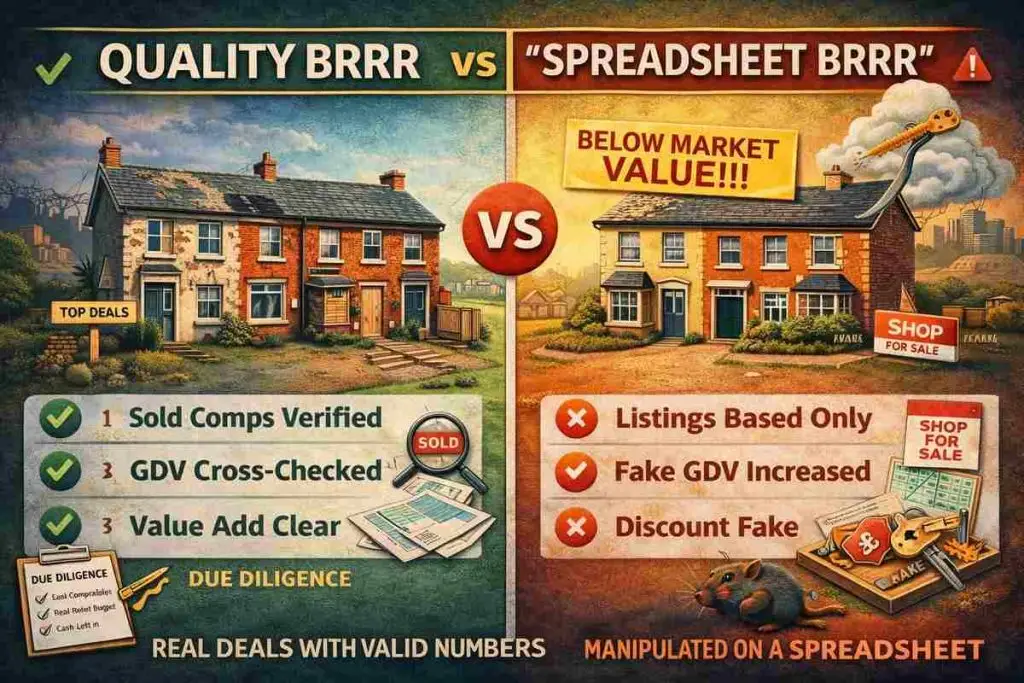
This is where the “uplift” comes from fantasy:
- unrealistic GDV
- “it’ll be worth £220k after £20k refurb”
- using asking prices as comps
- ignoring the valuer’s logic
This is how people get stuck, overexposed, and cash-trapped. Sophisticated investors always avoid this completely; you too should.
If you want to sanity-check a BRRR quickly, run it through our deal stack-up calculator before you go deeper.
What Makes a Property Have Refinance Headroom?
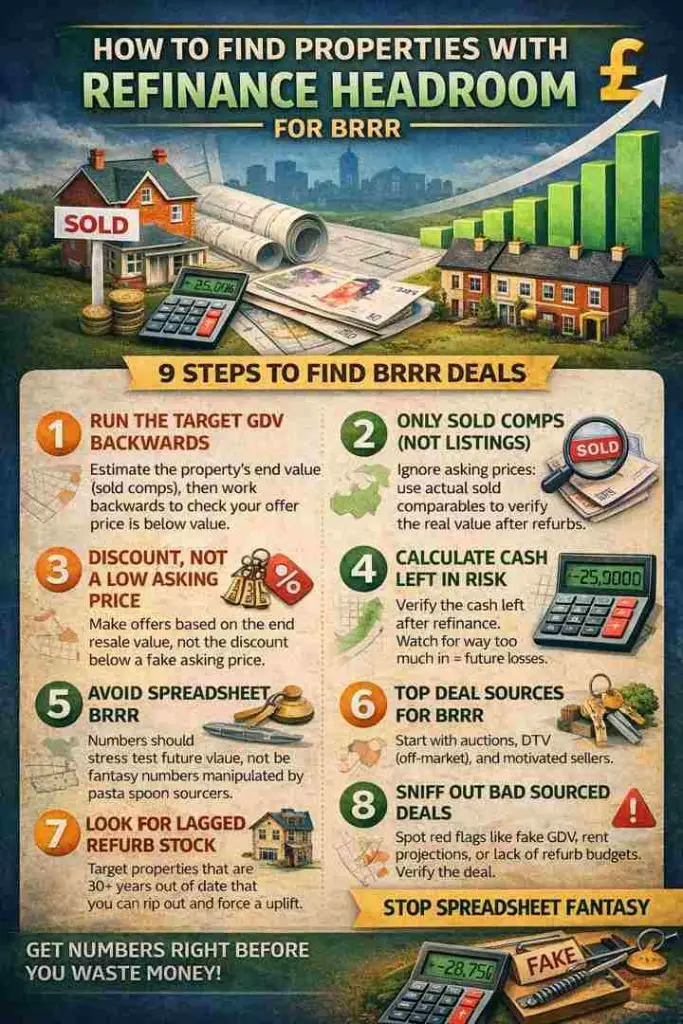
Refinance headroom comes from one thing: a valuation gap between what you pay (plus costs) and what the property can be proven to be worth after works. In the UK, that uplift must be supported by sold comparables, not asking prices or “agent estimates”. If the end value isn’t defensible on evidence, the refinance will be conservative — and your cash stays trapped.
The most reliable headroom shows up when you buy at the right price and the refurb creates measurable, lender-friendly improvement. That means raising the property to the local “done” standard, improving layout or usability, and avoiding over-spec finishes the street won’t pay for. A real BRRR deal works even if the valuation comes in slightly low, because the buffer was built in from day one.
Here’s the truth:
Refinance headroom comes from a valuation gap.
That gap is created when you buy at the right price and/or create the right uplift.
There are only a few ways headroom shows up reliably:
1) You buy below true local market value (not just “cheap”)
A property can be “cheap” and still be full price for its condition. Buying below true market value means you’re purchasing at a discount against sold comparables for similar stock, not just a low asking price. That initial gap is the first layer of refinance headroom.
Refinance headroom appears when you buy:
- motivated seller
- tired landlord exit
- probate sale
- auction mispricing
- structural stigma (that you can fix)
- poor presentation
2) The refurb creates a clear valuation uplift
A real BRRR refurb increases value because it changes the property’s comparable category from “tired” to “done”. Valuers pay for functional upgrades like modern kitchens/bathrooms, improved layout, EPC uplift, and an extra legitimate bedroom. Cosmetic spend that doesn’t change market position rarely creates dependable refinance headroom.
To summarise the above, valuers pay for:
- modern kitchens/bathrooms
- improved functionality
- better layout
- additional bedroom (where it’s legitimate)
- high-quality finish consistent with the area
On the other hand, valuers don’t pay much for:
- fancy design choices
- costly “premium” finishes in a basic street
- cosmetic overkill
3) The end value is supported by SOLD comparables (not listings)
UK valuers refinance off sold evidence, not what similar homes are listed for. Your end value should be backed by recent sold prices for the same property type, bedroom count, and finish level within the local area. If you can’t prove the GDV with sold comps, you can’t rely on refinance headroom.
The strongest BRRR deals are supported by:
- sold prices (Land Registry / Rightmove sold)
- within 0.5 miles (ideally)
- similar bed count + house type
- similar condition after works
If you can’t find good sold comps, your “GDV” is basically guesswork.
If you’re buying through a sourcer, you’ll want a proper due diligence checklist for verifying sourced deals before you trust any GDV.
For accuracy on property sold price, always anchor GDV using HM Land Registry sold price data, not asking prices.
The BRRR Deal Sourcing Rule: Start With The End Value First
In UK BRRR, you don’t source from the purchase price, you source from the end value. Start by proving the after-works value with sold comparables, then work backwards to your maximum buy price to protect refinance headroom. This one shift eliminates most dead deals before you waste time on them.
Most beginners source backwards:
cheap property → estimate refurb → guess value → hope refinance works
Do BRRR properly and source like this instead:
local end value → rental demand → lender criteria → purchase price target
This stops you wasting hours on deals that could never refinance.
This is the same logic we use to help investors spot a real discount (not just a low asking price).
The BRRR Headroom Calculator (Simple Version)
Refinance headroom is simply the gap between your all-in cost and what you can realistically pull out on refinance. If the refinance doesn’t return most of your capital, the deal becomes harder to repeat and scale. This calculator keeps it brutally simple so you can filter deals fast.
This calculation is based on: All-in Cost vs Refinance Amount (End Value × LTV), using sold comparable evidence for the end value.
Here’s the quick math:
Step 1: Estimate your “All In” cost
All In Cost = Purchase Price + Refurb + Buying Costs + Finance Costs
Buying costs include:
- SDLT
- solicitor
- broker fees
- surveys
- insurance
- utilities
- contingency
Finance costs include:
- bridging interest (if used)
- lender fees
- valuation fees
Step 2: Estimate your refinance value (end value)
The end value is based on recent sold comparables, not asking prices, and reflects the property’s finished condition after refurb. Comparable sales are from the same local area and are genuinely like-for-like in size, type, and bedroom count. A small buffer is included because UK valuers often lean conservative on refinance valuations.
This must be supported by sold comps.
Step 3: Work out what you can pull out on refinance
This is where BRRR becomes real: how much will a lender actually lend against the new value? Your refinance amount is based on the valuer’s end value and the lender’s LTV, not your purchase price or your refurb spend. If this number doesn’t return most of your capital, your “headroom” is weaker than it looks.
Refinance Amount = End Value × LTV
Typical BRRR refinance LTVs in the UK:
- 75% is common
- 80% exists but is more limited
- some lenders are conservative on heavy refurb history
Step 4: Work out your cash left in
Cash left in is the number that tells you whether BRRR is truly repeatable. It’s your total money in minus what you pull out on refinance, and the smaller it is, the faster you can recycle capital into the next deal. If this figure is high, you haven’t found headroom, you’ve found a capital-heavy buy-to-let.
Cash Left In = All In Cost – Refinance Amount.
The smaller this number, the better your headroom.
If you want this done automatically with stress tests, use the property deal analyser and compare refinance outcomes side-by-side.
Example: A Realistic UK BRRR Deal With Headroom
Assumptions: The end value is supported by recent sold comparables for similar refurbished properties in the same local area. The refinance is based on a standard UK buy-to-let product at 75% LTV, with typical purchase and finance costs included. The property is lender-friendly on completion and achieves market rent without needing optimistic assumptions.
Purchase: £120,000
Refurb: £25,000
Buying & finance costs: £10,000
All In Cost = £155,000
End Value after works: £200,000
Refinance at 75% LTV: £150,000
Cash Left In = £155,000 – £150,000 = £5,000
That is refinance headroom.
This is how BRRR becomes repeatable.
This is the easiest place to avoid future headaches: run the rental red flags before you buy so you don’t inherit problems that tenants will not tolerate.
Example: A “Fake BRRR” That Traps Investors
Assumptions: The end value is realistic and backed by sold comparables, but the purchase price is too close to full market value for the starting condition. Refinance is modelled at 75% LTV, using a lender’s valuation rather than optimistic estimates. Total costs include SDLT, legal fees, bridging interest/fees, and a sensible contingency — showing why cash gets trapped.
Purchase: £145,000
Refurb: £25,000
Buying & finance costs: £10,000
All In Cost = £180,000
End Value after works: £205,000
Refinance at 75% LTV: £153,750
Cash Left In = £180,000 – £153,750 = £26,250
That’s not necessarily a bad deal — but it’s no longer a “recycle your money fast” BRRR.
It becomes a capital-heavy BTL.
This is exactly how investors get burned. Here are the biggest deal sourcing traps in UK property.
The 7 Deal Sources That Produce Real BRRR Headroom (UK)
The best BRRR deals in the UK don’t usually come from “perfect” listings, they come from situations where price is misaligned with reality. Real refinance headroom shows up when you can buy below true local value, then upgrade the property to a proven sold-comparable standard. That’s why the strongest sources tend to be motivated sellers, tired stock, and channels where normal buyers get scared off.
In practice, the highest-headroom deals come from auctions (filtered properly), landlord exits, probate sales, poor presentation listings, and direct-to-vendor pipelines. These channels consistently create either a purchase discount, a value-add opportunity, or both. The common thread is simple: you’re not chasing cheap properties, you’re hunting valuation gaps you can prove.
Not all sourcing channels are equal. If you want a full breakdown of the best channels, see our UK deal sourcing guide.
If your goal is refinance headroom, these are the best places to hunt:
1) Auction Packs (If you know how to filter)
Auctions produce discounted purchases when:
- the lot is mispriced
- it has stigma or legal friction
- the condition scares normal buyers
But auctions punish lazy investors.
You must factor:
- completion timeline
- legal pack issues
- title defects
- special conditions
Sourced deal through auctions are great for headroom, but dangerous if you guess.
2) Tired Landlords Exiting
A tired landlords exiting is a seller who’s mentally and financially done with the property; often after years of repairs, voids, arrears, or compliance pressure. They usually prioritise speed, certainty, and a clean sale over squeezing out the last £5k–£10k, which is why real purchase discounts appear.
Assumption: you can negotiate below true local market value and still support the end valuation with sold comparables after refurb, creating refinance headroom.
These sellers often accept:
- speedy completion.
- reliability and assurance.
- convenience.
You find these via:
- agent conversations
- direct-to-vendor letters
- landlords in your network
3) Probate / Inherited Properties
A probate / inherited property is often sold for closure rather than maximum price, especially when it’s dated, empty, or needs clearing. This creates a frequent BRRR opportunity because the value-add is straightforward: modernise to the local “done” standard and anchor the uplift to sold comparables.
Assumption: the purchase price reflects the tired condition, and the post-refurb end value is supported by recent like-for-like sales, allowing a lender-friendly refinance.
Often:
- dated condition
- cleared quickly
- family wants closure not drama
The property is usually “fine”… just old.
This is perfect BRRR material.
4) Poor Presentation Listings
A poor presentation listing is a property that’s undervalued because the marketing is weak — bad photos, messy rooms, unclear layouts, or zero effort in the advert. These deals can create refinance headroom because you’re often buying at a discount caused by perception, then refurbing to match strong sold comparables nearby.
Assumption: the discount is real (not hiding structural/legal issues) and the post-works finish aligns with the local valuation “ceiling” for that property type.
The easiest undervalued deals are simply:
- badly photographed
- messy
- unloved
The market undervalues what it can’t visualise.
Most sophisticated property investors and professional deal sourcers always look out for these poor presentation listings.
5) Slightly “Ugly” Properties In Strong Streets
A bad house in a good street is ideal.
A good house in a weak street limits end value.
6) Vendor Motivation and Timing
Sometimes the deal is the seller’s situation:
- divorce
- relocation
- arrears
- chain pressure
Motivation creates the discount.
7) Direct-to-Vendor (If you do it consistently)
Direct-to-vendor works when:
- you build a pipeline
- you follow up
- you sound professional
- you don’t pitch nonsense
It’s a system, not a one-off.
BRRR Deal Filters: What to Reject Immediately
If you want refinance headroom, skip these quickly:
🚫 “No comps exist but it’ll be worth more”
Valuers need evidence.
If comps are weak, your GDV is weak.
🚫 “The rent is great so it’s a BRRR”
Rental performance matters, but BRRR requires refinance logic first.
🚫 “It’s a discount because it’s cheap”
Cheap doesn’t mean below value.
🚫 Heavy refurb + niche property
If the end product is “unique”, lenders and valuers become conservative.
🚫 Over-refurb in a basic area
You don’t get paid back for luxury finishes in low-value streets.
How to Build a BRRR Pipeline (20 Minutes a Day)
Building BRRR pipeline requires consistency more than brilliance. The headroom deals go to investors who keep showing up daily, not those who binge-source once a month. The assumption is you follow a simple routine that generates enough deal volume to compare options, reject weak numbers fast, and only pursue properties with provable end values. Over time, this compounds into a pipeline where every week you’re feeding your “refinance headroom” funnel with fresh leads.
If you want consistent deals, the secret is volume.
Here’s a simple daily system:
Daily (10–20 mins)
- Check uncommondeal already analysed deals (subscribe for deal updates)
- Check new listings (Rightmove, Zoopla, OnTheMarket)
- Watch reductions
- Save anything with “tired landlord” signs
- Track auctions weekly
Weekly (60 mins)
- call 3 agents
- ask for “tired stock that needs work”
- request “anything not listed yet”
Monthly
- review sold prices in your target streets
- refine your end value assumptions
BRRR sourcing is not about luck.
It’s about repetition.
The Valuation Reality Most Investors Ignore
Even if you do everything right, UK valuers can still be conservative.
Expect things like:
- they use the lowest strong comp
- they don’t fully reward your refurb
- they value to “typical” for the area, not “best in class”
- they downvalue if the street has mixed stock
That’s why the best BRRR investors build in:
- A buffer
- Downside scenario
- A second exit (flip or hold long-term)
BRRR Headroom Checklist (Quick Pass/Fail)
Before you pursue a deal, check:
✅ Strong sold comps support your end value
✅ You’re buying below “after-works potential”
✅ Works are value-adding, not cosmetic fluff
✅ Refinance at 75% LTV covers most of your money in
✅ Rental at market rate covers mortgage + safety margin
✅ Property will be lender-friendly on completion
✅ You can hold it long-term if refinance disappoints
If 3 of these are shaky, it’s not a BRRR deal — it’s a gamble.
Final Thought: BRRR Works perfectly Well If You Source For Headroom
The UK BRRR game isn’t dead.
But it has matured.
The winners are not the people who find “cheap houses”.
The winners are the people who:
- understand end value properly
- buy with a valuation buffer
- add real value through refurb
- refinance based on reality, not hope
If you can consistently find deals with refinance headroom, BRRR becomes repeatable.
And repeatable is where the money is.
Want Me to Stress-Test a BRRR Deal Before You Commit?
If you’ve got a BRRR deal you’re considering, I can help you test:
- realistic end value (based on comps)
- refinance headroom and cash left in
- rental coverage and downside risk
- whether the numbers still work if valuation comes in low
That’s exactly what UncommonDeal is built for: decision-grade deal analysis instead of guesswork.

Koye Beckley is a UK property investor and founder of UncommonDeal, with practical experience in buy-to-let, property auctions, refurbishment projects and investment deal analysis. Through UncommonDeal, he publishes property market research, property deal sourcing and compliance guidance, investment guides and data-driven analysis to help investors evaluate buy-to-let, BRRR, flip and auction opportunities.
