
How to Build a Deal Pipeline as a UK Property Investor
One of the biggest differences between successful UK property investors and those who struggle is the strength of their deal pipeline. A pipeline is a structured, predictable flow of property opportunities that arrive every week — allowing you to analyse, negotiate, and secure deals consistently.
Most beginners fail because they approach property investing randomly. They wait for “good deals” to appear on portals, and as a result, they never develop a repeatable system. Meanwhile, experienced investors operate like businesses. They rely on multiple lead sources, consistent routines, and data-driven analysis to stay ahead.
This in-depth guide shows you exactly how to build a deal pipeline that never runs dry, regardless of market conditions. Moreover, it helps you grow from occasional opportunities to a powerful, ongoing flow of profitable deals.
If you want consistent deal flow, you don’t need more websites or more scrolling – you need a simple repeatable system you can run every week.
Pipeline Quick Checklist:
- One sourcing channel (agents, auctions, direct-to-vendor)
- One repeatable filter (area, yield, refurb cap, exit margin)
- One viewing framework (red flags, works list, value drivers)
- One offer rule (walk-away cap and max bid logic)
- One follow-up habit (weekly calls, alerts, reminders)
What a deal pipeline actually is
A deal pipeline is the structured process an investor uses to move opportunities from first contact to final decision, without relying on guesswork or emotion.
It is not a list of properties, alerts, or deals “to look at later”. A real pipeline filters volume into quality by applying the same rules to every opportunity, regardless of where it comes from.
A strong deal pipeline does three things consistently: it captures leads, screens them quickly, and only promotes viable deals to deeper analysis. Everything else is rejected early.
This is what allows investors to review more opportunities without wasting time or capital.
Types of deal flow UK property investors rely on
Not all deal flow is equal. The source of a deal affects speed, pricing power, risk, and how much filtering you need to do before the numbers even matter.
A resilient deal pipeline usually combines more than one type of deal flow rather than relying on a single channel.
Inbound deal flow (opportunities come to you)
Inbound deal flow includes auction listings, online portals, property deal sourcers, agents, and mailing lists where deals are pushed to investors.
This type of flow is easy to access but highly competitive. Pricing is usually efficient, and weak deals are common, which means your edge comes from fast screening and disciplined filtering rather than negotiation.
Inbound deal flow works best when your analysis process is tight and repeatable.
Outbound deal flow (you go and find the deal)
Outbound deal flow is created by direct action. This includes agent follow-ups, direct-to-vendor letters, networking, referrer relationships, and proactive sourcing.
These deals take longer to surface but often come with better pricing and more flexibility. The effort is higher, but competition is lower, and deal terms are sometimes negotiable before they reach the open market.
Outbound deal flow is where systems and consistency create long-term advantage.
Paid deal flow (leveraging other people’s pipelines)
Paid deal flow includes sourcing companies, deal packagers, introducers, and subscription-based platforms.
This can save time, but it shifts risk rather than removing it. The key variable is not the deal itself, but the quality of the sourcing process behind it.
Paid deal flow only works when every opportunity is independently verified and fully underwritten.
Relationship-driven deal flow (the compounding layer)
Relationship-driven deal flow comes from brokers, agents, landlords, builders, and professionals who know what you buy and why.
These deals are rarely frequent, but they are often higher quality because they are pre-filtered by trust. Over time, this becomes one of the lowest-cost and highest-signal sources of opportunities.
This type of deal flow compounds with experience and credibility.
Why relying on one deal flow source is risky
Most investors struggle not because deals do not exist, but because their pipeline is fragile.
When one source dries up, deal flow stops. A strong pipeline is built by stacking multiple deal flow types and applying the same screening rules to all of them.
Consistency in process matters more than volume.
The table below compares the main types of deal flow UK property investors rely on, and where the real trade-offs sit.
| Deal flow type | Typical sources | Best for | Pros | Cons / risks | Competition level | Time & effort | Where your edge comes from |
|---|---|---|---|---|---|---|---|
| Inbound | Auctions, portals, agent lists, sourcer emails, alert services | High volume screening and fast decision-making | Easy access, consistent supply, quick to view and compare | Pricing often efficient, lots of weak deals, speed pressure can cause mistakes | High | Low to medium (screening is the workload) | A tight filter, fast underwriting, and the discipline to say no |
| Outbound | Agent follow-ups, direct-to-vendor, networking, canvassing, proactive calls | Creating pricing power and flexible terms | Lower competition, more negotiable, better chance of mispricing | Slower pipeline, requires consistency, lead quality varies | Medium to low | High (activity-driven) | Consistency, follow-up systems, and relationship building |
| Paid | Sourcing companies, deal packagers, introducers, subscription platforms | Time-saving when you can verify quickly | Convenience, quicker access to opportunities, outsourced lead generation | Quality depends on the sourcer, fees reduce margin, bias and incomplete info risk | Medium (varies) | Low to medium (verification becomes critical) | Independent due diligence and strict decision rules |
| Relationship-driven | Agents, brokers, landlords, builders, accountants, solicitors, repeat sellers | Higher-signal opportunities and long-term compounding | Pre-filtered leads, trust-based access, often higher quality | Slower at first, requires credibility, deal flow can be irregular | Low | Medium upfront, low ongoing once established | Reputation, clarity on buy-box, and being easy to transact with |
A deal pipeline only works when every lead, regardless of source, is screened the same way before time or money is committed.
Below is a visual infographic showing how serious UK property investors Reliable Deal Pipeline looks like:

SECTION 1 — What Is a Deal Pipeline and Why Does It Matter?
A deal pipeline is simply a continuous process of generating, analysing, and progressing property opportunities until a purchase is completed.
It typically includes:
- Lead generation
- Lead qualification
- Deal analysis
- Negotiation
- Due diligence
- Offer and acceptance
- Completion
Although it sounds simple, the secret lies in volume and consistency.
Why a pipeline matters:
✔ It reduces dependence on luck
Instead of hoping for deals, you create them.
✔ It exposes you to more opportunities
More leads = more chances to find one great property.
✔ It helps you negotiate stronger deals
Investors with multiple opportunities never chase a single seller — giving them leverage.
✔ It speeds up your portfolio growth
A reliable pipeline enables you to buy multiple properties in 12 months instead of waiting years between deals.
✔ It reduces emotional decision-making
A structured process prevents impulsive purchases that do not meet your criteria.
Transition: As you develop your pipeline, you’ll notice that deals start coming to you — not the other way around.
SECTION 2 — The 4 Stages of a High-Performing Deal Pipeline

To build a scalable pipeline, you must understand the four essential stages:
- Lead Generation (finding opportunities)
- Lead Qualification (filtering quickly)
- Analysis & Feasibility (checking numbers)
- Acquisition Process (moving deals to completion)
Each stage requires consistent habits and reliable tools.
Let’s explore them in detail.
SECTION 3 — Stage 1: Lead Generation — The Engine of Your Pipeline
Lead generation is the MOST important part of your investment pipeline. Without a steady flow of leads, you cannot analyse, negotiate, or buy.
A structured pipeline allows investors to move beyond raw listings and focus only on analysed property deals in the UK that have already been evaluated using realistic financial assumptions.
Below are the seven core lead sources used by UK property investors.
1. Online Portals (Rightmove, Zoopla, OTM)
Although public portals are competitive, they remain a valuable lead source when used effectively.
Tips for using portals strategically:
- Search “reduced” listings
- Filter by keywords (“needs modernisation”, “investment”, “cash buyers only”)
- Monitor listings over 60+ days
- Watch for price drops
- Save searches and activate email alerts
Note: You need to be deligent in your research.
2. Auctions
Auction houses are excellent for generating pipeline volume because they publish large catalogues every month.
Top auction houses:
- Allsop
- Barnard Marcus
- Sutton Kersh
- SDL
- Auction House UK
Why auctions boost your pipeline:
- High number of distressed properties
- Clear timelines
- Motivated sellers
- Opportunity for 15–30% discounts
- Great for BRR and flip strategies
As mentioned in an earlier posts, pairing auction sourcing with UncommonDeal’s analysis reports significantly reduces risk.
3. Estate Agent Relationships
Estate agents are arguably the most powerful lead source for investors. With the right relationships, you will receive:
- First look at new listings
- “Pocket listings” not online
- Price-reduced properties
- Chain-break opportunities
- Vendor motivation insights
Build relationships by:
- Calling weekly
- Viewing regularly
- Offering quickly
- Providing feedback
- Demonstrating professionalism
Transition: When agents trust you, your pipeline naturally fills with exclusive opportunities.
4. Deal Sourcers
Depending on your strategy, sourcers can dramatically increase lead flow. However, as explained in Article 4, you must qualify them properly.
Sourcers are useful when:
- You lack time
- You invest remotely
- You want off-market deals
- You need area specialists
Using sourcers in combination with your own lead sources provides pipeline diversity. A strong deal pipeline only works when it is built around the right property investment strategy for your capital, risk tolerance, and time horizon.
5. Direct-to-Vendor (DTV) Marketing
DTV is one of the strongest pipeline builders — especially for investors seeking off-market opportunities (Article 3).
Methods include:
- Leafleting
- Targeted letters
- Facebook ads
- Google PPC
- Probate lists
- Empty home lists
- Distressed landlord outreach
DTV produces fewer leads than portals, but a much higher conversion rate.
6. Investor + Networking Events
Deal flow often comes from:
- PIN meetings
- PPN events
- Local investor groups
- LinkedIn / WhatsApp property groups
- Landlord associations
Networking creates referral-based pipelines where other investors pass on deals that don’t fit their strategy.
7. Letting Agents and Builders
These underused sources can add a surprising number of quality leads.
Letting agents often know:
- Landlords selling privately
- Tenanted properties with arrears
- HMO owners struggling with compliance
Builders often know:
- Renovation properties
- Abandoned homes
- Landlords in distress
SECTION 4 — Stage 2: Lead Qualification — Filtering Good Deals From Bad Quickly
Generating leads is only half the battle. You must quickly filter out 80–90% of opportunities that don’t meet your criteria.
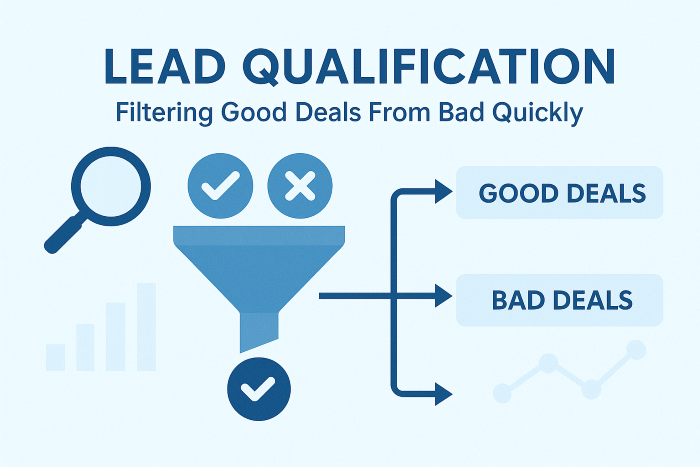
Qualification prevents you from wasting time.
Set Clear Deal Criteria
Define:
- Target areas
- Price range
- Property types
- Minimum yield
- Minimum ROI
- Maximum refurb budget
- Strategy (BTL, BRR, flips, HMO, SA)
When opportunities fall outside your criteria, discard them immediately.
Develop a 60-Second “Quick Analyse” System
Before deep analysis, ask:
- Does the area fit my strategy?
- Does the price compare well to local sold prices?
- Does the refurb seem manageable?
- Is there clear demand (rental or resale)?
- Does the opportunity seem realistic?
If no, move on.
If yes, proceed to full analysis.
Use Tools to Speed Up Filtering
Recommended:
- ONS local population/demand – https://www.ons.gov.uk
- Land Registry search – https://www.gov.uk/search-property-information-land-registry
These sources help validate the property quickly and accurately.
SECTION 5 — Stage 3: Full Deal Analysis — The Heart of the Pipeline
Once a property passes the quick filter, it enters the analysis phase.
As described in Unlocking Opportunities: The Ultimate Guide to UK Property Deals and some of our articles, a full analysis includes:
- GDV assessment
- Comparable sales review
- Renovation costing
- ROI and yield calculations
- Monthly cash flow
- Risk scoring
- Legal pack review (if auction)
- Strategy viability (BTL, BRR, flip)
- Maximum allowable offer (MAO)
Tip:
This is where UncommonDeal’s Property Investment Analysis Reports become your core tool.
Your analysis system dramatically increases:
- Speed
- Accuracy
- Professionalism
Moreover, it helps you avoid biased or inflated numbers often presented by sourcing agents or enthusiastic sellers.
SECTION 6 — Stage 4: Negotiation and Acquisition — Turning Deals Into Purchases
A deal pipeline is only effective when opportunities move forward toward completion. Therefore, negotiation is essential.
Below is the investor’s negotiation workflow.
1. Identify Motivation
Ask the seller or agent:
- Why are they selling?
- How fast do they want to complete?
- Are they facing delays or stress?
- Is the property difficult to mortgage or sell?
Motivation equals leverage.
2. Make Offers Quickly but Professionally
Successful investors don’t wait days. They analyse and offer within 24 hours.
Agents LOVE this.
Sellers appreciate it too.
3. Present Your Offer Clearly
Include:
- Price
- Proof of funds
- Solicitor details
- Timeline
- Rationale (comparables and refurb costs)
A clear and justified offer stands out from emotional or random offers.
4. Follow Up Consistently
Most investors never follow up. Experienced investors always do.
Follow up:
- 24 hours after offer
- 3 days later
- Weekly
- After price reductions
Deals often go to the investor who followed up at the right time.
5. Move Fast After Acceptance
Once accepted:
- Order valuation
- Confirm refurb budget
- Review legal pack
- Conduct due diligence
- Exchange swiftly
Speed matters because delays kill deals — especially off-market deals.
SECTION 7 — Pipeline Systems and Tools Every Investor Should Use
Although investors differ in style, they all rely on systems.
Here are the best tools and structures to keep your pipeline organised.
1. Deal Pipeline Spreadsheet or CRM
Track:
- New leads
- Status (New → Analysing → Offer → Negotiation → Accepted → Completed)
- Source (agent, auction, DTV, sourcer)
- Offer dates
- Follow-up schedule
You can use:
- Google Sheets
- Airtable
- Notion
- Real estate CRMs
- A custom-built system
2. Automated Alerts and Tracking
Enable alerts for:
- Price reductions
- New listings
- Auctions released
- Repossessions
- Probate properties
- Sales falling through
Automation reduces workload significantly.
3. Weekly Routine Checklist
Consistency beats intensity.
Create a weekly checklist:
- Review 50+ opportunities
- Analyse 5–10
- Make 2–3 offers
- Contact 5 agents
- Attend 1 viewing
- Follow up on offers
- Attend networking
When done consistently, this builds a powerful pipeline over time.
4. Monthly Review Process
Every month:
- Evaluate lead volume
- Identify best-performing sources
- Remove weak sources
- Strengthen high-performing ones
- Update your criteria
- Review finances
This optimisation keeps your pipeline efficient.
SECTION 8 — How to Scale Your Deal Pipeline (Beginner → Intermediate → Pro)
As your experience grows, your pipeline should evolve.
Beginner Level: Build the Foundation
Focus on:
- Agents
- Portals
- Auctions
- Early DTV tests
- Your first 1–2 deals
- Basic analysis workflow
See the quick guide on Where Profitable UK Property Deals Are Found in the UK.
Intermediate Level: Increase Volume
Add:
- Regular DTV campaigns
- Multiple agent relationships
- Networking groups
- 2–3 sourcers
- Better CRM system
- Faster analysis templates
Professional Level: Build a Machine
At this level:
- Deals come to you
- You receive off-market opportunities weekly
- Agents prioritise you
- Other investors send you deals
- You outsource parts of the pipeline
- You buy 4–12 properties per year
This is where UncommonDeal becomes a leverage tool, helping you analyse high volume quickly and professionally.

Koye Beckley is a UK property investor and founder of UncommonDeal, with practical experience in buy-to-let, property auctions, refurbishment projects and investment deal analysis. Through UncommonDeal, he publishes property market research, property deal sourcing and compliance guidance, investment guides and data-driven analysis to help investors evaluate buy-to-let, BRRR, flip and auction opportunities.
