
Buying Property at Auction in the UK: How It Really Works, the Risks, and Smarter Alternatives
Buying property at auction in the UK means purchasing a property through a competitive bidding process with immediate exchange of contracts, limited buyer protection, strict timelines, and higher legal and financial risk than most alternative buying routes.
Buying property at auction in the UK is often marketed as a fast way to secure bargains, but the reality is more complex. Auctions operate on speed, certainty, and legal finality, which means buyers take on significantly more risk than with most other purchasing routes. Once the hammer falls, you are legally committed, usually without the protections, surveys, or renegotiation options buyers expect elsewhere.
At a UK property auction, contracts are exchanged immediately and completion typically follows within 28 days. This structure suits experienced buyers with cash or specialist finance in place, but it exposes unprepared bidders to costly mistakes. Issues hidden in auction legal packs, short leases, title defects, unmortgageable construction, and aggressive buyer fees regularly turn apparent discounts into poor deals.
This is where many buyers go wrong. They focus on the guide price and ignore the underlying risks, misunderstand what auction legal packs actually say, or assume they can “sort things out later”. At auction, later rarely exists. Due diligence must be completed before bidding, not after.
Importantly, auctions are only one way to buy property in the UK. In many cases, off-market property deals and carefully negotiated purchases offer greater control, better risk management, and similar pricing without the pressure of the auction room. Understanding these alternative ways to buy property in the UK is often what separates disciplined investors from costly mistakes.
This guide explains how property auctions really work, the risks buyers consistently underestimate, how to read auction legal packs properly, and when smarter alternatives to auctions make more sense.
What Buying Property at Auction in the UK Actually Means
Buying a property at auction in the UK is not just “another way to buy” a house. It is a legal process built for speed and certainty. The key difference is commitment: in a traditional auction, once the hammer falls you have effectively exchanged contracts there and then. There is no cooling-off period, and you cannot later renegotiate because the survey was poor or the paperwork is messy.
How UK property auctions work from listing to completion
Most auction properties are marketed several weeks in advance through an auction catalogue, online listings, and scheduled viewing days. Alongside the marketing, the seller’s solicitor provides an auction legal pack, which typically includes title documents, searches, special conditions of sale, and lease information where relevant. This pack is not informational only. It forms part of the contract you agree to if you bid successfully.
Because of this structure, all due diligence must be completed before auction day. Buyers are expected to review the legal pack in full, raise enquiries where possible, understand title or lease issues, assess funding viability, and price risk into their maximum bid. There is no opportunity to renegotiate after the auction because defects discovered later are deemed to have been accepted.
If you are the winning bidder, you will usually be required to pay a deposit immediately, most commonly 10 percent of the purchase price, and sign the memorandum of sale on the day. This legally commits you to the purchase. Failure to complete can result in loss of the deposit and additional legal or seller costs.
Completion typically takes place within around 28 days, although some lots specify shorter or longer periods in the special conditions. These tight timelines are why auction purchases often rely on cash, bridging finance, or pre-arranged specialist funding. Standard residential and buy-to-let mortgages are frequently too slow or uncertain to meet auction deadlines without a robust back-up plan.
UK Property Auction Buying Timeline
1. Pre-Auction Marketing: Property listed in the auction catalogue with guide price, viewing access, and the legal pack released.
2. Due Diligence Before Bidding: Buyer reviews the legal pack, checks title and lease risks, confirms funding, and prices risk into the bid.
3. Auction Day:Bidding takes place. The highest bidder commits legally when the hammer falls.
4. Immediate Exchange: Buyer signs the memorandum of sale and pays a deposit, usually 10 percent, on the day.
5. Completion Period: Legal completion typically follows within around 28 days, subject to the special conditions of sale.
6. Completion or Default: Buyer completes and takes ownership, or risks losing the deposit and incurring further costs.
Key point: At auction, risk is front-loaded. By auction day, buyers are expected to understand and accept all known issues.
The difference between traditional auctions and the Modern Method of Auction
Traditional auctions exchange contracts immediately on the day. The Modern Method of Auction (MMoA) usually gives a longer window to exchange and complete, but it often comes with reservation fees and strict deadlines that still pressure buyers. MMoA can feel “safer” because you get more time, but it can be expensive if you fail to complete and may still leave limited room for negotiation once you have committed.
Who auctions are really designed for (and who they are not)
Auctions suit buyers who can act fast, read risk properly, and fund purchases without relying on slow processes. They work best for experienced investors, developers, and cash buyers with a clear plan. Auctions are usually a poor fit for first-time buyers or anyone depending on a standard mortgage without a back-up plan, because the timelines and legal finality punish hesitation and expose weak due diligence immediately.
Why Properties End Up at Auction
Properties rarely end up at auction by accident. In most cases, auction is chosen because it offers speed, certainty, and a forced sale outcome where other selling routes are slower, riskier, or unlikely to succeed. Understanding why a property is being sold this way is critical, because the reason often signals the type of risk a buyer is inheriting.
Repossessions, probate, and distressed sales
Auction is commonly used for repossessions, probate properties, and distressed sales where the seller needs a clean, time-bound exit. Lenders, executors, and administrators are typically motivated by certainty rather than price optimisation. This can create opportunities, but it also means properties are often sold with limited warranties, incomplete information, or minimal engagement with buyer enquiries. Buyers who fail to account for this often underestimate the importance of reviewing the auction legal pack properly before bidding.
Legal, title, or lease issues that limit mortgage buyers
Many auction properties are difficult or impossible to mortgage using standard residential or buy-to-let finance. Common examples include short leases, defective titles, restrictive covenants, absent landlords, or non-standard construction. Because mortgage buyers are filtered out, the seller is left with a smaller pool of cash or specialist buyers, making auction a practical route. The discount, where it exists, is usually compensation for these legal or structural complications.
Why “auction only†is often a red flag, not a bargain
When a property is marketed as “auction only”, it often signals that traditional buyers have already been excluded. This does not automatically mean the deal is bad, but it does mean risk is front-loaded. Sellers are effectively saying the property cannot withstand normal scrutiny or timelines. Smart buyers treat this as a prompt to dig deeper into the legal pack, funding viability, and exit strategy, rather than assuming the price alone justifies the risk.
Seller Motivation vs Buyer Risk at Auction
| Why the Seller Chose Auction | What It Often Means for the Buyer |
|---|---|
| Repossessed by a lender | Limited property knowledge, no warranties, higher chance of defects or neglect |
| Probate or estate sale | Incomplete records, outdated leases, unverified alterations or consents |
| Short lease or title complication | Restricted mortgage options, higher extension or legal costs |
| Previous sale fell through | Known issues already rejected by other buyers or lenders |
| Seller needs speed and certainty | Price reflects urgency, not necessarily value or deal quality |
| “Auction only” marketing | Traditional buyers excluded, risk transferred fully to the bidder |
Key insight: At auction, seller motivation explains speed. Buyer risk explains price.
The True Costs of Buying Property at Auction (Beyond the Hammer Price)
The hammer price is only the starting point. Many auction buyers focus on what they pay on the day and underestimate the total cost of completing the purchase. At auction, costs are front-loaded, timelines are compressed, and mistakes are expensive. Understanding the full cost picture before bidding is essential to avoid deals that look cheap but perform badly in reality, particularly when buyers fail to carry out proper auction due diligence before bidding.
Auction Cost Breakdown (Beyond the Hammer Price)
| Cost Category | What Buyers Often Miss | Why It Matters |
|---|---|---|
| Buyer’s premium / admin fees | Fixed, non-negotiable fees added by the auction house | Inflates true purchase price regardless of deal quality |
| Reservation fees (MMoA) | Often non-refundable if the deal fails | Creates downside risk even before exchange |
| Legal fees and searches | Fast-track conveyancing and extra enquiries | Higher upfront spend with limited time to resolve issues |
| Deposit at auction | Typically 10 percent paid immediately | At risk if completion deadlines are missed |
| Finance costs | Bridging interest, arrangement, and exit fees | Costs escalate quickly if refinance is delayed or fails |
| Penalty interest and default costs | Charged if completion deadlines are missed | Can turn a marginal deal into a loss |
| Holding and compliance costs | Council tax, insurance, safety works before refinance | Often ignored in auction underwriting |
Key takeaway: Auction risk is rarely in the price alone. It sits in the costs buyers underestimate or ignore.
Buyer’s premiums, administration fees, and hidden charges
In addition to the purchase price, auction buyers often pay a buyer’s premium, administration fee, or both. These fees vary by auction house and are usually non-negotiable. They can add thousands of pounds to the effective purchase price and are payable regardless of whether the property represents good value. In some auction formats, particularly the Modern Method of Auction, reservation fees can significantly inflate the true cost of acquisition and are often non-refundable if the deal fails. Buyers who do not understand these mechanics often misjudge whether an auction deal genuinely stacks up compared with alternative ways to buy property in the UK.
Legal fees, searches, and fast-track conveyancing costs
Auction conveyancing is accelerated. Buyers must instruct solicitors immediately and pay for searches, title checks, and legal work on a compressed timeline. Because the seller’s legal pack may be incomplete or limited in scope, buyers sometimes incur additional legal costs to clarify risks that would normally be resolved over a longer private treaty transaction. This is why experienced buyers prioritise reviewing the auction legal pack in detail before bidding, rather than relying on headline summaries or assumptions.
Financing reality: cash buyers, bridging loans, and failed exits
Most auction purchases cannot rely on standard residential or buy-to-let mortgages within the required timeframe. As a result, buyers often use cash or short-term finance such as bridging loans. While bridging can enable completion, it introduces higher interest rates, arrangement fees, and exit risk. If refinancing is delayed, down-valued, or declined, holding costs can escalate quickly and turn a marginal deal into a loss. Buyers who underestimate this risk often discover too late that the property is unmortgageable or difficult to refinance, locking them into expensive short-term funding.
Auction Legal Packs Explained (and Why Most Buyers Misread Them)
Auction legal packs are not background reading. They are the contractual foundation of the sale. Everything you agree to when bidding is set out in that pack, whether you have read it properly or not. Most buyer mistakes at auction stem from misunderstanding what the legal pack is, what it is not, and how much risk it quietly transfers to the buyer. This is why experienced buyers treat auction legal pack due diligence as a deal-critical step, not a box-ticking exercise.
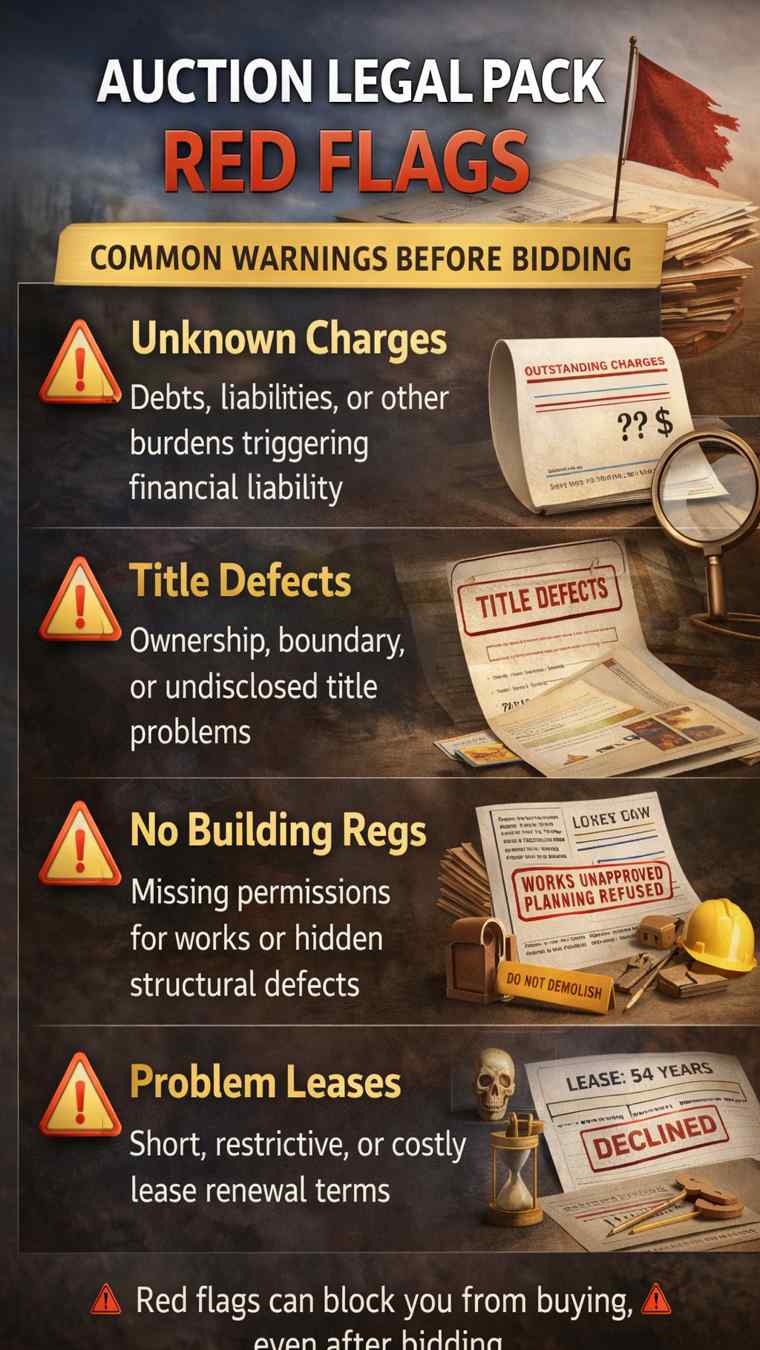
What an auction legal pack contains
A typical auction legal pack includes title documents, the contract of sale, special conditions, searches, and lease information where applicable. It may also include replies to enquiries, management information, and planning documents. Crucially, the pack is prepared by the seller’s solicitor, not for your protection, but to enable a fast and legally binding sale. Missing documents, limited searches, or seller-friendly wording are not errors. They are part of the structure and are explained in more depth in this full guide to UK auction legal packs.
Documents that matter vs documents buyers ignore
Buyers often skim the pack summary and overlook the documents that actually carry risk. The special conditions of auction sale frequently override standard contract terms and can introduce additional fees, shorter completion deadlines, or buyer liabilities. Title plans, lease clauses, rights of way, rent review provisions, and service charge obligations are often buried deeper in the pack and misunderstood or ignored entirely. These documents directly affect whether a property is mortgageable, rentable, or saleable, particularly where lease length or title issues are involved.
Common legal pack red flags that derail deals after exchange
Problematic legal packs often contain warning signs that buyers miss until it is too late. These include short or defective leases, unclear title boundaries, absent landlords, restrictive covenants, missing consents for alterations, or search gaps shifted onto the buyer. These issues regularly appear in short-lease auction properties and unmortgageable lots, where the apparent discount exists precisely because risk has been transferred to the bidder.
The key mistake buyers make is treating the legal pack as a formality rather than a risk document. Experienced auction buyers price legal uncertainty into their bids or walk away entirely. In many cases, recognising a bad legal pack early is what saves capital, not finding a “cheap” lot.
The Biggest Risks Buyers Underestimate at Auction
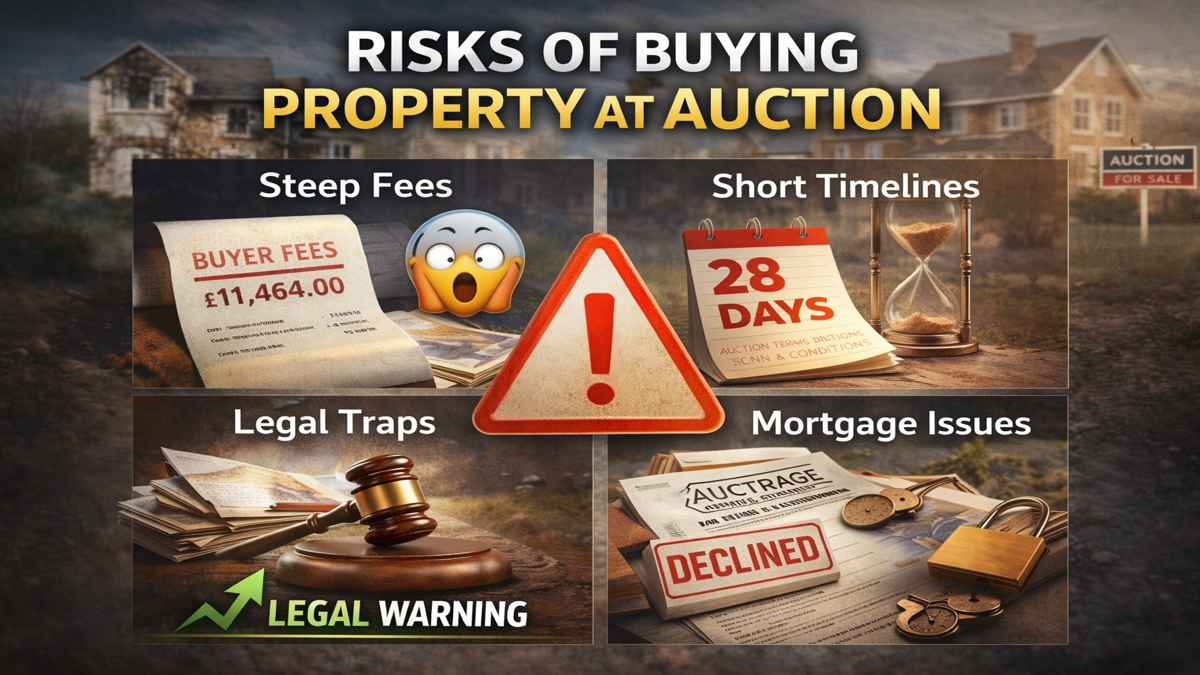
The biggest auction mistakes are rarely about enthusiasm or bidding too high. They are about underestimating risk that only becomes visible after exchange, when it is already too late to walk away. Auction structures reward certainty for the seller, not protection for the buyer, which means even small oversights can carry disproportionate consequences.
Short leases, defective titles, and unmortgageable properties
One of the most common risks buyers underestimate is mortgageability. Properties with short leases, defective titles, missing rights of access, or non-standard construction often look cheap because they exclude mainstream buyers. At auction, that exclusion is the point. A buyer may assume a refinance will be possible later, only to discover that lenders refuse the property or impose terms that destroy the deal economics.
Real-world example: a buyer purchases a flat at auction with a 61-year lease, assuming a lease extension can be completed quickly after purchase. After exchange, they discover the freeholder is absent and statutory notices cannot be served. The property becomes unmortgageable, bridging finance rolls on, and the discount evaporates in holding costs.
No surveys, no renegotiation, no safety net
Unlike private treaty purchases, auctions offer no opportunity to renegotiate based on survey findings. Structural movement, damp, roof failure, or unsafe alterations discovered after the auction do not create leverage. They create cost. Buyers who rely on viewing impressions or assume defects can be priced later often find that remedial works exceed the margin they believed existed in the deal.
Financing delays and failed exits
Auction timelines assume funding certainty. Buyers who depend on bridging finance frequently underestimate how sensitive exits are to valuation, lease length, and legal clarity. A down-valuation or a lender refusing to refinance due to title or lease issues can leave the buyer trapped in expensive short-term finance. At that point, the risk is not just higher interest, but forced resale at a loss.
Legal acceptance of risk at the point of bidding
At auction, the law assumes informed consent. By bidding, you are deemed to have accepted the contents and omissions of the legal pack. Discovering missing consents, search gaps, or adverse covenants after exchange does not create remedies. It confirms that the risk has already transferred to you.
The common thread across these risks is timing. At auction, risk is front-loaded and consequences are back-loaded. Buyers who underestimate this dynamic are not unlucky. They are unprepared.
Auction Risk Summary: What Buyers Commonly Get Wrong
- Mortgageability is assumed, not confirmed. Many buyers only discover lending issues after exchange.
- Legal risk transfers immediately. Missing consents, short leases, and title defects are accepted when you bid.
- Surveys do not create leverage. Defects found after the auction do not allow renegotiation.
- Finance exits are fragile. A down-valuation or lender refusal can trap buyers in expensive short-term funding.
- Discounts reflect risk, not generosity. The price often compensates for problems others could not accept.
Key takeaway: Auction success is not about spotting cheap property. It is about identifying which risks you can control and walking away from the rest.
Short Lease Properties and Auction Reality
Short lease properties are a fixture of UK property auctions, not an anomaly. They appear frequently because a diminishing lease length excludes most mortgage buyers, reduces market demand, and forces sellers toward routes that prioritise speed over price. For buyers, this creates the illusion of opportunity. In reality, short leases are one of the most consistently misunderstood risks at auction.
A lease below around 80 years is not just a valuation issue. It affects mortgage availability, resale demand, and extension cost, all at the same time. This is why experienced buyers treat short leases as a specialist scenario, not a generic auction discount, and why understanding short lease auction properties properly is essential before bidding.
Why short leases are common in auction rooms
Short leases often arise from probate sales, absent freeholders, long-term landlord neglect, or owners who cannot afford or complete a lease extension themselves. Once the lease drops below lender thresholds, the property becomes unmortgageable for most buyers. Auction becomes the default route, because cash and specialist buyers are the only realistic audience left. The discount exists to compensate for complexity, not to create a bargain.
Marriage value and lease extension cost traps
When a lease falls below 80 years, marriage value becomes payable as part of a statutory lease extension. This can dramatically increase the cost of extending the lease and is frequently underestimated by auction buyers. Many first-time bidders assume extension costs are fixed or easily negotiated, only to discover post-purchase that the premium wipes out the apparent discount. A detailed understanding of marriage value in short leases is therefore non-negotiable.
For authoritative guidance on how lease extensions work in England and Wales, including statutory rights and processes, see Leasehold property: Extending, changing or ending a lease.
When a short lease auction property can still make sense
Short lease properties can work where buyers have a clear extension strategy, professional advice, and sufficient contingency. This may include properties where the freeholder is known and cooperative, or where the numbers still stack up even after conservative extension and finance assumptions. Crucially, buyers must assess the deal as if the lease problem will be expensive and slow, not quick and convenient. This is why many disciplined investors compare short-lease auctions against alternative ways to buy property in the UK before committing capital.
Financing an Auction Purchase (What Actually Works)
Financing is where many auction deals quietly fail. The timelines are tight, the legal commitment is immediate, and lenders are far less forgiving than buyers expect. What works at auction is not about finding the cheapest finance. It is about certainty, speed, and having a viable exit if the first plan does not materialise. This is why disciplined buyers align auction funding with realistic property finance structures, not assumptions made after the hammer falls.
Cash purchases and why they dominate auction rooms
Cash buyers dominate auctions because they remove timing risk. With no lender approvals, valuations, or underwriting delays, cash allows buyers to complete within auction deadlines and absorb legal or title complexity that would stop mortgage-backed purchases. That does not mean cash buyers face less risk. It means they can choose which risks to accept without relying on third parties to approve the deal.
Bridging finance: useful tool, expensive mistake if misunderstood
Bridging finance is the most common funding method for auction purchases that are not cash. It can work well where the buyer has a clear, realistic exit and has already stress-tested valuation and legal issues. The mistake many buyers make is treating bridging as a temporary inconvenience rather than a cost driver. Interest accrues monthly, fees stack up quickly, and any delay in refinance or resale can turn a marginal deal into a loss. Buyers who want a deeper understanding of this should study how property development is financed in the UK, because many of the same risks apply.
Why standard mortgages rarely fit auction timelines
Most residential and buy-to-let mortgages are not designed for auction deadlines. Valuation delays, legal queries, lease length requirements, and lender risk appetite often clash with 28-day completion periods. Buyers who plan to use a standard mortgage frequently discover too late that the property fails lending criteria or that the lender cannot move fast enough. This is a common reason auction purchases collapse after exchange.
Exit risk is the real finance risk
The biggest finance risk at auction is not getting the purchase funded. It is getting out. Refinance down-valuations, unmortgageable titles, short leases, and incomplete works can all block the exit and trap buyers in expensive short-term finance. Successful auction buyers price this risk into the deal and assume the exit will be slower, costlier, or unavailable. If the deal still works under those assumptions, the finance strategy is realistic.
Smarter Alternatives to Property Auctions in the UK
Auctions are not the default route for disciplined buyers. They are a tool, used selectively. In many cases, alternative buying routes offer more control, better due diligence, and similar pricing, without the legal finality and time pressure that make auctions risky. This is why experienced investors compare auctions against alternative ways to buy property in the UK before committing capital.
Off-market deals and direct-to-vendor purchases
Off-market deals and direct-to-vendor purchases remove the competitive pressure of the auction room and allow buyers to negotiate based on information rather than urgency. While these deals require more sourcing effort and verification, they give buyers time to review legal documents, assess funding properly, and renegotiate if risks emerge. For buyers who value control and downside protection, off-market property deals often provide a more balanced risk profile than auctions.
Buying through property sourcers and co-deal structures
Property sourcers and co-deal arrangements can provide access to opportunities that never reach the open market. However, they introduce a different type of risk: reliance on third-party analysis. Buyers must understand who is responsible for due diligence, how fees are structured, and where liability sits if something goes wrong. This route works best for buyers who have their own review process and treat sourcing as access, not assurance. A solid understanding of off-market and deal sourcing in UK property and the risks of co-deal sourcing in UK property is essential before relying on this route.
Negotiated on-market purchases most investors overlook
Not all good deals are hidden. Many opportunities arise on the open market where properties have sat unsold due to pricing, condition, or seller circumstances. Unlike auctions, negotiated on-market purchases allow buyers to make conditional offers, commission surveys, and adjust terms as information emerges. Buyers who combine this approach with proper property deal analysis and stress testing often achieve better outcomes than those relying on speed alone.
The key advantage of these alternatives is flexibility. They allow buyers to walk away, renegotiate, or restructure the deal as risks become clearer. Auctions remove that flexibility in exchange for speed. Smarter buyers choose the route that gives them the greatest control over downside, not the one that feels most exciting.
Auctions vs Smarter Buying Routes: At-a-Glance
| Factor | Property Auctions | Alternative Routes |
|---|---|---|
| Speed | Very fast, fixed timelines | Flexible, negotiable timelines |
| Legal commitment | Immediate exchange on the day | Exchange only after full checks |
| Due diligence window | Before bidding only | Before exchange, with time to react |
| Ability to renegotiate | None after the hammer falls | Yes, based on surveys and findings |
| Finance flexibility | Limited, often cash or bridging | Broader finance options available |
| Risk transfer | Front-loaded onto the buyer | Shared or managed through process |
| Best suited for | Prepared, experienced buyers | Buyers prioritising control and downside protection |
Key insight: Auctions trade control for speed. Alternative routes trade speed for risk management.
Auctions vs Alternative Routes (Risk, Speed, Control Compared)
Choosing how to buy a property is often more important than choosing which property to buy. Auctions and alternative routes solve different problems, and understanding the trade-offs between risk, speed, and control is what separates strategic buyers from reactive ones.
Auctions prioritise certainty for the seller. Alternative routes prioritise flexibility for the buyer. Neither is inherently good or bad, but each produces very different outcomes depending on the buyer’s experience, funding, and tolerance for downside.
Speed vs certainty: auctions compared to private treaty
Auctions are fast by design. Once the hammer falls, the sale is legally binding and the timeline to completion is fixed. This certainty is attractive to sellers and to buyers who can move quickly with cash or pre-arranged finance. Private treaty and negotiated purchases move more slowly, but that time is not wasted. It allows surveys, funding approvals, and legal issues to surface before commitment, rather than after.
Risk profile comparison across buying routes
Auction risk is front-loaded. Buyers must absorb legal, structural, and finance risk upfront with limited ability to adjust once new information emerges. Alternative routes spread risk over the transaction, allowing buyers to reassess, renegotiate, or walk away if material issues arise. The difference is not risk level, but risk timing. Auctions compress risk into the bidding stage. Other routes distribute it across the process.
Control, due diligence, and renegotiation differences
Control is where auctions differ most sharply from other routes. At auction, due diligence must be completed before bidding, and renegotiation is effectively impossible once committed. Alternative routes allow buyers to pause, seek specialist advice, revise offers, or restructure deals as facts change. This control is particularly valuable when dealing with complex assets, uncertain titles, or evolving finance conditions.
The practical takeaway is simple. Auctions reward preparation and penalise assumptions. Alternative routes reward patience and process. Smarter buyers choose the route that gives them the greatest control over outcomes, not the one that offers the fastest route to ownership.
Auctions vs Alternative Routes: Risk, Speed, Control
| Dimension | Property Auctions | Alternative Routes |
|---|---|---|
| Speed to exchange | Immediate on the day | Variable, buyer-controlled |
| Completion timeline | Fixed (often ~28 days) | Negotiable |
| Due diligence window | Before bidding only | Before exchange, with time to react |
| Renegotiation ability | None after the hammer | Yes, based on findings |
| Finance options | Cash or bridging dominate | Broader lender choice |
| Risk timing | Front-loaded to buyer | Distributed across process |
| Buyer control | Low after commitment | High throughout |
| Best suited for | Prepared, experienced buyers | Buyers prioritising control |
Bottom line: auctions trade control for speed; alternative routes trade speed for risk management.
Who Should (and Should Not) Buy Property at Auction
Property auctions are not a test of confidence. They are a test of preparation, funding certainty, and risk tolerance. For the right buyer, auctions can be an efficient acquisition tool. For the wrong buyer, they are an expensive learning curve. Knowing which category you fall into is one of the most valuable decisions you can make before bidding.
Buyers auctions are suited to
Auctions tend to work best for experienced investors, developers, and cash buyers who understand legal risk and can move quickly without relying on slow or conditional finance. These buyers typically have solicitors lined up in advance, funding agreed in principle, and a clear exit strategy if the original plan changes. They are comfortable pricing risk into bids and walking away when the numbers no longer work.
Buyers who regularly succeed at auction also tend to have strong due diligence processes. They read legal packs in full, understand lease and title issues, and assume problems will be worse, slower, or more expensive than expected. For them, auctions are a sourcing tool, not a shortcut.
Buyers auctions are usually a poor fit for
Auctions are often unsuitable for first-time buyers, owner-occupiers, or investors relying on standard residential or buy-to-let mortgages without a robust back-up plan. The timelines are unforgiving, the legal commitment is immediate, and there is no scope to renegotiate if issues emerge. Buyers who need certainty, lender approval, or reassurance after offering are usually better served by alternative routes.
Auctions are also a poor fit for buyers who rely heavily on agents’ descriptions, viewing impressions, or optimistic assumptions about refinancing. At auction, optimism is not a strategy. It is a liability.
When auctions make strategic sense
Auctions can make sense where speed genuinely matters, where the buyer understands the legal and structural risks, and where funding is either in place or flexible. This often includes properties with known issues that are already priced accordingly, or situations where the buyer has a clear plan to add value and exit under conservative assumptions.
When walking away is the smartest move
Walking away is not a failure at auction. It is often the correct outcome. If the legal pack raises unanswered questions, the finance relies on best-case assumptions, or the margin disappears once realistic costs are applied, the discipline to stop bidding protects capital. The most successful auction buyers are not the ones who win the most lots, but the ones who avoid the most bad deals.
Auction Decision Checklist: Should You Bid?
Before bidding at a property auction, run through this checklist honestly.
If most of these points cannot be answered with confidence, walking away is usually the smarter move.
- The legal pack has been fully reviewed, including all special conditions.
- Mortgageability has been confirmed, or the reasons it is not mortgageable are fully understood.
- Funding is in place and capable of meeting the auction completion deadline.
- All costs beyond the hammer price have been priced in, including fees and finance.
- Lease length, title position, and any extension implications are clearly understood.
- A realistic exit strategy exists if the first plan does not work.
- The deal still works under conservative assumptions, not best-case scenarios.
- The potential loss of the deposit in a failed completion has been fully accepted.
Rule of thumb: if a deal only works when everything goes right, it is not an auction deal.
Final Verdict: Is Buying Property at Auction Still Worth It in the UK?
Buying property at auction in the UK can still make sense, but only for a narrow group of buyers who understand what auctions are designed to do and who they are designed for. Auctions are not a shortcut to cheap property. They are a mechanism for transferring risk quickly and efficiently from seller to buyer.
For disciplined investors with funding certainty, legal literacy, and conservative exit assumptions, auctions can be a useful sourcing route. They offer speed, clarity, and access to properties that may never transact through traditional channels. When used deliberately, auctions can fit into a broader acquisition strategy rather than replacing it.
For most buyers, however, auctions are not the optimal starting point. The lack of renegotiation, compressed timelines, and front-loaded risk mean that mistakes are punished more severely than in other buying routes. In many cases, negotiated on-market purchases, off-market deals, or structured acquisitions offer similar pricing with far greater control and downside protection.
The most important takeaway is this: the quality of the deal matters more than the route used to buy it. Auctions amplify both good preparation and bad assumptions. They reward buyers who walk away more often than they bid, and they punish those who rely on optimism, speed, or headline discounts.
If you are considering buying at auction, treat it as one tool among many. Analyse the deal first, stress-test the risks, and choose the buying route that gives you the greatest control over outcomes. When the numbers still work under conservative assumptions, auctions can be worth using. When they do not, the smartest move is often not to bid at all.
Property Auction FAQs (UK)
What happens when you win a property at auction in the UK?
In a traditional UK property auction, the sale becomes legally binding when the hammer falls.
You usually pay a deposit immediately, often 10%, sign the memorandum of sale, and complete within the timeframe set in the auction conditions, commonly around 28 days.
Do you exchange contracts on auction day?
Yes. In traditional auctions, contracts are effectively exchanged on the day you win the bid.
There is no cooling-off period, and you cannot renegotiate later if issues are discovered after bidding.
Can you buy an auction property with a mortgage?
Sometimes, but many auction properties are unmortgageable due to short leases, title issues, or property condition. Even where a mortgage is possible, standard timescales often do not meet auction completion deadlines without a back-up funding plan.
What is an auction legal pack?
An auction legal pack is the set of legal documents that forms the basis of the sale.
It typically includes title documents, the contract, special conditions, searches,
and lease information. Buyers are expected to review it fully before bidding.
Are properties cheaper at auction than through estate agents?
Sometimes, but any discount usually reflects higher risk or complexity.
Auctions can appear cheaper where properties have legal, lease, or condition issues.
Alternative buying routes can offer similar pricing with greater control and protection.

Koye Beckley is a UK property investor and founder of UncommonDeal, with practical experience in buy-to-let, property auctions, refurbishment projects and investment deal analysis. Through UncommonDeal, he publishes property market research, property deal sourcing and compliance guidance, investment guides and data-driven analysis to help investors evaluate buy-to-let, BRRR, flip and auction opportunities.