How Commercial Property Deals Are Structured in the UK for Maximum Profit
Many investors focus heavily on finding the “right” commercial property deals while paying far less attention to how the deal itself is structured. In reality, the structure can have a major impact on profitability, refinancing options, tax efficiency, liability exposure, and long-term scalability.
Two investors could buy the same commercial property at the same price and still achieve very different outcomes depending on how the acquisition, finance, ownership, and exit strategy were arranged.
Commercial property deals in the UK can involve far more than a simple purchase and mortgage arrangement. Depending on the strategy, investors may use:
- SPVs (Special Purpose Vehicles)
- Holding companies
- Bridging finance
- Commercial mortgages
- Joint venture (JV) agreements
- Investor equity structures
- Development finance
- Lease option agreements
- Refinance exit strategies
For example, an investor converting an office building into flats may use bridging finance through an SPV before refinancing onto a long-term facility after refurbishment. Another investor buying a fully let commercial unit may instead use a straightforward commercial mortgage for long-term income generation.
The optimal structure depends on factors such as the investment strategy, funding source, risk tolerance, tax position, and planned exit.
This guide explains how commercial property deals are commonly structured in the UK from a practical investor perspective. Rather than focusing purely on legal theory, the article breaks down how investors typically structure ownership, finance, partnerships, and exits across different commercial property strategies.
How to Structure Commercial Property Deals
Structuring a commercial property deal involves far more than simply buying a building and arranging finance. The structure behind the transaction can affect profitability, refinancing options, tax efficiency, investor protection, liability exposure, and long-term scalability.
A well-structured commercial property deal is usually designed around:
- The investment strategy
- The funding method
- The level of risk involved
- The intended exit
- The investor’s long-term goals
Different strategies often require completely different structures. A simple commercial buy-to-let investment may only need an SPV and commercial mortgage, while a development or conversion project may involve bridging finance, investor equity, JV agreements, title splitting, and refinance exits.
Define the Investment Strategy First
The structure should normally follow the strategy, not the other way around.
Many investors pursuing commercial conversions, mixed-use projects, or value-add strategies focus heavily on sourcing off market investment properties where pricing, negotiation flexibility, and repositioning potential may be stronger than openly marketed deals.
Before choosing finance, ownership setup, or investor arrangements, the investor should first understand:
- What type of asset is being acquired
- Whether the property will be held or sold
- If refurbishment or development is required
- Whether planning uplift is involved
- Whether long-term rental income or short-term profit is the objective
For example:
- A stabilised warehouse investment may suit long-term commercial lending
- An office conversion may require bridging finance and a refinance exit
- A development site may require phased development finance drawdowns
Many investors first encounter these structures after sourcing off-market or value-add opportunities, which is why understanding how property deal sourcing works can help investors identify which strategies require more complex structuring.
The more complex the strategy becomes, the more important the structure becomes.
Choose the Ownership Structure
The ownership structure determines who legally owns the property and how the project is organised.
Commercial property may be purchased through:
- Personal ownership
- Limited companies
- SPVs
- Holding company structures
- Joint venture entities
The structure can affect:
- Tax treatment
- Liability exposure
- Investor flexibility
- Finance availability
- Future disposals
- Portfolio scalability
Many commercial investors use SPVs to separate projects and ring-fence risk, especially where bridging finance, investor funding, or development activity is involved.
Build the Finance Structure
The finance structure determines how the acquisition, refurbishment, or development is funded.
This may involve:
- Commercial mortgages
- Bridging finance
- Development finance
- Investor capital
- Mezzanine finance
- Director loans
- Joint venture funding
The structure should account for:
- Deposit requirements
- Finance costs
- Build costs
- Contingency allowances
- Interest rate exposure
- Refinance assumptions
Many inexperienced investors focus too heavily on acquisition price while underestimating how finance costs and exit assumptions affect profitability.
Plan the Exit Before Acquisition
Experienced investors often structure the exit before purchasing the property.
This means understanding:
- How the bridge lender will be repaid
- Whether refinance assumptions are realistic
- Whether the property can be sold easily
- Whether rental demand supports the exit
- How long the project may realistically take
The intended exit may involve:
- Long-term hold
- Refinance
- Sale
- Flat split disposal
- Partial unit sales
- Portfolio retention
A commercial property deal can become financially stressful if the exit strategy depends on unrealistic assumptions around value, demand, or lender appetite.
Assess Tax and Legal Implications
Commercial property structures should also be assessed from a tax and legal perspective before acquisition.
Important considerations may include:
- Corporation Tax vs personal ownership
- SDLT exposure
- VAT on commercial property
- Capital gains implications
- Existing leases
- Planning restrictions
- Repair liabilities
- Service charge obligations
Legal and tax issues can materially affect whether a deal remains viable after acquisition costs and operational risks are properly assessed.
Stress Test the Downside Scenario
One of the biggest differences between inexperienced and experienced commercial investors is how they assess downside risk.
Experienced investors usually stress test:
- Higher interest rates
- Lower refinance valuations
- Build overruns
- Delayed exits
- Vacant periods
- Weak tenant demand
- Reduced lender appetite
Strong commercial property structures are designed not only for favourable market conditions, but also for periods where timelines extend, costs increase, or exit conditions weaken unexpectedly.
Before committing to a commercial acquisition, many investors model refinance sensitivity, finance costs, refurbishment overruns, and exit risk using structured property deal analysis frameworks rather than relying purely on headline GDV figures.
What is Commercial Property Deal Structure?
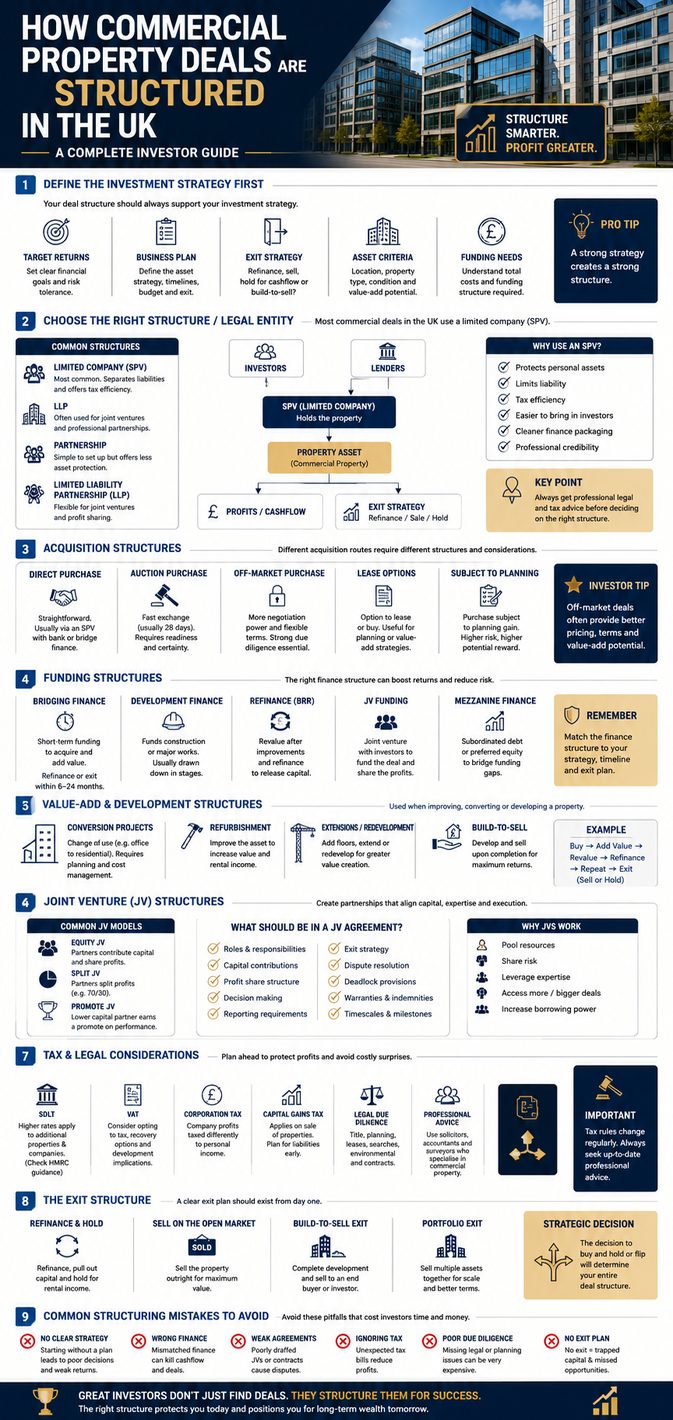
Commercial property deal structure is the way a property transaction is organised financially, legally, and operationally before the purchase takes place. This includes who owns the property, how the acquisition is funded, how profits are distributed, how risks are managed, and how the investor plans to exit the deal in the future.
In practice, the structure behind a commercial property investment can be just as important as the property itself. A poorly structured deal may create unnecessary tax exposure, refinancing problems, partnership disputes, or legal complications later on.
The structure used often depends on:
- The investment strategy
- The number of investors involved
- The funding method
- Tax planning objectives
- The planned exit strategy
- Liability protection requirements
For example, an investor buying a fully let retail unit for long-term rental income may use a simple limited company structure with a commercial mortgage. Meanwhile, a developer converting a vacant office building into flats may use an SPV with bridging finance, investor capital, and a refinance exit strategy after refurbishment.
The Ownership Structure
One of the first decisions investors typically make is how the property itself will be owned. This can affect taxation, liability, financing options, and future scalability.
Personal Ownership
Some investors purchase commercial property in their personal name, particularly when buying smaller assets or making a first investment. Personal ownership can be simpler administratively, but it may expose the investor directly to liabilities linked to the property or borrowing.
Financing options can also differ depending on whether the property is owned personally or through a company structure.
Limited Company Ownership
Many commercial property investors in the UK purchase assets through a limited company. This can help separate business activities from personal finances while also creating a more scalable structure for future acquisitions.
Lenders, investors, and joint venture partners will often expect commercial projects to operate through a company structure rather than personal ownership.
SPV (Special Purpose Vehicle) Setup
An SPV is a limited company created specifically for a particular property investment or project. Many commercial investors use SPVs to ring-fence risk and keep individual projects financially separate.
For example, an investor may use:
- One SPV for a mixed-use conversion project
- Another SPV for long-term commercial rental assets
- A separate SPV for development projects
This approach can simplify accounting, refinancing, investor agreements, and future asset disposals.
Holding Company Arrangements
More experienced investors sometimes use holding company structures when managing multiple SPVs or larger portfolios.
In this structure, a parent company may own shares in several separate SPVs, each holding different properties or projects. This can provide additional flexibility for portfolio management, future investment raises, asset segregation, and long-term scaling.
Holding structures are particularly common among developers, portfolio landlords, and investors operating across multiple commercial property strategies.
The Property Finance Structure
The property finance structure refers to how the commercial property acquisition, refurbishment, or development is funded. This is one of the most important parts of any commercial property deal because the finance arrangement can directly affect cash flow, profitability, refinance potential, and overall project risk.
Different commercial property strategies often require different funding structures. A long-term buy-to-let commercial investment may use a standard commercial mortgage, while a heavy refurbishment or conversion project may require short-term bridging finance or development funding.
Cash Purchase
Some investors acquire commercial properties entirely with cash, particularly at auction or when purchasing distressed assets that may not initially qualify for traditional lending.
Cash purchases can provide:
- Faster completion times
- Stronger negotiating power
- Reduced finance costs
- Greater flexibility during refurbishment
However, tying up large amounts of capital in a single asset can also reduce liquidity and limit portfolio scalability.
Commercial Mortgage
Commercial mortgages are commonly used for stabilised assets that already produce income, such as fully let office buildings, retail units, warehouses, or mixed-use properties.
Compared to bridging finance, commercial mortgages usually offer:
- Lower interest rates
- Longer repayment terms
- More predictable monthly payments
Lenders will typically assess:
- Rental income
- Tenant quality
- Lease length
- Property condition
- Investor experience
Many long-term commercial investors use commercial mortgages as part of a hold-for-income strategy.
Bridging Finance
Bridging finance is frequently used for commercial property projects that require speed, refurbishment, planning improvement, or conversion work before refinancing.
This type of finance is common in:
- Auction purchases
- Commercial-to-residential conversions
- Vacant buildings
- Heavy refurbishment projects
- Short-term value-add strategies
Bridging loans generally have higher interest rates than commercial mortgages, but they provide flexibility and faster access to capital. Investors usually plan a defined exit strategy before using bridging finance, such as refinancing or selling the property after works are completed.
Development Finance
Development finance is typically used for larger projects involving construction, major conversions, or ground-up development.
Unlike standard bridging finance, development finance is often released in stages as the project progresses. The lender may monitor:
- Build progress
- Project costs
- Planning status
- Contractor schedules
- Gross Development Value (GDV)
This type of funding is common among developers undertaking office conversions, mixed-use developments, or new-build commercial projects.
Investor Funding
Some commercial property deals are funded partly or entirely through private investors or joint venture partners. In these arrangements, investors may contribute capital in exchange for:
- Fixed returns
- Equity ownership
- Profit share agreements
- Interest payments
- Preferred returns
Investor funding structures are commonly used when:
- The project requires larger deposits
- Bank lending alone is insufficient
- Developers want to scale multiple projects simultaneously
- A deal requires additional working capital
In many commercial property projects, several finance methods may be combined within a single structure. For example, an investor may use private investor funds for the deposit, bridging finance for the acquisition, and a commercial refinance after refurbishment is completed.
The Legal Structure
The legal structure of commercial property deals refer to the agreements and legal arrangements that define how the transaction operates, how responsibilities are allocated, and how risks are managed between the parties involved.
This becomes particularly important when multiple investors, lenders, developers, or business partners are involved in a project. Even profitable commercial property deals can become problematic if expectations, profit splits, responsibilities, or exit rights are not properly documented from the beginning.
The complexity of the legal structure often depends on the size of the project and the number of stakeholders involved.
Joint Venture (JV) Agreements
JV agreements are commonly used when two or more parties work together on a commercial property investment or development project.
For example:
- One investor may provide funding
- Another partner may manage the refurbishment or development
- A sourcing partner may introduce the opportunity
- A developer may oversee planning and construction
The JV agreement usually outlines:
- Profit splits
- Capital contributions
- Decision-making authority
- Roles and responsibilities
- Exit arrangements
- Loss allocation
- Dispute resolution procedures
Clear JV agreements are particularly important in commercial conversion and development projects where costs, timelines, and risks can change during the deal.
Shareholder Agreements
When a commercial property project operates through a limited company or SPV with multiple owners, shareholder agreements are often used alongside the company structure.
These agreements help define:
- Ownership percentages
- Voting rights
- Profit distribution
- Director responsibilities
- Share transfer restrictions
- Exit procedures
Without a properly drafted shareholder agreement, disputes between investors or business partners can become far more difficult to resolve later.
Loan Agreements
Loan agreements are frequently used when private investors provide funding to a commercial property project rather than taking direct equity ownership.
For example, an investor may lend:
- Deposit funds
- Refurbishment capital
- Working capital
- Short-term bridging support
The agreement will typically specify:
- Interest rate
- Repayment terms
- Security arrangements
- Default provisions
- Exit repayment conditions
Many commercial property projects combine both equity investors and loan-based investor funding within the same structure.
Option Agreements
Option agreements are sometimes used in commercial property transactions where an investor wants the right, but not the obligation, to purchase a property at a later date.
These structures are commonly used when:
- Planning permission is being pursued
- Site assembly is taking place
- Funding is still being arranged
- Development viability is being assessed
An option agreement can give investors greater flexibility while reducing upfront acquisition risk before fully committing to the purchase.
The Exit Structure
The exit structure refers to how an investor plans to recover capital, generate profit, or release equity from a commercial property deal. Experienced investors often think about the exit strategy before purchasing the property because the planned exit can influence the finance structure, refurbishment scope, ownership setup, and overall risk profile of the project.
A commercial property investment that appears profitable on paper can become problematic if the exit strategy is weak, unrealistic, or overly dependent on favourable market conditions.
Different commercial property strategies often require different exit approaches.
Refinance
Refinancing is one of the most common exit strategies used in commercial property investing, particularly in value-add and conversion projects.
In this structure, the investor typically:
- Purchases the property
- Adds value through refurbishment, leasing, planning improvement, or conversion
- Refinances onto a longer-term commercial mortgage
The refinance may allow the investor to:
- Repay bridging finance
- Recover part of the original capital invested
- Reduce monthly finance costs
- Hold the asset long term for rental income
This approach is commonly used in commercial-to-residential conversions and BRRR-style commercial property strategies.
Sale
Some commercial property investors structure deals with the intention of selling the property after value has been added.
This may involve:
- Refurbishing a vacant commercial building
- Securing planning permission
- Splitting a mixed-use asset
- Improving tenant quality
- Increasing rental income before sale
The objective is usually to increase the property’s market value and realise profit upon disposal.
Sale exits are particularly common in development projects, auction purchases, and short-term commercial repositioning strategies.
Hold for Cashflow
Long-term income-focused investors may structure commercial property deals primarily around stable rental cash flow.
These investors often target:
- Fully let commercial units
- Mixed-use buildings
- Warehouses
- Offices with long leases
- Tenant-backed assets
The focus is generally on:
- Consistent rental income
- Long-term appreciation
- Debt reduction over time
- Portfolio scalability
In these structures, finance arrangements are often designed around long-term affordability and income stability rather than short-term resale profit.
Split and Sell Strategy
Some investors acquire larger commercial or mixed-use properties with the intention of dividing the asset into smaller units for individual sale.
Examples may include:
- Converting offices into flats
- Splitting mixed-use buildings
- Separating retail and residential titles
- Dividing industrial units
- Creating multiple leasehold units from a larger building
This strategy can sometimes generate higher overall value compared to selling the property as a single asset, although it may involve additional planning, legal, and construction complexity.
The chosen exit structure often shapes the entire commercial property deal from the beginning, including the funding approach, refurbishment scope, legal structure, and projected profitability.
Buying Commercial Property Personally vs Through a Limited Company
One of the first structuring decisions commercial property investors face is whether to purchase a property in their personal name or through a limited company. The choice can affect taxation, borrowing options, liability exposure, accounting complexity, and long-term portfolio growth.
There is no single structure that works best for every investor or every deal. The most suitable setup often depends on the investor’s strategy, income level, financing requirements, risk tolerance, and long-term objectives.
Some smaller investors initially purchase commercial property personally for simplicity, while larger investors and developers often operate through company structures or SPVs to separate projects and manage risk more efficiently.
Buying in Your Personal Name
Purchasing commercial property personally is generally the simplest ownership structure. The investor owns the asset directly rather than through a separate company.
For first-time investors or smaller commercial acquisitions, personal ownership can sometimes involve:
- Less administrative setup
- Simpler accounting requirements
- Fewer company filing obligations
- Direct ownership control
However, simplicity does not always mean the structure is optimal long term.
Tax Considerations
Commercial property held personally may create different tax consequences compared to company ownership. Rental income and profits may be taxed through personal income tax structures, which can become less efficient for higher-rate taxpayers depending on the investor’s circumstances.
Capital gains tax treatment may also differ upon sale of the property.
Because tax positions vary significantly between investors, many commercial buyers seek specialist tax advice before deciding on the ownership structure.
Liability Exposure
When commercial property is owned personally, the investor may have more direct personal exposure to liabilities linked to the property, borrowing, tenant disputes, or legal claims.
This can become particularly relevant in:
- Higher-risk refurbishment projects
- Commercial-to-residential conversions
- Multi-investor arrangements
- Development projects
- Properties with operational or compliance risks
Some investors prefer company structures partly to create separation between personal assets and investment activities.
Mortgage Limitations
Certain lenders may apply different lending criteria depending on whether the property is purchased personally or through a company.
For example, borrowing capacity, deposit requirements, stress testing, and lender appetite can vary between:
- Personal borrowers
- Limited companies
- SPVs
- Development entities
Some commercial lenders also prefer dealing with structured company arrangements for larger or more complex projects.
Using a Commercial Property SPV
Many commercial property investors in the UK purchase assets through an SPV (Special Purpose Vehicle) rather than buying personally. An SPV is usually a limited company created specifically to acquire, manage, or develop a particular property or investment project.
SPVs are widely used across commercial property investing because they can provide clearer financial separation, improved risk management, and a more structured approach to portfolio growth.
For example, an investor may:
- Use one SPV for a mixed-use building
- Create another SPV for a commercial-to-residential conversion project
- Hold long-term commercial investments in separate entities
This allows each project to operate independently from the others.
Why Many Investors Use SPVs
Commercial property projects often involve larger capital commitments, multiple funding sources, refurbishment works, planning risk, or investor partnerships. SPVs can help organise these projects more professionally and efficiently.
SPV structures are particularly common in:
- Commercial conversions
- Development projects
- Joint venture deals
- Investor-funded projects
- Portfolio expansion strategies
Many experienced investors also prefer SPVs because they create a more scalable structure for acquiring additional properties over time.
Ring-Fencing Risk
One of the main reasons investors use SPVs is to ring-fence risk between different projects or assets.
For example, if an investor owns several commercial properties, placing each project within separate SPVs may help isolate financial or legal problems linked to one asset from affecting the entire portfolio.
This can become especially important in:
- Development projects
- Heavy refurbishments
- Higher-risk conversions
- Multi-investor arrangements
- Properties with operational liabilities
While SPVs do not eliminate risk entirely, they can create clearer separation between projects and liabilities.
Easier Accounting Separation
SPVs can also simplify accounting and project-level financial management.
By separating properties into different companies, investors may find it easier to track:
- Rental income
- Finance costs
- Refurbishment spending
- Investor contributions
- Project profitability
- Tax reporting
This can be particularly useful when multiple investors or lenders are involved in a deal.
Professional Lender Preference
Many commercial lenders are familiar with SPV structures and may prefer lending to professionally organised company entities rather than individuals, especially on larger or more complex projects.
For example, lenders providing:
- Bridging finance
- Development finance
- Commercial investment loans
- Semi-commercial mortgages
will often expect borrowers to operate through a limited company or SPV structure.
Some lenders may even require certain commercial projects to be held within a dedicated SPV before finance is approved.
Holding Company Structures
As commercial property portfolios grow, some investors move beyond single-SPV ownership and adopt holding company structures. In this arrangement, a parent company sits above multiple subsidiary SPVs, with each SPV typically holding a separate property, development project, or investment strategy.
Holding structures are commonly used by developers, portfolio investors, and businesses managing several commercial assets simultaneously.
The goal is usually to create clearer separation between projects while improving portfolio organisation and long-term scalability.
Parent Company Ownership
In a typical holding structure, the parent company owns shares in multiple subsidiary SPVs rather than holding the properties directly itself.
For example:
- The holding company may own SPV A holding a warehouse
- SPV B holding a mixed-use building
- SPV C managing a commercial-to-residential conversion
This structure allows investors to centralise overall ownership while keeping individual projects operationally separate.
Subsidiary SPVs
Each subsidiary SPV generally operates as its own standalone company with separate:
- Accounts
- Borrowing arrangements
- Assets
- Liabilities
- Project finances
This can help investors manage commercial properties individually rather than combining every asset into a single company structure.
Different SPVs may also be used for different strategies, such as:
- Long-term commercial investments
- Development projects
- Refurbishment deals
- Joint venture schemes
- High-risk conversion projects
Asset Segregation
One of the major advantages of a holding structure is asset segregation.
Rather than exposing an entire portfolio to the risks of one project, investors may separate assets across multiple SPVs to reduce cross-project exposure.
For example, if a development project experiences cost overruns, legal disputes, or refinance problems, the issues may remain contained within that individual SPV rather than directly affecting other properties in the wider portfolio.
This approach is particularly common among investors managing:
- Larger portfolios
- Higher-risk projects
- Multiple investor partnerships
- Development-heavy strategies
Multi-Project Structuring
Holding company arrangements can also make it easier to scale across multiple commercial property projects over time.
Investors may find it simpler to:
- Raise finance
- Introduce investors into specific SPVs
- Sell individual projects
- Refinance separate assets
- Track project-level performance
This type of structure is frequently used in commercial property businesses operating across several acquisitions, developments, or conversion projects simultaneously.
Commercial Property Deals Ownership Structure
The right ownership structure depends on the type of commercial property deal, the investor’s tax position, the level of risk involved, and the long-term plan for the asset. A simple income-producing commercial unit may not need the same structure as a conversion, development, or investor-funded project.
The table below summarises how different ownership structures are commonly used in UK commercial property investing.
| Structure | Best For | Advantages | Risks / Limitations |
|---|---|---|---|
| Personal Ownership | Smaller commercial purchases or investors who want a simple setup. | Simple to set up, direct control, fewer company filing requirements. | Potential personal liability, tax inefficiency for some investors, may limit scalability. |
| Limited Company | Long-term commercial property ownership and portfolio building. | Clearer business separation, potential tax planning benefits, more professional structure. | More administration, company accounts, and possible personal guarantees from lenders. |
| SPV | Specific commercial projects, conversions, bridging finance, and investor-funded deals. | Ring-fences risk, easier accounting, lender-friendly, keeps projects separate. | May require separate accounts, banking, legal setup, and lender approval. |
| Holding Company Structure | Larger portfolios, multiple SPVs, development businesses, and multi-project investors. | Improves asset segregation, portfolio control, scalability, and project-level organisation. | More complex to manage and should usually be planned with tax and legal advisers. |
As a general rule, the more complex the deal becomes, the more important the structure becomes. A straightforward commercial buy-to-let may only require a simple company setup, while a conversion project involving bridging finance, investor capital, and a refinance exit may need a more carefully designed SPV or group structure.
How Commercial Property Finance Structures Work
The finance structure determines how a commercial property deal is funded, how debt is repaid, and how much financial pressure the investor takes on during the project. This can affect cash flow, profitability, risk, and the investor’s ability to refinance or exit the deal later.
Different finance structures suit different types of commercial property deals. A fully let asset with stable rent may be suitable for a standard commercial mortgage, while a vacant building, auction purchase, or conversion project may require bridging finance or development funding.
Standard Commercial Mortgages
A standard commercial mortgage is usually used for stabilised commercial property investments. These are assets that already have an established use, rental income, or a clear long-term investment case.
Compared with short-term finance, commercial mortgages usually offer lower interest rates and longer repayment terms. This can make them more suitable for investors who want to hold the asset for income rather than sell quickly after refurbishment or conversion.
However, commercial mortgage applications can take longer than bridging finance. Lenders will often carry out detailed checks on the property, lease agreements, rental income, tenant strength, valuation, and the borrower’s experience.
Commercial mortgages are commonly used for:
- Fully let shops
- Offices with existing tenants
- Warehouses and industrial units
- Mixed-use properties with stable income
- Commercial buy-to-let investments
For investors buying stabilised commercial assets, a commercial mortgage can provide a more sustainable long-term finance structure. The key risk is that the property must usually support the loan through reliable income, sensible valuation, and acceptable lender criteria.
Bridging Finance Structures
Bridging finance is commonly used in commercial property deals where speed, flexibility, or refurbishment work makes a standard commercial mortgage unsuitable at the point of purchase. These loans are usually short term and are designed to “bridge” the gap until the investor refinances or sells the property.
Compared with commercial mortgages, bridging finance is typically faster to arrange but carries higher interest costs and shorter repayment periods. Because of this, investors usually enter bridging deals with a clearly defined exit strategy already in place.
Auction Purchases
Bridging finance is widely used for auction acquisitions because commercial auctions often require completion within tight deadlines, sometimes as little as 28 days.
Traditional commercial mortgages may not move quickly enough for these transactions, particularly where:
- The property is vacant
- The title is complex
- Refurbishment is required
- Tenant issues exist
- The building is considered unmortgageable initially
Bridging lenders are generally more focused on the property value and exit strategy rather than purely the current condition of the asset.
Refurbishments
Many commercial investors use bridging finance when acquiring properties that require refurbishment before they can generate stable rental income or qualify for long-term finance.
Examples include:
- Vacant offices
- Tired retail units
- Semi-commercial buildings
- Poor-condition mixed-use assets
- Buildings requiring modernisation
After the refurbishment is completed, investors may refinance onto a standard commercial mortgage or sell the asset for profit.
Short-Term Acquisitions
Some commercial property deals are structured around short-term opportunities where investors intend to hold the property temporarily rather than long term.
This may include:
- Below-market-value purchases
- Distressed assets
- Repositioning projects
- Planning uplift opportunities
- Quick resale strategies
In these situations, bridging finance can provide the flexibility needed to move quickly before exiting the deal through refinance or disposal.
Heavy Works Projects
Commercial properties requiring significant structural works, conversions, or redevelopment may not initially qualify for traditional commercial lending.
Examples may include:
- Office-to-residential conversions
- Buildings with no functioning kitchens or bathrooms
- Fire-damaged properties
- Properties with major compliance issues
- Large internal reconfigurations
Bridging finance is often used during the higher-risk phase of the project before the property becomes stabilised and suitable for longer-term lending.
Because bridging finance can be expensive, investors usually stress test:
- Interest costs
- Refinancing assumptions
- Build timelines
- Contingency budgets
- Exit liquidity
before proceeding with the acquisition.
Development Finance Structures
Development finance is commonly used for larger commercial property projects involving construction, major conversions, or significant redevelopment works. Unlike standard commercial mortgages, development finance is designed for projects where the property may not yet produce stable income or may still be under construction.
This type of finance is frequently used by developers, commercial investors, and conversion specialists undertaking projects that require substantial capital over multiple stages.
Ground-Up Development
Ground-up development finance is used when a project involves building a new property from scratch rather than refurbishing an existing structure.
Examples include:
- New-build commercial units
- Industrial developments
- Apartment blocks
- Mixed-use schemes
- Purpose-built commercial spaces
Lenders will usually assess:
- Planning permission
- Construction costs
- Gross Development Value (GDV)
- Developer experience
- Build timelines
- Contractor arrangements
Because these projects carry higher risk, development finance tends to involve more monitoring and lender oversight than traditional commercial lending.
Conversion Projects
Development finance is also widely used for commercial conversion projects where existing buildings are being repurposed into a different use.
Examples may include:
- Office-to-residential conversions
- Mixed-use redevelopments
- Warehouse conversions
- Commercial building reconfigurations
- Large-scale refurbishments
These projects can carry additional complexity because lenders may need to assess:
- Planning viability
- Structural works
- Build costs
- End values
- Exit strategy feasibility
The finance structure is often built around the expected value of the completed project rather than the current value of the property in its existing condition.
Drawdown Stages
Unlike a standard mortgage where funds are usually released in full at completion, development finance is commonly released in stages known as drawdowns.
The lender may release funding at key milestones such as:
- Site acquisition
- Demolition
- Structural completion
- First fix works
- Final completion
Before releasing additional funds, the lender may carry out monitoring inspections to confirm that works are progressing as planned.
This staged structure helps lenders manage risk while also reducing the amount of interest charged on undrawn funds during the development process.
Because development projects can face delays, cost overruns, or market changes, investors often build contingency allowances into both the finance structure and overall project appraisal before proceeding.
Refinance Exit Structures
Many commercial property investors use refinance-based exit strategies rather than selling the property immediately after acquisition or refurbishment. In these structures, short-term finance is often replaced with longer-term lending once the asset has been improved, stabilised, or fully tenanted.
The refinance structure can allow investors to reduce borrowing costs, recover invested capital, and hold the asset for ongoing rental income.
Bridge-to-Term Strategy
A bridge-to-term strategy involves using short-term bridging finance to acquire or improve a property before refinancing onto a standard commercial mortgage later.
This approach is commonly used when a property:
- Is vacant at purchase
- Requires refurbishment
- Needs planning improvement
- Does not initially qualify for long-term lending
- Requires tenant stabilisation
For example, an investor may acquire a vacant mixed-use building using bridging finance, refurbish the property, secure tenants, and then refinance onto a lower-cost commercial mortgage after the building becomes income-producing.
The success of this strategy often depends heavily on:
- Refinance valuation
- Rental income strength
- Build costs remaining under control
- Market conditions at refinance stage
BRRR-Style Commercial Deals
Some investors apply BRRR-style strategies to commercial property investing. BRRR stands for:
- Buy
- Refurbish
- Refinance
- Rent
In commercial property, this often involves purchasing underperforming or distressed assets, improving the property, increasing rental value, and refinancing based on the higher post-works valuation.
Examples may include:
- Refurbishing tired offices
- Repositioning retail units
- Improving mixed-use buildings
- Commercial-to-residential conversions
- Increasing occupancy levels
Many investors now apply BRRR-style principles to semi-commercial and mixed-use assets in the same way residential investors approach BRRR property investing strategies.
The objective is often to recover a significant portion of the original capital while retaining ownership of the asset for long-term income or future appreciation.
Equity Recycling
Refinance structures can also support equity recycling strategies, where investors reuse released capital to fund additional projects.
For example, after refinancing a completed commercial conversion, an investor may extract part of the increased equity and use it as:
- Deposits for future acquisitions
- Refurbishment funding
- Development capital
- Working capital for new projects
This approach is commonly used by investors seeking to scale commercial property portfolios over time without relying entirely on fresh personal capital for every deal.
However, refinance-based strategies can also create risk if:
- Valuations fall short
- Interest rates rise
- Rental demand weakens
- Build costs overrun
- Lender criteria tighten
Because of this, many experienced investors stress test refinance assumptions before entering the deal rather than relying purely on optimistic future valuations.
Layered Finance Structures
Some commercial property deals involve multiple funding sources operating together within the same project. This is commonly referred to as a layered finance structure.
Rather than relying on a single lender or funding method, investors may combine different forms of capital to fund acquisitions, refurbishments, developments, or conversions. These structures are more common in larger or more complex commercial property projects where one funding source alone may not cover the full capital requirement.
Layered finance structures can help investors:
- Increase purchasing power
- Reduce upfront personal capital requirements
- Scale larger projects
- Improve cash flow flexibility
- Bring additional investors into the deal
However, they can also increase complexity and financial risk if not managed carefully.
A commercial property project may involve a combination of:
- Investor equity
- Bridging finance
- Mezzanine finance
- Director loans
- Development finance
- Joint venture capital
Investor Equity
Investor equity is often used as the foundational capital within a commercial property project. Equity investors usually contribute cash in exchange for:
- Ownership percentage
- Profit share
- Preferred return
- Equity uplift after refinance or sale
This funding is commonly used for:
- Deposits
- Refurbishment contributions
- Development costs
- Working capital
Investor equity is frequently seen in larger commercial conversions and development projects.
Bridging Lender
A bridging lender may provide the primary short-term debt used to acquire the property or fund the initial phase of the project.
This finance is often secured against:
- The property itself
- The project value
- Future refinance assumptions
Bridging lenders are commonly involved where:
- Speed is required
- Refurbishment works are planned
- The property is initially unmortgageable
- A value-add strategy is being pursued
The bridge is usually repaid through refinance or sale after the project stabilises.
Mezzanine Finance
Mezzanine finance sits between senior debt and investor equity within the capital stack. It is often used when the investor needs additional funding beyond what the primary lender is willing to provide.
This type of finance generally carries:
- Higher interest rates
- Higher risk
- Secondary security position
Mezzanine finance is more common in larger development projects or commercial schemes with substantial capital requirements.
Director Loan
Many commercial property investors also inject personal funds into projects through director loans rather than pure equity investment.
Director loans may help:
- Fund deposits
- Cover professional fees
- Provide refurbishment capital
- Support working capital requirements
In some structures, director loans may later be repaid from refinance proceeds or project profits before profit distributions are made to shareholders.
Because layered finance structures involve multiple parties with different repayment priorities and risk exposure, clear legal agreements and accurate cash flow forecasting become extremely important before proceeding with the deal.
Joint Venture (JV) Commercial Property Structures
Joint venture (JV) structures are widely used in commercial property investing when multiple parties combine resources, capital, expertise, or industry relationships to complete a project together.
In many cases, one party may have funding while another has development experience, sourcing ability, planning knowledge, or construction expertise. A JV structure allows both parties to participate in the project without one individual needing to handle every part of the deal alone.
JV arrangements are commonly used in:
- Commercial-to-residential conversions
- Development projects
- Larger refurbishment schemes
- Mixed-use investments
- Investor-funded acquisitions
The structure of the JV can vary significantly depending on the project size, risk profile, and responsibilities of each partner.
Equity Split Joint Ventures
An equity split JV is one of the most common structures used in commercial property projects. In this arrangement, each party receives an agreed percentage of ownership or profit based on their contribution to the deal.
Contributions may include:
- Cash investment
- Development expertise
- Deal sourcing
- Project management
- Finance arrangement
- Construction oversight
- Industry relationships
The agreed split does not always need to be equal. Some projects may operate on a 50/50 basis, while others may involve different percentages depending on the value each party brings to the transaction.
Profit Share Arrangements
Profit share arrangements are usually documented within the JV agreement before the project begins.
The agreement may define:
- How profits are calculated
- Which costs are deducted first
- How refinance proceeds are treated
- When investors are repaid
- Whether preferred returns apply
- How losses are shared if the project underperforms
For example, one investor may receive a fixed return on their capital before the remaining profits are split between the partners.
Clear profit-sharing structures become especially important in projects involving:
- Development finance
- Investor capital
- Refinancing exits
- Multiple funding layers
- Long project timelines
Typical Investor/Operator Structures
A common commercial property JV structure involves an investor and an operator working together on a project.
In this setup:
- The investor may provide capital
- The operator may manage sourcing, planning, refurbishment, or development
The operator is often responsible for:
- Deal management
- Contractor coordination
- Planning oversight
- Refinance strategy
- Project delivery
Meanwhile, the investor may focus primarily on:
- Funding
- Strategic oversight
- Financial approvals
- Risk management
This structure is widely used in commercial conversions and value-add projects where operational expertise is just as important as access to capital.
Because JV structures involve shared control, shared risk, and shared profits, detailed agreements and clearly defined responsibilities are usually critical before work begins.
Investor-Funded Structures
Investor-funded structures are commonly used in commercial property projects where one party provides the majority of the capital while another party manages the project itself. These arrangements are particularly common in development deals, conversions, refurbishment projects, and larger value-add commercial investments.
In many cases, the investor may have available capital but limited time, development experience, or operational expertise. Meanwhile, the developer or operator may have the knowledge and project management capability but require external funding to complete the deal.
This creates a structure where both parties contribute different forms of value to the project.
A typical investor-funded structure may involve:
- The investor providing capital for:
- Deposits
- Acquisitions
- Refurbishment costs
- Development funding
- Professional fees
- The developer or operator managing:
- Deal sourcing
- Planning applications
- Contractor coordination
- Refurbishment oversight
- Project delivery
- Refinance or sale strategy
Profit Split After Refinance or Sale
In many investor-funded commercial property deals, profits are distributed after the project reaches a defined exit point.
This may occur after:
- A refinance
- A property sale
- Unit disposals
- Stabilised rental occupancy
- Completion of development works
The structure often follows a sequence such as:
- Investor capital is repaid first
- Outstanding finance is cleared
- Agreed returns or preferred interest are paid
- Remaining profit is split between the parties
The profit split itself may vary depending on:
- Capital contribution size
- Project risk
- Developer experience
- Time commitment
- Responsibility allocation
For example, a heavily investor-funded project may involve:
- A fixed preferred return to the investor
- A percentage profit share above a target return
- Performance incentives for the operator or developer
These structures can allow larger commercial property projects to proceed without one individual needing to provide all of the capital personally.
However, because investor-funded projects involve shared risk, refinance assumptions, construction costs, and profit allocation, detailed legal agreements and transparent financial reporting are usually essential throughout the life of the project.
Skill-Based JV Arrangements
Not all commercial property joint ventures are structured purely around cash investment. In many projects, different partners contribute different skills, experience, industry relationships, or operational capabilities rather than simply contributing equal amounts of capital.
These are often referred to as skill-based JV arrangements.
This structure is common in commercial property because successful projects frequently require multiple areas of expertise, including:
- Deal sourcing
- Planning knowledge
- Construction management
- Finance structuring
- Investor relationships
- Asset management
- Commercial leasing experience
Rather than one investor handling every aspect of the deal alone, responsibilities are divided between partners based on their strengths.
One Partner Finds the Deal
In some commercial property JVs, one partner focuses primarily on sourcing opportunities.
This may involve:
- Finding below-market-value deals
- Identifying conversion opportunities
- Negotiating acquisitions
- Building agent relationships
- Securing off-market opportunities
- Assessing planning potential
Strong sourcing capability can be highly valuable in competitive commercial property markets, particularly for:
- Auction opportunities
- Distressed assets
- Mixed-use buildings
- Commercial-to-residential conversions
- Repositioning projects
Another Partner Funds the Project
A second partner may contribute most or all of the capital required for the deal.
This can include funding for:
- Deposits
- Acquisitions
- Refurbishments
- Professional fees
- Development costs
- Working capital
In many skill-based JVs, the funding partner may remain less involved in day-to-day operations while focusing more on financial oversight and risk management.
Another Partner Manages Construction
Commercial property projects involving refurbishment or development often require significant project management expertise.
A construction-focused JV partner may oversee:
- Contractor selection
- Build schedules
- Budget control
- Compliance requirements
- Structural works
- Site management
- Project delivery
This role becomes especially important in:
- Commercial conversions
- Heavy refurbishments
- Multi-unit developments
- Mixed-use projects
Skill-based JV structures allow commercial property projects to combine multiple forms of value rather than relying solely on one investor’s capital or experience. However, because responsibilities are divided across several parties, clearly defined agreements and decision-making processes are usually critical to avoid disputes during the project.
Joint Venture Risks, Mistakes and Legal Documentation
Joint ventures can allow commercial property investors to complete larger, more profitable, or more complex projects than they could manage alone. However, JV structures also introduce additional legal, financial, and operational risks that can quickly create disputes if expectations are unclear from the beginning.
Many commercial property JV problems do not happen because the property itself is a bad investment. Instead, issues often arise because the partnership structure, profit arrangements, funding obligations, or exit plans were poorly documented before the project started.
Investors working with sourcers, JV partners, or intermediaries should also ensure their agreements properly define responsibilities, fees, disclosures, and exit expectations using professionally structured property sourcing contracts.
This becomes particularly important in projects involving:
- Development finance
- Investor funding
- Refurbishment works
- Commercial conversions
- Long project timelines
- Multiple decision-makers
Common JV Mistakes
Many JV disputes are preventable when the structure, responsibilities, and financial arrangements are clearly agreed before acquisition or development begins.
Undefined Exit Plans
One of the most common mistakes in commercial property JVs is entering the project without a clearly documented exit strategy.
For example:
- One partner may expect a long-term refinance and hold strategy
- Another may expect a quick sale after refurbishment
- Another may want phased disposals after conversion
These differences can create major disagreements later, especially if market conditions change during the project.
A strong JV structure should normally define:
- The intended exit strategy
- Refinance expectations
- Sale conditions
- Target timelines
- What happens if the original exit becomes unrealistic
Weak Agreements
Some JV partnerships begin informally between friends, family members, or business associates without properly drafted agreements.
This can become extremely risky in commercial property projects where:
- Large sums of capital are involved
- Build costs can change
- Refinancing is uncertain
- Timelines may extend unexpectedly
Weak agreements often create disputes over:
- Decision-making authority
- Funding responsibilities
- Project control
- Profit calculations
- Exit rights
- Delays and defaults
The larger the commercial project becomes, the more important detailed legal documentation usually becomes.
Profit Ambiguity
Profit ambiguity is another common source of conflict in commercial property JVs.
Disputes often occur when the agreement does not clearly define:
- What counts as profit
- Which costs are deducted first
- Whether finance costs are included
- How refinance proceeds are distributed
- Whether investors receive preferred returns
- How losses are shared
In many cases, both parties believe they agreed to the same thing until the project reaches refinance or sale stage.
Cost Overrun Disputes
Commercial property projects frequently encounter unexpected costs during refurbishment, conversion, or development.
Examples may include:
- Structural problems
- Contractor variations
- Planning delays
- Compliance upgrades
- Material price increases
- Additional professional fees
If the JV agreement does not clearly explain:
- Who covers additional costs
- Whether contributions are proportional
- What happens if one partner cannot contribute further capital
- How delays affect profit shares
then financial pressure can quickly damage the partnership.
Many experienced investors focus heavily on downside planning before entering a JV rather than assuming the project will proceed exactly as forecast.
What Should Be Documented in a JV Agreement
A properly drafted JV agreement is one of the most important documents in a commercial property partnership. The agreement should clearly define how the project operates, how profits are distributed, how decisions are made, and what happens if problems arise during the deal.
Many disputes occur because partners rely on informal conversations or assumptions rather than documenting expectations clearly before acquisition or development begins.
This becomes particularly important in commercial property projects involving:
- Investor funding
- Bridging finance
- Development works
- Refinancing
- Multiple stakeholders
- Long project timelines
A strong JV agreement should usually address both the upside scenario and the downside scenario before the project starts.
Investors working with funding partners, sourcers, or joint venture operators should also ensure the commercial terms are properly documented using professionally structured property deal agreements rather than relying on informal arrangements.
Ownership Structure
The agreement should clearly define:
- Who owns the project
- Whether the property is held personally or through an SPV
- Shareholding percentages
- Voting rights
- Director responsibilities
- Ownership transfer restrictions
This helps avoid disputes over control and ownership later in the project lifecycle.
Capital Contributions
The agreement should specify:
- How much each party contributes
- Whether contributions are equity or loans
- When funds must be provided
- What happens if additional funding is required
- How cost overruns are handled
- Whether contributions are proportional between partners
This becomes especially important in refurbishment and development projects where costs can change unexpectedly.
Roles and Responsibilities
Each party’s responsibilities should be clearly documented from the beginning.
For example:
- One partner may source the deal
- Another may provide funding
- Another may manage planning and construction
- Another may oversee refinancing or disposals
Clearly defined operational responsibilities can reduce confusion and help avoid disputes during the project.
Profit Distribution
The agreement should explain:
- How profits are calculated
- Which costs are deducted first
- Whether finance costs are included
- How refinance proceeds are treated
- Whether preferred returns apply
- When distributions are made
- How losses are shared
Ambiguity around profit calculations is one of the most common causes of JV disputes in commercial property projects.
Decision-Making Authority
Commercial property projects often require major decisions during the lifecycle of the deal.
The agreement should clarify:
- Which decisions require unanimous approval
- Which decisions can be made independently
- Spending authority limits
- Refinance approval rights
- Sale approval rights
- Contractor appointment authority
This becomes particularly important if the project encounters delays, valuation issues, or changing market conditions.
Exit Strategy
A strong JV agreement should also document:
- The intended exit strategy
- Target refinance or sale timelines
- Minimum profit expectations
- Conditions for disposal
- What happens if the original exit becomes unviable
- Dispute resolution procedures
Because commercial property projects rarely proceed exactly as forecast, many experienced investors focus heavily on contingency planning within the JV agreement rather than relying purely on optimistic assumptions.
Commercial-to-Residential Conversion Deal Structures
Commercial-to-residential conversion projects have become one of the most common value-add strategies in UK property investing. These deals typically involve purchasing commercial or mixed-use buildings and converting them into residential units to increase rental income, improve asset value, or create refinance opportunities.
Compared with straightforward commercial buy-to-let investments, conversion projects usually involve more complex finance structures, planning considerations, legal work, and project management requirements.
The structure of the deal can significantly affect:
- Finance availability
- Planning viability
- Refinance potential
- Exit profitability
- Tax treatment
- Risk exposure
Because of this, experienced investors often structure commercial conversion projects very differently from standard income-producing commercial investments.
Office-to-Residential Conversions
Office-to-residential conversions are one of the most common commercial conversion strategies in the UK.
These projects typically involve:
- Vacant office buildings
- Underutilised commercial space
- Older office stock with weak demand
- Buildings suitable for flat conversion
Many office conversion projects are initially funded using:
- Bridging finance
- Development finance
- Investor capital
- JV structures
This is because the property may not qualify for a standard residential or commercial mortgage during the conversion phase.
The investor may then:
- Acquire the building
- Secure planning or permitted development approval
- Complete refurbishment and conversion works
- Refinance or sell the completed units
The success of office conversions often depends heavily on:
- Build costs
- Unit layout efficiency
- Local residential demand
- End values
- Planning constraints
- Refinance assumptions
Mixed-Use Conversion Structures
Mixed-use properties containing both commercial and residential elements are also commonly used in conversion strategies.
Examples include:
- Shops with flats above
- Vacant upper floors
- Part-commercial buildings
- Semi-commercial blocks
- Redundant retail space
Investors may restructure these buildings by:
- Converting upper floors into residential units
- Reconfiguring unused commercial areas
- Splitting residential and commercial titles
- Improving tenant mix
- Increasing rental efficiency
Mixed-use conversions can sometimes offer:
- Lower acquisition competition
- Multiple exit strategies
- Diversified income streams
- Stronger value-add opportunities
However, they may also involve additional complexity around:
- Lease structures
- Access arrangements
- Fire regulations
- Service charges
- Utility separation
- Commercial tenant rights
Title Split Strategies
Some commercial conversion projects are structured around title splitting to create additional value.
This may involve:
- Splitting flats into individual leasehold titles
- Separating commercial and residential elements
- Creating multiple disposal opportunities
- Structuring phased exits
For example, an investor may:
- Purchase a mixed-use building
- Convert upper floors into flats
- Create separate leasehold titles
- Sell individual units separately rather than selling the entire building as one asset
In some projects, the combined value of individually titled units may exceed the value of the building as a single freehold investment.
Title splitting strategies often require:
- Legal restructuring
- Lease creation
- Separate utility arrangements
- Building regulation compliance
- Mortgage lender approval
Refinance After Conversion
Many commercial conversion projects are structured around a refinance exit strategy rather than an immediate sale.
After conversion works are completed, investors may refinance onto:
- Buy-to-let mortgages
- Commercial investment loans
- Semi-commercial mortgages
- Portfolio lending facilities
The refinance may allow the investor to:
- Repay bridging or development finance
- Recover part of the original capital invested
- Reduce finance costs
- Retain the asset for long-term rental income
The refinance valuation usually depends on:
- Rental income
- Unit quality
- Planning compliance
- Market demand
- Comparable sales evidence
- Occupancy levels
Because refinance assumptions can heavily affect profitability, many investors stress test:
- End values
- Rental levels
- Interest rates
- Lender criteria
- Exit liquidity
before committing to the acquisition.
Planning and Permitted Development Considerations
Planning and permitted development rights play a major role in commercial-to-residential conversion structures.
Some office and commercial conversions may qualify under permitted development rights, allowing certain changes of use without full planning permission. However, this does not remove the need for:
- Prior approval
- Building regulations compliance
- Fire safety compliance
- Structural assessments
- Local authority requirements
Other projects may require:
- Full planning applications
- Change-of-use approval
- Listed building consent
- Conservation area restrictions
- Additional licensing considerations
Investors often assess planning viability before exchange because planning restrictions can significantly affect:
- Unit numbers
- Layout efficiency
- Build costs
- Exit values
- Overall project profitability
Practical Example
An investor acquires a vacant three-storey office building through an SPV using bridging finance. The upper floors are converted into six residential flats while the ground floor is retained as commercial space.
The project structure may involve:
- Bridging finance for acquisition
- Investor capital for refurbishment
- A contractor-led build programme
- Separate leasehold titles for each flat
- A refinance onto a semi-commercial investment loan after completion
Once the conversion is complete, the investor may:
- Sell some units individually
- Retain others for rental income
- Recycle released equity into future projects
In this type of structure, profitability often depends less on the original purchase price alone and more on:
- Build cost control
- Planning execution
- Refinance valuation
- Exit flexibility
- Market demand for the completed units.
Lease Option and Vendor Finance Structures
Some commercial property deals are structured without using traditional acquisition methods or large upfront cash purchases. Instead, investors may use creative structures such as lease options, vendor finance arrangements, or delayed completion agreements to control property with reduced initial capital requirements.
These structures are more common in:
- Value-add opportunities
- Distressed commercial assets
- Properties with motivated sellers
- Complex transactions
- Deals requiring planning or refurbishment before full purchase
While these strategies can create flexibility and lower upfront capital requirements, they also involve additional legal, financial, and operational complexity compared with standard acquisitions.
What Is a Lease Option?
A lease option is a structure where an investor obtains the right to purchase a property at a later date while controlling or leasing the asset during the option period.
In simple terms:
- The investor leases the property initially
- The seller grants the investor an option to buy later
- The purchase price or pricing mechanism is usually agreed in advance
This structure can allow investors to:
- Control a property with less upfront capital
- Improve or reposition the asset before purchase
- Secure planning permission before completing the acquisition
- Generate rental income during the option period
Lease options are sometimes used where:
- Sellers need ongoing income
- Immediate finance is difficult
- Planning uplift is being pursued
- Market timing is important
- The investor wants to reduce acquisition risk
The option agreement will usually define:
- Option period length
- Purchase price terms
- Lease payments
- Maintenance responsibilities
- Conditions for exercising the option
Commercial Lease Option Examples
Commercial lease options are commonly used in properties with redevelopment or repositioning potential.
Examples may include:
- Vacant office buildings
- Underperforming retail units
- Mixed-use properties
- Buildings requiring planning improvement
- Commercial premises with short-term operational issues
For example, an investor may:
- Secure a lease option over a vacant office building
- Apply for residential conversion approval during the option period
- Increase the property’s value through planning uplift
- Exercise the option and complete the purchase later
In some cases, the investor may negotiate:
- Fixed future purchase prices
- Deferred deposits
- Rental offsets
- Profit-sharing structures with the seller
The value in these deals often comes from controlling the asset before fully committing to ownership.
Vendor Finance Arrangements
Vendor finance structures involve the seller providing part of the funding for the acquisition rather than the buyer relying entirely on traditional bank lending.
In these arrangements, the seller may:
- Accept staged payments
- Provide deferred payment terms
- Leave money in the deal temporarily
- Act as a secondary lender
This structure can sometimes help investors acquire commercial property where:
- Traditional lending is limited
- Large deposits are difficult
- The property requires stabilisation
- The seller wants to achieve a sale more quickly
Vendor finance may also be combined with:
- Bridging finance
- Investor capital
- JV structures
- Refinancing strategies
The agreement will usually define:
- Repayment schedule
- Interest arrangements
- Security provisions
- Default conditions
- Exit timelines
Delayed Completion Structures
Delayed completion structures involve agreeing the purchase today while postponing legal completion until a later date.
These arrangements are sometimes used when the investor needs time to:
- Secure planning permission
- Arrange funding
- Complete due diligence
- Refinance another asset
- Improve project viability before acquisition
For example, a commercial investor may agree:
- A fixed purchase price
- A future completion date
- Conditional planning requirements
- Staged deposit arrangements
This can reduce immediate capital pressure while giving the investor time to improve the project economics before fully completing the transaction.
However, delayed completion structures usually require carefully drafted agreements because both parties remain exposed to:
- Market changes
- Planning outcomes
- Funding risk
- Valuation shifts
- Legal complications
Risks Investors Often Underestimate
Creative commercial property structures can offer flexibility, but they also introduce risks that some investors underestimate.
Common issues may include:
- Poorly drafted option agreements
- Unclear purchase conditions
- Seller disputes
- Planning refusal
- Refinancing problems
- Unexpected legal liabilities
- Overly optimistic future valuations
Some investors also underestimate:
- Holding costs during the option period
- Planning delays
- Market downturn risk
- Limited lender appetite for unusual structures
- Complexity around legal enforcement
In commercial property investing, creative structures can sometimes improve flexibility and reduce upfront capital requirements, but they generally require strong legal documentation, careful due diligence, and realistic exit planning before proceeding.
How Commercial Property Developers Structure Deals
Commercial property development projects are often structured very differently from standard investment purchases. Developers typically manage larger capital requirements, longer project timelines, construction risk, planning uncertainty, and multiple funding sources within a single transaction.
Because of this, development structures usually focus heavily on:
- Risk segregation
- Finance layering
- Investor protection
- Profit allocation
- Exit flexibility
- Tax efficiency
The structure chosen can affect everything from lender appetite and investor confidence to refinance potential and long-term profitability.
Land Acquisition SPVs
Many commercial developers acquire sites through SPVs (Special Purpose Vehicles) rather than purchasing land personally or through a general trading company.
A land acquisition SPV is usually created specifically for:
- A single development site
- A particular project phase
- A standalone conversion or redevelopment
This approach can help:
- Ring-fence project risk
- Simplify investor arrangements
- Separate accounting
- Isolate liabilities
- Improve project-level reporting
For example, a developer may:
- Use one SPV for a mixed-use scheme
- Another SPV for a commercial conversion
- Another SPV for a ground-up development project
This structure is especially common where:
- External investors are involved
- Development finance is being used
- The project carries significant planning or construction risk
Build-to-Sell Structures
Some commercial development projects are structured primarily around resale profit.
One of the biggest strategic decisions investors face is whether to buy and hold or flip a commercial property after value has been added, as the chosen exit can completely change the finance structure, risk profile, and projected returns.
In build-to-sell structures, the developer’s objective is usually to:
- Acquire a site
- Improve or develop the asset
- Sell the completed units or building
- Realise development profit
Examples may include:
- Flat developments
- Mixed-use schemes
- Commercial unit developments
- Office conversions
- Industrial developments
The finance structure often relies on:
- Development finance
- Investor equity
- Bridging facilities
- Mezzanine funding
Profitability usually depends heavily on:
- Build cost control
- Sales values
- Project timelines
- Market demand
- Exit liquidity
Because sale proceeds are required to clear development debt, these structures can become vulnerable during weaker market conditions or delayed sales periods.
Build-to-Hold Structures
Other developers structure projects around long-term ownership rather than immediate resale.
In build-to-hold structures, the developer typically:
- Acquires or develops the asset
- Stabilises rental income
- Refinances onto long-term debt
- Retains the property for cash flow and future appreciation
This structure is common in:
- Commercial investment portfolios
- Industrial developments
- Mixed-use schemes
- Student accommodation
- Build-to-rent projects
Developers using this model often focus more heavily on:
- Rental demand
- Long-term yield
- Asset management
- Tenant quality
- Refinance valuations
The exit strategy is usually refinance-based rather than sale-based.
Investor Waterfall Structures
Larger commercial property developments often use investor waterfall structures to determine how profits are distributed between investors, developers, and funding partners.
A waterfall structure sets out the order in which cash flows and profits are distributed after:
- Finance repayment
- Investor capital repayment
- Preferred returns
- Project costs
The structure may involve multiple stages, with different parties receiving different levels of return depending on overall project performance.
A simplified waterfall example may look like:
- Senior debt repaid first
- Investor capital returned
- Preferred investor return paid
- Remaining profits split between investor and developer
This type of structure is commonly used in:
- Investor-funded developments
- JV schemes
- Institutional partnerships
- Larger commercial projects
The waterfall arrangement can help align incentives between developers and investors while also compensating parties according to their level of risk.
Preferred Return Models
Preferred return models are commonly used when investors provide most of the project capital while the developer manages the deal.
Under this structure, investors may receive:
- A fixed annual return
- A target percentage return
- Priority profit distributions
before the developer receives their share of remaining profits.
For example:
- An investor may receive an 8% preferred annual return first
- Remaining profit may then be split 70/30 between investor and developer
Preferred return structures are designed to:
- Protect investor capital
- Compensate funding risk
- Create clearer profit expectations
- Align developer incentives with project performance
However, these structures can become complex in projects involving:
- Multiple investors
- Refinancing events
- Delayed timelines
- Partial disposals
- Changing project costs
Because of this, detailed financial modelling and legal agreements are usually essential before the project begins.
Simplified Investor Waterfall Example
A simplified commercial property development waterfall may operate as follows:
| Distribution Stage | Example Outcome |
|---|---|
| Senior lender repayment | Development finance cleared first |
| Investor capital repayment | Original investor funds returned |
| Preferred return payment | Investor receives agreed priority return |
| Remaining profit split | Developer and investor share remaining upside |
In many commercial development projects, the deal structure itself becomes just as important as the property being developed because small changes in finance terms, profit allocation, or refinance assumptions can materially affect investor returns.
Tax Considerations in Commercial Property Deal Structuring
Tax can materially affect how a commercial property deal is structured, especially where the transaction involves a limited company, SPV, mixed-use property, conversion project, refinance strategy, or future resale.
The tax position can influence:
- Whether the property is bought personally or through a company
- How rental profits are taxed
- How sale profits are treated
- Whether VAT applies
- How SDLT is calculated
- How investor returns are extracted
- Whether profits are retained or distributed
This section is for general educational purposes only and should not be treated as tax advice. Commercial property tax can be complex, and investors should speak to a qualified accountant or tax adviser before committing to any deal structure.
Corporation Tax vs Income Tax
One of the biggest tax considerations is whether the property is owned personally or through a limited company or SPV.
If a commercial property is owned personally, rental income is generally taxed through the individual’s personal tax position. This may be less efficient for some higher-rate taxpayers, depending on their wider income, expenses, borrowing costs, and investment goals.
If the property is owned through a company, profits are generally subject to Corporation Tax. GOV.UK states that companies pay Corporation Tax at the rate applying to the company’s accounting period, with the main rate applying to companies with higher profits and a small profits rate available for companies with lower profits.
Company ownership may allow investors to:
- Retain profits inside the company
- Reinvest into future projects
- Separate investment activity from personal income
- Structure multiple projects through SPVs
- Plan profit extraction more carefully
However, company ownership can also involve:
- Additional accounting costs
- Company filing obligations
- Potential double taxation when profits are extracted personally
- More complex lending and legal arrangements
The right structure depends on the investor’s wider tax position, portfolio strategy, and long-term plans.
SDLT Considerations
Stamp Duty Land Tax (SDLT) is another important cost in commercial property deal structuring. For property in England and Northern Ireland, SDLT applies to land and property transactions, including non-residential and mixed-use purchases. GOV.UK explains that non-residential and mixed-use SDLT rates apply when buying non-residential or mixed land and property at or above the relevant threshold.
This can be particularly relevant for:
- Shops with flats above
- Mixed-use buildings
- Offices
- Warehouses
- Industrial units
- Development sites
- Commercial land
The classification of the property can make a major difference. A property treated as fully residential may have a different SDLT outcome from one treated as non-residential or mixed-use.
Investors should be careful not to assume that a property is mixed-use purely because it has some commercial element. The actual facts, title position, use, lease arrangements, and legal classification should be reviewed before exchange.
SDLT should be included in the total acquisition cost stack before deciding whether a commercial deal is viable.
VAT on Commercial Property
VAT can be one of the most overlooked issues in commercial property transactions.
Some commercial properties may be sold with VAT if the seller has opted to tax the property. HMRC’s guidance explains that an option to tax can affect whether supplies of land and buildings become taxable and can also affect the ability to recover input tax on costs.
VAT can affect:
- Purchase price affordability
- Deposit requirements
- Cash flow during acquisition
- Bridging finance requirements
- Refurbishment costs
- Development appraisals
- Exit pricing
For example, if VAT is chargeable on a commercial property purchase, the investor may need to fund VAT upfront even if it may later be recoverable. This can create a major cash-flow issue if the investor has not planned for it.
VAT is especially important in:
- Commercial auctions
- Office purchases
- Retail units
- Industrial buildings
- Development sites
- Commercial-to-residential conversions
Investors should check early whether the property is VAT elected, whether VAT will be charged on the purchase, and whether any VAT recovery or transfer of going concern treatment may apply.
Investors can review HMRC guidance on opting to tax commercial property and VAT treatment for land and buildings.
Capital Gains Implications
Capital gains treatment can also influence whether a commercial property deal is structured personally, through a company, or through a wider group structure.
If an individual sells an asset personally and makes a gain, Capital Gains Tax may apply depending on the asset, allowances, reliefs, and the investor’s personal tax position. GOV.UK provides guidance on Capital Gains Tax for property, business assets, shares, and other chargeable assets.
If a company sells a property and makes a profit, the gain is generally dealt with through the company’s tax position rather than the individual’s personal capital gains position.
This matters because investors may choose different structures depending on whether the plan is to:
- Sell quickly after refurbishment
- Refinance and hold long term
- Transfer shares in an SPV
- Sell individual converted units
- Retain profits in the company for reinvestment
For build-to-sell projects, the tax treatment may also depend on whether the activity is treated more like trading or investment activity. This distinction can be important and should be reviewed with a tax adviser before the deal is structured.
Director Loans and Profit Extraction
Director loans are commonly used in commercial property structures where the investor introduces personal funds into a company or SPV.
For example, a director may lend money to the company to fund:
- Deposit contributions
- Refurbishment works
- Professional fees
- Working capital
- Planning costs
- Bridging finance shortfalls
The company may later repay the director loan from:
- Rental income
- Refinance proceeds
- Sale proceeds
- Project profits
Director loans can be useful because they allow investors to track how much personal capital has been introduced into the business. However, they should be properly documented and recorded in the company accounts.
Profit extraction is another important consideration. Investors may extract profits through:
- Salary
- Dividends
- Director loan repayment
- Interest on loans
- Management fees
- Sale proceeds
Each method can have different tax consequences, timing issues, and reporting requirements.
A common mistake is focusing only on the profit inside the project without considering how the investor will actually extract that profit personally or reinvest it efficiently.
For commercial property investors, tax planning should usually happen before the deal is acquired, not after the project has already completed. The ownership structure, finance structure, exit plan, and profit extraction route should all work together from the beginning.
Legal Due Diligence Before Structuring a Commercial Property Deal
Legal due diligence should come before the final deal structure is agreed. A commercial property may look attractive from a yield, conversion, or refinance perspective, but legal issues can change the entire risk profile of the transaction.
In some cases, the legal pack or title review may reveal problems that affect:
- Whether the property can be financed
- Whether the intended use is lawful
- Whether tenants can be removed or retained
- Whether refurbishment works are possible
- Whether the exit strategy is realistic
- Whether the buyer is taking on hidden liabilities
This is especially important in commercial property because the legal structure is often more complex than a standard residential purchase. Investors may be dealing with leases, occupational rights, planning restrictions, service charge obligations, repair covenants, environmental risk, or title limitations that materially affect the deal.
Investors reviewing commercial acquisitions should also understand the wider risks hidden inside auction legal packs, title documents, lease obligations, and planning restrictions, which are covered in this detailed guide to legal due diligence for property investors.
Title Restrictions
Title restrictions can affect what an investor can legally do with the property after purchase. A title may include covenants, easements, rights of way, restrictions on use, or obligations affecting future development.
For example, the title may reveal:
- Restrictions on residential conversion
- Rights of access benefiting neighbouring land
- Historic covenants limiting use
- Charges or notices affecting the property
- Boundary issues
- Restrictions on alterations or redevelopment
These issues can directly affect whether a planned commercial-to-residential conversion, title split, refinance, or resale strategy is viable.
Investors should not rely only on the property description or agent’s comments. The legal title should be reviewed carefully by a solicitor before exchange, especially where the strategy depends on changing the use, reconfiguring the building, or creating separate titles.
Existing Leases and Tenant Rights
Existing leases are one of the most important areas of commercial property due diligence. A commercial property may be sold with tenants in place, but the lease terms can significantly affect income, control, financing, and future flexibility.
Investors should review:
- Lease length
- Rent payable
- Rent review clauses
- Break clauses
- Repairing obligations
- Security of tenure position
- Assignment and subletting rights
- Tenant arrears
- Service charge provisions
A property with a tenant may appear lower risk because it produces income, but the lease may limit the investor’s ability to redevelop, regain possession, increase rent, or change the use.
Tenant rights can also affect exit strategy. For example, an investor planning to convert a commercial building may face delays or legal restrictions if existing occupational rights have not been properly understood.
Planning Restrictions
Planning due diligence is essential where the investor intends to convert, extend, redevelop, or change the use of a commercial property.
A building may appear physically suitable for conversion, but planning restrictions may prevent the intended strategy.
Issues to check include:
- Current lawful use
- Planning history
- Permitted development rights
- Article 4 directions
- Conservation area status
- Listed building restrictions
- Prior approval requirements
- Building regulation implications
Planning risk is particularly important for:
- Office-to-residential conversions
- Mixed-use redevelopment
- Retail-to-residential schemes
- HMO or serviced accommodation strategies
- Subdivision into multiple units
A deal should not be structured purely around assumed planning uplift unless the planning route has been properly assessed.
Environmental Liabilities
Environmental risk can be overlooked by investors buying older commercial buildings, land, yards, workshops, petrol stations, industrial units, or former manufacturing premises.
Environmental liabilities may include:
- Contaminated land
- Asbestos
- Underground tanks
- Hazardous materials
- Drainage issues
- Flood risk
- Historic industrial use
- Waste management concerns
These issues can affect finance, insurance, refurbishment costs, planning approval, and resale value.
In some cases, the buyer may inherit responsibility for dealing with environmental problems after completion. This can turn an apparently profitable deal into a costly liability if the risk was not priced correctly before purchase.
Environmental searches, surveys, and specialist reports may be necessary where the site history suggests elevated risk.
Service Charge Exposure
Service charge obligations can materially affect the profitability of commercial and mixed-use property investments. This is particularly relevant where the property forms part of a larger building, estate, parade, business park, or managed block.
Investors should understand:
- Current service charge costs
- Historic service charge trends
- Future major works liabilities
- Management company arrangements
- Sinking fund obligations
- Insurance contributions
- Dispute history
- Recovery rights from tenants
A commercial unit may look profitable based on headline rent, but high service charges or unrecoverable costs can reduce net income significantly.
This is especially important in mixed-use properties where residential and commercial service charge arrangements may differ. Investors should check whether costs can be passed to tenants or whether the landlord must absorb them.
Repair Obligations
Repairing obligations can create major hidden liabilities in commercial property transactions. Unlike many residential lettings, commercial leases often place significant repair responsibilities on tenants or landlords depending on the wording of the lease.
Investors should check whether the property is subject to:
- Full repairing and insuring leases
- Internal repairing leases
- Landlord structural repair obligations
- Dilapidation liabilities
- Historic disrepair
- Roof, window, drainage, or structural issues
- Fire safety or compliance works
A commercial building may be income-producing, but if the landlord is responsible for expensive repairs, the true net return may be much lower than expected.
Repair obligations are also important in conversion or development projects. If major works are required, the investor needs to understand whether those costs sit with the buyer, tenant, seller, freeholder, or management company.
Before structuring the deal, investors should understand not only the purchase price and projected income, but also the legal obligations attached to the asset. In commercial property, legal due diligence is not a formality. It is often the difference between a deal that can be safely structured and one that should be renegotiated, re-priced, or avoided.
Common Commercial Property Deal Structure Mistakes
Many commercial property deals fail to achieve their expected returns not because the property itself was poor, but because the structure around the deal was weak from the beginning.
Commercial property investing often involves:
- Larger capital commitments
- Complex financing arrangements
- Planning risk
- Refinancing assumptions
- Investor partnerships
- Legal obligations
- Long project timelines
Small structuring mistakes can therefore create major financial consequences later.
In many cases, investors focus heavily on acquisition price and projected profit while underestimating how ownership setup, finance structure, legal agreements, and exit planning affect the overall viability of the deal.
Choosing the Wrong Ownership Structure
One of the most common mistakes is selecting an ownership structure without fully considering the long-term implications.
For example, investors may:
- Buy personally when a company structure would have been more scalable
- Use the wrong SPV structure
- Combine multiple projects into one entity unnecessarily
- Ignore future refinancing implications
- Fail to separate higher-risk projects from existing assets
The wrong ownership structure can affect:
- Tax efficiency
- Liability exposure
- Investor flexibility
- Accounting complexity
- Future disposals
- Finance availability
Changing the structure later can also create additional legal, tax, and financing costs that could have been avoided with better planning at acquisition stage.
Underestimating Refinance Risk
Many commercial property deals rely heavily on future refinancing assumptions.
This is particularly common in:
- Commercial conversions
- BRRR-style projects
- Bridge-to-term strategies
- Development schemes
- Value-add investments
Some investors assume that refinancing will be straightforward once the works are completed. However, refinance outcomes can be affected by:
- Lower-than-expected valuations
- Reduced lender appetite
- Weak rental demand
- Higher interest rates
- Build quality issues
- Planning complications
- Market downturns
If the refinance valuation falls short, the investor may struggle to:
- Repay bridging finance
- Recover invested capital
- Meet lender requirements
- Maintain cash flow stability
Experienced investors often stress test refinance assumptions before acquisition rather than relying purely on optimistic projections.
Weak JV Documentation
Joint venture disputes are another major source of commercial property problems.
Some investors enter partnerships informally based on trust or verbal agreements without properly documenting:
- Ownership percentages
- Profit splits
- Capital contributions
- Decision-making authority
- Refinance expectations
- Exit strategy
- Responsibility for overruns
This becomes especially dangerous in:
- Development projects
- Investor-funded deals
- Commercial conversions
- Multi-year projects
Many JV disputes only emerge once the project faces delays, refinancing pressure, or lower-than-expected profitability.
Clear agreements do not eliminate risk entirely, but they can significantly reduce ambiguity and protect both parties if problems arise later.
Poor Tax Planning
Some investors only consider tax implications after the property has already been purchased or developed.
However, commercial property tax planning should usually happen before acquisition because the structure may affect:
- Corporation Tax exposure
- Income tax treatment
- SDLT costs
- VAT liabilities
- Capital gains treatment
- Profit extraction efficiency
For example:
- The wrong ownership structure may create avoidable tax exposure
- VAT on commercial property may create unexpected cash-flow pressure
- Profit extraction may become less efficient than expected
- Development profits may be treated differently from investment income
Tax planning becomes particularly important in:
- Commercial-to-residential conversions
- Development projects
- Mixed-use properties
- Investor-funded structures
- Portfolio scaling strategies
Because commercial property tax can be highly complex, many investors use specialist accountants before structuring larger transactions.
Overleveraging
Excessive leverage is another common commercial property structuring mistake.
Some investors rely too heavily on:
- Bridging finance
- Mezzanine debt
- Investor borrowing
- High loan-to-value structures
without leaving sufficient contingency for:
- Build overruns
- Delays
- Interest rate increases
- Refinancing problems
- Market slowdowns
Highly leveraged structures may appear profitable during favourable conditions, but they can become unstable if the project timeline extends or exit values weaken.
Commercial property projects involving development or conversion usually require realistic contingency planning rather than maximum leverage assumptions.
Ignoring Exit Liquidity
Some investors focus heavily on projected end values without considering how easily the asset can actually be refinanced or sold.
Exit liquidity risk becomes particularly important in:
- Secondary locations
- Specialist commercial assets
- Larger mixed-use schemes
- Unusual conversions
- Buildings with limited lender appetite
Exit liquidity can vary significantly between locations, which is why many investors assess local demand, rental strength, and resale depth before entering commercial repositioning projects.
A property may appear highly profitable on paper but still prove difficult to:
- Sell quickly
- Refinance efficiently
- Achieve target valuations
- Attract long-term tenants
- Exit during weaker market conditions
Experienced investors often assess:
- Buyer demand
- Refinance appetite
- Comparable transaction activity
- Rental demand
- Market depth
before structuring the deal.
In commercial property investing, the structure itself often determines whether a project remains resilient when market conditions, finance costs, or timelines change unexpectedly. Strong structuring does not remove risk entirely, but poor structuring can significantly magnify it.
Example Commercial Property Deal Structures
Commercial property deals can be structured in many different ways depending on the investment strategy, funding requirements, exit plan, and risk profile of the project.
Some structures are relatively straightforward and designed for long-term income generation, while others involve layered finance, development works, investor funding, or complex refinance strategies.
The examples below illustrate how different commercial property structures may operate in practice.
Example 1: Simple Commercial Buy-to-Let
One of the most straightforward commercial property structures is a long-term commercial buy-to-let investment.
In this example, an investor purchases a stabilised commercial property through an SPV using a standard commercial mortgage and holds the asset long term for rental income.
The property may be:
- A retail unit
- A warehouse
- A mixed-use building
- A small office building
- An industrial unit with an existing tenant
Example Structure
The structure may operate as follows:
- The investor creates a dedicated SPV
- The SPV acquires the commercial property
- A commercial mortgage funds part of the purchase
- The investor contributes the deposit and acquisition costs
- The property generates rental income from existing tenants
- The investor holds the asset long term for cash flow and future appreciation
Why Investors Use This Structure
This structure is commonly used because it is relatively simple compared with development or conversion projects.
Advantages may include:
- Lower finance complexity
- More predictable cash flow
- Long-term income generation
- Lower operational risk
- Simpler refinancing structure
- Potential portfolio scalability through multiple SPVs
Commercial lenders often prefer stabilised assets with:
- Existing tenants
- Reliable rental income
- Longer lease terms
- Strong covenant strength
This can improve financing availability compared with higher-risk development projects.
Typical Finance Structure
The finance structure may include:
- Commercial mortgage
- Investor deposit
- Director loan contribution
- Long-term repayment terms
Compared with bridging finance, commercial mortgages usually offer:
- Lower interest rates
- Longer repayment periods
- More stable monthly payments
However, lenders will often assess:
- Tenant quality
- Lease terms
- Rental coverage
- Building condition
- Investor experience
before approving finance.
Typical Risks
Even relatively straightforward commercial buy-to-let structures still carry risks.
Common issues may include:
- Tenant default
- Vacancy periods
- Lease expiry risk
- Unexpected repair costs
- Service charge disputes
- Falling commercial demand
- Refinance risk at mortgage expiry
For this reason, experienced investors usually assess:
- Local demand
- Lease quality
- Net operating income
- Exit liquidity
- Future refinancing options
before acquiring the asset.
Example Scenario
An investor acquires a fully let mixed-use building for £650,000 through an SPV.
The structure may involve:
- 70% commercial mortgage funding
- Investor-funded deposit and SDLT
- Existing ground-floor retail tenant
- Residential flats above producing rental income
- Long-term hold strategy
After acquisition, the investor focuses on:
- Maintaining occupancy
- Improving rental income gradually
- Reducing finance costs over time
- Building long-term equity within the SPV
This type of structure is commonly used by investors seeking stable income-producing commercial assets rather than short-term development profit.
Example 2: Commercial-to-Residential Conversion
Commercial-to-residential conversion projects are one of the most common value-add structures used by UK property investors and developers. These deals are usually designed around increasing the value of underperforming commercial buildings through refurbishment, reconfiguration, and change of use.
Compared with straightforward commercial buy-to-let investments, conversion projects often involve:
- Short-term finance
- Planning considerations
- Construction risk
- Title restructuring
- Refinance-based exits
Because of this, the deal structure itself becomes a major part of the project’s profitability.
Example Structure
A typical commercial conversion structure may operate as follows:
- An investor acquires a vacant office building through an SPV
- Bridging finance is used for the acquisition
- Investor capital or director loans fund refurbishment costs
- The building is converted into residential flats
- Separate leasehold titles are created
- The completed units are refinanced or partially sold
This type of structure is commonly used where:
- The building is vacant or underutilised
- Residential demand is stronger than commercial demand
- The property does not initially qualify for long-term lending
- The investor wants to create refinance uplift
Bridge Finance
Bridging finance is often used because many commercial conversion projects do not qualify for standard commercial or residential mortgages at acquisition stage.
For example, the building may:
- Be vacant
- Require heavy refurbishment
- Have no functioning kitchens or bathrooms
- Require planning approval
- Need structural reconfiguration
Bridging lenders are generally more focused on:
- Asset value
- Project viability
- Exit strategy
- Investor experience
rather than the property’s current condition alone.
The bridge loan is usually designed as a temporary funding solution before refinance or sale.
Refurbishment
The refurbishment phase is where much of the value is created within the conversion project.
Works may include:
- Internal reconfiguration
- Structural alterations
- Fire safety upgrades
- Utility separation
- Window replacement
- Roofing works
- Flat creation
- Building regulation compliance
Commercial conversion projects often require:
- Contractors
- Architects
- Structural engineers
- Planning consultants
- Building control approval
Because refurbishment costs can materially affect profitability, investors usually build:
- Contingency allowances
- Interest buffers
- Delay assumptions
- Refinance stress tests
into the original appraisal.
Flat Split Strategy
Some investors structure the deal around splitting the completed development into separate leasehold units.
For example:
- A former office building may become six separate flats
- A mixed-use property may be divided into residential and commercial titles
- A building may be legally restructured for phased disposals
The flat split strategy can create:
- Higher combined end value
- Multiple exit routes
- Improved refinance flexibility
- Opportunity for individual unit sales
However, title splitting may also require:
- Lease creation
- Separate utilities
- Building insurance restructuring
- Service charge arrangements
- Legal and lender approval
The value uplift from title separation is often one of the key drivers behind commercial conversion profitability.
Refinance Exit
Many commercial conversion deals are structured around a refinance exit rather than an immediate full disposal.
After the refurbishment and title split are completed, the investor may refinance onto:
- Buy-to-let mortgages
- Semi-commercial lending
- Portfolio finance
- Commercial investment loans
The refinance may allow the investor to:
- Repay the bridging lender
- Recover original capital invested
- Reduce monthly finance costs
- Retain the flats for rental income
This is effectively a commercial variation of a BRRR-style strategy:
- Buy
- Refurbish
- Refinance
- Rent
The success of the refinance usually depends on:
- End valuation
- Rental demand
- Unit quality
- Planning compliance
- Lender appetite
- Comparable evidence
Typical Risks
Commercial-to-residential conversion structures can be highly profitable, but they also carry significant risks.
Common issues include:
- Planning refusal
- Build cost overruns
- Refinance shortfalls
- Delays
- Contractor disputes
- Weak end valuations
- Reduced lender appetite
- Slower sales market
Many inexperienced investors underestimate:
- Finance holding costs
- VAT implications
- Fire safety requirements
- Building regulation upgrades
- Professional fees
- Exit liquidity risk
Because of this, experienced investors usually focus heavily on contingency planning before acquisition rather than relying purely on optimistic GDV assumptions.
Example Scenario
An investor acquires a vacant office building for £900,000 through an SPV using bridging finance.
The project structure may involve:
- 75% bridge funding for acquisition
- Investor-funded refurbishment costs
- Conversion into eight residential flats
- Separate leasehold titles created after completion
- Refinance onto individual buy-to-let mortgages
After refinance:
- The bridge lender is repaid
- Part of the investor capital is recycled
- The flats are retained for long-term rental income
In this type of structure, profitability is often driven more by:
- Planning execution
- Build cost control
- Refinance valuation
- Exit flexibility
than by the original purchase price alone.
Example 3: Investor JV Structure
Investor joint venture structures are commonly used in commercial property projects where one party provides most of the funding while another party manages the project itself.
This structure is particularly common in:
- Commercial-to-residential conversions
- Development projects
- Heavy refurbishments
- Mixed-use repositioning schemes
- Larger value-add acquisitions
In many cases:
- The investor contributes capital
- The operator or developer contributes expertise, time, and project management
The structure allows projects to proceed without one individual needing to provide both the funding and operational capability alone.
Example Structure
A typical investor JV structure may operate as follows:
- A commercial property opportunity is sourced by an experienced operator
- A dedicated SPV is created for the project
- The investor provides acquisition and refurbishment capital
- The operator manages the project delivery
- Bridging or development finance may also be introduced
- The property is refinanced or sold after completion
- Profits are distributed according to the JV agreement
This type of structure is often used where:
- The operator has experience but limited capital
- The investor has capital but limited time or development expertise
- The project requires active management
- Multiple layers of funding are involved
Investor Equity
In this structure, the investor typically contributes most of the financial capital required for the project.
This may include funding for:
- Deposits
- Acquisition costs
- Refurbishment works
- Professional fees
- Finance interest payments
- Contingency reserves
The investor may contribute funds as:
- Equity
- Director loans
- Shareholder loans
- Preferred return funding
The agreement should clearly define:
- How much capital is being contributed
- When funds are required
- Whether additional capital may be requested later
- How investor funds are repaid
In many commercial projects, investor capital sits behind senior debt within the funding structure.
Operator Management
The operator or developer is usually responsible for managing the day-to-day execution of the project.
This may include:
- Deal sourcing
- Negotiation
- Planning applications
- Contractor management
- Build oversight
- Finance coordination
- Refinance strategy
- Exit execution
The operator’s value often comes from:
- Industry experience
- Construction knowledge
- Project management capability
- Access to deals
- Ability to deliver value-add opportunities
In some structures, the operator contributes little or no capital personally but receives a share of the profits in exchange for managing the project successfully.
Profit Split
The profit distribution structure is one of the most important elements of an investor JV.
A typical structure may follow this sequence:
- Senior debt repaid first
- Investor capital returned
- Preferred investor return paid
- Remaining profits split between investor and operator
The actual split depends on:
- Capital contribution size
- Project risk
- Operator experience
- Time commitment
- Funding complexity
- Development risk
For example:
- An investor may receive a fixed preferred return first
- Remaining profits may then be split 70/30 or 50/50 between investor and operator
The JV agreement should clearly define:
- How profits are calculated
- Which costs are deducted
- How refinance proceeds are treated
- Whether losses are shared
- What happens if costs overrun
- Exit conditions and timelines
Typical Risks
Investor JV structures can work extremely well when both parties bring complementary value to the project. However, they also create risk if expectations are unclear or the structure is poorly documented.
Common issues include:
- Profit disputes
- Cost overruns
- Delayed refinances
- Weak project management
- Capital shortfalls
- Disagreements over exit strategy
- Poor reporting transparency
Because of this, experienced investors usually place significant emphasis on:
- Legal agreements
- Reporting structures
- Investor protections
- Contingency planning
- Defined responsibilities
before the project begins.
Example Scenario
An operator identifies a vacant mixed-use building with office conversion potential.
The structure may involve:
- An investor funding the deposit and refurbishment
- Bridging finance funding the acquisition
- An SPV holding the project
- The operator managing planning and construction
- Conversion into residential flats
- Refinance onto long-term lending after completion
After refinance:
- The bridge lender is repaid
- Investor capital is returned
- Remaining profits are split according to the JV agreement
This type of structure is widely used in commercial property because it combines:
- Capital
- Operational expertise
- Development capability
- Risk sharing
within a single project framework.
Example 4: Auction Purchase Structure
Auction acquisitions are one of the most common commercial property deal structures used by value-add investors. These projects are often built around speed, repositioning opportunities, and refinance-based exits.
Commercial auction properties may include:
- Vacant shops
- Mixed-use buildings
- Offices
- Warehouses
- Semi-commercial properties
- Distressed assets
- Buildings requiring refurbishment
Many of these assets attract investors because they may be:
- Below market value
- Poorly marketed
- Vacant
- Structurally tired
- Unmortgageable through standard lending initially
However, auction purchases also carry significant risk because buyers exchange contracts immediately when the hammer falls.
Example Structure
A typical commercial auction structure may operate as follows:
- The investor acquires a commercial property at auction
- A deposit is paid immediately after the auction
- Bridging finance funds the acquisition
- The investor repositions or refurbishes the asset
- Rental income or property value is improved
- The property is refinanced onto long-term lending
- The bridge lender is repaid
This structure is commonly used where:
- Speed is required
- The property needs refurbishment
- Existing income is weak
- The building requires repositioning
- The investor intends to create refinance uplift
Auction Acquisition
Auction structures differ from standard commercial purchases because the buyer becomes legally committed immediately after the winning bid.
This creates pressure around:
- Finance readiness
- Legal due diligence
- Completion deadlines
- Deposit funding
- Exit planning
Commercial auction buyers usually need to review:
- Legal packs
- Title documents
- Existing leases
- Planning restrictions
- Repair liabilities
- Service charge exposure
- Environmental issues
before bidding.
A common mistake is focusing only on the guide price without fully assessing:
- SDLT
- Auction fees
- Refurbishment costs
- Finance costs
- Holding costs
- Exit liquidity
The actual project cost can be materially higher than the auction hammer price alone.
Bridge Funding
Bridging finance is commonly used because many auction properties do not qualify for standard commercial mortgages at purchase stage.
For example:
- The building may be vacant
- The tenant situation may be unstable
- The property may require heavy works
- The legal structure may need resolving
- The asset may not meet lender criteria initially
Bridging lenders are often more flexible around:
- Property condition
- Speed of completion
- Value-add opportunities
- Complex transactions
The bridge loan is usually intended as short-term finance until the property becomes suitable for refinance or sale.
Because auction timelines can be tight, investors often arrange:
- Agreement in principle
- Broker discussions
- Legal review
- Valuation planning
before the auction date itself.
Reposition Strategy
The reposition phase is where investors attempt to increase the asset’s value, rental income, or refinance potential.
This may involve:
- Refurbishment
- Tenant replacement
- Lease restructuring
- Planning improvement
- Commercial-to-residential conversion
- Vacancy reduction
- Mixed-use optimisation
Examples may include:
- Refurbishing a vacant retail unit
- Letting empty office space
- Converting upper floors into flats
- Splitting titles
- Improving lease terms
- Upgrading building condition
The reposition strategy is usually designed to improve:
- Rental income
- Valuation
- Lender appetite
- Exit flexibility
Exit Refinance
Many commercial auction investors structure the deal around a refinance exit rather than an immediate resale.
After repositioning the property, the investor may refinance onto:
- Commercial mortgages
- Semi-commercial lending
- Portfolio finance
- Buy-to-let products for converted units
The refinance may allow the investor to:
- Repay the bridge lender
- Recover some original capital
- Reduce monthly finance costs
- Hold the asset long term
This type of structure is especially common in:
- BRRR-style commercial projects
- Mixed-use repositioning
- Conversion strategies
- Long-term income investing
The refinance outcome usually depends on:
- Improved valuation
- Rental strength
- Building condition
- Lease quality
- Market demand
- Lender appetite
Typical Risks
Auction purchase structures can be highly profitable, but they also involve elevated risk.
Common problems include:
- Legal defects discovered too late
- Overpaying at auction
- Refinance shortfalls
- Build cost overruns
- Vacant periods
- Planning complications
- Unexpected structural issues
- Limited lender appetite after acquisition
Many inexperienced investors underestimate:
- Holding costs
- Bridging interest
- Exit timing pressure
- Auction legal complexity
- Repair liabilities
Because auction deals move quickly, experienced investors often place significant emphasis on:
- Due diligence before bidding
- Conservative refinance assumptions
- Realistic contingency planning
- Exit liquidity assessment
rather than relying purely on optimistic GDV calculations.
Example Scenario
An investor acquires a vacant mixed-use building at auction for £475,000 through an SPV.
The structure may involve:
- Bridging finance funding 75% of the acquisition
- Investor capital covering deposit and refurbishment
- Upper floors converted into residential flats
- Ground-floor retail unit refurbished and re-let
- Property refinanced onto a semi-commercial mortgage after stabilisation
After refinance:
- The bridge lender is repaid
- Part of the investor’s original capital is recovered
- The property is retained for long-term rental income
In this type of structure, profitability is often created through:
- Speed of acquisition
- Effective repositioning
- Rental improvement
- Refinance uplift
- Strong exit planning
Which Commercial Property Deal Structure Works Best?
There is no single “best” commercial property deal structure. The right structure depends on the investor’s strategy, capital position, risk appetite, tax position, funding route, and intended exit.
A simple commercial buy-to-let may suit a standard SPV and commercial mortgage structure. A conversion or development project may require bridging finance, development finance, investor equity, or a joint venture structure.
The table below summarises how common commercial property strategies are typically structured.
| Strategy | Typical Structure | Risk Level | Capital Requirement | Typical Exit |
|---|---|---|---|---|
| Commercial BTL | SPV purchase with a commercial mortgage. | Low to moderate. | Medium deposit and acquisition costs. | Long-term hold for rental income. |
| Conversions | SPV with bridging finance, refurbishment funding, and refinance plan. | Moderate to high. | High due to works, finance costs, and contingency. | Refinance, sale, or partial unit disposal. |
| Mixed-Use | Semi-commercial lending or SPV structure with split income streams. | Moderate. | Medium to high depending on condition and lease structure. | Hold, refinance, title split, or sale. |
| Development | Development SPV with development finance, investor equity, and staged drawdowns. | High. | High due to land, build costs, professional fees, and contingency. | Build-to-sell, build-to-hold, or refinance. |
| Value-Add | Bridge-to-term structure with refurbishment, lease improvement, or repositioning. | Moderate to high. | Medium to high depending on improvement works. | Refinance or sale after value uplift. |
| Lease Options | Lease agreement with option to purchase later. | Moderate to high. | Lower upfront capital, but legal and holding costs still apply. | Exercise option, refinance, sell, or walk away if structured correctly. |
| JV Partnerships | Investor/operator structure with JV agreement and profit split. | Moderate to high. | Shared capital requirement depending on partner contributions. | Profit split after refinance, sale, or stabilisation. |
How to Choose the Right Structure
The best structure is usually the one that matches the actual risk profile of the deal. A low-risk income property may not need a complex JV or development structure, while a commercial conversion with planning, refurbishment, and refinance risk should not be treated like a simple buy-to-let.
Before choosing a structure, investors should consider:
- How the property will be funded
- Whether the asset is income-producing or vacant
- How much refurbishment or development work is required
- Whether investors or JV partners are involved
- How the deal will be exited
- Whether the refinance assumptions are realistic
- What legal, tax, and planning risks exist
In practice, the strongest commercial property deal structures are usually designed backwards from the exit. Investors should understand how they will refinance, sell, hold, or split the asset before committing capital at the beginning.
Final Thoughts
There is no single commercial property deal structure that works best for every investor or every project. The right structure depends on the type of asset being acquired, the strategy being used, the level of risk involved, and the investor’s long-term objectives.
A straightforward commercial buy-to-let investment may only require:
- An SPV
- A commercial mortgage
- A long-term hold strategy
Meanwhile, a commercial-to-residential conversion or development project may require:
- Bridging finance
- Investor equity
- JV agreements
- Development finance
- Layered funding structures
- Refinance-based exits
The structure should always match:
- The investment strategy
- The funding method
- The investor’s tax position
- Risk tolerance
- Operational complexity
- Exit plan
Many inexperienced investors focus heavily on:
- Purchase price
- GDV
- Rental income
- Estimated profit
while paying far less attention to how the deal itself is structured.
In reality, the structure often determines:
- Whether finance can be secured
- Whether the refinance will work
- Whether profits can be extracted efficiently
- Whether investor disputes can be avoided
- Whether risk is properly controlled
- Whether the project remains viable during market changes
Smart commercial property investors usually structure the exit before they buy the asset itself.
For example, they may ask:
- How will the bridge lender be repaid?
- What happens if valuations fall?
- Will the refinance still work at higher interest rates?
- Can the property be sold quickly if needed?
- Is there sufficient demand for the completed asset?
- What happens if the project overruns?
- Is the ownership structure scalable long term?
Experienced investors also understand that strong deal structuring is not simply about maximising leverage or reducing upfront capital. It is about building a structure that remains resilient if:
- Costs increase
- Timelines slip
- Market conditions weaken
- Lender criteria tighten
- Tenant demand changes
- Exit assumptions fail
Poor structuring can destroy otherwise profitable commercial property deals. A strong asset with weak finance, weak legal agreements, unrealistic refinance assumptions, or poor tax planning can quickly become financially stressful.
By contrast, well-structured commercial property deals often provide:
- Better risk management
- Greater exit flexibility
- Improved finance options
- Stronger investor protection
- More predictable cash flow
- Long-term portfolio scalability
For larger projects, investors should usually obtain professional advice from:
- Commercial finance brokers
- Property solicitors
- Tax advisers
- Accountants
- Planning consultants
before finalising the structure.
In commercial property investing, the structure behind the deal is often just as important as the property itself.

Koye Beckley is a UK property investor and founder of UncommonDeal, with practical experience in buy-to-let, property auctions, refurbishment projects and investment deal analysis. Through UncommonDeal, he publishes property market research, property deal sourcing and compliance guidance, investment guides and data-driven analysis to help investors evaluate buy-to-let, BRRR, flip and auction opportunities.