Why Equity-Heavy Properties Can Quietly Undermine Your Property Portfolio
Property equity is often treated as a badge of safety. When the equity on a house grows, many home owners and investors assume risk is falling and financial security is improving. But in real portfolios, high property equity can quietly create new problems. These could include – reducing income efficiency, limiting flexibility, and slowing long-term growth. Understanding when equity stops working for you is just as important as building it in the first place.
For years, property investors have been encouraged to believe one idea above all others:
The more equity you hold, the safer your portfolio becomes.
On the surface, this logic feels unbreakable.
Low leverage looks conservative. High equity feels like control.
Many landlords proudly describe themselves as “cash-rich on paper” — owning properties with little or no debt, sleeping soundly, and assuming that risk has largely been removed from the equation.
But most portfolios are never tested beyond that surface-level comfort.
They are rarely examined through the lens of capital efficiency, income resilience, or long-term adaptability.
And that is where the real risk hides.
The Uncomfortable Reality About Equity
Here is the truth most portfolios never stress-test:
High house equity does not automatically mean low risk.
In many cases, equity-heavy properties introduce slower, quieter, and harder-to-spot risks — the kind that do not appear on mortgage statements or annual summaries, but gradually weaken portfolios over time.
These risks tend to emerge through:
- Opportunity cost
- Poor capital efficiency
- Inflation erosion
- Tax drag
- Behavioural decision traps
They rarely trigger alarms.
They simply reduce momentum.
This article explains why equity-heavy properties can become a hidden portfolio risk, how to recognise when equity stops working for you, and what experienced investors do differently to stay flexible, resilient, and profitable.
What Is Property Equity?
Property equity is the difference between what a property is worth and what is still owed on it.
In simple terms, it is the portion of a home or investment property that you truly own, free of any mortgage or secured debt.
For example, if a property is valued at £400,000 and the outstanding mortgage is £150,000, the property equity is £250,000. As the mortgage balance reduces or the property value increases, the equity on the house grows.
Property equity can be built in three main ways:
through price growth over time, by paying down the mortgage, or by adding value through refurbishment, extension, or planning improvements.
While property or home equity is often viewed as a sign of financial strength, it is important to understand that equity itself does not generate income. It only becomes useful when it is actively supporting cashflow, flexibility, or long-term portfolio strategy.
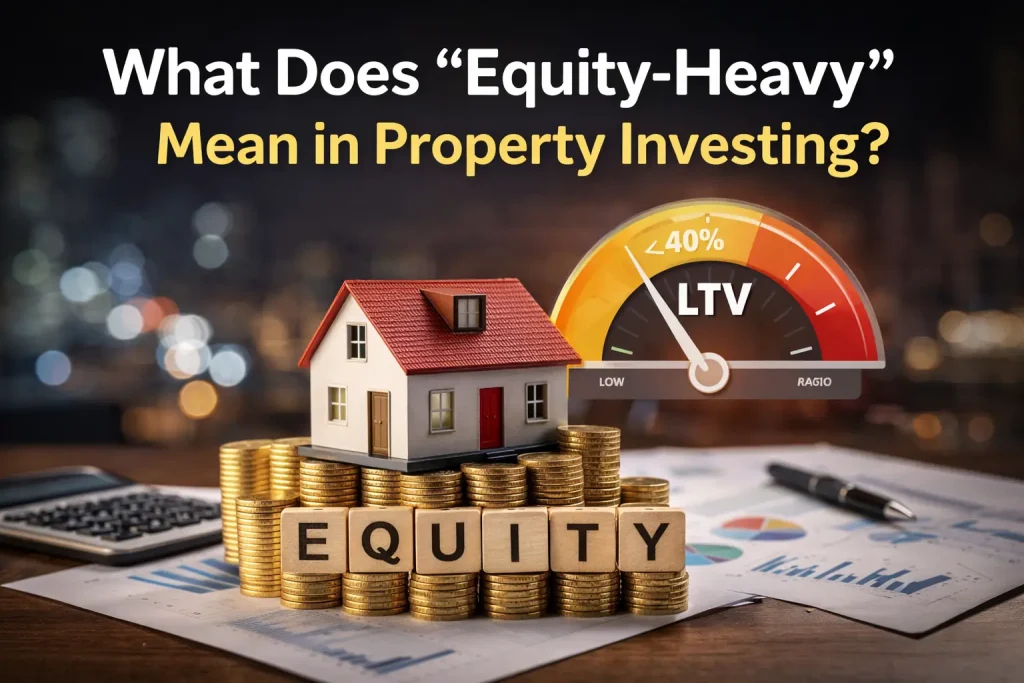
What Does “Equity-Heavy” Mean in Property Investing?
Before going further, it’s important to define the term clearly.
An equity-heavy property typically has one or more of the following traits:
- Very low Loan-to-Value (often below 40%)
- Owned outright or nearly mortgage-free
- Generates modest income relative to its market value
This is not an argument against owning property outright.
The issue is capital efficiency, not ownership style.
Equity that sits idle carries its own form of risk, even when it feels safe.
Why Equity Can Become a Risk Instead of a Buffer
Equity is often treated as a defensive shield.
In reality, it is a tool; and like any tool, its effectiveness depends on how it is used.
When equity grows faster than income, three things usually happen:
- Returns become diluted
- Flexibility decreases
- Decision-making slows down
This combination does not show up in year one or two.
It becomes visible over an entire cycle.
A Simple Equity-Heavy Example
Let’s look at a common real-world scenario.
Property details:
- Market value: £500,000
- Mortgage balance: £50,000
- Total equity: £450,000
- Monthly rent: £1,600 (£19,200 per year)
At first glance, this looks extremely safe:
- Minimal debt
- Strong equity buffer
- No lender pressure
Most investors would stop analysing here.
But safety changes once you ask a different question:
How hard is that £450,000 actually working?
The Metric Most Investors Overlook: Return on Equity (ROE)
Most landlords track:
- Rental yield
- Monthly cashflow
Very few track Return on Equity (ROE) — despite it being one of the clearest indicators of portfolio efficiency.
What Is Return on Equity?
Return on Equity measures how much income your tied-up capital is actually producing.
It shifts the focus from the property to your money.
ROE Formula
Annual Net Income ÷ Total Equity = Return on Equity (ROE)
ROE Calculation Example
- Annual net income (after costs): £12,000
- Total equity: £450,000
£12,000 ÷ £450,000 = 2.67% ROE

This means £450,000 of capital is producing a return that is:
- Lower than many low-risk alternatives
- Exposed to regulation and political change
- Dependent on tenant behaviour
- Subject to maintenance and void risk
This is where hidden portfolio risk begins.
Why Yield Alone Creates a False Sense of Comfort
A common response from investors is:
“But the yield is still fine.”
Yield measures the property.
Return On Equity (ROE) measures your capital.
A property yielding 4% on value can still deliver a weak ROE if most of the purchase is funded with equity.
Ignoring ROE is how portfolios become:
- Asset-rich
- Income-poor
- Slow to adapt
This distinction is often missed and rarely discussed openly.
You can easyly analyse a deal through the Property Investment Analysis Tool.
Hidden Risk #1: Opportunity Cost (The Risk You Never See)
Opportunity cost never appears on spreadsheets.
But over time, it becomes one of the most powerful forces shaping portfolio outcomes. Even if you are a Buy-to-let landlord, this can shape your property outcomes.
Every pound trapped in low-performing equity is a pound not being used to:
- Acquire additional income-producing assets
- Spread risk across locations or strategies
- Improve resilience against voids or regulation
- Fund value-add or redevelopment opportunities
- Build scalable income streams
Reframing £450,000 of Idle Equity
That same £450,000 could:
- Act as deposits on 4–6 additional properties
- Support multiple refurbishment or conversion projects
- Be recycled through several investment cycles
- Balance higher-yield assets with lower-risk holdings
The risk is not leverage.
The risk is capital inactivity.
Hidden Risk #2: Income Fragility Disguised as Safety
Low leverage does not guarantee strong or resilient income.
Equity-heavy properties often suffer from:
- Weak rental yield relative to value
- Limited rent growth headroom
- Higher council tax and maintenance exposure
- Concentration in premium markets
A Common UK Trap
Many London and South-East landlords own:
- £700,000–£1,000,000 properties
- Producing £2,000–£2,500 per month
- With minimal or no mortgage
If a tenant leaves or costs rise, income stress appears quickly — despite low LTV.
True safety comes from income reliability, not debt avoidance.
See: Buy-to-Let vs Flip Analysis.
Hidden Risk #3: Inflation Quietly Erodes Equity
Inflation punishes idle capital.
If inflation averages 4% and your ROE is 2.5%, your real return is negative.
That means:
- Purchasing power declines annually
- Equity feels safe but weakens
- Growth must outperform inflation just to stand still
Moderate leverage can hedge inflation.
Excess equity often magnifies inflation’s impact instead.
Hidden Risk #4: Tax Inefficiency
Equity-heavy properties often generate:
- High gross income
- But poor net efficiency
Why?
- Income tax applies regardless of leverage
- Capital gains tax applies on full uplift
- No interest offset
- No refinancing means no capital recycling
Paradoxically, many so-called low-risk landlords pay more tax per pound earned than moderately leveraged investors with structured portfolios.
Hidden Risk #5: Behavioural Traps and Decision Paralysis
As equity builds, behaviour changes.
Common patterns include:
- Reluctance to refinance “just in case”
- Emotional attachment to long-held assets
- Avoidance of selling due to tax friction
- Overconfidence in long-term capital growth
This leads to portfolio stagnation — assets are held for comfort, not performance.
The Illusion of Control
High equity creates a feeling of control.
But control without flexibility is fragile.
True control comes from:
- Liquidity
- Optionality
- Redeployable capital
Not from assets that are difficult to move.
Equity-Heavy vs Balanced Portfolio: A Comparison
Scenario A: Equity-Heavy Portfolio
- 3 properties @ £500k = £1.5m
- Mortgages: £150k
- Equity: £1.35m
- Net income: £36,000 per year
- ROE: 2.67%
Scenario B: Balanced Portfolio
- 6 properties @ £300k = £1.8m
- Mortgages: £900k
- Equity: £900k
- Net income: £72,000 per year
- ROE: 8%
Same exposure.
Same responsibility.
Very different outcomes.
When Equity-Heavy Properties Do Make Sense
Equity-heavy positions can be rational when:
- Significant planning or redevelopment upside exists
- The asset anchors wider portfolio stability
- External income reduces dependency on returns
- Risk tolerance is genuinely very low
The danger lies in drifting into equity-heavy positions without review.
The Portfolio Stress Test Most Investors Never Run
Ask yourself:
- If I sold this property tomorrow, where would the capital work harder?
- What is my true ROE across the portfolio?
- Which assets are income-efficient vs equity-heavy?
- What happens if rents stagnate for five years?
- Which holdings are emotional rather than rational?
These questions reveal risk faster than LTV ever will.
You can take a look at the Hold Vs Sell property Analysis that the professional home traders use for profitability.
Why Equity Risk Matters More From 2026
Several trends magnify equity inefficiency:
- Slower capital growth assumptions
- Higher compliance and regulation costs
- More cautious lending criteria
- Rising opportunity costs elsewhere
- Greater scrutiny of portfolio performance
The idea that “low debt equals safety” is fading.
The new benchmark is capital efficiency with resilience.
A Smarter Definition of Portfolio Safety
True portfolio safety comes from:
- Diversified income streams
- Measured, intentional leverage
- Recyclable capital
- Strong ROE
- Liquidity and flexibility
- Clear exit logic
Not from dormant equity.
Final Thought: Equity Is a Tool, Not a Trophy
Equity should be working, not resting.
If your portfolio feels safe but grows slowly, lacks flexibility, or underperforms inflation, the risk is subtle — but real.
The most resilient investors don’t chase leverage or avoid it.
They allocate equity deliberately, review it regularly, and move it when it stops pulling its weight.
That is how portfolios survive cycles — and grow through them.
Subtle, But True
If you want clarity on which properties are working — and which are quietly holding you back — structured analysis consistently beats instinc

Koye Beckley is a UK property investor and founder of UncommonDeal, with practical experience in buy-to-let, property auctions, refurbishment projects and investment deal analysis. Through UncommonDeal, he publishes property market research, property deal sourcing and compliance guidance, investment guides and data-driven analysis to help investors evaluate buy-to-let, BRRR, flip and auction opportunities.
