14 Steps Professional Property Investors Use to Evaluate Property Deals
Evaluate property deals like a professional investor, and you’ll quickly discover that successful investing is about far more than finding a property with a low asking price. Many new investors focus almost entirely on whether a property appears “cheap”, assuming that buying below market value automatically makes it a good investment. In reality, experienced investors know that a property’s purchase price is only one piece of the puzzle.
Professional property investors rely on a structured evaluation process that considers every aspect of a deal, including refurbishment costs, finance, rental demand, cash flow, projected returns, exit strategies, market conditions, and potential risks. A property that looks like a bargain on paper can quickly become an expensive mistake if these factors are overlooked, while a higher-priced property may deliver far stronger long-term returns when the numbers are analysed correctly.
Rather than relying on instinct or emotion, successful investors use a consistent framework to assess every opportunity against predefined investment criteria. This disciplined approach helps remove guesswork, reduce risk, and identify deals that genuinely meet their financial objectives.
In this guide, you’ll learn the same step-by-step framework professional property investors use to evaluate property deals in the UK. Whether you’re considering a buy-to-let, BRRR, property flip, HMO, auction purchase, or another investment strategy, this process will help you analyse opportunities with greater confidence and make more informed investment decisions.
If you’re new to property investing, our collection of property investment tools and guides can help you analyse opportunities with greater confidence.
1. Start With the Investment Strategy
Before you evaluate any property deal, the first question you should ask is “What is my investment strategy?” Professional property investors never analyse every opportunity using the same criteria because different strategies have different objectives, costs, financing requirements, risk profiles, and return expectations.
For example, a property that performs well as a buy-to-let investment may not generate enough profit for a property flip, while a property that is unsuitable for long-term rental could become an excellent small development opportunity. Defining your strategy from the outset ensures you’re measuring the deal against the right success criteria.
Buy-to-Let (BTL)
Buy-to-let investors focus on generating consistent rental income and long-term capital growth. When evaluating a BTL property, key metrics typically include:
- Rental yield
- Monthly cash flow
- Mortgage affordability
- Tenant demand
- Running costs
- Long-term appreciation potential
A property with a modest purchase price but weak rental demand may produce lower returns than a more expensive property in a stronger rental market.
Related guide: Rental Yield Guide.
BRRR (Buy, Refurbish, Refinance, Rent)
The BRRR strategy requires investors to purchase below market value, add value through refurbishment, refinance based on the improved value, and retain the property as a rental investment.
When analysing a BRRR opportunity, investors should consider:
- Purchase price
- Refurbishment costs
- Expected Gross Development Value (GDV)
- Refinanced loan amount
- Capital left in the deal
- Long-term rental cash flow
A successful BRRR deal aims to recycle as much invested capital as possible while creating a profitable rental asset.
Property Flip
Property flipping focuses on creating value over a relatively short period before selling the property for a profit. Unlike buy-to-let investing, rental income is less important than controlling costs and protecting profit margins.
Professional investors will typically assess:
- Purchase price
- Refurbishment budget
- Selling costs
- Finance costs
- Holding costs
- Expected sale price (GDV)
- Projected profit and return on investment (ROI)
Many experienced investors also set a minimum acceptable profit before proceeding with a project.
House in Multiple Occupation (HMO)
HMOs can generate significantly higher rental income than standard buy-to-let properties, but they also involve greater complexity and stricter regulations.
When evaluating an HMO opportunity, investors should review:
- Local licensing requirements
- Planning restrictions (where applicable)
- Room sizes and layout
- Refurbishment and conversion costs
- Expected room rents
- Occupancy levels
- Ongoing management costs
Higher income potential often comes with higher operational responsibilities and compliance requirements.
Commercial Conversion
Commercial-to-residential conversions can unlock substantial value but require careful due diligence. Investors should assess:
- Planning or permitted development rights
- Conversion costs
- Structural condition
- Utility upgrades
- Local demand for residential accommodation
- End values and exit options
Because these projects involve additional risks, accurate cost estimates and contingency planning are essential.
Small Development Projects
Small developments—such as building new homes, extending existing properties, or converting larger buildings into multiple units—are typically evaluated as development projects rather than standard property investments.
Important considerations include:
- Land acquisition costs
- Planning permission
- Build costs
- Professional fees
- Infrastructure and utility costs
- Sales values (GDV)
- Development finance
- Project timescales
- Developer profit margin
These projects can deliver attractive returns, but they also require careful project management and robust financial planning.
Choose the Right Framework Before You Analyse
One of the biggest mistakes inexperienced investors make is analysing every property using the same calculations. Professional investors understand that each investment strategy has different objectives, so they tailor their analysis accordingly.
By identifying your strategy first, you’ll know which financial metrics matter most, which risks to assess, and whether a property genuinely fits your investment goals before committing your time and money.
Related resources:
- Property Deal Sourcing UK
- Property Auction Investment Guide
- Deal Stack-Up Calculator
- Auction ROI Calculator
Before evaluating a deal, it’s important to understand which property investment strategy best matches your objectives and available capital.
2. Verify the Property Fundamentals
Before you start calculating yields, profits, or return on investment (ROI), it’s essential to verify the property’s fundamentals. Even the most attractive-looking deal can become a poor investment if there are underlying issues that affect its value, marketability, financing, or future exit strategy.
Professional property investors always carry out an initial due diligence review before spending time analysing the numbers. This helps identify potential deal breakers early and ensures that any financial projections are based on accurate information.
Location
Location remains one of the most important factors influencing a property’s long-term performance. A well-priced property in a weak location may struggle to attract tenants or buyers, while a property in a desirable area can benefit from stronger rental demand and capital growth.
When assessing a location, consider:
- Local rental demand
- Sold property prices
- Population growth
- Regeneration projects
- Employment opportunities
- Schools and universities
- Public transport links
- Shops and local amenities
- Crime levels
The goal is to understand not only what the area looks like today, but how it may perform over the coming years.
Property Type
Different property types appeal to different buyers, tenants, and investment strategies.
Ask yourself:
- Is it a house or a flat?
- Is it freehold or leasehold?
- Is it suitable for Buy-to-Let, BRRR, HMO, or flipping?
- Does it match demand in the local market?
- Is it likely to be easy to refinance or sell?
A property should align with both your investment strategy and the needs of your target market.
Tenure
The property’s tenure can significantly affect its value, financing options, and future costs.
Common types include:
- Freehold
- Leasehold
- Share of Freehold
If the property is leasehold, review:
- Remaining lease length
- Ground rent
- Service charges
- Restrictive covenants
- Planned major works
These ongoing costs can materially affect your investment returns.
Related guide: Freehold vs Leasehold vs Share of Freehold: What’s the Difference for UK Property Investors?
EPC Rating
A property’s Energy Performance Certificate (EPC) rating is becoming increasingly important for landlords and investors due to evolving energy efficiency regulations.
Review:
- Current EPC rating
- Recommended improvements
- Estimated upgrade costs
- Potential impact on future lettings
If significant improvements are required to meet legal standards, these costs should be factored into your overall investment appraisal.
Planning Issues
Planning restrictions can affect both your current strategy and future development opportunities.
Check whether the property has:
- Existing planning permissions
- Article 4 Directions (where applicable)
- Conservation area restrictions
- Listed building status
- Outstanding planning enforcement issues
- Development potential
For conversion or development projects, planning due diligence is particularly important before committing to a purchase.
Structural Concerns
Major structural issues can significantly increase refurbishment costs and project timelines.
Look out for signs of:
- Subsidence
- Damp
- Roof defects
- Timber decay
- Cracked walls
- Uneven floors
- Water damage
- Drainage problems
Where necessary, obtain professional surveys before proceeding. Unexpected structural repairs can quickly erode your projected profits.
Occupancy Status
Understanding who occupies the property—and under what circumstances—is essential before making an offer.
Establish whether the property is:
- Vacant
- Owner-occupied
- Tenant-occupied
- Sold with vacant possession
- Subject to an existing tenancy agreement
- Being sold at auction with occupiers in place
For investment properties, review tenancy agreements, rental income, and tenant history where available. Occupancy status can affect completion times, financing, refurbishment plans, and your chosen exit strategy.
Complete Your Due Diligence Before Crunching the Numbers
Professional property investors know that accurate financial analysis depends on accurate information. Verifying the property’s fundamentals before calculating yields or profits helps identify hidden risks, avoid costly surprises, and ensure you’re evaluating the right opportunity.
Once you’ve confirmed the property’s location, tenure, condition, legal status, and suitability for your chosen investment strategy, you can move on to analysing the financial performance with greater confidence.
3. Understand the Local Market Before You Evaluate Property Deals
Once you’ve verified the property’s fundamentals, the next step is to understand the local property market. A property’s performance is influenced not only by its condition and purchase price but also by the area in which it is located. Professional property investors spend time researching local market conditions before making any investment decision, as this helps them identify opportunities, minimise risk, and make realistic financial projections.
The aim is to answer one simple question:
“Is this property in a market that supports my investment strategy?”
Whether you’re investing for rental income, capital growth, refurbishment, or development, understanding the local market provides the context behind the numbers.
Sold Prices
One of the first things experienced investors examine is recent sold prices rather than just current asking prices. Asking prices reflect what sellers hope to achieve, whereas sold prices show what buyers have actually been willing to pay.
Compare the property with similar homes that have recently sold in the same area, taking into account:
- Property type
- Number of bedrooms
- Size and layout
- Condition
- Tenure
- Location
This research helps you determine whether the asking price represents fair value and supports your estimated Gross Development Value (GDV) or future resale price.
You can also verify historic sold prices and ownership information using the HM Land Registry property search service before committing to a purchase.
Rental Demand
If your strategy involves generating rental income, understanding tenant demand is essential. A property with an attractive purchase price can still perform poorly if it remains empty for extended periods.
Research factors such as:
- Average rental prices
- Time taken to let similar properties
- Tenant demographics
- Demand from families, professionals, or students
- Availability of competing rental properties
Strong rental demand generally leads to lower void periods and more stable long-term cash flow.
Vacancy Rates
Vacancy rates provide valuable insight into how quickly properties are being occupied within the local area. High vacancy levels may indicate weak demand, oversupply, or changing market conditions.
When assessing vacancy risk, consider:
- Local rental supply
- Seasonal fluctuations
- New housing developments
- Average void periods
- Population growth
Professional investors often build realistic vacancy assumptions into their financial projections rather than assuming their property will remain occupied throughout the year.
Regeneration
Areas undergoing regeneration can present attractive long-term investment opportunities. Improvements to infrastructure, housing, employment, or public services can increase demand and support future property values.
Look for signs such as:
- New residential developments
- Town centre regeneration projects
- Business investment
- Infrastructure upgrades
- New retail or leisure facilities
- Government-funded initiatives
While regeneration can create opportunities, investors should also evaluate project timelines and avoid relying solely on future promises when assessing a deal.
Schools
For many residential property investments, particularly family homes, the quality of nearby schools plays an important role in buyer and tenant demand.
Consider:
- School performance ratings
- Distance to primary and secondary schools
- Catchment areas
- Reputation within the local community
Properties located close to well-regarded schools often experience stronger demand and may benefit from greater long-term resilience.
Transport Links
Good transport connections make a property more attractive to both tenants and owner-occupiers. Easy access to employment centres, public transport, and major road networks can positively influence rental demand and resale value.
Assess factors including:
- Train stations
- Bus routes
- Motorway access
- Commuting times
- Walking and cycling routes
- Planned transport improvements
A well-connected location is often a key factor in attracting reliable tenants and supporting future capital growth.
Build Your Investment Decision on Local Evidence
Professional property investors don’t rely on assumptions or marketing brochures—they rely on local market data. By researching sold prices, rental demand, vacancy rates, regeneration projects, schools, and transport links, you gain a clearer understanding of whether an investment is likely to achieve your financial objectives.
Strong local market research not only helps you estimate realistic returns but also provides greater confidence when negotiating the purchase price, planning your investment strategy, and assessing the property’s long-term potential.
You can also browse our latest investment opportunities to compare asking prices and rental potential across different locations
4. Estimate the Purchase Costs
One of the biggest mistakes inexperienced investors make is focusing solely on the property’s asking price. Professional property investors know that the purchase price is only one component of the total acquisition cost. A deal that appears profitable can quickly become unviable if you underestimate the additional costs involved in completing the purchase.
Before calculating rental yields, return on investment (ROI), or projected profits, prepare a realistic acquisition budget that includes every expense associated with buying the property. This provides a more accurate picture of the capital required and helps avoid costly surprises during the transaction.
Purchase Price
The purchase price forms the foundation of your investment appraisal, but it should always be viewed in the context of the property’s market value and your chosen investment strategy.
Ask yourself:
- Is the asking price supported by recent sold prices?
- Can the price be negotiated?
- Does it provide enough margin for your target returns?
- Is there sufficient equity to support refinancing or resale?
Professional investors rarely assess a property based on its advertised price alone—they assess whether the purchase price leaves enough room for profit after all costs have been taken into account.
Stamp Duty Land Tax (SDLT)
For most investment purchases in England and Northern Ireland, Stamp Duty Land Tax (SDLT) represents one of the largest upfront costs after the purchase price itself.
The amount payable depends on several factors, including:
- Purchase price
- Whether the property is an additional property
- Whether you’re buying as an individual or through a limited company
- Current government tax rates and reliefs
Because SDLT can significantly affect your overall investment costs, it should always be included in your financial calculations before making an offer.
Legal Fees
Every property transaction involves legal work, and these costs should be budgeted from the outset.
Typical legal costs may include:
- Conveyancing solicitor fees
- Local authority searches
- Land Registry fees
- Identity verification
- Bank transfer charges
- Leasehold enquiries (where applicable)
Although legal fees are relatively small compared with the purchase price, they remain an essential part of the total acquisition cost.
Survey Costs
A professional survey can help identify issues that may not be immediately visible during a property viewing. Investing in the right survey can prevent unexpected repair costs and provide valuable information when negotiating the purchase price.
Depending on the property and your investment strategy, you may require:
- Mortgage valuation
- HomeBuyer Report
- Building Survey
- Structural Engineer’s Report
- Damp and Timber Survey
- Specialist reports where necessary
For refurbishment or development projects, survey findings can have a significant impact on your estimated renovation budget.
Auction Fees
If you’re purchasing through a property auction, remember that the hammer price is rarely the final amount you will pay.
Additional costs often include:
- Buyer’s premium
- Administration fees
- Reservation fees (where applicable)
- Legal pack costs
- Search fees
- Completion deadlines that may increase finance costs
Auction properties can offer excellent opportunities, but investors should review all associated fees before bidding to ensure the deal remains financially viable.
Related guide: Property Auction Investment Guide.
Finance Fees
Borrowing costs can have a significant impact on your overall returns, particularly for short-term projects such as property flips, BRRR investments, or developments.
Typical finance costs may include:
- Mortgage arrangement fees
- Bridging loan fees
- Valuation fees
- Broker fees
- Interest payments
- Exit fees
- Lender legal fees
These costs should be incorporated into your investment appraisal rather than treated as unexpected expenses later in the project.
Calculate the Total Acquisition Cost
Professional investors don’t ask, “How much does this property cost?” Instead, they ask, “How much capital will I need to acquire this property?”
By combining the purchase price with taxes, legal fees, surveys, auction costs, and finance charges, you can calculate the property’s true acquisition cost. This figure forms the foundation for every financial calculation that follows, including refurbishment costs, projected returns, rental yields, and overall profitability.
Only once you’ve established the total cost of acquiring the property can you accurately evaluate whether the investment meets your financial objectives.
5. Calculate the Refurbishment Costs
Accurately estimating refurbishment costs is one of the most important parts of evaluating a property deal. Many investment opportunities appear highly profitable until renovation costs are taken into account. Professional property investors understand that underestimating refurbishment expenses is one of the quickest ways to reduce profits or turn a promising investment into a financial loss.
Rather than relying on rough estimates or guesswork, experienced investors assess the property’s condition, identify the scope of work required, obtain realistic quotations where possible, and include a contingency for unexpected issues. The more accurate your refurbishment budget, the more reliable your investment appraisal will be.
Light Refurbishment
A light refurbishment typically focuses on cosmetic improvements that make the property more attractive to buyers or tenants without altering its structure.
Common examples include:
- Internal painting and decorating
- Replacing flooring or carpets
- Updating light fittings
- Minor kitchen improvements
- Bathroom refreshes
- New internal doors and handles
- Garden tidy-up
- General repairs and maintenance
These projects are usually completed quickly and can often add value with relatively modest investment.
Medium Refurbishment
A medium refurbishment involves more substantial improvements that enhance both the appearance and functionality of the property.
Typical work may include:
- Installing a new kitchen
- Replacing a bathroom suite
- Rewiring parts or all of the property
- Upgrading plumbing systems
- Installing new windows and doors
- Replacing central heating systems
- Improving insulation
- Replastering multiple rooms
These projects require larger budgets and longer project timelines but can significantly improve the property’s market value and rental appeal.
Heavy Refurbishment
Heavy refurbishment projects involve extensive renovation and are commonly found in properties that have been neglected, repossessed, inherited, or purchased at auction.
Examples include:
- Full property renovations
- Complete internal strip-outs
- Roof replacement
- Extensive damp treatment
- Major electrical and plumbing upgrades
- Internal reconfiguration
- Full refurbishment of kitchens and bathrooms
- External repairs and rendering
Because these projects carry greater complexity, investors should obtain detailed quotations from experienced contractors before committing to the purchase.
Structural Works
Structural issues represent some of the highest-risk and highest-cost elements of any refurbishment project. They often require specialist advice and should never be estimated without appropriate professional input.
Examples include:
- Subsidence repairs
- Foundation works
- Structural wall alterations
- Steel beam installations
- Chimney repairs or removal
- Roof structure replacement
- Floor strengthening
- Major drainage works
If structural concerns are identified during surveys or inspections, it is advisable to obtain reports from qualified structural engineers before finalising your investment calculations.
Allow for a Contingency Budget
No refurbishment project goes exactly as planned. Hidden defects, material price increases, and unforeseen repairs can all increase costs once work begins.
Professional property investors therefore include a contingency fund within every refurbishment budget. This contingency provides a financial buffer for unexpected expenses and helps prevent projects from exceeding available capital.
Examples of unforeseen costs include:
- Hidden damp
- Timber decay
- Asbestos removal
- Electrical faults
- Plumbing leaks
- Building regulation requirements
- Material price increases
- Additional labour costs
Including a realistic contingency is a sign of prudent financial planning, not pessimism.
Base Your Investment Decision on Realistic Refurbishment Costs
Successful property investors understand that refurbishment costs directly influence profitability, refinancing potential, and return on investment. A small error in estimating renovation costs can significantly reduce projected profits, particularly on property flips, BRRR projects, and development opportunities.
Where possible, obtain quotations from reputable contractors before exchanging contracts, and always review survey findings alongside your refurbishment budget. By accurately assessing cosmetic improvements, major renovations, structural works, and contingency costs, you’ll create a more reliable financial appraisal and make better-informed investment decisions.
Next step: Once you’ve established your total acquisition and refurbishment costs, the next stage is to estimate the property’s Gross Development Value (GDV) and assess whether the investment is likely to achieve your target returns.
For larger renovation projects, consider using a surveyor or building professional who follows standards set by the Royal Institution of Chartered Surveyors (RICS).
6. Estimate the End Value
Once you’ve calculated your acquisition and refurbishment costs, the next step is to estimate what the property will be worth after the work has been completed. This is commonly referred to as the end value or Gross Development Value (GDV). It plays a critical role in determining whether an investment is financially viable.
Professional property investors never rely on optimistic assumptions when estimating end value. Instead, they use market evidence, comparable sales, rental data, and local demand to produce realistic projections. Overestimating the property’s future value is one of the most common reasons investment deals fail to achieve their expected returns.
Analyse Comparable Sales
The most reliable way to estimate a property’s end value is by reviewing recently completed sales of similar properties in the surrounding area.
When selecting comparable properties, consider:
- Property type
- Number of bedrooms
- Floor area
- Condition after refurbishment
- Tenure
- Location
- Date of sale
Ideally, compare properties that have sold within the last six to twelve months, as these provide the most accurate indication of current market value.
Remember that asking prices reflect what sellers hope to achieve, while sold prices show what buyers have actually been willing to pay.
Estimate the Gross Development Value (GDV)
The Gross Development Value (GDV) is the estimated market value of a property after all planned refurbishment, conversion, or development works have been completed.
For investors undertaking a refurbishment, BRRR project, property flip, or small development, GDV is one of the most important figures in the investment appraisal.
Your estimated GDV influences:
- Projected profit
- Return on investment (ROI)
- Refinancing potential
- Loan-to-value calculations
- Exit strategy
A conservative approach is generally preferable. Professional investors would rather underestimate the final value than build an investment case around unrealistic expectations.
Assess the Rental Valuation
If your investment strategy involves retaining the property, understanding its expected rental value is just as important as estimating its sale price.
Research similar rental properties in the area to determine:
- Expected monthly rent
- Rental demand
- Property condition
- Furnished or unfurnished status
- Tenant expectations
Accurate rental projections allow you to calculate:
- Gross rental yield
- Cash flow
- Return on investment
- Mortgage affordability
- Long-term income potential
Using realistic rental figures helps ensure that the property will continue to perform financially after acquisition.
Evaluate Investor Demand
A property’s value is influenced not only by comparable sales but also by the level of demand from buyers and investors within the local market.
Ask yourself:
- Is this a desirable area for owner-occupiers?
- Are landlords actively buying in this location?
- Is there strong demand for refurbished properties?
- How quickly are similar properties selling?
- Are there enough comparable transactions to support your valuation?
Strong investor and buyer demand can improve liquidity, reduce selling times, and provide greater confidence in your projected exit strategy.
Use Conservative Assumptions
One of the hallmarks of experienced property investors is that they avoid relying on best-case scenarios. Instead, they use conservative assumptions when estimating both sale values and rental income.
A deal should remain financially attractive even if:
- The property sells for slightly less than expected.
- Rental income is lower than projected.
- Market conditions soften before completion.
- The sale takes longer than anticipated.
Stress-testing your assumptions helps protect your investment and reduces the likelihood of unpleasant surprises later in the project.
Build Your Financial Appraisal on Realistic Values
Estimating the end value is about much more than predicting what a property might be worth. It provides the foundation for calculating profitability, refinancing potential, rental performance, and overall investment returns.
By analysing comparable sales, estimating a realistic Gross Development Value (GDV), assessing rental valuations, and understanding local investor demand, you can make investment decisions based on market evidence rather than optimism.
Once you’ve established a realistic end value, you’re ready to calculate the key financial metrics that determine whether the property is genuinely worth investing in.
7. Analyse the Rental Potential
For buy-to-let investors, BRRR investors, and anyone planning to hold a property as a long-term investment, analysing the rental potential is just as important as estimating the purchase price or refurbishment costs. A property may look attractive on paper, but if it cannot generate sufficient rental income to cover its costs and produce an acceptable return, it may not be the right investment.
Professional property investors don’t simply ask, “How much rent could this property achieve?” They ask, “Will the rental income support my investment objectives?” This means assessing not only the expected rent but also the property’s yield, monthly cash flow, potential void periods, and ongoing management costs.
Estimate the Expected Rent
The first step is to establish a realistic monthly rental figure based on evidence rather than assumptions.
Research comparable rental properties that are similar in terms of:
- Property type
- Number of bedrooms
- Condition
- Location
- Furnished or unfurnished status
- Included amenities
Where possible, compare properties that have recently been let rather than simply advertised, as asking rents may not always reflect the final agreed rental amount.
A conservative rental estimate provides a stronger foundation for your financial analysis and helps avoid overestimating future returns.
Calculate the Rental Yield
Rental yield is one of the most commonly used metrics for comparing investment properties. It provides a quick indication of how much rental income a property generates relative to its purchase price or total investment.
When analysing yield, investors should consider:
- Gross rental yield
- Net rental yield
- Total investment cost
- Local market averages
- Alternative investment opportunities
While a higher yield can be attractive, it should always be assessed alongside property condition, tenant demand, capital growth potential, and overall investment risk.
Related guide: Rental Yield Guide.
Assess the Monthly Cash Flow
Positive cash flow is one of the primary objectives for many long-term property investors. Rather than focusing solely on rental income, professional investors calculate the amount of money that remains after all operating expenses have been paid.
Typical monthly costs include:
- Mortgage repayments
- Insurance
- Service charges (where applicable)
- Ground rent (for leasehold properties)
- Maintenance
- Letting agent fees
- Property management
- Safety certificates and compliance costs
A property that produces strong positive cash flow is generally more resilient during changing market conditions than one operating with very little financial margin.
Allow for Void Periods
No rental property remains occupied continuously forever. Even in areas with strong tenant demand, there may be periods between tenancies when the property generates little or no rental income.
Professional investors build realistic assumptions into their financial models by allowing for:
- Tenant move-outs
- Marketing periods
- Property cleaning
- Minor maintenance works
- Referencing and tenancy administration
- Seasonal fluctuations in demand
Factoring void periods into your calculations provides a more realistic picture of long-term rental performance.
Include Property Management Costs
Managing a rental property involves ongoing responsibilities and expenses that should not be overlooked during the investment appraisal.
Depending on your approach, costs may include:
- Letting agent fees
- Full property management services
- Rent collection
- Maintenance coordination
- Periodic inspections
- Compliance administration
- Emergency repairs
Even if you intend to self-manage the property initially, it’s sensible to include an allowance for management costs. This helps you understand the property’s true profitability and gives you flexibility should your circumstances change in the future.
Focus on Sustainable Rental Performance
Professional property investors don’t judge a rental property solely by its advertised rent. They evaluate whether the investment can consistently generate reliable income after accounting for operating costs, vacancies, and ongoing management expenses.
A property with slightly lower rental income but strong tenant demand, low vacancy rates, and healthy cash flow may prove to be a better long-term investment than one offering a higher headline rent but greater financial risk.
By carefully analysing expected rent, rental yield, monthly cash flow, void periods, and management costs, you’ll gain a far clearer understanding of the property’s long-term income potential and whether it aligns with your investment strategy.
Next step: Once you’ve assessed the property’s rental performance, it’s time to stress-test your financial assumptions to ensure the investment remains profitable under less favourable market conditions.
8. Stress-Test the Finance
A property deal should not only work when everything goes according to plan; in fact, it should still make financial sense when things don’t. This is one of the key differences between inexperienced investors and professional property investors. While many investors analyse a deal based on best-case assumptions, experienced investors deliberately test how the investment performs under less favourable conditions.
This process, often referred to as stress testing, helps identify potential risks before committing to a purchase. If a deal remains profitable after realistic downside scenarios have been considered, it is generally a far more resilient investment.
Consider Interest Rate Rises
Finance costs can change over the life of an investment, particularly if you’re using a variable-rate mortgage, bridging finance, or refinancing after refurbishment.
Ask yourself:
- What happens if interest rates increase?
- Will the property still generate positive cash flow?
- Can the rental income comfortably cover higher mortgage payments?
- Does the investment still meet your target return?
A deal that only works at today’s lowest borrowing rates may become far less attractive if financing costs increase.
Allow for a Longer Refurbishment Period
Refurbishment projects rarely finish exactly on schedule. Delays can arise due to contractor availability, material shortages, unexpected repairs, planning approvals, or adverse weather conditions.
A longer refurbishment period can result in:
- Additional finance costs
- Higher labour expenses
- Delayed refinancing
- Lost rental income
- Increased holding costs
When evaluating a project, consider how your financial projections would change if the refurbishment took several weeks—or even months—longer than expected.
Plan for a Longer Selling Period
If your exit strategy involves selling the property, don’t assume it will achieve a quick sale at the expected price.
Consider scenarios where:
- Buyer demand slows
- Mortgage approvals take longer
- Sales fall through
- Market conditions weaken
- Additional marketing time is required
A longer selling period increases holding costs, including mortgage interest, insurance, utilities, council tax, and maintenance. Professional investors ensure there is sufficient financial capacity to absorb these delays if necessary.
Test a Lower End Valuation
Valuations don’t always match expectations. Whether you’re selling the property or refinancing it, a lower-than-expected valuation can reduce profits and affect your financing options.
Ask yourself:
- What if the property is valued 5% to 10% below my estimate?
- Will the project still generate an acceptable profit?
- Can I still refinance the amount I expected?
- Will my return on investment remain attractive?
Using conservative valuation assumptions reduces the risk of overcommitting your finances.
Budget for Unexpected Costs
Unexpected expenses are common in property investment, regardless of the type or condition of the property.
These may include:
- Hidden structural defects
- Additional refurbishment works
- Survey recommendations
- Legal complications
- Planning requirements
- Increased material costs
- Contractor variations
- Utility upgrades
Professional investors recognise that unforeseen costs are part of the investment process and ensure adequate financial reserves are available to deal with them.
Always Prepare for the Worst-Case Scenario
Successful property investors don’t expect problems—they prepare for them. Before committing to any investment, they ask a series of questions:
- Can I still afford the project if costs increase?
- What happens if the refurbishment takes longer?
- Can the property remain profitable if interest rates rise?
- Will the investment still work if the valuation comes in lower than expected?
- Do I have sufficient cash reserves if something goes wrong?
If the answer to these questions is yes, the investment is likely to be far more resilient than one that only succeeds under ideal conditions.
Build Resilience Into Every Investment Decision
The purpose of stress testing is not to discourage investment—it is to improve decision-making. By challenging your assumptions and planning for realistic setbacks, you reduce financial risk and increase the likelihood of achieving your investment objectives.
Professional property investors understand that no project is entirely risk-free. However, by allowing for higher borrowing costs, longer project timescales, lower valuations, and unexpected expenses, they make informed decisions based on realistic scenarios rather than optimistic forecasts.
Next step: Once you’ve confirmed the investment remains financially viable under a range of scenarios, it’s time to calculate the key investment metrics—including rental yield, return on investment (ROI), cash-on-cash return, and projected profit—to determine whether the deal meets your investment criteria.
If you’re considering refinancing after refurbishment, our BRRR investment guide explains how the strategy works in practice.
9. Calculate the Key Investment Metrics
By this stage, you’ve assessed the property’s fundamentals, researched the local market, estimated your acquisition and refurbishment costs, projected its end value, analysed its rental potential, and stress-tested the financial assumptions. Now it’s time to bring everything together by calculating the key investment metrics.
Professional property investors don’t make decisions based on a single number. Instead, they evaluate several performance indicators to understand the profitability, cash flow, efficiency, and risk of an investment. Looking at multiple metrics provides a more balanced picture and helps you compare different opportunities objectively.
Rather than relying on spreadsheets or manual calculations, you can use the Deal Stack-Up Calculator to analyse your investment using the same metrics experienced investors use.
Gross Rental Yield
Gross rental yield provides a quick indication of how much rental income a property generates relative to its purchase price. It is often the first metric investors use when comparing multiple buy-to-let opportunities.
While gross yield is useful for comparing properties, it does not account for operating expenses, finance costs, or maintenance. For that reason, it should be viewed as a starting point rather than a complete measure of investment performance.
Net Rental Yield
Net rental yield provides a more realistic picture of investment performance because it considers the ongoing costs of owning and managing the property.
Typical expenses include:
- Letting agent fees
- Insurance
- Maintenance
- Ground rent and service charges
- Compliance costs
- Other recurring operating expenses
Professional investors generally place greater emphasis on net yield than gross yield because it reflects the property’s actual earning potential.
Return on Investment (ROI)
Return on Investment (ROI) measures how efficiently your investment generates profit relative to the total capital invested.
ROI allows investors to compare opportunities across different strategies, including:
- Buy-to-Let
- BRRR
- Property Flips
- Small Developments
A higher ROI generally indicates that your capital is working more effectively, although it should always be considered alongside risk, project duration, and cash flow.
Cash-on-Cash Return
Cash-on-cash return measures the annual income generated compared with the actual cash you have invested into the project.
This metric is particularly useful when using mortgage finance because it focuses on the return generated from your own capital rather than the property’s total value.
Professional investors often use cash-on-cash return to compare leveraged property investments with alternative investment opportunities.
BRRR Capital Left In
For investors using the Buy, Refurbish, Refinance, Rent (BRRR) strategy, one of the most important questions is:
“How much of my own money will remain tied up in the property after refinancing?”
The less capital left in the deal, the greater your ability to recycle funds into future investments.
Professional BRRR investors use this metric to assess whether a project supports long-term portfolio growth rather than simply generating a single profitable investment.
Flip Profit
For property flips, profitability is usually measured by the amount of money remaining after all acquisition, refurbishment, finance, legal, selling, and holding costs have been deducted.
When calculating projected flip profit, consider:
- Purchase costs
- Refurbishment costs
- Finance costs
- Estate agent fees
- Solicitor fees
- Stamp Duty
- Holding costs
- Selling price
Many experienced investors establish a minimum acceptable profit before proceeding with any refurbishment project.
Profit Margin
Profit margin measures how much profit is generated relative to the property’s total costs or sale value.
Unlike profit alone, profit margin helps investors compare projects of different sizes and determine how efficiently capital is being used.
A project with a high headline profit but a relatively low margin may involve greater risk than a smaller project with stronger overall efficiency.
Analyse Every Deal Using Consistent Metrics
Professional property investors don’t rely on instinct or optimistic assumptions—they rely on measurable financial data. By reviewing gross yield, net yield, ROI, cash-on-cash return, BRRR capital left in, flip profit, and profit margin together, you can make informed investment decisions based on evidence rather than emotion.
Using consistent performance metrics also makes it easier to compare different investment opportunities and identify which properties genuinely align with your financial objectives.
Calculate Your Property Investment Today
Instead of manually calculating every metric, use our Deal Stack-Up Calculator to evaluate your property investment in minutes.
The calculator helps you:
- Calculate Gross and Net Rental Yield
- Estimate Return on Investment (ROI)
- Measure Cash-on-Cash Return
- Analyse BRRR Capital Left In
- Project Flip Profit
- Review Profit Margin
- Compare different investment strategies using the same framework
Whether you’re analysing a Buy-to-Let, BRRR, Property Flip, or another investment opportunity, the Deal Stack-Up Calculator provides a structured way to evaluate deals before committing your money.
Ready to test your numbers? Use the Deal Stack-Up Calculator to analyse your next property investment and see whether it meets your investment criteria before making an offer.
10. Assess the Risks When You Evaluate Property Deals
Every property investment carries some level of risk. The difference between successful investors and those who make costly mistakes is not that professionals avoid risk altogether; it’s that they identify, assess, and manage it before committing their money.
Once you’ve established that a deal appears financially attractive, the next step is to evaluate the risks that could affect its profitability or prevent it from achieving your investment objectives. Professional property investors understand that a deal with slightly lower projected returns but manageable risks is often a better investment than one promising exceptional returns with significant uncertainty.
A structured risk assessment helps you decide whether the potential rewards justify the risks involved.
Market Risk
Property markets are constantly changing. Interest rates, economic conditions, government policy, and local supply and demand can all influence property values and rental performance.
Consider questions such as:
- Could local property prices fall?
- Is buyer demand slowing?
- Is rental demand increasing or declining?
- Are there large housing developments that could affect supply?
- How resilient is the local market during economic downturns?
Understanding market conditions helps you avoid making investment decisions based solely on current trends.
Planning Risk
For refurbishment, conversion, HMO, and development projects, planning considerations can have a major impact on the viability of an investment.
Assess whether:
- Planning permission is required.
- Permitted development rights apply.
- The property is located within a conservation area.
- Article 4 Directions affect your intended use.
- There are restrictive planning conditions.
- Future development plans could impact the property.
Failing to investigate planning issues early can lead to delays, increased costs, or projects that cannot proceed as intended.
Construction Risk
Every refurbishment or development project carries construction risk, regardless of its size.
Potential issues include:
- Hidden structural defects
- Contractor delays
- Material shortages
- Cost overruns
- Poor workmanship
- Health and safety issues
- Changes to the scope of work
Obtaining professional surveys, detailed quotations, and working with experienced contractors can significantly reduce construction-related risks.
Finance Risk
Most property investments rely on some form of external finance, making borrowing costs and lender requirements important considerations.
Review factors such as:
- Interest rate changes
- Mortgage approval conditions
- Bridging loan repayment deadlines
- Refinancing risk
- Loan-to-value requirements
- Cash flow during the project
Professional investors also ensure they have sufficient cash reserves to deal with unexpected financing challenges without placing the project under unnecessary pressure.
Legal Risk
Legal issues can delay transactions, increase costs, or prevent an investment from progressing altogether.
Areas to investigate include:
- Property title
- Restrictive covenants
- Lease terms
- Boundary disputes
- Easements and rights of way
- Outstanding planning enforcement
- Occupancy status
- Legal pack (for auction properties)
Working with an experienced property solicitor and carrying out thorough legal due diligence can help identify potential issues before contracts are exchanged.
Exit Strategy Risk
Every investment should have a clearly defined exit strategy before the purchase is completed.
Ask yourself:
- Can the property be sold quickly if necessary?
- Will there be sufficient buyer demand?
- Is refinancing a realistic option?
- Could the property be retained as a rental if market conditions change?
- What happens if your preferred exit strategy is no longer viable?
Professional investors rarely rely on a single exit plan. Instead, they consider multiple options that provide flexibility if market conditions change.
Risk Should Influence Every Investment Decision
Assessing risk doesn’t mean avoiding every investment opportunity—it means understanding where the greatest risks exist and deciding whether they can be managed effectively.
Many experienced investors use a simple principle:
- High return + Low risk = Strong opportunity
- High return + High risk = Proceed with caution
- Low return + High risk = Usually avoid
This balanced approach helps prevent emotional decision-making and encourages investments that offer an appropriate level of reward for the risks involved.
Manage Risk Before You Commit Your Capital
Professional property investors know that profitability alone doesn’t make a property a good investment. A successful deal combines strong financial performance with manageable levels of market, planning, construction, finance, legal, and exit strategy risk.
By identifying these risks before exchanging contracts, you can make more informed decisions, negotiate from a stronger position, and reduce the likelihood of unexpected problems affecting your investment.
Next step: Once you’ve assessed both the financial performance and the associated risks, the final stage is to decide whether the property meets your investment criteria—or whether it’s time to walk away and focus on a better opportunity.
11. Decide Whether the Deal Meets Your Criteria
After completing your due diligence, analysing the financial performance, and assessing the risks, there is one final question to answer:
Does this property actually meet your investment criteria?
This is where disciplined investors separate themselves from emotional buyers. Rather than falling in love with a property or trying to justify a marginal deal, professional investors compare the opportunity against a set of predefined investment rules.
These rules are established before any property is analysed. This approach removes emotion from the decision-making process and ensures every investment is assessed consistently.
Set Clear Investment Criteria
Every investor’s goals are different, so there is no single set of criteria that applies to everyone. Your investment rules should reflect your chosen strategy, available capital, appetite for risk, and long-term objectives.
Before making an offer, define what success looks like for your business.
For example, you might require:
- A minimum projected profit
- A target rental yield
- A minimum return on investment
- Positive monthly cash flow
- An acceptable level of risk
- A maximum refurbishment budget
- A clear exit strategy
Once these criteria have been established, every deal can be measured against the same standard.
Example Investment Rules
Professional investors often use minimum performance thresholds to filter opportunities quickly.
For example:
- ✓ Minimum £35,000 projected flip profit
- ✓ Minimum 8% gross rental yield
- ✓ Minimum 20% return on investment (ROI)
- ✓ Positive monthly cash flow after all costs
- ✓ Acceptable refurbishment risk
- ✓ Strong local rental demand
- ✓ Multiple viable exit strategies
These figures are only examples. Your own investment criteria should reflect your financial objectives and the type of properties you are targeting.
Avoid Emotional Decision-Making
One of the biggest mistakes inexperienced investors make is trying to make a deal work because they like the property.
Professional investors take the opposite approach.
If the numbers don’t meet their criteria, they move on.
They don’t:
- Ignore warning signs
- Inflate the expected sale price
- Underestimate refurbishment costs
- Assume rental income will be higher than market evidence suggests
- Accept unnecessary levels of risk
Successful investing is built on discipline, not optimism.
Remember That Walking Away Is a Decision
Many investors think the goal is to buy as many properties as possible. In reality, the goal is to buy the right properties.
Walking away from a poor investment is often one of the best decisions you can make.
Every property you reject because it fails your investment criteria saves capital, protects your cash flow, and leaves you available for a better opportunity.
Professional investors understand that there will always be another deal.
Use a Consistent Evaluation Process
Applying the same framework to every property creates consistency in your decision-making.
Ask yourself:
- Does the property meet my financial targets?
- Are the risks acceptable?
- Does it support my investment strategy?
- Am I relying on optimistic assumptions?
- Would I still buy this property if another investor challenged my figures?
If the answer is yes, the property may deserve further consideration.
If the answer is no, it is usually better to continue searching.
If It Doesn’t Meet Your Criteria, Walk Away
The most successful property investors are not those who buy the most properties. They are the investors who consistently buy the right properties.
A deal that falls short of your predefined investment criteria is not necessarily a bad property. It is simply not the right investment for your objectives.
There will always be another opportunity.
Maintaining the discipline to walk away from unsuitable deals protects your capital and allows you to focus on investments that genuinely support your long-term goals.
By following this step-by-step framework, you can evaluate property deals with greater confidence, reduce costly mistakes, and make investment decisions based on evidence rather than emotion.
12. Conduct Final Due Diligence
Even if a property appears to be an excellent investment on paper, you should never proceed without completing your final due diligence. This is your last opportunity to identify any issues that could affect the property’s value, profitability, or your ability to complete the purchase.
Professional property investors understand that financial analysis alone is not enough. They also verify the legal, structural, planning, and financial aspects of the transaction before exchanging contracts.
Taking the time to carry out thorough due diligence can help you avoid unexpected costs, legal disputes, and expensive mistakes after completion.
Review the Legal Pack
If you’re purchasing through a property auction, reviewing the legal pack is an essential part of your due diligence.
The legal pack may include:
- Official title documents
- Special conditions of sale
- Property information forms
- Searches
- Leases
- Planning documents
- Tenancy agreements
- Restrictive covenants
Never assume the legal pack is free from issues. Have it reviewed by an experienced property solicitor before bidding or exchanging contracts.
Check Property Searches
Property searches provide important information that may not be obvious during a viewing.
Common searches include:
- Local authority searches
- Environmental searches
- Water and drainage searches
- Flood risk information
- Mining searches, where applicable
These searches can reveal planning restrictions, environmental concerns, flood risks, and other issues that could affect the property’s future value or usability.
Arrange a Professional Survey
A survey can identify defects that may not be visible during a standard viewing.
Depending on the property’s age and condition, you may choose:
- Condition Survey
- HomeBuyer Report
- Building Survey
A professional survey can highlight issues such as:
- Structural movement
- Damp
- Roof defects
- Timber problems
- Electrical concerns
- Plumbing issues
Understanding the property’s true condition allows you to renegotiate where appropriate or reconsider the purchase if significant problems are discovered.
Confirm Your Mortgage or Finance
Before exchanging contracts, ensure your finance is fully in place.
Check that:
- Your mortgage offer has been issued.
- All lender conditions have been satisfied.
- Deposit funds are available.
- Bridging finance is ready to complete if applicable.
- Refinancing assumptions remain realistic.
Last-minute financing problems can delay completion or cause a transaction to fail entirely.
Verify Planning Information
If your investment relies on refurbishment, extension, conversion, or development, confirm that the necessary planning requirements have been investigated.
Review:
- Existing planning permissions
- Planning history
- Building Regulations approval
- Conservation area restrictions
- Article 4 Directions
- Permitted development rights
Never assume previous planning approvals guarantee future permissions.
Check the Property Title
A thorough review of the property’s title is essential before exchange.
Your solicitor should investigate issues such as:
- Ownership
- Boundaries
- Easements
- Rights of way
- Restrictive covenants
- Charges registered against the title
Identifying title issues early can prevent delays and reduce the risk of legal complications after completion.
Review the Lease Carefully
If you’re purchasing a leasehold property, the lease should be examined in detail.
Important considerations include:
- Remaining lease length
- Ground rent
- Service charges
- Repair obligations
- Restrictions on alterations
- Restrictions on subletting
- Future lease extension costs
A lease with unfavourable terms can significantly affect both the property’s value and its long-term investment potential.
Complete Your Due Diligence Before Exchanging Contracts
Exchanging contracts is one of the most significant milestones in any property transaction. Once contracts have been exchanged, withdrawing from the purchase can have serious financial consequences.
Before committing, make sure you have:
- Reviewed the legal documentation
- Completed all relevant searches
- Obtained an appropriate survey
- Secured your finance
- Investigated planning matters
- Verified the property title
- Examined the lease, where applicable
Professional property investors treat due diligence as a vital part of the investment process rather than a final administrative task. By carrying out these checks thoroughly, you reduce uncertainty, protect your investment, and move towards completion with greater confidence.
Next step: With your due diligence complete, you’re ready to make an informed investment decision, knowing you’ve assessed the property’s financial performance, risks, and legal position as thoroughly as possible.
Property deal sourcing should always be followed by your own due diligence and financial analysis.
13. Common Mistakes New Investors Make
Every experienced property investor has made mistakes at some point in their journey. The difference is that successful investors learn from those experiences and develop systems to avoid repeating them.
Many costly property investment mistakes are entirely preventable. They usually happen because investors rush into a purchase, rely on assumptions instead of evidence, or allow emotion to influence their decisions.
Understanding these common pitfalls can help you avoid unnecessary financial losses and improve the quality of your investment decisions.
Buying Emotionally Instead of Objectively
One of the biggest mistakes new investors make is becoming emotionally attached to a property before completing a full analysis.
This often leads to:
- Ignoring warning signs
- Overpaying for the property
- Accepting lower returns
- Underestimating the risks
- Trying to justify a poor investment
Professional investors do the opposite. They evaluate the numbers first and only proceed if the deal meets their predefined investment criteria.
Remember, you are buying an investment, not your dream home.
Underestimating Refurbishment Costs
Refurbishment budgets are frequently underestimated, particularly by first-time investors.
Common oversights include:
- Structural repairs
- Electrical upgrades
- Plumbing works
- Damp treatment
- Roofing repairs
- Decorating
- Building Regulations requirements
- Rising material costs
Obtaining detailed quotations and including a contingency budget can significantly improve the accuracy of your financial projections.
Ignoring Finance Costs
Many investors focus on the purchase price and refurbishment costs while overlooking the true cost of finance.
These costs may include:
- Mortgage arrangement fees
- Bridging finance costs
- Interest payments
- Valuation fees
- Legal fees
- Broker fees
- Exit fees
Failing to include finance costs can make a profitable-looking deal far less attractive once all expenses have been considered.
Overestimating the Gross Development Value (GDV)
Optimistic valuations are one of the fastest ways to create unrealistic investment projections.
Some investors assume:
- The property will achieve the highest sale price in the area.
- Every improvement will add significant value.
- Market conditions will remain favourable.
- Buyers will pay a premium without supporting evidence.
Professional investors use recent comparable sales and adopt conservative assumptions when estimating the Gross Development Value (GDV).
If the deal only works with an optimistic valuation, it may not be a sufficiently strong investment.
Failing to Include a Contingency Budget
Unexpected costs are a normal part of property investment.
Without a contingency fund, even relatively small problems can place unnecessary pressure on your finances.
Unexpected expenses might include:
- Hidden structural issues
- Contractor variations
- Material price increases
- Utility upgrades
- Additional legal costs
- Planning requirements
- Delayed completion
Including a realistic contingency budget helps protect both your cash flow and your projected returns.
Ignoring the Exit Strategy
Some investors focus entirely on purchasing a property without considering how they intend to leave the investment.
Before making an offer, ask yourself:
- Will I sell the property?
- Will I refinance it?
- Will I keep it as a long-term rental?
- Is there demand for this type of property?
- What happens if my preferred exit is no longer possible?
Professional investors always understand how they expect to exit a project before they commit to buying it.
Skipping Due Diligence
Perhaps the most expensive mistake of all is failing to carry out proper due diligence.
Rushing through legal checks, surveys, planning investigations, or title reviews can expose investors to significant financial and legal problems.
Never assume that:
- The legal pack contains no issues.
- A property is structurally sound because it looks well presented.
- Planning permission will automatically be granted.
- Lease terms are acceptable.
- The title is free from restrictions.
Comprehensive due diligence protects your investment and helps identify problems before they become your responsibility.
Learn From Other Investors’ Mistakes
Every mistake listed above has cost investors thousands of pounds. Fortunately, they are also some of the easiest mistakes to avoid.
By following a structured investment framework, analysing every deal objectively, and completing thorough due diligence, you dramatically improve your chances of making profitable investment decisions.
Successful property investing isn’t about finding perfect opportunities. It’s about consistently avoiding poor ones.
The more disciplined your decision-making process becomes, the more likely you are to build a profitable and sustainable property portfolio over the long term.
14. How UncommonDeal Helps Investors
Finding an investment property is only the beginning. The real challenge is identifying opportunities that match your investment strategy, analysing them thoroughly, and making confident decisions based on reliable data.
That’s where UncommonDeal is designed to help.
Whether you’re looking for your first investment property or expanding an established portfolio, our platform provides the tools, resources, and insights to help you evaluate opportunities more efficiently and reduce the risk of making costly investment mistakes.
Discover Curated Investment Opportunities
Searching hundreds of property listings can be time-consuming, particularly when many opportunities fail to meet basic investment criteria.
UncommonDeal helps simplify this process by showcasing carefully selected investment opportunities that may be suitable for strategies such as:
- Buy-to-Let
- BRRR
- Property Flips
- HMOs
- Small Developments
- Land Opportunities
Each listing is intended to help investors identify properties that deserve further investigation before carrying out their own due diligence.
Explore Our Deal Sourcing Marketplace
Finding quality property deals often depends on having access to experienced deal sourcers.
The UncommonDeal Deal Sourcing Marketplace connects investors with property professionals who source investment opportunities across the UK.
Instead of relying on general property portals, investors can browse opportunities submitted specifically with investment potential in mind.
As always, every property should still be independently assessed before making an offer.
Access Independent Deal Analysis
Not every property that appears attractive represents a good investment.
Our independent deal analysis service helps investors assess opportunities using a structured investment framework, considering factors such as:
- Purchase costs
- Refurbishment costs
- Gross Development Value (GDV)
- Rental potential
- Investment returns
- Key risks
- Exit strategies
The aim is to provide an objective assessment that supports better investment decisions.
Use Our Property Investment Calculators
Accurate calculations are at the heart of every successful property investment.
Our calculators are designed to help you analyse opportunities quickly and consistently without relying on complex spreadsheets.
Depending on your investment strategy, you can calculate metrics such as:
- Gross rental yield
- Net rental yield
- Return on Investment (ROI)
- Cash-on-Cash Return
- BRRR Capital Left In
- Flip Profit
- Profit Margin
Using the same calculation process for every opportunity makes it easier to compare deals and identify those that genuinely meet your investment criteria.
Learn Through Practical Investment Guides
Knowledge is one of the most valuable tools available to any property investor.
UncommonDeal includes a growing collection of educational guides covering topics such as:
- Property deal analysis
- Property deal sourcing
- Buy-to-Let investing
- Property auctions
- Rental yields
- Property finance
- Due diligence
- Investment strategies
Each guide is written to help investors make informed decisions using practical, evidence-based information rather than speculation or marketing claims.
Everything You Need to Evaluate Property Deals
Successful property investing requires more than finding properties for sale. It requires the ability to analyse opportunities consistently, understand the risks, and make decisions based on reliable financial information.
UncommonDeal brings together investment opportunities, independent analysis, practical calculators, and educational resources in one place to support investors throughout the entire decision-making process.
Whether you’re sourcing your next investment, comparing multiple opportunities, or validating a deal before making an offer, our goal is to provide the tools and information you need to evaluate property deals with greater confidence.
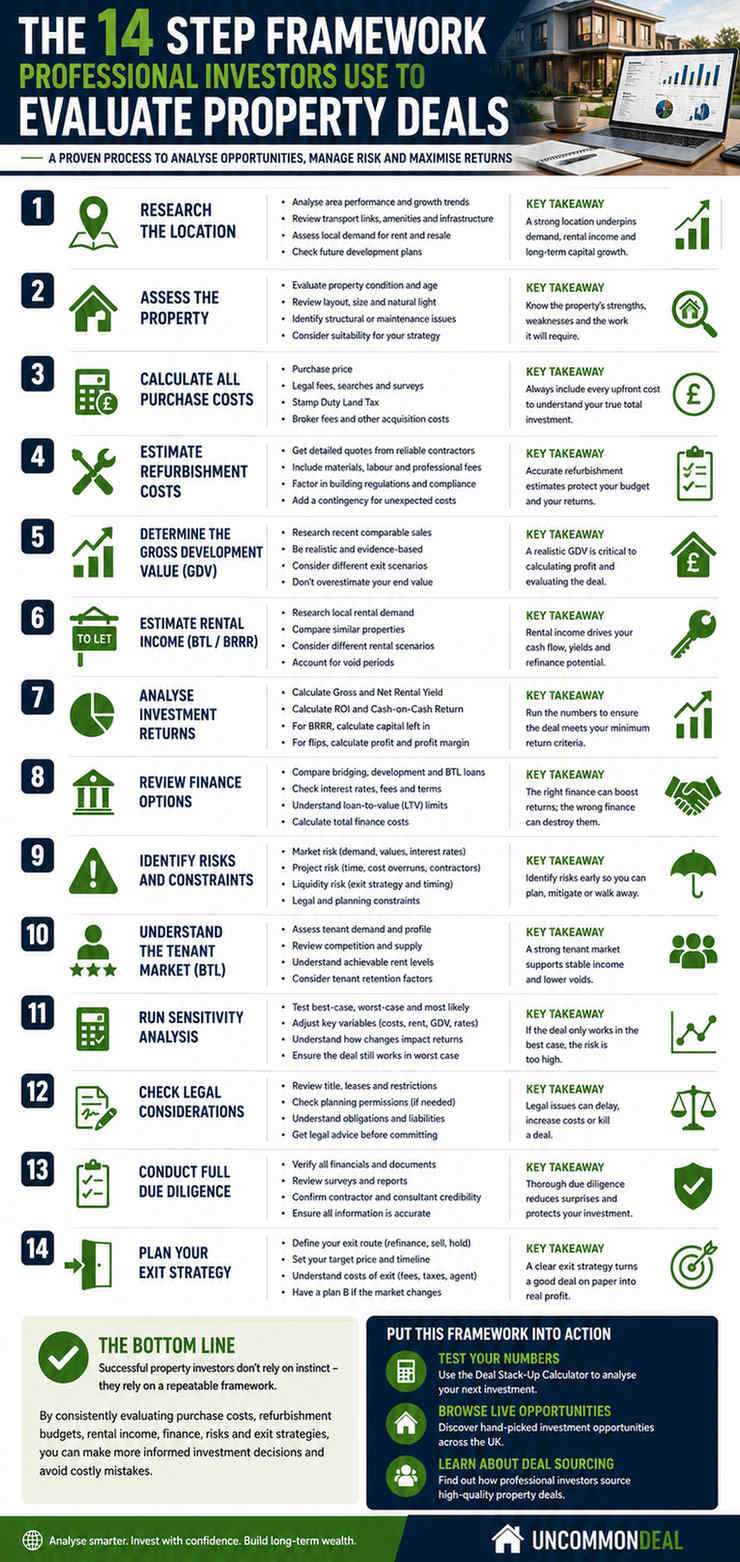
Infographic showing the 14-step framework professional property investors use to evaluate property deals, including location analysis, refurbishment costs, ROI, due diligence and exit strategy.
Frequently Asked Questions
How do investors evaluate property deals?
Professional property investors use a structured framework rather than relying on instinct or emotion. They typically assess the property’s location, condition, purchase costs, refurbishment budget, expected end value, rental potential, investment returns, financing, risks, and exit strategy before deciding whether the deal meets their investment criteria.
Using a consistent evaluation process helps investors compare multiple opportunities objectively and reduces the likelihood of making costly mistakes.
What numbers matter most when evaluating a property deal?
There is no single metric that determines whether a property is a good investment. Professional investors usually consider several key performance indicators together, including:
- Purchase price
- Total acquisition costs
- Refurbishment costs
- Gross Development Value (GDV)
- Expected rental income
- Gross and Net Rental Yield
- Return on Investment (ROI)
- Cash-on-Cash Return
- Monthly cash flow
- Projected profit
Looking at these figures collectively provides a more complete picture of an investment’s potential.
What is a good Return on Investment (ROI)?
A good ROI depends on your investment strategy, level of risk, and financial objectives.
For example:
- Buy-to-Let investors may prioritise long-term cash flow and capital growth.
- Property flippers often look for higher short-term returns to compensate for greater risk.
- BRRR investors usually focus on achieving a strong ROI while recycling as much capital as possible through refinancing.
Rather than comparing your investment with someone else’s target, establish your own minimum acceptable ROI before analysing any property and apply it consistently.
How much contingency should I allow for refurbishment projects?
Most experienced property investors include a contingency budget to cover unexpected costs that arise during refurbishment.
The appropriate amount will depend on the property’s condition and the scope of works. Older properties, structural refurbishments, and development projects generally require a larger contingency than cosmetic renovations.
Including a contingency in your financial analysis helps protect your projected returns if unforeseen issues arise during the project.
Should I use Gross Yield or Net Yield?
Both metrics are useful, but they serve different purposes.
Gross Rental Yield provides a quick way to compare potential investment opportunities based on rental income.
Net Rental Yield takes ongoing expenses into account, including maintenance, insurance, letting fees, and other operating costs. As a result, it provides a more realistic measure of the property’s long-term financial performance.
Most professional investors use gross yield as an initial screening tool and net yield when making their final investment decision.
How do I estimate refurbishment costs?
The most reliable approach is to obtain quotations from experienced contractors and compare them with refurbishment costs from similar projects.
Your budget should also include:
- Labour
- Materials
- Professional fees
- Building Regulations compliance
- Waste removal
- Contingency for unexpected works
Avoid relying solely on rough estimates, particularly for older properties or projects involving structural alterations.
What is Gross Development Value (GDV)?
Gross Development Value (GDV) is the estimated market value of a property after all planned refurbishment, renovation, or development works have been completed.
Investors commonly use GDV to:
- Estimate potential profit
- Assess refinancing opportunities
- Calculate Return on Investment (ROI)
- Evaluate development viability
A realistic GDV should always be based on recent comparable sales rather than optimistic assumptions.
What makes a property a good investment?
A good investment property is one that aligns with your investment strategy and meets your predefined financial criteria.
Professional investors typically look for properties that offer:
- Strong rental demand
- Realistic capital growth potential
- Attractive investment returns
- Manageable levels of risk
- Positive cash flow
- A clear exit strategy
- Sufficient contingency for unexpected costs
Most importantly, a good investment should continue to perform well even when conservative assumptions are used during the analysis.
Can I analyse property deals without using spreadsheets?
Yes. Many investors use dedicated property investment calculators to save time and improve consistency.
The Deal Stack-Up Calculator helps you calculate key investment metrics, including:
- Gross Rental Yield
- Net Rental Yield
- Return on Investment (ROI)
- Cash-on-Cash Return
- BRRR Capital Left In
- Flip Profit
- Profit Margin
Using a structured calculator reduces manual errors and allows you to compare multiple investment opportunities using the same methodology.
Should I walk away from a property if the numbers don’t work?
In many cases, yes.
Professional investors understand that not every property represents a good investment. If the financial returns fall below your minimum criteria, the risks are too high, or the due diligence reveals significant concerns, walking away is often the best decision.
There will always be more opportunities. Protecting your capital and maintaining investment discipline is usually more valuable than forcing a deal to work.
Conclusion
Successful property investors don’t rely on instinct. They rely on a structured, repeatable framework that helps them make informed decisions based on evidence rather than emotion.
Throughout this guide, you’ve seen how professional investors evaluate every aspect of a property before committing their capital. From assessing the property’s fundamentals and estimating refurbishment costs to analysing rental income, calculating investment returns, reviewing potential risks, and completing thorough due diligence, every stage plays an important role in determining whether a deal is worth pursuing.
The most profitable investments are rarely the result of luck. They are the result of consistent analysis, realistic assumptions, and disciplined decision-making.
Remember that no property needs to be perfect to become a successful investment. However, every property should be able to demonstrate strong financial performance, manageable risks, and a clear investment strategy before you decide to proceed.
By applying the same evaluation framework to every opportunity, you can compare deals objectively, avoid common investment mistakes, and build a stronger, more sustainable property portfolio over time.
Ready to Evaluate Your Next Property Deal?
Now it’s time to put this framework into practice.
Whether you’re analysing a buy-to-let, BRRR project, property flip, auction purchase, or another investment opportunity, UncommonDeal provides the tools and resources to help you make better investment decisions.
Start by:
- Using the Deal Stack-Up Calculator to calculate rental yield, ROI, cash-on-cash return, BRRR capital left in, flip profit, and profit margin.
- Browsing live investment opportunities to discover properties that may match your investment strategy.
- Exploring our Property Deal Sourcing guides and marketplace to learn how experienced investors find and evaluate opportunities across the UK.
The better your analysis, the better your investment decisions.
Take the time to evaluate every property thoroughly before making an offer, and let data, discipline, and due diligence guide every investment you make.

Koye Beckley is a UK property investor and founder of UncommonDeal, with practical experience in buy-to-let, property auctions, refurbishment projects and investment deal analysis. Through UncommonDeal, he publishes property market research, property deal sourcing and compliance guidance, investment guides and data-driven analysis to help investors evaluate buy-to-let, BRRR, flip and auction opportunities.