
Why Gross Yield Fails in UK Property Investment
Gross yield is one of the most commonly quoted metrics in UK property investment, but it tells you very little about whether a deal actually works.
Gross yield measures annual rent as a percentage of the purchase price, before tax, finance, and operating costs are considered. This simplicity is exactly why it is so widely used by agents, auctioneers, and property sourcers.
This is why relying on gross yield UK figures alone often leads investors to overestimate returns and underestimate risk.
However, gross yield ignores the factors that determine real profitability in the UK. It takes no account of income tax or corporation tax, mortgage interest restrictions under Section 24, stamp duty land tax, EPC compliance costs, or rising finance rates.
As a result, two properties with the same gross yield can produce completely different outcomes. One may generate sustainable, after-tax cash flow. The other may lose money despite appearing “high yielding” on paper.
This is why gross yield should only ever be used as a rough screening tool, not as a decision-making metric for UK property investors.
To understand why gross yield became so dominant despite these flaws, it helps to look at what the metric actually measures and how it is typically calculated.
What Gross Yield Actually Is
Gross yield is a simple property metric that shows annual rental income as a percentage of the purchase price, before any costs, tax, or finance are deducted.
Gross yield is the annual rental income of a property expressed as a percentage of the purchase price, calculated before tax, finance costs, and operating expenses.
Formula:
(Annual Rent ÷ Purchase Price) × 100
A proper UK property yield calculation must account for tax, finance, stamp duty, and compliance costs, not just rent and price.
In the UK, gross yield is commonly used as a headline comparison metric, but it does not reflect cash flow, tax exposure, or real investment risk.
It is calculated by dividing the annual rent by the property’s purchase price and multiplying by 100. Gross yield does not account for stamp duty, legal fees, refurbishment costs, mortgage interest, tax, management fees, maintenance, voids, or compliance expenses.
Because it ignores these factors, gross yield only reflects headline rental income, not profitability. In UK property investing, this distinction matters because tax treatment, finance structure, and regulatory costs have a significant impact on real returns.
This simplicity makes gross yield easy to calculate and easy to market, but also easy to misuse.
Why Gross Yield Is So Popular in the UK
Gross yield is popular in UK property investing because it is simple, fast, and easy to communicate. It reduces a complex investment decision into a single headline number that can be understood at a glance.
For agents and property portals, gross yield works well as a comparison tool. It allows listings to be filtered, ranked, and marketed quickly, even though it ignores the costs and risks that determine real profitability.
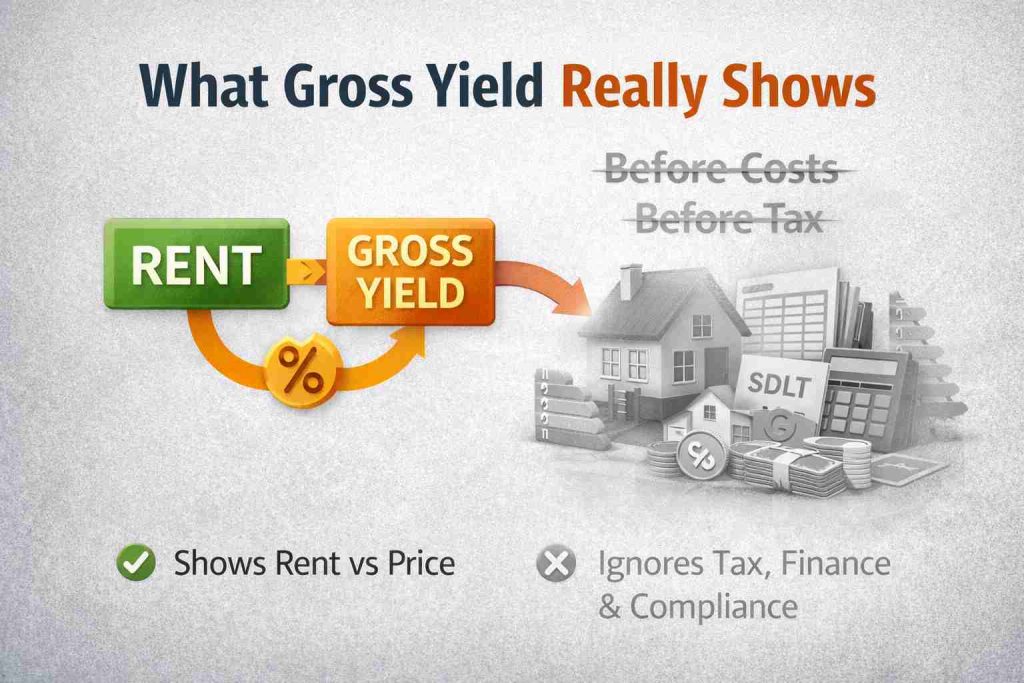
Property sourcers also rely on gross yield because it can be presented without knowing an investor’s tax position, finance structure, or ownership setup. The same yield figure can be used for a cash buyer, a mortgaged landlord, or a limited company investor, despite each facing very different outcomes.
UK property culture reinforces this behaviour. Investors are regularly exposed to gross yield through Rightmove listings, auction catalogues, social media deal breakdowns, and basic sourcing spreadsheets. Over time, it becomes shorthand for whether a deal is “good” or “bad”.
Crucially, gross yield predates many of the factors that now dominate UK property investing. It does not reflect Section 24 mortgage interest restrictions, stamp duty land tax on additional properties, EPC compliance costs, or the impact of higher interest rates.
Gross yield persists because it is convenient and marketable. But once UK tax, finance, and regulation are introduced, it quickly stops being a reliable indicator of whether a property deal actually stacks up.
The Fatal Flaws of Gross Yield in UK Property Deals
Gross yield breaks down the moment real-world UK costs are applied. While it may look useful as a headline comparison, it fails to account for the structural factors that determine whether a property actually makes or loses money.
The most damaging omission is tax.
It Ignores UK Tax Completely
Gross yield assumes that rental income is fully yours to keep. In reality, UK property returns are heavily shaped by how rental income is taxed and how the property is owned.
Since the introduction of Section 24 mortgage interest restrictions, many landlords have seen profitable-looking deals turn cash-flow negative after tax.
For individual landlords, rental profits are taxed at income tax rates, while mortgage interest relief is restricted under Section 24. This means interest costs are no longer fully deductible and are instead offset through a basic-rate tax credit. As interest rates rise, this restriction can turn a property with a healthy gross yield into a cash-flow negative investment.
Limited company investors face a different tax position. Rental profits are subject to corporation tax, and mortgage interest is treated as a deductible business expense. On paper, two investors may be buying the same property at the same gross yield, but their post-tax outcomes can be dramatically different.
This is where gross yield becomes actively misleading. It does not distinguish between:
- Personal ownership and limited company ownership
- Higher-rate and basic-rate taxpayers
- Fully deductible and restricted finance costs
As a result, the same “7% yield” property can generate stable, after-tax income for one investor while producing losses for another. Gross yield cannot see this difference, which is why it should never be relied on to assess real profitability in UK property deals.
UK Property Yield Comparison: Gross Yield vs Real Returns
| Metric | What it measures | Includes UK tax & finance? | Accounts for SDLT & compliance? | When it’s useful |
|---|---|---|---|---|
| Gross yield | Headline rent vs purchase price | No | No | Initial deal filtering only |
| Net yield | Rent after basic running costs | Partially | Sometimes | Comparing similar properties |
| Cash flow (after tax) | What you actually keep | Yes | Partially | Testing real viability |
| Cash-on-cash return | Return on cash invested | Optional | Yes | Comparing deals properly |
| Stress-tested return | Performance under downside scenarios | Yes | Yes | Decision-making & risk control |
On mobile, swipe left or right to view the full table.
This comparison shows why gross yield works as a headline filter, but fails as a decision-making metric once real UK costs are applied.
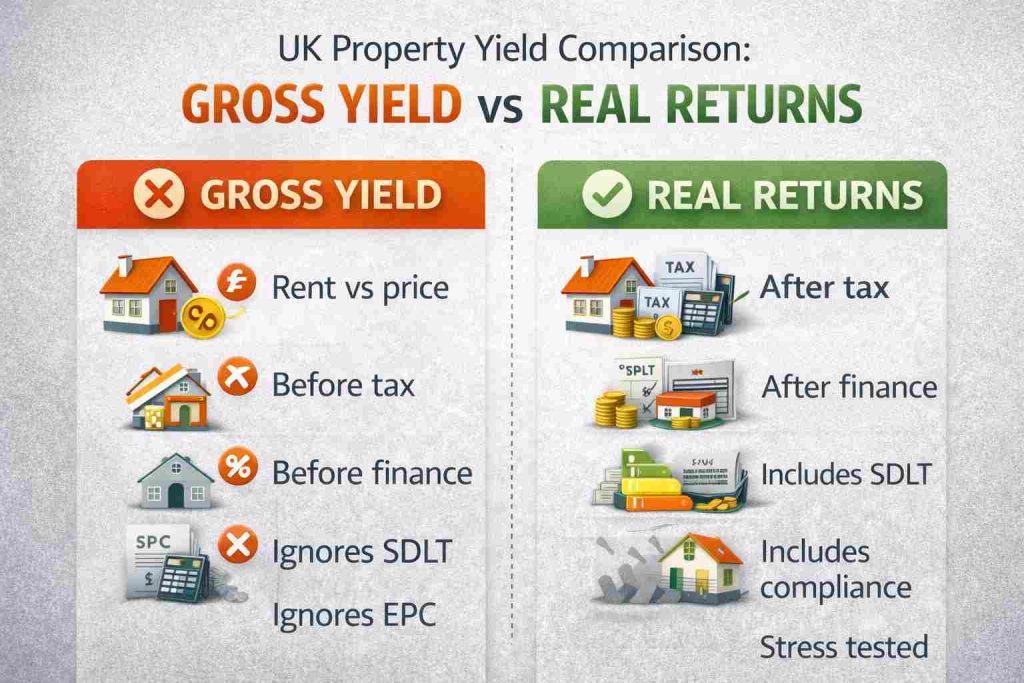
All of this becomes much clearer when you see how the same gross yield can produce completely different results in real UK property deals.
A Realistic UK Property Example: Same Gross Yield, Completely Different Outcome
At first glance, these two UK property deals look identical. In practice, they could not be more different.
Both properties show a 7 percent gross yield. Both sit in similar rental markets. Both attract the same headline rent. Yet once tax, finance, and compliance come into play, the results move in opposite directions.
Property A: Personal Ownership
The first investor buys in their own name using a buy-to-let mortgage. They sit in the higher-rate tax band.
Because of Section 24, they cannot fully deduct mortgage interest from rental income. Instead, they receive only a basic-rate tax credit. As interest rates rise, this restriction bites harder.
On top of that, the investor pays higher stamp duty as an additional property buyer. The building also needs EPC improvement work to stay compliant, which adds upfront cost with no immediate rental uplift.
Although the gross yield looks healthy, the deal produces thin cash flow. After tax, it barely breaks even. In some scenarios, it slips into a monthly loss.
Property B: Limited Company Ownership
The second investor buys the same type of property through a limited company.
Here, mortgage interest counts as a deductible business expense. Corporation tax applies to the remaining profit, not income tax. As a result, finance costs reduce taxable profit properly.
Stamp duty still applies. However, the investor models it as part of total capital invested, not as an afterthought. They also budget for EPC works upfront and factor them into returns.
The headline gross yield stays the same. However, the post-tax cash flow looks very different. The deal produces a stable surplus and remains resilient under higher interest rate assumptions.
Same Yield. Opposite Outcomes.
Both properties show the same gross yield on paper. Yet one struggles under tax and finance pressure, while the other works as intended.
This is why gross yield UK fails as a decision-making metric. It cannot see ownership structure. It cannot see tax rules. And it cannot show what you actually keep.
Until those factors are included, yield alone tells only a small part of the story.
Mini Summary: Same Gross Yield, Different Outcome
| Factor | Property A (Personal ownership) | Property B (Limited company) | Why gross yield misses it |
|---|---|---|---|
| Gross yield | 7% | 7% | Same headline number, different reality |
| Tax position | Income tax (higher-rate investor) | Corporation tax on profit | Yield ignores tax entirely |
| Finance treatment | Section 24 restricts interest relief | Interest deducted as a business cost | Yield assumes no mortgage impact |
| SDLT and buying costs | Paid, but often not modelled | Paid and included in capital invested | Yield uses price only, not total cash in |
| EPC and compliance | Upgrades reduce early cash flow | Upgrades budgeted upfront | Yield ignores capex and compliance |
| Net outcome | Thin or negative after-tax cash flow | Stable after-tax surplus | Yield cannot show what you keep |
On mobile, swipe left or right to view the full table.
What to Use Instead of Gross Yield
Gross yield tells you what a property might earn in theory. However, real investing depends on what a property earns after costs, after tax, and under pressure. For that reason, serious investors rely on a small set of metrics that reflect reality, not marketing.
Here are the ones that actually matter in UK property investing.
Net Yield (After Real UK Costs)
Net yield improves on gross yield by accounting for day-to-day running costs. Instead of looking only at rent and price, it factors in expenses such as management, maintenance, insurance, voids, and service charges.
As a result, net yield gives you a clearer view of operational performance. It answers a better question: how efficient is this property once it’s running?
That said, net yield still has limits. Many calculations ignore stamp duty, refurbishment costs, and finance. In addition, different investors include different expenses, which makes comparisons unreliable unless the assumptions match.
Use net yield to compare similar properties with similar cost structures. Do not use it to decide whether a deal works for you personally.
Cash Flow After Tax
Cash flow after tax shows what you actually keep once everything is paid. This includes running costs, mortgage interest, and UK tax based on how you own the property.
Crucially, this metric exposes the impact of:
- Income tax versus corporation tax
- Section 24 mortgage interest restrictions
- Your personal tax band or company structure
Because of this, cash flow after tax explains why two investors can buy the same property at the same yield and walk away with very different outcomes.
If you want to know whether a property will support itself month to month, this is the metric to use. Anything else is guesswork.
Cash-on-Cash Return
Cash-on-cash return measures how hard your money works. It compares annual cash profit to the actual cash you invested, including the deposit, stamp duty, legal fees, and refurbishment costs.
Unlike yield, this metric reflects opportunity cost. It helps you answer a practical question: is this deal worth tying up my capital compared to the alternatives?
For that reason, cash-on-cash return works especially well when:
- Comparing leveraged versus cash purchases
- Assessing high-SDLT acquisitions
- Choosing between multiple deals
If capital efficiency matters to you, this metric matters more than yield.
ROI With Stress Testing
Finally, stress-tested ROI looks at how a deal performs when conditions worsen, not when everything goes right.
Instead of assuming best-case numbers, this approach models:
- Higher interest rates
- Longer void periods
- Unexpected repairs or EPC upgrades
- Slower rent growth
Because markets change, this step matters more than ever. A deal that only works in perfect conditions is not a strong deal.
This is why experienced investors always stress-test property deals before relying on any headline yield figure.
Stress testing does not make projections pessimistic. Instead, it makes decisions safer.
When Gross Yield Can Still Be Used (Very Carefully)
Gross yield is not useless in every situation. However, its role is narrow and often misunderstood. When investors treat it as a decision-making tool, problems follow. When they use it carefully, it can still add value.
First, gross yield works as an initial filtering tool. At the early scanning stage, it helps rule out deals that clearly do not meet a minimum rental threshold. For example, if the rent cannot even cover basic operating costs at a headline level, deeper analysis rarely saves the deal. Used this way, gross yield helps you move faster, not smarter.
Next, gross yield can help when comparing similar assets. This only works when the properties share the same location, condition, tenant type, and likely cost profile. Even then, the comparison remains rough. Gross yield can highlight relative differences, but it cannot explain them.
Finally, gross yield should never be used for final decisions. At that stage, tax, finance, stamp duty, and compliance costs drive outcomes. Gross yield cannot see ownership structure. It cannot reflect Section 24. And it cannot show what you actually keep.
In short, use gross yield to screen deals, not to select them. The moment real money is at stake, switch to metrics that reflect reality.
The Bottom Line: Stop Chasing Yield, Start Measuring Reality
Gross yield is not wrong. However, it is incomplete.
On its own, gross yield shows only one thing: the relationship between rent and price. It says nothing about tax, finance, stamp duty, or compliance. In the UK, those factors do not sit on the margins. They drive the outcome.
That is why UK property investing is not yield-driven. It is tax-driven and finance-driven. Section 24, ownership structure, interest rates, EPC requirements, and upfront buying costs shape returns far more than a headline percentage ever will.
As a result, serious investors do not underwrite deals using marketing numbers. Instead, they test deals against reality. They model cash flow after tax. They measure returns against real capital invested. And they stress test assumptions before committing money.
Gross yield can help you scan opportunities. It cannot help you choose them.
If you want consistent results, stop chasing yield. Start measuring what actually matters.
If you want to go beyond headline yield, use the
Deal Stack-Up Calculator
to see how tax, finance, and real costs affect a property deal.
For deeper due diligence, the
Property Deal Analyser
breaks down cash flow, risk, and assumptions so you can decide with clarity before committing capital.

Koye Beckley is a UK property investor and founder of UncommonDeal, with practical experience in buy-to-let, property auctions, refurbishment projects and investment deal analysis. Through UncommonDeal, he publishes property market research, property deal sourcing and compliance guidance, investment guides and data-driven analysis to help investors evaluate buy-to-let, BRRR, flip and auction opportunities.
