
How To Make Money with Property in the UK: 15 Proven Strategies for 2026
Making money with property in the UK is not as simple as buying a house, renting it out, and waiting. In reality, how much money investors make depends largely on the strategy they use, where they invest, and when they enter the property cycle.
Most property profits come from a combination of rental income, capital growth, forced equity, and capital recycling. However, not every strategy accesses these equally.
A single-let buy-to-let may deliver modest long-term returns, while refurbishment projects, BRRR deals, or conversions can generate larger gains but with higher risk and complexity. This is why discussing property returns without considering the underlying strategy can be misleading.
The UK property cycle also plays a major role. In rising markets, capital growth can hide weak deals and poor analysis. In flatter markets, entry price, cashflow resilience, and exit flexibility become far more important.
Location adds another critical layer. Cities and neighbourhoods behave differently based on employment, tenant demand, planning policies, and local market conditions. A strategy that works well in one area can fail in another, even if the numbers initially appear similar.
The good news is that there is no single way to profit from UK property. Some investors focus on cashflow, while others prioritise capital growth, refurbishment profits, development gains, or sourcing fees. Many successful investors combine several approaches as their experience and capital grow.
Below are 15 proven ways investors make money with property in the UK, ranging from beginner-friendly strategies to more advanced investment models.
The Property Money Myth Most Investors Start With
Most people start UK property investment believing that making money from property means collecting monthly rental income. The idea is simple: buy a property, rent it out, and live off the surplus. This belief is reinforced online and in seminars, but it rarely survives contact with real UK numbers.
In practice, mortgage interest, tax, management fees, maintenance, voids, and compliance costs quickly eat into rent. For many landlords, especially at today’s house prices, true monthly profit is thin, inconsistent, or non-existent. Yet those same investors may still be making money overall, which is where the misunderstanding begins. Property returns come from different sources, not just rent.
Cashflow
Cashflow is the monthly surplus left after all expenses have been paid. While important, it is often the smallest and most fragile component of overall property returns.
Capital Growth
Capital growth comes from increases in property values over time. This can be influenced by inflation, local supply and demand, regeneration projects, economic conditions, and broader market cycles.
Capital Recycling
Capital recycling allows investors to reuse the same money through refinancing or selling. This is one of the main ways experienced investors scale their portfolios without continually injecting new capital.
When these sources of profit are confused or lumped together, investors often overestimate what property can deliver in the short term and misunderstand how long-term wealth is built.
Key concept: Property profits do not come from rent alone. They are created through a combination of cashflow, capital growth, leverage, value creation, and strategic exits.
The Four Ways People Actually Make Money with Property
There are only a handful of ways investors make money from property in the UK, but these profit sources are often blurred together or misunderstood. Most property strategies rely on a combination of them, although one or two usually play a much bigger role than the others.

Understanding which profit driver you are relying on is important because each behaves differently across market cycles, locations, and economic conditions.
Income
Income is the monthly surplus left after all costs have been paid, not simply the rent that arrives in your bank account.
Once mortgage payments, taxes, management fees, maintenance, insurance, compliance costs, and void periods are taken into account, true profit is often much smaller than many new investors expect. For this reason, income is often best viewed as a source of cashflow stability rather than the primary engine of long-term wealth creation.
Capital Growth
Capital growth occurs when a property’s value increases over time.
This growth is influenced by factors such as inflation, local demand, economic conditions, infrastructure investment, and supply constraints. While capital growth has created significant wealth for many property investors, it is largely outside an investor’s control and can take years to materialise.
Successful investors understand that capital growth rewards patience and the ability to hold assets through changing market conditions.
Forced Equity
Forced equity is value created through investor action rather than market appreciation.
Examples include refurbishing a neglected property, converting a building to a higher-value use, reconfiguring layouts, obtaining planning permission, or purchasing below market value.
Unlike capital growth, forced equity can be actively influenced by the investor. However, it also carries greater execution risk, including refurbishment overruns, planning delays, financing challenges, and changing market conditions.
Capital Recycling
Capital recycling is the process of extracting and reusing capital through refinancing, restructuring, or selling assets.
Many experienced investors use this approach to scale their portfolios without continually injecting fresh cash. Strategies such as BRRR (Buy, Refurbish, Refinance, Rent) are built around this principle.
When used carefully, capital recycling can accelerate portfolio growth. When used aggressively, it can increase leverage and risk exposure.
Once you understand these four profit mechanisms, it becomes much easier to evaluate the different ways investors make money from property. Most successful property strategies rely on one or more of these drivers, with different approaches suited to different goals, budgets, and levels of experience.
Key Property Investment Strategies That Actually Make Money
Not all property investment strategies are designed to achieve the same outcome. Some are built primarily to generate monthly cashflow, while others focus on long-term capital growth, forced equity creation, or capital recycling.
Problems often arise when investors treat all strategies as interchangeable or copy approaches without understanding the underlying objective. A strategy that works well for generating income may be poor at creating large amounts of equity. Likewise, a strategy designed for rapid capital growth may produce little immediate cashflow.
This is one reason why investors with similar budgets can achieve very different results. Success is not simply about choosing a property. It is about selecting a strategy that matches your goals, risk tolerance, available capital, and investment timeframe.
For example, a traditional buy-to-let investor may prioritise stability and long-term appreciation, while a property developer may focus on creating value and extracting profits within a much shorter period. A deal sourcer, on the other hand, can generate income without owning property at all.
Understanding the strengths and limitations of each strategy allows investors to make better decisions and avoid pursuing the wrong outcome with the wrong investment model.
The following strategies represent some of the most common and proven ways investors make money from property in the UK.
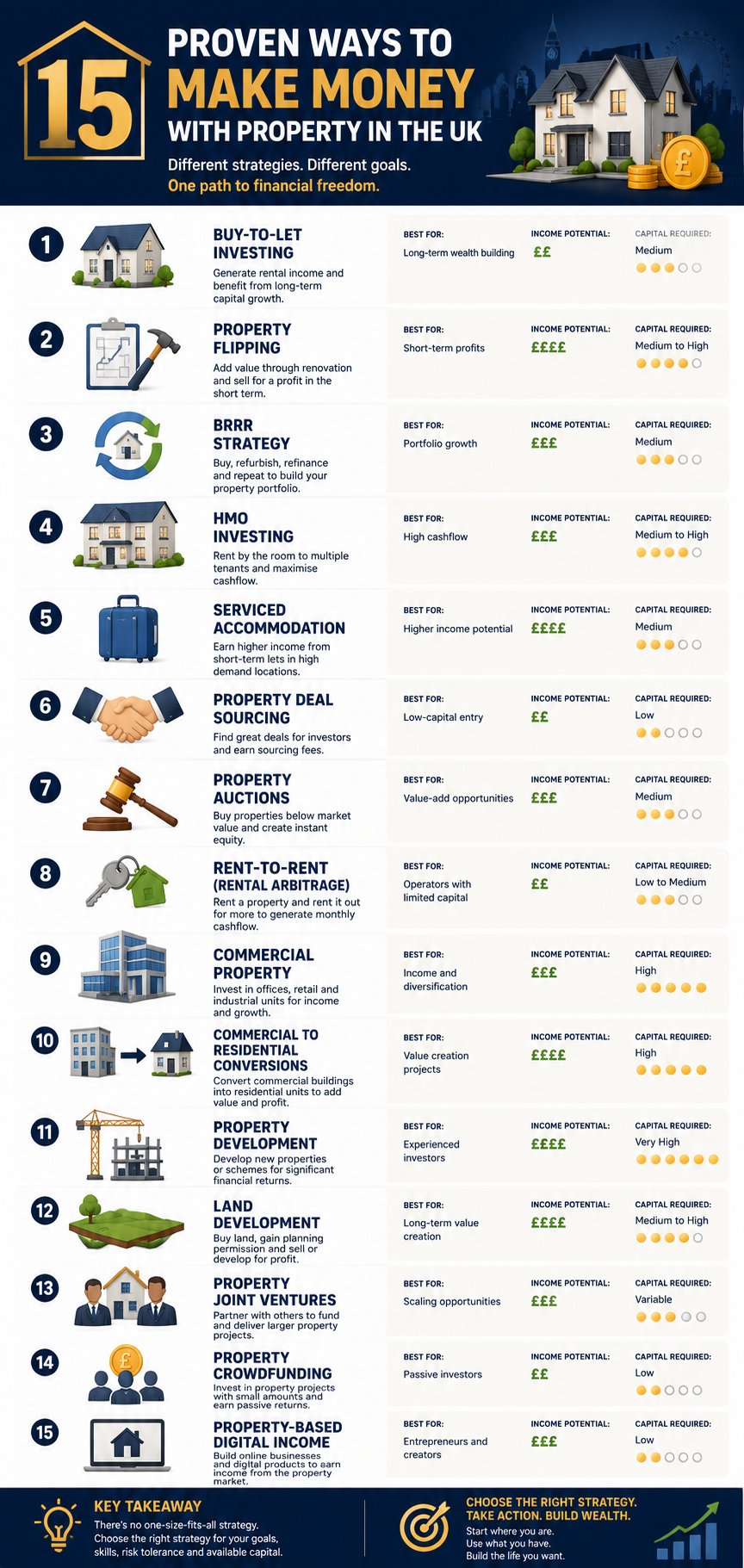
15 Proven Ways To Make Money with Property in the UK
Property investors generate income and build wealth in different ways. Some strategies focus on creating regular monthly cashflow, while others aim to generate lump-sum profits through refurbishment, development, or value-add projects.
The best approach depends on your available capital, risk tolerance, experience, and long-term investment goals. Some methods require substantial funds and specialist knowledge, while others can be started with relatively little capital.
Below are 15 of the most common and proven ways investors make money with property in the UK.
1. Buy-to-Let Property Investing
Buy-to-let is often presented as the simplest way to make money with property in the UK, but it is also one of the most misunderstood. Many new investors expect strong monthly income, when in reality most long-term returns come from capital growth, debt reduction, and time in the market.
The strategy typically involves purchasing a residential property and renting it to tenants on a long-term basis. While cashflow can be important, successful buy-to-let investing is usually built around steady wealth accumulation rather than rapid profits.
How Money Is Made
- Rental income generated from the difference between rent received and ongoing costs.
- Capital growth as the property’s value increases over time.
- Mortgage debt erosion as inflation reduces the real value of outstanding borrowing.
- Equity growth through mortgage repayments and market appreciation.
Advantages
- Relatively simple to understand and finance.
- Consistent tenant demand in many UK locations.
- Lower management intensity than HMOs or serviced accommodation.
- Potential for long-term wealth creation through leverage and capital growth.
Common Mistakes
- Overestimating monthly cashflow.
- Ignoring tax implications and ownership structure.
- Underestimating maintenance, voids, and compliance costs.
- Purchasing based on projected growth rather than strong fundamentals.
Best Suited For
Buy-to-let is generally best suited to investors seeking long-term wealth accumulation, steady portfolio growth, and relatively predictable property ownership. It works particularly well for investors with a long investment horizon and a focus on capital preservation.
Social Housing and Supported Living
Social housing and supported living are specialised rental strategies that involve leasing properties to housing associations, supported living providers, charities, or organisations that accommodate vulnerable individuals or people with specific support needs.
The appeal of these models is often the prospect of longer lease terms, predictable income, and reduced tenant turnover. However, returns depend less on the property itself and more on the quality of the provider, the lease structure, and the underlying funding arrangements.
How Money Is Made
- Long-term contracted rental income.
- Stable occupancy supported by ongoing housing demand.
- Reduced tenant turnover compared to some private rental markets.
- Potential for consistent cashflow when provider relationships are strong.
Key Risks
- Dependence on the financial strength of the provider.
- Complex lease structures and repair obligations.
- Regulatory and compliance requirements.
- Funding changes that affect supported housing operators.
- Overreliance on the concept of “guaranteed rent”.
While social housing and supported living can provide attractive income streams, investors should evaluate the operator, lease terms, and funding model with the same care they would apply to analysing the property itself.
Investors considering buy-to-let should also monitor UK landlord market trends, as recent data shows significant differences between landlords reducing their portfolios and professional investors continuing to acquire.
2. Property Flipping
Property flipping involves buying a property below its potential value, improving it, and then selling it for a profit. Unlike buy-to-let investing, which relies on long-term ownership, flipping is focused on creating and realising value over a relatively short period.
Successful property flipping requires disciplined deal analysis, accurate refurbishment budgeting, and a clear exit strategy. While profits can be generated much faster than with traditional buy-to-let investments, the strategy is also more sensitive to market conditions, financing costs, and project delays.
How Money Is Made
- Buying below market value through motivated sellers, auctions, distressed properties, or poor marketing.
- Creating forced equity through refurbishment, modernisation, or reconfiguration.
- Selling at a higher value after improvements have been completed.
- Leveraging capital efficiently by recycling profits into future projects.
Advantages
- Potential to generate significant profits within months rather than years.
- Greater control over value creation compared to relying on market appreciation.
- Faster capital recycling than many long-term investment strategies.
- Can be scaled through experience, systems, and reliable contractor relationships.
Common Mistakes
- Overpaying for the property at purchase.
- Underestimating refurbishment costs and contingency requirements.
- Ignoring finance, legal, and holding costs during the project.
- Assuming the property will achieve an unrealistic end value.
- Failing to allow for market changes between purchase and sale.
Best Suited For
Property flipping is generally best suited to investors who are comfortable managing refurbishment projects, making decisions under time pressure, and accepting a higher level of risk in exchange for potentially larger short-term profits. It works particularly well in markets where properties can be purchased below market value and improved cost-effectively.
3. BRRR (Buy, Refurbish, Refinance, Rent)
BRRR, which stands for Buy, Refurbish, Refinance, Rent, is one of the most popular property investment strategies for investors seeking to grow a portfolio without continually injecting large amounts of new capital. The strategy combines value creation with capital recycling, allowing investors to recover part or all of their original investment after improvements have been completed.
A typical BRRR project involves purchasing a property below market value, carrying out refurbishment works to increase its value, refinancing based on the new valuation, and then retaining the property as a long-term rental investment. When executed well, the strategy can generate both rental income and long-term capital growth while reducing the amount of capital left in the deal.
How Money Is Made
- Buying below market value to create an immediate equity position.
- Adding forced equity through refurbishment, modernisation, or reconfiguration.
- Refinancing at a higher valuation to recover invested capital.
- Generating rental income from the completed property.
- Benefiting from long-term capital growth while tenants help service the mortgage.
Advantages
- Allows capital to be recycled into future property purchases.
- Creates multiple profit drivers through equity growth, rental income, and capital appreciation.
- Can accelerate portfolio growth compared to traditional buy-to-let investing.
- Reduces the amount of personal capital tied up in individual properties when successful.
Common Mistakes
- Overestimating the post-refurbishment value of the property.
- Underestimating refurbishment costs and project timelines.
- Assuming the refinance will recover all invested capital.
- Ignoring lender requirements and refinancing criteria.
- Purchasing properties with insufficient value-add potential.
Best Suited For
BRRR is generally best suited to investors who want to build a property portfolio efficiently by combining refurbishment, refinancing, and long-term ownership. It works particularly well for investors who understand deal analysis, refurbishment management, and finance structures, and who are comfortable balancing short-term project risk with long-term investment goals.
4. Houses in Multiple Occupation (HMOs)
Houses in Multiple Occupation (HMOs) are rental properties where multiple tenants occupy individual rooms while sharing facilities such as kitchens, bathrooms, or living areas. The strategy is popular among property investors because it can generate significantly higher rental income than a comparable single-let property.
By renting rooms individually rather than as a whole property, investors can increase overall income and improve cashflow. However, HMOs also come with greater management responsibilities, stricter regulatory requirements, and higher operating costs. As a result, success depends heavily on location, tenant demand, compliance, and efficient management.
How Money Is Made
- Higher rental income generated by letting individual rooms rather than a single tenancy.
- Stronger cashflow compared to many traditional buy-to-let properties.
- Forced equity creation through reconfiguration, additional bedrooms, or property upgrades.
- Long-term capital growth where the underlying property increases in value over time.
- Commercial-style valuations in some circumstances, particularly for larger HMOs.
Advantages
- Potentially higher cashflow than standard buy-to-let investments.
- Multiple income streams reduce reliance on a single tenant.
- Strong demand in many student, professional, and city-centre markets.
- Opportunities to add value through layout optimisation and refurbishment.
Common Mistakes
- Underestimating licensing, compliance, and fire safety requirements.
- Purchasing in areas with insufficient HMO demand.
- Failing to budget for higher management and maintenance costs.
- Overestimating achievable room rents.
- Ignoring local authority planning restrictions and Article 4 directions.
Best Suited For
HMOs are generally best suited to investors seeking stronger cashflow than traditional buy-to-let properties and who are comfortable with increased management complexity. They work particularly well in locations with strong demand from students, young professionals, key workers, or other shared accommodation markets.
5. Serviced Accommodation
Serviced accommodation involves renting properties on a short-term basis to guests rather than securing long-term tenants. Common users include business travellers, contractors, tourists, relocation clients, and people requiring temporary housing. Properties are typically fully furnished and include utilities, internet access, and other amenities expected from short-stay accommodation.

The appeal of serviced accommodation is the potential to generate higher income than a traditional buy-to-let property. However, returns can fluctuate significantly depending on occupancy rates, seasonal demand, local competition, and operating costs. As a result, the strategy requires more active management and a stronger focus on customer experience.
How Money Is Made
- Higher nightly rates compared to traditional long-term rental agreements.
- Increased occupancy income during periods of strong local demand.
- Premium pricing for well-presented properties in desirable locations.
- Portfolio scaling through direct ownership or management agreements.
- Long-term capital growth where the underlying property appreciates in value.
Advantages
- Potentially higher cashflow than traditional buy-to-let investments.
- Greater flexibility over pricing and booking terms.
- Ability to adjust rates based on demand and seasonality.
- Strong demand in business, tourism, and relocation markets.
Common Mistakes
- Overestimating occupancy levels and nightly rates.
- Ignoring cleaning, management, platform fees, and utility costs.
- Operating without understanding local regulations or restrictions.
- Purchasing properties in locations with weak short-term rental demand.
- Underestimating the operational workload required to maintain guest satisfaction.
Best Suited For
Serviced accommodation is generally best suited to investors seeking higher income potential and who are comfortable with a more hands-on business model.
It works particularly well in locations with consistent demand from business travellers, contractors, tourists, healthcare workers, or relocation clients. Investors considering this strategy should also understand which areas currently demonstrate the strongest short-term rental demand and occupancy performance.
Success often depends as much on operations and customer service as it does on the property itself.
6. Property Deal Sourcing
Property deal sourcing involves finding, analysing, and introducing investment opportunities to property investors in exchange for a sourcing fee. Unlike most property investment strategies, deal sourcing does not necessarily require the sourcer to purchase or own property. Instead, the value comes from identifying opportunities that meet an investor’s criteria and helping them access deals they may not have found themselves.
The strategy has become increasingly popular because it can be started with relatively little capital compared to buying property directly. However, successful deal sourcing requires strong market knowledge, accurate deal analysis, compliance with relevant regulations, and the ability to consistently find opportunities that offer genuine value to investors.
How Money Is Made
- Sourcing fees paid by investors for introducing suitable property opportunities.
- Packaging below-market-value deals that meet specific investment criteria.
- Building relationships with investors who require a regular pipeline of opportunities.
- Generating repeat business through trust, credibility, and consistent deal quality.
- Expanding into related services such as property analysis, consultancy, or portfolio support.
Advantages
- Can be started with significantly less capital than purchasing investment properties.
- Does not require long-term ownership of property assets.
- Potential to generate income from market knowledge and networking skills.
- Can be operated alongside other property investment activities.
- Scalable through systems, marketing, and investor relationships.
Common Mistakes
- Charging fees for deals that offer little genuine investor value.
- Failing to understand compliance requirements and sourcing regulations.
- Performing weak or incomplete deal analysis.
- Overestimating achievable rental income, GDV, or profit projections.
- Focusing on quantity of deals rather than quality of opportunities.
Best Suited For
Property deal sourcing is generally best suited to individuals with strong analytical skills, local market knowledge, and an ability to build relationships with investors. It can be an attractive entry point for people looking to generate income from property without needing substantial capital to purchase assets themselves. Long-term success depends on consistently delivering opportunities that genuinely help investors achieve their goals.
7. Property Auctions
Property auctions provide investors with access to properties that may be difficult to acquire through traditional estate agent channels. Auction stock often includes repossessions, probate properties, refurbishment projects, vacant homes, mixed-use buildings, and assets requiring specialist knowledge or finance.
Many investors use auctions to secure properties below market value, create forced equity, or access opportunities with less competition. However, auction purchases require thorough due diligence, rapid decision-making, and a clear understanding of costs before bidding. While auctions can offer attractive opportunities, mistakes can be expensive because contracts are legally binding once the hammer falls.
How Money Is Made
- Buying below market value by identifying overlooked or mispriced opportunities.
- Creating forced equity through refurbishment, conversion, or repositioning projects.
- Generating rental income by retaining suitable properties as investments.
- Achieving capital growth through long-term ownership in strong locations.
- Recycling capital by refinancing or selling completed projects.
Advantages
- Access to a wide range of investment opportunities.
- Potential to purchase properties below open market value.
- Faster transaction times than many traditional purchases.
- Opportunities to add value through refurbishment or redevelopment.
- Suitable for multiple strategies including flipping, BRRR, buy-to-let, and development.
Common Mistakes
- Bidding without fully reviewing the legal pack.
- Underestimating refurbishment, finance, and transaction costs.
- Becoming emotionally involved during the auction process.
- Assuming a property is a bargain simply because it is being auctioned.
- Failing to arrange finance before bidding.
Best Suited For
Property auctions are generally best suited to investors who are comfortable carrying out detailed due diligence and making decisions quickly. They work particularly well for investors seeking below-market-value opportunities, refurbishment projects, development sites, or properties that can support value-add strategies such as flipping, BRRR, and portfolio expansion.
8. Rent-to-Rent
Rent-to-rent is a property strategy where an investor or operator leases a property from a landlord and then rents it out to tenants or short-term guests at a higher rate. Unlike traditional property investment, the rent-to-rent operator does not own the property. Instead, they profit from the difference between the rent paid to the landlord and the income generated from the occupants.
The strategy is often promoted as a way to enter the property industry with less capital than purchasing property outright. However, while it can reduce the need for large deposits and mortgages, it introduces operational, contractual, and occupancy risks that must be carefully managed. Success depends on securing favourable agreements, maintaining strong occupancy levels, and understanding the legal responsibilities involved.
How Money Is Made
- Income arbitrage by generating more rental income than the fixed rent paid to the landlord.
- Managing shared accommodation such as HMOs where room-by-room rents exceed the master lease cost.
- Operating serviced accommodation where short-term rental income exceeds long-term lease costs.
- Scaling through management agreements without needing to purchase properties.
- Building recurring cashflow from multiple leased properties.
Advantages
- Requires significantly less capital than purchasing investment properties.
- No need for large mortgage deposits.
- Can generate cashflow without owning property assets.
- Potential to scale relatively quickly through additional agreements.
- Provides practical experience in property management and operations.
Common Mistakes
- Entering agreements without landlord consent or clear contractual terms.
- Overestimating occupancy rates and achievable income.
- Underestimating management, maintenance, and operating costs.
- Failing to understand licensing, planning, or compliance requirements.
- Relying on a small number of properties without adequate cash reserves.
Best Suited For
Rent-to-rent is generally best suited to individuals who want to generate property-related income without purchasing assets and who are comfortable managing properties as an operational business. It can be attractive to investors with limited capital, but long-term success depends on strong systems, careful deal selection, and a thorough understanding of legal and contractual obligations.
9. Commercial Property Investment
Commercial property investment involves purchasing and leasing properties used for business purposes rather than residential occupation. Common examples include offices, retail units, industrial buildings, warehouses, mixed-use properties, and other income-producing commercial assets.
Unlike residential property, commercial investments are often valued based on the income they generate and the strength of the tenant covenant. This can create opportunities for investors to increase value through lease restructuring, rent reviews, tenant improvements, or changes in property use. While commercial property can provide attractive returns and longer lease terms, it also carries risks linked to economic conditions, tenant demand, and vacancy periods.
How Money Is Made
- Rental income from business tenants occupying the property.
- Capital growth as property values increase over time.
- Value creation through lease improvements, rent reviews, and asset management.
- Repositioning opportunities by changing property use or attracting stronger tenants.
- Capital recycling through refinancing or strategic disposal of assets.
Advantages
- Potential for stronger yields than many residential investments.
- Longer lease agreements can provide greater income stability.
- Commercial tenants are often responsible for a larger share of property-related costs.
- Opportunities to add value through active asset management.
- Diversification away from purely residential property markets.
Common Mistakes
- Focusing solely on yield without assessing tenant quality.
- Underestimating vacancy risk and reletting costs.
- Ignoring local economic conditions and tenant demand.
- Failing to understand lease terms and repair obligations.
- Overpaying for assets based on unrealistic rental assumptions.
Best Suited For
Commercial property investment is generally best suited to investors seeking income-producing assets with opportunities for active value creation. It works particularly well for investors who are comfortable analysing leases, assessing tenant strength, and understanding the factors that influence commercial property demand. While it can offer attractive returns, success often depends on asset management skills as much as property selection.
11. Property Development
Property development involves creating, improving, or transforming property with the objective of increasing its value and generating a profit. Projects can range from constructing new-build homes on vacant land to converting large buildings, extending existing properties, or undertaking substantial redevelopment schemes.
Unlike many investment strategies that rely on rental income or market appreciation, property development focuses on actively creating value. The potential rewards can be significant, but so can the risks. Planning delays, construction overruns, financing costs, market changes, and project management challenges can all have a major impact on profitability.
How Money Is Made
- Creating value through development rather than relying on market growth alone.
- Generating development profit by selling completed properties for more than the total project cost.
- Creating forced equity through planning gains, construction, and redevelopment.
- Producing rental income if completed properties are retained.
- Recycling capital into future projects through sales or refinancing.
Advantages
- Potential for substantial profits compared to many traditional investment strategies.
- Greater control over value creation and project outcomes.
- Multiple exit strategies including sale, refinance, or long-term hold.
- Ability to scale through larger and more complex projects over time.
- Opportunities to benefit from planning uplift and redevelopment potential.
Common Mistakes
- Underestimating build costs, contingencies, and financing expenses.
- Overestimating the end value or demand for the completed development.
- Failing to account for planning delays and project overruns.
- Taking on projects beyond available experience or resources.
- Insufficient due diligence before acquisition.
Best Suited For
Property development is generally best suited to experienced investors, developers, and project managers who are comfortable managing risk, coordinating multiple professionals, and making decisions throughout the development process. While the strategy offers some of the highest potential returns in property, success depends heavily on planning, cost control, and disciplined execution.
12. Land Development Opportunities
Land development involves acquiring land with the intention of increasing its value through planning permission, infrastructure improvements, subdivision, or future development potential. Unlike many property investment strategies, land can generate substantial returns without producing rental income, making it a strategy focused primarily on capital growth and value creation.
Investors are often attracted to land because relatively small changes in planning status can significantly increase value. However, land development is highly dependent on planning policies, local authority decisions, infrastructure requirements, and market demand. As a result, thorough due diligence and patience are essential.
How Money Is Made
- Securing planning permission that increases the land’s development potential.
- Obtaining planning uplift through changes in zoning or permitted use.
- Subdividing larger sites into smaller development plots.
- Selling land to developers at a higher value after planning improvements.
- Developing the land directly to create residential, commercial, or mixed-use projects.
Advantages
- Potential for significant value increases from successful planning outcomes.
- No tenant management or day-to-day property operations.
- Multiple exit strategies including sale, joint venture, or development.
- Ability to control valuable development opportunities with relatively low holding costs in some cases.
- Less exposure to many of the operational issues associated with rental property.
Common Mistakes
- Purchasing land without understanding planning constraints.
- Overestimating the likelihood of obtaining planning permission.
- Ignoring infrastructure, access, utility, or environmental issues.
- Underestimating holding periods and planning timescales.
- Paying speculative prices based on unrealistic future development assumptions.
Best Suited For
Land development opportunities are generally best suited to investors who are patient, comfortable with planning risk, and willing to undertake detailed due diligence before acquisition. The strategy can produce substantial returns when planning value is successfully created, but profits often take longer to realise than many traditional property investment approaches.
Land Banking as a Long-Term Strategy
Land banking is a specialised form of land investment that involves purchasing land and holding it for an extended period in anticipation of future planning, infrastructure improvements, or development demand.
Unlike active property development, land banking often requires little day-to-day management. Investors are primarily relying on planning uplift, population growth, infrastructure projects, or changes in local planning policy to increase the value of the land over time.
While successful land banking can generate substantial returns, it is also highly speculative. Planning outcomes are uncertain, holding periods can be lengthy, and many sites never achieve the development potential originally anticipated by investors.
For this reason, land banking is generally best viewed as a long-term capital growth strategy rather than a source of immediate income or cashflow.
13. Property Joint Ventures
Property joint ventures involve two or more parties combining resources, skills, knowledge, or capital to undertake a property investment or development project. Joint ventures are common throughout the UK property industry because they allow investors to access opportunities that may be difficult to pursue independently.
A typical arrangement might involve one party providing funding while another contributes experience, deal sourcing expertise, project management skills, or development knowledge. By sharing resources, investors can undertake larger projects, spread risk, and accelerate growth. However, the success of a joint venture often depends as much on the quality of the partnership as it does on the property itself.
How Money Is Made
- Sharing development profits from refurbishment, conversion, or development projects.
- Generating rental income from jointly owned investment properties.
- Combining capital and expertise to access larger opportunities.
- Creating forced equity through value-add projects and active management.
- Scaling investment activity beyond what individual investors could achieve alone.
Advantages
- Access to greater financial resources and investment opportunities.
- Ability to combine complementary skills and experience.
- Shared risk across project participants.
- Potential to undertake larger or more complex projects.
- Faster portfolio growth through collaboration.
Common Mistakes
- Entering partnerships without clear written agreements.
- Failing to define roles, responsibilities, and decision-making authority.
- Choosing partners based solely on available capital.
- Ignoring exit strategies and dispute resolution procedures.
- Misaligned objectives between venture partners.
Best Suited For
Property joint ventures are generally best suited to investors who have either capital, expertise, opportunities, or specialist skills but lack one or more of the other components required to complete a project independently. When structured properly, joint ventures can create opportunities that would not otherwise be achievable, while allowing partners to leverage each other’s strengths.
14. Property Crowdfunding and Fractional Investing
Property crowdfunding and fractional investing allow individuals to invest in property without purchasing an entire asset themselves. Instead, multiple investors contribute capital towards a property or portfolio, with each participant owning a proportionate share of the investment or receiving returns based on their contribution.
The strategy has become increasingly popular among investors seeking exposure to property with lower capital requirements. Rather than needing a large deposit, mortgage, and direct management responsibility, investors can participate in property projects through specialist platforms and investment structures. While this approach improves accessibility, investors typically have less control over decisions and are dependent on the performance of the underlying investment and management team.
How Money Is Made
- Rental income distributions generated from income-producing properties.
- Capital growth as underlying property values increase over time.
- Development profits from projects completed and sold at a profit.
- Portfolio diversification across multiple properties and locations.
- Passive investment returns without direct ownership responsibilities.
Advantages
- Lower capital requirements compared to purchasing property directly.
- Access to property investments that may otherwise be unavailable.
- Diversification across multiple assets, sectors, or locations.
- Reduced day-to-day management responsibilities.
- Opportunity to gain property exposure without arranging finance personally.
Common Mistakes
- Investing without fully understanding the investment structure.
- Focusing solely on projected returns while ignoring risks.
- Underestimating liquidity constraints and exit limitations.
- Failing to assess the experience and track record of the management team.
- Assuming diversification eliminates investment risk.
Best Suited For
Property crowdfunding and fractional investing are generally best suited to individuals who want exposure to property markets without directly owning or managing assets. The strategy can be attractive to investors with limited capital, those seeking diversification, or people who prefer a more passive investment approach. However, successful investing still requires careful due diligence and an understanding of the risks involved.
15. Creating Property-Based Digital Income Streams
Not all property-related income comes from owning, developing, or managing property. Many investors and industry professionals generate income by creating digital assets, platforms, and services that support the property sector. These businesses leverage property knowledge, market insights, and audience building rather than direct ownership of real estate.
Examples include property websites, deal analysis services, educational platforms, newsletters, membership communities, software tools, calculators, and content businesses. While building a digital property business often requires significant upfront effort, successful platforms can generate recurring income and scale without the capital requirements associated with purchasing property.
How Money Is Made
- Subscription revenue from memberships, premium content, or investor communities.
- Lead generation fees from connecting investors with relevant services.
- Property analysis and consultancy services provided to investors and landlords.
- Advertising and sponsorship income from property-focused audiences.
- Digital products and tools such as calculators, templates, guides, and educational resources.
- Affiliate commissions from recommending relevant property-related services.
Advantages
- Significantly lower capital requirements than direct property ownership.
- Ability to scale without purchasing additional properties.
- Multiple potential income streams from a single platform.
- Geographic flexibility and location independence.
- Less exposure to tenant, maintenance, and financing risks.
Common Mistakes
- Focusing on monetisation before building an audience or providing value.
- Publishing generic content without a clear niche or expertise.
- Underestimating the time required to build trust and authority.
- Relying on a single traffic source or income stream.
- Expecting immediate results from content, SEO, or audience-building efforts.
Best Suited For
Property-based digital income streams are generally best suited to individuals with property knowledge, analytical skills, or industry experience who want to create scalable income beyond traditional property ownership. The strategy can complement existing property investments or serve as a standalone business model. While results often take time to develop, successful digital property businesses can generate recurring income without the capital intensity associated with acquiring physical assets.
How to Leverage Property in the UK
Property leverage is one of the main reasons many investors choose real estate over other asset classes.
In simple terms, leverage means using borrowed money, typically through a mortgage, to control a property worth more than your own cash investment.
For example, an investor may purchase a £200,000 property using a £50,000 deposit and a £150,000 mortgage. If the property’s value increases by 10%, the gain is based on the full property value rather than just the cash invested.
Leverage can potentially accelerate portfolio growth because investors can:
- Purchase larger assets with less upfront capital
- Spread capital across multiple properties
- Increase returns on invested cash
- Recycle capital through refinancing strategies
- Build a portfolio more quickly than buying with cash alone
However, leverage also increases risk.
Mortgage payments, interest rate changes, void periods, maintenance costs and unexpected repairs can reduce profitability if a property is not properly analysed before purchase.
Many experienced investors use leverage alongside strategies such as:
- Buy-to-let investing
- BRRR (Buy, Refurbish, Refinance, Rent)
- Property flips
- HMOs (Houses in Multiple Occupation)
- Small residential developments
The key is ensuring that the property’s income and projected returns comfortably support the borrowing involved.
Property Leverage Example
| Example | Amount |
|---|---|
| Property Purchase Price | £200,000 |
| Deposit (25%) | £50,000 |
| Mortgage | £150,000 |
| Property Value After Growth | £220,000 |
| Increase in Value | £20,000 |
In this example, the investor gains £20,000 in equity while only contributing £50,000 of their own capital, demonstrating how leverage can amplify returns when a property performs well.
Important Consideration
Leverage can increase both gains and losses. Before using finance, investors should carefully assess rental demand, cash flow, refurbishment costs, financing costs and exit strategies.
Before using leverage on any investment property, it is worth understanding the numbers behind the deal. Our guide on property deal analysis explains how experienced investors assess profitability, risk and returns before committing capital.
This is why many professional investors perform detailed property deal analysis before committing capital rather than relying solely on expected house price growth.
How Experienced Investors Combine Strategies
Experienced property investors rarely rely on a single strategy. Instead, they combine multiple approaches so that income, capital growth, and liquidity support one another across different market conditions.
Each strategy serves a specific purpose within a wider investment plan. The goal is not to find the “best” strategy, but to build a portfolio where different strategies complement each other.
Buy-to-Let for Stability
Many investors use buy-to-let properties as the long-term foundation of their portfolio. These assets are often selected for stability, capital growth, and gradual debt erosion rather than high monthly income.
HMOs and Serviced Accommodation for Cashflow
Higher-income strategies such as HMOs and serviced accommodation are often used to increase cashflow and improve portfolio resilience. While they require more management, they can generate stronger income than traditional buy-to-let investments.
BRRR for Portfolio Growth
BRRR is frequently used to recycle capital and acquire additional properties without continually injecting large amounts of new money. Many investors use it as the engine that drives portfolio expansion.
Property Flipping for Capital Generation
Property flips are often treated as short-term capital-generation projects. Profits can then be reinvested into buy-to-let properties, HMOs, or future development opportunities.
Commercial Property and Conversions for Value Creation
Commercial property investments and commercial-to-residential conversions are commonly used to create value through active asset management, planning gains, and redevelopment opportunities.
Joint Ventures for Larger Opportunities
As investors gain experience, many use joint ventures to access larger projects, combine expertise, or secure funding that would be difficult to obtain independently.
Digital Property Businesses for Additional Income
Some investors also build property-related digital businesses, deal sourcing operations, educational platforms, or analysis services to create additional income streams that are not directly tied to property ownership.
The most successful investors rarely depend on a single source of profit. Instead, they combine different strategies to balance risk, generate income, create equity, and maintain flexibility as market conditions change.
Cross-Strategy To Make Money with Property UK: Comparison Table
A high-level comparison of how different UK property strategies make money, what they demand, and where they typically fail.
| Strategy | Primary Profit Driver | Capital Required | Complexity | Best For |
|---|---|---|---|---|
| Buy-to-Let | Capital growth and rental income | Medium | Low to medium | Long-term wealth building |
| Property Flipping | Forced equity and resale profit | Medium to high | High | Short-term profit generation |
| BRRR | Capital recycling | Medium | Medium to high | Portfolio growth |
| HMOs | Higher rental cashflow | Medium to high | High | Income-focused investors |
| Serviced Accommodation | Short-term rental income | Medium | High | Higher income potential |
| Property Deal Sourcing | Sourcing fees | Low | Medium | Low-capital entry |
| Property Auctions | Discounted purchase and value-add | Medium | Medium to high | Value-add opportunities |
| Rent-to-Rent | Income arbitrage | Low to medium | Medium | Operators with limited capital |
| Commercial Property | Income and asset growth | High | Medium | Income and diversification |
| Commercial-to-Residential Conversions | Forced equity and planning gain | High | High | Value creation projects |
| Property Development | Development profit | High | Very high | Experienced investors |
| Land Development | Planning uplift | Medium to high | High | Long-term value creation |
| Property Joint Ventures | Shared profit and scale | Variable | Medium to high | Larger opportunities |
| Property Crowdfunding | Passive income and growth | Low | Low | Passive property exposure |
| Property-Based Digital Income | Digital products and services | Low | Medium | Scalable income streams |
Risk vs Reward Matrix
This matrix shows how different strategies typically trade risk for reward under real UK conditions.
| Strategy | Risk Level | Reward Potential |
|---|---|---|
| Buy-to-Let | Low to medium | Medium |
| Property Deal Sourcing | Medium | Medium |
| Property Crowdfunding | Low | Low to medium |
| Rent-to-Rent | Medium | Medium |
| HMOs | Medium to high | High |
| Serviced Accommodation | High | High |
| BRRR | Medium to high | High |
| Property Auctions | Medium to high | High |
| Commercial Property | Medium | High |
| Joint Ventures | Medium to high | High |
| Commercial-to-Residential Conversions | High | Very high |
| Land Development | High | Very high |
| Property Flipping | High | Very high |
| Property Development | Very high | Very high |
| Property-Based Digital Income | Medium | High |
Which Property Strategy Is Best?
There is no single property strategy that is best for everyone. The most suitable approach depends on your available capital, experience, risk tolerance, time commitment, and long-term financial goals.
Many new investors make the mistake of searching for the highest-yielding strategy without considering whether it matches their circumstances. A strategy that works exceptionally well for one investor may be completely unsuitable for another.
Investors Strategies to Make Money with Property UK
In general, different strategies tend to serve different objectives:
| Goal | Strategies Often Used |
|---|---|
| Long-term wealth building | Buy-to-Let, BRRR, Commercial Property Investment |
| Stronger monthly cashflow | HMOs, Serviced Accommodation, Social Housing |
| Short-term profit generation | Property Flipping, Property Development |
| Capital recycling and portfolio growth | BRRR, Property Flipping |
| Lower capital entry | Property Deal Sourcing, Rent-to-Rent, Property-Based Digital Income Streams |
| Larger projects and scaling | Joint Ventures, Commercial-to-Residential Conversions, Property Development |
| Passive property exposure | Property Crowdfunding and Fractional Investing |
For many investors, the best strategy is not the one with the highest projected return. It is the one they can execute consistently and sustainably.
A beginner with limited capital may benefit more from learning deal sourcing or analysing opportunities than attempting a large development project. Likewise, an experienced developer may prioritise value creation projects over traditional buy-to-let investments because they have the knowledge and systems required to manage greater complexity.
The most successful property investors often evolve through multiple strategies over time. They may begin with a buy-to-let property, move into BRRR projects, undertake refurbishments, participate in joint ventures, and eventually build a portfolio that combines income, capital growth, and capital recycling.
Rather than asking which strategy is universally best, a better question is:
Which strategy is best suited to your current resources, skills, and investment objectives?
Common Mistakes New Property Investors Make
Many property investment mistakes occur long before a property is purchased. In many cases, the issue is not the strategy itself but unrealistic expectations, poor analysis, or a misunderstanding of how property returns are actually generated.
While every strategy carries its own risks, the following mistakes consistently appear across the UK property market.
Chasing the Wrong Strategy
One of the most common mistakes is choosing a strategy because it is popular rather than because it aligns with personal goals, available capital, and experience.
For example, an investor seeking immediate cashflow may be disappointed with a traditional buy-to-let property, while someone looking for long-term wealth may take unnecessary risks pursuing short-term development profits.
Overestimating Profits
Many new investors focus on best-case scenarios while ignoring costs, delays, void periods, taxes, and market risks.
Small errors in refurbishment budgets, rental assumptions, finance costs, or end values can significantly affect profitability. Conservative assumptions often produce better investment decisions than optimistic projections.
Ignoring Due Diligence
Property investment is ultimately a numbers business. Failing to analyse comparable sales, rental demand, planning restrictions, legal issues, or local market conditions can quickly turn a promising opportunity into a costly mistake.
Successful investors spend as much time evaluating risk as they do calculating potential profit.
Relying on Capital Growth Alone
During strong property markets, rising values can hide weak acquisitions and poor investment decisions. However, market conditions do not always move in one direction.
Investors who rely entirely on future appreciation often struggle when growth slows or financing costs increase. Strong investments should remain resilient even if capital growth is lower than expected.
Underestimating Cash Requirements
Many projects fail because investors run out of money rather than because the strategy itself is flawed.
Refurbishments, legal costs, finance charges, compliance requirements, and unexpected repairs can quickly consume available funds. Maintaining contingency reserves is essential for managing risk.
Neglecting Tax and Ownership Structure
Tax treatment can have a significant impact on investment performance. Income tax, corporation tax, capital gains tax, stamp duty, and financing structures can all influence returns.
Investors who consider tax planning only after purchasing a property often discover that a profitable deal is less attractive than expected.
Trying to Scale Too Quickly
It is common for new investors to focus on portfolio size rather than investment quality.
Many experienced investors started with a single property, learned the process, refined their systems, and expanded gradually. Rapid growth without sufficient knowledge, systems, or capital reserves can magnify mistakes and increase risk exposure.
Treating Property as Passive Income
Property is frequently marketed as passive income, but most successful strategies require ongoing involvement, particularly in the early stages.
Whether managing tenants, overseeing refurbishments, sourcing deals, or analysing opportunities, property investing typically rewards active decision-making and disciplined execution.
The most successful investors are rarely those who find a perfect strategy. Instead, they are the ones who understand the risks, analyse opportunities carefully, and remain consistent over many years.
Frequently Asked Questions
What is the best way to make money with property in the UK?
There is no single strategy that is best for every investor. The right approach depends on your available capital, experience, risk tolerance, and investment goals. Buy-to-let is often used for long-term wealth building, while strategies such as HMOs, BRRR, property flipping, and development may offer higher returns but typically involve greater complexity and risk.
Can you make money from property without owning property?
Yes. Strategies such as property deal sourcing, rent-to-rent, property consultancy, and property-based digital businesses can generate income without requiring direct property ownership. However, these approaches still require knowledge, systems, and the ability to create value for investors or clients.
How much money do I need to start investing in property?
The amount of capital you required to start investing in property depends on the real estate investment strategy you choose. Traditional buy-to-let investments often require a deposit, legal fees, and stamp duty, while strategies such as deal sourcing or digital property businesses can be started with significantly less capital. Investors should always maintain contingency funds in addition to their initial investment budget.
Is buy-to-let still worth it in 2026?
Buy-to-let can still be an effective long-term investment strategy when properties are purchased at sensible prices and supported by strong rental demand. However, investors must carefully consider tax implications, financing costs, maintenance expenses, and local market conditions before investing.
What property strategy generates the highest cashflow?
HMOs, serviced accommodation, and some social housing arrangements often generate stronger cashflow than traditional single-let properties. However, higher income is usually accompanied by increased management responsibilities, regulatory requirements, and operational risk.
What property strategy is best for beginners?
Many beginners start with buy-to-let investing because it is relatively straightforward compared to development, conversions, or large-scale commercial projects. Others choose property deal sourcing or property analysis services as a lower-capital entry point into the industry.
How do professional property investors grow large portfolios?
Many experienced investors combine multiple strategies rather than relying on one approach. Common methods include BRRR projects, refinancing, joint ventures, development profits, and capital recycling. These strategies allow investors to reuse capital and expand more efficiently over time.
Is property flipping better than buy-to-let?
Neither strategy is inherently better. Property flipping is designed to generate short-term profits through value creation and resale, while buy-to-let focuses on long-term wealth accumulation through rental income, capital growth, and debt reduction. The best choice depends on your objectives, experience, and appetite for risk.
What are the biggest risks in property investing?
Common risks include overpaying for property, inaccurate deal analysis, rising finance costs, refurbishment overruns, void periods, tax changes, regulatory compliance issues, and market downturns. Thorough due diligence and conservative financial assumptions help reduce these risks.
Can property investing create passive income?
Property can generate recurring income, but most successful strategies require active involvement, especially during acquisition, refurbishment, financing, and management stages. Many investors eventually build systems, teams, or management structures that reduce day-to-day involvement, but property is rarely completely passive.
Conclusion
Making money with property in the UK is not about finding a single perfect strategy. It is about understanding how different strategies generate returns and selecting the approach that best matches your capital, skills, risk tolerance, and long-term objectives.
As this guide has shown, property profits can come from rental income, capital growth, forced equity, or capital recycling. Some investors focus on steady long-term wealth through buy-to-let investing, while others pursue higher cashflow through HMOs and serviced accommodation. More active investors may generate profits through property flipping, development projects, commercial conversions, or land opportunities. Others build income streams through deal sourcing, joint ventures, or property-based digital businesses.
The most successful investors rarely rely on a single strategy forever. Instead, they adapt as markets change, experience grows, and new opportunities emerge. A strategy that is suitable today may not be the most effective approach five years from now.
Ultimately, property investing is less about chasing the highest projected return and more about making informed decisions, managing risk, and remaining consistent over time. Investors who understand the numbers, perform thorough due diligence, and choose strategies aligned with their goals are far more likely to build sustainable wealth than those who simply follow trends.
Whether you are considering your first buy-to-let property, analysing a BRRR opportunity, exploring property auctions, or looking for lower-capital ways to enter the industry, the key is to understand how the strategy works before committing time and money.
Property can be a powerful wealth-building tool, but success rarely comes from the property alone. It comes from choosing the right strategy, executing it well, and staying disciplined through changing market conditions.

Koye Beckley is a UK property investor and founder of UncommonDeal, with practical experience in buy-to-let, property auctions, refurbishment projects and investment deal analysis. Through UncommonDeal, he publishes property market research, property deal sourcing and compliance guidance, investment guides and data-driven analysis to help investors evaluate buy-to-let, BRRR, flip and auction opportunities.