Off-Market Property Sourcing in the UK: Legit Opportunity or Marketing Spin?
Off-market property sourcing is one of the most heavily marketed concepts in UK property investing. It is often presented as a shortcut to discounted deals, reduced competition, and insider access that ordinary buyers never see. For investors trying to move quickly or scale portfolios, the promise sounds compelling.
But behind the marketing, a more important question remains.
Is off-market property deal sourcing a genuine opportunity, or is it simply a repackaging of deals that could have been found elsewhere?
In the UK, “off-market” has no strict legal definition. It can refer to a genuine private sale between a buyer and seller, a property quietly circulated to a mailing list before hitting portals, or a fully marketed deal deliberately withheld from Rightmove to create a sense of exclusivity. This ambiguity is exactly why many investors struggle to judge whether the premium they are paying is justified.
A common assumption is that off-market automatically means below market value. In reality, price is driven by seller motivation, local demand, risk, and execution difficulty, not by whether a property appears on a portal. A deal does not become better simply because fewer people have seen it.
This guide looks at how off-market property sourcing actually works in the UK, when it can make sense, and where investors are most likely to misunderstand the risks.
Additionally, this article focuses on whether off-market sourcing works at all. If you’re looking for execution strategies, see our practical guide linked below.
What Is Off-Market Property Sourcing?
Off-market property sourcing in the UK refers to the process of finding and acquiring properties that are not openly advertised on major portals like Rightmove or Zoopla. These deals are typically shared through private networks, agents’ internal lists, or property sourcers, and may range from genuine private sales to fully marketed properties deliberately withheld to create exclusivity.
What Off-Market Property Sourcing Actually Means in UK Property
“Off-market” sounds like a clear category, but in the UK it is usually a spectrum of marketing and access, not a fixed deal type. Two properties can both be described as off-market while having completely different levels of exposure, competition, and pricing pressure.
A practical way to think about it is this: off-market describes how a deal is distributed, not whether it is discounted.
In UK property circles, off-market commonly refers to any property that is not publicly listed on major portals like Rightmove or Zoopla at the time you are offered it. That definition is simple, but the problem is that sellers, agents, and sourcers use the same label for several very different situations.

1) True off-market (private, direct-to-buyer)
This is the closest version of what most investors imagine.
A seller does not list publicly at all. Instead, the property is sold quietly through a personal network, a known investor buyer, a landlord-to-landlord sale, or a direct approach. There is little to no open advertising, and the “market” in the traditional sense is limited.
Why this happens:
-
The seller values privacy (divorce, probate sensitivity, tenant issues, reputation concerns)
-
They want a fast, discreet transaction
-
The property has complexities that make public marketing difficult (tenants in situ, condition, title issues)
-
The seller already knows a buyer who can perform
Investor reality:
-
Discounts can exist, but only when there is genuine motivation or complexity
-
The seller is still likely to sanity-check price using agent advice, online comparables, or “what the neighbour got”
-
You often gain speed and certainty more than you gain price advantage
2) Agent off-market (quiet marketing to an internal list)
This is extremely common in the UK and is often misrepresented as “exclusive”.
An estate agent may have a property that they do not put on portals immediately. Instead, they circulate it to:
-
their internal applicant list
-
specific investor buyers
-
WhatsApp groups
-
mailing lists
-
other agents they trust
Why agents do this:
-
Testing pricing before committing to full public marketing
-
To secure a quick sale and reduce fall-through risk
-
Protecting the instruction from being competed away by other agents
-
To create urgency through limited visibility
Investor reality:
-
Competition still exists, it is just concentrated inside the agent’s network
-
You can sometimes negotiate better terms if you move quickly, are chain-free, and have proof of funds or a broker ready
-
Pricing is often close to market because the agent is benchmarking against local comparables anyway
This is “off-portal” rather than “off-market” in the way investors mean it.
3) Pre-market (coming soon, early access)
Pre-market is basically a timing advantage, not a structural advantage.
The property is going to hit the portals, but you are being shown it first. The pitch is early access, not secrecy.
Where it shows up:
-
investor sourcer lists
-
agent “coming soon” emails
-
deal-sourcing platforms
-
social media posts that say “not launched yet”
Investor reality:
-
The main benefit is speed. If you have decision systems and finance ready, you can act while other buyers are still waiting.
-
The pricing is often set with portal-level expectations in mind.
-
You still need to underwrite it like any other deal because it may be headed to the open market for a reason (price optimism, low urgency, vendor testing the waters).
4) Portal-avoiding marketing (intentional exclusivity)
This is where “off-market” becomes marketing language.
Some deals are withheld from portals not because the vendor needs privacy, but because the distributor wants to control the story and create an exclusivity narrative. This often shows up with sourcing pipelines and packaged investor deals.
Typical signals:
-
“We don’t put our deals on Rightmove”
-
“We only share with our private list”
-
“It’s off-market so it won’t last”
-
“Below market value” with no supporting comparables
Investor reality:
-
Withholding from portals does not guarantee a better price
-
If a fee is layered on top, your true entry price might be higher than an equivalent on-market purchase
-
The deal may be withheld because it would not compete well in open view (condition, location, yield reality, service charges, title issues, tenant problems, or an over-ambitious price)
This is the category that creates the most disappointment because the label is used to substitute for evidence.
5) Repackaged on-market deals (the quiet part nobody says out loud)
This is more common than most investors realise.
A deal is already listed publicly, or was listed very recently, and is then circulated as “off-market” through:
-
a sourcer’s database
-
investor groups
-
deal platforms
-
bulk email lists
Sometimes the property is removed from portals temporarily, renamed, re-photographed, or re-written, then presented as an exclusive opportunity.
Investor reality:
-
There is nothing inherently wrong with a deal being repackaged, but the label can be misleading
-
You should check whether it is already on the portals, has been listed previously, or has a price history
-
If you are paying a sourcing fee for something you could have found yourself, the fee must be justified by added value (negotiation, access, due diligence, structuring, or genuine discount)
The definition that matters for investors
If you want a useful investor definition, it is this:
Off-market in the UK usually means reduced visibility, not reduced price.
The value, when it exists, tends to come from one of three things:
-
Speed: you can move before a wider audience sees it
-
Complexity: you are willing to handle issues other buyers avoid
-
Relationships: repeat buyers get first call and smoother transactions
None of these guarantees a bargain. They just change the playing field.
Why the label is so overused
Because it sells.
“Off-market” sounds like insider knowledge. It implies you are ahead of the crowd. It appeals to the idea that the best deals are hidden and only accessible through the right person. That story is powerful, especially when investors feel priced out or frustrated by portal competition.
But an investor should treat “off-market” as a starting point for due diligence, not as proof of value.
If someone cannot explain clearly:
-
where the deal came from
-
why the vendor is selling
-
what exposure it has had
-
why the price is what it is
-
and what fees are being added
then “off-market” is not a deal attribute. It is a sales technique.
Key takeaway
Most “off-market” deals are not private transactions. They are differences in timing, access, or packaging, not fundamentally different assets.
Why Investors Are Attracted to Off-Market Deals
Off-market property deals appeal to investors for reasons that go well beyond the numbers. The attraction is not purely financial. It is psychological, emotional, and shaped by how the UK property market is framed to buyers.
Understanding these drivers matters, because they influence decision-making long before due diligence begins.
The belief that less competition means better prices
One of the strongest assumptions is that fewer buyers automatically lead to better deals. Investors imagine a quieter negotiation, less bidding pressure, and more room to secure a discount.
In reality, reduced visibility does not remove competition, it concentrates it. Instead of competing with the public, you are competing with a smaller group of motivated investors who are often better capitalised, more experienced, and able to move quickly. The competitive pressure is still there, just less visible.
The promise of discounts without negotiation
Off-market is frequently marketed as “below market value” by default. This is appealing because it suggests the hard work has already been done.
Many investors want to believe that access itself creates value, rather than accepting that value usually comes from negotiation, risk, or execution. The idea that a deal is already discounted lowers scepticism and reduces the urge to independently validate pricing.
This is one reason why some investors accept thin margins once sourcing fees are included.
Speed and the desire to move quickly
UK property investing often feels slow. Mortgage approvals, legal packs, surveys, and conveyancing delays frustrate buyers. Off-market deals are positioned as a way to bypass friction and get moving.
Early access creates urgency. When a deal is framed as “only shared with a few buyers” or “available for 48 hours”, investors are nudged to act before full property deal analysis is complete. Speed becomes a feature, even when it increases risk.
The appeal of exclusivity and insider status
Exclusivity is powerful. Being told you are on a “private list” or part of a “trusted buyer group” taps into the idea that the best opportunities are hidden.
For newer investors especially, off-market access can feel like validation. It creates a sense of progress and belonging, even if the underlying deal quality is average. The psychological reward often arrives before the financial one.
Frustration with on-market competition
Many investors turn to off-market sourcing after losing multiple properties on the open market. Gazumping, sealed bids, and over-optimistic pricing can make portals feel hostile.
Off-market deals appear to offer relief from that chaos. The problem is that frustration can lower standards. Investors who feel worn down are more likely to accept weak fundamentals simply to “get a deal done”.
In reality, off-market is one channel how investors find property deals in the UK, but it’s not a strategy in isolation
The perception that professionals know something you don’t
Sourcers, agents, and deal platforms are often positioned as insiders with privileged information. Investors assume that if a deal is being shared privately, it must have passed some form of professional filtering.
Sometimes that is true. Often it is not. In many cases, the “filtering” is commercial, not analytical. The deal exists because it can be sold to buyers, not because it outperforms alternatives.
Fear of missing out
Scarcity messaging is everywhere in off-market sourcing. Limited slots, short deadlines, and claims of high demand are designed to trigger action.
Fear of missing out shifts attention away from fundamentals and toward speed. Investors worry that hesitation equals lost opportunity, even when walking away might be the better decision.
The uncomfortable truth
Off-market deals are attractive because they promise simplicity in a complex market. They suggest that access can replace analysis, and that being early is the same as being right.
For disciplined investors, off-market sourcing can be a useful acquisition channel. For everyone else, the attraction often comes from emotion rather than evidence.
Recognising why off-market deals feel appealing is the first step in assessing whether the opportunity is real, or whether the appeal itself is the product being sold.
How Off-Market Property Sourcing Really Works
To understand off-market property sourcing in the UK, it helps to ignore the branding and look at the mechanics. Deals do not appear because they are “off-market”. They appear because someone controls access to a seller, a buyer, or both, and sees a commercial opportunity in bringing them together.
At its core, off-market sourcing is about distribution and incentives, not hidden inventory.
Where off-market deals actually come from
Most off-market deals originate from the same places as on-market ones. The difference is how early, how widely, and how selectively they are circulated.
Estate agents
Agents remain the primary source of off-market stock. Properties are often shared internally before going live, especially when:
-
an agent wants a fast sale
-
the vendor prefers discretion
-
the instruction is being tested at a price point
-
the agent wants to reduce marketing costs or fall-through risk
These deals are rarely “secret”. They are simply not public yet.
Property sourcers
Sourcers build buyer lists and distribute opportunities they believe can be placed quickly. Sometimes they have direct relationships with vendors. More often, they sit between agents and buyers, repackaging opportunities and adding a fee.
The quality depends entirely on:
-
the sourcer’s sourcing method
-
their compliance standards
-
whether they add real value beyond access
Landlords and portfolio sellers
Off-market transactions are more common among landlords who want to sell quietly, avoid tenant disruption, or exit multiple units at once. These deals are often relationship-driven and may never touch the open market.
Withdrawn or failed listings
A large proportion of “off-market” deals are properties that have already been marketed unsuccessfully. They are removed from portals, adjusted, and then circulated privately to see if a different audience will bite.
The role of the property sourcer (in practice)
When done properly, a sourcer acts as an introducer, not a decision-maker.
A legitimate sourcer may:
-
identify potential opportunities
-
facilitate access to information and viewings
-
coordinate communication between parties
-
explain known risks or constraints
-
assist with negotiation or structuring
What they do not control:
-
the true market value
-
the seller’s motivation
-
your finance terms
-
your due diligence outcomes
This distinction matters, because many investors subconsciously transfer responsibility to property sourcers in the UK. Access is mistaken for endorsement.
Investors looking to compare sourcing businesses, investor networks and specialist deal providers can review our property deal sourcing platforms directory before choosing a sourcer.
How deals are packaged and presented
Off-market deals are rarely raw. They are curated to be consumable.
Typical packaging includes:
-
headline purchase price
-
estimated market value or “end value”
-
rental projections
-
yield or ROI figures
-
light commentary on condition or strategy
What is often missing at this stage:
-
full comparable evidence
-
downside scenarios
-
regulatory constraints
-
realistic voids, maintenance, and compliance costs
-
sensitivity to interest rates and financing structure
The goal of the initial presentation is not full analysis. It is to generate interest and momentum.
The fee layer and how it affects pricing
Sourcing fees change the economics of a deal.
If a property could sell on the open market for £200,000 and a sourcer needs £5,000–£10,000 to make the deal work commercially, that cost must be absorbed somewhere. Either:
-
the buyer pays more than market
-
the discount is reduced
-
the risk is understated
-
or the deal only works on optimistic assumptions
This does not make sourcers “bad”, but it does mean the investor must treat the fee as part of the purchase price, not a separate cost.
Why speed matters more than secrecy
The real advantage in off-market sourcing is rarely secrecy. It is speed of execution.
Buyers who benefit most tend to:
-
have finance lined up
-
understand their numbers
-
accept certain risks
-
move decisively when a deal fits
Sellers respond to certainty. A buyer who can proceed cleanly often beats a higher offer with conditions. This is where off-market sourcing can work, not because others cannot see the deal, but because others cannot act as quickly or confidently.
The uncomfortable reality for investors
Off-market sourcing does not remove market forces. It simply shifts where and how they show up.
If a deal is genuinely attractive, it will still attract competition, even in a private channel. If it is weak, being off-market does not make it stronger. It only makes the weaknesses easier to overlook.
For investors, the takeaway is simple:
Off-market sourcing is a route to deals, not a filter for quality. The filtering still has to be done by you.
The Commercial Reality Behind Most Off-Market Deals
Once the marketing language is stripped away, off-market deals in the UK are governed by the same commercial forces as any other property transaction. Sellers still want the best price they believe is achievable. Agents still benchmark against comparables. Sourcers still need to make a margin. None of that disappears just because a property is not on a portal.
Understanding this reality is where many investors recalibrate their expectations.
Why genuine discounts are rarer than advertised
The idea that off-market automatically equals below market value does not hold up in most UK locations, especially in areas with strong rental demand or limited supply.
In practice:
-
Sellers usually know roughly what their property is worth
-
Agents will still advise on achievable pricing
-
Online sold-price data is widely available
-
Vendors often test price privately before conceding value
If a meaningful discount exists, it is almost always tied to seller motivation or complexity, not secrecy. Time pressure, legal issues, condition problems, or execution risk are what create pricing gaps, not the absence of a Rightmove listing.
How sourcing fees reshape the deal economics
Sourcing fees are one of the most overlooked factors in off-market investing.
A £5,000 to £10,000 fee does not sit outside the deal. It sits inside your entry price and directly affects:
-
true loan-to-value
-
cash invested
-
yield
-
return on capital
-
downside protection
In many cases, an off-market deal that looks “below market” becomes average or overpriced once the sourcing fee is included. The investor feels they have secured a discount, but the economics quietly shift back to market level.
This is not an argument against paying fees. It is an argument for treating them as part of the purchase price, not as a separate line item you mentally ignore.
Why sellers rarely “leave money on the tableâ€
A common assumption is that private sellers are less informed or more willing to accept a low offer. In reality, most UK sellers:
-
consult at least one agent
-
check recent sold prices
-
talk to neighbours
-
research online before agreeing terms
Even distressed sellers usually want reassurance that they are not being taken advantage of. They may accept less for speed or certainty, but not blindly.
When someone claims a deal is cheap simply because it is off-market, the burden of proof is on them to explain why the seller would accept that price.
The difference between price and value
Another misconception is that price alone determines whether a deal is good.
Some off-market deals are priced “fairly” but offer value elsewhere:
-
flexible completion timelines
-
reduced competition risk
-
tenant retention
-
portfolio efficiencies
-
ability to structure creatively
These advantages can be real, but they are strategic benefits, not discounts. Investors who confuse the two often overestimate returns and underestimate risk.
Why weak deals are often pushed off-market
Not all off-market deals are weak, but many weak deals end up there.
Properties that struggle publicly may be:
-
overpriced for their condition or location
-
burdened by high service charges
-
affected by short leases or title issues
-
tenanted with poor-performing occupants
-
difficult to mortgage
Private circulation allows these issues to be framed as “opportunity” rather than obstacles. The reduced scrutiny of a private channel can make it easier to place a deal that would receive pushback on the open market.
The margin reality for investors
In regulated, high-demand UK rental markets, margins are already compressed. When sourcing fees, finance costs, compliance, and voids are applied, there is often little room for error.
This is why many experienced investors report that:
-
the best numbers they achieve come from well-negotiated on-market deals
-
off-market works best when paired with strong execution, not passive ownership
-
the label alone has no predictive power over performance
The investor takeaway
Off-market deals are not magic. They do not bypass market pricing, and they do not eliminate risk. They simply change how the deal is introduced and who gets first look.
The commercial reality is this:
If an off-market deal looks exceptional, it is almost always because of motivation, complexity, or execution skill. If it looks easy and obviously underpriced, it usually isn’t.
Investors who understand this treat off-market sourcing as one acquisition channel among many, not as a shortcut to superior returns.
When Off-Market Deals Can Genuinely Make Sense
Despite the scepticism around the label, off-market sourcing is not inherently flawed. There are situations where private or limited-distribution deals can create real advantages for investors. The key is understanding why the deal is off-market and what problem it is solving for the seller.
When those two things align, off-market can be commercially sensible rather than purely promotional.
Distressed or time-sensitive sellers
This is one of the clearest cases where off-market can work.
Sellers facing time pressure often prioritise certainty over headline price. Common scenarios include:
-
probate with multiple beneficiaries
-
divorce or relationship breakdowns
-
financial stress or arrears
-
landlords exiting quickly due to regulation or fatigue
-
relocation deadlines
In these cases, a private sale can reduce delays, failed viewings, and fall-through risk. Discounts may exist, but they are compensation for speed and certainty, not generosity.
Properties with execution complexity
Some assets are unattractive to the wider market because they are complex property deals. They require effort, experience, or risk tolerance.
Examples include:
-
properties with tenants in situ
-
short leases or lease extension requirements
-
title or boundary complications
-
poor condition requiring heavy refurbishment
-
planning uncertainty or change-of-use potential
These deals are often better suited to private circulation because the buyer pool is smaller and more specialised. Value comes from the investor’s ability to execute, not from secrecy.
Portfolio sales and bulk transactions
Landlords selling multiple units frequently prefer private negotiations. Listing each property individually can be disruptive, time-consuming, and unpredictable.
For investors with capital, systems, and management capacity, portfolio transactions can offer:
-
pricing efficiency across multiple units
-
reduced transaction friction
-
economies of scale
-
stronger negotiation leverage
These deals are rarely advertised publicly and are genuinely off-market in practice.
Relationship-driven repeat transactions
Off-market access often improves with reputation, not mailing lists.
Investors who:
-
complete reliably
-
communicate clearly
-
do not retrade aggressively
-
understand local markets
are more likely to receive early calls from agents, landlords, or solicitors. In these cases, off-market is a byproduct of trust, not a product being sold.
This is one of the few scenarios where access consistently improves outcomes.
Situations where speed matters more than price
Some sellers value a clean, fast transaction over maximising price. Investors who can move decisively may secure terms that would not survive open-market exposure.
Speed advantages include:
-
flexible completion dates
-
reduced conditionality
-
fewer renegotiation points
-
lower fall-through risk
These benefits can be commercially valuable even if the purchase price is close to market.
When the fee is justified by real added value
Paying a sourcing fee can make sense when the sourcer provides more than access.
Legitimate value may include:
-
uncovering genuinely hard-to-find opportunities
-
structuring complex transactions
-
facilitating difficult negotiations
-
managing sensitive vendor situations
-
saving meaningful time for experienced investors
If the fee improves execution or reduces risk, it can be rational. If it simply buys exclusivity language, it usually is not.
The common thread across legitimate off-market deals
When off-market sourcing works, it is rarely because the deal is hidden. It works because:
-
the seller has a real constraint
-
the asset has real complexity
-
the buyer has real capability
-
and the transaction solves a problem for both sides
When those elements are missing, the off-market label alone adds no value.
The investor mindset that makes off-market work
Investors who benefit most from off-market deals tend to:
-
analyse aggressively
-
move decisively only when numbers stack up
-
walk away without emotional attachment
-
treat access as a starting point, not a conclusion
For these investors, off-market is a useful tool; and for everyone else, it is often an expensive distraction.
For investors who already understand the risks and want to focus on execution, this guide on how investors use off-market deals to maximise profit breaks down the strategies, structures, and decision-making involved.
The Regulatory and Legal Reality Investors Miss
Regulation is the least discussed part of off-market property sourcing, yet it is where many investors are most exposed. Because off-market deals are framed as private, informal, or relationship-driven, buyers often assume the usual rules either do not apply or are less strict.
That assumption is wrong. In fact, that is when you need to do your thorough property legal due diligence very well.
In the UK, property sourcing sits in a regulated grey zone that still carries clear legal obligations. The fact that a deal is not advertised publicly does not reduce consumer protection standards, disclosure duties, or contractual risk. In some cases, private distribution actually increases the likelihood of misrepresentation because fewer checks are triggered by default.
Understanding the regulatory and legal framework is not about being cautious. It is about knowing where liability sits when something goes wrong.
Property sourcing regulation in the UK
Property sourcers are not unregulated freelancers operating outside the system. When a sourcer introduces a buyer to a property in exchange for a fee, they are engaging in regulated estate agency activity.
This means they are expected to:
-
comply with consumer protection regulations.
-
avoid misleading or false statements.
-
disclose material information that could affect a buyer’s decision.
-
act transparently about fees and conflicts of interest.
Many investors assume regulation only applies to traditional estate agents. In reality, the legal standard focuses on what activity is being carried out, not what title someone uses. Calling yourself a “property sourcer” does not remove regulatory obligations.
Why “off-market†does not reduce disclosure duties
A common misconception is that private deals require less disclosure because they are not marketed to the public. In practice, the opposite can be true.
If a property is being presented as an investment opportunity, the person presenting it has a duty not to mislead by:
-
omission
-
selective presentation
-
optimistic assumptions presented as fact
Key information that should be disclosed includes:
-
known defects or legal issues
-
material lease terms
-
service charges or abnormal costs
-
restrictions affecting use or finance
-
conflicts of interest
The absence of a portal listing does not reduce the obligation to be accurate and fair.
The sourcing agreement most investors skip or misunderstand
Many investors pay sourcing fees without a clear written agreement, or with agreements they do not fully read. This is one of the biggest avoidable risks in off-market sourcing.
A proper sourcing agreement should clearly state:
-
what service is being provided
-
whether the sourcer acts for the buyer, seller, or both
-
when the fee becomes payable
-
whether the fee is refundable
-
what happens if the deal falls through
-
liability limitations and dispute handling
Without clarity, disputes become messy. Investors often assume the fee buys due diligence, negotiation, or deal quality. In reality, it often buys an introduction only.
Dual agency and conflicts of interest
Conflicts of interest are common in off-market sourcing and frequently undisclosed.
Examples include:
-
a sourcer being paid by both buyer and seller
-
referral fees from agents not disclosed to the buyer
-
incentives to push certain deals regardless of suitability
-
volume-based sales targets
These conflicts do not automatically invalidate a deal, but failure to disclose them can. Investors should always ask who else is being paid and for what.
Misrepresentation risk in packaged deals
Off-market deals are often packaged with numbers, projections, and strategy commentary. This is where legal exposure quietly increases.
Statements about:
-
market value
-
achievable rent
-
yields
-
refurbishment costs
-
exit values
can cross from opinion into misrepresentation if presented as fact without reasonable basis. Investors often assume responsibility lies with them. That is not always the case.
If a deal is marketed using figures that a reasonable professional should know are unrealistic, liability may attach to the person presenting them.
Why “investor-only†language offers no protection
Some off-market distributors rely on language like “experienced investors only” or “for guidance purposes” to reduce responsibility. These phrases do not remove regulatory duties.
Courts and regulators focus on:
-
how the deal was presented
-
what a reasonable buyer would understand
-
whether material information was withheld or distorted
Disclaimers do not override misleading conduct.
The legal reality investors need to internalise
Off-market sourcing does not operate outside the law. It often operates closer to the edge of it.
For investors, this means:
-
verbal assurances are meaningless without documentation
-
private distribution increases the need for independent checks
-
fees do not equal accountability
-
responsibility ultimately sits with the buyer, but liability may not
The safest approach is to treat off-market deals as higher scrutiny transactions, not lower. The fewer people who have seen a deal, the more important it becomes to question how it is being presented and why.
Red Flags That Signal Marketing Spin, Not Opportunity
Most off-market deals that disappoint investors do not fail because the property is terrible. They fail because warning signs were visible early and ignored. The problem is not that red flags are hidden. It is that they are often reframed as advantages.
This section is designed to give investors clear filters. None of these red flags automatically kill a deal, but the more of them that appear together, the more likely you are looking at marketing spin rather than genuine opportunity.
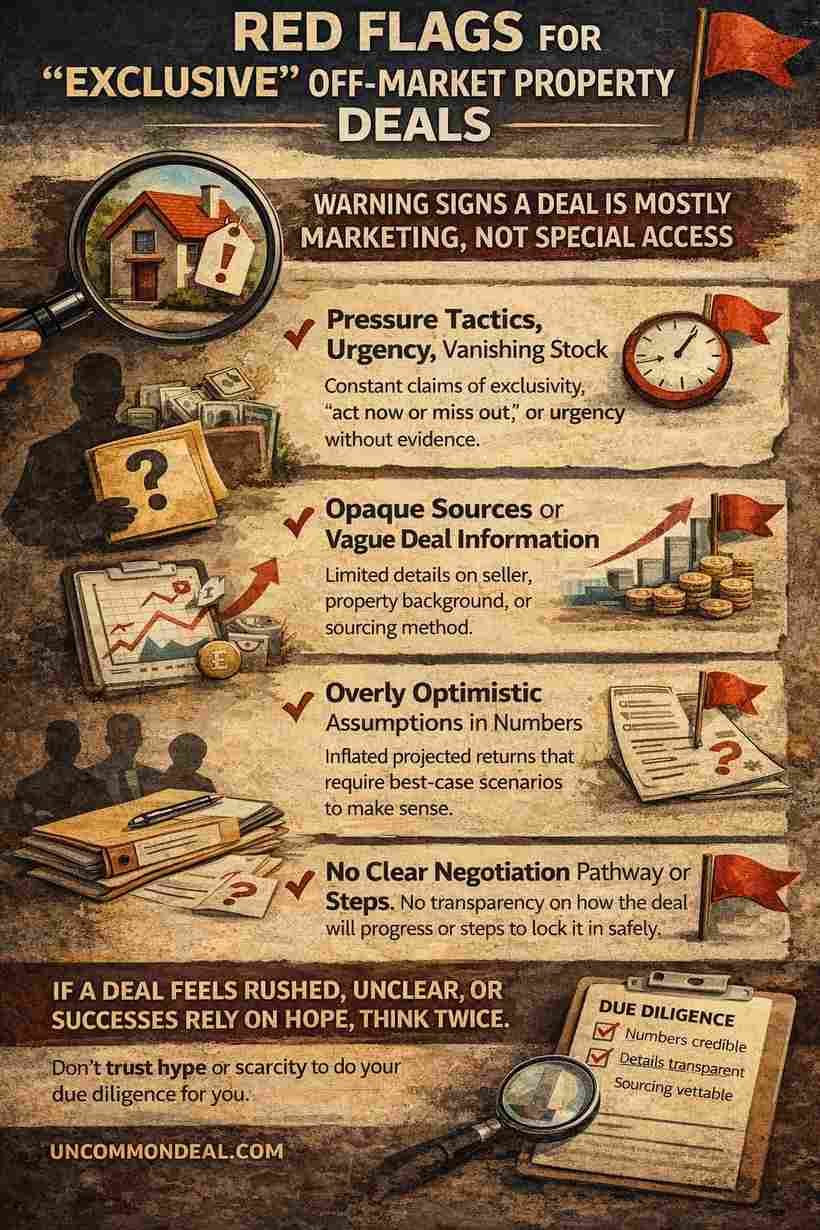
“Below market value†with no evidence
One of the most common claims in off-market sourcing is that a deal is below market value. On its own, this means nothing.
A legitimate claim should be supported by:
-
recent comparable sales
-
explanation of why the seller would accept less
-
acknowledgement of trade-offs such as condition, risk, or speed
When “below market value” is asserted without data, it is usually a sales hook rather than a pricing insight.
Artificial urgency and short deadlines
Deadlines are sometimes real, but urgency is frequently manufactured.
Red flags include:
-
“48 hours only” offers with no clear reason
-
pressure to reserve before full information is available
-
statements implying someone else is ready to exchange immediately
Urgency reduces scrutiny. Deals that require you to suspend due diligence are rarely as time-sensitive as they are made to appear.
Lack of clarity on fees and who is being paid
Fee opacity is one of the strongest indicators of misalignment.
Be cautious when:
-
the sourcing fee is mentioned late in the process
-
fees are payable before meaningful analysis
-
it is unclear whether the sourcer is paid by the seller, buyer, or both
-
referral fees to agents or brokers are undisclosed
If someone is uncomfortable explaining how they are paid, that discomfort usually has a reason.
Numbers that look neat but lack downside analysis
Many off-market deals are presented with clean, optimistic numbers. What is missing is often more important than what is shown.
Warning signs include:
-
no sensitivity to interest rates
-
no allowance for voids or compliance costs
-
refurbishment estimates with no contingency
-
yields based on best-case rent assumptions
Professional investors stress-test. Marketing materials rarely do.
Refusal to share full information early
While some details genuinely take time to gather, blanket resistance to sharing information is a concern.
Examples include:
-
reluctance to provide lease details
-
vague answers on service charges or ground rent
-
delayed disclosure of tenant issues
-
missing title or planning information
Withholding material facts while asking for commitment is not a sign of exclusivity. It is a sign of imbalance.
Over-reliance on trust and relationship language
Phrases like “we’ve done loads of these”, “trust us”, or “everyone on our list knows this works” are not substitutes for evidence.
Trust matters, but:
-
trust should follow transparency
-
relationships do not replace documentation
-
past deals do not guarantee future performance
Deals should stand up to scrutiny even when the relationship is strong.
The deal only works if everything goes right
If a deal collapses under modest stress, it is not resilient.
Red flags include:
-
thin margins after fees
-
no buffer for cost overruns
-
reliance on aggressive refinancing assumptions
-
sensitivity to small interest rate changes
Off-market should improve execution odds, not reduce margin for error.
“We don’t put deals on Rightmove†as a selling point
Avoid confusing distribution with value.
Not listing on portals does not:
-
make a deal cheaper
-
mean it is of higher quality
-
make it more suitable for your strategy
When portal avoidance is positioned as a feature rather than explained as a consequence of seller needs, it is usually part of the pitch.
When multiple red flags appear together
Any one of these issues might be manageable. Several together point to a pattern.
Marketing-led off-market deals typically combine:
-
weak evidence
-
urgency
-
fee opacity
-
optimistic projections
-
emotional language
When that pattern appears, the product being sold is often the feeling of access, not the underlying asset.
The investor filter that matters most
A simple test cuts through most marketing spin.
Ask:
If this deal were openly listed tomorrow, would the numbers still make sense once fees, finance, and risk are fully priced in?
If the answer is no, being off-market is not an advantage. It is a warning.
Off-Market vs On-Market Deals: A Reality Comparison
Many investors treat off-market and on-market deals as fundamentally different categories. In practice, the distinction is far less important than how the deal is analysed, negotiated, and executed. Both routes are subject to the same market forces, but they expose risks and advantages in different ways.
Buying property on the open market, or off-market should also be subject to a proper due diligence.
A realistic comparison helps remove portal bias and refocus attention on what actually drives returns.
Pricing transparency
Pricing transparency is one of the biggest practical differences between off-market and on-market deals, and one of the easiest areas for investors to misjudge. Transparency is not about whether a price is good or bad. It is about how easily that price can be tested against reality. The more visible the market, the easier it is to benchmark value, challenge assumptions, and understand where negotiation leverage genuinely sits. When visibility is reduced, the burden shifts to the buyer to independently verify whether a price reflects opportunity, optimism, or hidden risk.
On-market deals
Pricing is visible and anchored by comparable listings and recent sales. While this creates competition, it also provides clear reference points. Investors can quickly sanity-check whether an asking price is optimistic, realistic, or aggressive.
Off-market deals
Pricing is often framed without full context. Comparables may be selective, outdated, or implied rather than shown. Without public benchmarking, investors must work harder to validate value.
Reality:
Transparency tends to be higher on-market. Off-market requires more independent verification, not less.
Competition dynamics
Competition is often misunderstood in off-market sourcing. Many investors assume that fewer eyeballs automatically mean less competition, but competition does not disappear when deals move off portals. It simply becomes less visible. Understanding who you are competing against, how informed they are, and how quickly they can act matters far more than how many people see the listing. In private channels, competition is often tighter, quieter, and more professional, which can change the dynamics of pricing and negotiation in subtle but important ways.
On-market deals
Competition is open and obvious. Multiple viewings, sealed bids, and best-and-final offers are common. This can push prices up but also reveals where the true market level sits.
Off-market deals
Competition still exists, but it is quieter. You may be competing with a smaller group of investors who are often more experienced and decisive.
Reality:
Off-market does not remove competition. It changes who you compete against.
Negotiation leverage
Negotiation leverage is not created by labels or exclusivity. It comes from conditions that reduce risk and uncertainty for the seller. Investors frequently overestimate the power of “off-market” status while underestimating the value of certainty, speed, and credibility. Understanding where leverage truly comes from helps investors avoid paying a premium for perceived advantage and instead focus on the factors that actually influence seller decisions.
On-market deals
Negotiation leverage depends on time on market, price reductions, and seller motivation. Information asymmetry is lower, but so is flexibility in some cases.
Off-market deals
Negotiation can feel more flexible, particularly when speed or certainty matters to the seller. However, leverage is often overstated when fees or exclusivity narratives are involved.
Reality:
True leverage comes from the ability to proceed cleanly, not from the marketing channel.
Due diligence quality
Due diligence is where off-market deals quietly diverge from on-market ones. Reduced exposure often means reduced scrutiny at the early stages, which places greater responsibility on the buyer. While on-market deals benefit from multiple viewings, questions, and market feedback, off-market deals can progress with fewer external checks. This makes structured, independent due diligence essential, especially when information is incomplete or presented selectively.
On-market deals
Information is usually more complete upfront. Floorplans, EPCs, lease details, and agent disclosures are easier to obtain. The volume of scrutiny can surface issues early.
Off-market deals
Information may be drip-fed. Key details sometimes emerge only after initial commitment. This increases the importance of disciplined due diligence.
Reality:
Off-market deals demand higher diligence standards, not lower ones.
Fee impact
Fees are where many off-market deals quietly succeed or fail. Because sourcing fees are often framed as separate from the purchase price, investors can underestimate how significantly they affect returns. In reality, every fee paid to access a deal alters the true entry cost, reshapes leverage, and compresses margin. Understanding fee impact is not about arguing whether fees are fair, but about recognising how they change the commercial profile of a deal.
On-market deals
There is no sourcing fee. All costs relate directly to purchase, finance, and conveyancing.
Off-market deals
Sourcing fees are common and must be absorbed into the economics. This directly affects entry price and return metrics.
Reality:
Fees can erase perceived discounts if not carefully priced in.
Risk visibility
Risk does not disappear in off-market deals. It becomes harder to see. Reduced exposure often means fewer questions asked, fewer objections raised, and fewer warning signs surfaced early. While this can create a smoother buying experience, it also increases the chance that material issues remain undiscovered until later in the process. Investors need to understand how visibility affects risk detection, not assume that privacy equals safety.
On-market deals
Risks are often easier to spot because the deal has been exposed to a wider audience. Repeated listings or price reductions can be informative.
Off-market deals
Reduced exposure can hide weaknesses. Some deals are private precisely because they would struggle publicly.
Reality:
Lower visibility often increases risk, rather than reducing it.
Exit liquidity
Exit liquidity is rarely considered at acquisition, yet it is one of the most important drivers of long-term performance. How easily you can sell a property in future depends heavily on how you bought it. Deals acquired with limited price discovery or thin margins can become fragile when market conditions shift. Understanding exit liquidity means assessing whether today’s entry price will still make sense to tomorrow’s buyers, not just whether the deal works on paper today.
On-market deals
If you buy at a transparent market level, exiting is usually straightforward, assuming market conditions hold.
Off-market deals
If you overpay due to fees or optimism, exit becomes more sensitive to market shifts. Liquidity risk increases when margins are thin.
Reality:
Exit risk is driven by entry price and fundamentals, not by how you sourced the deal.
The performance myth
A persistent myth is that off-market deals outperform on-market deals by default.
In reality:
-
strong returns come from buying well, not buying privately
-
disciplined negotiation on-market can outperform poorly structured off-market purchases
-
access does not replace analysis
The balanced conclusion
Off-market and on-market deals are not competing strategies. They are different acquisition channels.
A well-negotiated on-market deal with strong fundamentals will almost always outperform a weak off-market deal wrapped in exclusivity language. Conversely, a genuinely motivated off-market sale with real complexity can be an excellent opportunity for the right investor.
The deciding factor is not where the deal was found. It is how well it stands up to scrutiny.
Who Off-Market Property Sourcing Is (and Isn’t) For
Off-market property sourcing is not universally good or bad. It is situational. The same deal can be a smart acquisition for one investor and a poor decision for another. The difference is rarely access. It is experience, capital structure, and execution capability.
Understanding whether off-market sourcing fits your profile is more important than deciding whether it works in theory.
Investors off-market sourcing can work for
Off-market sourcing tends to work best for investors who already have clarity, capability, and execution systems in place. For these buyers, access is useful because it complements experience and speed, rather than substituting for them.
- Experienced investors with defined criteria
Investors who know their numbers, target locations, and acceptable risks can filter opportunities quickly. Off-market access allows them to move decisively when a deal fits, without being distracted by volume or noise. - Buyers with flexible or non-standard finance
Cash buyers or those comfortable with bridging, refurbishment finance, or complex lending structures are better positioned. Many off-market deals involve timelines or property issues that standard buy-to-let mortgages cannot accommodate. - Investors comfortable with complexity and execution risk
Short leases, tenant issues, heavy refurbishments, or title complications deter the wider market. Investors who understand these risks and can manage them may extract value where others cannot. - Relationship-driven operators
Repeat buyers who complete reliably often receive early calls from agents and sellers. In these cases, off-market access is earned over time and is paired with realistic pricing rather than hype. - Active investors, not passive buyers
Off-market works best for investors who are hands-on, responsive, and engaged in the transaction. Speed and clarity are advantages only when backed by action.
Investors off-market sourcing is usually a poor fit for
Off-market sourcing often underperforms when it is used as a substitute for experience rather than a supplement to it. Investors who rely on access, reassurance, or marketing narratives instead of independent analysis are far more likely to overpay or underestimate risk.
- First-time investors
First-time property investors often lack the experience to separate genuine opportunity from polished marketing. Reduced transparency and higher complexity increase the risk of early mistakes. - Yield-only or spreadsheet-led buyers
If a deal only works on optimistic assumptions, tight margins, or perfect execution, off-market access will not save it. These buyers are often better served by transparent, on-market opportunities. - Heavily leveraged strategies
Thin margins combined with sourcing fees and interest rate sensitivity leave little room for error. Off-market does not reduce financial risk for highly leveraged buyers. - Investors relying on others to validate the deal
If you expect the sourcer, agent, or introducer to filter quality for you, off-market sourcing is dangerous. Access does not equal endorsement. - Buyers chasing exclusivity rather than fundamentals
Those motivated by the feeling of insider access are most likely to overpay or overlook risk. The label becomes the selling point, not the deal.
The self-check that matters
Before pursuing off-market deals, investors should ask:
-
Can I assess this deal independently?
-
Do I understand the risks being transferred to me?
-
Am I paying for value or for access?
-
Would I buy this if it were openly listed tomorrow?
If those questions cannot be answered confidently, off-market sourcing is unlikely to improve outcomes.
The balanced conclusion
Off-market property sourcing is not a shortcut. It is a tool.
Used by the right investor, in the right context, it can improve execution and access. Used without discipline, it often increases cost and risk while reducing transparency.
The deciding factor is not who shared the deal. It is whether the investor has the capability to evaluate and execute it properly.
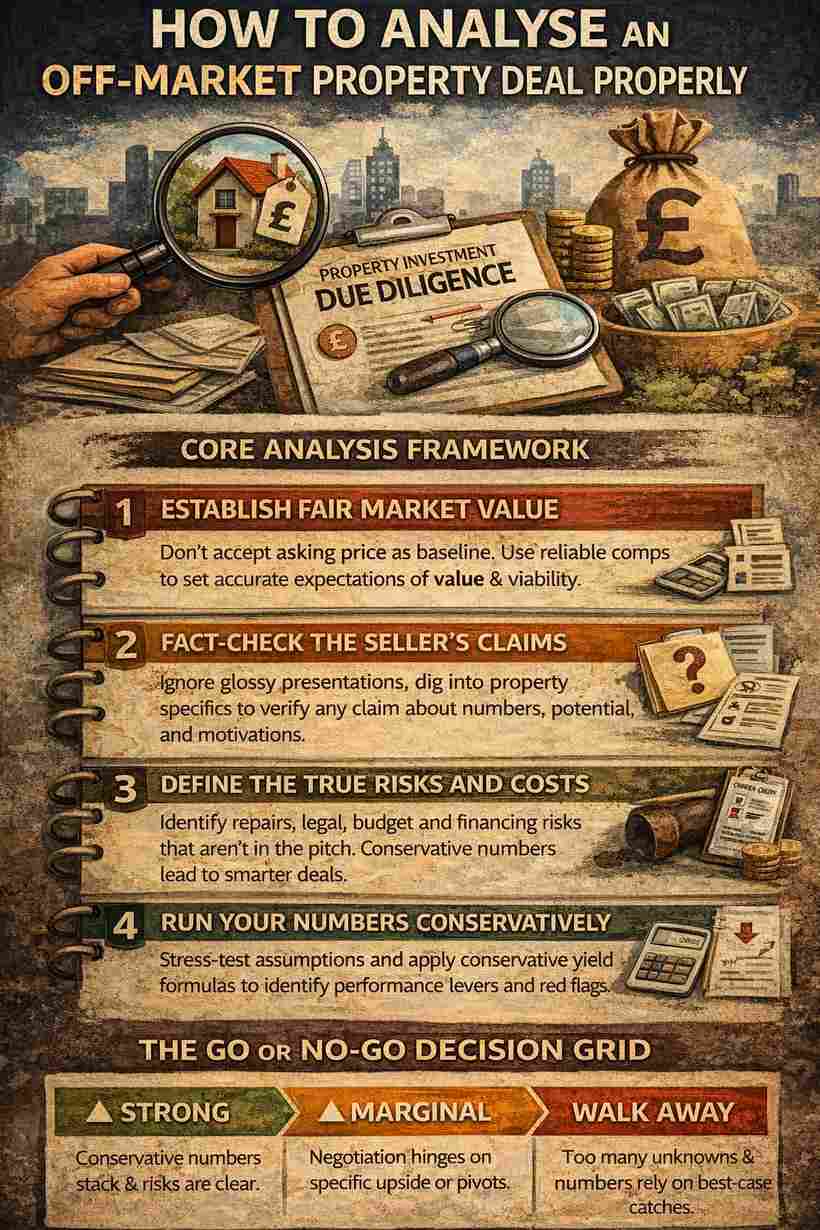
How to Analyse an Off-Market Deal Properly
The biggest mistake investors make with off-market deals is treating the label as a value signal. It isn’t. An off-market deal is simply a deal that has been distributed privately or early. It still needs to earn its place through numbers, evidence, and risk-adjusted returns. In a word, you need to know how to analyse a property deal properly.
A proper analysis process does two things:
-
It protects you from marketing-led deals
-
It helps you move faster on the rare deals that genuinely stack up
Below is a practical, investor-grade framework you can apply to any off-market opportunity.
1) Start by ignoring the narrative
The first step in analysing any off-market deal is separating the asset from how it has been presented. Private distribution often comes with framing designed to create urgency or confidence, which can distort judgement if left unchallenged. By mentally detaching from the presentation, investors put themselves in a position to evaluate the deal on facts rather than persuasion.
Before you touch the numbers, strip out the story:
-
“exclusive”
-
“below market”
-
“won’t last”
-
“investor only”
-
“we’ve done loads like this”
Treat those as sales language until proven otherwise.
Your job is to identify:
-
type of asset it is
-
what you are paying all-in
-
type of risks you are inheriting
-
what must go right for it to work
2) Rebuild the “true entry price†(all-in acquisition cost)
Off-market deals often look attractive because costs are separated and framed as optional. They are not optional.
Private distribution makes it easier for fees and charges to be presented in isolation, which can cause investors to underestimate their true exposure and overestimate returns. Rebuilding the all-in acquisition cost forces the deal back into commercial reality and removes the illusion created by fragmented pricing.
Build your true entry price using:
-
purchase price
-
sourcing fee (and VAT if applicable)
-
reservation fee (if Modern Method style structures are involved)
-
legal fees (purchase and lender)
-
surveys and searches
-
finance fees (arrangement, broker, valuation)
-
stamp duty (including any relevant surcharge)
-
initial compliance and certification costs (gas, electric, EPC, licensing where relevant)
Investor rule:
If you do not know your true entry price within a tight range, you do not yet have a deal.
3) Verify the “below market value†claim with your own comps
Off-market deals are frequently positioned as being priced below market value, yet this claim is often accepted without sufficient challenge. Private circulation reduces price visibility, which makes it easier for optimistic or selective comparisons to go unquestioned. Verifying value using your own comparable evidence is essential to determine whether any discount is real, and if so, what risk or constraint is driving it.
Never rely on presented comparables.
Do your own benchmarking:
-
sold prices, not asking prices
-
comparable streets and property types
-
last 6 to 12 months where possible
-
adjust for condition, size, and tenure
-
be conservative on end values
Then ask the key question:
If this is below market, what is the reason?
Legitimate reasons usually include:
-
time pressure
-
legal complications
-
condition issues
-
tenant problems
-
structural or mortgageability constraints
If there is no clear reason, assume the discount is not real.
4) Validate rent using reality, not projections
Rental assumptions are one of the easiest areas for optimism to creep into off-market deals. Projected figures are often based on best-case scenarios rather than what similar properties are actually achieving in the same location. Validating rent against real market evidence helps ensure that cashflow, yields, and stress tests are built on reality rather than expectation.
Off-market packs often inflate rent to make yields look strong.
Reality-check rent by:
-
comparing current listings locally
-
checking achieved rents if you have access
-
adjusting for condition and tenant profile
-
considering licensing constraints and room sizes if relevant
Then underwrite with:
-
void allowance
-
management costs even if self-managing
-
maintenance reserve
-
compliance costs
If the deal only works at the top end of rent estimates, it is fragile.
5) Identify the deal type and its risk profile
Off-market deals are often presented as broadly suitable without clearly defining what type of investment they actually are. When the strategy is vague, risk becomes harder to quantify and mistakes are easier to make. Identifying the deal type early allows investors to align their analysis with the correct risk profile and avoid applying the wrong assumptions.
Be specific about whether this is:
-
buy-to-let hold
-
light refurb and let
-
heavy refurb
-
BRR / refinance
-
flip
-
title or lease resolution play
-
tenant-led cashflow play
-
planning or conversion play
Each strategy has different failure points. Your analysis should reflect the actual strategy, not the story you were sold.
6) Stress-test the deal like a lender would
Many off-market deals look workable only under ideal conditions. Lenders, however, assess risk by assuming delays, higher costs, and less favourable outcomes. Stress-testing the deal in the same way reveals how resilient it really is and how quickly it breaks when conditions shift.
Assume:
-
higher interest rates than today
-
slower refinancing
-
longer time to let
-
higher maintenance than expected
-
conservative end values
You want to know two things:
-
Does it still survive under stress?
-
How quickly does it break?
A deal that breaks under mild stress is not investable. It is a speculation.
7) Treat “unknowns†as costs, not footnotes
Off-market deals often progress with gaps in information, especially at early stages. The mistake investors make is treating missing details as neutral rather than potentially costly. By pricing unknowns as risks upfront, you protect yourself from surprises that only surface once commitment has already been made.
In fact, these deals often have missing information early. That is normal. The mistake is proceeding as if missing information is neutral.
Unknowns usually become:
-
time delays
-
additional legal cost
-
renegotiation
-
or deal collapse
Examples of unknowns you should price in:
-
service charge ranges not confirmed
-
lease length and ground rent terms
-
licensing position (selective licensing, additional licensing, HMO)
-
planning constraints or Article 4 impacts
-
tenant status and arrears
-
title restrictions or missing rights
Investor rule:
If something matters and you cannot verify it, assume it is unfavourable until proven otherwise.
8) Get the legal and compliance picture early
Legal and compliance issues are where off-market deals most often unravel. Private distribution can delay the disclosure of critical facts, which increases the risk of costly surprises later in the process. Getting clarity early allows investors to assess viability before time, money, or leverage is committed.
Off-market deals can move quickly. That is exactly why you need legal clarity early.
At minimum, confirm:
-
tenure and remaining lease term (if leasehold)
-
service charge and ground rent (and review patterns)
-
restrictions on letting, subletting, or short-term use
-
any onerous clauses
-
licensing requirements for your use case
-
whether the property is mortgageable for your intended lender
If the deal requires a fee or commitment before basic legal facts are shared, that is a red flag.
9) Check who is being paid and where incentives sit
Incentives shape behaviour, and off-market deals are no exception. When payment structures are unclear, it becomes difficult to assess whether advice is aligned with your interests or driven by commission. Understanding who is being paid, by whom, and for what ensures you are analysing the deal on its merits rather than absorbing someone else’s sales incentives.
You need incentive clarity before you rely on anyone’s claims.
Ask:
-
if the sourcer is paid by the buyer, the seller, or both.
-
is there an agent referral fee?
-
if the broker is being paid separately.
-
is the deal being “sold” multiple times across lists?
If incentives are unclear, assume the deal is being pushed because it sells, not because it stacks.
10) Decide your walk-away conditions upfront
Off-market deals often create momentum that makes investors gradually relax their standards. Without clear boundaries, it becomes easy to justify compromises that would not have been accepted at the outset. Deciding walk-away conditions upfront protects discipline and prevents urgency from overriding judgement.
They often create urgency; therefore, making investors move goalposts.
Set your red lines before you proceed, such as:
-
maximum all-in entry price
-
minimum yield or return on capital
-
maximum refurb budget
-
minimum lease length
-
maximum service charge
-
required proof of motivation or comparables
If the deal fails any red line, you walk. No negotiation with yourself.
11) Use a simple decision framework
Off-market sourcing generates volume and pressure, which can make decision-making inconsistent. Without a clear framework, similar deals can be judged differently depending on presentation or timing. A simple, repeatable decision structure keeps analysis objective and ensures every opportunity is assessed by the same standard.
To keep decisions consistent, use a three-tier outcome:
-
Strong: conservative numbers stack, risks understood, evidence supports claims
-
Marginal: works only with assumptions, requires negotiation or specific execution
-
Walk away: relies on optimism, unclear facts, thin margin, or hidden costs
Off-market sourcing becomes powerful when it feeds a disciplined decision framework, not when it replaces one.
Final takeaway
Off-market deals can be excellent, but only when you analyse them more rigorously than on-market deals.
The fewer people who have seen a deal, the more important it becomes to validate:
-
price
-
rent
-
risks
-
fees
-
legal position
-
and downside scenarios
If you can do that quickly and consistently, off-market access becomes an advantage. If you cannot, it becomes a cost.
Remember, the same property evaluation framework should be applied whether a property is sourced on or off the market.
Final Verdict: Opportunity Exists, but the Label Is Overused
Off-market property sourcing is not a strategy in itself. It is simply a method of accessing deals earlier, more quietly, or through private channels. Treating the label as a guarantee of value is where most investors go wrong.
Genuine opportunities do exist off-market, but they are situational rather than systematic. They usually arise because a seller has a constraint, an asset carries complexity, or an investor has the capability to execute where others cannot. In those cases, private distribution can improve speed and certainty, not magically create discounts.
The problem is that the term “off-market” is now used far more broadly than its original meaning. It is often applied to deals that are merely pre-market, lightly repackaged, or intentionally withheld to create a sense of exclusivity. When the label becomes the selling point, analysis tends to suffer.
For investors, the correct approach is simple. Ignore how a deal is described and focus on how it performs once all costs, risks, and constraints are priced in. If the numbers work conservatively, the route to the deal is irrelevant. If they do not, being off-market will not fix them.
Off-market sourcing can be a useful acquisition channel for disciplined investors. But access never replaces due diligence, and exclusivity never substitutes for margin.

Koye Beckley is a UK property investor and founder of UncommonDeal, with practical experience in buy-to-let, property auctions, refurbishment projects and investment deal analysis. Through UncommonDeal, he publishes property market research, property deal sourcing and compliance guidance, investment guides and data-driven analysis to help investors evaluate buy-to-let, BRRR, flip and auction opportunities.