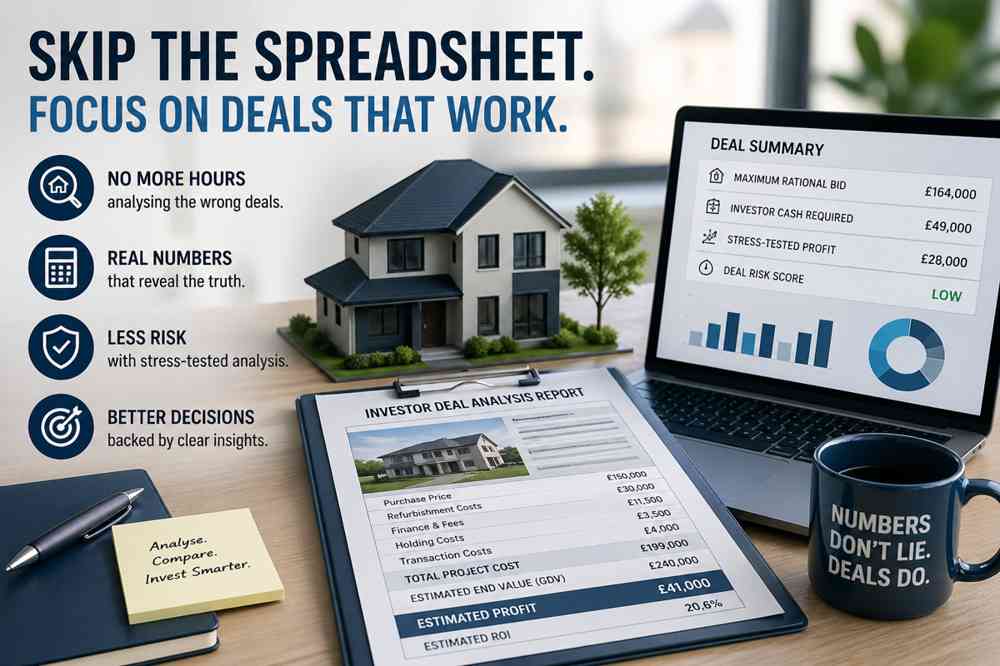
Skip the Spreadsheet: Why Smart Investors Buy Pre-Vetted Property Deals
Most property investors believe property deal analysis requires complex spreadsheets and hours of calculations. In reality, experienced investors focus on pre-vetted property deals where the analysis has already revealed whether the numbers actually work.
Most property investors start with a spreadsheet.
They download a template, add a few formulas, and begin analysing potential deals. On the surface, this seems like the responsible way to invest. Numbers matter. Returns matter. Risk matters.
But experienced investors eventually discover an uncomfortable truth.
The problem is not analysing deals.
The problem is how much time investors waste analysing the wrong deals.
A typical investor might review dozens of listings each week. They check the guide price, estimate rental income, review comparable sales, and try to calculate potential returns. Hours disappear into spreadsheets, property portals, and rough calculations.
And yet, after all that work, most of those deals never make sense.
Some fail because refurbishment costs were underestimated. Others collapse once finance costs are included. Many simply cannot produce acceptable returns once real-world expenses and risk are considered.
This is why many experienced investors no longer begin with spreadsheets.
Instead, they focus on pre-vetted property deals.
A pre-vetted deal is not just a property that looks attractive. It is a deal that has already been analysed from an investor’s perspective. The numbers have been tested, the costs stress-tested, and the realistic profit and risk evaluated.
In other words, the analysis has already been done.
This approach changes how investors operate. Instead of spending hours analysing every opportunity, they focus only on deals that have already passed the most important financial filters.
The result is simple: less time wasted, better decisions, and fewer expensive mistakes.
In today’s market, proper property deal analysis is no longer optional. It separates disciplined investors from expensive speculation.
What Are Pre-Vetted Property Deals?
A pre-vetted property deal is a property investment opportunity that has already been analysed using realistic financial assumptions.
Instead of relying on headline figures from estate agents or marketing material, the deal is tested using the numbers that actually matter to investors.
These typically include:
-
realistic refurbishment costs
-
financing and bridging costs
-
stamp duty and transaction fees
-
holding costs during the project
-
resale or rental assumptions based on comparable evidence
-
stress-tested profit or yield scenarios
When these inputs are applied correctly, the analysis reveals whether a property deal genuinely works or only appears attractive at first glance.
This is why professional investors often evaluate deals using metrics such as:
-
maximum rational bid
-
total project cost
-
cash required to complete the deal
-
stress-tested profit scenarios
-
risk scores based on financial sensitivity
These numbers reveal something that marketing listings rarely show.
Not whether a property is interesting.
But whether the deal itself actually works.
And once investors start thinking this way, something surprising happens.
They realise that most deals they used to analyse were never viable in the first place.
The Hidden Cost of Analysing Property Deals Yourself
At first glance, analysing property deals yourself seems like the smart approach. Many investors believe that building spreadsheets, estimating numbers, and reviewing listings carefully will help them avoid bad investments.
In theory, that makes sense.
But in practice, the real cost of doing property deal analysis manually is rarely the spreadsheet itself. The real cost is the time lost analysing opportunities that were never viable in the first place.
Property markets generate thousands of listings every week. Auction catalogues, estate agent portals, deal sourcing emails, and off-market leads constantly present new opportunities. On the surface, many of these deals appear attractive.
But once realistic costs and assumptions are applied, most of them fall apart.
This means many investors spend hours analysing deals that a disciplined investor could reject within minutes.
Over time, that hidden cost becomes significant.
Not just in lost hours, but in missed opportunities.
Why Most Investors Spend Hours Analysing the Wrong Property Deals
Many investors begin analysing a deal because it looks promising at first glance.
The guide price seems low.
The potential rent appears strong.
The property might need refurbishment that seems manageable.
So the investor opens a spreadsheet and starts calculating.
They estimate the purchase price, renovation costs, financing costs, stamp duty, and expected resale or rental income. But what often happens next is that the numbers slowly start to change.
Refurbishment costs increase once realistic quotes are considered.
Financing costs grow when bridging interest and fees are added.
Holding costs appear during the renovation period.
What initially looked like a profitable opportunity gradually becomes less attractive.
Eventually the investor realises the deal does not work.
The problem is that by this point, an hour or more may already have been spent analysing it.
Experienced investors learn to recognise something important: most deals that require deep analysis often fail basic financial tests anyway.
This is why disciplined investors focus on filtering opportunities before investing significant time into detailed calculations.
The Spreadsheet Trap Many Property Investors Fall Into
Spreadsheets are powerful tools.
Used correctly, they allow investors to model scenarios, estimate returns, and stress-test assumptions. Many professional investors rely on them to make decisions.
However, spreadsheets also create a trap.
When investors build their own analysis models, they often feel compelled to analyse every deal they encounter. Each new listing becomes another opportunity to test their calculations.
The result is a cycle that looks productive but rarely leads to results:
-
A property listing looks interesting
-
The investor opens their spreadsheet
-
They spend time estimating the numbers
-
The deal ultimately fails the analysis
Then the process repeats.
Over time, this approach creates a false sense of progress. The investor feels busy analysing deals, but very few opportunities actually survive the financial scrutiny.
Instead of improving decision-making, the spreadsheet becomes a time-consuming filter applied too late in the process.
Why Time Is the Most Expensive Cost in Property Investing
In property investing, money is not the only resource that matters.
Time is often far more valuable.
An investor who spends several hours each week analysing deals that never work may believe they are being diligent. In reality, they may simply be spending their time on the wrong stage of the investment process.
Professional investors think differently.
They focus on efficient deal filtering before committing significant time to analysis. Opportunities that fail basic financial logic are rejected quickly.
Only the deals that survive these early filters are analysed in depth.
This approach allows experienced investors to concentrate their time where it actually matters: evaluating opportunities that already show realistic potential.
Because in property investing, the biggest advantage is rarely having the most sophisticated spreadsheet.
It is knowing which deals are worth analysing in the first place.
Why Most “Good Looking” Property Deals Fail Under Real Analysis
Many property listings appear attractive at first glance.
The guide price looks competitive. The potential rental income seems strong. Estate agent descriptions often highlight “great investment potential” or “excellent yield opportunity.”
But once proper property deal analysis is applied, a surprising number of these deals stop making financial sense.
This happens because the numbers shown in property listings rarely reflect the true cost of completing and operating the investment.
Experienced investors understand that a deal must work after every realistic cost is included, not just the purchase price.
Estate Agent Numbers vs Investor Numbers
Estate agents typically present numbers that make a property look appealing to the widest possible audience.
These figures often focus on:
-
guide price
-
potential rental income
-
basic yield calculations
While these numbers are not necessarily wrong, they are often incomplete from an investor’s perspective.
Investors must evaluate additional factors that significantly change the financial picture.
For example:
-
financing costs during the purchase period
-
refurbishment costs required to reach rental or resale value
-
stamp duty and legal fees
-
holding costs during renovation
-
selling costs if the strategy involves a flip
Once these costs are applied, the real profitability of a deal can change dramatically.
A property that initially looked like a strong investment may suddenly reveal very limited margins.
Costs Investors Often Underestimate
One of the most common reasons property deals fail under proper analysis is that investors underestimate key costs.
These are some of the expenses that frequently transform a “good looking” deal into a marginal one.
Refurbishment Costs
Initial renovation estimates are often optimistic. Once structural work, compliance upgrades, or contractor costs are considered, budgets can increase significantly.
Finance Costs
Bridging loans, development finance, or short-term borrowing can add substantial interest and arrangement fees, particularly if the project timeline extends.
Holding Costs
During refurbishment or planning delays, investors may still need to cover council tax, utilities, insurance, and loan interest.
Transaction Costs
Stamp duty, legal fees, surveys, and valuation costs add to the total project investment and reduce the final margin. Also, legal fees and property legal due diligence requirements can significantly impact total project cost.
When these expenses are properly included in property investment deal analysis, many deals quickly reveal much thinner profits than initially expected.
Why Yields and Headline Prices Can Be Misleading
Headline yields and attractive guide prices often create the illusion of a strong investment opportunity.
For example, a property advertised with an 8% or 9% yield may appear highly attractive compared to typical market returns.
But these figures often rely on simplified calculations that ignore several key factors:
-
refurbishment costs needed to achieve the projected rent
-
financing costs during purchase or renovation
-
management fees or licensing requirements
-
maintenance and compliance expenses
Similarly, auction guide prices can be misleading. They often represent a starting point for bidding, not the final purchase price.
Without proper analysis, investors may focus too heavily on the guide price and underestimate the maximum rational bid that still allows the deal to remain profitable.
This is why experienced investors rely on structured analysis rather than marketing figures.
Because in property investing, a deal does not become good simply because the price looks low or the yield appears high.
A deal only works when all the numbers still make sense after every realistic cost has been accounted for.
What Smart Investors Actually Want: Pre-Vetted Property Deals
Once investors gain experience in the property market, their priorities begin to change.
In the early stages, many investors focus on finding as many potential deals as possible. They browse property portals, monitor auction catalogues, subscribe to sourcing emails, and analyse every listing that appears promising.
But over time, experienced investors realise something important.
The real challenge is not finding deals.
The real challenge is finding deals that actually work.
This is why many professional investors prefer to focus on pre-vetted property deals instead of analysing every opportunity from scratch.
What a Pre-Vetted Deal Actually Means
A pre-vetted property deal is an opportunity that has already been examined using realistic financial assumptions.
Instead of relying on headline figures or optimistic projections, the deal has been tested using the same numbers serious investors apply before committing capital.
This typically includes analysing:
-
total acquisition cost
-
realistic refurbishment costs
-
financing expenses and holding costs
-
expected resale or rental value based on comparable evidence
-
projected profit or yield under different scenarios
When these factors are properly evaluated, the analysis reveals whether the deal is genuinely viable.
In other words, a pre-vetted deal is not simply a property that looks attractive on paper. It is a deal that has already passed the first stage of property deal analysis.
How Serious Investors Filter Deals Before Bidding
Experienced investors rarely analyse every property they encounter in detail.
Instead, they apply quick filters that allow them to reject unsuitable opportunities early.
These filters often include questions such as:
-
Does the guide price leave enough margin for profit?
-
Are the refurbishment requirements realistic for the expected end value?
-
Is there sufficient demand for the resale or rental strategy?
-
Does the location support the expected valuation or rental level?
If a deal fails these basic checks, experienced investors move on quickly.
Only the opportunities that pass these initial filters are analysed in depth.
This approach dramatically reduces the number of deals that require detailed spreadsheets and financial modelling.
Why Professional Investors Analyse Deals Before Viewing
Many new investors believe that analysis should happen after they have viewed a property.
Professional investors often do the opposite.
They analyse the deal before arranging a viewing.
This approach saves time and allows investors to focus their attention on properties that already show realistic financial potential.
By the time they view a property, the key financial questions have already been addressed.
They know:
-
the approximate maximum price they can pay
-
the expected project costs
-
the potential profit or yield
-
the financial risks involved
This is the advantage of structured property investment deal analysis.
Instead of reacting emotionally to listings or marketing descriptions, investors make decisions based on numbers.
And once investors adopt this approach, they quickly realise that the most valuable opportunities are rarely the properties that attract the most attention.
They are the deals where the numbers quietly work in the background.
Careful deal analysis is becoming increasingly important in the changing buy-to-let market, where increased landlord selling can create opportunities but does not automatically make every property a good investment.
What Real Property Deal Analysis Looks Like
Once investors move beyond basic spreadsheets and marketing figures, they begin to understand what real property deal analysis actually involves.
Proper deal analysis is not just about estimating profit.
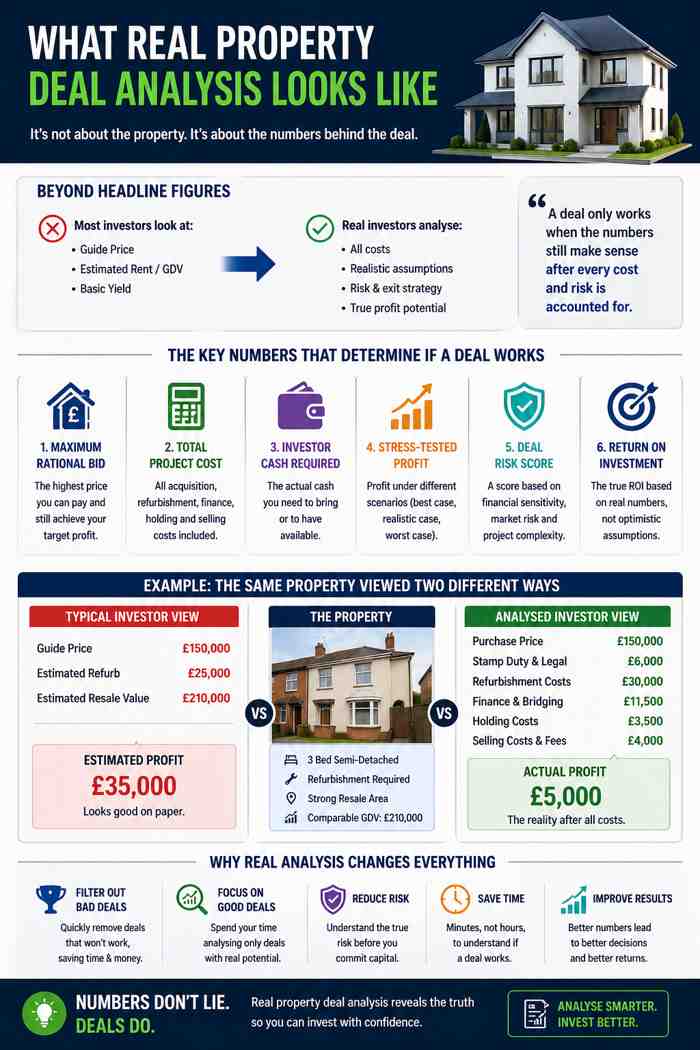
It is about understanding whether a property investment still works after every realistic cost, risk, and scenario has been considered.
This means looking beyond headline figures such as guide price or rental yield and focusing on the numbers that truly determine whether a deal is viable.
Experienced investors rely on structured analysis because it reveals something that marketing listings rarely show.
Not whether the property looks attractive.
But whether the deal itself actually works.
The Numbers That Actually Determine If a Deal Works
Professional investors evaluate property deals using a set of financial metrics that quickly reveal whether an opportunity deserves further attention.
These numbers go far beyond the simple “purchase price vs potential rent” calculations that many beginners rely on.
Some of the most important metrics include:
Maximum Rational Bid
This is the highest price an investor can pay for a property while still maintaining an acceptable profit or return after all costs are included.
Without calculating this number, investors risk overpaying for properties that appear cheap but ultimately produce weak margins.
Total Project Cost
The true investment cost goes beyond the purchase price. It includes stamp duty, legal fees, financing costs, refurbishment, and holding expenses during the project.
Understanding the full project cost allows investors to see how much capital is actually required to complete the deal.
Investor Cash Required
This figure shows how much cash an investor must contribute to complete the transaction. It accounts for deposits, renovation funding, and any financing gaps that cannot be covered by borrowing.
For many investors, this number determines whether a deal is even feasible.
Stress-Tested Profit
A deal may look profitable under optimistic assumptions, but real analysis examines what happens when costs increase or values change.
Stress testing allows investors to see whether a deal still works if refurbishment costs rise, timelines extend, or resale values soften.
Deal Risk Score
Some investors also use risk scoring systems that consider factors such as market demand, planning uncertainty, renovation complexity, and financing exposure.
While not always precise, these scores help investors compare opportunities and identify deals that carry higher uncertainty.
Why Proper Analysis Reveals the Truth About a Deal
Once these numbers are calculated properly, many deals that initially looked attractive begin to change.
Some deals reveal thin margins that leave little room for unexpected costs. Others require far more capital than originally assumed. In some cases, the deal simply does not produce enough return to justify the risk.
But occasionally, the opposite happens.
A property that looked unremarkable at first glance may reveal strong fundamentals once analysed properly.
This is one of the most important lessons experienced investors learn.
Successful property investing is rarely about finding the most exciting listing.
It is about identifying the opportunities where the numbers quietly make sense long before the market notices them.
And that is exactly what structured property investment deal analysis is designed to reveal.
Case Example: The Same Property Viewed Two Different Ways
One of the clearest ways to understand the importance of property deal analysis is to look at how the same property can appear very different depending on how it is evaluated.
At first glance, many listings look attractive. A low guide price, a property that needs refurbishment, and the promise of higher resale value or rental income assumptions can make a deal appear promising.
But once proper analysis is applied, the financial reality often looks very different.
The difference usually comes down to how the deal is viewed.
The Typical Investor View
Many investors first evaluate a property based on the headline information in the listing.
They may see something like this:
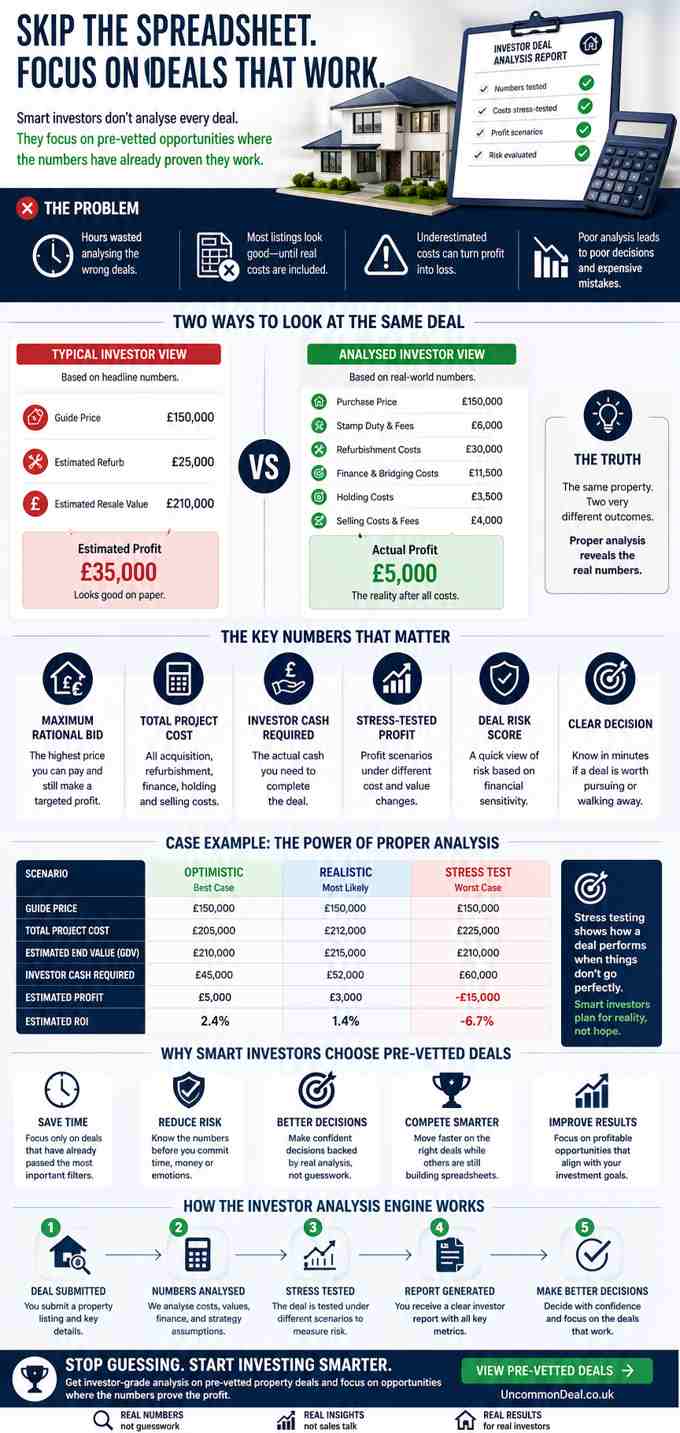
Guide price: £150,000
Estimated refurbishment: £25,000
Estimated resale value: £210,000
At first glance, the numbers appear attractive.
An investor might quickly estimate:
Potential profit = £35,000
From this perspective, the deal seems straightforward. The purchase price looks low compared to the potential resale value, and the renovation appears manageable.
But this quick calculation usually ignores several important factors.
The Analysed Investor View
When the same deal is evaluated using structured property investment deal analysis, the financial picture becomes far more detailed.
Instead of focusing only on the purchase price and renovation budget, the analysis includes the full project cost.
For example:
Purchase price: £150,000
Stamp duty and legal fees: £6,000
Refurbishment costs: £30,000
Bridging finance and fees: £11,500
Holding costs during renovation: £3,500
Selling costs and agent fees: £4,000
Total project cost: £205,000
If the property sells for £210,000, the profit is no longer £35,000.
It may be closer to £5,000 before tax, assuming everything goes exactly to plan.
At this point the deal may no longer justify the time, risk, and capital required to complete it.
This example highlights why experienced investors rely on structured analysis rather than quick assumptions.
A deal that appears highly profitable at first glance may reveal very thin margins once all realistic costs are included.
And this is exactly why disciplined investors focus on analysing deals properly before committing time, money, or attention.
Why Smart Investors Pay for Deal Analysis
At first glance, paying for property deal analysis may seem unnecessary.
After all, many investors believe they can calculate the numbers themselves. With enough time, a spreadsheet, and access to property listings, it is possible to estimate purchase costs, refurbishment budgets, and potential returns.
But experienced investors often see the situation differently.
They do not pay for analysis because they cannot calculate the numbers.
They pay for analysis because time, clarity, and risk reduction are more valuable than another spreadsheet.
Investors Pay for Speed
Property opportunities move quickly.
Auction deals may only be available for a few weeks. Off-market opportunities can disappear within days. Even traditional listings may attract competing buyers once the opportunity becomes obvious.
If an investor spends hours analysing every potential deal manually, they risk missing opportunities that were worth pursuing.
Structured property investment deal analysis allows investors to understand a deal quickly.
Instead of building a spreadsheet from scratch each time, the numbers are already organised into a clear decision framework. Within minutes, an investor can see whether the deal deserves further attention.
This speed is a significant advantage in competitive markets.
Investors Pay for Clarity
Spreadsheets often produce numbers, but they do not always produce clear decisions.
Many investors finish analysing a deal and still feel uncertain.
Is the profit realistic?
Are the costs underestimated?
Does the margin justify the risk?
Professional deal analysis frameworks simplify this decision.
By presenting key metrics such as maximum rational bid, total project cost, investor cash required, and stress-tested profit, investors can immediately see whether the opportunity meets their investment criteria.
Clarity allows investors to move forward with confidence or walk away without hesitation.
Investors Pay to Reduce Risk
Perhaps the most important reason investors value structured analysis is risk reduction.
Property investing involves large financial commitments. A small miscalculation in refurbishment costs, financing expenses, or resale value can significantly impact the final outcome.
Detailed property deal analysis helps reveal these risks before money is committed.
It highlights scenarios where profits may disappear if costs increase, timelines extend, or market conditions change.
By identifying these vulnerabilities early, investors can avoid deals that look profitable under optimistic assumptions but become dangerous once realistic conditions are applied.
Why Paying for Analysis Is Often the Cheapest Decision
When investors view deal analysis this way, the logic becomes clear.
The cost of analysing a deal is tiny compared to the potential cost of entering a weak investment.
Paying for proper analysis is not about outsourcing work.
It is about protecting capital, saving time, and focusing attention on the deals that genuinely deserve it.
For disciplined investors, this approach turns deal analysis from a tedious process into a powerful filter that separates real opportunities from expensive distractions.
Where Pre-Vetted Property Deals Come From
Many investors assume that pre-vetted property deals are rare opportunities that only large investors or professional developers can access.
In reality, most pre-vetted deals come from the same places where ordinary property opportunities appear. The difference is not the source of the deal. The difference is how the opportunity is analysed before investors commit to it.
Once proper property deal analysis is applied, a large number of listings can be filtered quickly, leaving only the opportunities that genuinely deserve further attention.
These opportunities typically come from several common parts of the property market.
Auction Opportunities
Property auctions are one of the most common sources of pre-vetted deals.
Auction catalogues often contain properties that require refurbishment, have unusual characteristics, or need investors who are comfortable managing projects. Because of this, some properties appear undervalued compared to traditional listings.
However, auctions also carry significant risks.
Guide prices are frequently designed to attract interest rather than reflect the final sale price. Properties may require substantial renovation, legal issues may appear in the auction pack, and financing timelines are usually strict.
This makes proper deal analysis essential before bidding.
Experienced investors often analyse auction deals in advance to determine the maximum price they are willing to pay, ensuring they do not get carried away during competitive bidding.
Off-Market Opportunities
Some of the most attractive deals never appear on public property portals.
Off-market opportunities can arise through direct relationships with estate agents, property owners, developers, or deal sourcers. These opportunities may include motivated sellers, properties that require redevelopment, or assets that need specialist investors.
However, off-market deals are not automatically good deals.
Even when a property is offered privately, the numbers still need to work. Proper property investment deal analysis ensures that the opportunity is financially viable before capital is committed.
Distressed Property Deals
Properties that require significant refurbishment, legal resolution, or structural improvement can sometimes create opportunities for investors.
These distressed properties may include:
-
homes requiring major renovation
-
properties with title or legal complications
-
assets owned by sellers who need a quick transaction
-
buildings that require redevelopment or conversion
While these deals can appear risky, they may also offer potential for investors who understand how to evaluate them properly.
But again, the key factor is not the property itself.
It is whether the numbers still work once every cost and risk is fully analysed.
Why Analysis Reveals Hidden Opportunities
One of the most important insights experienced investors develop is that attractive opportunities often do not look exciting at first glance.
Some of the best deals appear ordinary, overlooked, or even unattractive to casual buyers.
But when structured property deal analysis is applied, these properties can reveal strong financial fundamentals.
This is why disciplined investors focus less on finding “exciting” listings and more on identifying deals where the numbers quietly work in the background.
Because in property investing, the best opportunities are rarely the ones that look impressive at first glance.
They are the ones where careful analysis reveals value that most buyers fail to notice.
How Investors Can Check Deals Without Building Complex Spreadsheets
Many investors assume that analysing property deals properly requires building complicated spreadsheets.
They imagine dozens of formulas, multiple financial scenarios, and hours spent adjusting assumptions just to understand whether a deal might work.
While detailed models can be useful for large developments or complex projects, most investors do not actually need to build their own analysis system from scratch.
What they need is clear, structured property deal analysis that answers the most important investment questions quickly.
The Real Purpose of Deal Analysis
The goal of analysing a property deal is not to create a sophisticated spreadsheet.
The goal is to answer a few critical questions:
-
Does the deal produce a realistic profit or acceptable return?
-
How much cash will the investor need to complete the project?
-
What is the maximum price the investor can pay without destroying the margin?
-
How sensitive is the deal to rising costs or changing market conditions?
Once these questions are answered, the investor can make a clear decision.
Either the deal works within acceptable risk limits, or it does not.
This is why many experienced investors move away from complicated personal spreadsheets and instead rely on structured property investment deal analysis frameworks.
These frameworks focus on the numbers that matter most rather than attempting to model every possible scenario.
Why Most Spreadsheet Models Become Too Complex
Many investors begin building spreadsheets with simple intentions.
They want to calculate purchase price, renovation costs, and potential profit. But over time, the model becomes more complicated.
Additional variables are added, such as finance costs, contingency budgets, holding periods, and alternative exit strategies.
Eventually, the spreadsheet becomes difficult to maintain, difficult to interpret, and difficult to apply quickly when new opportunities appear.
Ironically, this complexity can slow investors down rather than helping them make better decisions.
Instead of quickly identifying viable opportunities, investors may spend hours adjusting formulas and inputs.
What Investors Actually Need
Most investors do not need hundreds of spreadsheet cells to evaluate a deal.
They need a clear financial overview that highlights the metrics that truly matter.
Effective property deal analysis typically focuses on a small number of key outputs:
-
total project cost
-
investor cash required
-
maximum rational bid
-
stress-tested profit scenarios
-
overall risk assessment
When these figures are presented clearly, investors can quickly understand whether a deal deserves further attention.
This approach transforms deal analysis from a complicated exercise into a practical decision-making tool.
And once investors experience this type of structured analysis, many realise that the most valuable part of the process is not the spreadsheet itself.
It is the clarity the numbers provide.
How the Investor Analysis Engine Works
Understanding how a deal works financially is one thing.
Having a structured way to analyse opportunities quickly is another.
This is where the UncommonDeal Investor Analysis Engine was designed to help.
Instead of spending hours building spreadsheets or estimating numbers from scratch, investors can use a structured framework that evaluates property opportunities using the metrics that actually matter.
The goal is simple: turn property listings into clear investment decisions.
Step 1: The Property Is Submitted for Analysis
The process begins with a property listing.
This could be:
-
an auction property
-
a buy-to-let opportunity
-
a refurbishment project
-
a potential flip or BRRR deal
The investor simply provides the listing details and key information such as the guide price, property condition, and investment strategy.
From there, the deal is evaluated using structured property deal analysis.
Step 2: The Deal Is Analysed Using Real Investor Metrics
Once the property information is reviewed, the analysis focuses on the numbers that determine whether the deal actually works.
This includes evaluating:
-
total acquisition cost
-
refurbishment and project costs
-
financing expenses
-
holding costs during the project
-
resale or rental assumptions based on comparable evidence
Instead of relying on optimistic projections, the numbers are calculated using realistic assumptions that reflect real-world investing conditions.
Step 3: The Deal Is Stress-Tested
Many deals look profitable under ideal conditions.
However, experienced investors know that projects rarely follow the perfect scenario.
That is why the analysis also includes stress testing.
This examines how the deal performs if:
-
refurbishment costs increase
-
project timelines extend
-
resale values soften
-
financing costs change
By examining these scenarios, investors can see whether the deal still works under less favourable conditions.
Step 4: A Clear Investor Report Is Generated
Once the analysis is complete, the results are presented in a structured Investor Deal Analysis Report.
This report highlights the key metrics that investors need to make decisions, such as:
-
maximum rational bid
-
total project cost
-
investor cash required
-
estimated profit scenarios
-
deal risk indicators
Instead of navigating through complex spreadsheets, investors receive a clear summary of the deal’s financial structure.
This allows them to quickly determine whether the opportunity deserves further attention.
Why Structured Analysis Changes How Investors Approach Deals
The purpose of the Investor Analysis Engine is not simply to produce numbers.
It is to help investors avoid spending time analysing deals that were never financially viable.
By applying structured property investment deal analysis, investors can focus their attention on opportunities where the numbers already show realistic potential.
And in property investing, that shift in focus can make the difference between constantly analysing deals and actually finding the ones worth pursuing.
Example of an Investor Deal Analysis Report
One of the biggest challenges property investors face is turning a property listing into a clear financial decision.
Listings provide basic information such as the guide price, property description, and sometimes estimated rental income. But they rarely show the numbers that actually determine whether the investment works.
This is where a structured Investor Deal Analysis Report becomes valuable.
Instead of relying on rough estimates or partial calculations, the report brings together all the key financial inputs required for proper property deal analysis and presents them in a clear, investor-focused format.
What the Report Shows at a Glance
The purpose of the report is not to overwhelm investors with complex spreadsheets.
Instead, it highlights the most important numbers that determine whether a deal deserves further attention.
A typical investor analysis report may include:
-
Guide Price – the advertised purchase price or auction guide
-
Estimated End Value (GDV) – projected resale value based on comparable properties
-
Total Project Cost – including purchase, renovation, finance, and transaction costs
-
Investor Cash Required – the capital needed to complete the deal
-
Maximum Rational Bid – the highest purchase price that still allows the investment to remain profitable
-
Estimated Profit or Return – based on realistic assumptions
-
Deal Risk Indicators – highlighting potential financial sensitivity
By seeing these numbers together, investors can quickly understand whether the opportunity meets their investment criteria.
Why Many Investors Lock the Most Valuable Numbers
Some investors and platforms intentionally limit how much of the analysis is visible upfront.
For example, a listing may show basic details such as the guide price and property description, while the most valuable numbers remain locked within the full report.
These locked insights may include:
-
maximum rational bid
-
investor cash required
-
stress-tested profit scenarios
-
deal risk evaluation
This approach serves an important purpose.
It allows investors to preview the opportunity while ensuring that the most valuable insights, the numbers that determine whether the deal actually works, are delivered within the full analysis.
Turning Listings into Investment Decisions
A property listing alone rarely provides enough information to make a confident investment decision.
But when the same listing is analysed using structured property investment deal analysis, the opportunity becomes much clearer.
Instead of guessing whether a deal might work, investors can see the financial structure of the opportunity in one place.
And once investors begin evaluating deals this way, they often discover something surprising.
Many listings that initially looked promising quickly fail under proper analysis.
But occasionally, the opposite happens.
An ordinary listing reveals itself as a genuine investment opportunity once the numbers are fully understood.
Who These Reports Are For
Not every property buyer needs detailed property deal analysis.
Homebuyers purchasing a property to live in may focus primarily on location, lifestyle preferences, and long-term affordability.
But property investors operate under very different conditions.
When capital is committed to an investment property, the numbers must work. Returns must justify the risk, and the financial structure of the deal must be clear before the purchase is made.
This is why structured property investment deal analysis reports are particularly valuable for certain types of investors.
Auction Buyers
Property auctions attract investors looking for discounted opportunities, refurbishment projects, or properties that may not be suitable for traditional buyers.
However, auctions also move quickly. Once the hammer falls, the buyer is legally committed to completing the purchase.
Because of this, investors often need to understand the financial structure of the deal before bidding begins.
A structured analysis report can help auction buyers determine their maximum rational bid, ensuring they do not overpay in competitive bidding situations.
Buy-to-Let Investors
Buy-to-let investors rely heavily on accurate financial projections.
Rental income must cover financing costs, maintenance expenses, compliance requirements, and potential vacancies while still producing an acceptable return.
Proper property deal analysis allows buy-to-let investors to examine whether a property’s projected rental income realistically supports the investment strategy.
This includes evaluating yield, cash flow, and the capital required to complete the purchase.
BRRR Investors
Investors using the Buy, Refurbish, Refinance, Rent (BRRR) strategy depend on accurate assumptions about refurbishment costs and post-renovation property values.
Small errors in these estimates can significantly affect whether the strategy works.
A structured analysis helps BRRR investors evaluate:
-
realistic refurbishment budgets
-
projected refinancing valuations
-
investor cash required during the project
-
potential capital recycling after refinancing
This clarity helps investors avoid projects where the refinancing stage may not release the expected capital.
Property Developers and Refurbishment Investors
Developers and refurbishment investors focus on creating value through improvement, conversion, or redevelopment.
For these investors, understanding the full project cost structure is essential.
Analysis reports help identify:
-
realistic acquisition costs
-
renovation and construction budgets
-
holding costs during the project
-
expected resale values
By examining these numbers together, investors can determine whether the project margin justifies the financial risk.
Investors Who Want to Avoid Guesswork
Ultimately, these reports are designed for investors who prefer disciplined decision-making over speculation.
Rather than relying on rough estimates or optimistic assumptions, these investors want to see the numbers clearly before committing capital.
Because in property investing, the difference between a good deal and a bad one is rarely the property itself.
It is whether the financial structure of the deal actually works.
Deal Sourcing vs Deal Analysis: What Most Investors Get Wrong
In the UK investment world, the terms property deal sourcing and deal analysis are often used interchangeably.
But they represent two very different parts of the investment process.
Deal sourcing focuses on finding potential opportunities. A property sourcer identifies properties that might be attractive to investors and introduces them to buyers, often charging a sourcing fee if the investor proceeds with the purchase.
Deal analysis focuses on testing whether the opportunity actually works financially.
This distinction matters more than many investors realise.
A sourced deal may still fail financially if the numbers are weak, the refurbishment costs are underestimated, or the financing structure does not support the investment strategy.
In other words:
A sourced deal is simply an opportunity presented to an investor. In fact, many investors rely on deal sourcing contracts UK without fully verifying whether the numbers actually work.
An analysed deal is an opportunity that has already been tested against real investor numbers.
Understanding this difference can prevent investors from committing to deals that look attractive on the surface but fail once proper financial analysis is applied.
Why Deal Sourcing Does Not Replace Proper Analysis
Deal sourcers can play a useful role in the property market.
They help investors discover opportunities they may not have found themselves, particularly in auctions, distressed property situations, or off-market networks.
However, sourcing alone does not guarantee that a deal is financially viable.
Many sourced deals are marketed using simple figures such as:
-
headline yield
-
estimated refurbishment cost
-
projected resale value
These numbers can provide a useful starting point, but they often require deeper property investment deal analysis before an investor can make a confident decision.
This is why experienced investors rarely rely solely on sourcing information.
Instead, they verify the deal using structured analysis before committing capital.
Deal Sourcing vs Deal Analysis: Key Differences
| Aspect | Deal Sourcing | Deal Analysis |
|---|---|---|
| Primary purpose | Finding potential investment opportunities | Evaluating whether the deal financially works |
| Focus | Property discovery | Financial viability |
| Who typically provides it | Deal sourcers or sourcing companies | Investors, analysts, or analysis platforms |
| Information provided | Property details, guide price, estimated figures | Full cost breakdown, financial modelling, risk evaluation |
| Typical marketing metrics | Yield estimates, potential GDV, refurbishment suggestion | Maximum rational bid, total project cost, stress-tested profit |
| Investor benefit | Saves time finding deals | Reduces risk before investing |
| Main question answered | “Is this property interesting?” | “Does this deal actually work?” |
Why Serious Investors Focus on Analysis First
Many new investors believe their biggest challenge is finding deals.
But experienced investors often discover the opposite.
There is no shortage of property opportunities. What is scarce are deals where the numbers genuinely work after proper analysis.
This is why disciplined investors treat sourcing and analysis as two separate steps.
First, potential opportunities are identified.
Then those opportunities must pass structured property deal analysis before they are taken seriously.
Only when the numbers make sense do experienced investors move forward.

Koye Beckley is a UK property investor and founder of UncommonDeal, with practical experience in buy-to-let, property auctions, refurbishment projects and investment deal analysis. Through UncommonDeal, he publishes property market research, property deal sourcing and compliance guidance, investment guides and data-driven analysis to help investors evaluate buy-to-let, BRRR, flip and auction opportunities.


