
Property Deal Sourcing Legal Requirements in the UK (2026 Compliance Guide)
Property Deal Sourcing Legal Requirements in the UK are often misunderstood by new and aspiring property sourcers. As property deal sourcing has grown in popularity, many people assume they can simply find investment opportunities, introduce them to investors, and charge a fee. However, property sourcing activities are subject to a range of legal, regulatory, and compliance obligations that should not be overlooked.
Property deal sourcers may be required to comply with legislation relating to estate agency activities, anti-money laundering procedures, consumer protection, data protection, and contractual obligations. Failure to follow these requirements can result in complaints, financial penalties, reputational damage, and, in some cases, legal action.
Understanding the legal framework is essential for anyone looking to operate a professional and sustainable property sourcing business. This guide explains the main Property Deal Sourcing Legal Requirements in the UK and outlines the practical steps sourcers should take to remain compliant while protecting both their business and their clients.
What Is a Property Deal Sourcer?
A property deal sourcer is an individual or business that identifies investment opportunities and introduces them to prospective property investors for a fee. Property deal sourcers typically search for below-market-value properties, auction opportunities, refurbishment projects, buy-to-let investments, or development opportunities that may be suitable for their clients’ investment strategies.
Unlike traditional estate agents, property deal sourcers generally focus on helping investors find suitable opportunities rather than marketing properties to the general public. Many sourcers conduct initial research, assess potential returns, gather property information, and package the opportunity before presenting it to investors.
The business model can vary between sourcers. Some charge a fixed sourcing fee upon successful introduction, while others earn referral fees, consultancy fees, or package deals that include property analysis, due diligence information, and investment reports. In some cases, a sourcer may work with a network of investors and provide exclusive access to off market property deals that are not widely advertised to the general public.
Because property deal sourcers often introduce buyers to sellers, market investment opportunities, handle client information, and receive payment for their services, a range of Property Deal Sourcing Legal Requirements may apply to their activities.. Understanding these obligations is essential for operating a compliant and professional property sourcing business.
Is Property Deal Sourcing Legal in the UK?
Yes, property deal sourcing is legal in the UK. Many investors rely on property deal sourcers to help identify investment opportunities, provide market research, and introduce them to properties that match their investment criteria. As a result, deal sourcing has become an established part of the UK property investment industry.
However, the fact that property deal sourcing is legal does not mean it is unregulated. Property deal sourcers are expected to operate within a legal framework that governs how they market opportunities, interact with clients, handle personal information, and conduct business activities. Depending on the nature of the sourcing business, several areas of legislation and regulation may apply.
Some of the most important Property Deal Sourcing Legal Requirements include:
- The Estate Agents Act 1979
- Consumer Protection Regulations
- Anti-Money Laundering (AML) Regulations
- Data Protection and GDPR requirements
- Contract and consumer law obligations
The specific requirements that apply will depend on how a deal sourcer operates and the services they provide. For example, introducing buyers to sellers, collecting client information, charging sourcing fees, or making investment-related claims can all create legal and compliance responsibilities.
Understanding these Property Deal Sourcing Legal Requirements is essential for anyone operating a sourcing business or considering becoming a property deal sourcer. The following sections examine each of these areas in more detail and explain the practical steps sourcers can take to remain compliant and operate professionally.

Property deal sourcing legal requirements UK infographic showing AML compliance, GDPR, Estate Agents Act, written agreements and consumer protection
Does the Estate Agents Act 1979 Apply to Property Deal Sourcers?
The Estate Agents Act 1979 forms an important part of the wider Property Deal Sourcing Legal Requirements that many sourcing businesses must consider.
One of the most common questions asked by new and experienced deal sourcers is whether property deal sourcing falls within the scope of the Estate Agents Act 1979.
The answer is that it can.
The Estate Agents Act 1979 regulates certain activities carried out in connection with the sale and purchase of property. While many property deal sourcers do not consider themselves estate agents, some of the services they provide may bring them within the scope of the legislation.
Property deal sourcers should familiarise themselves with the requirements of the Estate Agents Act 1979, particularly where they introduce buyers to sellers or receive payment for property-related introductions.
When the Estate Agents Act May Apply
Whether the Act applies depends on the nature of the activities being carried out rather than the job title used by the individual or business.
Examples of activities that may fall within the scope of the Act include:
- Introducing property buyers to property sellers
- Arranging introductions between investors and vendors
- Negotiating the terms of a property transaction
- Acting as an intermediary between parties during a sale
- Receiving payment or another form of reward for facilitating a property transaction
Many property deal sourcers regularly introduce investors to investment opportunities and receive sourcing fees for doing so. Depending on the circumstances, these activities may be considered estate agency work under the legislation.
Key Obligations for Property Deal Sourcers
Where the Estate Agents Act applies, property deal sourcers must comply with a number of important obligations.
Disclose Personal Interests
If a deal sourcer has a financial interest in a property being marketed or introduced, this interest should be disclosed clearly to all relevant parties. For example, a sourcer who owns the property, has an ownership stake, or stands to receive additional financial benefits should make this known.
Avoid Misleading Statements
Property information should be presented accurately and honestly. Sourcers should avoid making exaggerated claims about potential profits, rental income, refurbishment costs, market values, or investment returns. Investors should be provided with information that is fair, transparent, and capable of being verified.
Act Honestly and Fairly
Professional conduct is an important part of compliance. Property deal sourcers should act honestly in their dealings with clients, sellers, and investors and should avoid practices that could mislead or disadvantage any party involved in a transaction.
Why This Matters
Many people enter the property sourcing industry believing that simply introducing investors to properties falls outside regulation. However, where sourcing activities involve introductions, negotiations, or receiving payment in connection with property transactions, legal obligations may arise under the Estate Agents Act 1979.
Understanding whether the Act applies is an important part of meeting Property Deal Sourcing Legal Requirements and operating a professional sourcing business.
For further information, sourcers should review the official guidance published by the UK government and seek professional legal advice where necessary.
Anti-Money Laundering (AML) Requirements
Anti-money laundering (AML) compliance is one of the most important areas of Property Deal Sourcing Legal Requirements.
Anti-money laundering (AML) compliance is one of the most important areas of Property Deal Sourcing Legal Requirements. Property transactions can be attractive to criminals seeking to disguise the origins of illegally obtained funds, which is why the UK has implemented strict anti-money laundering regulations across parts of the property sector.
Property deal sourcers should understand when AML obligations apply and ensure that appropriate procedures are in place to reduce the risk of financial crime and demonstrate professional standards.
When AML Requirements Apply
The application of anti-money laundering regulations will depend on the nature of the services being provided and the business model being used. In some circumstances, property deal sourcers may be required to register for AML supervision and comply with the relevant regulations.
Even where a sourcing business is not directly subject to AML supervision requirements, carrying out basic client verification and due diligence checks is considered good practice and can help protect both the sourcer and their clients.
Given the complexity of AML legislation, sourcers should seek professional advice where necessary to determine their specific obligations.
Customer Due Diligence (CDD)
Customer Due Diligence is a process used to verify the identity of clients and assess potential risks before entering into a business relationship.
The purpose of due diligence is to ensure that clients are who they claim to be and that there are no obvious indicators of money laundering, fraud, or other criminal activity.
Verify Identity
A property deal sourcer should take reasonable steps to verify the identity of investors, buyers, and clients before providing services or accepting fees.
Identity verification may involve reviewing documents such as:
- Passport
- Driving licence
- National identity card
Electronic identity verification systems may also be used to support the process.
Obtain Proof of Address
In addition to confirming identity, it is common practice to verify a client’s residential address.
Examples of acceptable documents may include:
- Utility bills
- Bank statements
- Council tax statements
- Official government correspondence
These documents should typically be recent and clearly show the client’s name and address.
Conduct a Risk Assessment
Not all clients present the same level of risk. Property deal sourcers should consider factors such as:
- The source of funds being used for a purchase
- The client’s location and residency status
- The complexity of the transaction
- Any unusual payment arrangements
- Whether the transaction appears commercially reasonable
Higher-risk situations may require enhanced due diligence and additional checks before proceeding.
Record Keeping
Maintaining accurate records is an important part of AML compliance and professional business practice.
Property deal sourcers should retain records relating to:
- Identity verification checks
- Proof of address documents
- Client communications
- Due diligence procedures
- Transaction-related information
Good record keeping can help demonstrate compliance, support future audits, and provide evidence should a dispute arise.
Reporting Suspicious Activity
If a property deal sourcer becomes aware of information that suggests money laundering, fraud, or other criminal activity may be taking place, the matter should not be ignored.
Examples of warning signs may include:
- Unexplained sources of funds
- Reluctance to provide identification documents
- Complex ownership structures with no clear purpose
- Requests to conceal information from other parties
- Unusual payment methods or transaction arrangements
Where suspicious activity is identified, professional advice should be sought and the appropriate reporting procedures followed where required by law.
Why AML Compliance Matters
Anti-money laundering procedures are not simply a regulatory requirement. They help protect property businesses, investors, and the wider property market from financial crime.
By implementing appropriate due diligence procedures, maintaining accurate records, and adopting a risk-based approach to client verification, property deal sourcers can demonstrate professionalism, build investor trust, and strengthen their overall compliance framework.
Do Property Deal Sourcers Need Professional Indemnity Insurance?
Professional Indemnity Insurance is not always a legal requirement for property deal sourcers, but it is widely regarded as one of the most important forms of protection for a sourcing business. Given that property sourcers provide information, research, analysis, and introductions that may influence investment decisions, there is always a risk that a client could claim they have suffered a financial loss as a result of the services provided.
For this reason, many experienced property deal sourcers choose to obtain Professional Indemnity Insurance as part of their wider risk management and compliance framework.
Why Professional Indemnity Insurance Matters
Property deal sourcers often provide information that investors rely upon when deciding whether to proceed with a property purchase. While investors should always carry out their own independent due diligence, sourcers can still face complaints or legal claims if clients believe information provided was inaccurate or misleading.
Professional Indemnity Insurance can help cover legal costs, compensation payments, and defence expenses associated with certain types of claims.
Incorrect Information
One of the most common risks faced by property deal sourcers is the possibility of providing incorrect or incomplete information.
Examples may include:
- Incorrect rental estimates
- Inaccurate refurbishment cost projections
- Errors in property details
- Incorrect assumptions regarding market value
- Misunderstanding planning or development potential
Even genuine mistakes can sometimes lead to disputes if an investor experiences financial losses after relying on the information provided.
Financial Loss Claims
Investors may occasionally allege that a sourcing opportunity failed to perform as expected and claim that they suffered financial losses as a result.
For example, a client may argue that:
- A property’s profitability was overstated
- Costs were underestimated
- Risks were not properly disclosed
- Important information was omitted
Whether such claims are justified or not, defending against them can be expensive and time-consuming.
Professional Negligence Allegations
Professional negligence claims can arise when a client believes a property sourcer failed to exercise reasonable care in carrying out their services.
Examples might include:
- Failing to disclose known issues with a property
- Providing inaccurate investment analysis
- Neglecting to verify key information
- Making statements that could be interpreted as guarantees
Professional Indemnity Insurance may provide protection against certain negligence-related claims, subject to the terms and conditions of the policy.
Typical Levels of Cover
The level of cover required will depend on the size of the business, the value of transactions being sourced, and the perceived level of risk.
Many property sourcing businesses choose cover levels ranging from:
- £100,000
- £250,000
- £500,000
- £1 million or more
Higher levels of cover may be appropriate for businesses handling larger transactions or working with professional investors.
Is Professional Indemnity Insurance Mandatory?
Professional Indemnity Insurance is not legally mandatory for every property deal sourcer in the UK. However, many industry professionals consider it a sensible safeguard and an important indicator of professionalism.
Having appropriate insurance can help protect both the sourcing business and its clients, while also demonstrating a commitment to operating responsibly and managing risk. For many property deal sourcers, Professional Indemnity Insurance forms an important part of meeting broader Property Deal Sourcing Legal Requirements and maintaining investor confidence.
Data Protection and GDPR Compliance
Data protection is an important part of Property Deal Sourcing Legal Requirements because property deal sourcers routinely collect, store, and process personal information about investors, buyers, sellers, and other business contacts. Whenever personal data is handled, property sourcers must comply with applicable data protection laws, including the UK General Data Protection Regulation (UK GDPR) and the Data Protection Act 2018.
Failing to handle personal information correctly can expose a business to complaints, regulatory action, reputational damage, and potential financial penalties.
What Personal Data Do Property Deal Sourcers Collect?
As part of their day-to-day activities, property deal sourcers commonly collect information such as:
- Names
- Email addresses
- Telephone numbers
- Investor requirements
- Property preferences
- Financial information provided by clients
- Identification documents for due diligence purposes
This information may be collected through websites, enquiry forms, email communications, networking events, social media, or direct conversations with clients and investors.
Privacy Policy Requirements
Property deal sourcers who collect personal information should have a clear and accessible Privacy Policy explaining how personal data is collected, used, stored, and protected.
A Privacy Policy should typically explain:
- What information is collected
- Why the information is collected
- How the information is used
- Who the information may be shared with
- How long records are retained
- The rights available to individuals under data protection laws
For online property sourcing businesses, the Privacy Policy should usually be easily accessible from the website footer and any pages where personal information is collected.
Secure Storage of Personal Data
Property deal sourcers have a responsibility to protect personal information from unauthorised access, loss, misuse, or disclosure.
Examples of good data security practices include:
- Using secure passwords and two-factor authentication
- Restricting access to sensitive information
- Encrypting digital records where appropriate
- Maintaining secure cloud storage systems
- Regularly updating software and security measures
The level of security should be proportionate to the sensitivity of the information being stored.
Lawful Processing of Personal Information
Under UK GDPR, personal data must be processed lawfully, fairly, and transparently.
Property deal sourcers should have a legitimate reason for collecting and using personal information. Examples may include:
- Responding to enquiries
- Providing sourcing services
- Conducting due diligence checks
- Managing client relationships
- Meeting legal and regulatory obligations
Individuals should be informed about how their information will be used and should not be added to marketing lists without an appropriate lawful basis.
Data Access Rights
Individuals have a number of rights under UK data protection laws. These may include the right to:
- Request access to their personal data
- Correct inaccurate information
- Request deletion of personal information in certain circumstances
- Object to certain types of processing
- Withdraw consent where consent is being relied upon
Property deal sourcers should have procedures in place to respond appropriately if a client exercises these rights.
Why GDPR Compliance Matters
Data protection compliance is not simply an administrative requirement. It demonstrates professionalism, protects client information, and helps build trust with investors and business contacts.
By maintaining a clear Privacy Policy, implementing appropriate security measures, and handling personal data responsibly, property deal sourcers can reduce risk and strengthen their overall compliance framework. GDPR compliance should therefore be viewed as an essential part of operating a professional property sourcing business.
If you operate a property sourcing website, it is good practice to make your Privacy Policy easily accessible and keep it regularly updated to reflect how personal information is collected and processed.
Why Every Sourcer Needs a Written Deal Sourcing Agreement
A written deal sourcing agreement is one of the most important documents for meeting Property Deal Sourcing Legal Requirements and protecting both the sourcer and the investor.
While many sourcers focus on finding opportunities and building investor relationships, a properly drafted agreement helps establish clear expectations, reduce misunderstandings, and protect both parties throughout the sourcing process.
From a compliance and risk management perspective, a written agreement demonstrates professionalism and forms an important part of meeting broader Property Deal Sourcing Legal Requirements. It provides a clear record of what has been agreed and can help resolve disputes should disagreements arise in the future.
Scope of Services
A deal sourcing agreement should clearly define the services being provided.
For example, the agreement may specify whether the sourcer will:
- Identify suitable investment opportunities
- Conduct initial property research
- Arrange introductions to sellers or agents
- Provide investment analysis or reports
- Assist with negotiations
- Offer post-purchase support
Clearly defining the scope of services helps prevent clients from assuming that additional services are included when they are not.
Fee Structure
The agreement should explain exactly how and when the sourcer will be paid.
This may include:
- Fixed sourcing fees
- Reservation fees
- Consultancy fees
- Referral fees where appropriate
- Payment deadlines and methods
Transparent fee disclosure helps avoid disputes and ensures investors understand their financial commitments before proceeding.
Refund Policy
A clear refund policy is essential.
The agreement should explain:
- Whether fees are refundable
- The circumstances in which a refund may be available
- Any cancellation rights that apply
- Situations where fees become non-refundable
Having these terms documented can significantly reduce the risk of misunderstandings between sourcers and investors.
Due Diligence Disclaimer
One of the most important clauses in a sourcing agreement is the due diligence disclaimer.
Property deal sourcers should make it clear that any information provided is for guidance purposes and that investors remain responsible for carrying out their own independent investigations before committing to a purchase.
This may include obtaining:
- Independent legal advice
- Financial advice
- Survey reports
- Valuation reports
- Tax advice where appropriate
A properly drafted disclaimer can help manage expectations and reduce the risk of disputes arising from investment decisions.
Investor Responsibilities
The agreement should also outline the responsibilities of the investor.
Examples may include:
- Conducting independent due diligence
- Verifying financial projections
- Arranging finance where required
- Seeking professional advice when necessary
- Reviewing all documentation before purchase
Making these responsibilities clear helps reinforce the fact that investment decisions ultimately remain the responsibility of the investor.
Liability Limits
Many professional sourcing agreements include clauses that limit liability to the extent permitted by law.
These provisions may address:
- Reliance on third-party information
- Market fluctuations
- Changes in property values
- Forecasts and projections
- Indirect or consequential losses
Appropriate liability clauses can help provide a degree of protection where circumstances arise outside the sourcer’s control.
Why Written Agreements Matter
Property transactions often involve substantial sums of money, which means misunderstandings can quickly become costly. A written agreement helps establish transparency, protects the interests of both parties, and demonstrates a commitment to professional business practices.
For this reason, every property deal sourcer should consider using a professionally prepared property deal sourcing agreement before providing services or accepting fees from investors. A well-drafted agreement can form the foundation of a compliant and professionally managed sourcing business while helping to reduce legal and commercial risks.
Consumer Protection Regulations and Marketing Claims
Property deal sourcers must be careful about how they market investment opportunities and communicate with potential clients. Consumer protection laws are designed to prevent misleading practices and ensure that buyers and investors are provided with accurate information when making financial decisions.
As part of Property Deal Sourcing Legal Requirements, sourcers should ensure that all marketing materials, property analyses, advertisements, social media posts, and investor communications are clear, honest, and capable of being substantiated.
Avoid Misleading Statements
One of the most common compliance mistakes made by inexperienced deal sourcers is making claims that overstate potential returns or understate investment risks.
Property investment always carries risk. Market conditions can change, refurbishment costs can increase, finance can become unavailable, and projected rental income may not be achieved. For this reason, marketing materials should avoid making absolute promises or guarantees.
Examples of statements that should generally be avoided include:
Poor Examples
- “Guaranteed returns”
- “Risk-free investment”
- “You cannot lose money on this deal”
- “100% success rate”
- “Guaranteed rental income”
These types of claims can create unrealistic expectations and may expose a sourcer to complaints, regulatory scrutiny, or legal disputes if the investment does not perform as expected.
Instead, sourcers should use language that accurately reflects the assumptions and uncertainties involved in property investment.
Better Examples
- “Projected returns based on current assumptions”
- “Estimated rental income”
- “Indicative refurbishment costs”
- “Potential investment opportunity”
- “Figures should be independently verified”
Using balanced and transparent language helps investors make informed decisions while reducing the risk of misleading representations.
Accurate Property Information
Property deal sourcers should take reasonable steps to ensure that information provided to investors is accurate and up to date. This is particularly important when preparing investment appraisals, cash flow projections, or buy to let investment analysis that investors may rely upon when assessing a potential opportunity.
This may include:
- Property descriptions
- Purchase prices
- Rental estimates
- Refurbishment budgets
- Comparable sales data
- Planning information
- Investment projections
Where information has been obtained from third parties, this should be made clear. Sourcers should also avoid presenting assumptions or estimates as established facts.
If information is uncertain or subject to verification, investors should be informed accordingly.
Transparent Fee Disclosure
Transparency regarding fees is another important aspect of consumer protection compliance.
Investors should understand:
- What fees are being charged
- How much the fees are
- When payment is due
- Whether fees are refundable
- Any referral fees or commissions being received
Failing to disclose fees clearly can damage trust and potentially lead to disputes. Many professional deal sourcers include fee disclosures within their sourcing agreements and discuss them openly with clients before any commitment is made.
Why Consumer Protection Compliance Matters
Consumer protection regulations exist to promote fairness, transparency, and informed decision-making. Property deal sourcers who communicate honestly, provide accurate information, and disclose fees clearly are more likely to build long-term credibility with investors.
By avoiding misleading marketing claims and maintaining high standards of transparency, sourcers can reduce legal risks, strengthen their reputation, and demonstrate a professional approach to property investment opportunities.
Property Ombudsman Membership: Is It Required?
Many property deal sourcers ask whether membership of a redress scheme such as the The Property Ombudsman is a legal requirement. The answer will depend on the nature of the services being provided and whether the sourcing activities fall within the scope of estate agency work.
Where a property deal sourcer is carrying out activities that are considered estate agency work under the Estate Agents Act 1979, membership of an approved redress scheme may be required. Even where membership is not strictly mandatory, many professional sourcers choose to join a recognised scheme as a way of demonstrating their commitment to high standards and consumer protection.
How Membership Can Increase Credibility
Property sourcing often involves significant financial decisions. Investors want confidence that they are dealing with a professional business that operates transparently and has procedures in place to handle complaints fairly.
Membership of a recognised redress scheme can provide reassurance that a sourcer is willing to be held accountable to independent standards and dispute resolution procedures.
For newer sourcing businesses in particular, membership can help establish trust and professionalism when working with investors.
Dispute Resolution
One of the main benefits of membership is access to an independent dispute resolution process.
If a disagreement arises between a property sourcer and a client, the redress scheme may be able to review the complaint and help reach a fair outcome without the need for costly legal proceedings.
This can provide protection for both parties and help resolve issues more efficiently.
Professional Standards
Recognised redress schemes generally require members to follow codes of practice and maintain professional standards in their business activities.
These standards often encourage:
- Fair treatment of clients
- Transparent business practices
- Accurate marketing information
- Proper complaint handling procedures
- Ethical conduct
Adhering to these standards can help reduce compliance risks and improve the overall quality of service provided to investors.
Investor Confidence
Trust is one of the most valuable assets in any property sourcing business.
Investors are often more comfortable working with sourcers who can demonstrate that they operate within recognised industry frameworks. Membership of a reputable redress scheme can signal that a business takes compliance seriously and is committed to resolving disputes fairly should problems arise.
For this reason, many investors view redress scheme membership as a positive indicator when choosing a property deal sourcer.
Should Property Deal Sourcers Join a Redress Scheme?
While membership may not be necessary in every situation, it is often viewed as a sensible step for property sourcing businesses that want to operate professionally and build long-term credibility.
Alongside written sourcing agreements, AML procedures, GDPR compliance, and transparent business practices, membership of an appropriate redress scheme can form an important part of a robust compliance framework and help strengthen investor confidence.
Common Compliance Mistakes Made by New Deal Sourcers
Many compliance issues in the property sourcing industry do not arise from deliberate misconduct. Instead, they often occur because new deal sourcers are unaware of their legal obligations or fail to implement the systems and procedures needed to operate professionally.
Understanding the most common mistakes can help sourcers avoid unnecessary risks, protect their reputation, and improve compliance with Property Deal Sourcing Legal Requirements.
Operating Without a Written Sourcing Agreement
One of the most common mistakes is providing sourcing services without a written agreement in place.
Without clear contractual terms, disputes can arise over:
- The services being provided
- Sourcing fees
- Refund rights
- Investor responsibilities
- Liability limitations
A professionally drafted agreement helps establish expectations and provides important legal protection for both the sourcer and the investor.
Failing to Carry Out AML Checks
Some new sourcers overlook anti-money laundering procedures altogether, particularly when they are starting out.
Failing to verify client identities or assess potential risks can expose a business to compliance issues and increase the risk of becoming involved in suspicious transactions.
Appropriate due diligence procedures should form part of every professional sourcing business.
Advertising Unrealistic Returns
Property investment involves risk, yet some sourcers promote opportunities using overly optimistic or unrealistic projections.
Examples include:
- Guaranteed returns
- Guaranteed rental income
- Risk-free investments
- Claims that investors cannot lose money
Marketing materials should present information fairly and avoid creating unrealistic expectations. Estimates and projections should always be supported by reasonable assumptions and appropriate disclaimers.
Poor Record Keeping
Maintaining accurate records is essential for compliance and professional business management.
Some sourcers fail to keep records of:
- Client communications
- Identity verification checks
- Sourcing agreements
- Property information provided to investors
- Fee payments and invoices
Poor record keeping can make it difficult to demonstrate compliance, respond to complaints, or defend against potential claims.
Collecting Fees Without Written Terms
Charging sourcing fees without clearly documented terms is another common mistake.
Investors should understand:
- What fees are being charged
- When payment is due
- Whether fees are refundable
- What services are included
Providing this information in writing helps avoid misunderstandings and promotes transparency.
Misrepresenting Refurbishment Costs
Refurbishment costs can have a significant impact on the profitability of an investment property.
Some sourcers rely on rough estimates or present optimistic figures without sufficient evidence. If actual refurbishment costs are substantially higher than suggested, disputes can arise.
Where refurbishment estimates are provided, they should be based on reasonable assumptions and clearly identified as estimates rather than guarantees.
Failing to Disclose Conflicts of Interest
Transparency is a key part of professional property sourcing.
A conflict of interest may arise where a sourcer:
- Has a financial interest in the property
- Owns the property being sourced
- Receives undisclosed commissions
- Has a personal relationship with a seller or service provider
Failing to disclose such interests can damage trust and may create legal or regulatory issues. Investors should be provided with sufficient information to make informed decisions.
Why These Mistakes Matter
Many of these mistakes are avoidable with the right systems, documentation, and compliance procedures. New deal sourcers who invest time in understanding their obligations are better positioned to build a sustainable business and establish credibility with investors.
By implementing written agreements, carrying out appropriate due diligence, maintaining accurate records, and communicating transparently, property deal sourcers can significantly reduce risk and demonstrate a professional approach to compliance.
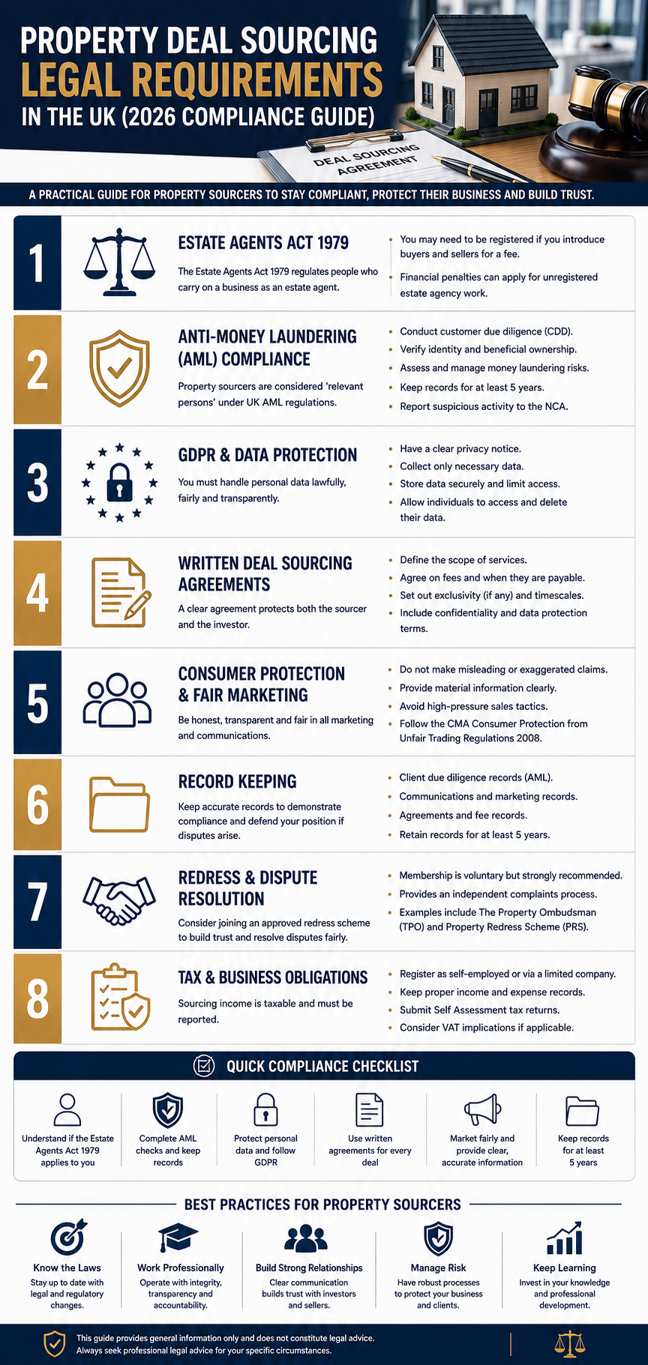
Property deal sourcing legal requirements UK infographic covering Estate Agents Act, AML compliance, GDPR, sourcing agreements, consumer protection and record keeping.
Property Deal Sourcing Compliance Checklist
Understanding and implementing the key Property Deal Sourcing Legal Requirements is essential for operating a compliant and professional sourcing business.
While the exact requirements may vary depending on the nature of the sourcing business, the following checklist covers some of the most important areas that property deal sourcers should review before offering services or charging sourcing fees.
Use this checklist as a practical guide to assess whether your business has the key compliance measures in place.
| Requirement | Status |
|---|---|
| Anti-Money Laundering (AML) Procedures | ✓ |
| Client Identity Verification | ✓ |
| Written Deal Sourcing Agreement | ✓ |
| GDPR-Compliant Privacy Policy | ✓ |
| Professional Indemnity Insurance | ✓ |
| Record Keeping Procedures | ✓ |
| Transparent Fee Disclosure | ✓ |
While completing this checklist does not guarantee compliance with every legal obligation, it provides a useful starting point for building a professional property sourcing business. Sourcers should regularly review their procedures, documentation, and business practices to ensure they remain compliant with current regulations and industry standards.
Where there is any uncertainty regarding legal or regulatory obligations, professional legal, compliance, or accounting advice should be obtained.
Frequently Asked Questions
Is property deal sourcing regulated in the UK?
Yes. Property deal sourcing is legal in the UK, but businesses must comply with various Property Deal Sourcing Legal Requirements, including AML regulations, data protection laws, consumer protection rules, and contractual obligations.
Depending on how a sourcing business operates, these may include obligations under the Estate Agents Act 1979, anti-money laundering regulations, consumer protection laws, data protection legislation, and contract law. Property deal sourcers should understand their responsibilities and ensure appropriate compliance procedures are in place.
Do property sourcers need AML registration?
Whether AML registration is required depends on the specific activities being carried out by the business. Some property sourcing businesses may fall within the scope of anti-money laundering regulations and require registration with the relevant supervisory authority. Because the rules can be complex and fact-specific, sourcers should seek professional advice to determine their obligations and ensure compliance.
Can I charge a sourcing fee without a contract?
While it may be possible to charge a sourcing fee without a written contract, doing so is generally not recommended. A written deal sourcing agreement helps define the services being provided, explains the fee structure, outlines refund provisions, and clarifies the responsibilities of both parties. Operating without written terms can increase the risk of misunderstandings and disputes.
Do I need professional indemnity insurance?
Professional Indemnity Insurance is not legally mandatory for every property deal sourcer, but it is highly recommended. Property sourcers often provide information, analysis, and introductions that may influence investment decisions. Insurance can provide protection against claims relating to professional negligence, inaccurate information, or alleged financial losses suffered by clients.
Is a deal sourcing agreement legally required?
There is no specific law that requires every property deal sourcer to use a written sourcing agreement. However, having a professionally drafted agreement is considered best practice and is strongly recommended. A written agreement helps protect both the sourcer and the investor by clearly setting out the scope of services, fees, disclaimers, responsibilities, and key contractual terms.
What happens if a property deal sourcer fails to comply with legal requirements?
Failure to comply with applicable regulations can result in complaints, disputes, reputational damage, financial penalties, and, in some circumstances, legal action. The risks will depend on the nature of the breach and the regulations involved. Maintaining appropriate documentation, compliance procedures, and professional standards can help reduce these risks.
What is the most important compliance document for a property deal sourcer?
While several compliance measures are important, a written property deal sourcing agreement is often considered one of the most valuable documents for a sourcing business. It helps establish clear expectations, protects both parties, and provides a contractual framework for the sourcing relationship.
Conclusion
Property deal sourcing is a legitimate and growing part of the UK property investment industry. However, while sourcing opportunities and introducing investors to deals can be a profitable business model, it also comes with important legal and compliance responsibilities.
Understanding and complying with Property Deal Sourcing Legal Requirements is essential for anyone operating a sourcing business. From the Estate Agents Act 1979 and anti-money laundering obligations to GDPR compliance and consumer protection requirements, sourcers should ensure they understand the rules that apply to their activities and implement appropriate procedures to remain compliant.
Professional systems not only help reduce legal and regulatory risks but also provide valuable protection for both property deal sourcers and investors. Clear documentation, accurate record keeping, transparent marketing, and robust compliance procedures can help build trust, reduce disputes, and support the long-term growth of a sourcing business.
By understanding and implementing the core Property Deal Sourcing Legal Requirements, sourcers can operate more professionally, protect their reputation, and provide a better experience for their clients and investors.

Koye Beckley is a UK property investor and founder of UncommonDeal, with practical experience in buy-to-let, property auctions, refurbishment projects and investment deal analysis. Through UncommonDeal, he publishes property market research, property deal sourcing and compliance guidance, investment guides and data-driven analysis to help investors evaluate buy-to-let, BRRR, flip and auction opportunities.