Property Deal Sourcing: How UK Sourcers Close More Deals with the Right System
A strong Property Deal Sourcing System is about more than finding properties that look like good investments. A sourcer still needs to establish whether an opportunity matches an investor’s criteria, whether the numbers work, what risks need investigating and whether there is enough evidence to support an investment decision.
More deal flow does not automatically mean more completed deals. Without clear investor requirements, consistent due diligence and reliable deal analysis, even promising opportunities can stall.
A property deal sourcing system is the repeatable process used to move from investor requirements to sourced opportunity, due diligence, analysis, presentation and ultimately a completed transaction.
The solution is a repeatable process that connects each stage of sourcing:
Investor requirements → Buying criteria → Sourcing → Screening → Viewing → Due diligence → Deal analysis → Presentation → Follow-up
In this guide, we’ll look at how UK property sourcers can build a practical system that helps them identify suitable opportunities, assess them consistently and move viable deals forward more efficiently.
If you’re new to the process, our guide to how to become a property deal sourcer gives you step-by-step information on becoming a better deal sourcer. Not only will you learn what it take from the guide, but also on how sourcing works and where the sourcer fits between the property opportunity and the investor.
What Is a Property Deal Sourcing System?
A Property Deal Sourcing System is a repeatable process for taking an investor from their initial requirements through to identifying, assessing and presenting a suitable property opportunity. It helps a sourcer work consistently rather than approaching every investor or property differently.
The system does not have to involve expensive software. It can combine structured forms, checklists, spreadsheets, research tools and, as the sourcing business grows, CRM or workflow software.
A typical property deal sourcing system might look like this:
| Stage | Key Question |
|---|---|
| Investor onboarding | Who are you sourcing for? |
| Buying criteria | What exactly will they buy? |
| Deal sourcing | Where will suitable opportunities come from? |
| Initial screening | Is the property worth investigating further? |
| Property viewing | What does the property actually tell us? |
| Due diligence | What needs to be checked or verified? |
| Deal analysis | Do the numbers work? |
| Deal presentation | Is there enough evidence for the investor to assess it? |
| Follow-up | What needs to happen next? |
| Records and compliance | Has the process been properly documented? |
The purpose is simple: each stage should provide enough reliable information to decide whether an opportunity should move forward, require further investigation or be rejected.
Why Finding More Properties Doesn’t Necessarily Mean Closing More Deals
A common mistake in property sourcing is assuming that more opportunities will automatically lead to more completed deals. In reality, the problem is often not the number of properties being found, but what happens after they are found.
Deals can stall when investor criteria are unclear, refurbishment costs are underestimated, rental or resale figures lack supporting evidence, or important risks only emerge after significant time has already been spent analysing the property.
A good sourcing system therefore focuses on quality and investor fit before quantity. Before spending hours researching a property, a sourcer should be able to answer three basic questions:
- Does this property match the requirements of an active investor?
- Is there enough potential in the numbers to justify further investigation?
- Are there any obvious issues that could make the opportunity unsuitable?
The aim is not to analyse every property in detail. It is to filter opportunities efficiently, investigate the strongest ones properly and present investors with deals supported by realistic assumptions and evidence.
In many cases, the real bottleneck in property deal sourcing isn’t finding properties. It’s the process between finding an opportunity and giving an investor enough confidence and information to make a decision.
Stage 1: Qualify the Investor Before You Source
Effective property sourcing should start with the investor, not the property. Before searching for opportunities, a sourcer needs to understand what the investor is actually prepared and able to buy.
What Should a Property Sourcer Know About an Investor?
The information collected should go beyond preferred location and budget. A useful investor profile should establish:
- Available capital and overall purchasing budget
- Cash purchase or finance requirements
- Preferred locations and property types
- Investment strategy, such as BTL, BRRR, HMO, flip or development
- Target returns
- Acceptable refurbishment level
- Preferred timescale
- Exit strategy
- Relevant experience and risk appetite
Without this information, a sourcer can spend considerable time finding properties that the investor was never likely to purchase.
Turn Investor Requirements Into a Documented Brief
Investor requirements should also be recorded rather than left across WhatsApp messages, emails or informal conversations. A structured onboarding process creates a clearer sourcing brief and provides a consistent record of what the investor is looking for.
For sourcers who want a ready-made framework, the Investor Onboarding Pack for UK Property Deal Sourcers can be used to collect and organise key investor information before the sourcing process begins.
A structured investor onboarding process can help capture these requirements consistently before any sourcing work begins.
Once the investor has been properly qualified, those requirements can be converted into specific buying criteria that can be used to screen potential deals quickly.
Stage 2: Convert Investor Requirements Into Clear Buying Criteria
Once an investor has been qualified, their requirements need to be turned into specific buying criteria that can be applied consistently when assessing opportunities.
An investor saying, “I want a good buy-to-let in Liverpool” is not enough. A useful sourcing brief should define measurable parameters such as:
- Target location or postcode areas
- Maximum purchase price
- Property type and tenure
- Investment strategy
- Minimum target yield or return
- Maximum refurbishment budget
- Available cash and finance position
- Target rental income or resale value
- Acceptable level of risk
- Preferred timescale
For example, instead of sourcing broadly for a “Liverpool investment property”, the criteria might specify a freehold 2–3 bedroom house below £130,000, suitable for BTL or BRRR, requiring no more than £25,000 of refurbishment and capable of achieving the investor’s minimum target return.
Clear buying criteria make it easier to reject unsuitable properties quickly and concentrate time on opportunities that genuinely fit the investor.
The criteria should also be reviewed periodically. An investor’s available capital, financing position, preferred locations or strategy can change, and the sourcing brief should reflect those changes before new opportunities are presented.
Stage 3: Build Repeatable Deal-Sourcing Channels
A reliable Property Deal Sourcing System should not depend on a single source of opportunities. Different sourcing channels can produce different types of deals, so building a repeatable process for monitoring several relevant channels can create a more consistent pipeline.
On-Market Property Sourcing
Estate agents and property portals remain useful sources of opportunities. Sourcers can look beyond newly listed properties and monitor price reductions, properties that have been on the market for longer periods, sales that have fallen through and listings requiring refurbishment.
The objective is not simply to search more listings, but to identify properties that match an investor’s predefined buying criteria.
Property Auctions
Auctions can provide access to residential properties, refurbishment projects, mixed-use buildings, land and other opportunities. However, the guide price should never be treated as the expected purchase price or evidence that a property represents good value.
Auction sourcing should include reviewing the legal pack, comparable evidence, property condition, likely refurbishment costs and total acquisition costs before deciding whether an opportunity warrants further investigation.
If auctions form part of your sourcing strategy, our Auction Deals section provides further guidance and resources for assessing auction opportunities.
Off-Market Property Sourcing
Off-market opportunities can come through direct-to-vendor approaches, landlord networks, referrals, developers, local contacts and relationships built with agents or other property professionals.
The advantage is potential access to opportunities before they reach the wider market, but an off-market property still requires the same level of due diligence and financial analysis as any publicly advertised deal.
A strong sourcing system therefore focuses less on finding one “best” channel and more on building repeatable sources of opportunities that can be screened against real investor demand.
For a deeper look at finding opportunities away from the major portals, see our guide to off-market property deals in the UK.
Stage 4: Screen Deals Before Spending Hours Analysing Them
Not every property that matches an investor’s basic criteria deserves a full deal analysis. Initial screening provides a quick way to decide whether an opportunity is worth investigating further.
Before committing significant time to a property, consider:
- Does it match an active investor’s buying criteria?
- Is the asking or guide price within the required range?
- Is the proposed investment strategy realistic for the property?
- Is there sufficient rental or comparable sales evidence?
- Is the tenure suitable for the investor and strategy?
- Are there obvious property, legal or planning concerns?
- Is there enough potential margin or return to justify further investigation?
This first-stage assessment can quickly eliminate properties that are clearly unsuitable and allow more time to be spent on stronger opportunities.
Screening is not the same as due diligence. Its purpose is to determine whether a property deserves deeper investigation. Any opportunity that passes the initial screening should still be properly viewed, researched and financially analysed before it is presented as a potential deal.
Stage 5: Standardise Property Viewings
A property viewing should be more than a quick walk-through and a collection of photographs. Within a Property Deal Sourcing System, the viewing should follow a consistent process so that important observations are captured and can feed into the subsequent due diligence and deal analysis.
For a more structured approach, the UK Property Viewing Due Diligence pack provides a practical framework for recording property condition, observations and issues requiring further investigation.
What Should a Sourcer Check During a Property Viewing?
Depending on the property and strategy, a structured viewing might consider:
- External condition, roof and guttering
- Windows and doors
- Signs of damp, movement or water damage
- Heating, electrics and plumbing
- Kitchen and bathroom condition
- Room sizes and layout
- Extensions, conversions or alterations
- Likely refurbishment requirements
- Garden, parking and external areas
- Access and neighbouring properties
- Photographs and notes to support further investigation
Relying on memory or taking random photographs can make it difficult to assess the property properly afterwards. Using a consistent checklist also makes it easier to compare different opportunities and identify areas that require professional investigation.
A structured resource such as the UK Property Viewing Due Diligence pack can help sourcers record property information consistently and reduce the risk of overlooking important areas during a viewing.
However, a sourcing inspection should not be treated as a substitute for a professional survey, electrical inspection, structural assessment or other specialist advice where these are required. The purpose is to gather better information and identify issues that may need further investigation before the deal progresses.
Stage 6: Carry Out Due Diligence Before Calling It a Deal
A property should not be described as a deal simply because the headline numbers look attractive. Due diligence is the process of testing the assumptions behind the opportunity and identifying issues that could affect the investment.
A sourcer’s due diligence should consider several areas:
Property Due Diligence
Review the property’s condition, layout, likely refurbishment requirements and any visible issues identified during the viewing. Where concerns require specialist knowledge, further investigation should be recommended.
Location and Market Due Diligence
Check local rental demand, comparable rents, recent sold prices and other relevant market evidence. Comparable properties should be genuinely comparable rather than simply the highest-priced examples available.
Legal and Planning Due Diligence
Tenure, title restrictions, leases, planning history, licensing requirements and other legal matters may affect the proposed strategy. For auction purchases, the legal pack should also be reviewed carefully, with appropriate legal advice obtained before bidding or committing to purchase.
Auction properties require an additional layer of investigation, particularly because the legal pack can contain information that materially affects the investment decision. That said, you will need to familiarise yourself with our composed property auction checklist.
Financial Due Diligence
Test the assumptions behind the projected return, including purchase costs, refurbishment, finance, holding costs, rental income, resale value and contingency.
The sourcer’s role is not to replace a solicitor, surveyor, accountant, mortgage adviser or planning professional. Instead, a good sourcing process should identify what has been checked, what evidence supports the opportunity and what still requires professional verification.
Ultimately, due diligence should help answer a simple question: does the opportunity still look attractive when the costs, evidence and risks are considered together?
Stage 7: Analyse the Deal, Not Just the Purchase Price
A low purchase price does not automatically make a property a good investment. The analysis should consider the total amount of money required to acquire, improve, finance and hold the property, together with the income or value it could realistically produce.
Depending on the strategy, the calculation may need to include:
- Purchase price
- Stamp Duty Land Tax (SDLT)
- Legal and professional fees
- Sourcing fees
- Finance and bridging costs
- Refurbishment costs
- Contingency
- Holding costs
- Expected rental income
- Realistic resale value or GDV
- Refinancing assumptions
- Selling or exit costs
This is also where deal sourcing and deal analysis should be treated as separate disciplines. Sourcing identifies the opportunity; analysis tests whether the opportunity makes financial sense.
For example, a property advertised with an attractive gross yield may look very different once refurbishment, finance, acquisition costs and ongoing expenditure are included. Similarly, a potential flip can appear profitable until realistic refurbishment, holding and selling costs are added.
The objective is therefore not to make the numbers fit the deal. It is to use realistic assumptions and supporting evidence to establish what the numbers actually say.
A well-structured analysis gives both the sourcer and investor a clearer basis for deciding whether the opportunity should progress, require further investigation or be rejected.
Therefore, understanding the difference between deal sourcing and deal analysis is important because finding an opportunity and determining whether the numbers actually work are two separate stages of the investment process.
Stage 8: Stress-Test the Deal Before Presenting It
A deal may look attractive under the original assumptions, but property investments rarely perform exactly as projected. Stress testing helps show what happens to the expected return when key assumptions change.
For buy-to-let opportunities, this should also include testing how periods without rental income could affect the projected return.
Depending on the strategy, a sourcer might test scenarios such as:
- Refurbishment costs being higher than expected
- Rental income being lower than estimated
- A resale taking longer than planned
- The achieved sale price or GDV being lower than projected
- A refinance valuation coming in below expectations
- Finance and holding costs increasing
- Additional works being discovered during refurbishment
- A longer void period before the property is let
For example, a BRRR opportunity may appear attractive based on a £200,000 refinance valuation. The analysis should also consider what happens if the eventual valuation is £185,000 or £190,000. Does the strategy still work, and how much additional capital would remain tied up in the property?
Stress testing does not predict what will happen. Instead, it shows how sensitive the projected outcome is to changes in the assumptions.
This gives the investor a more balanced view of the opportunity and helps avoid presenting a deal based solely on the most optimistic scenario.
Stage 9: Package the Opportunity So the Investor Can Make a Decision
Once an opportunity has been researched and analysed, the next step is to present it clearly. A good deal presentation should help the investor understand the opportunity, the supporting evidence, the assumptions being made and the main risks.
Rather than relying on headline figures such as “10% yield” or “£40,000 profit potential”, a deal pack should provide enough information for the investor to understand how those figures were calculated.
Depending on the strategy, this could include:
- Property details and proposed investment strategy
- Purchase or agreed price
- Why the property matches the investor’s criteria
- Comparable sales and rental evidence
- Refurbishment assumptions
- Estimated acquisition and finance costs
- Projected rental income, yield or profit
- GDV or refinance assumptions where relevant
- Key risks and outstanding due diligence
- Property photographs and supporting evidence
- Clear next steps
Show the Assumptions, Not Just the Outputs
Two sourcers can analyse the same property and produce very different projected returns simply because they have used different assumptions.
For this reason, investors should be able to see where important figures came from. If the projected rent is £1,200 per month, show the evidence supporting it. If the GDV is £250,000, provide relevant comparable sales. If refurbishment is estimated at £30,000, explain what that budget is expected to cover.
A well-presented deal should therefore do more than make an opportunity look attractive. It should give the investor enough evidence and transparency to assess whether the opportunity fits their own investment objectives.
Stage 10: Track Investors, Deals and Follow-Ups
As a sourcing business grows, keeping investor requirements, property opportunities and follow-ups across emails, spreadsheets and messaging apps can become difficult to manage. A good Property Deal Sourcing System should make it easy to see where each investor and opportunity sits within the process.
Useful information to track can include:
- Investor requirements and buying criteria
- Properties sourced for each investor
- Viewings and due diligence completed
- Deals presented and investor responses
- Offers submitted
- Follow-up dates and outstanding actions
- Deal status and next steps
- Documents and supporting evidence
- Completed, rejected or withdrawn opportunities
Spreadsheet vs CRM for Property Sourcing
For a small sourcing operation, a well-designed spreadsheet may be sufficient. As the number of investors, properties and follow-ups increases, however, a CRM or workflow management system can help bring this information together and reduce the risk of opportunities or investor enquiries being overlooked.
The important point is not which software a sourcer uses. The system should provide a clear view of who the investor is, what they are looking for, which opportunities have been presented and what needs to happen next.
Technology should support the sourcing process rather than define it. A poorly organised process will not automatically become effective simply because it has been moved into a CRM.
Stage 11: Build Compliance Into the System, Not Around It
Compliance should be part of a Property Deal Sourcing System from the beginning, rather than something considered only when a deal is ready to proceed.
HMRC’s current guidance specifically includes businesses that introduce buyers or investors to a “property deal”, including property sourcing, deal packaging and investment brokering, within the scope of estate agency business for anti-money laundering purposes.
Depending on the activities carried out, a UK property sourcing business may need to consider requirements including:
- HMRC registration for anti-money laundering supervision
- Customer due diligence (CDD) and identity verification
- Business and customer risk assessments
- AML policies, controls and procedures
- Record keeping
- Ongoing monitoring
- Membership of an approved property redress scheme where required
- Data protection obligations
- Appropriate business insurance
- Clear sourcing agreements, fees and terms of business
Clear property sourcing agreements can also help establish responsibilities, fees and the terms of the relationship before sourcing work progresses.
HMRC’s guidance also makes clear that, for a property sourcing business, the AML business relationship with the customer begins when the customer instructs the sourcer. This makes compliance relevant from the investor onboarding stage, not simply when a property is found or an offer is made.
For residential estate agency work, the government also requires applicable businesses to belong to an approved redress scheme.
Building these requirements into onboarding, record keeping and deal progression creates a more consistent process and reduces the risk of compliance becoming an afterthought.
Compliance requirements can vary according to the activities a sourcing business carries out, so sourcers should check the latest official guidance and obtain professional advice where necessary.
The Complete Property Deal Sourcing Workflow
A successful Property Deal Sourcing System connects each stage rather than treating sourcing, due diligence and deal analysis as separate activities.
The complete workflow can be summarised as:
Investor Onboarding → Buying Criteria → Source Opportunities → Initial Screening → Property Viewing → Due Diligence → Deal Analysis → Stress Testing → Deal Presentation → Investor Follow-Up → Progress or Reject → Record the Outcome
Each stage has a clear purpose. Investor onboarding establishes who you are sourcing for, while buying criteria determine which opportunities should enter the pipeline. Screening removes unsuitable properties early, and viewing and due diligence provide the evidence needed for more detailed financial analysis.
Only after these stages should an opportunity be packaged and presented to an investor. The investor’s response then determines whether the deal progresses, requires further investigation or is rejected.
Importantly, rejection is also part of an effective sourcing system. The purpose of the process is not to make every property become a deal. It is to identify which opportunities are worth progressing and which should be discarded before more time or money is committed.
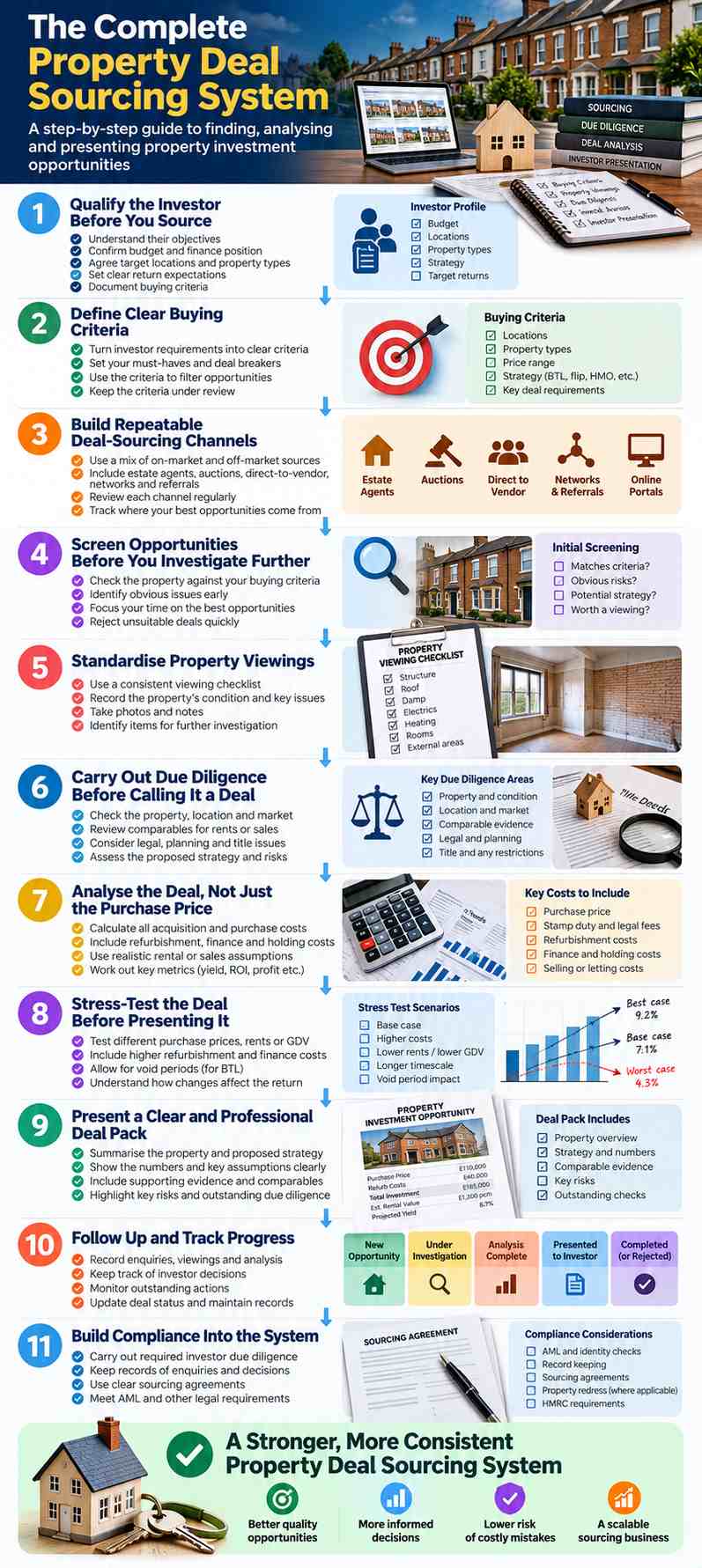
The complete Property Deal Sourcing System: an 11-step process for qualifying investors, sourcing and screening opportunities, carrying out due diligence, analysing deals, presenting opportunities and managing compliance.
Where Property Deal Sourcing Systems Commonly Break Down
Even a steady flow of property opportunities will not produce consistent results if the process behind them is weak. Problems often occur when important stages are skipped, rushed or handled differently from one deal to another.
| Weak Process | What Can Happen |
|---|---|
| Sourcing before qualifying the investor | Time is spent finding properties the investor is unlikely to buy |
| Vague buying criteria | Too many unsuitable opportunities enter the pipeline |
| No initial screening | Hours are spent analysing properties that could have been rejected earlier |
| Unstructured property viewings | Important information or potential issues may be missed |
| Overly optimistic assumptions | Projected returns can appear stronger than they realistically are |
| No stress testing | The impact of changing costs, rents or valuations remains unclear |
| Weak comparable evidence | Rental, GDV or resale assumptions become difficult to support |
| Poor deal presentation | Investors struggle to understand or verify the opportunity |
| Inconsistent follow-up | Potential deals and investor enquiries can be overlooked |
| Poor record keeping | Decisions, evidence and compliance activity become difficult to demonstrate |
A strong sourcing system does not eliminate risk or guarantee that deals will complete. Instead, it creates consistent checkpoints where unsuitable opportunities can be identified, assumptions challenged and outstanding questions investigated before the property progresses further.
The goal is not to make the sourcing process more complicated. It is to make it repeatable, evidence-led and easier to manage as the business grows.
How to Build Your Own Property Deal Sourcing System
A Property Deal Sourcing System does not need to be complicated. The aim is to create a repeatable process that helps you manage investors and opportunities consistently from initial enquiry through to completion or rejection.
A practical system can be built around these steps:
- Create a structured investor onboarding process to capture objectives, budget, strategy and other important requirements.
- Convert those requirements into clear buying criteria that can be used to screen properties.
- Define your sourcing channels and establish how frequently each one will be reviewed.
- Create an initial screening process to eliminate unsuitable opportunities quickly.
- Standardise property viewings so the same key information is captured each time.
- Set a due diligence process covering the property, location, market, legal considerations and proposed strategy.
- Use a consistent deal analysis method so costs, returns and assumptions are calculated on the same basis.
- Stress-test important assumptions before presenting the opportunity to an investor.
- Create a standard deal presentation format that clearly shows the numbers, evidence, risks and outstanding checks.
- Track follow-ups, decisions and outcomes while maintaining the records required for your business and compliance obligations.
You do not need to introduce every piece of technology at once. Forms, checklists and spreadsheets can provide the foundations, with CRM and workflow tools added as the volume of investors and opportunities increases.
The most important principle is consistency. A defined process makes it easier to see what has already been checked, what still needs investigating and whether a property is ready to move to the next stage.
Property Deal Sourcing System Checklist
A simple checklist can help ensure that important stages of the sourcing process are completed consistently before an opportunity progresses.
Before You Start Sourcing
- Investor onboarding completed
- Identity and required compliance checks completed
- Investment strategy confirmed
- Available budget and finance position understood
- Target locations and property types recorded
- Return expectations discussed
- Buying criteria documented
Before You Present a Property
- Property matches the investor’s buying criteria
- Initial screening completed
- Property viewing completed where appropriate
- Key property risks identified
- Rental or sales comparables checked
- Refurbishment assumptions reviewed
- Purchase and acquisition costs calculated
- Finance and holding costs considered
- Proposed strategy assessed
- Financial analysis completed
- Key assumptions stress-tested
- Outstanding due diligence clearly identified
Before the Deal Progresses
- Supporting evidence retained
- Investor understands the key assumptions and risks
- Required professional advice or specialist checks identified
- Responsibilities and next steps agreed
- Follow-up actions recorded
- Compliance records updated
- Deal status documented
The checklist should act as a control point rather than a box-ticking exercise. If important information is missing or an assumption cannot be supported, the next step may be further investigation rather than presenting or progressing the opportunity.
A good Property Deal Sourcing System should make it just as easy to identify when to stop pursuing a property as when to move it forward.
Frequently Asked Questions About Property Deal Sourcing Systems
What is a property deal sourcing system?
A Property Deal Sourcing System is a repeatable process for managing an investor from initial onboarding through to sourcing, screening, due diligence, deal analysis, presentation and follow-up. It helps ensure opportunities are assessed consistently rather than handled differently each time.
What information should a property sourcer collect from an investor?
A sourcer should understand the investor’s budget, available capital, finance position, preferred locations, property types, investment strategy, target returns, refurbishment appetite and timescale. These requirements can then be converted into clear buying criteria.
How do property sourcers find deals?
Property sourcers can find opportunities through estate agents, property portals, auctions, direct-to-vendor approaches, landlord networks, developers, referrals and other on-market or off-market channels. Using several repeatable sourcing channels can reduce reliance on a single source of opportunities.
What due diligence should a property sourcer carry out?
Due diligence can include checking the property’s condition, location, comparable rents and sales, proposed strategy, refurbishment assumptions, title and planning considerations, and the overall financial viability of the opportunity. Specialist matters should be referred to appropriately qualified professionals.
Should a property sourcer use a CRM?
Not necessarily. A spreadsheet may be sufficient for a small sourcing operation. As the number of investors, properties and follow-ups grows, a CRM can make it easier to manage investor requirements, communications, opportunities, tasks and deal progress in one place.
What should be included in a property sourcing deal pack?
A useful deal pack should clearly present the property, proposed strategy, purchase price, acquisition costs, refurbishment assumptions, comparable evidence, projected returns, key risks and outstanding due diligence. Investors should be able to understand how the headline figures were calculated, not simply see the final numbers.
How do you know whether a sourced property is actually a good deal?
There is no single figure that makes a property a good deal. The opportunity should be assessed against the investor’s objectives, total acquisition cost, expected income or resale value, financing, refurbishment requirements, risks and alternative scenarios. A deal that works for one investor may not suit another.
Is property deal sourcing regulated in the UK?
Property sourcing activities can fall within UK estate agency and anti-money laundering requirements depending on the activities carried out. Sourcers should establish which requirements apply to their business, including AML supervision, customer due diligence, record keeping and property redress obligations where applicable.
Do UK property sourcers need to register with HMRC?
Businesses carrying out property sourcing, deal packaging or similar activities may fall within HMRC’s definition of estate agency business for anti-money laundering supervision. Sourcers should check the latest HMRC guidance to determine the requirements that apply to their activities.
What is the difference between property sourcing and deal analysis?
Property sourcing identifies potential investment opportunities. Deal analysis determines whether the numbers, evidence, assumptions and risks make an opportunity suitable for further consideration. Finding a property is therefore not the same as establishing that it is a viable investment deal.
Final thoughts: Better Property Deal Sourcing Starts With a Better System
Successful property sourcing is not simply about finding more properties. It is about having a consistent process for identifying opportunities that match genuine investor requirements, investigating them properly and presenting the evidence clearly enough for an informed decision to be made.
A good Property Deal Sourcing System connects investor onboarding, buying criteria, sourcing, screening, property viewings, due diligence, financial analysis and follow-up. Each stage helps determine whether an opportunity should progress, requires further investigation or should be rejected.
The system does not need to be complicated. What matters is that it is repeatable, evidence-led and appropriate for the size of your sourcing business.
For more guidance on building and operating a property sourcing business, explore the UncommonDeal Deal Selling Hub.
As your operation grows, the tools you use may change, from checklists and spreadsheets to dedicated CRM and workflow software. But the principle remains the same: find opportunities systematically, analyse them realistically and give investors the information they need to make their own investment decisions.

Koye Beckley is a UK property investor and founder of UncommonDeal, with practical experience in buy-to-let, property auctions, refurbishment projects and investment deal analysis. Through UncommonDeal, he publishes property market research, property deal sourcing and compliance guidance, investment guides and data-driven analysis to help investors evaluate buy-to-let, BRRR, flip and auction opportunities.