
UK Property Market 2025: Rates, Rents & Investor Risks
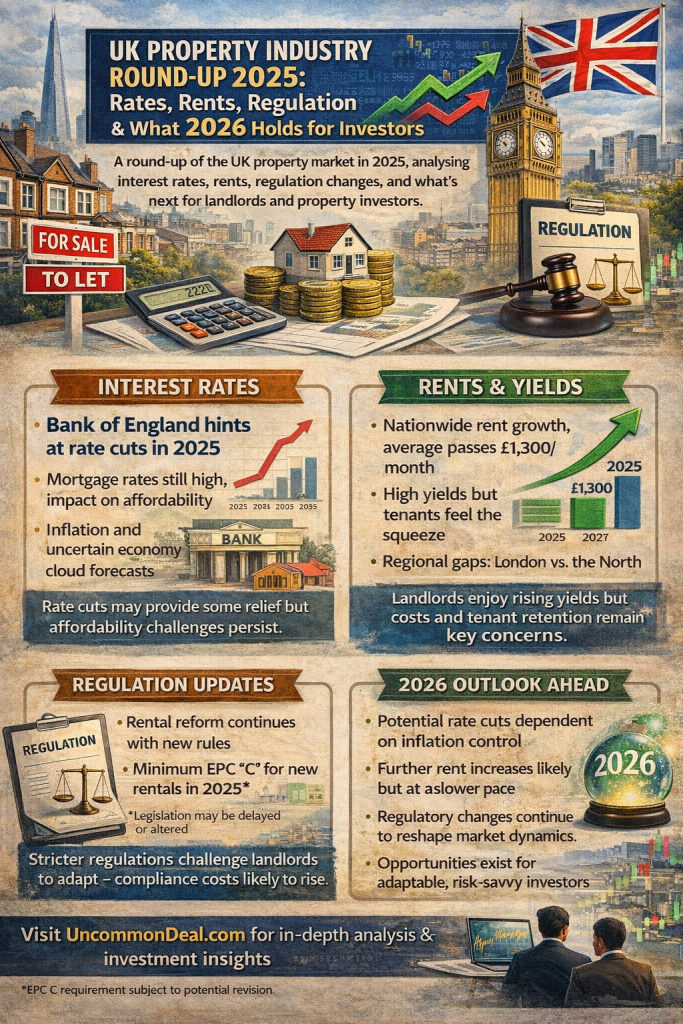
2025 was a “margin and method” year: less about easy capital growth, more about affordability, financing costs, tighter underwriting, and disciplined deal selection.
The big macro driver: Bank of England base rate cuts (and what they did to the market)
Mortgage affordability and investor cashflow in 2025 were heavily shaped by a steady easing in the Bank Rate across the year:
- 6 Feb 2025: Bank Rate cut to 4.50% Bank of England
- 8 May 2025: cut to 4.25% Bank of England
- 7 Aug 2025: cut to 4.00% Bank of England
- 18 Dec 2025: cut to 3.75% Bank of England+1
Impact on housing and investor behaviour
- Transactions stayed “subdued” for much of the year as buyers adjusted to the new normal of mortgage pricing and stress tests. GOV.UK
- Rate cuts improved sentiment and affordability at the margin, but didn’t instantly transform the market because many borrowers were still rolling off older fixed deals. Financial Times+1
- Investors increasingly prioritised:
- stronger yields, not just growth narratives
- value-add (refurb, layout uplift, planning angles)
- robust downside cases (voids, higher finance costs, slower exits)
House prices: modest growth, but highly regional
Official data showed UK house price growth easing through late 2025, with clear regional divergence:
- Average UK house price annual inflation around 1.7% (to Oct 2025), with London negative and several regions positive. GOV.UK
- Example regional split (to Oct 2025): North East +5.0%, North West +3.1%, London −2.4%. GOV.UK
Investor takeaway: “The UK market” didn’t move as one. Micro-location and exit liquidity mattered more than ever.
The rental market: still tight, but growth cooled
Rental demand remained a dominant theme, but growth slowed as affordability caps met rising supply in some areas:
- Zoopla reported rental growth slowing to ~2.2% with demand at a multi-year low and supply rising. Zoopla
What this meant on the ground
- Landlords faced higher costs (finance, compliance, maintenance) while rent rises became harder to push through in many tenant segments.
- Deals that still worked typically had:
- genuine rental scarcity locally
- quality/spec upgrades (better EPC, modern finish)
- sensible entry price (or strong value-add upside)
Policy and government changes: the direction of travel hardened in late 2025
Autumn Budget 2025 (26 Nov 2025): property sector headlines
Industry commentary highlighted:
- No Stamp Duty changes (despite speculation). Propertymark
- Continued debate/concern around high-value property taxation measures (often described as “mansion tax” style changes). Propertymark+1
- NRLA reaction noted future landlord tax pressures (including changes planned from April 2027 for rental income tax rates). NRLA
Investor impact: Even when measures aren’t immediate, policy direction influences:
- landlord confidence
- portfolio decisions (hold/sell/upgrade)
- supply dynamics in the PRS
The biggest structural story: Renters’ Rights reform (now set up for 2026)
Key dates in 2025
- 15 Jan 2025: Renters’ Rights Bill 1st reading (Lords) UK Parliament Bills
- 27 Oct 2025: Royal Assent (becoming the Renters’ Rights Act 2025) UK Parliament Bills
- 13 Nov 2025: Government published the implementation roadmap GOV.UK
What investors should understand heading into 2026
The roadmap confirms the government’s intent to abolish Section 21 and reform security of tenure, with implementation staged. GOV.UK+1
Most commentary converges on 1 May 2026 as the key “go-live” date for major tenancy changes. Pinsent Masons+1
2025: what it meant from an investor’s point of view
Upsides investors could still capture
- Better negotiation in pockets of the market where affordability suppressed demand
- Refurb/value-add strategies that create equity rather than waiting for the market
- Regions with strong rental fundamentals and realistic purchase prices (vs “trophy pricing”)
Downsides investors had to manage
- Deals became more sensitive to:
- finance costs
- time overruns
- voids and rent affordability ceilings
- Regulation uncertainty increased the value of:
- compliance readiness
- robust legal pack / title review
- EPC and property standards planning
Looking into 2026: what investors should watch
1) Further rate cuts may help activity — but don’t bank on a boom
With the base rate at 3.75% by December 2025, lenders signalled room for mortgage pricing to ease into early 2026. Financial Times+1
Expect improved market “flow,” but not necessarily rapid price growth—especially if wider growth and employment stay soft.
2) Renters’ Rights Act: likely effects on the market
As major reforms phase in (with 1 May 2026 a key milestone), likely impacts include: Pinsent Masons+1
- Landlords becoming more selective on tenant screening and affordability
- Potential further PRS supply reduction if some landlords exit (supporting rents, but unevenly)
- Increased importance of:
- property condition
- documentation and processes
- professional management standards
3) Where the money may be in a “turbulent” (or simply “tight margin”) market
Even if 2026 isn’t chaotic, it’s still a market where process beats optimism. The money is typically in:
- Buying right (discounted entries, motivated sales, auction mispricing)
- Creating value (refurb, layout optimisation, planning angles)
- Running tighter operations (void reduction, tenant quality, compliance efficiency)
- Picking the right strategy for the postcode (not forcing BRRR/flip everywhere)
As margins tighten, investors are being forced to rely on structured analysis rather than speculation — something we cover in detail in our how professional investors analyse property deals.
Conclusion: What 2025 Has Taught Property Investors — And Why 2026 Rewards the Prepared
The UK property industry in 2025 has been less about rapid growth and more about adjustment, resilience, and realism. Higher interest rates, sustained rental demand, and ongoing regulatory reform have reshaped how landlords and investors assess risk, structure deals, and deploy capital. Easy margins have largely disappeared, but opportunity has not.
In a market shaped by regulation and tighter finance, many investors are choosing to get a professional property investment analysis before committing capital.
For investors who relied on leverage and passive appreciation, 2025 has been a wake-up call. In contrast, those who focused on cash flow resilience, regional affordability, value-add strategies, and regulatory compliance have continued to find viable and often overlooked opportunities.
Looking ahead to 2026, the market is likely to remain selective rather than expansive. Potential interest rate relief may improve affordability at the margins, but regulation and operating costs will continue to separate professional investors from casual participants. The winners will be those who understand their numbers, stress-test assumptions, and adapt quickly to policy and market shifts.
In short, the UK property market is no longer about chasing deals — it is about understanding them. In a more complex environment, informed analysis, disciplined strategy, and clear risk assessment are not optional; they are essential.
At UncommonDeal, this is exactly where we focus — helping investors cut through noise, analyse deals properly, and make decisions based on evidence rather than emotion.

Koye Beckley is a UK property investor and founder of UncommonDeal, with practical experience in buy-to-let, property auctions, refurbishment projects and investment deal analysis. Through UncommonDeal, he publishes property market research, property deal sourcing and compliance guidance, investment guides and data-driven analysis to help investors evaluate buy-to-let, BRRR, flip and auction opportunities.
