Beyond the Asking Price: 5 Hidden Property Investment Costs That Could Kill Your Returns
Property investment costs are often far higher than the asking price alone. While many investors focus on securing a property at the lowest possible purchase price, the most successful investors know that true profitability depends on understanding every cost involved before making an offer. A deal that appears highly profitable on paper can quickly become far less attractive once hidden expenses are taken into account.
It is easy to become fixated on the purchase price, especially when comparing properties online or bidding at auction. However, buying an investment property involves much more than paying the seller. From taxes and legal fees to finance costs, refurbishment expenses, ongoing compliance and selling costs, every additional expense has the potential to reduce your cash flow, rental income and overall return on investment.
Understanding the true cost of property investment allows you to assess deals more accurately, budget with greater confidence and avoid expensive surprises after completion. Investors who account for every foreseeable cost are far better positioned to protect their profits and make informed decisions based on realistic financial projections rather than optimistic assumptions.
In this guide, we’ll explore five hidden property investment costs that many investors underestimate or overlook entirely: acquisition costs, refurbishment expenses, finance costs, ongoing ownership and compliance costs, and selling or exit costs. By understanding how each of these can affect your investment, you’ll be better equipped to analyse property deals thoroughly and make smarter buying decisions that support long-term financial success.
Before making an offer, it’s worth carrying out a detailed property deal analysis to understand the true cost of the investment.
Why the Asking Price Tells Only Part of the Story
The asking price is often the first figure investors look at when assessing a property, but it should never be the only number that influences a buying decision. While securing a property below market value can create opportunities, the purchase price represents just one part of the total investment. Every property comes with additional costs that must be factored into your calculations before you can determine whether a deal is genuinely profitable.
Successful property investors focus on the total acquisition cost rather than the purchase price alone. This includes every expense required to buy, finance, renovate and prepare the property for its intended strategy. Costs such as Stamp Duty Land Tax, legal fees, mortgage or bridging finance charges, surveys, refurbishment works and contingency budgets all contribute to the true amount of capital required. Ignoring these expenses can create an unrealistic picture of a property’s financial performance.
This is why experienced investors build detailed financial models before committing to a purchase. Rather than relying on rough estimates or headline figures, they calculate expected income, financing costs, ongoing ownership expenses and exit costs under different scenarios. By stress-testing their assumptions, they can identify potential risks, understand how changes in costs or rental income affect profitability and make decisions based on realistic projections rather than optimism.
Overlooking hidden costs can quickly transform what appears to be an excellent investment into an average or even loss-making deal. A property that promises strong rental returns or an attractive resale profit may become far less appealing once taxes, finance costs, unexpected repairs and selling expenses are included. Taking the time to analyse every cost before exchanging contracts helps investors avoid costly surprises and make decisions that support long-term financial success.
Key Takeaway
Successful property investors analyse the total cost of ownership rather than focusing solely on the asking price. Understanding every acquisition, finance, refurbishment, ownership and exit cost leads to more accurate deal analysis and better investment decisions.
Hidden Cost #1: Stamp Duty and Acquisition Costs
One of the biggest mistakes property investors make is assuming the purchase price represents the majority of the upfront investment. In reality, acquiring an investment property involves several additional costs that must be paid before the property can generate any income. These acquisition costs can amount to thousands, or even tens of thousands, of pounds depending on the purchase price and financing arrangements.
Among these expenses, Stamp Duty Land Tax (SDLT) is often the largest and is one of the most commonly underestimated costs when investors first assess a deal. Failing to include SDLT and other acquisition costs in your financial calculations can significantly reduce your available cash, affect your return on investment and even determine whether a property remains financially viable.
Stamp Duty Land Tax (SDLT)
Stamp Duty Land Tax is a tax payable when purchasing property or land in England and Northern Ireland above the applicable thresholds. For property investors, SDLT should always be included as part of the total acquisition cost rather than treated as an afterthought.
The amount you pay depends on several factors, including the property’s purchase price, whether it is your first property or an additional property, and the current SDLT rates in force at the time of purchase. Because SDLT is paid upfront, it directly affects the amount of capital required to complete a purchase.
One of the largest upfront expenses for many investors is Stamp Duty Land Tax, so it’s important to calculate your tax liability before making an offer.
Standard SDLT
Standard SDLT rates apply based on the property’s purchase price and are calculated using a tiered system. As the purchase price increases, different portions of the price are taxed at different rates.
Although owner-occupiers may benefit from lower overall SDLT liabilities depending on the purchase price and prevailing thresholds, investors should still calculate the full tax payable before making an offer. Even a relatively modest SDLT bill can have a noticeable impact on the total amount of cash needed to acquire a property.
Additional Property Surcharge
Most buy-to-let investors and owners purchasing an additional residential property are also required to pay an additional property surcharge on top of the standard SDLT rates. This surcharge can add several thousand pounds to the overall acquisition cost and is frequently overlooked by inexperienced investors when assessing potential deals.
For example, an investor purchasing a second property for £250,000 may find that the additional surcharge alone represents a significant upfront expense. If this cost has not been factored into the investment appraisal, the expected return on investment may be considerably lower than originally anticipated.
Why Investors Often Underestimate SDLT
Many investors initially concentrate on securing a property below market value or negotiating a lower purchase price. While these factors are important, they sometimes forget that SDLT is calculated independently of the property’s perceived value or potential profitability.
It is also common for investors to underestimate SDLT because they focus on mortgage deposits and refurbishment budgets while overlooking taxes and acquisition expenses. By the time these costs are added, the total cash required can be substantially higher than expected.
Before committing to any investment property, calculate the full SDLT liability alongside every other acquisition cost. Including these figures in your financial analysis provides a more accurate picture of the capital required and helps ensure the investment still meets your expected return targets.
Legal Fees and Searches
Legal fees are another essential acquisition cost that investors should include in every property purchase. While these expenses may seem relatively small compared with the purchase price, they can quickly add up and should never be overlooked when calculating the total cost of acquiring an investment property.
A conveyancing solicitor will typically handle the legal transfer of ownership, review contracts, raise enquiries with the seller’s solicitor and ensure the transaction is completed correctly. Solicitor fees vary depending on the property’s value and complexity, but they form an important part of every investment budget.
In addition to solicitor fees, investors should also budget for several other legal and administrative costs, including:
- Local authority searches, which identify planning restrictions, road schemes and other matters that could affect the property.
- Land Registry fees, which cover the registration of the property’s ownership following completion.
- Identity verification checks, which solicitors are legally required to carry out as part of anti-money laundering regulations.
- Other disbursements, such as environmental searches, drainage searches and bankruptcy searches, where applicable.
Although each individual cost may appear relatively modest, together they can add several hundred or even thousands of pounds to the total acquisition cost. Including these expenses from the outset helps prevent unexpected costs from reducing your available investment capital.
Mortgage Arrangement and Valuation Fees
If you’re using finance to purchase an investment property, lender fees should also form part of your acquisition budget. Many investors focus on the monthly mortgage payment while overlooking the upfront costs associated with securing the loan.
Depending on the lender and product selected, you may be required to pay:
- Mortgage or bridging loan arrangement fees.
- Property valuation fees.
- Product or booking fees.
- Broker fees, where applicable.
- Legal fees required by the lender.
These costs can either be paid upfront or added to the loan, but they still reduce your overall return on investment because they increase the total cost of financing the purchase.
If you’re using finance, understanding the different borrowing options is just as important as calculating lender fees. Our Buy-to-Let Mortgage Guide explains the key considerations.
Example Calculation
Consider an investor purchasing a buy-to-let property for £220,000.
| Cost | Estimated Amount |
|---|---|
| Purchase Price | £220,000 |
| Stamp Duty Land Tax | £8,100 |
| Solicitor Fees and Searches | £1,600 |
| Mortgage Arrangement Fee | £1,999 |
| Valuation Fee | £500 |
Total Acquisition Cost: £232,199
Although the property’s asking price was £220,000, the investor actually needs more than £232,000 to complete the purchase before any refurbishment, insurance or ongoing ownership costs are considered. This example demonstrates why experienced investors analyse the total acquisition cost rather than relying solely on the property’s purchase price when assessing potential returns.
Hidden Cost #2: Refurbishment Costs That Often Exceed Budget
Refurbishment is one of the most difficult costs to estimate accurately when analysing an investment property. While cosmetic improvements such as decorating or replacing flooring are usually straightforward to budget for, many properties reveal additional problems only after work has begun. These unexpected issues can increase refurbishment costs significantly, delay completion and reduce the overall return on investment.
Older properties, auction purchases and homes that have been vacant for an extended period are particularly susceptible to hidden defects. Even where a property appears to be in reasonable condition during a viewing, underlying structural or mechanical issues may not become apparent until contractors begin stripping out existing fixtures or opening up walls and floors.
This is why experienced property investors rarely rely on the seller’s description or a visual inspection alone. Instead, they allow for a realistic refurbishment budget and include a contingency fund to account for unforeseen repairs that could affect both project costs and timelines.
Unexpected Structural Repairs
Structural and essential repairs are among the biggest reasons refurbishment budgets exceed expectations. Unlike cosmetic improvements, these issues often require immediate attention before the property can be safely occupied, refinanced or sold.
Some of the most common unexpected repairs include the following.
Damp Problems
Damp is one of the most frequently encountered issues in UK investment properties. Rising damp, penetrating damp and condensation can all require specialist investigation and remedial work. In some cases, repairing damaged plaster, replacing affected timber and improving ventilation may substantially increase refurbishment costs beyond the original budget.
Roofing Repairs
Roof defects are often difficult to identify during a standard viewing. Missing tiles, damaged flashing, deteriorating felt, leaking flat roofs or structural roof issues may only become apparent after heavy rainfall or a detailed inspection. Roof repairs can range from relatively minor maintenance to complete roof replacements, making them one of the largest unexpected refurbishment expenses.
Timber Defects
Timber decay caused by moisture, woodworm or fungal attack can affect floor joists, roof timbers and structural beams. Because these problems are frequently hidden beneath floor coverings or behind ceilings, they are sometimes only discovered after refurbishment work has commenced. Repairing or replacing structural timber can significantly increase both costs and project duration.
Plumbing Issues
Ageing pipework, leaking water supplies, blocked drainage systems and outdated heating installations are common in older properties. Investors may also discover that boilers require replacement or that existing plumbing does not meet modern standards. These issues often involve additional labour and materials that were not included in the original refurbishment estimate.
Electrical Defects
Outdated or unsafe electrical installations can present both financial and compliance challenges. Older consumer units, deteriorating wiring or inadequate electrical capacity may require partial or complete rewiring before the property can be rented or sold. Because electrical work must comply with current regulations, these repairs should always be carried out by qualified professionals and factored into the overall refurbishment budget.
Unexpected structural repairs are rarely optional. They are often essential to protect the property’s value, meet legal requirements and ensure the investment remains safe and marketable. Including realistic allowances for these potential issues before purchasing a property can help investors avoid costly surprises and produce more accurate investment appraisals.
Cosmetic Improvements vs Essential Repairs
Not every refurbishment expense has the same impact on an investment property. Understanding the difference between cosmetic improvements and essential repairs can help investors prioritise their budget and avoid spending money in the wrong areas.
Cosmetic improvements are enhancements that improve the property’s appearance and appeal without affecting its structural integrity or safety. These typically include:
- Painting and decorating.
- Replacing carpets or flooring.
- Installing a new kitchen or bathroom for aesthetic reasons.
- Updating lighting fixtures.
- Landscaping or improving kerb appeal.
These improvements can increase rental demand, enhance resale value and help achieve a higher valuation, but they are often flexible. If budgets become tight, some cosmetic upgrades can be delayed until the property begins generating income.
Essential repairs, on the other hand, are works that must be completed to make the property safe, habitable or compliant with current standards. These often include:
- Repairing structural defects.
- Treating damp and timber decay.
- Replacing unsafe electrical installations.
- Fixing plumbing or heating systems.
- Repairing roofing defects.
- Resolving drainage issues.
Unlike cosmetic upgrades, essential repairs cannot usually be postponed without creating additional risks or reducing the property’s value. They should always take priority within the refurbishment budget because they directly affect safety, compliance and the long-term performance of the investment.
Experienced investors understand that a property with dated décor may still represent an excellent investment, while an attractively presented property with hidden structural defects can quickly become an expensive mistake.
Always Include a Contingency Budget
Even the most detailed refurbishment schedule cannot predict every issue that may arise once work begins. Hidden defects, rising material costs, unexpected labour requirements and changes to the project scope can all increase the final refurbishment bill. This is why experienced investors always include a contingency budget as part of their financial planning.
As a general guide, many investors allow 10% to 15% of the refurbishment budget as a contingency fund. For properties requiring significant renovation, older buildings or auction purchases where access before completion is limited, a higher contingency may be appropriate.
For example, if you estimate a refurbishment will cost £30,000, setting aside an additional £3,000 to £4,500 can provide valuable protection against unforeseen expenses. If the project proceeds as planned, the unused contingency simply remains part of your available capital. However, if unexpected repairs are discovered, the additional funds can help keep the project moving without affecting cash flow.
Consider another example. An investor purchases a Victorian terraced property expecting to spend £40,000 on refurbishment. Once contractors remove the existing flooring, they discover extensive timber decay affecting several floor joists, along with outdated electrical wiring that requires a full rewire. The refurbishment budget increases by £6,000. Without a contingency allowance, the investor may need to secure additional finance, delay the project or reduce the quality of other planned improvements.
A contingency budget should never be viewed as optional. It is an essential part of professional property investment analysis and helps ensure that unexpected costs do not undermine the profitability of an otherwise promising investment.
Hidden Cost #3: Finance Costs Can Quickly Reduce Profits
Finance is one of the largest expenses associated with property investment, yet it is frequently underestimated when investors analyse potential deals. Whether you’re using a buy-to-let mortgage, bridging finance or development finance, borrowing money comes at a cost that directly affects your profitability.
Many investors focus on the monthly mortgage payment or interest rate without considering the full range of finance-related expenses. Arrangement fees, valuation fees, broker fees, interest charges and exit costs can all reduce your net profit. If a project takes longer than expected or interest rates are higher than anticipated, finance costs can increase significantly and erode the returns that originally made the investment attractive.
This is particularly important for investors purchasing properties that require refurbishment before being refinanced or sold. Every additional month spent completing works, waiting for planning approval or finding a buyer can result in further borrowing costs that reduce overall profitability.
Understanding how finance costs affect your investment allows you to build more realistic financial projections, stress-test different scenarios and determine whether a deal remains viable if the project takes longer or costs more than expected.
Bridging Finance Interest
Bridging finance is widely used by property investors to purchase auction properties, below-market-value opportunities and properties that are unsuitable for a standard mortgage. It provides fast access to capital, but this convenience comes at a higher cost than traditional mortgage finance.
Unlike a standard residential or buy-to-let mortgage, bridging loans typically charge interest on a monthly basis. Depending on the lender, the loan product and the borrower’s circumstances, interest may be paid monthly or rolled up and repaid when the loan is redeemed. While rolling up the interest can improve short-term cash flow, it does not reduce the overall cost of borrowing.
Many investors calculate bridging finance based on their intended project timeline without allowing for potential delays. However, refurbishment projects often take longer than expected due to contractor availability, unforeseen repairs, planning issues or slower-than-expected sales. Every additional month the loan remains outstanding increases the total interest payable and reduces the investment’s profitability.
For example, an investor who expects to complete a refurbishment and refinance within six months may budget accurately based on that timeline. If the project ultimately takes nine months because of unexpected structural repairs and delays in obtaining a new mortgage valuation, the additional three months of bridging interest can reduce the expected profit by several thousand pounds.
This is why experienced investors stress-test their finance assumptions before purchasing a property. Rather than relying solely on the best-case scenario, they assess whether the investment would still produce acceptable returns if the project overruns or interest costs increase. Factoring bridging finance into your deal analysis from the outset helps ensure you understand the true cost of borrowing and avoid unpleasant surprises later in the project.
Mortgage Fees
Whether you’re purchasing a buy-to-let property or refinancing after a refurbishment project, obtaining a mortgage involves more than simply paying interest each month. Most lenders charge a variety of upfront and ongoing fees that should be included in your investment calculations from the very beginning.
Although each individual fee may appear relatively modest, the combined cost can have a noticeable impact on your total acquisition costs and overall return on investment. Investors who fail to budget for these expenses often underestimate the amount of capital required to complete a purchase or refinance successfully.
Some of the most common mortgage-related costs include the following.
Lender Fees
Many mortgage products include arrangement fees, product fees or booking fees charged by the lender. Depending on the mortgage, these fees can range from a few hundred pounds to several thousand pounds. While some lenders allow these fees to be added to the loan balance, doing so increases the amount borrowed and the interest paid over time.
Valuation Fees
Before approving a mortgage or refinance application, lenders usually require a professional valuation of the property. The valuation confirms that the property’s value supports the proposed lending amount.
The cost of this valuation varies depending on the property’s value and the lender’s requirements. Investors using the BRRR strategy should remember that a second valuation is often required after refurbishment when applying for refinancing, creating an additional expense that should be factored into the project budget.
Broker Fees
Many investors choose to work with mortgage brokers to access a wider range of products and receive guidance throughout the application process. While brokers can often secure competitive lending terms, some charge broker fees in addition to the lender’s own charges.
Before proceeding with any finance application, ensure you understand exactly what services are included and whether broker fees are payable upfront or upon completion.
Exit Fees and Redemption Charges
Finance costs do not end once the property has been purchased. Investors should also consider the costs associated with repaying, refinancing or replacing their borrowing when planning an exit strategy.
These expenses are frequently overlooked during the initial deal analysis but can significantly reduce overall profits, particularly for investors using bridging finance or the BRRR strategy.
Early Redemption Charges
Some mortgage and bridging finance products include early repayment or redemption charges if the loan is repaid before the agreed term. Depending on the product, these charges may be calculated as a percentage of the outstanding balance or as a fixed fee.
If your investment strategy involves selling or refinancing sooner than expected, these charges should be incorporated into your financial projections.
Refinance Costs
Many investors assume refinancing simply replaces one loan with another. In reality, refinancing often involves a new set of costs, including:
- New lender arrangement fees.
- Fresh property valuation fees.
- Legal and conveyancing costs.
- Broker fees, where applicable.
- Administrative charges.
For BRRR investors, these costs are particularly important because they reduce the amount of capital that can be released from the property. Ignoring refinance costs may lead to unrealistic expectations about how much cash can be recycled into the next investment.
Successful property investors consider finance costs throughout the entire lifecycle of a project, not just at the point of purchase. By accounting for lender fees, valuation costs, broker charges and exit expenses before committing to a deal, investors can produce more accurate financial projections and avoid seeing their expected profits gradually disappear through overlooked borrowing costs.
Hidden Cost #4: Ongoing Ownership and Compliance Costs
Buying an investment property is only the beginning of the financial commitment. Once the purchase has completed, investors must budget for a range of ongoing ownership costs that continue throughout the life of the investment. Unlike one-off acquisition or refurbishment expenses, these recurring costs can affect monthly cash flow, annual profitability and long-term return on investment.
Many first-time investors underestimate these ongoing expenses because they focus primarily on rental income. However, even well-maintained properties require regular upkeep, appropriate insurance and compliance with legal obligations. Ignoring these costs can quickly reduce profits and create financial pressure when unexpected issues arise.
Experienced investors include ongoing ownership and compliance costs in their financial projections before purchasing a property. This provides a more realistic picture of expected cash flow and helps ensure the investment remains profitable over the long term.
Maintenance
Every investment property requires ongoing maintenance, regardless of its age or condition. Even newly refurbished properties will eventually need repairs as components wear out through normal use. Regular maintenance not only helps preserve the property’s value but also contributes to tenant satisfaction and reduces the likelihood of more expensive repairs developing over time.
Typical maintenance expenses may include:
- Boiler servicing and repairs.
- Plumbing repairs.
- Electrical maintenance.
- Roof and gutter repairs.
- Decorating between tenancies.
- Replacement flooring and internal fixtures.
- Garden and external maintenance where applicable.
While some maintenance costs can be planned, others occur unexpectedly. A leaking pipe, failed boiler or damaged roof can require immediate attention and result in unplanned expenditure. Setting aside a dedicated maintenance budget each year helps investors manage these costs without affecting cash flow.
A common mistake is assuming that a newly renovated property will require little or no maintenance for several years. Although refurbishment may reduce the likelihood of major repairs initially, every property continues to experience wear and tear, making ongoing maintenance an unavoidable part of property ownership.
Insurance
Insurance is another essential ongoing expense that protects both the property and the investor’s financial position. Selecting the appropriate level of cover helps minimise the financial impact of unforeseen events while satisfying lender requirements where finance is involved.
Depending on the property and investment strategy, investors may require:
- Buildings insurance.
- Landlord insurance.
- Contents insurance for furnished properties.
- Loss of rent cover.
- Property owners’ liability insurance.
- Legal expenses cover.
The cost of insurance varies according to factors such as the property’s location, construction type, rebuild value, occupancy status and claims history. While it may be tempting to choose the cheapest policy available, inadequate cover can prove far more expensive if significant damage or legal issues arise.
Insurance premiums should be treated as a recurring operating expense rather than an optional extra. Including them in your cash flow calculations from the outset provides a more accurate assessment of your investment’s long-term profitability and helps protect your returns against unexpected events.
Void Periods
Even the most desirable rental properties are unlikely to remain occupied continuously throughout their lifetime. Tenants move out, refurbishment works may be required between tenancies and it can take time to find suitable replacement tenants. These periods without rental income are known as void periods, and they can have a significant impact on an investment property’s cash flow.
During a void period, rental income stops, but many expenses continue. Investors may still need to pay:
- Mortgage repayments.
- Buildings and landlord insurance.
- Council Tax, where applicable.
- Utility bills.
- Service charges and ground rent for leasehold properties.
- Ongoing maintenance and security costs.
A property that remains vacant for several weeks or months can quickly reduce annual profits, particularly if the investor has not budgeted for lost rental income. This is why experienced landlords often include an allowance for void periods when forecasting annual cash flow rather than assuming the property will be occupied every day of the year.
Reducing void periods through effective property management, realistic rental pricing and proactive maintenance can improve profitability, but they should never be ignored entirely when assessing the long-term performance of an investment.
Many investors budget for purchase costs but overlook the cost of changing tenants, which can quietly reduce overall profitability.
Compliance Costs
Property investors must also budget for a range of recurring compliance costs to ensure their rental properties continue to meet legal and safety requirements. While some compliance obligations are annual and others occur less frequently, they should all form part of a property’s ongoing operating expenses.
Ignoring compliance costs can lead to financial penalties, enforcement action, difficulties letting the property and increased legal risk. More importantly, maintaining compliance helps protect both tenants and the investment itself.
Some of the most common recurring compliance costs include the following.
Gas Safety Certificate
Landlords with gas appliances are generally required to obtain an annual Gas Safety Certificate from a qualified Gas Safe registered engineer. The inspection helps confirm that gas appliances, pipework and flues remain safe for continued use.
Electrical Installation Condition Report (EICR)
Rental properties in England are generally required to have a valid Electrical Installation Condition Report (EICR). These inspections assess the safety of the property’s electrical installation and must be renewed at the required intervals or sooner if recommended within the report.
EPC Requirements
Energy Performance Certificate (EPC) requirements should also be considered as part of ongoing property ownership. While an EPC remains valid for a number of years, landlords may need to improve the property’s energy efficiency to meet current or future minimum standards before letting the property.
Budgeting for energy efficiency improvements over the long term can help avoid larger unexpected costs if regulations change.
Property Licensing
Depending on the property’s location and use, landlords may need to obtain licences from the local authority. This may include mandatory, additional or selective licensing schemes for certain rental properties.
Licence application fees, renewal costs and any work required to satisfy licence conditions should all be included when assessing the long-term profitability of an investment.
Smoke and Carbon Monoxide Alarms
Landlords are responsible for ensuring smoke alarms and, where required, carbon monoxide alarms are correctly installed and maintained. Although the equipment itself is relatively inexpensive, periodic replacement, testing and maintenance should still be factored into ongoing operating costs.
Why These Costs Matter for Long-Term Cash Flow
Many investors focus on the costs of purchasing and refurbishing a property but overlook the recurring expenses that continue year after year. Maintenance, insurance, void periods and compliance obligations may appear manageable individually, yet together they can have a significant effect on annual cash flow and overall investment returns.
Properties with longer tenancy periods often experience fewer changeover costs, helping investors keep annual expenses under control.
Accurately forecasting these recurring costs produces more realistic financial projections and reduces the risk of unexpected expenses affecting profitability. Investors who include ongoing ownership and compliance costs in their long-term cash flow analysis are better prepared to manage their properties sustainably, maintain legal compliance and make informed investment decisions based on the property’s true financial performance.
Hidden Cost #5: Selling and Exit Costs
Many property investors devote significant time to calculating the costs of buying, financing and refurbishing a property, yet overlook the expenses involved in selling or exiting the investment. These exit costs can have a direct impact on overall profitability and should be included in every investment appraisal before a property is purchased.
Whether your strategy is to flip the property for a profit, sell after several years of rental income or refinance and release capital, exiting an investment is rarely free. Estate agent commissions, legal costs and other transaction expenses can reduce your final return, particularly if profit margins are already tight.
Experienced investors work backwards from their anticipated selling price by deducting every expected exit cost before estimating their potential profit. This approach provides a far more realistic assessment of whether the investment meets their financial objectives.
Estate Agent Fees
If you intend to sell your investment property through an estate agent, you should allow for the commission charged to market and sell the property. Estate agent fees are typically calculated as a percentage of the final sale price, although some agents offer fixed-fee packages.
While the percentage may appear relatively small, the actual cost can be substantial on higher-value properties. For example, a commission of 1.5% on a property sold for £300,000 would amount to £4,500, excluding any applicable taxes or additional marketing services.
Some estate agents may also charge separately for services such as:
- Premium property listings.
- Professional photography.
- Floor plans.
- Energy Performance Certificates where required.
- Accompanied viewings.
These expenses should be included when calculating your expected sale proceeds rather than treated as unexpected deductions after completion.
Legal Fees
Selling a property also involves legal costs that are often forgotten during the initial investment analysis. A conveyancing solicitor is usually required to prepare the legal documentation, respond to enquiries from the buyer’s solicitor, manage the transfer of ownership and complete the transaction.
Legal fees vary depending on the property’s value and complexity, but investors should also allow for additional disbursements that may arise during the sale process. If the property has a mortgage or bridging loan secured against it, there may also be administration costs associated with redeeming the finance.
Although legal fees generally represent a relatively small proportion of the overall sale price, they still reduce the final profit from the investment. Including these costs within your exit strategy helps ensure your projected returns remain realistic and prevents avoidable surprises when the property is eventually sold.
Capital Gains Tax Considerations
For many property investors, selling an investment property may also create a Capital Gains Tax (CGT) liability. While the amount payable depends on individual circumstances, ownership structure, allowable deductions and the tax rules in force at the time of sale, it is important to recognise that tax can reduce the final profit received from an investment.
Many investors calculate their expected profit by simply subtracting the purchase price and refurbishment costs from the anticipated selling price. However, this approach may overstate the actual return if potential tax liabilities are not taken into account.
Although detailed tax planning should always be discussed with a qualified accountant or tax adviser, investors should consider the potential impact of Capital Gains Tax when assessing the long-term profitability of a property investment. Factoring tax into your exit strategy provides a more realistic estimate of the net proceeds available after the sale has completed.
Refinancing Costs for BRRR Investors
For investors following the Buy, Refurbish, Refinance, Rent and Repeat (BRRR) strategy, refinancing is a key stage of the investment lifecycle. While refinancing allows investors to release capital for future purchases, it is not a cost-free process.
A new mortgage application often involves a range of expenses, including:
- Mortgage arrangement fees.
- Property valuation fees.
- Legal and conveyancing costs.
- Mortgage broker fees, where applicable.
- Administrative charges required by the lender.
These costs reduce the amount of equity that can be extracted from the property and should therefore be included in the overall investment analysis. Ignoring refinancing expenses can lead to unrealistic expectations about how much capital will be available for the next investment.
For example, an investor may expect to release £80,000 after refinancing. However, once arrangement fees, valuation costs, legal expenses and broker fees have been deducted, the amount of usable capital may be several thousand pounds lower.
Successful BRRR investors analyse refinancing costs alongside acquisition, refurbishment and ongoing ownership expenses. By considering the full lifecycle of the investment rather than focusing solely on the refinance valuation, they can make more informed decisions, improve capital planning and build a more sustainable property portfolio.
Once you’ve accounted for every purchase and ownership cost, the next step is comparing property investment opportunities to determine whether the investment still delivers acceptable returns.
Worked Example: How Hidden Costs Can Change a Deal
One of the biggest mistakes new property deal sourcers and investors make is focusing on the purchase price while overlooking the additional costs involved in completing, holding and exiting a property investment. A deal that appears highly profitable on paper can produce a much smaller return once every expense has been accounted for.
The example below demonstrates why professional deal analysis should always include every foreseeable cost before recommending an investment opportunity.
Initial Deal Assessment
| Item | Amount |
|---|---|
| Purchase Price | £180,000 |
| Estimated Resale Value | £250,000 |
| Estimated Refurbishment Costs | £20,000 |
| Expected Profit | £42,000 |
At first glance, this looks like an attractive refurbishment and resale opportunity. Based on these headline figures, many inexperienced investors would assume the deal offers a healthy profit margin.
However, a professional property deal sourcer knows that the purchase price and refurbishment budget represent only part of the overall investment.
Hidden Costs That Reduce Profit
Once the remaining costs are included, the financial picture changes significantly.
| Additional Cost | Example Cost |
|---|---|
| Stamp Duty Land Tax (SDLT) | £6,500 |
| Legal Fees | £2,000 |
| Bridging Finance Interest and Fees | £3,800 |
| Refurbishment Contingency | £2,500 |
| Void Allowance and Holding Costs | £1,200 |
| Compliance and Certification | £700 |
| Estate Agent and Selling Fees | £1,000 |
| Total Additional Costs | £17,700 |
The Real Outcome
After including these additional costs, the figures look very different.
| Comparison | Amount |
|---|---|
| Expected Profit | £42,000 |
| Less Additional Costs | £17,700 |
| Actual Profit | £24,300 |
Although the project still produces a profit, the investor’s expected return has reduced by £17,700, representing a reduction of more than 40%.
This example illustrates why experienced property deal sourcers never rely on headline figures alone. Every investment should be assessed using a comprehensive financial analysis that includes acquisition costs, finance, refurbishment, holding costs, compliance requirements and selling expenses.
Presenting investors with realistic projections rather than optimistic estimates builds trust and helps them make informed investment decisions. It also reduces the likelihood of expensive surprises during the project and demonstrates the level of professionalism that distinguishes successful property deal sourcers from those who simply forward property listings.
How to Budget for Hidden Property Investment Costs
Identifying hidden property investment costs is only the first step. The real value comes from incorporating them into your financial planning before making an offer on a property. A comprehensive budget allows you to understand the true amount of capital required, forecast realistic returns and reduce the likelihood of unexpected expenses affecting your investment.
Rather than relying on rough estimates or assuming everything will go according to plan, experienced investors prepare detailed budgets that cover the entire lifecycle of the investment. This includes the costs of purchasing, financing, refurbishing, owning and eventually exiting the property.
Creating a consistent budgeting process also makes it easier to compare multiple investment opportunities objectively. By applying the same financial checklist to every property, you can identify which deals genuinely meet your investment criteria and which may carry greater financial risk than initially appears.
Hidden Property Investment Cost Checklist
Before committing to any investment property, consider whether you have allowed for each of the following costs in your financial projections.
| Cost Category | Have You Budgeted for It? |
|---|---|
| ✔ Stamp Duty Land Tax | ☐ |
| ✔ Legal fees and conveyancing costs | ☐ |
| ✔ Mortgage, bridging and finance fees | ☐ |
| ✔ Property surveys and valuations | ☐ |
| ✔ Refurbishment costs | ☐ |
| ✔ Contingency budget (10-15%) | ☐ |
| ✔ Compliance costs | ☐ |
| ✔ Buildings and landlord insurance | ☐ |
| ✔ Ongoing maintenance | ☐ |
| ✔ Potential void periods | ☐ |
| ✔ Selling and exit costs | ☐ |
Why a Detailed Budget Matters
A detailed budget does more than prevent unexpected expenses. It gives you confidence that your investment decisions are based on realistic financial assumptions rather than optimistic estimates.
For example, two properties with the same asking price may require very different levels of investment once acquisition costs, refurbishment works, finance charges and ongoing ownership expenses are included. Without a detailed budget, it is easy to underestimate the true cost of one property and overestimate its profitability.
Professional investors rarely ask, “Can I afford the purchase price?” Instead, they ask:
- How much cash will I need from purchase to completion?
- What will the project cost if refurbishment exceeds budget?
- Can the investment still produce acceptable returns if interest rates rise or the property remains vacant for longer than expected?
- What profit will remain after all ownership and exit costs have been paid?
Answering these questions before making an offer helps reduce investment risk and improves the quality of your decision-making.
A disciplined budgeting process is one of the simplest ways to avoid costly mistakes. By accounting for every foreseeable expense before purchasing a property, you can protect your cash flow, produce more accurate investment projections and make better long-term property investment decisions.
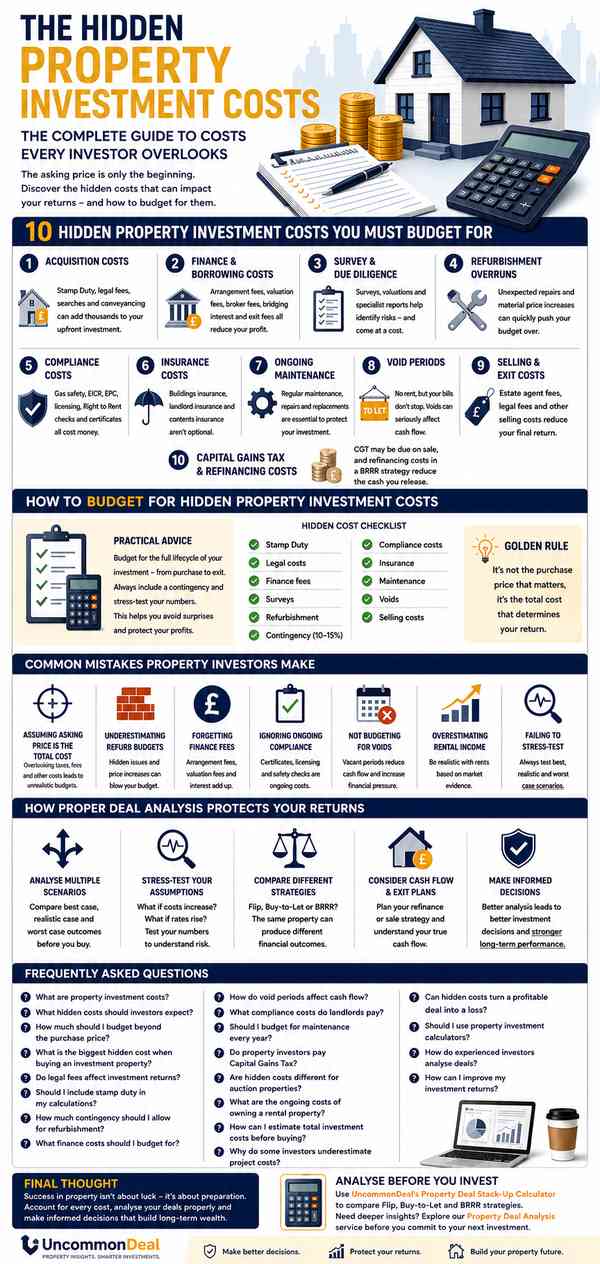
Successful property investment starts with understanding the true cost of ownership, not just the asking price.
Common Mistakes Property Investors Make
Even experienced property investors can underestimate the true cost of an investment if they focus too heavily on headline figures. In many cases, poor investment decisions are not caused by choosing the wrong property but by failing to account for the full range of costs involved before making an offer.
Fortunately, most of these mistakes are avoidable with careful planning, realistic financial projections and thorough deal analysis. Understanding where investors commonly go wrong can help you assess opportunities more accurately and protect your long-term returns.
Assuming the Asking Price Equals the Total Investment Cost
One of the most common mistakes is treating the asking price as the total cost of acquiring a property. In reality, the purchase price is only one part of the overall investment.
Stamp Duty Land Tax, legal fees, finance costs, surveys, refurbishment expenses and other acquisition costs can add thousands of pounds to the amount of capital required. Investors who fail to include these costs often underestimate how much cash they need and overestimate their expected returns.
Underestimating Refurbishment Budgets
Many investors prepare refurbishment budgets based only on visible improvements, such as decorating or replacing kitchens and bathrooms. However, hidden issues including damp, structural defects, outdated electrics and plumbing problems frequently emerge once work begins.
Without a realistic contingency budget, these unexpected repairs can significantly increase project costs and reduce profitability.
Forgetting Finance Fees
Borrowing costs extend far beyond monthly mortgage repayments. Arrangement fees, valuation fees, broker charges, bridging finance interest and refinancing costs should all be included in the investment appraisal.
Ignoring these expenses can make a deal appear more profitable than it actually is, particularly for short-term investment strategies such as property flips or BRRR projects.
Ignoring Ongoing Compliance Costs
Legal compliance is an ongoing responsibility for landlords, not a one-time expense. Gas safety inspections, Electrical Installation Condition Reports (EICRs), licensing schemes, insurance and other regulatory requirements all generate recurring costs that affect long-term cash flow.
Investors who fail to budget for compliance may face unexpected expenditure while increasing their exposure to legal and financial risks.
Not Budgeting for Void Periods
Many financial projections assume that rental income will be received every month of the year. In practice, most rental properties experience occasional void periods between tenancies.
During these periods, rental income stops while mortgage payments, insurance premiums, maintenance costs and other expenses continue. Allowing for occasional vacancies creates more realistic cash flow projections and reduces financial pressure if a property takes longer to re-let.
Overestimating Rental Income
Another common mistake is basing investment decisions on optimistic rental estimates rather than realistic market evidence. Rental demand can fluctuate, local competition can increase and achievable rents may differ from initial expectations.
Using conservative rental figures when analysing a property helps reduce risk and ensures the investment remains financially viable even if market conditions change.
Failing to Stress-Test the Numbers
Perhaps the biggest mistake of all is analysing a deal using only the best-case scenario. Successful investors test multiple outcomes before committing to a purchase.
For example, they consider questions such as:
- What happens if refurbishment costs increase by 15%?
- What if the property remains vacant for two months?
- What if refinancing takes longer than expected?
- Can the investment still generate acceptable returns if interest rates increase?
Stress-testing financial assumptions helps identify potential weaknesses before money is committed. If a property only works under perfect conditions, it may represent a higher level of risk than initially appears.
Avoiding these common mistakes does not guarantee every investment will be successful, but it significantly improves the quality of your decision-making. Investors who analyse every cost, allow for uncertainty and plan for less favourable scenarios are far more likely to build profitable and resilient property portfolios over the long term.
How Proper Deal Analysis Protects Your Returns
Successful property investment is not about finding the cheapest property or the highest advertised rental yield. It is about understanding the complete financial picture before committing your money. Every hidden cost discussed in this guide has the potential to reduce profitability, but thorough deal analysis allows investors to identify these risks early and make informed decisions based on realistic financial projections.
Rather than relying on assumptions or headline figures, experienced investors evaluate every stage of the investment lifecycle. They assess the total acquisition cost, estimate refurbishment expenses, account for finance charges, forecast ongoing ownership costs and consider how they will eventually refinance or exit the investment. This disciplined approach helps them avoid costly surprises and improve the consistency of their investment returns.
Analyse Multiple Scenarios
Professional investors rarely rely on a single set of figures. Instead, they analyse several possible outcomes before making an offer.
For example, they may compare:
- A best-case scenario where the project finishes on time and within budget.
- A realistic scenario based on current market conditions.
- A worst-case scenario where refurbishment costs increase, interest payments rise or the property takes longer to sell or refinance.
Comparing multiple scenarios provides a clearer understanding of the risks involved and helps determine whether the investment remains worthwhile under less favourable circumstances.
Stress-Test Your Assumptions
Every property investment is based on assumptions. Rental income, refurbishment costs, finance costs and resale values are all estimates rather than guarantees.
Professional investors therefore stress-test their calculations by asking questions such as:
- What if refurbishment costs increase by 10% or 15%?
- What if the property remains vacant for several months?
- What if refinancing is delayed?
- What if the final sale price is lower than expected?
If a deal remains profitable after these assumptions are tested, it is generally a stronger investment than one that only works under perfect conditions.
Compare Different Investment Strategies
The same property can produce very different financial outcomes depending on the investment strategy.
For example, one property may deliver:
- Strong monthly cash flow as a buy-to-let.
- A modest profit as a flip.
- Excellent capital recycling potential using the BRRR strategy.
Comparing multiple strategies allows investors to identify the option that best aligns with their financial goals, available capital and appetite for risk instead of assuming there is only one way to maximise returns.
Consider Cash Flow and Your Exit Strategy
Every investment should have a clear plan from the day it is purchased. Investors should understand not only how the property will generate income but also how they intend to refinance or exit the investment in the future.
Questions worth considering include:
- Will the rental income comfortably cover all ongoing expenses?
- How much cash will remain after finance costs and maintenance?
- What is the plan if the market changes?
- Will the property be sold, refinanced or held as a long-term investment?
Thinking about cash flow and exit planning before buying helps ensure every investment decision supports your wider property portfolio objectives.
Analyse Before You Invest
The most successful investors do not rely on guesswork or rough calculations. They use structured analysis to understand every cost, test different scenarios and evaluate multiple investment strategies before committing their capital.
If you’re assessing your next investment opportunity, try the Property Deal Stack-Up Calculator on UncommonDeal. It helps you compare Flip, Buy-to-Let and BRRR strategies, estimate the true cost of an investment and understand how hidden expenses can affect your cash flow, profitability and long-term returns before you make an offer.
Frequently Asked Questions
What are property investment costs?
Property investment costs are all the expenses associated with buying, financing, renovating, owning and eventually selling an investment property. They include the purchase price as well as costs such as Stamp Duty Land Tax, legal fees, finance charges, refurbishment, insurance, maintenance and selling expenses.
What hidden costs should property investors expect?
Some of the most commonly overlooked costs include Stamp Duty Land Tax, conveyancing fees, mortgage arrangement fees, property surveys, refurbishment overruns, bridging finance interest, ongoing maintenance, insurance, compliance costs, void periods and selling costs.
How much should I budget beyond the purchase price?
There is no fixed amount because every property is different. However, investors should budget for all acquisition, finance, refurbishment, ownership and exit costs before making an offer rather than focusing solely on the asking price.
What is the biggest hidden cost when buying an investment property?
For many investors, Stamp Duty Land Tax is one of the largest overlooked upfront costs. However, unexpected refurbishment work and finance costs can also have a significant impact on profitability.
Do legal fees affect investment returns?
Yes. Solicitor fees, conveyancing costs and property searches increase your total acquisition cost and reduce your overall return on investment. These expenses should always be included in your financial calculations.
Should I include Stamp Duty Land Tax in my calculations?
Absolutely. Stamp Duty Land Tax is a significant acquisition cost and should be included when calculating the total amount of capital required to purchase an investment property.
How much contingency should I allow for refurbishment?
Many experienced investors include a contingency budget of 10% to 15% of the planned refurbishment cost to cover unexpected repairs and cost overruns.
What finance costs should I budget for?
Finance costs may include mortgage arrangement fees, bridging finance interest, valuation fees, broker fees, lender administration charges and refinancing costs where applicable.
How do void periods affect cash flow?
During a void period, rental income stops while many expenses continue, including mortgage payments, insurance and maintenance. Allowing for occasional vacancies produces more realistic cash flow projections.
What compliance costs do landlords pay?
Compliance costs may include Gas Safety Certificates, Electrical Installation Condition Reports (EICRs), Energy Performance Certificate (EPC) requirements, property licensing fees where applicable and the installation and maintenance of smoke and carbon monoxide alarms.
Should I budget for maintenance every year?
Yes. Every property requires ongoing maintenance, even if it has recently been refurbished. Setting aside an annual maintenance budget helps manage both routine repairs and unexpected issues.
Do property investors pay Capital Gains Tax?
Capital Gains Tax may apply when selling an investment property, depending on your personal circumstances and the tax rules in force at the time. Professional tax advice should always be sought for individual situations.
Are hidden costs different for auction properties?
Auction properties often involve additional considerations such as immediate completion deadlines, higher refurbishment requirements, bridging finance costs and limited opportunities to inspect the property before purchase.
What are the ongoing costs of owning a rental property?
Typical ongoing costs include mortgage repayments, insurance, maintenance, compliance, repairs, service charges where applicable, ground rent on leasehold properties and occasional void periods.
How can I estimate total investment costs before buying?
The best approach is to prepare a detailed investment budget covering acquisition costs, finance, refurbishment, contingency, ongoing ownership expenses and exit costs. This provides a more realistic assessment of the property’s profitability.
Why do some investors underestimate project costs?
Many investors focus on the purchase price while overlooking finance fees, compliance costs, refurbishment overruns and ongoing ownership expenses. Optimistic assumptions can also lead to unrealistic budgets.
Can hidden costs turn a profitable deal into a loss?
Yes. If several unexpected expenses arise during a project, they can significantly reduce or even eliminate the expected profit. This is why comprehensive deal analysis is essential before purchasing any investment property.
Should I use property investment calculators?
Yes. Property investment calculators can help estimate acquisition costs, cash flow, profitability and return on investment. They provide a structured way to compare opportunities using consistent assumptions.
How do experienced investors analyse deals?
Experienced investors calculate the total cost of ownership, analyse multiple scenarios, stress-test assumptions, compare different investment strategies and evaluate both cash flow and exit plans before committing to a purchase.
How can I improve my investment returns?
Improving investment returns starts with thorough deal analysis. By accurately budgeting for every cost, negotiating effectively, controlling refurbishment spending, minimising void periods and selecting the right investment strategy, you can improve profitability while reducing investment risk.
Final Thoughts
The asking price is only one part of the overall investment. While securing a property at a competitive price is important, it is the total cost of acquiring, financing, renovating, owning and eventually exiting the investment that determines whether a deal is truly profitable.
Hidden property investment costs can have a significant impact on cash flow, profitability and long-term returns if they are overlooked. Expenses such as Stamp Duty Land Tax, finance charges, refurbishment overruns, ongoing maintenance, compliance obligations and selling costs can quickly reduce the returns that initially made a property appear attractive.
Careful budgeting and thorough financial planning help investors avoid expensive surprises and make more informed decisions. By accounting for every foreseeable cost before making an offer, you can build realistic financial projections, manage risk more effectively and invest with greater confidence.
Successful property investors understand that analysing a deal properly is just as important as finding the right property. Taking the time to assess multiple scenarios, stress-test assumptions and calculate the true cost of ownership leads to better investment decisions and stronger long-term portfolio performance.
Before committing to your next investment, use UncommonDeal’s Property Deal Stack-Up Calculator to compare Buy-to-Let, BRRR and Flip strategies using your own figures. If you’d like a more detailed assessment, explore our Property Deal Analysis service for a comprehensive review of a property’s financial performance, risks and investment potential before you commit your capital.

Koye Beckley is a UK property investor and founder of UncommonDeal, with practical experience in buy-to-let, property auctions, refurbishment projects and investment deal analysis. Through UncommonDeal, he publishes property market research, property deal sourcing and compliance guidance, investment guides and data-driven analysis to help investors evaluate buy-to-let, BRRR, flip and auction opportunities.