
The 7 Important Questions Every Investor Should Ask Before Buying Investment Property
Buying Investment Property can be one of the most effective ways to build long-term wealth, generate rental income, and create financial security. However, successful investing is rarely about finding the most deals. More often, it is about avoiding the wrong ones.
Many costly property investment mistakes happen before a purchase is ever completed. Investors often focus heavily on finding below-market-value opportunities, auction bargains, or off-market deals while spending too little time analysing whether the numbers, risks, and strategy actually stack up.
A property that looks attractive on paper may hide expensive refurbishment costs, legal issues, weak rental demand, poor cash flow, or limited exit options. Asking the right questions before committing funds can help eliminate poor investments and reduce the likelihood of costly surprises later.
Whether you are buying a buy-to-let property, pursuing a BRRR strategy, planning a flip, creating an HMO, or bidding at auction, the same principles apply. The most successful investors follow a structured due diligence process that helps them assess value, costs, risks, returns, and exit opportunities before making an offer.
In this guide, we explore seven critical questions every investor should ask before buying investment property and why the answers could have a significant impact on the success of an investment.
1. Why Is This Property Being Sold?
One of the first questions investors should ask before buying investment property is why the seller is selling in the first place. The answer can provide valuable insight into both the opportunity and the risks attached to a deal.
While sellers rarely disclose every detail, understanding the circumstances behind a sale can help investors identify motivated vendors, negotiate more effectively, and avoid unexpected problems after completion.
Common Reasons Properties Are Sold
Properties come to market for many reasons, including:
- Motivated sellers seeking a quick sale
- Probate and inheritance disposals
- Auction sales
- Landlords exiting the market
- Properties requiring substantial refurbishment
- Structural or legal issues
- Financial pressure or debt-related sales
- Portfolio restructuring by investors
Not every motivated sale is a good investment, but understanding the context can help explain why a property may be available at a discount.
Motivated Sellers Can Create Opportunities
A seller who prioritises speed and certainty over achieving the highest possible price may be more willing to negotiate.
Examples include:
- Landlords retiring from property investing
- Executors selling inherited property
- Owners relocating for work
- Vendors facing financial difficulties
- Investors looking to recycle capital into other projects
These situations can sometimes create opportunities to acquire property below full market value.
Watch for Hidden Problems Before Buying Investment Property
A discounted property is not automatically a good deal.
Some sellers are motivated because the property has issues that make it difficult to sell through traditional channels. These may include:
- Structural movement
- Damp and timber problems
- Roofing defects
- Short lease terms
- Problem tenants
- Planning restrictions
- Legal title complications
Understanding why a seller is accepting a lower price can help investors separate genuine opportunities from expensive mistakes.
Auction Properties Require Extra Due Diligence
Auction properties often attract investors because they can sometimes be purchased below market value. However, many properties are entered into auctions because they have characteristics that may limit mainstream buyer interest.
These can include:
- Non-standard construction
- Structural defects
- Short leases
- Legal complications
- Extensive refurbishment requirements
Before bidding, investors should ensure they understand both the reason for the sale and the risks associated with the property.
Finding Opportunities Before Everyone Else
Many of the best investment opportunities never reach the major property portals. Instead, they are identified through networking, direct-to-vendor marketing, estate agent relationships, and specialist sourcing channels.
Many opportunities originate through effective property deal sourcing rather than simply browsing public portals.
Key Takeaway
Understanding why a property is being sold can reveal valuable information about negotiation opportunities, potential risks, and the likelihood of achieving your investment objectives. Before focusing on purchase price alone, take time to understand the motivation behind the sale and whether it aligns with your investment strategy.
2. What Is the True Market Value?
Determining a property’s true market value is one of the most important steps when buying investment property. Yet many investors make the mistake of assuming the asking price reflects the property’s actual worth.
In reality, asking prices are often influenced by seller expectations, estate agent strategies, market conditions, and negotiation tactics. A successful investor focuses on evidence rather than marketing.
Before making an offer, it is essential to understand what similar properties are actually selling for, not simply what they are being advertised for.
Never Rely Solely on the Asking Price
The asking price is only the seller’s starting point. It does not necessarily represent market value.
Some properties are deliberately priced low to attract interest and create competition, while others are listed above market value in the hope that a buyer will pay a premium.
The key question is not what the seller wants. It is what the property is genuinely worth in the current market.
Use Comparable Sales Evidence
One of the most reliable ways to establish market value is by reviewing comparable sales, often referred to as “comps.”
Look for properties that are:
- Similar in size and layout
- Located in the same area
- Sold recently
- In a similar condition
- Comparable in tenure and property type
Sold prices generally provide far more useful information than active listings because they show what buyers were actually willing to pay.
Consider Local Demand
Market value is influenced by more than bricks and mortar.
Investors should also assess:
- Rental demand
- Employment levels
- Transport links
- School catchments
- Regeneration projects
- Population growth
A property in an area with strong tenant demand and improving infrastructure may justify a higher valuation than a similar property in a weaker location.
Estate Agent Valuations Are Not Always Accurate
Estate agents can provide useful local insight, but valuations should be treated as one piece of evidence rather than the final answer.
Some agents may overvalue properties to win instructions, while others may suggest lower prices to secure a quicker sale.
Obtaining multiple opinions and comparing them against actual sold-price data can help build a more accurate picture of value.
Understanding Below Market Value, Market Value and Above Market Value
Below Market Value (BMV)
A property is generally considered below market value when it can be purchased for less than comparable properties in similar condition and locations.
Examples may include:
- Probate sales
- Landlord disposals
- Repossessions
- Auction purchases
- Motivated vendor sales
However, investors should always determine whether the discount exists for a valid reason, such as significant repairs or legal complications.
Market Value
Market value is the price a willing buyer and willing seller would typically agree upon in an open market transaction.
This is usually supported by recent comparable sales evidence and reflects prevailing market conditions.
Above Market Value
A property may be above market value when the asking price exceeds what comparable evidence suggests buyers are prepared to pay.
Examples include:
- Overly optimistic sellers
- Emotional pricing decisions
- Estate agent overvaluations
- Markets experiencing declining demand
Paying above market value can reduce future profitability and limit exit options.
Focus on Evidence, Not Opinion
Many investors lose money before they even complete a purchase because they rely on assumptions rather than data.
Investors who properly analyse property deals usually focus on comparable evidence rather than seller expectations.
The strongest investment decisions are supported by facts, local market knowledge, and objective analysis rather than speculation.
If you are a serious investor, you will check the historical sold-price data using HM Land Registry records to support comparable sales analysis.
Key Takeaway
A property’s asking price and its true market value are often very different. Before buying investment property, take time to review comparable sales, assess local demand, and challenge assumptions. The more accurately you understand value, the better positioned you will be to negotiate effectively and avoid overpaying.
3. What Will It Cost to Refurbish or Improve?
A property may appear to offer strong investment potential, but the numbers can quickly fall apart if refurbishment costs are underestimated. This is one of the most common mistakes made by new and experienced investors alike.
Many deals that look profitable on paper become disappointing investments because the true cost of bringing the property up to standard was not identified before purchase. Accurate refurbishment budgeting is essential when assessing buy-to-let properties, BRRR projects, flips, HMOs, and auction purchases.
Before making an offer, investors should carefully assess both visible defects and potential hidden costs.
Cosmetic Refurbishment
Cosmetic improvements are typically the easiest costs to estimate and often provide the quickest uplift in value or rental appeal.
Examples include:
- Painting and decorating
- New flooring
- Kitchen upgrades
- Bathroom improvements
- Lighting replacements
- Internal doors and fixtures
While individual items may seem relatively inexpensive, costs can add up quickly across an entire property.
Structural Works
Structural problems can significantly affect project profitability and should never be overlooked.
Examples include:
- Subsidence or movement
- Cracked walls
- Damaged foundations
- Chimney repairs
- Structural alterations
- Floor replacement works
These issues often require specialist inspections and can substantially increase refurbishment budgets.
Damp and Moisture Problems
Damp is one of the most common issues found in investment properties, particularly older housing stock.
Potential costs may involve:
- Damp-proof treatments
- Timber repairs
- Ventilation improvements
- Plaster replacement
- Mould remediation
A professional survey may be worthwhile if signs of damp are present.
Roofing Repairs
Roofing defects can be expensive and are often missed during initial viewings.
Common roofing costs include:
- Missing tiles or slates
- Flat roof replacement
- Chimney repairs
- Gutter and fascia replacement
- Structural roof timber repairs
Even relatively minor roofing issues can develop into major expenses if left unresolved.
Electrical Upgrades
Many older properties require electrical improvements before they can be rented safely or refinanced.
Potential works include:
- Consumer unit replacement
- Rewiring
- Additional sockets
- Smoke alarm installation
- Electrical safety compliance works
Obtaining an Electrical Installation Condition Report (EICR) can help identify potential issues before purchase.
Compliance and Regulatory Works
Compliance costs are often underestimated because they are not always obvious during a viewing.
Depending on the strategy, investors may need to budget for:
- Fire doors
- Interlinked smoke alarms
- Carbon monoxide alarms
- HMO requirements
- Energy efficiency improvements
- Building regulation compliance
Failure to account for these costs can significantly affect project returns.
Refurbishment Cost Checklist
Before buying investment property, consider the following:
☐ Internal decoration assessed
☐ Flooring replacement costs estimated
☐ Kitchen and bathroom condition reviewed
☐ Damp and timber issues investigated
☐ Roofing condition checked
☐ Electrical system assessed
☐ Heating and plumbing reviewed
☐ Compliance requirements identified
☐ Contingency budget included
☐ Quotes obtained where possible
Always Include a Contingency
Even the most detailed refurbishment budget may not uncover every issue before purchase. Hidden defects, material price increases, and unexpected repairs can arise once work begins.
Many experienced investors include a contingency allowance of 10% to 20% to reduce the impact of unforeseen costs.
Key Takeaway
Successful property investors focus not only on purchase price but also on the total cost of improving the asset. A property that appears highly profitable can quickly become a poor investment if refurbishment expenses are underestimated. Understanding the likely costs before committing to a purchase can help protect both profit margins and cash flow.
4. Does the Property Generate Sufficient Cash Flow?
A property can increase in value over time, but if it fails to generate sufficient cash flow, it may place unnecessary pressure on your finances. Before buying investment property, investors should understand whether the expected income is enough to cover ongoing costs and support their overall investment strategy.
Many purchases look attractive based on purchase price or projected capital growth, but successful property investing also requires a realistic assessment of monthly income and expenses.
The key question is simple: after all costs are paid, does the property still produce an acceptable return?
Assess the Expected Rental Income
The starting point is understanding how much rent the property is likely to generate.
This should be based on:
- Comparable rental properties
- Local market demand
- Property condition
- Tenant profile
- Location and amenities
Avoid relying solely on optimistic rental estimates. Instead, verify figures using local market evidence and multiple sources where possible.
Consider Mortgage Costs
For leveraged investments, mortgage payments will often represent the largest ongoing expense.
Investors should account for:
- Interest rates
- Mortgage fees
- Product changes at the end of fixed terms
- Potential future rate increases
A property that appears profitable at today’s interest rates may become less attractive if borrowing costs rise.
Budget for Maintenance and Repairs
Every property requires ongoing maintenance, regardless of age or condition.
Typical costs may include:
- Boiler repairs
- Plumbing issues
- Appliance replacement
- General wear and tear
- External maintenance
Ignoring maintenance costs can create an unrealistic picture of profitability.
Allow for Void Periods
Properties are not always occupied every day of the year.
Investors should consider the impact of:
- Tenant changeovers
- Marketing periods
- Unexpected vacancies
- Property refurbishment between tenancies
Even strong rental markets can experience occasional void periods, and these should be factored into cash flow projections.
Include Management Costs
Many investors use letting agents or property managers to handle day-to-day operations.
Potential costs may include:
- Tenant sourcing fees
- Letting fees
- Full management fees
- Compliance administration
- Rent collection services
Even self-managing landlords should allow for the time and resources required to operate a rental property effectively.
Gross Yield vs Actual Profitability
One of the biggest mistakes investors make is focusing only on gross yield.
Gross yield is a useful starting point, but it does not account for the costs associated with owning and operating the property.
Gross Yield
Gross yield is typically calculated as:
Annual Rental Income ÷ Purchase Price × 100
For example:
- Purchase price: £150,000
- Annual rent: £12,000
Gross yield = 8%
While this figure may look attractive, it does not reflect actual profit.
Actual Profitability
True profitability considers:
- Mortgage payments
- Insurance
- Maintenance
- Management fees
- Compliance costs
- Void periods
- Ground rent and service charges where applicable
A property with a lower gross yield may ultimately produce stronger cash flow than a property with a higher headline yield but greater operating costs.
Compare Opportunities Objectively
When reviewing multiple investments, investors should focus on the overall financial performance rather than a single metric.
Understanding yield calculations can help investors compare opportunities more objectively, as explained in our rental yield guide.
Looking beyond headline figures often leads to better investment decisions and more sustainable returns.
Key Takeaway
Strong cash flow is one of the foundations of successful property investing. Before buying investment property, ensure that expected rental income can comfortably support mortgage payments, maintenance, management costs, and potential void periods. A property’s true investment performance is determined not by gross yield alone, but by the income that remains after all costs have been accounted for.
5. What Are the Biggest Risks?
Every property investment carries risk. There is no such thing as a completely risk-free property, regardless of location, strategy, or market conditions.
The objective of successful investing is not to avoid risk altogether. Instead, it is to identify, understand, and manage risks before committing capital. Investors who recognise potential problems early are often better positioned to negotiate, budget accurately, and avoid costly surprises after purchase.
Before buying investment property, take time to assess the major risks that could affect profitability, cash flow, refinancing options, or future resale value.
Structural Issues
Structural defects can significantly impact both refurbishment costs and long-term property value.
Examples include:
- Subsidence
- Structural movement
- Cracked walls
- Foundation problems
- Roof defects
- Damaged floor structures
Some structural issues can be repaired relatively easily, while others may require extensive and expensive remedial work.
If concerns are identified during a viewing or survey, specialist advice should be obtained before proceeding.
Legal Restrictions
Legal issues can affect how a property is used, altered, financed, or sold in the future.
Potential concerns include:
- Restrictive covenants
- Rights of way
- Boundary disputes
- Title defects
- Planning enforcement notices
- Unregistered land complications
Legal restrictions are not always visible during a viewing, which is why reviewing legal documentation is a critical part of due diligence.
Short Leases
Leasehold properties require additional scrutiny.
A short lease can:
- Reduce market value
- Increase financing difficulties
- Limit buyer demand
- Create expensive lease extension costs
Many lenders become more cautious as lease lengths decrease, making future refinancing and resale more challenging.
Investors should always understand the remaining lease term and any associated costs before purchasing.
Tenant Issues
For properties with existing tenants, it is important to understand the tenancy situation.
Potential risks include:
- Rent arrears
- Ongoing disputes
- Anti-social behaviour complaints
- Unauthorised occupants
- Poor property maintenance
A property with sitting tenants may appear attractive, but tenant-related issues can affect both cash flow and management costs.
Planning Concerns
Planning restrictions can impact future development potential and intended investment strategies.
Examples include:
- Conservation area restrictions
- Listed building requirements
- Article 4 Directions
- HMO planning limitations
- Previous planning refusals
Investors planning extensions, conversions, or changes of use should confirm planning viability before relying on projected returns.
Local Market Decline
Property values and rental demand are influenced by local market conditions.
Warning signs may include:
- Rising vacancy rates
- Declining population
- Weak employment growth
- Reduced tenant demand
- Falling property prices
A property can be purchased at an attractive price but still underperform if the local market is experiencing long-term decline.
Investors should assess both the property itself and the wider area before making a decision.
Risk Assessment Should Be Part of Every Deal
Experienced investors rarely ask whether a property contains risk. Instead, they ask:
- What are the risks?
- How likely are they to occur?
- What will they cost if they occur?
- Can they be managed effectively?
This approach creates a more realistic view of the investment and helps avoid decisions based purely on optimism.
Key Takeaway
Every investment property comes with risks, whether they relate to the building, legal position, tenants, planning restrictions, or local market conditions. The goal is not to avoid risk entirely but to understand it before purchase. Investors who identify risks early can make more informed decisions, negotiate more effectively, and protect their long-term returns.
6. What Is My Exit Strategy?
One of the most overlooked questions when buying investment property is how you intend to exit the investment. Many investors focus heavily on acquisition and refurbishment while giving little thought to what happens after the property has been purchased.
A property should ideally have a defined exit strategy before purchase. Understanding how you plan to generate returns, recover capital, or dispose of the asset can influence everything from the price you pay to the type of property you buy.
The most successful investors often begin with the end in mind.
Flip
A property flip involves purchasing a property, improving it, and selling it for a profit.
This strategy typically relies on:
- Buying below market value
- Adding value through refurbishment
- Strong local buyer demand
- Accurate cost control
- Efficient project delivery
When considering a flip, investors should assess whether sufficient profit remains after refurbishment costs, finance costs, legal fees, taxes, and selling expenses.
A property that appears profitable at first glance may offer only a small margin once all costs are accounted for.
Buy-to-Let
A buy-to-let strategy focuses on generating long-term rental income while benefiting from potential capital growth.
Key considerations include:
- Rental demand
- Yield potential
- Cash flow
- Tenant profile
- Long-term market prospects
This approach is often suited to investors seeking recurring income and gradual wealth accumulation rather than immediate profit.
BRRR
BRRR stands for:
Buy, Refurbish, Refinance, Rent, Repeat
This strategy aims to recycle capital by increasing the property’s value through improvements before refinancing and extracting some of the invested funds.
For a BRRR project to work effectively, investors typically need:
- Sufficient value-add potential
- Strong refinancing prospects
- Sustainable rental demand
- Accurate refurbishment budgeting
A property may look attractive as a flip but perform even better as a BRRR opportunity.
HMO Conversion
Some properties can generate significantly higher rental income when converted into a House in Multiple Occupation (HMO).
However, investors should carefully assess:
- Planning requirements
- Licensing obligations
- Fire safety regulations
- Conversion costs
- Local tenant demand
Not every property is suitable for HMO use, and assumptions should be verified before purchase.
Development Opportunities
Certain properties may offer development potential through:
- Extensions
- Loft conversions
- Change of use
- Flat conversions
- New-build opportunities
Development strategies can increase profitability but often involve greater risk, additional capital requirements, and longer project timelines.
Planning feasibility should always be investigated before relying on development-based returns.
Choose the Strategy That Best Fits the Property
One of the most common investor mistakes is attempting to force a property into a strategy that does not suit its characteristics.
Some properties generate excellent rental returns but offer limited resale profit. Others may work exceptionally well as refurbishment projects but produce weak long-term cash flow.
Some properties work better as rental investments while others are more suitable for resale, making the flip vs buy-to-let decision critical.
Understanding the most appropriate strategy before purchase can significantly improve investment outcomes.
Exit Strategies Can Change
While it is important to have a primary exit strategy, experienced investors often consider alternative exits as part of their due diligence.
For example:
- A planned flip may become a buy-to-let if market conditions change.
- A BRRR project may be sold if refinancing proves unattractive.
- A development opportunity may be retained as a long-term rental investment.
Having multiple potential exits can provide additional flexibility and reduce risk.
Key Takeaway
Every property investment should be supported by a clear exit strategy before purchase. Whether your objective is a flip, buy-to-let, BRRR project, HMO conversion, or development opportunity, understanding how you intend to generate returns can help guide acquisition decisions and improve overall investment performance.
7. Have I Reviewed All Legal Documents?
Many investors spend hours analysing property prices, rental income, and refurbishment costs, yet give surprisingly little attention to the legal documentation attached to a purchase.
This can be an expensive mistake.
Many investors lose money because they ignore legal due diligence. A property that appears attractive from a financial perspective may contain legal issues that affect value, financing, development potential, profitability, or future resale prospects.
Before buying investment property, it is essential to review the key legal documents associated with the transaction and understand any obligations, restrictions, or risks that may exist.
Title Documents
The title register and title plan provide important information about legal ownership and rights affecting the property.
Key areas to review include:
- Ownership details
- Boundaries
- Easements
- Rights of way
- Charges and restrictions
- Access rights
Problems relating to title can sometimes delay transactions or create difficulties after completion.
Restrictive Covenants
Restrictive covenants are legal obligations that may limit how a property can be used.
Examples include restrictions on:
- Extensions
- Alterations
- Commercial activities
- Additional dwellings
- Subdivision of land
Investors planning to add value through development or conversion should pay particular attention to these restrictions.
A profitable strategy on paper may become unviable if legal restrictions prevent the intended use.
Lease Terms
For leasehold properties, the lease can be just as important as the property itself.
Areas requiring careful review include:
- Remaining lease length
- Ground rent obligations
- Service charges
- Repair responsibilities
- Restrictions on subletting
- Lease extension provisions
Short leases can affect financing options, reduce market value, and create significant future costs.
Property Searches
Searches help identify issues that may not be immediately visible during inspections.
Common searches include:
- Local authority searches
- Drainage and water searches
- Environmental searches
- Mining searches where relevant
These reports can reveal planning matters, environmental concerns, infrastructure proposals, and other factors that may affect the property’s suitability as an investment.
Auction Legal Packs
Auction purchases require particularly careful legal due diligence because contracts become legally binding once the auction concludes.
For auction purchases, reviewing the auction legal pack is often more important than viewing the property itself.
The legal pack may contain critical information regarding:
- Title issues
- Lease terms
- Restrictive covenants
- Search results
- Special conditions
- Occupancy arrangements
Investors who skip this stage expose themselves to unnecessary risk.
Special Conditions of Sale
Special conditions are frequently overlooked but can have a significant financial impact.
These conditions may require buyers to pay:
- Seller legal fees
- Search costs
- Auction administration charges
- Additional completion fees
In some cases, these costs can add thousands of pounds to the overall purchase price.
Understanding all special conditions before committing to a purchase is essential.
Learn to Identify Warning Signs
Not every legal issue is a deal-breaker, but investors should understand the implications before proceeding.
Investors should understand common auction legal pack red flags before placing a bid.
Examples include:
- Defective leases
- Missing rights of access
- Restrictive covenants
- Planning breaches
- Unusual special conditions
- Short lease terms
Identifying these issues early allows investors to make informed decisions and avoid unpleasant surprises after completion.
Legal Due Diligence Is Part of Risk Management
The purpose of legal due diligence is not necessarily to eliminate every risk. Instead, it helps investors understand the risks they are taking and whether those risks are acceptable within the context of the deal.
A property can still be a strong investment despite legal complications, provided those issues are understood, properly costed, and reflected in the purchase price.
Key Takeaway
Legal documentation can reveal risks and liabilities that are impossible to identify from a viewing alone. Before buying investment property, ensure that title documents, lease terms, restrictive covenants, searches, auction legal packs, and special conditions have been reviewed thoroughly. Strong legal due diligence can prevent costly mistakes and help protect long-term investment returns.
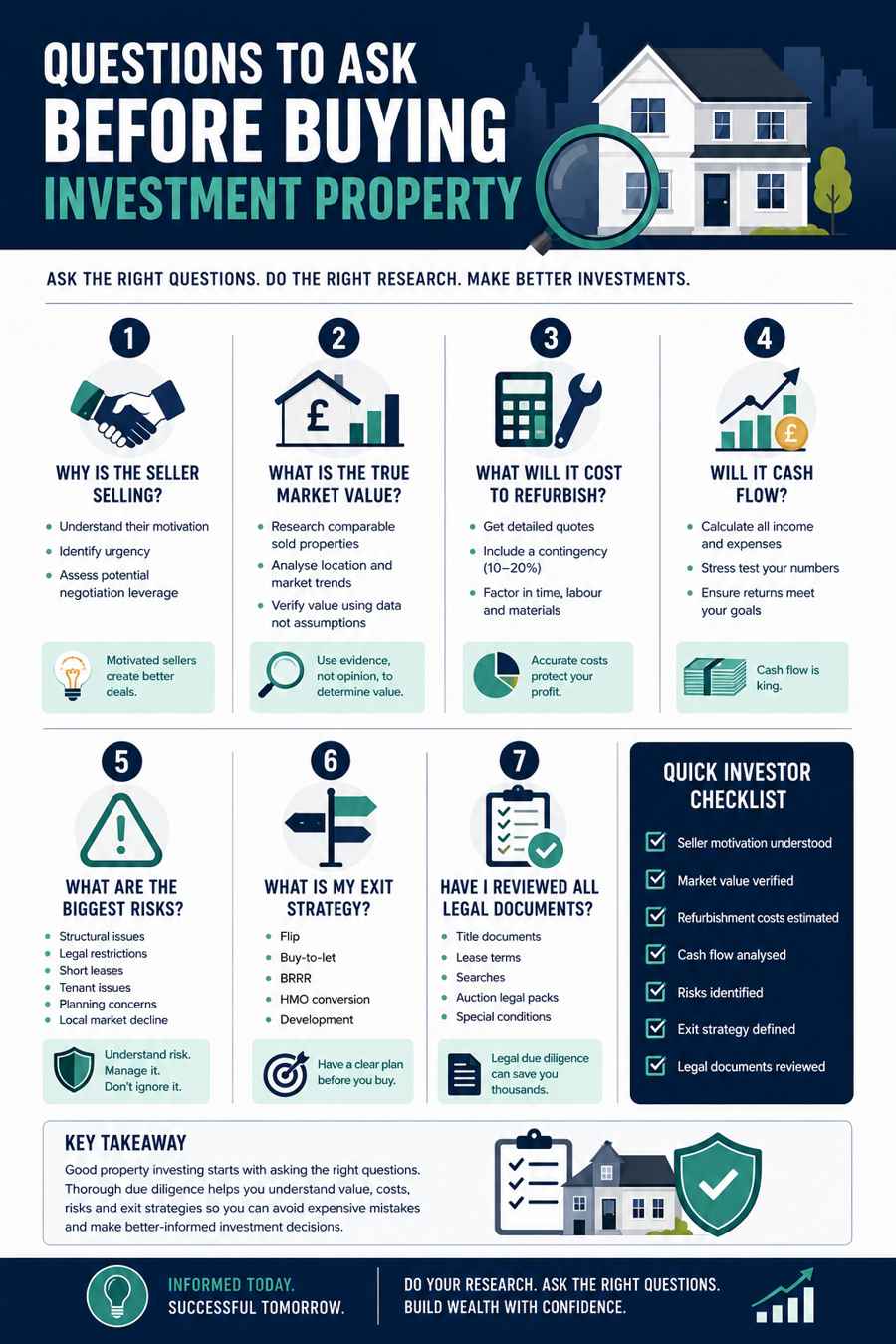
Buying investment property infographic showing the seven key questions investors should ask before purchasing property, including market value, refurbishment costs, cash flow, risks, exit strategy and legal due diligence.
Quick Investor Checklist Before Buying Investment Property
Before buying investment property, it can be helpful to step back and review the fundamentals. A deal may look attractive at first glance, but overlooking one critical area can significantly affect profitability, cash flow, or future resale potential.
Use the checklist below as a final due diligence review before committing to a purchase. If you cannot confidently tick each box, further investigation may be worthwhile before proceeding.
Property Investment Due Diligence Checklist
☐ Seller motivation understood
☐ Market value verified using comparable sales evidence
☐ Refurbishment and improvement costs estimated
☐ Rental income and cash flow analysed
☐ Key risks identified and assessed
☐ Exit strategy clearly defined
☐ Title documents reviewed
☐ Restrictive covenants checked
☐ Lease terms reviewed (where applicable)
☐ Searches completed or reviewed
☐ Auction legal pack reviewed (where applicable)
☐ Special conditions of sale understood
Why This Checklist Matters
Many costly property investment mistakes occur because investors become focused on securing a deal rather than validating the assumptions behind it. A structured checklist helps ensure that important details are not overlooked during the buying process.
While no checklist can guarantee a successful investment, completing thorough due diligence can help reduce risk, improve decision-making, and increase the likelihood of achieving your investment objectives.
Key Takeaway
Successful property investing is often about avoiding poor decisions rather than simply finding opportunities. Taking the time to complete a structured pre-purchase checklist can help investors identify risks, verify assumptions, and approach investment decisions with greater confidence.
Property Investment Resources
Successful investing relies on having access to reliable information, tools and frameworks. Whether you are analysing a buy-to-let opportunity, assessing an auction property, planning a BRRR project, or comparing different investment strategies, having the right information can help you make more informed decisions and reduce costly mistakes.
The resources below provide practical guidance, investment frameworks, due diligence checklists, and educational content designed to help UK property investors evaluate opportunities more effectively.
1. Property Investment Resources
Explore our Property Investment Resources hub for access to calculators, guides, checklists, downloads, and tools created to support investors at every stage of the investment process.
2. Deal Sourcing
Learn how property deal sourcing works, where investors find opportunities, and the techniques used to identify potential investments before they become widely available.
3. How to Analyse Property Deals
Follow a structured framework used by investors to assess market value, refurbishment costs, rental income, risks, profitability, and investment returns before committing capital.
4. Rental Yield Guide
Understand how rental yield calculations work, what gross and net yields mean, and how to compare investment opportunities using objective performance metrics.
5. Property Auction Investment Guide
Discover how property auctions work, how to prepare before bidding, and the due diligence process investors should follow when evaluating auction opportunities.
6. Auction Legal Pack Guide
Learn what an auction legal pack contains, which documents should be reviewed before bidding, and how legal due diligence can help prevent expensive mistakes.
These resources are designed to help investors make more informed decisions, improve deal analysis skills, and approach property investing with greater confidence.
Frequently Asked Questions
Buying investment property involves a wide range of considerations, from assessing value and rental demand to understanding legal risks and future exit strategies. Below are answers to some of the most common questions investors ask before purchasing an investment property.
What questions should I ask before buying an investment property?
Before buying investment property, investors should understand:
- Why the property is being sold
- Its true market value
- Expected refurbishment costs
- Potential cash flow and rental income
- Key investment risks
- The intended exit strategy
- Any legal issues or restrictions
These factors can help determine whether a property genuinely supports your investment objectives.
How do I know if a property is a good investment?
A good investment property should align with your strategy while offering an acceptable balance between risk and reward.
Key areas to assess include:
- Purchase price versus market value
- Rental demand
- Cash flow potential
- Refurbishment costs
- Local market conditions
- Future growth prospects
- Exit options
A property should be evaluated using evidence and financial analysis rather than assumptions or emotion.
Should I buy property at auction?
Property auctions can offer opportunities to acquire properties below market value and access deals that may not be available through traditional estate agency channels.
However, auction purchases also carry risks, including:
- Legal complications
- Structural defects
- Short leases
- Tight completion deadlines
Investors should complete thorough due diligence and review all legal documentation before bidding.
How important is rental yield?
Rental yield is an important metric because it helps investors compare potential returns across different properties.
However, yield should not be considered in isolation.
Investors should also assess:
- Mortgage costs
- Maintenance expenses
- Void periods
- Management fees
- Long-term growth prospects
A property with a slightly lower yield may still produce stronger overall returns if operating costs are lower and demand is more stable.
What documents should I review before buying?
The exact documents will vary depending on the property and purchase method, but investors should typically review:
- Title documents
- Title plans
- Lease agreements (where applicable)
- Property searches
- Restrictive covenants
- Planning information
- Auction legal packs
- Special conditions of sale
Reviewing these documents can help identify risks that are not visible during property viewings.
Is below market value property always a good deal?
No. A below-market-value property is not automatically a good investment.
Properties may be discounted because of:
- Structural defects
- Legal issues
- Short leases
- Problem tenants
- Significant refurbishment requirements
- Weak local demand
The most important question is not whether the property is discounted, but whether the investment still works after all risks, costs, and future requirements have been properly assessed.
Final Thoughts
Successful property investing rarely comes down to luck. More often, it is the result of asking the right questions before committing capital and taking the time to complete proper due diligence.
The most effective investors do not simply focus on finding deals. They focus on understanding the factors that determine whether a deal is likely to succeed. This includes assessing market value, estimating refurbishment costs, analysing cash flow, identifying risks, reviewing legal documentation, and defining a clear exit strategy.
Every property purchase should be supported by analysis rather than emotion. A property that appears attractive at first glance may not perform as expected once all costs, risks, and constraints are fully understood.
By taking a structured approach to due diligence, investors can reduce the likelihood of costly mistakes and improve their chances of achieving their investment objectives. In many cases, thorough due diligence is the difference between a successful investment and an expensive lesson.
Before committing to any property purchase, use the tools, guides and resources available through UncommonDeal to assess opportunities more objectively and make better-informed investment decisions.

Koye Beckley is a UK property investor and founder of UncommonDeal, with practical experience in buy-to-let, property auctions, refurbishment projects and investment deal analysis. Through UncommonDeal, he publishes property market research, property deal sourcing and compliance guidance, investment guides and data-driven analysis to help investors evaluate buy-to-let, BRRR, flip and auction opportunities.