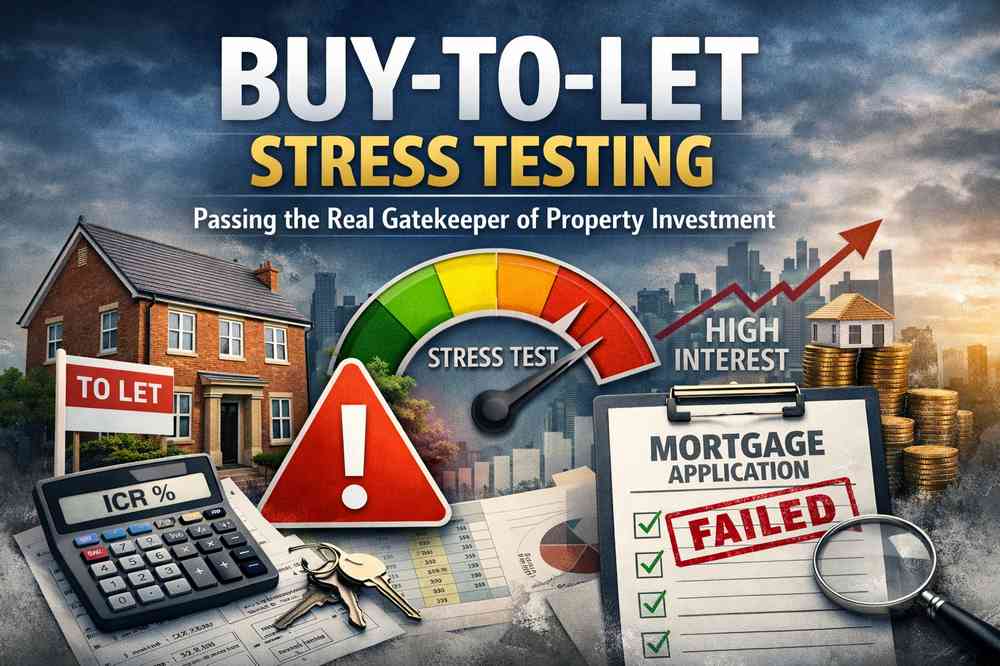
Rental Stress Testing in Buy-to-Let: How UK Lenders Really Assess Affordability
Rental stress testing is the part of buy-to-let that quietly decides whether you can actually finance a deal. Not the headline mortgage rate. Not the gross yield on Rightmove. It is the lender’s affordability maths, run under assumptions that often have little to do with today’s interest rates or your spreadsheet optimism.
Most investors focus on the deal rate they are being offered; whereas, lenders do not. Instead, they test rental income against hypothetical interest rates, inflated coverage ratios, and conservative rent assumptions designed to survive future shocks. This is why a property can look cashflow positive at 5 percent interest and still fail a lender’s affordability check without warning.
The gap exists because investors and lenders are solving different problems. Investors ask, “Will this property pay for itself today?” Lenders ask, “Will this loan still be safe if rates rise, rents stall, and costs increase?” Under rules shaped by the Prudential Regulation Authority, lenders are required to assume tougher conditions than most buyers ever model.
Understanding rental stress testing changes how you analyse buy-to-let entirely. It explains why some deals never get off the ground, why limited company structures pass where personal ownership fails, and why affordability, not enthusiasm, is the real gatekeeper in UK buy-to-let investing.
What Is Rental Stress Testing in UK Buy-to-Let Mortgages?
Rental stress testing is the method UK buy-to-let lenders use to decide whether a property’s rent is strong enough to support the mortgage under tougher-than-today assumptions.
In plain English, the lender does not ask whether the rent covers your actual mortgage payment. Instead, they recalculate affordability as if interest rates were higher and costs were less forgiving, then check whether the rent still clears a required safety margin.
That safety margin is known as the interest coverage ratio (ICR). It usually means the rent must exceed the stressed mortgage interest by a fixed percentage, commonly 125 percent to 145 percent, depending on ownership structure and lender policy.
If the rent fails this test, the deal fails. Even if it looks profitable on your spreadsheet.
Why lenders do not use real mortgage payments
Lenders avoid using real mortgage payments because those payments are temporary. A two-year or five-year fixed rate tells them almost nothing about risk over the full life of the loan.
Instead, lenders assume a future scenario where:
-
Interest rates are higher than today
-
Fixed deals expire and revert to higher rates
-
Rents stagnate or rise more slowly than expected
-
Costs increase but income does not
By stress testing rent against these assumptions, lenders protect themselves against rate cycles rather than today’s market conditions.
This approach is not optional. Under rules shaped by the Prudential Regulation Authority, lenders are required to assess affordability using prudent, forward-looking assumptions rather than current deal rates. That is why base rate cuts or attractive fixed deals often fail to unlock additional borrowing capacity.
The result is a disconnect that catches many investors out. You may see a deal that comfortably pays for itself at today’s rate. The lender is testing whether it would still survive under conditions you are not currently modelling.
That difference is exactly why rental stress testing matters more than the mortgage rate you are offered.
Rental Coverage Ratio Explained (ICR)
The rental coverage ratio, usually shortened to ICR, is the core calculation behind every buy-to-let affordability decision.
In practice, ICR measures how much rental income a property generates relative to the mortgage interest the lender assumes, not the interest you will actually pay today.
Put simply, lenders ask:
“If interest rates rise to our stress level, does the rent still cover the mortgage by a comfortable margin?”
That margin is expressed as a percentage. An ICR of 145 percent means the rent must be 45 percent higher than the stressed mortgage interest. An ICR of 125 percent means it must be 25 percent higher.
For example, if a lender assumes stressed annual interest of £10,000:
-
At 145% ICR, required rent is £14,500 per year
-
At 125% ICR, required rent is £12,500 per year
If the rent falls short by even a small amount, the loan size is reduced or declined entirely.

What ICR really means for investors
ICR is not a measure of profitability. It is a measure of lender comfort.
A property can pass ICR and still be a weak investment once running costs, tax, and voids are applied. Equally, a property can generate real-world surplus cashflow and still fail ICR because the lender’s stress assumptions are harsher than reality.
This is why investors often feel deals are “killed by the bank” even when the numbers appear sensible.
Typical ICR benchmarks used by UK lenders
While exact thresholds vary by lender and product, most UK buy-to-let stress tests fall into predictable ranges:
-
Individual / personal ownership:
Usually 140% to 145% ICR, reflecting higher tax exposure and perceived risk -
Limited company buy-to-let:
Commonly 125% to 135% ICR, due to corporation tax treatment and retained profits -
Portfolio landlords:
Often at the higher end of these ranges, with additional scrutiny across the wider portfolio -
Five-year fixed products:
Sometimes assessed at slightly lower ICRs, but still stress tested rather than assessed on pay rate
These benchmarks are not designed to be fair or flexible. They are designed to enforce discipline. Understanding them early allows investors to reverse-engineer deals that pass lender maths before time, fees, and momentum take over.
Stress Rates vs Pay Rates
One of the most misunderstood parts of buy-to-let affordability is the difference between pay rates and stress rates.
The pay rate is the interest rate on the mortgage product you actually take today.
The stress rate is the higher, hypothetical interest rate the lender uses to test affordability.
Lenders almost always assess rental income against the stress rate, not the pay rate.
Why lenders ignore today’s deal rate
From a lender’s perspective, today’s deal rate is temporary and largely irrelevant.
Most buy-to-let mortgages are fixed for two or five years. The loan itself may run for 25 years or more. Lenders therefore assume that:
-
Fixed rates will end
-
Borrowers may revert to higher variable rates
-
Refinancing may not always be available on favourable terms
If lenders based affordability on today’s deal rate, they would be underwriting risk that disappears the moment the fixed period ends.
This is why even low-rate five-year fixes are still stress tested. The lender is not assessing your next five years. They are assessing the durability of the loan across multiple rate cycles.
The logic behind stressed interest assumptions
Stress rates are set deliberately above current market rates to build in resilience.
Typically, lenders apply one of two approaches:
-
A minimum stressed rate, often in the range of 5.5 percent to 7 percent
-
A margin above the pay rate, such as pay rate plus 2 or 3 percent
The higher of the two usually applies.
This ensures the affordability calculation remains conservative even when market rates fall. It also explains why base rate cuts do not automatically improve borrowing capacity for buy-to-let investors.
From an investor’s point of view, this can feel frustrating or disconnected from reality. From a lender’s point of view, it is the mechanism that prevents affordability from being based on short-term pricing or optimistic forecasts.
Understanding the gap between stress rates and pay rates is critical. It explains why deals that work at today’s interest rate can still fail, and why successful buy-to-let investors learn to model lender assumptions before committing capital.
Why UK Lenders Stress Test Rental Income
Rental stress testing is often perceived by investors as an obstacle or an unnecessary hurdle. In reality, it is a core risk management tool. It is not designed to punish landlords or restrict borrowing for its own sake. It exists to protect lenders against uncertainty that investors do not always factor in.
Buy-to-let lending is long-term by nature. Even if a mortgage is fixed for two or five years, the underlying loan exposure spans decades. Over that period, interest rates move in cycles, rental markets soften and tighten, and economic conditions change. Stress testing is how lenders ensure that loans remain viable beyond today’s conditions.
Risk management, not punishment
Lenders are not asking whether a property works in a best-case scenario. They are asking whether it survives a worse one.
Stress testing rental income allows lenders to filter out deals that only work when everything goes right. Low interest rates, uninterrupted tenancies, rising rents, and minimal costs are not guaranteed. If affordability depends on those assumptions, the risk sits with the lender once conditions change.
By applying conservative stress rates and coverage ratios, lenders reduce the chance that borrowers fall into distress when fixed rates end or costs increase. This is particularly important in buy-to-let, where rental income is the sole repayment source and there is no salary to fall back on.
Seen through that lens, stress testing is not about distrust. It is about limiting exposure to fragile cashflow.
How stress testing protects lenders from rate cycles
Interest rates do not move in straight lines. Periods of low rates are often followed by sharp adjustments. Lenders learned this lesson repeatedly in previous cycles, which is why modern affordability models assume that current pricing will not last.
Stress testing rental income against higher assumed rates creates a buffer. It means that when rates rise, fewer loans tip from marginally affordable into unmanageable territory. That stability protects lenders, but it also reduces forced sales and defaults across the wider market.
This approach is reinforced by regulatory oversight. Under guidance shaped by the Prudential Regulation Authority, lenders are expected to underwrite prudently and demonstrate that their loan books can withstand adverse scenarios, not just favourable ones.
For investors, this explains an important reality. Stress testing is not a temporary policy that relaxes when markets improve. It is a structural feature of UK buy-to-let lending, designed to smooth out rate cycles rather than react to them. Understanding that changes how and when deals stack up.
Regulatory Pressure and Capital Rules
When we talk about why lenders cannot just relax affordability rules, we have to recognise that mortgage underwriting in the UK does not happen in a vacuum. It sits within a formal regulatory framework designed to make banks and building societies safe, sound and resilient across economic cycles. The Prudential Regulation Authority’s regulatory framework requires lenders to apply prudent stress testing when assessing buy-to-let affordability.
The PRA’s core objective is to promote the safety and soundness of the financial firms it regulates, including banks and building societies that provide buy-to-let mortgages. It does this through rules and supervisory expectations built into the PRA Rulebook and supporting guidance that lenders must follow. These rules include having sufficient capital, robust risk controls, conservative underwriting and prudent stress testing so that firms can withstand future shocks without threatening financial stability.
For mortgage lenders, this means they cannot simply ignore stress tests when assessing buy-to-let affordability, even if market rates look stable or falling. The PRA expects stressed assumptions to be applied consistently, because they ensure that lenders have enough capital and risk buffers to absorb higher rates, rental downturns or other stress events. Many of today’s buy-to-let underwriting standards – including minimum interest coverage tests and assumptions about future rent and rates – stem directly from supervisory expectations originally set out by the PRA for the specialist mortgage market.
Portfolio Risk vs Single Property Risk
Lenders assess portfolio landlords very differently from investors with a single buy-to-let. The reason is simple: risk compounds as portfolios grow.
A single property is evaluated largely in isolation. If it underperforms, the impact is contained. A portfolio, however, introduces interconnected risk. One weak asset can drag on others through shared cashflow, cross-subsidisation, and refinancing exposure across multiple loans.
That is why landlords with four or more mortgaged properties typically face tighter scrutiny.
Why multiple properties trigger tougher assessments
With portfolios, lenders are not just asking whether this property passes a stress test. They are asking whether the entire portfolio can withstand pressure at the same time.
Key concerns include:
-
Concentration risk: Similar property types or locations rising and falling together
-
Rate shock exposure: Multiple loans reverting off fixed rates in the same period
-
Cross-subsidy risk: Strong properties masking weak ones until conditions tighten
-
Refinancing dependency: Reliance on future valuations and lending appetite
To manage this, lenders often apply:
-
Higher effective ICR expectations at portfolio level
-
Full portfolio cashflow assessments, not just property-by-property checks
-
More conservative assumptions on rent sustainability and costs
Even if a new purchase passes its own stress test, it can still be declined if the wider portfolio looks stretched under stressed assumptions.
What this means for investors
Portfolio landlords often feel penalised for scale. In reality, lenders are reacting to systemic risk rather than individual deal quality.
This explains why experienced investors sometimes reduce leverage as portfolios grow, prioritise longer fixed periods, or restructure ownership to keep affordability resilient. The goal is not to maximise borrowing on every asset, but to ensure the portfolio survives interest rate cycles without relying on best-case assumptions.
Understanding how lenders view portfolio risk allows investors to plan growth more strategically, rather than being surprised when affordability tightens just as they try to scale.
Standard Stress Test Thresholds Used by UK Lenders
While each lender sets its own criteria, UK buy-to-let stress testing follows a fairly consistent pattern. Once you understand the typical thresholds, most affordability outcomes become predictable long before a mortgage application is submitted.
The key variable is not the interest rate you are offered. It is the minimum interest coverage ratio the lender requires when applying its stressed rate.

Typical ICR percentages in today’s market
Across mainstream and specialist lenders, ICR requirements usually fall into these bands:
-
Individual (personal name) buy-to-let
Commonly 140% to 145% ICR
This reflects personal tax exposure and higher perceived repayment risk. -
Limited company buy-to-let
Typically 125% to 135% ICR
Lenders recognise corporation tax treatment and retained profit flexibility. -
Portfolio landlords
Often assessed at the upper end of the above ranges, with additional portfolio-level testing. -
Five-year fixed products
Sometimes assessed at slightly lower ICRs, but still stress tested rather than assessed on pay rate.
These figures are not targets or guidelines. They are hard pass or fail thresholds. Miss them by a small margin and the lender either reduces the loan amount or declines the case entirely.
This is why two investors buying identical properties can receive very different lending outcomes based purely on ownership structure and portfolio size.
Where the “145% rule†actually comes from
The 145% figure often gets repeated as if it is a universal rule. It is not a law and it is not applied in every case. It became common because it achieved two things lenders needed at the same time.
First, it created a buffer against higher interest rates.
Second, it compensated for the fact that individual landlords pay tax on rental income before mortgage interest is fully accounted for.
In simple terms, lenders needed rental income to stretch further to remain comfortable. A 145% coverage ratio under stressed rates provided that margin.
Over time, this threshold became embedded in lender models, broker expectations, and underwriting systems. Even as tax rules, rates, and products changed, the ratio stayed because it consistently filtered out fragile affordability.
That is why the 145% rule still shows up today, even when market conditions look calmer. It is not about current risk. It is about enforcing discipline across the cycle.
For investors, the takeaway is clear. Stress test thresholds are structural, not negotiable. If a deal does not clear them comfortably, it is not lender-friendly, no matter how attractive it looks on paper.
Stress Testing for Individual Landlords
Buy-to-let mortgages held in a personal name are stress tested more aggressively than their limited company equivalents. This is not arbitrary. It reflects how rental income is taxed and how vulnerable personal landlords are to changes in interest rates.
As a result, individual landlords are the group most likely to see otherwise sensible deals fail affordability checks.
Higher ICRs due to tax treatment
For individual landlords, rental income is taxed before mortgage interest is fully taken into account. This creates a structural squeeze on net cashflow that lenders must allow for when assessing risk.
To compensate, lenders typically apply higher interest coverage ratios, often around 140% to 145%, when stress testing personal buy-to-let mortgages. The higher the assumed tax burden, the more rental headroom the lender demands.
From the lender’s perspective, this is about ensuring that:
-
Tax liabilities do not erode the ability to service the loan
-
Rental income still covers stressed interest after tax pressure
-
Borrowers are less exposed to affordability shocks when rates rise
Even if the borrower is a basic-rate taxpayer today, lenders cannot underwrite on that assumption over the life of the loan. They assess risk on a forward-looking basis, which pushes ICRs higher.
Why personal ownership fails affordability more often
Personal ownership fails stress testing more frequently because it combines three pressure points at once.
First, higher ICR thresholds raise the rental bar significantly.
Second, stressed interest rates inflate the assumed mortgage cost.
Third, tax treatment reduces the effective buffer between rent and debt.
Together, these factors mean that modestly geared properties or flats with service charges often fall short, even when they generate positive cashflow in real life.
This is why many investors experience the same frustration pattern. The deal works on a spreadsheet. The rent covers the mortgage. But the lender reduces the loan amount or declines the application entirely.
Understanding this explains a broader market trend. As stress testing tightened and tax rules changed, more investors shifted away from personal ownership, not because it was unprofitable, but because it became structurally harder to finance under lender affordability models.
Stress Testing for Limited Company Buy-to-Let
Limited company buy-to-let is stress tested differently because the risk profile is different. Lenders are not being generous. They are recognising how rental income behaves once tax and cashflow mechanics change.
As a result, limited company mortgages usually benefit from lower ICR requirements than personal ownership.
Lower ICRs and why they exist
For limited companies, rental income is taxed after mortgage interest is deducted as a business expense. This materially alters how much cashflow remains available to service debt under stress.
Because of this, lenders commonly apply ICRs in the region of 125% to 135% for limited company buy-to-let. The lower threshold reflects the fact that interest costs are not competing with income tax in the same way they are for individual landlords.
From a lender’s perspective, this structure:
-
Preserves more rental income for debt servicing
-
Reduces the risk of tax eroding affordability under stress
-
Produces more stable coverage ratios over time
The key point is that lenders are not favouring limited companies for strategic reasons. They are responding to how the numbers behave under stress.
The cashflow advantage lenders recognise
Under stress testing, lenders care less about theoretical profit and more about durable cashflow.
Limited companies tend to show stronger, more predictable coverage because:
-
Mortgage interest is fully accounted for before tax
-
Retained profits can buffer temporary income dips
-
Cashflow remains more resilient when rates increase
This is why limited company structures often pass stress tests where identical properties fail in personal names. The property itself has not changed. The cashflow mechanics have.
That does not mean limited company ownership automatically makes a deal good. It simply makes it more lender-compatible.
Understanding this distinction is critical. Stress testing rewards structures that preserve rental headroom under pressure. Limited company buy-to-let does that more effectively, which is why lenders recognise it in their affordability models.
How Interest Rates Are Stress Tested in Practice
Interest rate stress testing is where many buy-to-let assumptions quietly fall apart. Investors often expect affordability to improve when rates fall. Lenders do not assess risk that way.
In practice, stress testing is designed to stay conservative regardless of where the base rate sits today.
Typical stress rate ranges used by lenders
Most UK buy-to-let lenders apply one of two methods when setting stress rates, and often combine both.
The first is a fixed minimum stress rate. This typically sits somewhere between 5.5 percent and 7 percent, depending on lender policy and product type. Even if the pay rate is well below this level, affordability is tested at the higher assumed rate.
The second is a margin above the pay rate, commonly pay rate plus 2 to 3 percent. If this produces a higher figure than the fixed minimum, the higher number applies.
In practice, lenders use whichever result is more conservative.
This is why:
-
A 4.5 percent mortgage can still be stress tested at 6.5 percent
-
Two borrowers on different products can face the same stress rate
-
Falling market rates do not automatically unlock higher borrowing
The stress rate is not a forecast. It is a safeguard.
Why base rate cuts do not always help affordability
Base rate cuts affect pricing, not risk models.
While lower rates can reduce actual mortgage payments, lenders rarely adjust stress rates in line with short-term rate movements. Stress testing is built to reflect long-term risk, not current monetary policy.
From a lender’s perspective:
-
Rate cycles are temporary
-
Affordability should not swing with every policy decision
-
Reducing stress assumptions too quickly increases systemic risk
This is why investors often feel disappointed after rate cuts. The mortgage looks cheaper, but the borrowing capacity barely moves.
Affordability improves only when stress assumptions change, not when headline rates do. That shift happens slowly, if at all.
For buy-to-let investors, the lesson is simple. Model deals against lender stress rates, not the Bank of England base rate. Doing so removes false optimism and reveals whether a deal is genuinely financeable under real-world lending conditions.
Fixed Rate Mortgages vs Variable Assumptions
Fixed rate mortgages create a false sense of certainty in buy-to-let affordability. While they offer payment stability for a defined period, lenders do not treat them as long-term risk protection.
That is why even five-year fixed buy-to-let mortgages are stress tested.
Why even five-year fixes get stress tested
From a lender’s perspective, a five-year fix is still a short window in the life of a buy-to-let loan.
Most buy-to-let mortgages run for 20 to 30 years. A five-year fix only guarantees pricing for a fraction of that time. Once it ends, the borrower is exposed to whatever rates and lending conditions exist at that point.
If lenders assessed affordability purely on the fixed rate:
-
Risk would be deferred, not removed
-
Affordability could collapse at remortgage
-
Lenders would be underwriting short-term comfort, not long-term viability
Stress testing prevents that. It ensures the rental income can support the loan beyond the fixed period, not just during it.
What lenders assume happens after the fixed period
When stress testing, lenders effectively assume the fixed rate disappears and the loan reverts to a higher, less favourable environment.
Common assumptions include:
-
Reversion to a variable or standard variable rate
-
Higher interest costs than the fixed period
-
Reduced refinancing options if market conditions tighten
Lenders do not assume that refinancing will always be available or affordable. They assess the loan as if the borrower must carry it through adverse conditions without relying on a favourable remortgage.
This explains why longer fixes do not always unlock significantly higher borrowing, and why affordability often looks detached from the product being offered.
For investors, the takeaway is important. Fixed rates manage cashflow volatility. They do not replace stress testing. Lenders are underwriting the life of the loan, not the comfort of the next few years.
When a Property Looks Profitable but Still Fails Lender Stress Tests
This is the point where most buy-to-let frustration comes from.
A property can look comfortably profitable on an investor’s spreadsheet and still be rejected by a lender. The rent covers the mortgage at today’s rate. There is surplus cashflow. The yield looks healthy. Yet the mortgage offer never materialises.
The reason is simple. Investor ROI and lender affordability are not measuring the same thing. This is why smart investors analyse lender maths before committing capital.
Cashflow positive on paper, unmortgageable in reality
Investors usually model deals using real-world assumptions:
-
The current mortgage rate
-
Expected rent based on market comparables
-
Normal running costs
-
Target profit or surplus
Lenders do not.
Instead, lenders test:
-
A higher assumed interest rate
-
A fixed minimum coverage ratio
-
Conservative rent assumptions
-
No benefit from optimism or future growth
This creates a scenario where a deal works at 5 percent but fails at a stressed 6.5 percent with a 145 percent coverage requirement.
Nothing is “wrong” with the deal in real terms. It simply does not clear the lender’s safety margin.
This is why high-yield properties often fail affordability. Yield alone does not matter. What matters is how much rent remains after stress, not how attractive the headline numbers look.
The mismatch between investor ROI and lender maths
Investor ROI focuses on return on capital. Lender maths focuses on loan survivability.
Investors ask:
-
Does this deal generate surplus cashflow?
-
Is the return worth the risk and effort?
Lenders ask:
-
Does this rent cover stressed interest with room to spare?
-
Will the loan survive rate rises without borrower distress?
Because these questions are different, outcomes diverge.
A deal can be:
-
A good investment but a poor lending proposition
-
A poor investment but a lender-friendly one
Understanding this mismatch is critical. It explains why experienced investors reverse-engineer deals from lender criteria first, then assess whether the remaining returns justify the effort.
Affordability is not a judgement on deal quality. It is a filter. If a property fails it, the lender’s answer is final, regardless of how good the spreadsheet looks.
High Yield, Low Rent Properties
High yield often looks attractive because it suggests efficiency. Low purchase price, decent rent, strong percentage return. In practice, this category of property is one of the most likely to fail lender stress tests.
The issue is not yield. It is absolute rent.
Why cheap properties often fail ICR
Interest coverage ratios are based on rental income in pounds, not percentage yield.
A £70,000 property renting for £550 per month can show an impressive yield on paper. But once a lender applies a stressed interest rate and a 140% to 145% ICR, the actual rent may simply be too low to support the loan size.
Cheap properties fail stress tests because:
-
There is not enough rental headroom to absorb stress rates
-
Small changes in assumptions wipe out coverage
-
The rent cannot scale in line with leverage
Even modest borrowing can push these properties below the lender’s threshold. The deal may generate surplus cashflow in real life, but the stressed numbers do not leave enough margin.
This is why lenders often reduce loan sizes sharply on low-value properties, even when yields look strong.
Regional rent ceilings lenders apply
Lenders also apply implicit rent ceilings, particularly in lower-priced regions.
They rely on conservative rental benchmarks, not optimistic agent appraisals. If the rent sits near the top of the local market, lenders may haircut it or cap it based on comparable data.
This disproportionately affects:
-
Low-value areas with slower rental growth
-
Properties priced cheaply relative to their rent
-
Regions where affordability ratios already look stretched
As a result, investors may struggle to borrow against rents that tenants are perfectly willing to pay.
The takeaway is counterintuitive but important. High yield does not guarantee lender comfort. In buy-to-let, rent level matters more than yield percentage. If the absolute rent cannot clear stress tests comfortably, the deal becomes difficult to finance, regardless of how attractive it looks on paper.
Service Charges, Ground Rent, and Hidden Drags
Service charges and ground rent are some of the most common reasons buy-to-let flats fail lender stress tests. They rarely look dramatic in isolation, but they quietly erode the rental income lenders are willing to count.
From an affordability perspective, these costs act like permanent interest increases. They reduce usable rent without reducing the stressed mortgage calculation.
Costs that reduce usable rental income
Lenders do not always assess rent on a simple gross basis. Certain fixed costs are treated as unavoidable drags on cashflow and are effectively deducted before affordability is considered.
Common examples include:
-
Annual service charges
-
Ground rent obligations
-
Communal maintenance costs
-
Estate charges on leasehold developments
A flat renting for £1,000 per month may look fine on paper. But once a £3,000 annual service charge is factored in, the usable rent drops materially. The mortgage stress calculation does not adjust downward. The rent does.
This is why two properties with identical rents can produce very different affordability outcomes once fixed costs are accounted for.
Why flats fail more often than houses
Flats fail stress testing more frequently because they combine several structural disadvantages.
They typically have:
-
Higher fixed running costs that cannot be avoided
-
Less flexibility to absorb rising charges
-
Limited scope to offset costs through rent increases
These are some of the reasons flats fail more often than houses under lender stress tests.
In contrast, houses usually avoid service charges entirely. The full rent is available to support the mortgage, which makes passing ICR materially easier.
This does not mean flats are bad investments. It means they are less lender-friendly under stress testing models.
For investors, the implication is clear. Service charges and ground rent should be treated as affordability risks, not just cost items. If they materially reduce usable rent, the deal may fail stress tests even when the headline numbers appear sensible.
Common Stress Testing Traps That Catch Investors Out
Most buy-to-let affordability failures are not caused by obscure lender rules. They are caused by predictable assumptions investors make before fully understanding how stress testing works.
These traps repeat themselves because they feel logical from an investor’s point of view, but they do not align with lender maths.
Assuming gross rent equals assessable rent
Many investors assume the full advertised rent will be used in affordability calculations. In practice, lenders often apply conservative adjustments.
Rent may be reduced due to:
-
Fixed costs such as service charges
-
Conservative rental benchmarks
-
Internal caps based on comparable evidence
The rent you think you have is not always the rent the lender uses.
Ignoring the impact of small leverage changes
Stress testing is extremely sensitive to loan size.
A small increase in borrowing can push a deal from pass to fail. Investors often assume that being “close” is good enough. It is not.
If the stressed interest rises just beyond what the rent can support at the required ICR, the lender will simply reduce the loan amount or decline the case.
Relying on today’s mortgage rate
Modelling affordability using the pay rate is one of the fastest ways to misjudge a deal.
Lenders assess against stressed rates that are often materially higher. If a deal only works at today’s rate, it is fragile from a lender’s perspective.
Treating ownership structure as an afterthought
Ownership structure directly affects ICR thresholds. Many investors find out too late that personal ownership fails where limited company ownership passes.
By the time this becomes obvious, time, fees, and momentum are already invested.
Assuming experience overrides lender models
Past success does not override affordability rules.
Even experienced landlords are assessed against the same stress testing framework. Lenders do not relax criteria because a borrower has a strong track record or confidence in the deal.
The common thread across all these traps is expectation mismatch. Investors analyse deals through profitability. Lenders analyse them through survivability. The earlier that difference is recognised, the fewer surprises appear at mortgage stage.
Using Agent Rent Estimates Instead of Lender Figures
One of the most common and costly stress testing mistakes is relying on letting agent rent estimates as if they are lender-approved numbers.
Agents price for marketing. Lenders price for risk. The two are not the same.
Why agent rent appraisals often fail stress tests
Letting agents are incentivised to be competitive. Their estimates are usually based on:
-
Best-case comparable listings
-
Current demand rather than long-term sustainability
-
Optimistic assumptions about condition and tenant profile
Lenders, on the other hand, apply conservative benchmarks. They may:
-
Use internal rental databases rather than agent letters
-
Discount rents that sit at the top of the local range
-
Ignore “achievable with minor works” assumptions
This creates a gap where the rent an agent confidently supports is not the rent the lender is willing to accept.
It is important to realise ths many sourced deals rely on optimistic rent assumptions that lenders simply do not accept.
How lenders actually assess rental figures
In many cases, the lender’s valuer sets the rent for affordability purposes. That figure, not the agent’s estimate, drives the stress test.
If the valuer comes in lower, affordability drops immediately. No amount of explanation changes the calculation.
This is particularly common where:
-
The rent is high relative to purchase price
-
The property is in a lower-value area
-
Comparable evidence is thin or inconsistent
The practical lesson is simple. Agent rent estimates are useful for market insight, but they should never be treated as the affordability figure.
Experienced investors build headroom into their numbers. They assume the lender’s rent will be lower than the agent’s and check whether the deal still passes stress tests when that happens.
Overleveraging at Purchase
Overleveraging is one of the easiest ways to turn a workable buy-to-let into an unmortgageable one. It often happens unintentionally, driven by a desire to maximise borrowing rather than to pass affordability cleanly.
Stress testing is unforgiving at the margins.
Why small deposit differences can flip a deal from pass to fail
Interest coverage ratios are calculated on the loan amount, not the property price. That means even a small increase in borrowing can materially change the stressed interest figure.
An extra £5,000 or £10,000 on the loan:
-
Increases stressed interest immediately
-
Raises the required rent under ICR
-
Can push coverage just below the lender’s threshold
Because ICR is a hard cutoff, there is no tolerance band. Being slightly short is the same as failing outright.
This is why investors are often surprised to see a lender reduce the loan offer even though the deal looked close. The maths is binary.
Why maximum leverage rarely aligns with lender comfort
Many investors aim for the highest possible loan-to-value to improve returns on capital. Lenders aim for durability.
High leverage reduces the margin for error. There is less rental headroom to absorb stress rates, cost increases, or valuation adjustments. As a result, highly leveraged deals are more sensitive to every assumption in the stress test.
This is why experienced investors often:
-
Accept lower leverage to secure finance
-
Price deals to allow for lender deductions
-
Treat borrowing capacity as a constraint, not a target
The takeaway is straightforward. Passing stress tests is often about restraint, not optimisation. A slightly larger deposit can be the difference between a smooth mortgage offer and a deal that collapses at underwriting.
How Stress Testing Changes Your Buy-to-Let Strategy
Once you understand how stress testing works, it stops being a hurdle and starts becoming a design constraint. Affordability is no longer something you check at the mortgage stage. It becomes something that shapes what you buy, how you structure it, and how much you are willing to pay.
In fact, stress testing changes how you approach buy-to-let strategy entirely.
This is where many investors either level up or get stuck repeating failed applications.
Why affordability should shape your acquisition model
If a deal cannot pass stress testing, it is not a financeable deal, regardless of how attractive it looks on paper. That makes affordability the first filter, not the last one.
Experienced investors build this into their acquisition model by:
-
Targeting price points where rent has natural headroom
-
Avoiding property types with fixed cost drag that erodes coverage
-
Accepting lower leverage where necessary to protect affordability
-
Treating lender stress rates as the default assumption
This changes sourcing behaviour. Instead of chasing yield or cosmetic value, investors prioritise rental resilience. They buy properties that still work when rates rise, rents flatten, and costs increase.
It also explains why some investors walk away from “good deals” early. They are not being pessimistic. They are screening for lender compatibility before momentum sets in.
How experienced investors reverse-engineer lender maths
Rather than asking, “How much can I borrow on this deal?”, experienced investors ask the opposite question:
“What loan size will this rent comfortably support under stress?”
They start with:
-
A realistic lender-assessed rent
-
A conservative stress rate
-
The relevant ICR threshold
From there, they calculate the maximum lender-friendly loan, not the maximum theoretical leverage.
Only once that number is clear do they decide:
-
Does the purchase price still stack up
-
Are the returns worth the capital tied up
-
Would a different structure improve affordability
This approach avoids late-stage surprises. It also forces discipline. Deals either fit lender maths or they do not.
Stress testing, used properly, becomes a strategic tool. It helps investors design portfolios that can grow, refinance, and survive rate cycles, rather than portfolios that only work when conditions are perfect.
Purchase Price vs Loan Size Trade-offs
In buy-to-let stress testing, purchase price and loan size are not equal levers. One of them has far more influence on affordability than most investors expect.
That lever is loan size.
Why paying less often matters more than higher rent
Rental income usually moves in small increments. Loan size moves in large ones.
An extra £25 per month in rent barely shifts the stress test outcome. A £10,000 reduction in borrowing can move a deal from fail to pass instantly. That imbalance is why paying less often solves affordability problems more effectively than chasing marginal rent uplifts.
From a lender’s perspective:
-
Rent increases are uncertain and capped by local markets
-
Loan size directly increases stressed interest
-
Lower borrowing creates immediate coverage headroom
This is why lenders respond more favourably to price discipline than to optimistic rental projections.
How this changes deal selection
Investors who understand stress testing focus on entry price control.
They prioritise:
-
Buying below comparable value
-
Negotiating harder on price rather than stretching rent assumptions
-
Walking away from deals where price leaves no affordability buffer
In contrast, investors who rely on future rent growth or minor refurb uplifts often find that lenders simply do not credit those assumptions.
The practical outcome is clear. In stress testing terms, a cheaper purchase with average rent usually outperforms a fully priced purchase with slightly higher rent. Lower debt reduces risk in a way higher rent rarely compensates for.
This is why experienced investors obsess over price, not because they are pessimistic, but because lender maths rewards restraint far more than optimism.
Structuring Deals to Pass Stress Tests
Passing stress tests is rarely about finding a clever loophole. It is about aligning the deal structure with how lenders assess risk.
Experienced investors accept that lender rules are fixed. What they control is how the deal is presented to those rules.
Limited company structures
As already explored, limited company ownership often produces more lender-friendly affordability outcomes.
This is not because lenders prefer companies. It is because:
-
Mortgage interest is accounted for before tax
-
Rental income shows stronger coverage under stress
-
Cashflow remains more resilient as rates increase
For many deals that fail in personal names, a limited company structure does not improve profitability. It improves financeability. That distinction matters.
Lower leverage strategies
Lower leverage is one of the most reliable ways to pass stress tests.
Reducing the loan amount:
-
Lowers stressed interest immediately
-
Reduces required rental coverage
-
Creates headroom against valuation or rent adjustments
This does not mean abandoning returns. It means recognising that maximum leverage often sits exactly where affordability breaks.
Investors who plan for growth treat leverage as adjustable, not fixed. They prioritise deals that pass comfortably over deals that scrape through.
Longer-term fixes as a tool, not a cure
Longer fixed-rate products can sometimes help affordability, but they do not eliminate stress testing.
Some lenders apply:
-
Slightly lower ICRs on five-year fixes
-
Alternative stress rate calculations
However, these changes are incremental, not transformational. The underlying stress test still assumes higher future rates once the fixed period ends.
Longer fixes manage payment volatility, not affordability risk. Used correctly, they can improve lender comfort at the margins. Used incorrectly, they create false confidence.
The core principle remains the same. Deal structure can improve stress test outcomes, but it cannot rescue fragile numbers. Lenders reward resilience, not creativity.
Stress Testing vs Real-World Cashflow
Stress testing and real-world cashflow are often confused, but they serve very different purposes. Understanding the difference prevents two common mistakes: assuming lender approval means a deal is good, and assuming lender rejection means a deal is bad.
Neither is true.

Why passing a lender test does not mean a good investment
Passing a stress test only means the deal meets a minimum safety threshold under lender assumptions. It says nothing about whether the investment is attractive.
A property can pass stress testing and still:
-
Deliver weak or marginal net cashflow
-
Tie up large amounts of capital for low return
-
Carry hidden risks not captured by affordability models
Lenders do not assess:
-
Total return on capital
-
Exit strategy quality
-
Local market liquidity
-
Management intensity or hassle factor
Their focus is narrow by design. They are testing loan survivability, not investment merit.
This is why some lender-friendly deals feel underwhelming once fully analysed. They are safe for the bank, but not compelling for the investor.
Why failing a lender test does not always mean a bad deal
Equally, failing a stress test does not automatically mean the deal is poor.
A property may:
-
Generate strong real-world cashflow
-
Perform well under current rates
-
Make sense with alternative funding structures
The issue is not the asset. It is the mismatch between the deal and standard lender criteria.
This is particularly common with:
-
High-yield, low-value properties
-
Flats with fixed cost drag
-
Deals reliant on moderate leverage
For investors with access to different funding or lower leverage expectations, these deals can still be rational.
The key is clarity. Stress testing is a financing filter, not a quality stamp. Investors who separate lender approval from investment judgement make better decisions and avoid both overconfidence and false rejection.
Final Verdict: Why Stress Testing Is the Real Gatekeeper of Buy-to-Let
In buy-to-let, stress testing quietly decides which deals exist for you and which ones do not. Not your spreadsheet, the yield headline, or the mortgage rate you hope to secure.
Affordability is the gate you must pass through before anything else matters.
Affordability decides what you can buy, not your spreadsheet
Spreadsheets are useful, but they solve the wrong problem if they ignore lender maths.
You can model a deal that looks robust under today’s rates, shows surplus cashflow, and meets your return targets. If it fails stress testing, it is not a deal you can execute with standard finance.
Lenders operate on non-negotiable rules:
-
Stressed interest rates
-
Fixed coverage ratios
-
Conservative rent assumptions
If the numbers do not clear those rules, the outcome is final.
This is why experienced investors often discard deals early. They are not being overly cautious. They are recognising that lender approval, not spreadsheet optimism, determines what is actually buyable.
Why smart investors analyse lender maths before sourcing deals
The most effective buy-to-let investors do not treat stress testing as a final hurdle. They treat it as a design constraint.
Before viewing properties, they already know:
-
The rent required to support a target loan
-
The maximum loan size a rent can carry
-
The price range that leaves affordability headroom
This flips the process. Instead of sourcing first and hoping finance works, they source within lender limits from the outset.
The result is fewer wasted fees, fewer failed applications, and portfolios that can grow without hitting invisible affordability walls.
Stress testing is not there to stop investors. It is there to expose fragile assumptions. Once you accept that, it becomes one of the most valuable tools in building a resilient, financeable buy-to-let portfolio.

Koye Beckley is a UK property investor and founder of UncommonDeal, with practical experience in buy-to-let, property auctions, refurbishment projects and investment deal analysis. Through UncommonDeal, he publishes property market research, property deal sourcing and compliance guidance, investment guides and data-driven analysis to help investors evaluate buy-to-let, BRRR, flip and auction opportunities.


