
Rental Yield Guide: How to Calculate Gross and Net Rental Yield for UK Property Investments
Rental yield is one of the first figures experienced investors examine when comparing buy-to-let opportunities, making a solid Rental Yield Guide an essential resource for anyone investing in UK property. It provides a quick way to assess how much rental income a property could generate relative to its purchase price, helping investors compare opportunities across different locations, property types, and investment strategies.
However, rental yield is also one of the most misunderstood property investment metrics. Many beginners calculate it incorrectly, rely solely on gross rental yield, overlook ongoing costs such as maintenance and management fees, or assume that a higher yield automatically means a better investment. In reality, a property with an attractive headline yield may deliver weaker long-term returns if it suffers from high running costs, frequent void periods, or limited potential for capital growth.
This guide explains how to calculate both gross and net rental yield, what is considered a good rental yield in the UK, the factors that influence rental returns, and the common mistakes investors should avoid. You’ll also learn how rental yield fits into a broader property investment analysis, enabling you to compare opportunities more confidently and make better-informed investment decisions.
What Is Rental Yield?
Rental yield is the percentage return a property generates each year from rental income compared with its purchase price or current market value. It is one of the most widely used metrics in UK property investing because it allows investors to quickly compare the income-producing potential of different buy-to-let properties, regardless of their location or purchase price.
In simple terms, rental yield shows how efficiently a property generates rental income. A higher rental yield generally indicates stronger income relative to the property’s value, while a lower yield suggests that rental income represents a smaller proportion of the investment. However, rental yield should always be assessed alongside factors such as property condition, tenant demand, financing costs, and long-term capital growth.
Property investors use rental yield to compare investment opportunities, estimate potential cash flow, and identify properties that may offer stronger income returns. It is particularly useful when evaluating multiple properties across different towns, cities, or investment strategies, helping investors narrow down opportunities before carrying out more detailed due diligence.
Mortgage lenders also consider rental yield, although they typically focus on the property’s expected rental income rather than the yield percentage itself. Most buy-to-let lenders require projected rental income to comfortably cover the mortgage payments by a specified margin, helping to ensure the investment remains financially sustainable even if interest rates change.
Gross Rental Yield Formula
Understanding how to use the gross rental yield formula below is important for any property investor that is serious.
Gross Rental Yield Formula:
- Gross Rental Yield (%) = (Annual Rental Income ÷ Purchase Price) × 100.
Or as a mathematical equation:
- Gross Rental Yield (%) = (£12,000 ÷ £200,000) × 100 = 6%.
It is also important to understand the difference between rental income and capital growth. Rental yield measures the income a property generates from rent, whereas capital growth refers to any increase in the property’s value over time. A property in one area may produce a high rental yield but experience modest price growth, while another may offer lower rental income but stronger long-term capital appreciation. Many successful investors aim to strike a balance between reliable rental income and future growth in property value.
Example
Imagine you purchase a buy-to-let property for £200,000 that generates £12,000 in annual rental income (£1,000 per month).
Using the gross rental yield formula:
Gross Rental Yield = (£12,000 ÷ £200,000) × 100 = 6%
This means the property generates an annual gross rental yield of 6% before deducting expenses such as maintenance, insurance, management fees, service charges, or void periods. Later in this guide, we’ll explain how to calculate net rental yield, which provides a more realistic picture of a property’s ongoing investment performance.
Why Rental Yield Matters When Investing in Property
Rental yield is one of the most important financial metrics used by property investors because it provides a quick way to compare the income-generating potential of different investment opportunities. Whether you’re purchasing your first buy-to-let property or expanding an existing portfolio, understanding rental yield can help you identify properties that are more likely to deliver sustainable rental income.
However, rental yield should be viewed as a starting point rather than the final decision-making factor. Experienced investors combine rental yield with due diligence, cash flow analysis, financing costs, local market research, and long-term investment objectives before deciding whether a property represents good value.
Comparing Different Cities
Rental yield makes it easier to compare investment opportunities across different UK locations. For example, one city may offer lower property prices and stronger rental yields, while another may have higher purchase prices but greater potential for long-term capital growth.
Comparing rental yields across cities helps investors understand how much rental income they may receive relative to the cost of purchasing a property. It also highlights the importance of balancing rental returns with local economic conditions, tenant demand, and future growth prospects.
Comparing Property Types
Different property types often produce different rental yields. Flats, terraced houses, semi-detached homes, HMOs, and student accommodation each have their own income potential, maintenance requirements, and tenant profiles.
Calculating rental yield allows investors to compare these property types on a consistent basis, making it easier to identify which investment best aligns with their financial goals and risk tolerance.
Comparing Purchase Prices
Two properties may generate similar rental income but have significantly different purchase prices. Rental yield helps investors understand which property delivers a stronger income return relative to the amount invested.
For example, a property purchased below market value may achieve a higher rental yield than a similar property bought at full market price, demonstrating why acquisition cost plays an important role in overall investment performance.
Comparing Rental Income
Rental yield also enables investors to assess whether a property’s rental income is proportionate to its value. This can be particularly useful when comparing similar properties within the same area or evaluating whether refurbishment or value-adding improvements could justify higher rents.
By comparing rental income alongside purchase price, investors can identify opportunities where stronger rental returns may be achievable without significantly increasing their investment.
Rental Yield Is Only One Part of Investment Analysis
Although rental yield is an essential metric, it should never be used in isolation. A property with an attractive rental yield may still prove to be a poor investment if it requires substantial refurbishment, experiences frequent void periods, attracts unreliable tenants, or is located in an area with weak long-term demand.
Professional property investors typically evaluate rental yield alongside several other factors, including:
- Cash flow after mortgage and running costs
- Property condition and refurbishment requirements
- Local rental demand and vacancy rates
- Capital growth potential
- Financing costs and mortgage affordability
- Exit strategy and resale potential
- Local economic and regeneration factors
By considering these factors together, investors gain a more complete picture of a property’s true investment potential and can make more informed purchasing decisions.
📊 Market Insight
Two properties may produce the same rental yield but offer very different levels of risk, refurbishment costs, tenant demand, and long-term capital growth. Rental yield should always be considered alongside a wider investment analysis. Many experienced investors prioritise sustainable cash flow, property quality, and future growth potential rather than focusing solely on achieving the highest possible rental yield.
Gross Rental Yield Explained
Gross rental yield is the most commonly used metric for quickly assessing the income potential of a buy-to-let property. It measures the annual rental income as a percentage of the property’s purchase price before any expenses are deducted. Because it is simple to calculate, gross rental yield is often the first figure investors use to compare multiple investment opportunities.
While gross rental yield provides a useful starting point, it does not account for the ongoing costs of owning and managing a property. For that reason, it should be viewed as an initial screening tool rather than a complete measure of investment performance.
Gross Rental Yield Formula
The formula for calculating gross rental yield is:
Gross Rental Yield (%) = (Annual Rental Income ÷ Purchase Price) × 100
To calculate annual rental income, simply multiply the monthly rent by 12.
For example:
- Monthly rent: £1,000
- Annual rental income: £12,000
- Purchase price: £200,000
Calculation:
(£12,000 ÷ £200,000) × 100 = 6%
The property’s gross rental yield is 6%.
Worked Example
Imagine you are comparing two buy-to-let properties.
| Property | Purchase Price | Monthly Rent | Gross Rental Yield |
|---|---|---|---|
| Property A | £180,000 | £900 | 6.0% |
| Property B | £240,000 | £1,100 | 5.5% |
Although Property B generates more rental income each month, Property A delivers the higher gross rental yield because it was purchased at a lower price relative to its rental income.
This example demonstrates why gross rental yield is useful when comparing properties with different purchase prices and rental values.
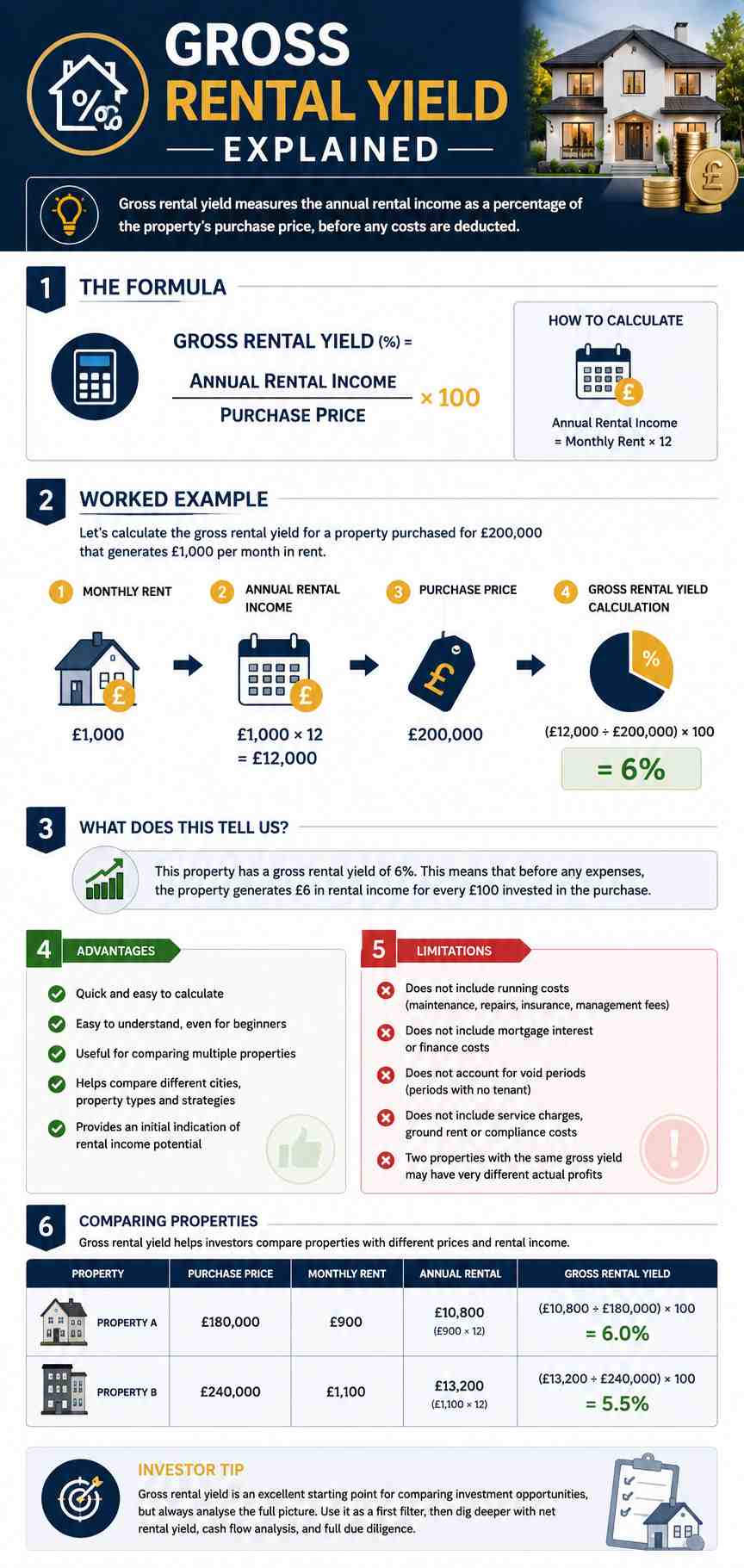
Gross rental yield explained infographic showing the rental yield formula, worked example, advantages, limitations and property comparison for UK buy-to-let investors.
Advantages of Gross Rental Yield
Gross rental yield offers several benefits for property investors:
- Quick to calculate, making it ideal for comparing multiple investment opportunities.
- Easy to understand, even for first-time investors.
- Useful for shortlisting properties before carrying out detailed financial analysis.
- Helps compare different cities, property types, and investment strategies using a consistent percentage-based measure.
- Provides an initial indication of rental income potential relative to the purchase price.
Because of its simplicity, gross rental yield is often the first calculation investors perform when assessing a property’s investment potential.
Limitations of Gross Rental Yield
Despite its usefulness, gross rental yield has several important limitations.
It does not include:
- Property maintenance and repairs
- Letting or property management fees
- Buildings and landlord insurance
- Service charges and ground rent (where applicable)
- Mortgage interest and finance costs
- Void periods between tenants
- Compliance and licensing costs
- Unexpected maintenance expenses
As a result, two properties with identical gross rental yields may generate very different levels of actual profit once their running costs are taken into account.
This is why experienced property investors rarely rely on gross rental yield alone. Instead, they use it as an initial comparison tool before calculating net rental yield, cash flow, return on investment (ROI), and conducting a full property investment analysis.
💡 Investor Tip
Gross rental yield is an excellent way to compare potential investments quickly, but it should never be the only figure influencing your decision. A property with a slightly lower gross yield may deliver stronger long-term returns if it benefits from lower running costs, higher tenant demand, better capital growth prospects, and fewer maintenance issues.
Net Rental Yield Explained
While gross rental yield provides a useful starting point, net rental yield gives a far more realistic picture of a property’s investment performance. It measures the annual rental income remaining after deducting many of the ongoing costs associated with owning and managing a rental property.
For this reason, experienced property investors generally place greater emphasis on net rental yield when assessing buy-to-let opportunities. It helps determine whether a property is likely to generate sustainable income rather than simply appearing attractive based on its headline rental figures.
What Costs Does Net Rental Yield Include?
Unlike gross rental yield, net rental yield takes into account many of the recurring expenses that reduce your actual rental income.
These may include:
- Property maintenance and routine servicing
- Buildings and landlord insurance
- Letting or property management fees
- Service charges (for leasehold properties)
- Ground rent (where applicable)
- Expected void periods between tenants
- General repairs and maintenance
- Safety certificates and compliance costs
- Other regular operating expenses
Because these costs vary from one property to another, two investments with the same gross rental yield can produce very different net rental yields.
Net Rental Yield Formula
The formula for calculating net rental yield is:
Net Rental Yield (%) = ((Annual Rental Income − Annual Running Costs) ÷ Purchase Price) × 100
This calculation provides a much clearer indication of the property’s true income-generating performance after typical ownership costs have been considered.
Worked Example
Imagine you purchase a buy-to-let property for £200,000 that generates £1,000 per month in rent.
Annual rental income
£1,000 × 12 = £12,000
Annual running costs:
- Maintenance: £700
- Landlord insurance: £300
- Property management: £900
- Service charges: £350
- Ground rent: £150
- Expected void periods: £600
- Repairs: £500
Total annual running costs = £3,500
Now calculate the net rental yield:
((£12,000 − £3,500) ÷ £200,000) × 100 = 4.25%
Although the property’s gross rental yield is 6%, its net rental yield falls to 4.25% once realistic annual costs are deducted.
This demonstrates why relying solely on gross rental yield can create an overly optimistic impression of a property’s income potential.
Why Experienced Investors Focus on Net Rental Yield
Professional property investors understand that rental income alone does not determine whether an investment is profitable. What matters is the amount of income that remains after paying the costs of owning and operating the property.
Net rental yield provides a more accurate measure because it reflects the financial realities of being a landlord. It helps investors:
- Compare properties on a more realistic basis.
- Estimate ongoing cash flow more accurately.
- Identify properties with excessive running costs.
- Make better investment decisions before committing capital.
- Avoid being misled by properties that appear attractive based only on gross rental yield.
When combined with cash flow analysis, financing costs, expected capital growth, and a clear exit strategy, net rental yield becomes a valuable part of a comprehensive property investment assessment.
💡 Investor Insight
Experienced investors rarely purchase a property based solely on its gross rental yield. Instead, they evaluate net rental yield, projected cash flow, financing costs, refurbishment requirements, tenant demand, and long-term capital growth before deciding whether an investment meets their financial objectives. This more comprehensive approach helps reduce risk and leads to better-informed investment decisions.
Gross vs Net Rental Yield
Both gross rental yield and net rental yield are valuable metrics when analysing a buy-to-let property, but they serve different purposes. Gross rental yield provides a quick estimate of a property’s income potential, while net rental yield offers a more realistic assessment by accounting for the ongoing costs of owning and managing the property.
Understanding the difference between the two helps investors make more informed decisions and avoid relying on headline figures that may overstate a property’s true financial performance.
Gross Rental Yield vs Net Rental Yield
| Factor | Gross Rental Yield | Net Rental Yield |
|---|---|---|
| Formula | (Annual Rental Income ÷ Purchase Price) × 100 | ((Annual Rental Income − Annual Running Costs) ÷ Purchase Price) × 100 |
| Includes costs? | ❌ No | ✅ Yes |
| Accuracy | Provides a quick estimate of rental performance before expenses | Provides a more realistic picture after ongoing property costs are deducted |
| Used for | Comparing properties quickly and creating an initial shortlist | Evaluating the true profitability and financial performance of an investment |
| Best use | Early-stage property screening | Final investment analysis and decision-making |
Which Rental Yield Should You Use?
Both calculations have their place within the property investment process.
Gross rental yield is ideal when comparing several properties over a short period. It allows investors to quickly identify opportunities that may warrant further investigation without spending time calculating every expense.
Net rental yield, however, becomes increasingly important as you narrow down your shortlist. By incorporating running costs such as maintenance, insurance, management fees, service charges, ground rent, expected void periods, and repairs, it provides a far more accurate indication of how the investment is likely to perform in practice.
For this reason, many experienced investors begin by comparing gross rental yields before moving on to calculate net rental yield, projected cash flow, return on investment (ROI), and long-term capital growth potential.
Which Is More Important?
If you had to choose just one figure, net rental yield generally provides the better basis for making an investment decision.
A property with a lower gross rental yield but modest running costs may outperform another property that advertises a higher gross yield but suffers from expensive maintenance, high service charges, or frequent tenant turnover.
While rental yield is an important performance metric, investors should also account for tenant turnover costs, as frequent changes in occupancy can significantly reduce annual returns.
Rather than focusing on achieving the highest possible percentage, successful property investors look for investments that deliver sustainable income, manageable costs, strong tenant demand, and long-term growth potential.
📊 Market Insight
Gross rental yield helps investors identify opportunities quickly, while net rental yield reveals how those opportunities are likely to perform in the real world. The most successful investors use both metrics together as part of a wider investment analysis that also considers cash flow, financing costs, refurbishment requirements, local market conditions, and exit strategy.
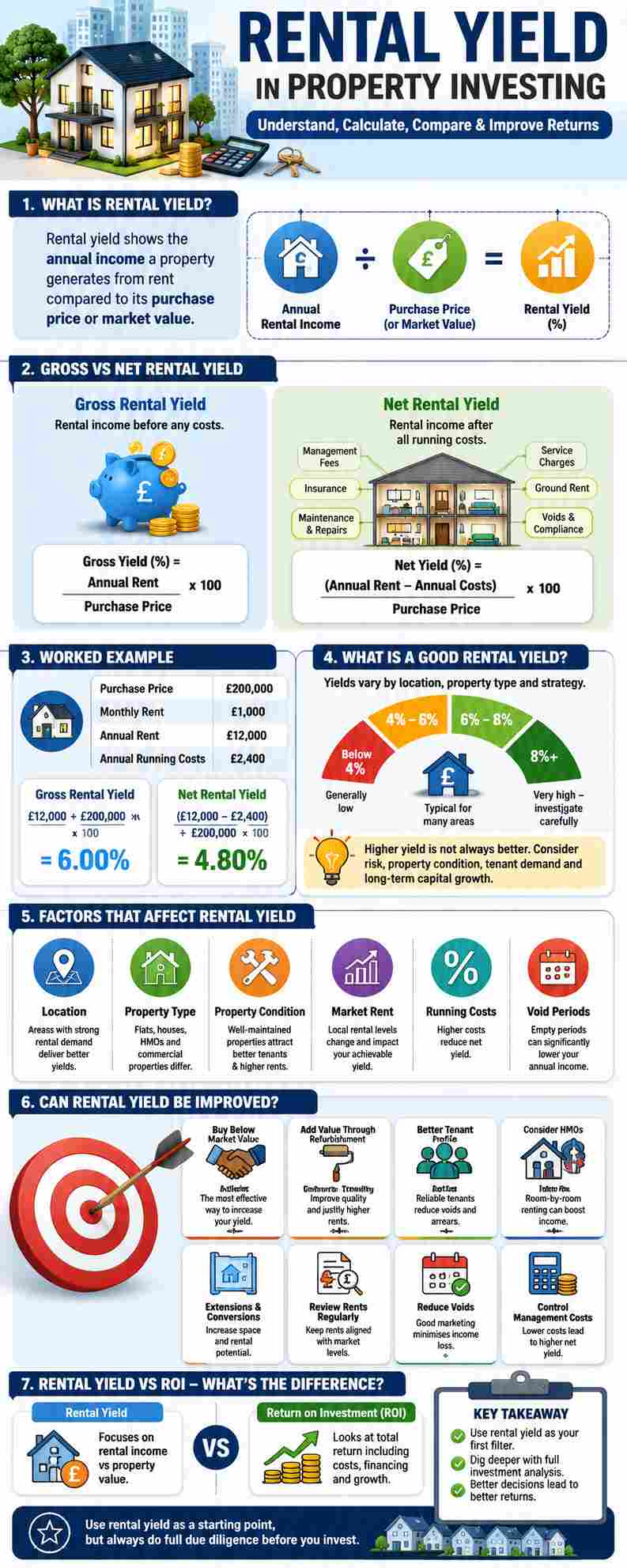
Rental yield in property investing infographic comparing gross and net rental yield, factors affecting rental returns, ways to improve rental yield, and ROI for UK buy-to-let investors.
What Is Considered a Good Rental Yield in the UK?
There is no single rental yield that is considered “ideal” for every property investment. A good rental yield depends on factors such as the property’s location, purchase price, tenant demand, ongoing costs, financing, and your overall investment strategy.
Some investors prioritise strong monthly cash flow, while others are willing to accept a lower rental yield in exchange for greater long-term capital growth. As a result, the most suitable rental yield varies depending on your financial objectives and risk tolerance.
The table below provides a general guide to how rental yields are often interpreted by UK property investors.
Typical Rental Yield Ranges
| Gross Rental Yield | General Interpretation |
|---|---|
| Below 4% | Often found in areas with higher property prices or stronger long-term capital growth potential. Suitable for investors prioritising appreciation over rental income. |
| 4% to 5% | Considered a balanced yield in many established residential markets, offering a combination of rental income and potential for capital growth. |
| 5% to 6% | Frequently regarded as a strong rental yield for many buy-to-let investments, providing healthy rental income while remaining achievable in a range of UK markets. |
| 6% to 8% | Attractive rental income that may be available in certain regional markets or specialist property types. Investors should carefully assess running costs and tenant demand. |
| Above 8% | High yields can be appealing but often come with increased risk, higher management requirements, or properties in markets with weaker long-term growth prospects. Thorough due diligence is essential. |
Why a Higher Rental Yield Isn’t Always Better
It is easy to assume that the property with the highest rental yield represents the best investment, but this is not always the case.
A high rental yield may reflect higher levels of risk rather than a superior investment opportunity. For example, properties offering exceptionally high yields may require extensive refurbishment, experience higher tenant turnover, or be located in areas where long-term demand is less predictable.
Successful investors look beyond the headline percentage and consider the overall quality and sustainability of the investment.
Tenant Demand
Strong rental demand helps reduce void periods, supports consistent rental income, and can make it easier to increase rents over time.
A property with a slightly lower rental yield but consistently occupied by reliable tenants may outperform a higher-yielding property that experiences frequent vacancies.
Capital Growth
Rental yield measures income, but it does not measure how much a property’s value may increase over time.
Some locations with relatively modest rental yields have historically experienced stronger capital growth, while areas offering very high rental yields may see slower house price appreciation.
Many investors therefore aim to balance immediate rental income with the potential for future capital growth.
Maintenance and Running Costs
Properties requiring regular repairs or higher ongoing maintenance costs may produce attractive gross rental yields while generating much lower net returns.
Older buildings, leasehold apartments with significant service charges, or properties requiring continual refurbishment can all reduce profitability despite strong headline yields.
Neighbourhood Quality
The surrounding area plays a significant role in a property’s long-term performance.
Factors such as local employment, transport links, schools, regeneration projects, and access to amenities can all influence tenant demand, rental growth, and future resale value.
Investors should always assess the wider neighbourhood rather than relying solely on rental yield calculations.
Void Risk
Every period that a property sits empty reduces annual rental income.
Even a property with a strong advertised rental yield can underperform if it experiences frequent void periods or high tenant turnover. Estimating realistic vacancy rates should therefore form part of every investment appraisal.
London vs Northern England
Different regions of the UK often present different investment characteristics.
Properties in London have traditionally commanded higher purchase prices, which can result in lower gross rental yields but may offer stronger long-term capital appreciation in some areas.
By contrast, many locations across Northern England have historically offered lower purchase prices and comparatively stronger rental yields, making them attractive to investors seeking higher income returns. However, rental yield alone should never be used to compare regions, as local economies, tenant demand, property condition, financing costs, and future growth prospects all play an important role in determining investment performance.
📊 Market Insight
Rather than chasing the highest possible rental yield, experienced investors focus on finding properties that combine sustainable rental income, manageable running costs, strong tenant demand, realistic capital growth potential, and low vacancy risk. A balanced investment often delivers better long-term results than simply choosing the property with the highest headline yield.
Rental Yield vs Capital Growth
When evaluating a property investment, one of the biggest decisions investors face is whether to prioritise rental yield or capital growth. While both contribute to overall investment returns, they measure very different aspects of a property’s performance.
Rental yield focuses on the income a property generates through rent, whereas capital growth measures the increase in the property’s market value over time. Understanding the difference is essential when choosing an investment strategy that aligns with your financial goals.
What Is Rental Yield?
Rental yield measures the annual rental income a property produces as a percentage of its purchase price. Investors who prioritise rental yield typically focus on generating reliable monthly cash flow that can help cover mortgage payments, operating costs, and provide regular income.
High-yield investments are often favoured by investors seeking immediate returns or those looking to build a portfolio that produces consistent cash flow.
What Is Capital Growth?
Capital growth refers to the increase in a property’s value over time.
For example, if a property is purchased for £180,000 and later sold for £230,000, the capital growth is £50,000 before selling costs and taxes.
Investors focused on capital appreciation are generally willing to accept lower rental yields if they believe the property’s value is likely to increase significantly over the long term.
Example: High Rental Yield
Imagine an investor purchases a property in an area where:
- Purchase price is relatively affordable.
- Rental demand is strong.
- Monthly rental income is high compared with the purchase price.
The property produces a 7% gross rental yield, generating healthy monthly cash flow.
However, local house prices have remained relatively stable over recent years, meaning the property may experience slower long-term capital growth.
This type of investment may suit landlords whose primary objective is generating regular income.
Example: Higher Capital Growth
Now consider a property in a more expensive location.
- Purchase price is significantly higher.
- Rental income is proportionally lower.
- Gross rental yield is around 4%.
Although the monthly rental return is lower, the area benefits from strong employment, transport improvements, regeneration projects, and continued buyer demand, creating greater potential for long-term capital appreciation.
This strategy may appeal to investors who are prepared to accept lower rental income today in exchange for greater wealth creation over the coming years.
High Yield vs Higher Capital Growth
| High Rental Yield Strategy | Higher Capital Growth Strategy |
|---|---|
| Higher monthly rental income | Lower monthly rental income |
| Stronger cash flow | Greater potential for property value appreciation |
| Often lower purchase prices | Often higher purchase prices |
| May suit income-focused investors | May suit long-term wealth builders |
| Capital growth may be more modest | Rental yield may be lower |
Which Strategy Is Better?
Neither strategy is inherently better than the other. The right approach depends on your investment objectives, financial circumstances, and risk appetite.
For example:
- An investor seeking additional monthly income may prioritise higher rental yields.
- Someone building long-term wealth may focus more on capital appreciation.
- Portfolio investors often combine both approaches by owning properties that deliver reliable cash flow alongside assets with stronger growth potential.
Many Experienced Investors Seek a Balance
Rather than focusing exclusively on either rental yield or capital growth, many experienced investors aim to achieve a balance between the two.
A property that offers a respectable rental yield, stable tenant demand, manageable running costs, and good long-term growth prospects can often provide more sustainable returns than one that excels in only a single area.
This balanced approach can help investors generate regular income while also benefiting from increases in property value over time, creating stronger overall returns and reducing reliance on any one aspect of investment performance.
💡 Investor Insight
The most successful property investments rarely have the highest rental yield or the fastest capital growth. Instead, they combine dependable rental income with quality locations, strong tenant demand, realistic running costs, and long-term appreciation potential. Evaluating both income and growth together provides a more complete picture of an investment’s true potential.
Factors That Affect Rental Yield
Rental yield is influenced by much more than the monthly rent a property generates. While the rental yield formula itself is straightforward, the factors that determine whether a property achieves a high or low yield are often interconnected. Understanding these factors can help investors identify opportunities to improve returns while avoiding investments that may appear attractive on paper but perform poorly in reality.
Below are some of the key factors that can significantly affect a property’s rental yield.
Purchase Price
The price you pay for a property has a direct impact on its rental yield.
For example, if two identical properties each generate £12,000 in annual rent, the investor who purchases at £180,000 will achieve a higher rental yield than someone who pays £220,000.
Buying below market value, negotiating effectively, or purchasing properties with value-add opportunities can therefore improve rental yield without increasing rental income.
Rental Demand
Strong tenant demand is one of the most important drivers of sustainable rental yield.
Areas with consistent demand from professionals, families, or students are generally more likely to experience:
- Shorter vacancy periods
- Stable rental income
- Greater ability to increase rents over time
By contrast, weaker rental demand can result in longer void periods, reduced rental income, and lower overall investment returns.
Interest Rates
Although mortgage interest is not included when calculating gross or net rental yield, interest rates still have a major influence on an investment’s profitability.
Higher borrowing costs reduce monthly cash flow and may affect the type of property investors are willing to purchase. Many landlords therefore assess rental yield alongside mortgage affordability and projected cash flow before committing to an investment.
Local Employment
Areas with strong employment opportunities often support healthier rental markets.
Growing business sectors, new employers, and expanding local economies typically attract more tenants, increasing demand for rental accommodation and supporting both rental income and occupancy levels.
Conversely, areas experiencing declining employment may see reduced tenant demand and greater vacancy risk.
Universities
University towns and cities often benefit from consistent demand from students, academic staff, and university-related employment.
Properties located near established universities may achieve attractive rental yields due to regular tenant turnover and predictable annual demand. However, student accommodation can also involve higher management requirements and increased maintenance costs, which should be factored into any investment analysis.
Transport Links
Good transport connections can significantly improve a property’s appeal to tenants.
Properties close to railway stations, major roads, public transport, and employment hubs often experience stronger demand because they offer convenient access to work, education, and local amenities.
Improved transport infrastructure can also contribute to future capital growth in some locations.
Regeneration
Regeneration projects can influence both rental demand and property values.
Investment in town centres, transport infrastructure, commercial developments, public spaces, and housing improvements may attract new residents and businesses, increasing demand for rental properties over time.
While regeneration can create opportunities, investors should assess projects carefully rather than relying solely on future development plans.
Property Condition
The condition of a property has a direct impact on both rental income and ongoing costs.
A well-presented, modern property may attract higher-quality tenants, command stronger rental income, and experience fewer maintenance issues. In contrast, properties requiring frequent repairs or substantial refurbishment may produce lower net rental yields despite attractive purchase prices.
Regular maintenance also helps preserve tenant satisfaction and reduce unexpected expenditure.
Property Management
Effective property management plays an important role in protecting rental yield.
Professional management can help:
- Reduce tenant turnover
- Minimise rent arrears
- Respond quickly to maintenance issues
- Maintain occupancy levels
- Protect the property’s long-term condition
Although management fees increase operating costs, good management often improves overall investment performance by reducing costly vacancies and improving tenant retention.
Landlords should also ensure they understand their legal responsibilities before letting a property. The GOV.UK guidance for landlords explains many of the key obligations involved in renting out residential property in England.
Void Periods
Every day a property remains vacant reduces annual rental income.
Even a property with an excellent advertised rental yield can underperform if it experiences frequent void periods between tenancies. Investors should therefore estimate realistic vacancy allowances when calculating net rental yield and forecasting cash flow.
Choosing properties in locations with consistent rental demand can help reduce vacancy risk and support more reliable long-term returns.
📊 Investor Insight
Rental yield is not determined by rental income alone. Successful investors understand that purchase price, tenant demand, location, property condition, management quality, and running costs all work together to influence a property’s overall performance. Improving even one of these factors can often have a meaningful impact on long-term investment returns.
Common Mistakes When Calculating Rental Yield
Calculating rental yield is relatively straightforward, but many investors make assumptions that result in figures which overstate a property’s true investment performance. While these mistakes may seem small, they can significantly affect cash flow projections, profitability, and ultimately the success of an investment.
By understanding the most common errors, investors can produce more accurate rental yield calculations and make better-informed purchasing decisions.
Ignoring Maintenance Costs
Every rental property requires ongoing maintenance, whether it involves routine servicing, decorating between tenancies, replacing appliances, or dealing with unexpected repairs.
Investors who exclude these costs from their calculations may significantly overestimate the property’s profitability.
Even newer properties should include an allowance for future maintenance when calculating net rental yield.
Ignoring Void Periods
Rental income is rarely received every day of the year.
Properties may remain vacant between tenancies, require refurbishment before being re-let, or experience delays while new tenants are found.
Failing to allow for expected void periods can make rental income projections unrealistically optimistic and result in disappointing actual returns.
Many experienced investors include an annual vacancy allowance when calculating net rental yield.
Using Unrealistic Rental Figures
Some investors base their calculations on the highest advertised rent rather than the rent the property is realistically likely to achieve.
Rental income should always be based on comparable properties, local market evidence, and current demand rather than optimistic assumptions.
Using inflated rental figures may make a poor investment appear attractive on paper while delivering much lower returns in reality.
Ignoring Service Charges
Leasehold properties often include annual service charges that can have a significant impact on profitability.
These costs should always be included when calculating net rental yield.
A property with an attractive gross rental yield may produce much lower net returns if service charges are particularly high.
Ignoring Refurbishment Costs
Properties requiring refurbishment are often purchased below market value, but improvement costs should never be overlooked.
Although refurbishment costs are not included within the standard rental yield formula, they directly affect the amount of capital invested and therefore influence the investment’s overall return.
Many professional investors assess refurbishment costs alongside rental yield, return on investment (ROI), and projected cash flow before proceeding with a purchase.
Only Looking at Gross Rental Yield
Gross rental yield is useful for comparing properties quickly, but it does not reflect the true financial performance of an investment.
Two properties with identical gross rental yields may produce very different profits once maintenance, insurance, management fees, repairs, and other running costs are taken into account.
For this reason, experienced investors typically use gross rental yield only as an initial screening tool before calculating net rental yield and conducting a more detailed financial analysis.
Ignoring Financing Costs
While mortgage payments are not included when calculating gross or net rental yield, financing costs remain one of the largest expenses for many landlords.
A property with an attractive rental yield may still generate weak cash flow if borrowing costs are high.
Before purchasing any investment property, investors should assess rental yield alongside:
- Mortgage repayments
- Interest rates
- Cash flow
- Return on investment (ROI)
- Capital growth potential
This broader analysis provides a much clearer understanding of whether the property is likely to meet their investment objectives.
How to Avoid These Mistakes
The most successful property investors recognise that rental yield is only one part of the decision-making process.
Before purchasing any investment property, it is good practice to:
- Base rental income on realistic local market evidence.
- Include all predictable running costs.
- Allow for maintenance, repairs, and expected void periods.
- Consider refurbishment costs where applicable.
- Calculate both gross and net rental yield.
- Assess mortgage affordability and projected cash flow.
- Review the property’s long-term capital growth potential alongside its rental income.
By following this structured approach, investors can avoid overly optimistic projections and make more informed, financially sustainable investment decisions.
💡 Investor Insight
Most poor investment decisions are not caused by incorrect rental yield formulas, but by unrealistic assumptions. Accurate rental income, realistic expenses, and comprehensive due diligence provide a far more reliable basis for evaluating a property’s true investment potential than headline rental yield alone.
Rental Yield vs Cash Flow
Although rental yield and cash flow are closely related, they measure different aspects of a property’s financial performance. Many first-time investors assume that a property with a high rental yield will automatically generate strong cash flow, but this is not always the case.
A property can produce an attractive rental yield while delivering poor monthly cash flow if operating expenses or mortgage repayments are high. Likewise, a property with a relatively modest rental yield may generate healthy positive cash flow if it has low running costs and favourable financing.
Understanding the difference between these two metrics is essential when assessing whether a buy-to-let property is likely to meet your investment objectives.
What Is Rental Yield?
Rental yield measures the annual rental income generated by a property as a percentage of its purchase price.
It answers the question:
“How much rental income does this property generate relative to what I paid for it?”
Rental yield is primarily used to compare different investment opportunities and assess their income-generating potential.
It does not take into account:
- Mortgage repayments
- Financing costs
- Tax liabilities
- The timing of monthly income and expenses
What Is Cash Flow?
Cash flow measures the actual amount of money left over after all property income and expenses have been paid.
It answers the question:
“How much money am I actually keeping each month?”
Cash flow typically includes:
- Rental income
- Mortgage repayments
- Property management fees
- Insurance
- Maintenance and repairs
- Service charges
- Ground rent
- Compliance costs
- Other operating expenses
Positive cash flow means the property generates more income than it costs to operate.
Negative cash flow means expenses exceed rental income, requiring the investor to contribute additional funds each month.
Example
Imagine two investors each purchase a property with a 6% gross rental yield.
Property A
- Gross rental yield: 6%
- Mortgage: Low fixed-rate loan
- Annual running costs: Low
- Monthly cash flow: £350 positive
Property B
- Gross rental yield: 6%
- Mortgage: Higher interest rate
- Annual running costs: Higher due to service charges and maintenance
- Monthly cash flow: £40 positive
Although both properties have identical rental yields, Property A generates significantly stronger monthly cash flow because its ongoing expenses are lower.
This example highlights why rental yield alone should never be used to assess an investment’s financial performance.
Rental Yield vs Cash Flow
| Rental Yield | Cash Flow |
|---|---|
| Measures rental income as a percentage of the purchase price | Measures the actual money remaining after income and expenses |
| Primarily used to compare investment opportunities | Used to assess monthly profitability |
| Expressed as a percentage (%) | Expressed as a monetary value (£ per month or £ per year) |
| Does not include mortgage repayments | Includes financing costs where applicable |
| Useful during the initial screening stage | Essential when deciding whether a property is financially sustainable |
Which Metric Is More Important?
Neither metric should be used on its own.
Rental yield provides a useful way to compare properties quickly, while cash flow determines whether an investment can comfortably support its ongoing costs and generate regular income.
Professional property investors typically calculate both before purchasing a property. They also assess net rental yield, return on investment (ROI), capital growth potential, and local market conditions to gain a complete understanding of the investment.
💡 Investor Insight
A property with an impressive rental yield may still produce weak cash flow if mortgage repayments, maintenance costs, or service charges are high. The most successful investors evaluate rental yield and cash flow together to ensure a property not only looks attractive on paper but also performs well in practice.
Rental Yield vs Return on Investment (ROI)
Rental yield and Return on Investment (ROI) are two of the most important metrics used by property investors, yet they are often confused. While both help measure investment performance, they answer different questions and should be used together when analysing a buy-to-let opportunity.
Rental yield focuses on the income a property generates relative to its purchase price. ROI, on the other hand, measures the overall return generated from the money you have invested, taking into account costs, financing, and sometimes capital growth.
Understanding the difference allows investors to make more informed decisions and avoid relying on a single financial metric.
What Is Rental Yield?
Rental yield measures how much rental income a property generates each year compared with its purchase price.
It is primarily used to:
- Compare buy-to-let properties.
- Assess rental income potential.
- Shortlist investment opportunities.
- Estimate how efficiently a property generates rental income.
Rental yield is expressed as a percentage (%) and is commonly calculated using either the gross or net rental yield formula.
What Is Return on Investment (ROI)?
Return on Investment (ROI) measures the total return generated from the money you have invested in a property.
Unlike rental yield, ROI can include:
- Rental profit
- Purchase costs
- Refurbishment costs
- Mortgage structure
- Financing costs
- Capital invested
- Capital appreciation (depending on the calculation method)
ROI provides a broader assessment of investment performance because it measures how effectively your invested capital is working.
What Is Cash-on-Cash Return?
Cash-on-cash return is another performance metric commonly used by experienced property investors, particularly when using mortgages or bridging finance.
Rather than comparing rental income with the property’s purchase price, it measures the annual pre-tax cash flow against the actual cash you have invested.
This makes cash-on-cash return particularly useful for leveraged investments, including buy-to-let, BRRR, and property refurbishment projects.
Rental Yield vs ROI vs Cash-on-Cash Return
Rental Yield vs Profit
Another common misconception is that rental yield and profit are the same thing.
They are not.
A property may advertise a 7% rental yield, but once mortgage payments, maintenance, insurance, management fees, repairs, taxes, and other expenses are deducted, the actual profit may be much lower.
Profit measures the amount of money remaining after all relevant costs have been paid.
Rental yield simply provides an indication of rental performance relative to the property’s value.
Rental Yield vs Equity Growth
Over time, many property investors build wealth through equity growth rather than rental income alone.
Equity growth occurs when:
- Property values increase.
- Mortgage balances reduce through repayments.
- Value is added through refurbishment or extensions.
A property with a modest rental yield may still become an excellent investment if it experiences substantial equity growth over several years.
For this reason, experienced investors rarely evaluate rental yield in isolation. Instead, they consider how rental income, cash flow, ROI, profit, and equity growth work together to create long-term wealth.
Which Metric Should Investors Focus On?
Each metric provides valuable information, but none should be used on its own.
A professional property analysis typically includes:
- Gross rental yield
- Net rental yield
- Cash flow
- Return on Investment (ROI)
- Cash-on-cash return
- Projected profit
- Equity growth potential
- Capital appreciation
- Exit strategy
Looking at these metrics together provides a far more accurate picture of a property’s investment potential than relying on rental yield alone.
💡 Investor Insight
Rental yield tells you how effectively a property generates rental income, while ROI measures how effectively your money is working. Investors who evaluate rental yield alongside ROI, cash flow, and long-term equity growth are generally better equipped to identify investments that deliver both sustainable income and long-term wealth creation.
How Rental Yield Fits Into Professional Deal Analysis
Rental yield is an important metric, but it is only one piece of the investment puzzle. Professional property investors rarely make purchasing decisions based solely on a property’s rental yield because doing so can overlook risks that may significantly affect long-term profitability.
Instead, experienced investors use rental yield as an initial screening tool before carrying out a comprehensive deal analysis. This broader approach helps identify whether a property offers sustainable income, manageable risks, and realistic opportunities for future growth.
Purchase Price
The price paid for a property has a direct impact on both rental yield and future returns.
Professional investors do not simply ask whether a property offers a good rental yield. They also consider whether it has been purchased at fair market value, below market value, or whether there is potential to add value through refurbishment or negotiation.
Buying well is often just as important as managing the property effectively.
Refurbishment Costs
Many investment properties require improvements before they can achieve their full rental potential.
Professional investors estimate refurbishment costs in detail before making an offer, considering:
- Essential repairs
- Cosmetic improvements
- Compliance upgrades
- Contingency allowances
- Expected increase in rental income
A property with a slightly lower rental yield but minimal refurbishment requirements may prove to be a better investment than one requiring significant capital expenditure.
Financing
The way a property is financed can have a major influence on profitability.
Experienced investors assess:
- Mortgage interest rates
- Deposit requirements
- Arrangement fees
- Bridging finance costs (where applicable)
- Refinancing opportunities
Even a property with an attractive rental yield can generate poor returns if financing costs are too high.
Cash Flow
Rental yield measures income potential, but cash flow determines how much money remains after all expenses have been paid.
Professional investors carefully forecast monthly cash flow by considering:
- Mortgage repayments
- Management fees
- Insurance
- Maintenance
- Service charges
- Expected void periods
- Compliance costs
Positive cash flow is often just as important as achieving a strong rental yield.
Exit Strategy
Every property investment should have a clearly defined exit strategy before purchase.
Depending on the investment objectives, this could include:
- Long-term buy-to-let
- Selling after refurbishment (property flip)
- BRRR (Buy, Refurbish, Refinance, Rent)
- Portfolio refinancing
- Development exit
Understanding the intended exit strategy helps investors determine whether the property’s rental yield aligns with their broader financial goals.
Capital Growth
Rental income represents only one component of investment returns.
Professional investors also assess the potential for long-term capital appreciation by considering:
- Local market trends
- Infrastructure investment
- Regeneration projects
- Housing supply
- Economic growth
A property with a slightly lower rental yield may ultimately generate stronger overall returns if it benefits from significant capital growth over time.
Tenant Demand
Consistent tenant demand helps protect rental income and reduce vacancy periods.
Before purchasing a property, experienced investors assess factors such as:
- Local population growth
- Employment opportunities
- Schools and universities
- Transport links
- Nearby amenities
- Typical tenant demographics
Properties located in areas with stable demand often provide more reliable long-term investment performance.
Comparable Sales
Professional investors rarely rely solely on the asking price.
They compare the property with recent local sales to determine:
- Whether the purchase price represents fair value.
- Whether there is scope for negotiation.
- The property’s likely market value after refurbishment.
- Future resale potential.
Comparable sales evidence helps ensure that investment decisions are based on market data rather than marketing material.
Rental Yield Is Part of a Bigger Picture
Successful property investing is rarely about finding the highest rental yield. It is about understanding how rental income fits within the overall financial performance of an investment.
Experienced investors typically assess:
- Purchase price
- Rental yield
- Refurbishment costs
- Financing
- Cash flow
- Capital growth potential
- Tenant demand
- Comparable sales
- Exit strategy
Evaluating these factors together provides a much more complete picture of an investment’s potential and helps reduce the risk of costly mistakes.
📈 Professional Tip
A property with a lower rental yield can often outperform a higher-yielding investment if it benefits from lower running costs, stronger tenant demand, better financing, and greater long-term capital growth. Professional investors evaluate the complete investment rather than relying on a single metric.
Learn How Professional Investors Analyse Property Deals
If you’d like to understand the full due diligence process used by experienced property investors, read our guide on How to Analyse Property Deals in the UK.
The guide explains how to assess purchase price, refurbishment costs, financing, rental demand, cash flow, comparable sales, exit strategies, and investment returns using a structured framework before committing to a purchase.
Can Rental Yield Be Improved?
One of the advantages of property investing is that rental yield is not always fixed. Unlike many other investments, landlords can often take practical steps to increase rental income, reduce costs, or add value to a property, all of which can improve overall rental yield.
While not every strategy will be suitable for every property, experienced investors regularly look for opportunities to enhance returns without taking on unnecessary risk.
Invest in Better Refurbishment
A well-planned refurbishment can increase both the rental appeal and market value of a property.
Modern kitchens, updated bathrooms, fresh decoration, energy-efficient improvements, and improved kerb appeal can often justify higher rental income while attracting better-quality tenants.
The key is to focus on improvements that deliver a reasonable return rather than overcapitalising on unnecessary upgrades.
Attract a Better Tenant Profile
Reliable, long-term tenants can significantly improve investment performance.
Properties that attract professional tenants or long-term family occupiers often benefit from:
- Lower tenant turnover
- Fewer void periods
- Reduced maintenance issues
- More consistent rental income
Although the rent achieved may not always be the highest available, a stable tenancy can improve long-term profitability.
Rental yield is influenced not only by rental income but also by average UK tenancy lengths, as longer tenancies often help reduce vacancy periods and improve overall returns.
Consider an HMO Strategy
Where planning rules, licensing requirements, and local demand allow, converting a property into a House in Multiple Occupation (HMO) can increase rental income.
By renting individual rooms rather than the entire property, landlords may achieve a higher overall rental income and potentially improve rental yield.
However, HMOs typically involve:
- Higher management responsibilities
- Additional licensing requirements
- Greater compliance obligations
- Increased maintenance costs
Investors should carefully assess whether the additional income outweighs the increased complexity and operating expenses.
Add Additional Living Space
Increasing a property’s usable living space can often support higher rental income.
Depending on the property and local planning regulations, improvements may include:
- Loft conversions
- Rear or side extensions
- Garage conversions
- Creating an additional bedroom
- Improving the property’s layout
Any extension or conversion should be evaluated carefully to ensure the increase in rental income justifies the cost of the work.
Carry Out Regular Rent Reviews
Rental markets change over time.
Landlords who regularly review local market rents can ensure their property remains competitively priced without falling below prevailing market levels.
Where tenancy agreements and legislation allow, periodic rent reviews may help improve rental yield while keeping rents aligned with local demand.
Reduce Void Periods
Every week that a property remains vacant reduces annual rental income.
Landlords can help minimise void periods by:
- Responding quickly to maintenance issues
- Marketing the property before tenants move out
- Maintaining the property to a high standard
- Offering competitive rental terms
- Providing good tenant communication
Keeping occupancy levels high often has a greater impact on rental yield than attempting to achieve slightly higher monthly rent.
Reduce Management Costs
Property management fees form part of the ongoing operating costs that reduce net rental yield.
While professional management often provides excellent value, landlords should periodically review whether:
- Management fees remain competitive.
- Services offered meet expectations.
- Better value can be obtained elsewhere.
Reducing unnecessary operating costs can improve net rental yield without affecting rental income.
Buy Below Market Value
One of the most effective ways to improve rental yield is to purchase a property below its market value.
Because rental yield is calculated using the purchase price, negotiating a lower acquisition cost can increase rental yield immediately, even if the rental income remains unchanged.
Many experienced investors actively search for:
- Motivated sellers
- Auction properties
- Off-market opportunities
- Probate properties
- Properties requiring refurbishment
- Portfolio disposals
Buying well creates a stronger foundation for both rental income and future capital growth.
Focus on Sustainable Improvements
Improving rental yield should never come at the expense of tenant satisfaction or long-term investment performance.
The most successful landlords focus on strategies that increase rental income while maintaining high occupancy, controlling costs, and preserving the property’s long-term value. Sustainable improvements often produce better long-term returns than simply chasing the highest possible rental yield.
💡 Investor Insight
Improving rental yield is often about making a series of small, informed decisions rather than relying on one major change. Buying below market value, maintaining the property well, attracting reliable tenants, reducing unnecessary costs, and reviewing rental income regularly can collectively have a significant impact on long-term investment performance.
Using Our Rental Yield Calculator
Calculating rental yield manually is straightforward, but comparing multiple investment opportunities can quickly become time-consuming. Our Rental Yield Calculator has been designed to help UK property investors calculate both gross and net rental yield in seconds, allowing you to assess potential buy-to-let investments more efficiently.
Whether you’re analysing a property from an estate agent, an auction catalogue, or an off-market opportunity, the calculator provides a quick way to estimate rental performance before carrying out more detailed due diligence.
Simply Enter Your Property Details
Using the calculator is easy. Just enter the key information about the property, including:
- Purchase price
- Expected monthly rental income
- Annual running costs (for net rental yield)
The calculator automatically performs the calculations for you, helping to reduce errors and save valuable time.
Get Instant Rental Yield Results
Within seconds, you’ll receive an instant estimate of your property’s rental yield, making it easier to compare different investment opportunities.
You can use the results to:
- Compare multiple buy-to-let properties.
- Assess whether a property’s rental income justifies its purchase price.
- Estimate both gross and net rental yield.
- Support your wider property investment analysis.
Remember, the calculator provides a useful starting point, but every investment should also be assessed for financing, cash flow, refurbishment costs, tenant demand, and long-term capital growth.
Take Your Analysis Further
Rental yield is only one part of a successful investment strategy. Once you’ve calculated the yield, consider using our other property investment resources to analyse cash flow, return on investment (ROI), refurbishment costs, and overall deal profitability.
The more information you evaluate before making an offer, the more confident your investment decisions are likely to be.
Calculate Your Rental Yield Today
Ready to analyse your next investment?
Use our free Rental Yield Calculator to calculate gross and net rental yield instantly and compare buy-to-let opportunities with confidence.
Calculate Your Rental Yield Now
Related Resources
If you’re looking to develop a deeper understanding of UK property investing, the following guides and tools complement this Rental Yield Guide and can help you analyse opportunities with greater confidence.
Property Investment Resources
Explore our growing collection of calculators, investment guides, due diligence checklists, market research, and practical tools designed to help UK property investors make better-informed decisions. Whether you’re new to property investing or building an established portfolio, these resources provide valuable support throughout your investment journey.
Buy-to-Let Mortgage Guide
Choosing the right finance is just as important as selecting the right property. Our Buy-to-Let Mortgage Guide explains how buy-to-let mortgages work, lender requirements, deposit expectations, affordability assessments, and the factors that can influence your borrowing options.
Best UK Areas for Property Investment
Location remains one of the biggest drivers of property investment performance. Discover some of the UK’s most promising investment locations, together with the factors investors should consider when assessing rental demand, affordability, regeneration, and long-term capital growth.
Deal Stack-Up Calculator
Go beyond rental yield by using our Deal Stack-Up Calculator to analyse the overall profitability of a property investment. Estimate refurbishment costs, financing, return on investment (ROI), cash flow, and projected profits before making an offer.
Property Auction Investment Guide
Thinking about buying property at auction? Our comprehensive guide explains how property auctions work, the opportunities they present, the risks to consider, and the due diligence required before bidding on an auction property.
How to Analyse Property Deals in the UK
Rental yield is only one part of a successful investment appraisal. Learn the structured framework professional investors use to assess purchase price, refurbishment costs, financing, cash flow, comparable sales, exit strategies, and overall investment potential before committing to a property purchase.
How to Make Money in Property UK
Explore practical strategies investors use to generate income in property through buy-to-let investments, property flips, BRRR projects, HMOs, serviced accommodation, commercial property, and other UK property investment approaches. Whether you’re looking to build long-term wealth or create additional income streams, this guide explains the most common property investment strategies used across the UK.
Frequently Asked Questions
What is rental yield?
Rental yield is the annual rental income generated by a property expressed as a percentage of its purchase price or market value. It is one of the most widely used metrics by property investors to compare the income potential of different buy-to-let investments.
How do you calculate rental yield?
Gross rental yield is calculated using the following formula:
Gross Rental Yield (%) = (Annual Rental Income ÷ Purchase Price) × 100
For net rental yield, subtract annual running costs from the annual rental income before dividing by the purchase price.
What is gross rental yield?
Gross rental yield measures the annual rental income generated by a property before deducting any expenses such as maintenance, insurance, management fees, or repairs. It provides a quick way to compare investment opportunities but should not be used as the only measure of profitability.
What is net rental yield?
Net rental yield measures the annual rental income remaining after deducting ongoing property expenses, including maintenance, insurance, management fees, service charges, ground rent, repairs, and expected void periods. It provides a more realistic assessment of a property’s financial performance than gross rental yield.
What is considered a good rental yield?
There is no universal benchmark, but many UK property investors consider a gross rental yield of around 5% to 6% to represent a strong balance between rental income and investment quality. However, what is considered a good rental yield depends on factors such as location, tenant demand, running costs, financing, and long-term capital growth potential.
Is a higher rental yield always better?
No. A higher rental yield does not necessarily mean a better investment. Properties with exceptionally high yields may also involve higher maintenance costs, greater vacancy risk, weaker capital growth prospects, or increased management responsibilities. Investors should always consider rental yield alongside cash flow, financing, property condition, and local market demand.
Does rental yield include mortgage costs?
No. Standard gross and net rental yield calculations do not include mortgage repayments or interest costs. Financing should be assessed separately through cash flow analysis, return on investment (ROI), and affordability calculations to understand a property’s overall financial performance.
How can landlords improve rental yield?
Landlords may improve rental yield by:
- Purchasing below market value
- Carrying out value-adding refurbishments
- Reviewing rental income regularly
- Reducing void periods
- Lowering unnecessary management costs
- Improving property condition
- Attracting reliable long-term tenants
- Considering alternative strategies such as HMOs where appropriate
Each approach should be assessed carefully to ensure it improves overall profitability rather than simply increasing rental income.
Should rental yield be the only factor when buying property?
No. Rental yield is only one part of a comprehensive property investment analysis. Professional investors also evaluate purchase price, refurbishment costs, financing, cash flow, comparable sales, tenant demand, capital growth potential, local market conditions, and exit strategy before making an investment decision.
What is the difference between rental yield and ROI?
Rental yield measures the rental income generated by a property relative to its purchase price. Return on Investment (ROI) measures the overall return achieved from the money invested, taking into account factors such as purchase costs, refurbishment expenses, financing, and, in some cases, capital growth.
While rental yield is useful for comparing income potential, ROI provides a broader assessment of an investment’s overall financial performance. Investors often calculate both metrics to gain a more complete understanding of a property’s profitability.
Final Thoughts
Rental yield is one of the most valuable metrics for assessing the income potential of a buy-to-let property. It provides investors with a quick and consistent way to compare different investment opportunities, helping to identify properties that may warrant further analysis.
However, rental yield should never be viewed in isolation. While gross rental yield offers a useful first comparison, net rental yield provides a more accurate reflection of a property’s financial performance by accounting for ongoing ownership and management costs. Looking beyond the headline percentage can help investors avoid costly mistakes and make more informed decisions.
The strongest property investments combine healthy rental income with thorough due diligence, sustainable cash flow, realistic refurbishment costs, strong tenant demand, sensible financing, and clear long-term growth potential. Evaluating these factors together provides a much more complete understanding of an investment than rental yield alone.
Before committing to any property purchase, take the time to assess rental yield alongside financing options, refurbishment requirements, local market conditions, comparable sales, capital growth prospects, and your planned exit strategy. A structured investment analysis can help reduce risk and improve the likelihood of achieving your financial goals.
Ready to Analyse Your Next Investment?
Whether you’re comparing buy-to-let opportunities, analysing auction properties, or building a long-term property portfolio, having the right tools can make all the difference.
Explore our Property Investment Resources to access rental yield calculators, deal analysis tools, buy-to-let guides, due diligence resources, and practical investment tools designed to help you make more informed property investment decisions.

Koye Beckley is a UK property investor and founder of UncommonDeal, with practical experience in buy-to-let, property auctions, refurbishment projects and investment deal analysis. Through UncommonDeal, he publishes property market research, property deal sourcing and compliance guidance, investment guides and data-driven analysis to help investors evaluate buy-to-let, BRRR, flip and auction opportunities.