Sell or Hold Your Rental Property in 2026? UK Landlord Guide
For many UK landlords, 2026 does not feel like a year for expansion. It feels like a year for decision-making.
Interest rates remain well above the ultra-cheap borrowing era. Tax rules continue to reduce the efficiency of leveraged rental income. Regulatory changes have added cost, friction, and uncertainty. In many areas, property prices have not risen enough to offset these pressures.
As a result, more landlords are asking one or two practical question like:
- Should I sell my rental property — or hold and ride this out?
- Does holding my rental property still make financial sense, or would selling improve my overall position?
On the surface, it sounds like a simple decision. In reality, it rarely is.
The problem isn’t property itself. The problem is decision clarity. Many landlords are holding assets that are fine — but no longer efficient. Others are selling assets that still quietly outperform once capital, risk, and alternatives are properly considered.
This article sets out a numbers-first framework to help UK landlords decide whether to sell or hold a rental property in 2026, based on cashflow resilience, capital efficiency, tax impact, and risk — not emotion or headlines.
Quick Answer: Should You Sell or Hold in 2026?
There is no universal answer to whether you should sell or hold a rental property in 2026. The decision depends on whether the property still delivers resilient cashflow, efficient use of capital, and acceptable risk under current tax and interest-rate conditions.
Below is the quick answers to the question – Should I sell or Hold my property in 2026:
- Selling may make sense if capital is tied up in low-return, high-risk assets
- Holding can still work where cashflow is resilient after tax and rates
- The decision depends on capital efficiency, not property value alone
- A numbers-first analysis removes guesswork from the choice
Table 1: Hold vs Sell — What Actually Changes
| Factor | Holding | Selling |
|---|---|---|
| Cashflow | Ongoing but taxed | Stops |
| Capital tied up | Remains | Released |
| Risk exposure | Continues | Reduced |
| Flexibility | Limited | Increased |
Before deciding whether to sell or hold a rental property, it helps to understand what the property is actually producing after its ongoing costs. A UK landlord income and expense tracker can help you organise rental income, expenses and cash flow before assessing the property’s longer-term performance.
Why “Sell vs Hold” Is the Wrong Starting Question
Most landlords approach this decision as a simple binary: sell or hold.
In reality, that framing skips the most important step — understanding what the property is actually doing for your wider financial position.
A rental can still appear acceptable on paper while underperforming once tax, financing costs, capital tied up, and risk are properly accounted for.
Until those numbers are clear, any sell-or-hold decision is more assumption than analysis.
Binary used by most landlords to frame the decision:
- Do I sell?
- Or do I hold?
That framing is already a mistake.
“Sell vs hold” assumes there are only two outcomes. It ignores what actually matters in modern property investing: what your capital is doing.
Capital tied up in a rental property is not neutral. If it’s underperforming relative to its risk, it’s quietly costing you money; even if the rent still covers the mortgage.
The more useful question is:
What is the best use of this capital under today’s conditions?
Once you ask that, the decision opens up.
The same property can produce very different outcomes depending on strategy. Selling isn’t just an exit. Holding isn’t just rent collection. There are multiple paths — and most landlords never compare them properly.
This shift in perspective mirrors the broader principles of how to analyse property deals, where the focus is on understanding performance, capital efficiency, and risk before deciding on the outcome.
The Three Ways the Same Property Actually Performs
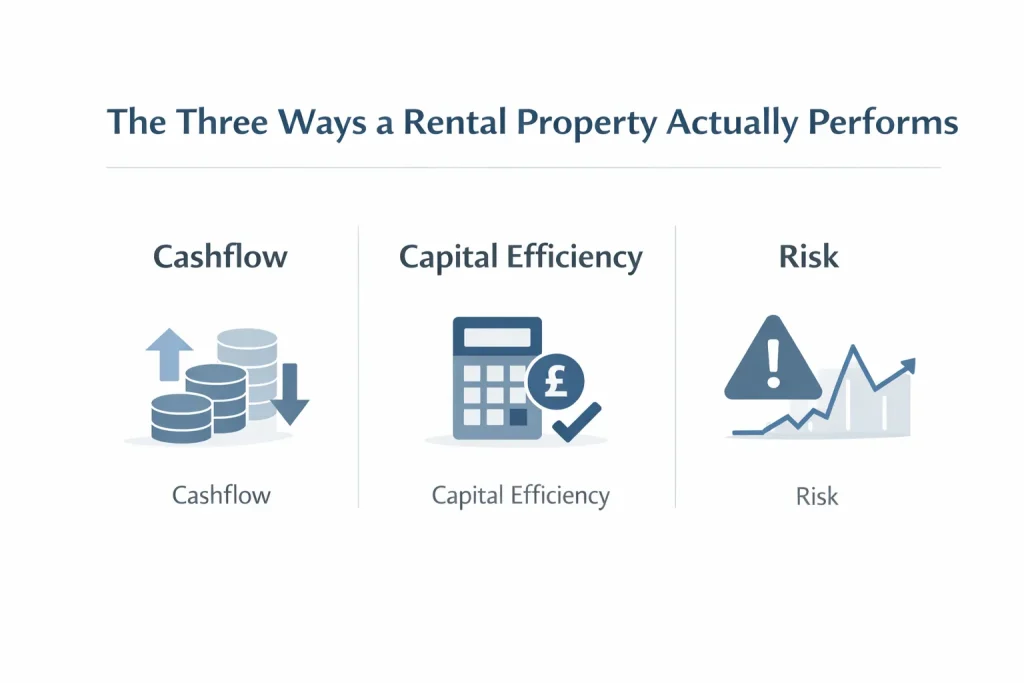
The same rental property does not perform in just one way.
In practice, it delivers three different outcomes depending on how you measure it: day-to-day cashflow, capital efficiency, and risk-adjusted return.
Focusing on only one of these can make a weak deal appear acceptable, or a strong deal look worse than it is.
A numbers-first analysis looks at all three together to reveal what the property is truly contributing to your portfolio.
Every property you own (or are considering) can usually be assessed through three strategic lenses:
- Hold as a Buy-to-Let
- Sell or Flip
- Refinance or Redeploy Capital (BRRR-style logic)
The mistake is judging the property itself, rather than how it performs under each strategy.
Holding as a Buy-to-Let
Holding feels safe because it’s familiar.
The rent comes in. The mortgage gets paid. On paper, the property “works”.
But in 2026, buy-to-let performance needs to be judged more harshly than it was a decade ago.
Key questions landlords often avoid:
- What is the true net cashflow after tax, not just before?
- How much capital is tied up relative to the return?
- How exposed is the property to interest rate movement or regulatory change?
- Is the return compensating you for the risk and effort?
Many rentals still cashflow, but poorly. They absorb time, capital, and risk while delivering returns that would look weak in almost any other asset class.
A property can be profitable and still be a bad hold.
Any sell-or-hold decision that looks ahead to 2026 should be grounded in realistic economic assumptions, not hope, particularly around inflation, borrowing costs, and income pressure highlighted in the UK’s latest economic and fiscal outlook.
Selling or Flipping
Selling is often framed as failure. In reality, it’s just a redeployment decision.
Selling releases capital. What matters is what that capital does next.
Some landlords sell to reduce stress or exposure. Others sell because they see a better opportunity elsewhere. Some sell because the property’s future risk no longer justifies the return.
Flipping adds another layer: short-term gain versus long-term position.
A flip can:
- Improve liquidity
- Reduce exposure
- Create cash for better opportunities
But it can also:
- Trigger tax costs
- Shrink long-term capital base
- Create the illusion of progress without improving overall position
A “good” flip on paper can still weaken your long-term portfolio if the released capital isn’t redeployed efficiently.
Refinancing or Redeploying Capital (BRRR Logic)
BRRR strategies remain popular, but also widely misunderstood.
The core question isn’t whether BRRR works. It’s how much capital is left in the deal after refinance.
If too much cash remains trapped, the strategy quietly fails. The investor ends up with:
- modest cashflow
- high exposure
- limited flexibility
BRRR only works when refinance assumptions are realistic and conservative. In 2026, over-optimistic valuations, tighter lender criteria, and rate sensitivity mean the margin for error is smaller than ever.
The key metric isn’t rent. It’s capital efficiency.
Most landlords never compare these three outcomes side by side. That’s where bad decisions start. If you’re analysing BRRR deals, use this BRRR headroom quick-check method to avoid trapping cash.
Why Gut Feelings Fail (Even for Experienced Landlords)
Gut instinct plays a role in experience, but it is a poor substitute for structured analysis.
Even experienced landlords can misjudge a property’s performance when decisions rely on familiarity, past success, or headline figures.
Market conditions, tax treatment, and financing costs change, but instinct often lags behind reality.
A numbers-first framework forces decisions to be tested against current conditions, not past assumptions.
Many landlords pride themselves on experience. Unfortunately, experience can create blind spots.
Common biases include:
- Anchoring: “I bought it cheap, so it must still be good.”
- Rent fixation: Focusing on monthly rent while ignoring capital drag.
- Status quo bias: Holding because change feels risky, not because it’s optimal.
- Outdated rules: Using yield thresholds or rent cover ratios that no longer reflect reality.
These instincts worked in a rising, low-rate environment. They are far less reliable in a market where risk, cost, and opportunity need to be weighed carefully.
Nowhere is this more dangerous than at auctions.
Why Auction Deals Magnify Mistakes
Auction purchases compress decision-making into days rather than weeks.
That speed leaves little room for assumption-led thinking or incomplete analysis.
Small errors in cost, timing, or risk assessment are amplified by tight completion deadlines and limited exit flexibility.
As a result, auction deals punish weak analysis more quickly than traditional purchases.
Auctions don’t create bad deals.
They expose weak assumptions.
The speed and pressure of auctions remove time for reflection. Errors compound faster. Optimism is punished quickly.
Key reasons auction deals fail more often than expected:
- Legal risks hide in plain sight within packs
- Condition issues escalate costs after completion
- Bridging finance amplifies timing and margin errors
- Exit delays become expensive
- Strategy changes after purchase destroy returns
At auction, price alone does not protect you. A “cheap” property can still be unforgiving if the strategy is unclear.
Auctions and Strategy Mismatch
Many auction losses come from strategy drift.
A property might look attractive as a flip, but fail as a buy-to-let once finance and tax are applied. A BRRR deal might rely on a perfect refinance that never materialises. An investor who expected flexibility discovers they’re boxed into the worst possible option.
The danger isn’t auctions. It’s bidding without a defined strategy.
Why Auction Buyers Need Strategy Clarity Before Bidding
Once the hammer falls, your options narrow.
You cannot easily switch strategies without cost. That’s why serious auction buyers define the strategy first, then decide whether the numbers still work.
As more investors turn to auctions for opportunity, the ability to stress-test strategies quickly is becoming essential.
A Numbers-First Framework for 2026 Decisions
A numbers-first framework strips emotion out of the sell-or-hold decision.
Instead of relying on yield headlines or market sentiment, it tests how a property performs under current interest rates, tax rules, and regulatory risk.
The focus is on what the asset delivers today, not what it delivered in the past.
In a tighter 2026 environment, this approach helps landlords make decisions that improve overall capital efficiency rather than defend legacy positions.
The common thread across all these scenarios is not price. It’s decision structure.
A numbers-first framework focuses on:
- Total cash in versus cash out
- Capital efficiency, not just income
- Risk exposure under each strategy
- Outcome comparison, not isolated metrics
This isn’t about building complex spreadsheets. It’s about asking better questions and seeing the trade-offs clearly.
You don’t need perfect forecasts. You need relative clarity. If your property consistently attracts long-term tenants, holding the investment may generate more stable returns than selling.
Additionally, before deciding whether to sell or keep a rental property, calculate the costs of replacing a tenant, as frequent vacancies can have a significant impact on returns.
How to Stress-Test Your Own Property
Stress-testing a rental property means assessing how it performs when conditions move against you.
Rather than assuming stable rents and static costs, it examines the impact of higher interest rates, tax drag, voids, and regulatory pressure.
This process reveals whether returns are resilient or simply holding up under favourable assumptions.
A property that passes a stress test supports confident decisions; one that fails highlights where holding may no longer be justified.
At this point, most landlords realise the problem isn’t finding deals — it’s comparing strategies properly.
The same property can look viable as a buy-to-let, marginal as a flip, and misleading as a BRRR once capital, tax, and risk are properly accounted for.
This is exactly what the Deal Stack-Up Calculator is designed to show.
Rather than asking “Is this a good deal?”, it asks:
- How does this deal perform as a Flip?
- How does it perform as a Buy-to-Let?
- How does it perform as a BRRR-style hold?
You enter your assumptions.
You see a Deal Summary.
You get a verdict — not just raw numbers.
One way to apply this framework in practice is to run your numbers through a property deal calculator, which allows you to test cashflow, capital tied up, and risk under current conditions before making a decision.
This isn’t about telling you what to do. It’s about showing you what the deal actually does under each path.
What a “Good” Result Actually Looks Like in 2026
In 2026, a “good” result in property investing looks different from past cycles.
With higher financing costs, tax drag, and regulatory friction, acceptable performance is defined less by headline yield and more by resilience and capital efficiency.
A property can still be worth holding if it delivers stable cashflow, justifies the capital tied up, and does not concentrate risk.
The goal is not maximum return at any cost, but a position that remains robust under current conditions.
One of the hardest outcomes for investors to accept is “marginal”.
Bad deals are easy to reject. Good deals are easy to pursue. Marginal deals quietly drain capital and attention.
In 2026:
- A marginal buy-to-let often underperforms relative to its risk.
- A marginal flip can destroy optionality.
- A marginal BRRR locks cash in place without sufficient reward.
Walking away is sometimes the best outcome. Clarity is more valuable than activity.
The most successful investors are not those who do the most deals, but those who select the few that genuinely improve their position.
When a Calculator Isn’t Enough
A calculator can show whether the numbers work, but it cannot identify every risk.
Legal issues, title restrictions, planning constraints, and exit limitations often sit outside simple financial models.
These factors can materially change outcomes even when a deal appears sound on paper.
Knowing when to move beyond calculations to deeper due diligence is a critical part of disciplined decision-making.
No calculator can replace judgement entirely.
Some decisions require deeper analysis:
- Tax structuring
- Finance layering
- Regulatory exposure
- Interest rate sensitivity
- Exit risk and timing
This is where structured property investment analysis becomes essential, not to complicate decisions, but to remove blind spots before capital is committed.
Final Thought: Decide With Clarity, Not Hope
In uncertain markets, hope is not a strategy.
The most reliable decisions come from understanding exactly what a property contributes after tax, costs, and risk.
A clear, numbers-first view allows landlords to hold with confidence or sell without regret.
In 2026, clarity matters more than conviction.
2026 is not a year that rewards passive holding or blind optimism.
It rewards:
- discipline
- selectivity
- capital efficiency
Holding a property “because it’s fine” is no longer neutral. It’s a decision — whether you’ve acknowledged it or not.
If you’re unsure whether to sell, hold, or redeploy, start by testing assumptions properly, you are not alone. In most cases, the answer becomes clearer once you stress-test your own property against today’s interest rates, tax position, and risk exposure.
Then decide — with clarity, not hope.

Koye Beckley is a UK property investor and founder of UncommonDeal, with practical experience in buy-to-let, property auctions, refurbishment projects and investment deal analysis. Through UncommonDeal, he publishes property market research, property deal sourcing and compliance guidance, investment guides and data-driven analysis to help investors evaluate buy-to-let, BRRR, flip and auction opportunities.
