Why Short Lease Properties Are Hard To Finance
Short lease properties often attract attention because they appear cheaper than comparable homes with longer leases. Investors sometimes view them as discounted opportunities, assuming the lower price represents an easy profit.
In reality, many buyers quickly discover that short lease properties are significantly harder to finance than standard properties.
Mortgage lenders treat lease length as a major risk factor. As the remaining lease term declines, lenders become less willing to provide mortgages. This reduces the number of potential buyers and puts downward pressure on the property’s market value.
This relationship between lease length, financing availability, and property value explains why short lease properties often sell at a discount in the UK property market.
Understanding how lenders assess lease length is essential before buying a short lease property, particularly for investors who plan to finance, refinance, or resell the property later.
Why are short lease properties hard to finance?
Short lease properties are difficult to finance because mortgage lenders require the lease to remain long enough to protect the value of the property used as loan security. Most UK lenders require at least 70–85 years remaining on the lease and around 25–30 years beyond the mortgage term. If the lease falls below these thresholds, lenders may refuse to lend or require the lease to be extended before purchase.
Key Takeaways: Short Lease Properties and Mortgage Financing
-
Short lease properties are harder to finance because mortgage lenders require a minimum lease length to protect the property used as loan security.
-
Most UK lenders prefer properties with 70–85 years remaining on the lease and typically require the lease to extend 25–30 years beyond the mortgage term.
-
Once a lease falls below 80 years, lease extension costs increase due to marriage value, which can significantly affect property value.
-
Short leases can reduce a property’s market value by 10% to 40% or more, depending on the remaining term and extension costs.
-
Investors sometimes buy short lease properties at a discount and extend the lease to restore the property’s full market value.
What Is Considered a Short Lease in the UK?
Before understanding why short lease properties are difficult to finance, it is important to understand what actually qualifies as a short lease in the UK property market.
Most flats in the UK are sold as leasehold properties, meaning the buyer owns the property for a fixed period of time rather than owning the land permanently.
When the lease term expires, ownership of the property returns to the freeholder unless the lease is extended.
Because the lease term gradually decreases every year, the remaining lease length becomes a critical factor affecting property value, mortgage availability, and resale demand.
Typical Lease Lengths on UK Flats
New residential leases are usually granted with long initial terms.
Common starting lease lengths include:
-
99 years
-
125 years
-
250 years
-
999 years
At the beginning of the lease, the length rarely affects the property’s value or mortgageability. Buyers and lenders generally view long leases as secure because there is little risk of the lease expiring during the property’s ownership.
However, as time passes and the lease length declines, lenders begin to treat the property differently.
When a Lease Becomes “Short”
There is no single legal definition of a short lease, but in practical terms the property market begins to treat a lease as “short” once it falls below around 85–90 years remaining.
At this stage:
-
some lenders begin applying stricter lending criteria
-
buyers start factoring future lease extension costs into the price
-
resale demand can begin to weaken.
The shorter the lease becomes, the more these factors influence both property value and mortgage availability.
Why the 80-Year Threshold Matters
One of the most important points in a leasehold property’s life is when the remaining lease term drops below 80 years.
This threshold is significant because of a concept known as marriage value.
Once a lease falls below 80 years, the cost of extending the lease increases because the freeholder becomes entitled to a share of the property’s potential value increase after the extension.
As a result:
-
lease extension costs rise significantly
-
buyers become more cautious
-
mortgage lenders become more restrictive.
This is one of the main reasons short lease properties begin to lose value and become harder to finance as the remaining term declines.
For a deeper breakdown of the value impact, see our guide explaining how much a short lease can devalue a property, which analyses the typical price discounts associated with shorter leases.
Additionally, the government’s GOV.UK guidance on extending a lease explains that once a lease has 80 years or less remaining, the cost of extending it can increase significantly.
How Lease Length Affects Property Value
A short lease can reduce a property’s value by 10% to 40% or more, depending on the remaining lease length, the cost of extending the lease, and the availability of mortgage finance.
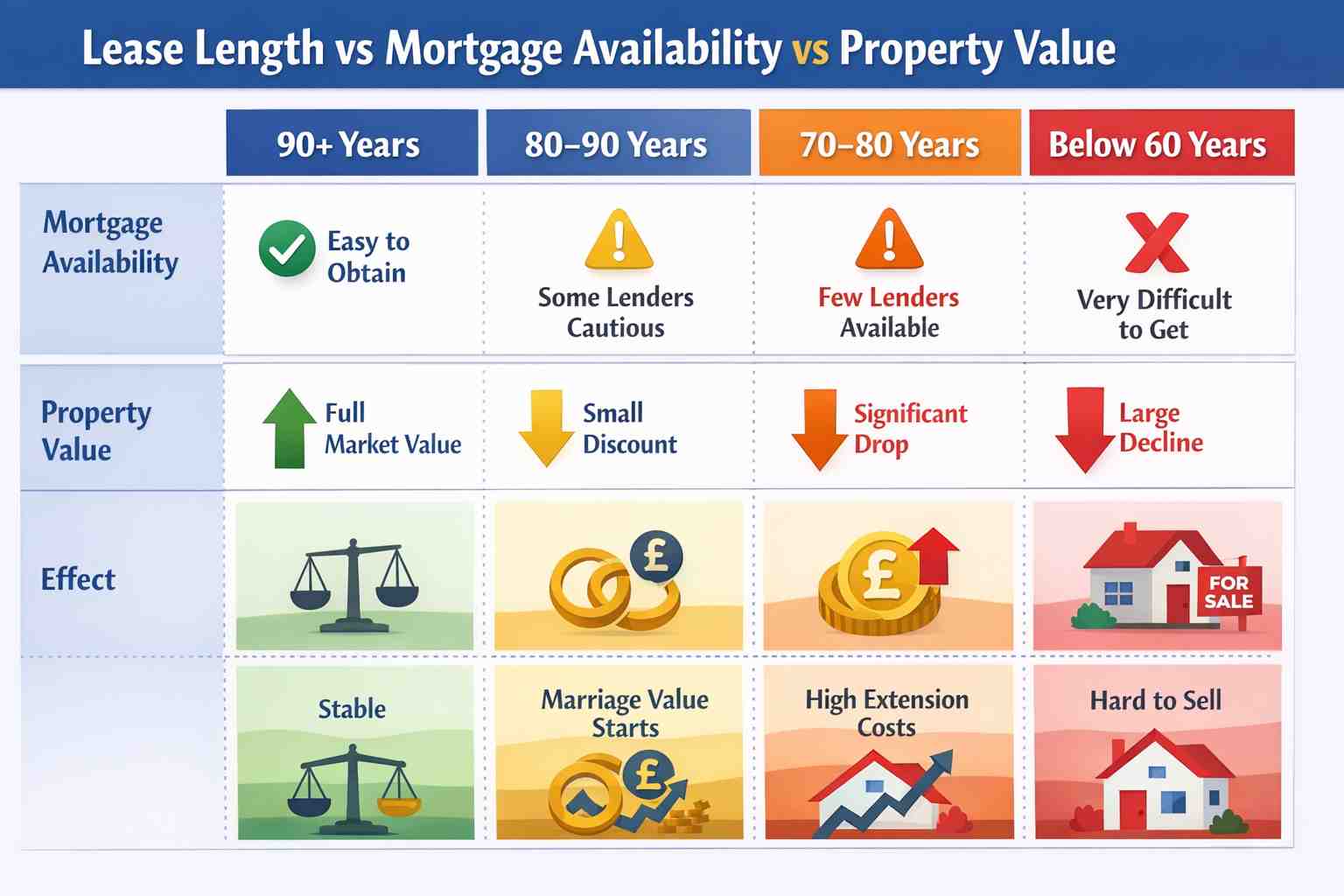
Lease length has a direct and measurable impact on property value in the UK housing market. As the remaining term of a lease decreases, the property’s market value typically declines because buyers must factor in the future cost of extending the lease and the increasing difficulty of obtaining mortgage finance.
This relationship between lease length and property value is one of the main reasons short lease properties often sell at a noticeable discount compared with similar properties that have long leases.
For investors and buyers, the key issue is not simply the number of years remaining on the lease. Instead, the market price reflects a combination of factors including:
-
the cost of extending the lease
-
mortgage lender requirements
-
resale demand from future buyers
-
the point at which marriage value becomes payable.
When these factors combine, the property’s value can fall significantly as the lease term shortens.
Typical Property Value Reductions Based on Lease Length
Although the exact discount varies depending on location, property type, and extension costs, the market generally follows a predictable pattern.
| Remaining Lease Length | Typical Market Impact on Property Value |
|---|---|
| 90+ years | Little or no impact on value |
| 80–90 years | Small discount may begin to appear |
| 70–80 years | Noticeable discount as buyers factor extension costs |
| 60–70 years | Significant reduction due to limited mortgage availability |
| Below 60 years | Large discounts because many lenders will not finance the property |
The closer a lease moves toward the critical 80-year threshold, the more buyers begin to consider the cost of extending it. Once the lease drops below this point, extension costs usually increase because marriage value becomes payable, accelerating the property’s decline in value.
Why Shorter Leases Reduce Buyer Demand
Property value is ultimately determined by demand. When fewer buyers can purchase a property, its market price tends to fall.
Short lease properties reduce the number of potential buyers for several reasons:
-
Many mortgage lenders restrict lending on shorter leases
-
Buyers anticipate the cost and complexity of extending the lease
-
Some investors avoid properties with uncertain extension costs.
Because of these limitations, short lease properties are often purchased primarily by cash buyers or experienced investors, which reduces competition and places downward pressure on the sale price.
Why Lease Length and Financing Are Closely Linked
Mortgage availability is one of the strongest influences on property demand. When lenders refuse to finance properties with short leases, a large portion of the buyer pool disappears.
This is why the relationship between lease length and financing availability plays such an important role in property valuation.
As the lease shortens:
-
fewer lenders are willing to offer mortgages
-
buyers become more cautious
-
resale demand decreases.
The combined effect is that properties with shorter leases typically sell below the value of comparable properties with longer leases.
For a detailed breakdown of typical price reductions, see our guide explaining short lease property devaluation, which examines the valuation impact of different lease lengths in more detail.
Why Investors Still Analyse Short Lease Opportunities
Despite these valuation challenges, short lease properties are sometimes attractive to experienced investors.
If the purchase price properly reflects the lease extension cost and financing risk, investors may be able to create value by extending the lease and restoring the property’s full market value.
However, this strategy requires careful analysis of:
-
lease extension costs
-
lender requirements
-
total project cost
-
resale value after the extension.
Without accurate analysis, what appears to be a discounted property can quickly become an expensive mistake.
Minimum Lease Length Requirements for UK Mortgages
Mortgage lenders in the UK apply minimum lease length requirements before approving finance on a leasehold property. These requirements exist because the lender needs the lease to remain long enough to protect the property’s value throughout the life of the mortgage.
If the lease becomes too short, the property may be harder to sell in the future. From the lender’s perspective, this increases the risk that the loan may not be fully recoverable if the borrower defaults.
As a result, lease length is one of the key factors lenders assess when deciding whether a property can be financed.
Typical Lease Length Requirements for Mortgage Approval
Although lending policies vary between banks and building societies, most lenders follow broadly similar guidelines when assessing leasehold properties.
| Remaining Lease Length | Mortgage Availability |
|---|---|
| 90+ years | Accepted by almost all lenders |
| 80–90 years | Usually acceptable to most lenders |
| 70–80 years | Fewer lenders available |
| 60–70 years | Mostly specialist lenders only |
| Below 60 years | Very difficult to obtain a mortgage |
Once a lease begins to fall below 80 years, some lenders become more cautious because the cost of extending the lease increases significantly. As the term approaches 70 years, the number of lenders willing to finance the property can drop sharply.
Why Lenders Require the Lease to Outlast the Mortgage
Most mortgage lenders apply a simple rule when assessing leasehold properties:
The lease should extend at least 25–30 years beyond the mortgage term.
This requirement ensures that the lease will still have a reasonable length remaining when the mortgage is fully repaid.
For example:
| Mortgage Term | Minimum Lease Typically Required |
|---|---|
| 25 year mortgage | 55–60 years remaining |
| 30 year mortgage | 60–65 years remaining |
If the lease does not meet this requirement, lenders may decline the application or require the lease to be extended before the purchase completes.
Can You Get a Mortgage on a 70-Year Lease?
It is sometimes possible to obtain a mortgage on a property with around 70 years remaining on the lease, but lender options become more limited.
Some mainstream lenders may still accept leases at this level, but borrowers often face stricter lending conditions such as:
-
lower loan-to-value limits
-
additional underwriting checks
-
higher interest rates.
Because of these restrictions, properties with leases close to 70 years often attract fewer buyers relying on standard mortgage finance.
Can You Get a Mortgage on a 60-Year Lease?
Obtaining a mortgage on a property with around 60 years remaining is much more difficult.
At this point, most high street lenders will decline the application because the lease is considered too short to provide reliable long-term security for the loan.
Buyers purchasing properties with leases around this length typically rely on:
-
cash purchases
-
bridging finance
-
specialist lenders.
This is one of the main reasons short lease properties become harder to finance and often sell at lower prices compared with similar properties that have longer leases.
The 80-Year Rule and Why It Changes Everything for Leasehold Property
One of the most important thresholds in the UK leasehold system is the 80-year rule. This rule plays a major role in determining both the cost of extending a lease and the value of the property itself.
Many buyers and investors do not fully understand the importance of this threshold until a lease approaches or falls below it. However, once the remaining lease term drops under 80 years, the financial implications can become significant.
This is why experienced investors monitor lease lengths carefully and often consider extending a lease before it reaches the 80-year point.
What Is the 80-Year Rule in Leasehold Property?
The 80-year rule refers to the point at which marriage value becomes payable when extending a lease.
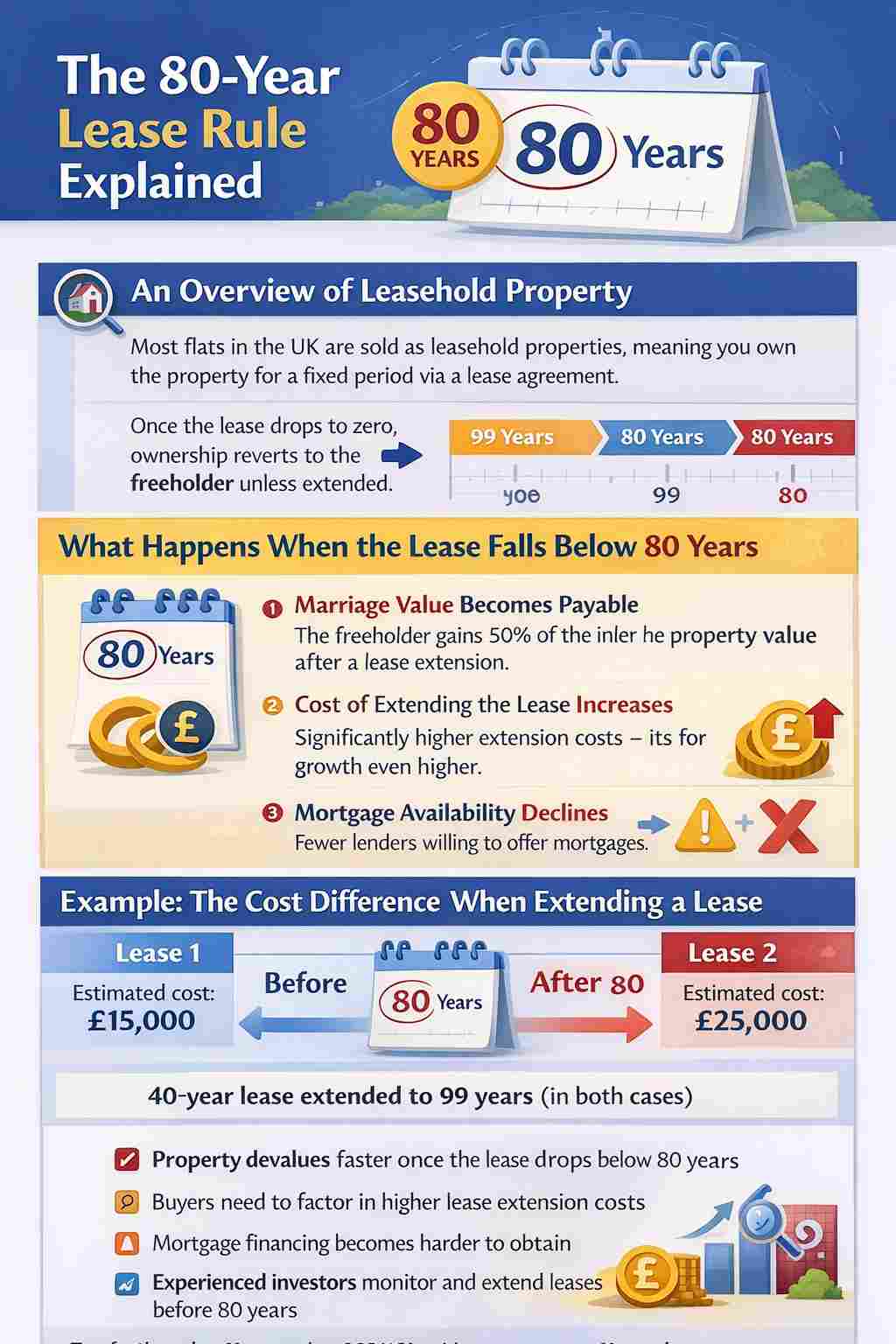
Marriage value represents the increase in the property’s value after the lease has been extended. When a lease falls below 80 years, the freeholder becomes entitled to a share of that increase in value.
In practical terms, this means that once the lease drops below 80 years:
-
the cost of extending the lease increases
-
the freeholder receives part of the property’s value uplift
-
the lease extension process becomes more expensive.
Because of this rule, the cost of extending a lease can rise significantly once the 80-year threshold has been crossed.
Why 80 Years Is So Important for Property Value
The 80-year threshold often marks the point where property values begin to decline more noticeably.
Buyers purchasing a property with a lease approaching this threshold will usually factor in the potential cost of extending the lease in the near future.
As a result:
-
buyers negotiate lower purchase prices
-
lenders begin to apply stricter mortgage criteria
-
demand from mortgage buyers can decline.
These factors contribute to the discounts often seen on properties with leases approaching or falling below the 80-year mark.
This relationship between lease length and value is one of the main reasons short lease properties can trade below market value.
Why Investors Often Extend Leases Before 80 Years
Because lease extension costs increase once marriage value becomes payable, many property owners aim to extend their leases before the remaining term drops below 80 years.
Extending the lease earlier can help:
-
avoid paying marriage value
-
preserve the property’s market value
-
maintain mortgage eligibility.
For investors analysing leasehold opportunities, understanding this timing is crucial. Properties with leases approaching the 80-year threshold can sometimes present opportunities, but only if the cost of extending the lease is properly factored into the purchase price.
A more detailed explanation of how marriage value works and why it affects lease extension costs can be found in our guide on marriage value in lease extensions, which explores the financial mechanics behind this rule.
Why the 80-Year Rule Matters for Financing
Mortgage lenders also pay close attention to the 80-year threshold when assessing leasehold properties.
As leases move closer to this point:
-
some lenders become more cautious about approving mortgages
-
buyers become more aware of future lease extension costs
-
financing options may begin to narrow.
Because mortgage availability plays such a large role in property demand, the 80-year rule indirectly influences both financing options and property valuation.
For this reason, understanding the 80-year rule is essential for anyone analysing short lease property opportunities in the UK.
Why Investors Still Buy Short Lease Properties
Despite the financing challenges and valuation risks associated with short leases, experienced property investors still actively analyse and purchase these types of properties.
The reason is simple: short lease properties sometimes create opportunities to buy below market value.
Because many buyers cannot obtain mortgage finance, the pool of potential purchasers becomes smaller. This reduction in demand can push prices down, creating situations where investors who understand lease extensions and financing structures may be able to unlock value.
However, these opportunities only exist when the numbers are analysed carefully. A short lease property is not automatically a good deal simply because it is cheaper than comparable homes.
Discounted Purchase Prices
One of the main attractions of short lease properties is the potential for a discounted purchase price.
When a lease becomes short:
-
mortgage lenders restrict lending
-
fewer buyers can purchase the property
-
sellers may struggle to attract standard buyers.
As a result, the property may be marketed at a price significantly below the value of a comparable property with a long lease.
This discount reflects the cost, risk, and complexity of extending the lease, which must be considered before purchasing.
Value Creation Through Lease Extension
Many investors view short lease properties as value-add opportunities.
If a property is purchased at a sufficient discount, extending the lease can increase the property’s value once the lease term returns to a more acceptable length.
For example:
| Item | Example Scenario |
|---|---|
| Market value with long lease | £250,000 |
| Purchase price with short lease | £200,000 |
| Estimated lease extension cost | £25,000 |
| Total investment | £225,000 |
| Value after extension | £250,000 |
In this simplified scenario, extending the lease restores the property’s full market value, creating a potential gain.
However, this outcome depends entirely on accurate deal analysis, particularly when estimating extension costs and financing risks.
Less Competition From Mortgage Buyers
Short lease properties often attract less competition because many buyers rely on standard mortgage finance.
When lenders refuse to finance a property due to a short lease, the number of potential buyers decreases significantly. This often leaves the market dominated by:
-
cash buyers
-
experienced property investors
-
buyers using bridging finance.
For investors who understand leasehold risks, this reduced competition can create opportunities that are not available in the wider property market.
Why Deal Analysis Is Essential
While short lease properties can present opportunities, they can also become expensive mistakes if analysed incorrectly.
The true viability of a short lease investment depends on several factors, including:
-
the cost of extending the lease
-
the property’s value after extension
-
financing availability
-
legal and ground rent terms
-
total project cost.
This is why investors analysing short lease opportunities must approach them as structured property deals rather than simple discounted purchases.
Understanding the numbers behind the deal is essential before committing to a purchase.
For investors evaluating potential opportunities, tools such as a structured property deal analysis framework can help assess whether a short lease property represents genuine value or hidden risk.
Example Short Lease Property Deal Analysis
Understanding how short lease properties work in practice is easier when looking at a simple deal analysis example. Investors evaluating these opportunities must consider purchase price, lease extension costs, financing options, and the property’s value after the lease has been extended.
Without analysing these numbers properly, what appears to be a discounted property can quickly become an unprofitable investment.
The following example illustrates how investors typically assess a short lease opportunity.
Example Scenario: Analysing a Short Lease Flat
Assume an investor identifies a flat being sold with 68 years remaining on the lease. Comparable flats in the same building with long leases sell for around £250,000.
Because the lease is short and mortgage availability is limited, the seller lists the property at a discounted price.
| Item | Example Deal Figures |
|---|---|
| Estimated market value (long lease) | £250,000 |
| Purchase price (68-year lease) | £200,000 |
| Estimated lease extension cost | £25,000 |
| Legal and professional fees | £3,000 |
| Total project cost | £228,000 |
| Estimated value after lease extension | £250,000 |
In this simplified example, the investor potentially creates around £22,000 of value by extending the lease and restoring the property’s full market value.
However, this outcome depends on whether the assumptions used in the analysis are accurate.
Key Factors Investors Must Analyse
Experienced investors do not rely on headline discounts alone. Instead, they examine several key variables before deciding whether a short lease property represents a viable opportunity.
Important factors include: Lease extension cost.
Estimating the cost of extending the lease is critical. If the extension cost is higher than expected, the apparent discount can disappear quickly.
Property value after extension
Investors must confirm the realistic market value once the lease has been extended. Overestimating this value is one of the most common mistakes made when analysing short lease deals.
Financing structure
Because many lenders restrict mortgages on short leases, investors must consider whether the property will require:
-
cash purchase
-
bridging finance
-
specialist lenders.
Financing costs can significantly affect the overall profitability of the deal.
Total project costs
Legal fees, valuation fees, lease extension costs, and financing expenses must all be included in the analysis.
Why Many Short Lease Deals Fail
Short lease opportunities often look attractive on property listings because the asking price appears significantly lower than nearby properties.
However, deals can quickly become unprofitable if:
-
lease extension costs are underestimated
-
financing costs are ignored
-
the property’s post-extension value is overestimated.
For this reason, experienced investors treat short lease purchases as structured property deals rather than simple discounted purchases.
Using Structured Deal Analysis
Because short lease investments involve multiple variables, many investors use structured analysis tools to evaluate the viability of a deal before making an offer.
A proper analysis typically examines:
-
purchase price
-
lease extension cost
-
total project cost
-
financing assumptions
-
expected value after the lease extension.
This type of structured approach helps investors determine whether the property represents a genuine opportunity or a hidden risk.
Why Analysis Matters More Than the Discount
The key lesson from most short lease deals is that price alone does not determine whether a property is a good investment.
A large headline discount may simply reflect:
-
expensive lease extension costs
-
limited mortgage availability
-
legal complexities within the lease.
Only by analysing the full financial picture can investors determine whether a short lease property is truly worth buying.
The Biggest Risks When Buying Short Lease Properties
Short lease properties can sometimes present investment opportunities, but they also carry several risks that buyers must understand before committing to a purchase.
Many inexperienced buyers focus only on the discounted purchase price, without fully considering the financial, legal, and financing risks involved. In practice, these risks are the main reason why short lease properties trade below the value of comparable homes with longer leases.
Understanding these potential problems is essential when analysing whether a short lease property represents a genuine opportunity or a costly mistake.
Underestimating Lease Extension Costs
One of the most common risks when buying a short lease property is underestimating the cost of extending the lease.
Lease extension costs depend on several factors, including:
-
the remaining lease length
-
the property’s market value
-
ground rent terms
-
whether marriage value applies.
Once the lease falls below the 80-year threshold, extension costs can increase significantly because marriage value becomes payable to the freeholder.
Buyers who fail to estimate these costs accurately may find that the expected profit from the deal disappears entirely.
Limited Mortgage Availability
Another major challenge with short lease properties is the reduced availability of mortgage finance.
As explained earlier, many lenders require leases to exceed a minimum length before approving a mortgage. When a lease becomes too short, lenders may decline the application altogether.
This can create several problems for buyers:
-
difficulty obtaining finance to purchase the property
-
limited refinancing options after purchase
-
fewer buyers when the property is resold.
Because mortgage availability strongly influences demand in the housing market, restricted lending can have a direct impact on the property’s value and liquidity.
Legal Complications Within the Lease
Leasehold properties often contain legal provisions that can affect both the cost and complexity of ownership. Conducting proper property legal due diligence before purchasing a short lease property is essential to identify potential risks within the lease.
Before purchasing a short lease property, buyers should carefully review the lease terms and conduct proper property legal due diligence to identify potential risks such as:
-
restrictive covenants
-
escalating ground rent clauses
-
unusual lease conditions
-
disputes with the freeholder.
These factors can influence the long-term value and mortgageability of the property.
Overestimating the Property’s Post-Extension Value
Another common mistake when analysing short lease opportunities is overestimating the property’s value after the lease has been extended.
Investors sometimes assume that extending the lease will automatically restore the property’s value to the level of comparable long-lease properties.
However, the actual resale value may be affected by:
-
local market conditions
-
property condition
-
buyer demand in the area
-
changes in lending criteria.
Accurate valuation assumptions are therefore critical when analysing short lease deals.
Financing Risk After Purchase
Even if a buyer successfully purchases a short lease property, financing risks can continue after completion.
Many investors purchase short lease properties using cash or bridging finance, intending to extend the lease and refinance onto a standard mortgage later.
However, refinancing may not always proceed as planned if:
-
lease extension costs increase
-
property values change
-
lender criteria tighten.
This refinancing risk is another reason why short lease investments require careful planning and realistic financial assumptions.
Why Risk Analysis Matters
Short lease properties highlight an important principle of property investing: a low purchase price does not automatically mean a good deal.
In many cases, the discount simply reflects the risks associated with financing, lease extension costs, and resale demand.
For this reason, experienced investors approach short lease opportunities with a structured analysis process that evaluates both the potential upside and the associated risks before committing to a purchase.
Understanding these risks is essential for anyone considering investing in short lease property in the UK.
Final Verdict: Are Short Lease Properties Worth Buying?
Short lease properties can be both opportunities and traps, depending entirely on how the deal is analysed.
For many buyers, the lower purchase price of a short lease property appears attractive. However, that discount usually reflects real risks related to lease extension costs, mortgage availability, and future resale demand.
Because of these factors, short lease properties require a much more careful level of analysis than standard freehold or long-lease properties.
When Short Lease Properties Can Be Worth Buying
In some cases, short lease properties can present genuine investment opportunities.
This usually happens when:
-
the purchase price reflects the full cost of extending the lease
-
the property’s market value after extension is realistic
-
financing costs have been carefully considered
-
legal terms within the lease do not introduce additional risks.
When these factors align, extending the lease can restore the property’s full market value and create potential upside for investors.
However, identifying these opportunities requires detailed financial analysis rather than relying on headline discounts.
When Short Lease Properties Become Risky
Short lease properties can quickly become problematic if key assumptions are wrong.
Deals often fail when buyers:
-
underestimate the cost of extending the lease
-
overestimate the property’s value after extension
-
assume mortgage financing will be available later
-
ignore legal risks within the lease.
Because financing options are limited and extension costs can vary, mistakes in the analysis can remove the expected profit entirely.
Why Analysis Matters More Than the Discount
The most important principle when evaluating short lease property is that price alone does not determine whether a deal is good or bad.
A large discount may simply reflect:
-
expensive lease extension costs
-
reduced mortgage availability
-
legal complexities within the lease.
Experienced investors therefore focus on analysing the full financial picture, including extension costs, financing structure, and realistic resale value.
The Key Question Investors Should Ask
Instead of asking: “Is this short lease property cheap?”
Investors should ask: “Does the total project cost still make sense once the lease is extended?”
This approach shifts the focus from price to structured deal analysis, which is essential when evaluating short lease opportunities.
Final Thought
Short lease properties can create value in the right circumstances, but they require far more analysis than standard property purchases.
Understanding how lease length affects mortgage availability, property value, and extension costs is essential before committing to a deal.
For investors willing to analyse the numbers carefully, short lease properties can sometimes offer opportunities. For buyers who ignore the underlying risks, however, they can quickly become expensive mistakes.
Frequently Asked Questions About Short Lease Properties
What is considered a short lease property?
A property is generally considered to have a short lease when fewer than 80 years remain on the lease. At this point, lease extension costs usually begin to rise more sharply, and mortgage lenders often become more cautious about lending against the property.
What is the minimum lease length for a mortgage in the UK?
Most UK mortgage lenders prefer properties with at least 70 to 85 years remaining on the lease. Many lenders also require the lease to extend 25 to 30 years beyond the mortgage term, which is why shorter leases can make mortgage approval more difficult.
How much does a short lease devalue a property?
A short lease can reduce a property’s value by 10% to 40% or more, depending on the remaining lease length, the cost of extending the lease, and the level of mortgage demand from buyers. In most cases, the shorter the lease becomes, the greater the discount buyers expect.
Are short lease properties worth buying?
Short lease properties can sometimes be worth buying if the purchase price properly reflects the cost of extending the lease, the financing risk, and the likely value after the extension. They are not automatically good deals, so buyers should analyse the full numbers before committing to the purchase.

Koye Beckley is a UK property investor and founder of UncommonDeal, with practical experience in buy-to-let, property auctions, refurbishment projects and investment deal analysis. Through UncommonDeal, he publishes property market research, property deal sourcing and compliance guidance, investment guides and data-driven analysis to help investors evaluate buy-to-let, BRRR, flip and auction opportunities.