
How to Spot a Bad Property Deal Before You Waste Legal Fees
A bad property deal is one where the numbers, strategy, or legal position fail basic checks, meaning the deal should be walked away from before spending money on solicitors, surveys, or searches.
Most investors lose money on a bad property deal long before completion, not because they bought the wrong property, but because they paid legal fees too early. Knowing how to spot a bad property deal before you waste legal fees is one of the most important skills in UK property investing. Solicitors, surveys, and searches can cost thousands, yet many deals show clear warning signs well before any legal review is needed.
A bad property deal is rarely hidden. In most cases, the numbers do not stack, the strategy is weak, or the deal relies on assumptions that only work in a best-case scenario. If you understand the early red flags, you can walk away before instructing a solicitor, ordering searches, or paying non-refundable fees. This is not about being pessimistic. It is about filtering deals properly before money leaves your account.
In this guide, you will learn how experienced investors identify property deal red flags early, why relying on solicitors to validate a deal is often the wrong first step, and what checks should be completed before spending a pound on legal fees. Whether you are buying at auction, through an agent, or via a sourcer, this process helps you kill bad deals fast and protect your capital for opportunities that genuinely stack up.
What Is Classified as a Bad Property Deal in the UK Property Industry
Not every bad property deal looks obviously wrong at first glance. Many appear “workable” on paper, especially when optimistic assumptions are used or key early warning signs are glossed over. In practice, most bad deals fall into a small number of recognisable categories that experienced investors learn to avoid early, long before legal fees are paid.
Below are the most common types of property deals that should raise immediate caution.
Deals Where the Numbers Only Work in a Best-Case Scenario
These are deals that rely on perfect conditions to succeed. If rental demand softens, refurbishment costs rise, or valuations come in lower than expected, the deal quickly turns unprofitable.
If a property only works at the top end of rent, GDV, or financing assumptions, it is not a robust investment. Strong deals survive stress-testing. Weak ones collapse the moment reality intervenes.
Deals With No Clear or Viable Exit Strategy
A bad property deal often lacks a defined exit or relies on one that may not be achievable. This includes vague plans to “sell later”, refinance without lender appetite, or exit via planning outcomes that are not guaranteed.
If you cannot clearly explain how you will get your money out and under what conditions, the deal is incomplete. Unclear exits are one of the most common reasons investors get trapped.
Deals That Depend on Planning Permission or Assumptions
Some deals only work if planning permission is granted, change of use is approved, or a future uplift materialises. While planning-led strategies can be valid, they are high-risk when treated as a certainty rather than a possibility.
If the purchase price assumes planning success before approval is in place, the risk is already priced incorrectly, because planning permission is not guaranteed. That is a red flag, not an opportunity.
Deals With Hidden Costs or Unverified Ongoing Expenses
Service charges, ground rents, management fees, and maintenance costs are often underestimated or not confirmed at all. These costs can materially change the viability of a deal.
Any property where key costs are “to be confirmed” or estimated without evidence should be paused. Unknown costs are not neutral. They usually move against you.
Deals That Rely on Legal Workarounds to Function
A property that needs indemnity insurance, title restructuring, access agreements, or legal gymnastics to be usable as intended should be treated with caution.
Legal solutions can manage risk, but they do not remove it. If a deal only works because a solicitor finds a workaround, it is often compensating for a fundamentally weak position.
Deals Driven by Urgency, Pressure, or Missing Information
High-pressure sales tactics, incomplete legal packs, or requests to “move quickly” are common features of bad deals. Time pressure is often used to prevent proper analysis.
A good deal remains a good deal after scrutiny. A bad deal relies on speed, emotion, and incomplete facts to proceed.
The key point is that most of these warning signs appear before any solicitor is instructed or legal fees are paid.
Why Legal Fees Are the Most Expensive Early Mistake
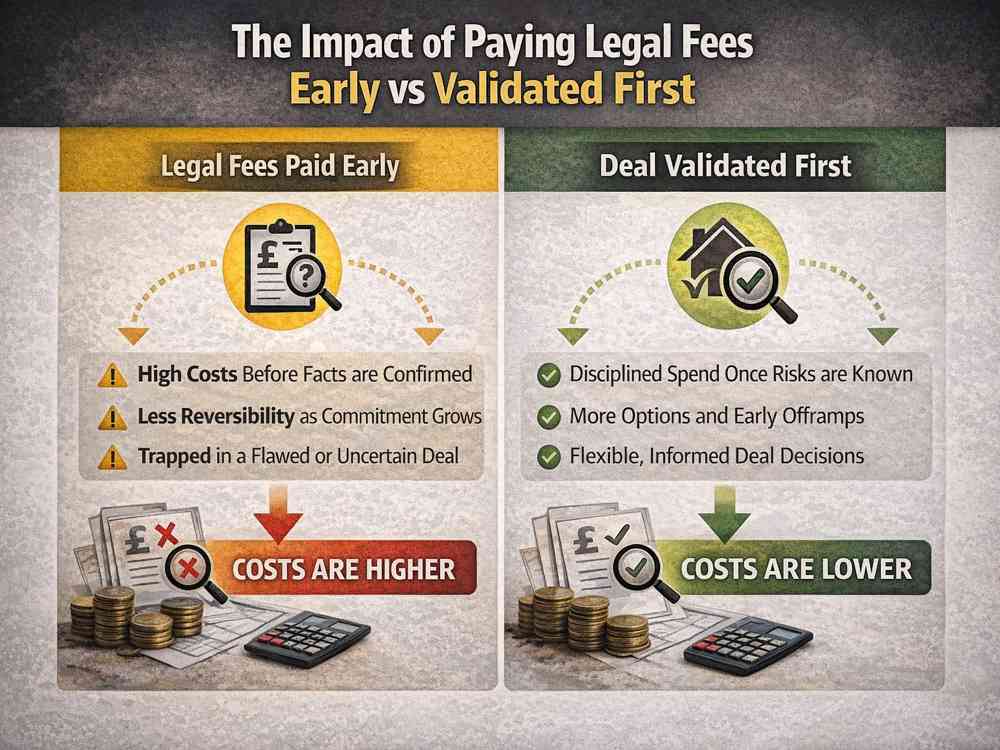
Legal fees are often the first money investors spend on a property deal, and they are usually the hardest to recover. Solicitor onboarding costs, ID checks, searches, and initial reviews are payable whether the deal completes or not. Once this process starts, many buyers feel psychologically committed, even when new information suggests they should walk away.
The real problem is that legal fees are frequently paid too early in the decision process. A solicitor’s role is to assess legal compliance and risk, not to confirm whether a deal makes financial or strategic sense. When investors instruct solicitors before validating the numbers, exit strategy, and known risks, they end up paying professional fees to uncover issues that could have been spotted much earlier.
Legal work also creates momentum. As emails, reports, and timelines start to move, it becomes harder to pause objectively. Investors begin to think in terms of “how do we make this work” rather than “should we still be doing this at all”. This is how small early fees turn into much larger losses later.
This is why experienced investors delay legal spend until a deal has passed basic commercial and strategic checks. Legal fees should be used to confirm a good deal, not to rescue a weak one. If a deal only collapses once solicitors are involved, the warning signs were almost always there beforehand.
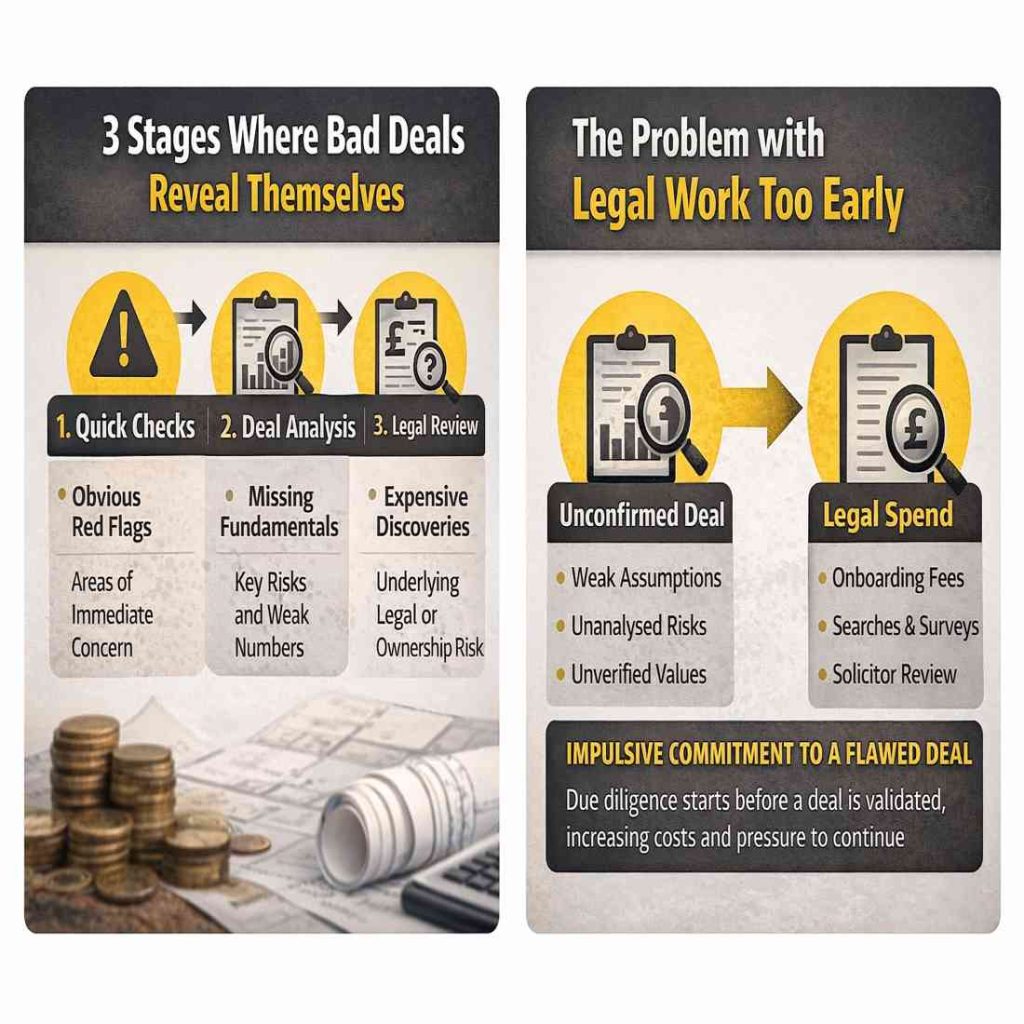
The 3 Stages Where Bad Deals Reveal Themselves
Most bad property deals do not fail suddenly. They reveal themselves in stages, often long before any legal work is required. Investors who learn to recognise these stages can walk away early, saving time, money, and emotional energy. The mistake most people make is ignoring early-stage warning signs and hoping later checks will “sort things out”.
Below are the three points in the deal process where problems most commonly appear.
Stage 1: The Numbers Do Not Stack
This is the earliest and most obvious failure point. At this stage, the deal only works if optimistic assumptions are used, such as top-end rent, minimal refurbishment costs, or perfect financing terms.
If small changes to rent, valuation, or costs turn a deal unviable, the numbers are not robust. Strong deals survive conservative assumptions. Weak deals collapse the moment they are stress-tested. This stage alone eliminates a large percentage of bad property deals before any legal review is necessary.
Stage 2: The Strategy Is Weak or Unclear
At this stage, the numbers may appear workable, but the overall strategy lacks clarity. There may be no defined exit, or the exit depends on refinancing assumptions, market growth, or buyer demand that cannot be guaranteed.
A common warning sign is a deal that sounds flexible but is actually unfocused. If the answer to “how do I get my money out?” is vague, conditional, or delayed, the strategy is incomplete. Deals without clear exits often trap capital and force investors into poor decisions later.
Stage 3: The Deal Relies on Legal or Structural Fixes
This is where many investors wrongly believe a solicitor will save the deal. At this stage, issues such as title defects, access rights, lease problems, or restrictive covenants emerge and are treated as technical hurdles rather than fundamental risks.
Legal solutions can reduce risk, but they cannot turn a weak deal into a strong one. If a property only works after indemnity insurance, legal restructuring, or complex workarounds, the underlying problem is usually commercial, not legal. This is often the final warning before legal fees begin to escalate.
By the time a deal reaches the third stage, most of the critical risks are already visible. The key skill is learning to validate the right things early, before instructing a solicitor or spending money on formal legal checks.
What You Should Validate Before Instructing a Solicitor
Before any solicitor is instructed or legal fees are paid, a property deal should pass a small number of non-negotiable checks. These are not detailed legal reviews or lengthy reports. They are commercial and strategic validations designed to kill weak deals early and protect your capital.
If a deal fails any of the checks below, spending money on legal work is premature.
Conservative Gross Development Value (GDV)
Your GDV should be based on recent, comparable sold prices, not asking prices or best-case projections. Using the highest achievable sale price to justify a deal is one of the fastest ways to misprice risk.
If the deal only works at the top end of GDV assumptions, it is already fragile. A conservative GDV creates margin for valuation down-risk, market movement, and delays.
Realistic Rental Income, Not Advertised Rents
Rental figures should reflect what tenants are actually paying now, not the highest listing on a portal. Advertised rents often represent aspirational pricing rather than achieved outcomes.
If your cash flow depends on pushing rent beyond local norms or assuming instant occupancy, the deal is vulnerable. Stable deals work at average rents, not exceptional ones.
Exit Viability Today, Not in Theory
An exit strategy should be viable in the current market, under current lending conditions. Planning future refinancing, selling into a stronger market, or relying on buyer demand that may not exist is speculative, not strategic.
If the exit only works after several favourable assumptions align, it is not a reliable exit. Clear exits reduce risk. Hypothetical exits increase it.
Finance Reality, Not Broker Optimism
Early conversations with brokers are useful, but they are not binding. Lending criteria, stress tests, and valuations often change once a case reaches underwriting.
You should validate whether the deal works under conservative finance terms, higher rates, and lower valuations. If finance needs to be “worked around” to make the deal viable, that is a warning sign.
Known Planning and Regulatory Constraints
Planning restrictions, Article 4 directions, licensing requirements, and use-class limitations should be identified upfront. Assuming permission will be granted later is not due diligence.
If the deal relies on planning outcomes that are uncertain or unsupported by policy, the risk should be priced in or the deal paused.
A Clear and Singular Deal Objective
Every property deal should have one primary objective, such as long-term hold, refinance, or sale. Trying to keep all options open often masks a lack of strategy.
If you cannot clearly articulate why you are buying the property and how it fits your broader plan, legal fees will not fix that uncertainty.
Once these checks are completed, legal work becomes a confirmation exercise rather than a discovery process, which is exactly how it should be.
Early Red Flags That Should Stop You Immediately
Some warning signs are so strong that they justify stopping a deal outright, even before deeper analysis is carried out. These red flags often appear early and are frequently dismissed as “normal”, “fixable”, or something a solicitor can resolve later. In reality, they exist to protect you from wasting time and legal fees on fundamentally weak deals.
If one or more of the issues below is present, the default response should be to pause or walk away.
Missing or Incomplete Legal Pack
A missing title register, incomplete lease, or absent management information is not a minor delay. It usually indicates poor preparation, unresolved issues, or a seller hoping the buyer will proceed without full visibility.
If critical documents are not available upfront, assume there is a reason and proceed with caution.
Unverified Service Charges, Ground Rent, or Ongoing Costs
Any deal where service charges, ground rent, or management fees are “to be confirmed” should be treated as high risk. These costs can materially change cash flow and exit value.
If the seller or agent cannot provide written confirmation, the numbers cannot be relied upon.
Pressure to Move Quickly or Pay Fees Immediately
Artificial urgency is one of the most common tactics used to push bad deals forward. Requests to instruct solicitors, pay reservation fees, or “secure the deal” before proper checks are completed are red flags, not buying signals.
Good deals withstand scrutiny. Bad deals rely on speed.
Optimistic Assumptions Presented as Certainties
Statements such as “planning will be fine”, “rent will definitely achieve this”, or “the solicitor can sort it” are not evidence. They are assumptions framed as facts.
If a deal depends on outcomes that are not already confirmed, those risks must be priced in or the deal declined.
Unclear Tenure, Access, or Boundary Information
Ambiguity around whether a property is freehold or leasehold, who owns accessways, or where boundaries lie is a serious concern. These issues affect value, finance, and resale.
If basic ownership details are unclear, deeper problems often follow.
Reservation Fees That Shift All Risk to the Buyer
Non-refundable reservation fees, particularly where the seller pays no selling costs, significantly increase buyer risk. They reduce your ability to walk away even when legitimate issues emerge.
If the structure discourages you from exiting a bad deal, it is working against your interests.
Reluctance to Answer Direct Questions
Evasive responses, vague answers, or repeated deflections when asking about costs, history, or documentation should not be ignored. Transparency is a baseline requirement, not a bonus.
If clear questions do not receive clear answers, that is often the answer.
Spotting these red flags early allows you to disengage before emotional attachment or sunk costs take over, which is where most investors make their most expensive mistakes.
Why “Getting a Solicitor to Check” Is the Wrong First Step
Many investors believe the safest move is to instruct a solicitor as early as possible and let them decide whether a deal is acceptable. While this feels sensible, it is often the wrong first step. Solicitors are not engaged to assess whether a property deal makes commercial sense. They are there to review legal title, compliance, and documentation.
This mismatch in expectations is where problems begin. A solicitor can confirm whether you can buy a property, but they are not responsible for telling you whether you should. By the time legal issues are uncovered, you may already have paid for onboarding, searches, and initial reviews, even if the deal is commercially weak.
Another issue is timing. Legal reviews are most effective when the key deal risks are already understood. When legal work starts too early, solicitors end up uncovering fundamental deal problems that could have been identified through basic analysis. At that point, walking away feels harder because money has already been spent.
There is also a psychological cost. Once legal work is underway, investors subconsciously shift from objective assessment to problem-solving mode. The question changes from “is this a good deal?” to “how do we make this work?”. That shift is responsible for many avoidable losses.
None of this diminishes the importance of solicitors; as a matter of fact, Legal due diligence is essential. The mistake is using legal work as a discovery tool rather than a confirmation step. When a deal has already passed commercial, strategic, and risk checks, a solicitor’s role becomes clear, efficient, and far more cost-effective.
Understanding this distinction helps explain why so many weak deals still proceed, even when the warning signs are obvious early on.
Why Most Bad Deals Still Go Ahead
Most bad property deals do not proceed because investors fail to spot the risks. They go ahead because psychological and structural pressures make it harder to walk away once a deal is in motion. By the time warning signs appear, money, time, and emotion are already involved.
One of the biggest drivers is the sunk cost fallacy. Once legal fees, surveys, or reservation deposits have been paid, investors feel compelled to continue so those costs do not feel “wasted”. In reality, continuing with a bad deal only increases the eventual loss, but the emotional pull to recover early spend is strong.
Another factor is time pressure. Agents, sellers, and sourcers often emphasise urgency, deadlines, or competing interest. This creates a false sense of scarcity and discourages proper analysis. When speed becomes the priority, risk is almost always underestimated.
There is also the desire to make the deal work. After weeks of searching, analysing, and negotiating, walking away can feel like failure. This leads investors to reframe problems as temporary obstacles rather than structural flaws. At this point, logic gives way to justification.
Finally, responsibility becomes fragmented. Investors assume solicitors, brokers, or other professionals will raise serious concerns if something is wrong. When no single party is tasked with assessing the deal as a whole, weak deals slip through the cracks.
Understanding these pressures is not about blame. It is about recognising the forces at play so you can step back, reassess objectively, and walk away when the facts no longer support proceeding.
When It Does Make Sense to Spend on Legal Fees
Legal fees are an essential part of buying property, and there are clear situations where spending them early is justified. The key difference is whether legal work is being used to confirm a sound deal or to rescue a weak one.
It makes sense to instruct a solicitor once a deal has passed basic commercial and strategic checks. This includes conservative numbers, a clear exit strategy, realistic finance assumptions, and known risks that are already understood and priced in. At this point, legal due diligence adds value by verifying title, rights, restrictions, and compliance.
Legal fees are also appropriate when a transaction involves known complexity that cannot be assessed without legal input, such as lease variations, overage clauses, or formal access agreements. In these cases, the legal review is targeted and purposeful, not exploratory.
What matters most is intent. If legal work is being commissioned to validate facts rather than to uncover unknowns, it is being used correctly. The aim is clarity, not reassurance.
When legal fees are spent at the right stage, they reduce uncertainty, protect against future disputes, and support a smooth transaction. When they are spent too early, they often serve only to increase commitment to a deal that should have been declined.
How Professional Deal Analysis Saves More Than It Costs
Professional deal analysis is not about adding another layer of expense. It is about preventing the far more costly mistake of committing to the wrong deal. A small upfront investment in structured deal analysis can save thousands in legal fees, finance costs, and opportunity loss.
Good deal analysis looks at the whole picture, not just one part of the transaction. It tests the numbers conservatively, stress-tests the exit strategy, and identifies commercial risks before legal work begins. This allows investors to walk away early with clarity, rather than late with regret.
Another benefit is objectivity. When you analyse your own deal, it is easy to become attached to the outcome. Independent analysis removes emotion and replaces it with evidence. This makes decision-making faster, cleaner, and more consistent over time.
Professional analysis also improves how legal fees are used. When a deal has already passed commercial checks, solicitors can focus on confirming title, restrictions, and compliance rather than uncovering fundamental problems. This leads to more efficient legal work and fewer surprises.
Most importantly, professional deal analysis changes behaviour. Investors stop chasing deals and start filtering them. Over time, this leads to fewer transactions, better outcomes, and stronger long-term performance.
Final Thought: The Best Investors Kill Deals Fast
The most successful property investors are not the ones who complete the most deals. They are the ones who walk away early and often. Killing bad deals quickly is not a sign of indecision. It is a sign of discipline.
Every pound spent on legal fees, surveys, or finance for the wrong deal is capital that could have been used elsewhere. Time spent trying to rescue weak deals is time not spent finding better opportunities. The ability to say no early protects both money and momentum.
Strong investors build systems that filter deals before emotion, pressure, or sunk costs take over. They understand that walking away is not failure. It is part of the process.
In property investing, deals are infinite. Capital, attention, and patience are not. The faster you kill bad deals, the more room you create for the right ones.

Koye Beckley is a UK property investor and founder of UncommonDeal, with practical experience in buy-to-let, property auctions, refurbishment projects and investment deal analysis. Through UncommonDeal, he publishes property market research, property deal sourcing and compliance guidance, investment guides and data-driven analysis to help investors evaluate buy-to-let, BRRR, flip and auction opportunities.
