
How to Spot a “Real” Discount in UK Property
Many UK property deals look “cheap” on Rightmove or at auction, but a low asking price doesn’t always mean you’re buying below market value. This guide shows how to identify a genuine property discount using sold comparables, all-in costs, and strategy fit, so you can avoid deals that are simply priced low for a reason.
You’ll learn how experienced investors assess true market value, calculate a realistic max bid, and test whether the upside still works after refurb, finance, and holding costs. We also break down the most common “fake discount” traps from hidden defects and legal issues to weak local demand and limited exit options.
If you’re analysing buy-to-let, BRRR, or flip opportunities, saying “it’s discounted” isn’t enough, the numbers must prove it. By the end, you’ll have a practical checklist you can apply to any UK property listing to separate real deals from expensive mistakes.
A property can look “cheap” and still be a bad deal. In fact, a lot of “cheap” listings are cheap for a reason, and these deal sourcing traps in UK property are where investors lose money fast.
In UK property, the asking price is often the least important number in the whole deal. What matters is whether you’re buying below true value after adjusting for condition, finance costs, legal risk, strategy fit, and your exit.
This guide shows you how to tell the difference between:
- A real discount (where you’re being paid to take complexity)
and - A fake discount (where the “cheap price” is just hiding problems)
The key idea: A “real discount” is measurable
A genuine UK property discount is one you can prove with evidence, not just a seller’s price tag. If the gap between the asking price and true market value can’t be supported by sold comparables, costs, and a clear value-add route, it’s usually not a discount, it’s unpriced risk.
In this section, you’ll learn how to measure the discount properly so you only pursue deals where the numbers stack up even after refurb, finance, and exit assumptions.
A discount is only real if at least one of these is true:
- You can prove the market value is higher (with evidence)
- You can create value quickly (via refurb / change of use / title fix)
- You have structural leverage (motivated seller, timeline pressure, limited buyer pool)
If you can’t explain why it’s discounted, it’s not a discount. It’s a risk.
Many investors use property auctions to source below-market-value opportunities, but not all auction operators perform equally. Our UK Auction House Performance Index 2026 compares the UK’s leading auction houses based on success rates, investor suitability, fees, regional coverage and overall market performance.
Step 1: Separate “cheap” from “discounted”
A cheap property is simply low-priced, but a discounted property is underpriced relative to its realistic value once the friction is removed. The easiest way to tell is to compare sold evidence, demand, and exit options: if the deal still works after costs and stress-testing, the discount is real.
This step helps UK investors avoid “low price traps” and focus on properties with measurable upside for BTL, BRRR, or flip strategies.
Here’s the difference:
Cheap property
- low asking price
- weak buyer demand
- low ceiling price
- hard to finance
- expensive to fix
- limited exit options
Discounted property
- priced below comparable sales
- discounted because of solvable friction (speed / condition / paperwork)
- strong resale/refinance value after work or solution
- multiple exits still available
A real discount means the property is underpriced relative to what it will be worth once the friction is removed.
If your plan changes mid-deal, this sell or hold decision framework helps you choose the best exit using cashflow, risk, and capital efficiency.
Step 2: Use the “Discount Reality Check” (5 numbers)
Discount Reality Check is a simple numbers-first method for confirming whether a UK property is truly discounted or just marketed to look cheap. It forces you to validate value using sold comparables, calculate your real all-in cost, and check if the deal still stacks up after finance, refurb, and exit assumptions.
Before you commit, make sure you run the right legal due diligence checks so a “discount” does not turn into a title or compliance problem later.
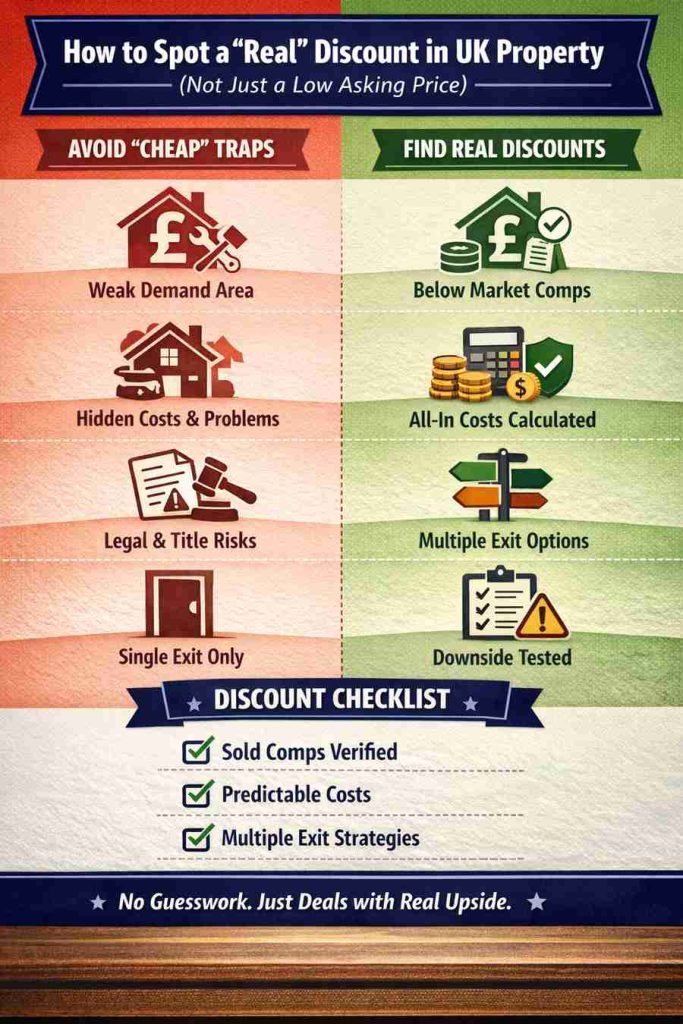
To spot a real discount, you need five numbers (not one). If any of the five numbers fail, the “discount” isn’t investable, it’s just risk dressed up as a bargain.
1) True market value (not agent valuation)
True market value is the price real buyers have recently paid for comparable homes within the property area; not an agent’s optimistic guide or a seller’s anchor price. When you base your analysis on sold comparables and realistic adjustments, you can quickly identify whether the listing is genuinely below market value or simply priced to attract clicks.
Use sold prices, not asking prices.
Your benchmark is:
Comparable sold price – realistic adjustments = True Market Value
Adjustments include:
- size (sqm)
- condition
- bedrooms (only if meaningful locally)
- street quality / micro-location
- lease vs freehold
If you can’t find 3 relevant sold comps within 0.5 miles, be careful. To confirm true market value, check HM Land Registry sold price data for recent transactions near the property, then adjust for size and condition.
2) All-in cost (what it really costs you to own it)
All-in cost is the real price of the deal once you include all cost listed below. Sometimes, the numbers can usually destroy “bargains”. If the property only looks discounted before these are added, it isn’t a deal you can rely on.
Most “discounts” die here.
All-in cost includes:
- purchase price
- SDLT
- legals and searches
- broker fees
- finance fees
- bridging interest (if applicable)
- refurb and contingency
- utilities, council tax and insurance
- letting fees (if letting)
- exit costs (agent, EPC, sales legals)
Rule: A real discount must survive all-in costs, not just purchase price.
3) Your “max bid” (discounted price after margin and risk)
Your max bid is the highest price you can pay while still protecting your profit margin and downside buffer; based on GDV, costs, and risk. If the asking price is above that number, the property isn’t discounted for you, no matter how “cheap” it looks online.
If you want to validate the numbers properly, submit the deal to our Property Deal Analyser and we’ll stress-test it for value, costs, finance, and exit risk.
A buyer’s max bid is what makes the deal safe.
For a flip, one simple formula is:
Max bid = GDV – (Refurb + All costs + Desired Profit + Risk buffer)
If the “cheap price” is still above your max bid, it’s not discounted.
4) Profit margin (not just profit amount)
Profit margin shows whether a deal is worth the effort, risk, and capital tied up; not just whether it makes money on paper. In UK property investing, a “real discount” should produce a strong return relative to time, complexity, and total cash invested.
A £20,000 profit on a risky deal might be terrible.
You want to see:
- profit % on total cash in
- profit vs timeline risk
- profit vs exit uncertainty
Example:
- £25k profit on £110k cash in (23%) = could be decent
- £25k profit on £180k cash in (14%) = not worth the headache (most times)
5) Downside protection (what happens if things go wrong)
Downside protection is your safety margin when the deal doesn’t go to plan on higher refurb costs, longer timelines, softer resale values, or increased interest rates. A genuine UK property discount should still hold up under realistic stress, so you’re not relying on perfect conditions to make the numbers work.
A real discount still works under stress:
Stress-test these:
- refurb +15%
- time +3 months
- sale price -5%
- interest rate +1%
- void period 1–2 months
If your “discount” disappears under light stress, it wasn’t a discount.
Step 3: Spot the 7 types of real discounts in UK property
Real discounts in UK property usually exist because most buyers avoid friction — not because the property is genuinely “worse”. These seven categories show where sellers often price below market due to speed, condition, legal complexity, finance constraints, or strategy mismatch, creating genuine opportunities for prepared investors.
If you can identify the reason for the discount and prove the upside with numbers, you’re much more likely to secure a deal that stacks up for BTL, BRRR, or a flip.
These are the scenarios where “discount” is often genuine (and explainable).
1) Speed discount (deadline seller)
A speed discount happens when the seller values certainty and fast completion over squeezing every last pound from the sale. This is one of the most reliable ways to buy below market value in the UK, especially when the vendor needs a clean exit, minimal delays, and a buyer who can proceed quickly.
If your funding and due diligence process are ready, speed-driven deals can deliver a genuine discount without relying on aggressive refurb assumptions.
Examples:
- probate sale with timeline pressure
- divorce / urgent sale
- auction sellers
- chain collapse
- empty property draining cash
Real discount signal: seller cares about certainty + speed, not price perfection.
2) Condition discount (works needed, but solvable)
A condition discount is where the asking price reflects visible work needed — and the market discounts it because most buyers want “move-in ready”. For investors, this can be a genuine opportunity when the refurb scope is clear, the uplift is supported by sold comparables, and the value-add is achievable within your timeline and budget.
The key is controlling uncertainty: if you can price the works accurately, you can turn a tired property into a measurable below-market purchase.
Examples:
- dated interiors
- minor structural work (not unknown)
- layout improvements
- modernisation / compliance upgrades
A real discount signal that the refurb is priceable and gives a clear uplift; while a fake discount warning indicate that “work is needed” but no one can quote it confidently.
3) Finance discount (harder mortgage = fewer buyers)
A finance discount appears when a property is difficult to mortgage, which shrinks the buyer pool and forces the price down. These deals can be genuinely below market value if the issue is temporary or solvable. Meaning you can exit later into the standard residential market once the friction is removed.
For UK investors using bridging or cash, finance-driven discounts are often where the strongest value gaps exist.
Examples:
- short lease
- non-standard construction
- high-rise blocks
- commercial element
- title quirks
- EPC issues
Real discount signal: it’s hard for normal buyers, but solvable for you.
4) Title / legal discount (paperwork friction)
A title or legal discount happens when paperwork issues scare off mainstream buyers, even though the property itself may be solid. If the problem can be resolved through a clear legal route (or properly insured), the gap between the asking price and true market value can represent a genuine, measurable discount.
The goal is simple: pay less because of the friction, then restore “normal saleability” for your exit.
Examples:
- missing building regs
- missing planning permission evidence
- unclear boundaries
- restrictive covenants
- flying freehold
- absent landlord on a lease
Real discount signal is that, you can fix or insure it and resell normally; while the main warning is that anything that can’t be fixed or insured is not a discount, it’s a liability.
5) Tenanted discount (vacant possession complexity)
A tenanted discount happens when a property is priced lower because buyers struggle with access, viewings, or the timeline to achieve vacant possession. These deals can be genuinely discounted if the tenancy situation is clear, the yield works during the hold period, and you have a realistic route to either retain the tenant or exit cleanly later.
For UK investors, this is where “low price” becomes a real discount, and when you’re being paid for complexity you can manage.
Examples:
- sitting tenants
- limited access for viewings
- rent below market
- delayed vacant possession
Real discount signal: you’re being paid to take the inconvenience, and you’re comfortable with the route to vacant possession.
6) Strategy mismatch discount (good property, wrong audience)
A strategy mismatch discount happens when a property is marketed to the wrong type of buyer, so the price does not reflect its best-use value. This is common in UK property investing, where a deal listed as a standard BTL could actually perform better as a flip, HMO, or multi-let, but the seller is not pricing that upside in.
If you can identify the stronger exit strategy early and back it with sold comparables, this type of discount is often one of the cleanest ways to buy below market value.
Example:
- great HMO property sold as standard BTL
- strong flip property sold by landlord who won’t refurb
- value-add potential ignored by seller
Real discount signal: you see the better strategy, and the market isn’t pricing it in.
7) Micro-market ignorance discount (agent under-prices)
A micro-market ignorance discount happens when the property is under-priced because the agent misjudges the street, demand pocket, or local ceiling price. In the UK, this often creates genuine below-market opportunities when listings are poorly presented, miscategorised, or marketed weakly, so the best buyers never engage.
If your local knowledge and sold comp research show stronger value than the guide price, this can be a real discount driven by visibility, not fundamentals.
Happens when:
- agent is not local
- property is mis-listed (wrong bedroom count, wrong type)
- poor marketing photos / timing
Real discount signal: buyers simply haven’t seen it properly yet.

Step 4: Fake discount red flags (what “cheap” often really means)
Most “cheap” UK properties are not discounted, they are warning signs priced into the deal. These red flags help you spot when the low asking price is caused by weak demand, hidden costs, legal issues, or an exit that only works under perfect assumptions.
Use this checklist to avoid false bargains and focus only on opportunities where the discount is real, measurable, and investable.
These are the traps.
Red flag 1: No sold comparables support the upside
If the ceiling price is low, your “discount” is irrelevant.
Red flag 2: The refurb isn’t measurable
If the refurb cost range is huge (£20k–£60k), the deal is not discounted, it’s uncertain.
Red flag 3: You only have one exit strategy
A discount is safest when you have multiple exits, such as:
- Flip
- Let
- Refinance
- Sell to another investor
If it only works one way, the discount must be deeper.
Red flag 4: It’s cheap because the area has weak demand
Some streets are “cheap forever”.
A true discount is below value for that area, not just low in general.
Red flag 5: The deal depends on perfect assumptions
If it only works when:
- refurb stays exactly on budget
- timeline is perfect
- interest rates stay flat
- GDV hits top comp
That’s not a discount. That’s gambling.
Step 5: The “UncommonDeal Discount Score” (simple and brutal)
The UncommonDeal Discount Score is a quick pass/fail framework for judging whether a UK property is genuinely below market value, or simply low priced for a reason. It focuses on proof, control, and resilience: sold comparables, predictable costs, multiple exits, and downside stress-testing.
If the score is low, the discount is not real, and the smartest move is to walk away early and protect your capital.
Use this quick scoring system (out of 10):
2 points each:
- ✅ Sold comps prove upside
- ✅ Refurb is quoteable + controlled
- ✅ Multiple exit strategies exist
- ✅ Downside stress test still works
- ✅ Discount reason is explainable and fixable
Score guide:
- 8–10: real discount (worth pursuing hard)
- 5–7: borderline (needs negotiation or better structure)
- 0–4: fake discount (walk away)
Quick examples
Example A — “Looks cheap, not discounted”
- Asking: £105k
- Sold comps: £110k
- Refurb: £25k
- Exit: £145k (hope)
- Bridge: 9 months
This is not a discount, it’s full price plus risk.
Example B — “Asking is higher, but discounted”
- Asking: £160k
- Sold comps: £195k in good condition
- Needs modernisation: £20k–£25k
- Strong demand street
- Multiple exits
This can be a real discount even though it’s not “cheap”.
The negotiation line that wins deals
The best negotiation offers in UK property are evidence-led, not emotional, because sellers respond to clarity and certainty. When you anchor your offer to sold comparables, real refurb costs, and time-to-complete, you position yourself as a serious buyer and justify a below-market price without sounding like you are “just trying it on”.
This approach works especially well for motivated sellers, auction-style timelines, and any deal where the discount exists because of friction.
When you can justify the discount clearly, negotiation becomes easy.
Try this style:
“I’m not discounting the property, I’m pricing the risk and the cost to make it mortgageable/resale-ready.
Based on sold evidence and works, my best number is £X. If that works, I can move quickly and proceed without delays.”
That’s clean, rational, and hard to argue against.
Final takeaway: Don’t buy cheap, buy mispriced
In UK property investing, the best deals are rarely the cheapest, they are the ones the market has priced incorrectly because of solvable friction. When you can explain the discount, prove the upside with sold evidence, and protect the downside with stress-testing, you are no longer guessing, you are buying value.
Mispriced opportunities are where real investor profit comes from, not bargain hunting on the asking price alone.
In a word, real discount is where the market has mispriced a property because of friction.
Your job is to confirm:
- the upside is real
- the costs are known
- the risks are contained
- the exits are flexible
That’s what creates decision-grade confidence, and stops you buying “cheap problems”.
Want to know if your “discount” is real?
Submit the deal to UncommonDeal’s Property Deal Analyser — we stress-test it using comps, finance structure, refurb reality, and exit risk so you can see whether it’s genuinely discounted or just cheap.

Koye Beckley is a UK property investor and founder of UncommonDeal, with practical experience in buy-to-let, property auctions, refurbishment projects and investment deal analysis. Through UncommonDeal, he publishes property market research, property deal sourcing and compliance guidance, investment guides and data-driven analysis to help investors evaluate buy-to-let, BRRR, flip and auction opportunities.
