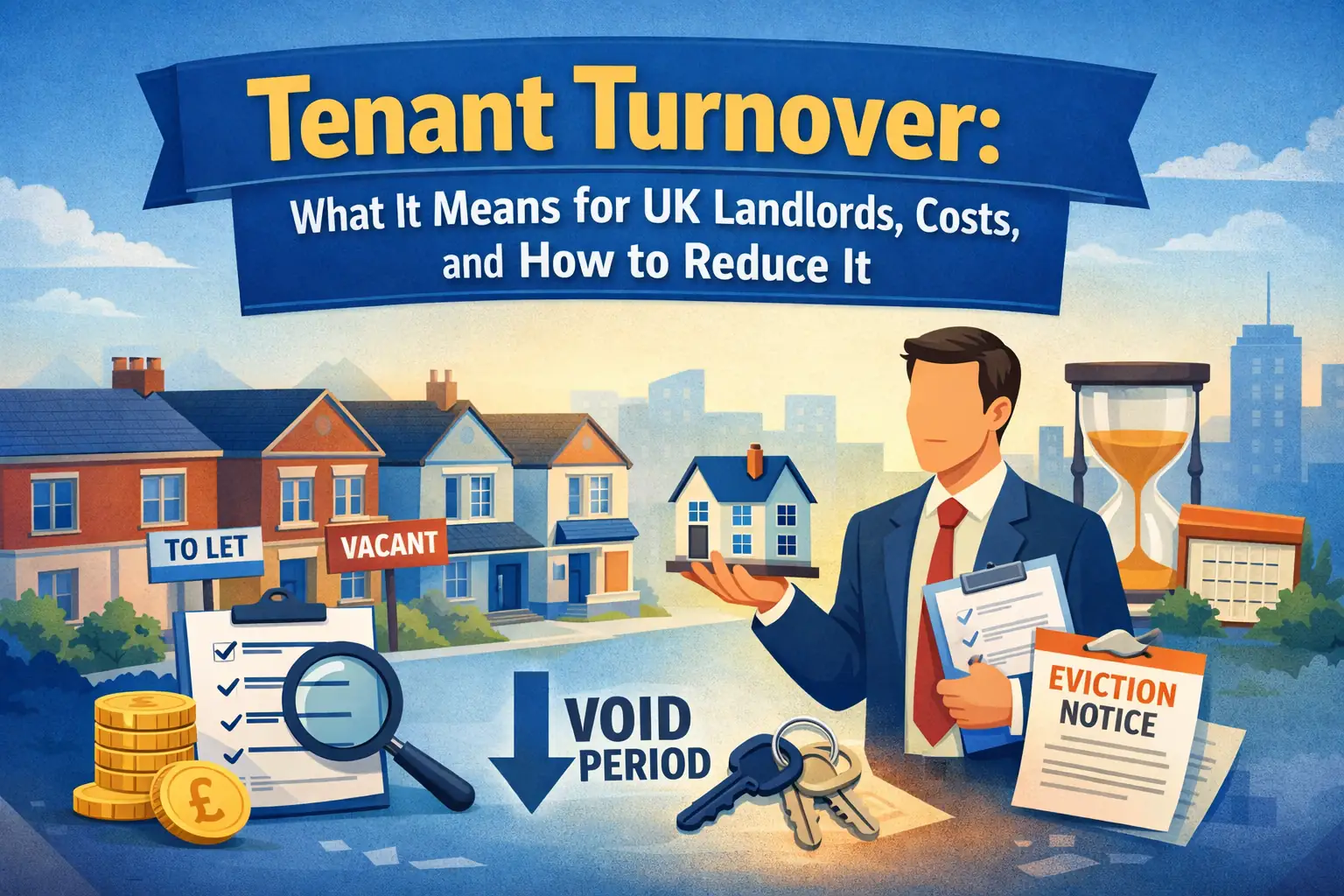
Tenant Turnover Costs: What UK Landlords Must Know
Tenant turnover in the UK refers to how often tenants leave a rental property and the vacancy period before a new tenancy begins. For landlords, it matters because turnover can reduce net income through voids, re-letting fees, and compliance resets.
Although purchase price, mortgage rates, and headline rent are easy to measure, turnover is one of the biggest drivers of real-world performance. Frequent tenant changes can compress yield and make cashflow harder to predict.
This guide outlines the meaning of tenant turnover, the costs it creates, and practical steps to reduce it in UK rental property.
What Is Tenant Turnover?
Tenant turnover refers to the rate at which tenants leave a rental property and are replaced by new occupants. The term is also commonly used to describe the vacancy period between tenancies — the time from one tenant moving out to the next tenant moving in.
In practical terms, tenant turnover captures two connected issues:
- Frequency of tenant departures
- Length of time a property sits empty between tenancies
Both elements directly affect rental income, operating costs, and overall investment performance.
Tenant Turnover vs Vacancy Rate: What’s the Difference?
In UK rental property, tenant turnover and vacancy rate are related but measure different aspects of performance. High tenant turnover refers to how often tenants change, while vacancy rate measures how long a property remains unoccupied.
Although often used interchangeably, tenant turnover and vacancy rate measure slightly different things.
- Tenant turnover focuses on movement — how often tenants change.
- Vacancy rate measures time empty — the percentage of time a property is unoccupied.
A property can experience:
- High turnover with low vacancy (frequent tenant changes but fast re-letting)
- Low turnover with high vacancy (tenants stay longer, but re-letting takes time)
From an investment perspective, both matter, but tenant turnover is often the early warning sign.
Why Tenant Turnover Matters for UK Landlords
Tenant turnover affects far more than just missed rent. Each tenancy change introduces friction, cost, and risk — particularly in the UK, where regulatory compliance and re-letting standards have tightened.
Therefore, high tenant turnover affects rental income by increasing void periods and re-letting costs. For landlords, even short gaps between tenancies can disrupt cashflow while fixed expenses continue.
High tenant turnover can:
- Reduce net yield
- Increase annual operating costs
- Disrupt cashflow forecasting
- Increase management workload
- Expose weaknesses in pricing or tenant selection
Over time, even “small” voids compound and materially reduce returns.
Many landlords now rely on structured property investment analysis to understand how factors like void periods and re-letting costs affect real-world returns.
Common Causes of Tenant Turnover in the UK
In UK rental property, tenant turnover is driven by a mix of market conditions and management decisions. For landlords, understanding which factors are controllable is key to improving tenant retention.
In the light of this, tenant turnover is influenced by both external market conditions and landlord-controlled factors.
Market-Driven Factors
- Job relocation or redundancy
- Changes in household size
- Rising cost of living
- Local rental supply changes
- Interest rate pressure passed through rents
These are largely outside a landlord’s control.
Landlord-Controlled Factors
- Poor maintenance response
- Uncompetitive rent levels
- Weak tenant communication
- Inadequate tenant screening
- Unclear tenancy expectations
Reducing tenant turnover usually starts with addressing the second group.
The True Costs of Tenant Turnover
The costs associated with a change of occupier extend beyond lost rent and are often underestimated. Void periods typically trigger a chain of additional expenses, including council tax, re-letting fees, and compliance resets. Taken together, these costs can materially reduce net rental income even when gaps between tenancies are relatively short.
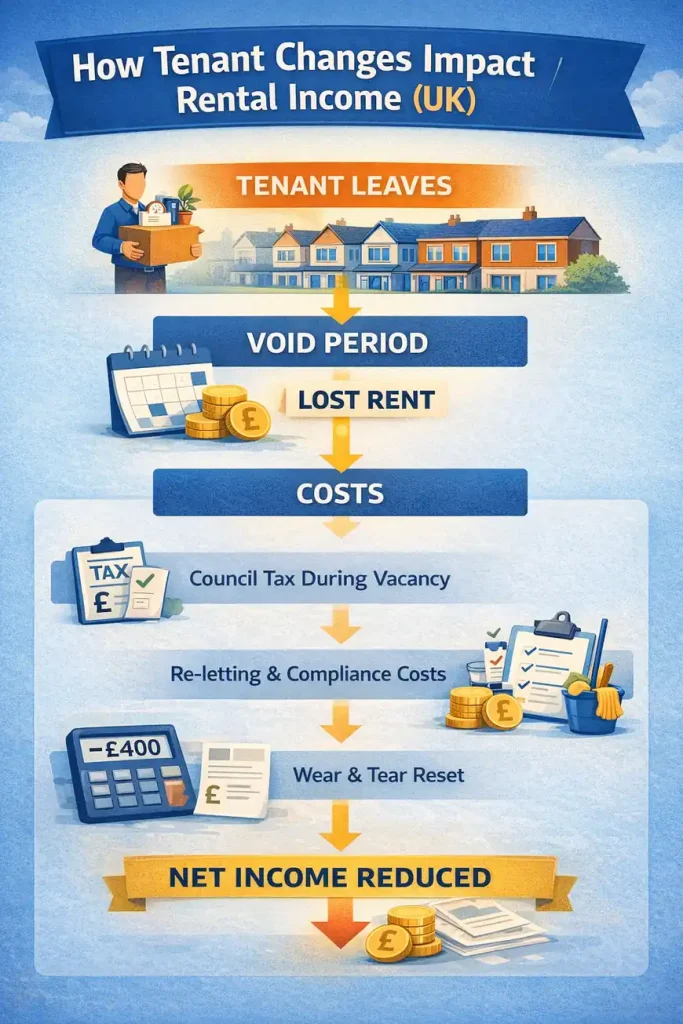
High tenant turnover affects far more than missed rent and often introduces several indirect costs. For landlords, these expenses can accumulate over time and materially reduce net rental returns.
Tenant turnover costs are often underestimated because many expenses are indirect or spread over time. Below is a breakdown of the main cost categories UK landlords typically face.
1. Lost Rental Income During Void Periods
Frequent changes in occupancy affect rental income most directly through void periods. In UK rental property, each vacant day represents income that cannot be recovered once the tenancy gap has passed.
Thus, the most obvious cost is rent not received while the property is vacant.
Even a short void can have a meaningful impact:
- One-month void on a £900 pcm property = £900 lost income
- Two voids per year = £1,800 reduction in gross rent
Void periods often coincide with continued fixed costs, amplifying the effect. Additionally, they are one of the most common reasons rental income underperforms initial projections.
2. Council Tax Liability During Voids
For landlords, tenant turnover can trigger council tax liability during vacancy periods. In UK rental property, this cost often continues even when no rent is being received.
In many UK councils, landlords become liable for council tax once a property is empty.
While discounts may apply initially, these often expire quickly, adding an unexpected cost during vacancy periods.
3. Letting and Re-Letting Fees
High tenant turnover affects operating costs by increasing the frequency of letting and re-letting fees. For landlords using agents, these charges can significantly reduce net income over time.
Depending on the management structure, turnover may trigger:
- Tenant-find fees
- Inventory updates
- Check-in / check-out reports
- Referencing and right-to-rent checks
Even self-managing landlords incur time and administrative costs during re-letting.
4. Cleaning, Repairs, and Compliance Resets
In UK rental property, changes in tenant often requires cleaning, repairs, and updated compliance checks before a new tenant moves in. For landlords, these reset costs apply regardless of how long the previous tenancy lasted.
Most tenancy changes require some level of reset:
- Professional cleaning
- Minor repairs or redecorating
- Safety certificate renewals (gas, EICR)
- Smoke and carbon monoxide compliance checks
These costs are rarely optional and increase with frequency of turnover.
5. Marketing and Advertising Costs
The rate at which tenant is turned around on a property is directly related to the cost of marketing and advertisment. Therefore, it directly affects marketing spend by increasing the need for advertising and viewings. For landlords, repeated re-letting can make these costs more noticeable over the course of a year.
Marketing expenses may include:
- Online listings
- Photography
- Agent advertising packages
- Time spent conducting viewings
While individually modest, they add up over repeated turnovers.
6. Increased Wear and Tear
For landlords, the rate at whinh tenant move-in and move-out can accelerate wear and tear within a property. In UK rental property, more frequent tenant changes often lead to higher maintenance and replacement costs.
Frequent tenant changes accelerate:
- Carpet replacement
- Painting cycles
- Appliance wear
- Fixture degradation
Higher turnover generally correlates with higher long-term maintenance spend.
How Tenant Turnover Impacts Investment Performance
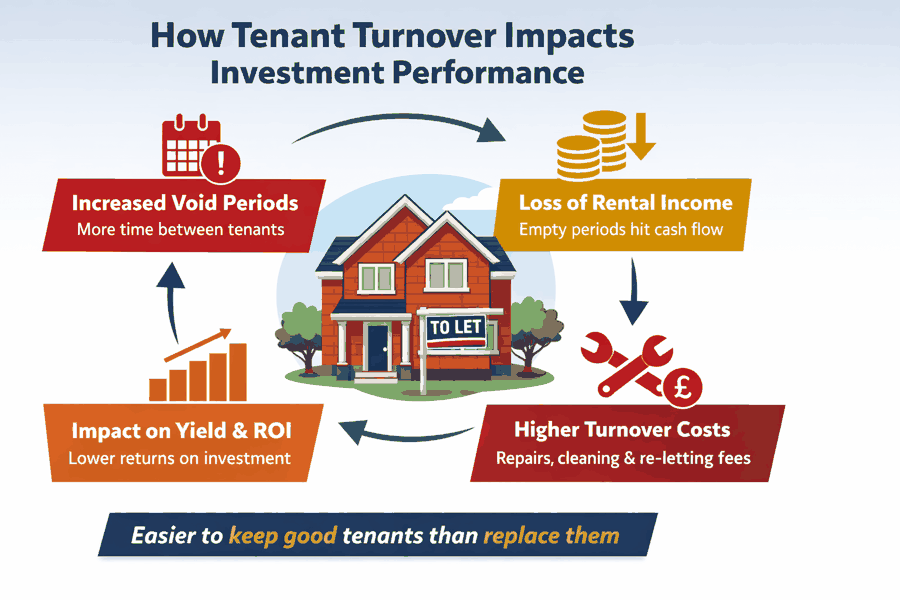
The frequency of tenant change affects key investment metrics such as yield, cashflow, and income reliability. For landlords, increased tenant movement can make projected returns less predictable.
Tenant turnover affects multiple performance metrics used by UK investors.
Yield Compression
Gross yields may appear healthy on paper, but net yields fall sharply when voids and turnover costs are accounted for.
Cashflow Volatility
High turnover introduces unpredictability, making mortgage payments and reserves harder to manage — particularly with variable interest rates.
Risk Mispricing
Deal appraisals that assume continuous occupancy often overstate returns, especially in areas with transient tenant demand.
Tenant Turnover in Different UK Rental Strategies
In UK rental property, patterns of occupancy change vary widely depending on the strategy being used. For landlords, understanding these differences is essential when comparing single-let, HMO, and short-term letting models.
Occupancy patterns vary significantly between single-let properties, HMOs, and short-term letting strategies as discribed in rental strategy comparison guide.
Single-Let Buy-to-Let
Typically lower turnover, but longer voids when tenants do leave. Take a look at the 12 top reasons UK Tenants Leave their rented property.
HMOs
Higher tenant movement, but staggered income reduces total void risk.
Short-Term or Serviced Accommodation
Extremely high turnover by design, requiring robust operational systems to remain profitable.
Understanding expected turnover is critical when comparing strategies.
How to Reduce Tenant Turnover: Practical UK-Focused Strategies
For landlords, the rate at which tenancy change can often be reduced through practical improvements in pricing, maintenance, and communication. In UK rental property, small management changes can have a meaningful impact on tenant retention.
While turnover cannot be eliminated entirely, it can be materially reduced with the right approach.
1. Price Rent at Market Level — Not Maximum
Overpricing rent often leads to:
- Longer voids
- Shorter tenancies
- Higher churn
Sustainable pricing usually outperforms aggressive rent setting over time.
2. Maintain the Property Proactively
Fast response to maintenance issues signals professionalism and encourages tenants to stay longer.
Deferred maintenance often leads to:
- Tenant dissatisfaction
- Early exits
- Higher long-term repair costs
3. Communicate Clearly and Consistently
Simple improvements such as:
- Clear contact channels
- Transparent processes
- Timely updates
Can significantly improve tenant retention.
4. Screen Tenants Properly
Robust referencing reduces:
- Rent arrears
- Early departures
- Tenancy disputes
Stable tenants are more likely to remain long-term.
5. Encourage Longer Tenancy Agreements
In UK rental property under the new Renters’ Rights Act, fixed-term contracts (such as 12–24 months) are being replaced by rolling periodic tenancies. However, landlords may benefit from structuring agreements and management practices that make tenancies functionally longer.
For example by ensuring tenants understand market rent expectations, offering clear rent review processes, and providing incentives for continued occupation. These approaches can help reduce turnover without sacrificing tenant flexibility and legal compliance.
In effect, this can help reduce turnover without sacrificing flexibility.
Encourage Longer Effective Tenancy Periods (Post-Renters’ Rights Act)
Under the Renters’ Rights Act 2025, most fixed-term assured shorthold tenancies are being replaced by periodic (rolling) tenancies, changing how landlords approach tenant retention. While traditional 12–24 month fixed terms may no longer be standard, landlords can still encourage longer effective tenancy periods through compliant structures and management practices.
Understanding Protected Periods
The new framework introduces protected periods during which landlords are restricted from seeking possession on many grounds. In practice, this means that for a defined initial period of a tenancy, landlords may have limited ability to regain possession except under specific, justified circumstances.
For landlords, this creates a shift:
- The focus moves from contract length to tenancy stability
- Reducing early tenant churn becomes more valuable
- Clear expectations at the start of a tenancy matter more than ever
Protected periods can function similarly to fixed terms in terms of stability, provided the tenancy is well-managed.
Changes to Eviction Grounds and What They Mean for Turnover
With the removal of “no-fault” eviction routes, possession is now primarily linked to specific statutory grounds, such as:
- Selling the property
- Moving in a close family member
- Serious rent arrears or tenancy breaches
These changes place greater emphasis on:
- Up-front tenant selection
- Clear communication of landlord intentions
- Ongoing tenancy management
For landlords, higher tenant turnover caused by poor fit or unclear expectations becomes harder to correct quickly, making prevention more important than cure.
Practical Retention Strategies That Still Work
Even within a periodic tenancy framework, landlords can reduce turnover by making tenancies functionally longer:
- Rent review clarity
Being transparent about how and when rent may be reviewed helps tenants plan ahead and reduces unexpected exits. - Early communication of long-term intentions
If a landlord expects to hold a property for several years, stating this clearly can reassure tenants seeking stability. - Incentives for continuity
Prompt maintenance responses, predictable management, and minor discretionary improvements can encourage tenants to remain beyond the minimum notice period. - Professional onboarding
Setting clear expectations at the start of the tenancy reduces disputes that often lead to early departures.
Why This Matters for Tenant Turnover
Under the new regime, frequent tenant changes increase risk, not just cost. Longer effective tenancies:
- Reduce void periods
- Lower re-letting and compliance reset costs
- Improve cashflow predictability
- Reduce exposure to possession delays
For landlords navigating the transition, the goal is no longer to “lock in” tenants contractually, but to create conditions where tenants choose to stay.
This information is general in nature and reflects current guidance on the phased introduction of the Renters’ Rights Act 2025. Landlords should always check official sources for the most up-to-date requirements.
Modelling Tenant Turnover in Deal Analysis
In UK rental property analysis, tenant turnover is increasingly modelled as a core risk assumption. For landlords and investors, including realistic void and re-letting costs helps prevent overstating returns.
Experienced investors increasingly factor it into their financial modelling.
Key assumptions often include:
- Conservative void periods
- Annualised maintenance allowances
- Re-letting cost provisions
Stress-testing deals against higher-than-expected turnover helps identify fragile investments before capital is committed.
This is particularly important when buying at auction, where incomplete auction property due diligence can increase the risk of extended voids and unexpected costs.
Is Low Tenant Turnover Always Better?
Not necessarily.
For landlords, longer periods of continuous occupancy are usually positive, but not always optimal. In UK rental property, extended tenancies can sometimes limit rental growth or delay necessary upgrades.
Low turnover can sometimes:
- Lock in below-market rents
- Delay necessary refurbishments
- Reduce flexibility in changing market conditions
The goal is optimal, not minimal, turnover — balancing stability with long-term performance.
Tenant Turnover and the UK Regulatory Environment
In UK rental property, a change of occupier often triggers additional regulatory requirements. For landlords, each new tenancy may require updated checks, certificates, and prescribed information.
UK landlords must also account for compliance obligations triggered by tenancy changes, including:
- Right-to-rent checks
- Updated safety certificates
- Deposit handling rules
- Prescribed information requirements
Higher turnover increases regulatory exposure and administrative burden.
Landlords navigating these changes should refer to official UK government guidance on private renting for the most up-to-date requirements.
Measuring Tenant Turnover Effectively
For landlords, occupancy patterns can be measured using indicators such as average tenancy length and annual void periods. In UK rental property, tracking these metrics provides a clearer view of performance than headline yields alone.
Common ways to monitor turnover include:
- Average tenancy length
- Annual void days per property
- Re-letting cost as a percentage of rent
- Net yield after void adjustments
Tracking these metrics over time provides far better insight than headline yield figures alone.
Key Takeaways
Frequent changes in occupancy affect both profitability and risk in UK rental property. For landlords, understanding the causes and costs of these changes is essential for making more resilient investment decisions.
- Tenant turnover measures both tenant movement and vacancy time
- High turnover directly reduces net rental profitability
- Many turnover costs are indirect and underestimated
- UK-specific factors amplify the impact of frequent tenant changes
- Reducing turnover requires pricing discipline, maintenance, and communication
- Modelling turnover realistically improves investment decision-making
Final Thoughts
Tenant turnover is not simply an operational inconvenience — it is a core driver of rental performance. Understanding its causes, costs, and implications allows landlords and investors to make better decisions, price risk more accurately, and build more resilient portfolios.
In a market where margins are tighter and regulation is more demanding, managing tenant turnover effectively has become an essential skill rather than an optional optimisation.

Koye Beckley is a UK property investor and founder of UncommonDeal, with practical experience in buy-to-let, property auctions, refurbishment projects and investment deal analysis. Through UncommonDeal, he publishes property market research, property deal sourcing and compliance guidance, investment guides and data-driven analysis to help investors evaluate buy-to-let, BRRR, flip and auction opportunities.
