Most people think real estate is about finding a bargain and watching the market do the rest. That belief is why so many investors buy a “deal” that turns into a cashflow headache, a refinance disappointment, or a flip that drags on for months longer than planned.
Professionals don’t have magical access or secret spreadsheets. What they have is a different way of thinking: they treat property like a business, and they make decisions using evidence, numbers, and downside planning.
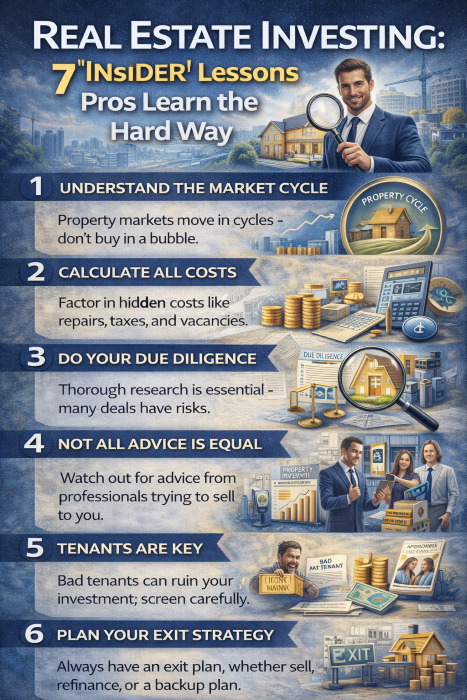
Below are seven “insider” lessons professional investors learn early (often the hard way). They’ll help you understand the finance, sourcing, and deal analysis that actually produces profitable outcomes—especially in the UK.
If you want a structured overview of what proper analysis includes, start with UK property deal analysis.
Secret #1: A “Good Deal” Is a Deal With a Strong Downside — Not a Great Upside
Beginners often ask: “How much can I make?” Professionals ask: “How much can I lose, and how likely is it?”
That’s the difference.
A deal can look amazing with optimistic assumptions:
top-of-market resale value
zero delays
perfect tenants
best-case mortgage products
refurb magically stays on budget
But real life is messy. Materials arrive late. Contractors get sick. Surveys discover issues. Buyers renegotiate. Valuations come in lower. Finance costs keep ticking.
What professionals do instead
They build an analysis that works under “normal problems,” not perfect conditions:
resale value 5–10% lower than the best comparables
refurb costs 10–15% higher
project timeline 1–2 months longer
interest rates 1–2% higher
voids and rent reductions built in
If the deal still works—or at least stays safe—then it’s worth serious attention.
Takeaway: Upside is optional. Downside is mandatory.
Secret #2: The Real Profit Is Made at Purchase — But Only If Your Max Offer Is Calculated
Property investors love talking about strategies. Professional investors spend more time on something less glamorous: the maximum offer price.
Your max offer isn’t what you feel comfortable with. It’s a number produced by the deal’s structure.
The simple formula (the one pros actually live by)
Maximum Offer = Conservative End Value − All Costs − Required Profit Buffer
That “profit buffer” isn’t greed. It’s your insurance against real-world friction.
Why this matters
If your deal only works when:
you buy at the guide price
the refurb is perfect
the valuation is generous
the exit is fast
…then you don’t have a deal. You have a fragile plan.
Professional investors can walk away because they already decided the number before emotion kicks in.
Secret #3: Finance Is the Silent Deal Killer (Even When Everything Else Looks Fine)
Many deals fail quietly—not because the property is bad, but because the finance assumptions were lazy.
What beginners often do
Use a single “typical mortgage rate”
Ignore fees
Assume refinance is guaranteed
Underestimate bridging timelines
Forget holding costs during refurb and marketing
What professionals do
They model finance like a risk factor, not a line item.
If using a mortgage (BTL or purchase)
Pros ask:
What’s the payment at today’s rate?
What if rates rise by 1%?
What if rent drops slightly or voids increase?
Does the deal still have safe coverage?
If using bridging (common for auctions/refurbs)
Pros model:
arrangement fees + broker fees
interest per month
exit fees (if applicable)
realistic timeline + overrun timeline
worst-case exit delay
They also ask a brutal question: “If the refinance valuation comes in 10% lower, does the plan still work?”
That one question saves people from expensive surprises.
Takeaway: If your finance plan needs perfect timing, it’s not a plan.
Secret #4: Most “Deal Finding” Is Actually Deal Filtering
People say: “How do I find deals?” Professionals would answer: “How do you avoid wasting time on non-deals?”
Because most listed properties are already priced for retail buyers. The “deal” isn’t in the listing—it’s in the situation or the value-add.
Where real opportunities usually come from
Auctions (distressed or non-standard stock)
Probate and tired landlords selling
Properties with poor presentation
Chain collapse or urgent sales
Structural layout issues that can be improved
Planning angles (where appropriate)
The pro system: pipelines, not browsing
Professionals usually run a pipeline:
specific postcodes
daily or weekly scans
agent relationships
repeatable “quick filter” criteria
pre-built calculator templates
They don’t “hunt” deals in chaos. They let deals come through a system, then filter fast.
Takeaway: The best investors don’t find more deals. They reject bad deals faster.
Secret #5: Valuation Is Not “What It Could Be Worth” — It’s “What Someone Actually Pays”
A common mistake is using asking prices or the highest comparable as “the value.”
Professionals treat value like a courtroom case:
What evidence supports it?
Are the comps truly comparable?
Can the market absorb it quickly?
How professionals value properly
They base end value on:
sold prices in the last 6–12 months
similar property type, bed count, condition
realistic adjustments for size and finish
local buyer demand and liquidity
For flips, they ask:
Will my finished property match the best comp, or just be “good”?
Is the street desirable or merely average?
Are buyers active in that price bracket?
For rentals, they do the same with rent:
achieved rents (where possible)
tenant affordability
condition/spec compared to competitors
void risk
In fact, professional investors rely on evidence rather than headlines when assessing value; often referencing established pricing data and methodologies such as those outlined in the Nationwide House Price Index methodology to understand how real market values are formed.
Takeaway: The market doesn’t pay for your spreadsheet. It pays for evidence and desirability.
Secret #6: Professional Returns Are Measured in Net Cashflow and Resilience (Not Gross Yield)
Gross yield is popular because it’s quick. It’s also misleading.
Professionals focus on:
net cashflow (after real costs)
cash-on-cash return
break-even occupancy
downside scenarios
the quality of the tenant base and demand
What to include (minimum)
mortgage/interest
management (even if self-managing, value your time)
maintenance allowance
insurance
compliance and certificates
void allowance
service charges/ground rent (if applicable)
The truth: Some “high yield” areas deliver poor net returns due to voids, management intensity, and tenant risk. Some “lower yield” areas perform better due to stability and liquidity.
Takeaway: A resilient 6% can beat a fragile 9%.
Secret #7: The Best Investors Win With Process, Not Prediction
People love to predict: “Is the market going up or down?”
Professionals care more about:
buying with margin of safety
improving a property’s quality or layout
keeping finance conservative
choosing an exit that suits the area
running a tight management process
Their edge is boring—but powerful
checklists
repeatable models
conservative assumptions
clear exit strategy
legal and compliance awareness
disciplined max offer rule
This is why two people can buy in the same market—one succeeds, one struggles. The market is shared. The process is not.
Putting It All Together: A Step-by-Step Mini Framework (Practical)
If you want a simple version you can use on your next deal:
Define the strategy (BTL, BRRR, flip)
Validate sold comps (end value)
Estimate achievable rent (not advertised top rent)
Build total cost model (purchase + refurb + holding + exit)
Model finance conservatively (fees + overrun timeline)
Calculate net returns (not gross yield)
Stress-test (rate up, costs up, value down, delay)
Common Mistakes That Cost Investors Money (Quick List)
Overpaying because the area is “hot”
Using asking prices instead of sold comps
Forgetting finance and holding costs
Underestimating refurb scope and time
Not budgeting contingency
Assuming refinance valuation will be generous
Ignoring legal pack or title risks
Choosing an exit with weak buyer demand
If you avoid these, you’re already operating more like a professional.
Final Thoughts: The Real “Secret” Is Discipline
Real estate isn’t a mystery business. The “secrets” are mostly unglamorous habits: careful valuation, realistic finance modelling, stress testing, and disciplined max offers.
If you take one thing from this article, let it be this:
The best investors don’t rely on luck—they rely on a repeatable process that protects the downside.
Koye Beckley is a UK property investor and founder of UncommonDeal, with practical experience in buy-to-let, property auctions, refurbishment projects and investment deal analysis. Through UncommonDeal, he publishes property market research, property deal sourcing and compliance guidance, investment guides and data-driven analysis to help investors evaluate buy-to-let, BRRR, flip and auction opportunities.
Manage Consent
To provide the best experiences, we use technologies like cookies to store and/or access device information. Consenting to these technologies will allow us to process data such as browsing behaviour or unique IDs on this site. Not consenting or withdrawing consent, may adversely affect certain features and functions.
Functional
Always active
The technical storage or access is strictly necessary for the legitimate purpose of enabling the use of a specific service explicitly requested by the subscriber or user, or for the sole purpose of carrying out the transmission of a communication over an electronic communications network.
Preferences
The technical storage or access is necessary for the legitimate purpose of storing preferences that are not requested by the subscriber or user.
Statistics
The technical storage or access that is used exclusively for statistical purposes.The technical storage or access that is used exclusively for anonymous statistical purposes. Without a subpoena, voluntary compliance on the part of your Internet Service Provider, or additional records from a third party, information stored or retrieved for this purpose alone cannot usually be used to identify you.
Marketing
The technical storage or access is required to create user profiles to send advertising, or to track the user on a website or across several websites for similar marketing purposes.