
UK Landlord Market Trends 2026: Who’s Buying and Who’s Selling?
UK landlord market trends in 2026 tell a more complicated story than the familiar headline that landlords are simply leaving the private rented sector.
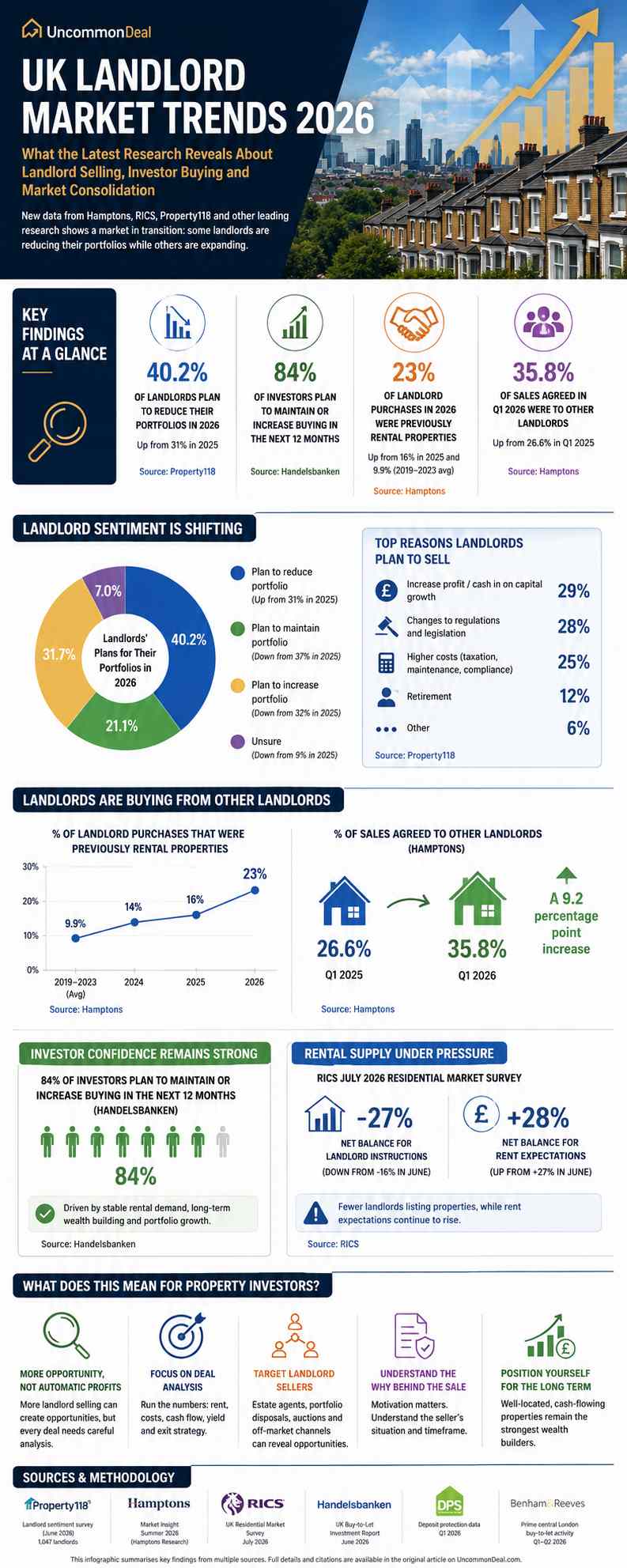
There is clear evidence that many landlords are selling. Property118’s Q2 2026 Landlord Sentiment Survey found that 40.2% of respondents had reduced their portfolios over the previous two years, while only 6% had expanded. Higher costs, taxation, regulation and changing returns are encouraging some landlords to reconsider their position.
But that is only one side of the market.
Handelsbanken’s 2026 Property Investor Report found that 84% of the property professionals and investors surveyed planned to increase their holdings. Meanwhile, Hamptons reported that 23% of homes purchased by landlords in 2026 had previously been rental properties, up from 16% in 2025 and an average of 9.9% between 2019 and 2023.
This raises an important question:
Is the UK experiencing a landlord exodus, or is the private rented sector gradually consolidating as some landlords sell and other investors expand?
This UncommonDeal analysis brings together several major 2026 landlord and property-market datasets to examine who is selling, who is buying and what may be driving these different investment decisions.
Because the studies survey different groups and use different methodologies, their percentages should not be treated as directly comparable measures of the entire UK landlord population. Instead, together they reveal a market increasingly defined not simply by landlords leaving, but by who is selling, who is buying and where rental-property ownership may be heading next.
Key Findings: UK Landlord Market Trends 2026
The data analysed by UncommonDeal points to a UK private rented sector moving in two directions.
While many landlords are reducing their portfolios, other investors are continuing to acquire rental property.
Property118’s Q2 2026 survey found that 40.2% of respondents had reduced their property portfolios over the previous two years.
Handelsbanken’s 2026 Property Investor Report found that 84% of surveyed property investors and professionals planned to increase their holdings.
Hamptons reported that 23% of homes purchased by landlords in 2026 had previously been rental properties.
In northern England, 35.8% of buy-to-let investor purchases were homes that had previously been rented out.
DPS research found that the proportion of surveyed landlords owning just one or two properties fell from 57% to 50%.
What the Data Suggests
Taken together, these findings suggest that the UK landlord market may be undergoing consolidation rather than a uniform exodus. Some landlords are selling or reducing their exposure, while other investors are acquiring properties and expanding their portfolios.
Methodology note: The datasets use different samples, methodologies and time periods and should not
be directly compared as measures of the entire UK landlord population. They are analysed together to identify broader
trends within the private rented sector.
The UK Landlord Market Is Splitting in Two
The UK private rented sector is increasingly difficult to describe with a single headline. While some landlords are selling properties or leaving the market, others are actively looking to expand.
Much of the discussion has focused on a potential “landlord exodus”, driven by higher borrowing costs, taxation, regulation and rising operating costs. These pressures are particularly significant for landlords whose portfolios produce relatively narrow margins.
However, properties sold by landlords do not necessarily disappear from the private rented sector.
Hamptons data shows that an increasing proportion of homes purchased by landlords were already rental properties, suggesting that some rental stock is moving from one landlord to another rather than leaving the sector.
There is also a striking contrast between general landlord sentiment surveys and research involving professional property investors. While significant numbers of landlords report reducing their portfolios, Handelsbanken found strong expansion intentions among the investors and property professionals it surveyed.
Taken together, the evidence points towards a market that may be becoming more concentrated and professionalised.
Some smaller or highly leveraged landlords may be more inclined to sell, while investors with stronger access to capital or strategies focused on higher-yielding and value-add opportunities may be better positioned to acquire.
The defining UK landlord market trend in 2026 may therefore be less about whether landlords are leaving and more about who is selling, who is buying and where those rental properties ultimately end up.
How Many UK Landlords Are Selling Property in 2026?
There is substantial evidence that many UK landlords are reducing their exposure to the private rented sector.
Property118’s Q2 2026 Landlord Sentiment Survey found that 40.2% of respondents had reduced their portfolios during the previous two years, while 53.8% remained broadly unchanged and only 6% had expanded.
Future intentions also point towards continued selling. The Deposit Protection Service’s 2026 Private Rented Sector Review found that 56% of landlords surveyed planned to sell some or all of their rental properties within the next one to two years.
Research from Benham & Reeves provides another indication of the imbalance between buyers and sellers. Its 2026 landlord research found that 27.2% planned either to reduce their portfolios or exit the sector, compared with just 3.9% who intended to expand.
These surveys use different samples, questions and time periods, so the percentages should not be directly compared. Nevertheless, they consistently show that a meaningful proportion of landlords are considering disposals while relatively few respondents in general landlord surveys are planning expansion.
This creates an important distinction between landlords leaving property investment completely and those simply restructuring their portfolios.
A landlord selling one poorly performing property while retaining several others is very different from somebody exiting the private rented sector altogether. Understanding that distinction is essential when assessing whether Britain’s rental stock is genuinely disappearing or simply changing ownership.
Why Are UK Landlords Selling?
The decision to sell rental property rarely comes down to a single factor. In 2026, landlords are balancing higher costs, regulatory change and the returns available from their portfolios.
Higher Finance and Operating Costs
Higher borrowing costs have placed additional pressure on leveraged landlords, particularly where mortgage payments have risen faster than rents. Maintenance, insurance, management and refurbishment costs have also increased, reducing margins on some properties.
Tax and Regulatory Pressure
Changes to the tax treatment of landlords, alongside greater regulatory responsibilities, continue to influence investment decisions. The implementation of the Renters’ Rights Act is also changing how landlords assess the long-term responsibilities and risks associated with remaining in the sector.
Portfolio Performance
Not every rental property performs equally. Some landlords are using the current environment to dispose of lower-yielding properties, release equity or concentrate their portfolios in locations offering stronger rental demand and returns.
For landlords managing one or more rental properties, keeping a clear record of rental income, expenses and cash flow can make it easier to assess how each property is performing. Our rental property income and expense tracker helps organise these figures in one place using Microsoft Excel or Google Sheets.
Retirement and Changing Priorities
Some selling is also part of the natural investment cycle. Landlords who have owned property for many years may decide to realise capital gains, reduce management responsibilities or use accumulated equity for retirement.
The result is not necessarily a wholesale rejection of property investment. In many cases, landlords are becoming more selective about what they continue to own.
This helps explain why rising property disposals can exist alongside continued investment: one landlord may decide that a property no longer fits their strategy at exactly the point another investor sees an opportunity to acquire it.
Professional Property Investors Are Still Buying
While general landlord surveys show significant selling intentions, research focused on professional property investors presents a very different picture.
Handelsbanken’s 2026 Property Investor Report found that 84% of the property investors and professionals surveyed planned to increase their portfolio holdings, compared with 54% in the previous year. Only 1% expected to exit the market completely.
Among those planning to expand, 70% identified buying opportunities and attractive valuations as a reason, while 58% pointed to strong rental demand and 33% cited the availability of finance.
These figures should not be directly compared with general landlord surveys because the populations and methodologies differ. However, the contrast provides an important insight into how different parts of the market are responding to the same economic and regulatory environment.
Conditions that encourage one landlord to sell can potentially create an acquisition opportunity for another investor.
For investors looking to expand their portfolios, identifying the right buy-to-let investment deals remains critical, as increased availability does not necessarily mean every rental property represents a profitable opportunity.
Professional and portfolio landlords may have greater access to capital, more diversified rental income and the ability to spread operating costs across multiple properties. Some may also be better positioned to undertake refurbishment or acquire properties requiring more active management.
The result is a market where landlord selling and investor buying can happen simultaneously.
Rather than investment demand disappearing altogether, the evidence suggests that some demand may be shifting towards investors with the capital, experience and strategy to continue acquiring in a more challenging market.
Why Are Some Property Investors Expanding?
The same market pressures encouraging some landlords to sell can create opportunities for investors who remain in a position to buy.
More Buying Opportunities
When more landlords consider selling, investors may gain access to properties that would otherwise remain within long-term portfolios. Increased supply can also give buyers greater negotiating power, particularly where vendors are motivated to sell.
Some of these opportunities may also emerge as off-market property deals, particularly where landlords prefer a quicker or more discreet portfolio disposal.
Strong Rental Demand
Rental demand remains an important reason for investment. Handelsbanken found that 58% of surveyed investors planning expansion identified strong rental demand as a factor behind their decision.
Opportunities to Add Value
Some investors are not relying solely on house-price growth. Properties requiring refurbishment, improved management or repositioning may provide opportunities to create equity or improve rental returns.
Long-Term Investment Strategy
Short-term market conditions do not necessarily change an investor’s long-term objectives. Investors focused on building rental income and property assets over many years may view periods of weaker confidence as an opportunity to acquire selectively.
However, greater availability does not automatically mean better deals. Purchase price, finance costs, refurbishment, achievable rent and realistic end value still determine whether an acquisition makes financial sense.
The investors continuing to expand in 2026 therefore appear to be operating in an increasingly selective market, where the quality and economics of individual deals matter more than simply increasing portfolio size.
Landlords Are Increasingly Buying Properties From Other Landlords
One of the strongest signs of change within the private rented sector is the growing number of landlords buying properties that were already being rented.
According to Hamptons, 23% of homes purchased by landlords in 2026 had previously been rental properties. That compares with 16% in 2025 and an average of just 9.9% between 2019 and 2023.
This suggests that a growing proportion of landlord sales are not necessarily removing homes from the rental market. Instead, some properties are effectively being transferred from one landlord’s portfolio to another.
There may also be a financial reason why these properties attract investors. Hamptons reported that landlords buying previously rented homes achieved an average gross yield of 7.0% in 2026, compared with 5.9% in 2022.
Existing rental properties can also offer investors advantages such as established rental demand, clearer evidence of achievable rents and, in some cases, an existing tenancy.
The trend provides an important counterpoint to headlines about landlords selling. Rising disposals can reduce rental supply when properties are bought by owner-occupiers, but where another landlord acquires the property, the ownership changes while the home may remain within the private rented sector.
This landlord-to-landlord rotation is therefore an important part of understanding UK landlord market trends in 2026.
The North Is Seeing the Strongest Landlord-to-Landlord Rotation
The movement of rental properties between investors is particularly visible in the North of England.
Investors considering where these opportunities may be concentrated can also explore our analysis of the best areas to invest in property, which compares locations based on factors relevant to property investors.
Hamptons reported that 35.8% of buy-to-let purchases in the North during 2026 had previously been rental properties. This was substantially higher than the national figure of 23%.
Landlords also accounted for 23.9% of all property transactions in the North between January and April 2026, compared with 14.5% during the same period in 2025.
One possible explanation is the stronger rental yields available in many northern markets. Lower property prices relative to achievable rents can make these areas attractive to investors focused on income rather than relying primarily on capital growth.
The figures also support the wider consolidation argument. If smaller landlords are selling rental properties that are subsequently acquired by other investors, parts of the private rented sector may be changing ownership rather than simply shrinking.
However, the trend will vary considerably between individual towns and cities. Strong headline yields alone do not make a property a good investment; local rental demand, property condition, tenant profile and purchase price remain critical.
Nevertheless, the data suggests that northern England is playing an important role in the reshaping of landlord ownership in 2026, with investors acquiring a significant proportion of properties already operating within the rental market.
Is Britain’s Private Rental Sector Consolidating?
Taken together, the 2026 data suggests that Britain’s private rented sector may be undergoing a gradual consolidation of ownership, although it is too early to describe this as a definitive structural shift.
Deposit Protection Service data provides one indication. Between October 2024 and October 2025, the proportion of surveyed landlords owning just one or two properties fell from 57% to 50%. Over the same period, those owning three to five properties increased from 27% to 31%, while landlords with more than 11 properties rose from 5% to 8%.
This does not prove that larger landlords are directly acquiring properties from smaller landlords. However, when considered alongside Hamptons’ finding that an increasing proportion of landlord purchases involve homes already within the rental sector, a clearer pattern begins to emerge.
Some smaller landlords are selling, while other investors are expanding and acquiring existing rental stock.
The result could be a private rented sector with fewer small landlords and a greater concentration of properties within larger portfolios.
This matters because a landlord selling a property does not automatically mean that a rental home has disappeared. The eventual impact on rental supply depends partly on who buys it.
The evidence therefore supports a more nuanced interpretation of the landlord-exodus narrative: Britain’s rental market may be experiencing both landlord exits and portfolio consolidation at the same time.
UK landlord market trends: UncommonDeal analysis of landlord selling, investor buying, landlord-to-landlord purchases and changing rental market ownership.
What Do These UK Landlord Market Trends Mean for Property Investors?
For property investors, the changing structure of the private rented sector could create opportunities, but it also increases the importance of disciplined deal selection.
If more landlords decide to reduce their portfolios, investors may encounter more properties being sold with an established rental history.Some vendors may also prioritise certainty and speed over achieving the highest possible price.
Investors looking to take advantage of changing ownership patterns should understand how to source property deals through multiple channels rather than relying solely on properties advertised on the major portals.
However, a landlord selling does not automatically make a property a good investment. The reason for the sale matters. Poor rental demand, high maintenance costs, weak yields or expensive financing can affect the next owner just as easily as the previous one.
Investors therefore need to assess each opportunity independently, including the purchase price, achievable rent, refurbishment costs, financing, ongoing expenses and realistic exit value.
A structured property investment analysis can help investors test these assumptions before committing capital to a potential acquisition.
The geographical shift is also significant. Hamptons’ data indicates particularly strong landlord buying activity in northern England, but investors should avoid selecting locations based on headline yields alone. Local employment, tenant demand, property values and future resale prospects remain important.
The wider lesson from the 2026 data is that periods of landlord selling can create opportunities for other investors, but only where the underlying numbers support the acquisition.
As the market becomes more selective, the advantage may increasingly lie with investors who can identify why a property is being sold, what value can realistically be created and whether the deal remains viable under conservative assumptions.
What Could This Mean for Tenants and Rental Supply?
The changing ownership of rental properties could have important consequences for tenants and the overall supply of homes available to rent.
When a landlord sells to an owner-occupier, that property may leave the private rented sector, reducing available rental stock. However, when another landlord purchases the property and continues letting it, ownership changes without necessarily reducing supply.
This distinction helps explain why landlord sales figures alone do not provide a complete picture of the rental market.
RICS data continues to point towards pressure on rental supply. Its July 2026 Residential Market Survey recorded a net balance of -27% for landlord instructions, while rent expectations remained positive at +28%.
If rental supply remains constrained while demand stays relatively resilient, competition for available properties could continue to support rents in many areas.
At the same time, consolidation could change the type of landlord operating within the sector. A greater share of rental homes may gradually move towards larger portfolio landlords and more professionally managed investment structures.
For tenants, the long-term impact will therefore depend not simply on how many landlords sell, but on whether those properties remain available to rent after they are sold.
UncommonDeal UK Landlord Market Consolidation Index 2026
To assess whether the UK private rented sector is experiencing a broad landlord exodus or a shift in ownership, UncommonDeal compared several indicators from independent 2026 landlord and property market datasets.
Rather than assigning a single numerical score, the index uses an evidence dashboard to show the direction of travel across landlord selling, investor buying and portfolio concentration.
| Indicator | Evidence | Direction |
|---|---|---|
| General landlord expansion | 6% expanded portfolios | ↓ |
| General landlord portfolio reduction | 40.2% reduced portfolios | ↑ |
| Professional investor expansion | 84% plan to increase holdings | ↑↑ |
| Landlord-to-landlord acquisitions | 23% of landlord purchases were previously rentals | ↑ |
| Northern landlord-to-landlord acquisitions | 35.8% of BTL purchases were previously rentals | ↑↑ |
| 1–2 property landlords | Representation fell from 57% to 50% | ↓ |
| 3–5 property landlords | Representation increased from 27% to 31% | ↑ |
| Landlords with 11+ properties | Representation increased from 5% to 8% | ↑↑ |
UncommonDeal’s Assessment
The evidence points towards consolidation rather than a uniform landlord exodus.
Smaller landlords are reducing their presence in parts of the market, while professional and portfolio investors continue to acquire property. At the same time, a growing proportion of landlord purchases involve homes that were already within the private rented sector.
Important: The indicators above come from separate research studies with different samples, methodologies and reporting periods. The dashboard should therefore be read as an assessment of the overall direction of the evidence rather than a statistically weighted index of the UK landlord population.
Methodology and Sources
This report was produced by UncommonDeal using publicly available landlord and property market research published during 2026.
The analysis brings together findings from several independent sources, including:
- Property118 Landlord Sentiment Surveys, covering landlord portfolio changes and future buying and selling intentions.
- Deposit Protection Service (DPS) research examining landlord intentions and changes in portfolio sizes.
- Hamptons Market Insight, providing data on landlord purchases, rental properties changing ownership and regional investment activity.
- Handelsbanken’s 2026 Property Investor Report, examining investment intentions among UK property investors and property professionals.
- Benham & Reeves landlord research, covering portfolio intentions, investment confidence and landlord profitability expectations.
- Royal Institution of Chartered Surveyors (RICS) residential market data, including landlord instructions, tenant demand and rental expectations.
These studies use different sample sizes, respondent profiles, questions and reporting periods. Their percentages should therefore not be interpreted as directly comparable measurements of the entire UK landlord population.
UncommonDeal has analysed the datasets collectively to identify recurring patterns in landlord selling, investor buying and the potential consolidation of rental-property ownership.
The analysis does not claim that every property sold by a landlord remains within the private rented sector, or that larger landlords are acquiring every property sold by smaller investors.
Instead, the report highlights evidence that the UK landlord market in 2026 is moving in more than one direction, with landlord exits, portfolio reductions and continued investor acquisition occurring simultaneously.

Koye Beckley is a UK property investor and founder of UncommonDeal, with practical experience in buy-to-let, property auctions, refurbishment projects and investment deal analysis. Through UncommonDeal, he publishes property market research, property deal sourcing and compliance guidance, investment guides and data-driven analysis to help investors evaluate buy-to-let, BRRR, flip and auction opportunities.