
UK Property Market for Landlords 2026: What Has Changed and What Comes Next
The UK property market for landlords in 2026 is being reshaped by major regulatory changes, evolving financing conditions and continued rental demand. With key Renters’ Rights Act reforms now in force and UK private rents still rising, some landlords are exiting or reducing their portfolios while others continue to acquire property more selectively, making individual deal quality, cash flow and risk increasingly important.
Key Takeaways: UK Property Market for Landlords in 2026
- UK rents are still rising. The average UK private rent reached
£1,393 per month in July 2026, up 3.7% compared with a year earlier, although rental growth varies considerably by region. - House prices are growing more slowly. The average UK house price was approximately
£272,000 in June 2026, 2.0% higher than a year earlier, with annual price growth slowing from 3.0% in May. - Borrowing costs remain an important part of whether a property deal works. The Bank of England held Bank Rate at
3.75% in July 2026, meaning landlords still need to assess mortgage and refinancing costs carefully rather than relying on rental yield alone. - The regulatory environment for landlords in England has changed significantly. From
1 May 2026, existing assured shorthold tenancies moved to assured periodic tenancies under the Renters’ Rights Act reforms, while Section 21 can no longer be used to regain possession. - Rental demand and investment conditions are not uniform across the country. In England, annual private rent inflation ranged from
6.3% in the North East to 2.9% in the South East in July 2026, reinforcing the importance of analysing individual locations rather than relying on national averages. - The landlord market is becoming more selective rather than simply disappearing. Higher operating and financing costs, regulatory changes and differences in local property performance mean that the strength of the individual investment increasingly matters. Investors need to consider cash flow, financing, refurbishment, compliance costs and exit options together before deciding whether to buy, hold or sell.
- For property investors, 2026 is increasingly a market for careful deal selection. Strong rental growth alone does not automatically make a property a good investment. Purchase price, achievable rent, finance costs, ongoing expenditure, potential capital growth and the investor’s required return all need to stack up.
What Is Happening in the UK Property Market for Landlords in 2026?
The UK property market for landlords in 2026 is becoming increasingly selective. Rents are still rising, house prices remain relatively resilient and borrowing conditions have improved from their previous peaks, but higher operating costs and major regulatory changes mean that a property needs to work on its own financial merits rather than simply benefiting from a rising market.
This does not mean that buy-to-let has stopped working. Instead, the gap between a strong investment and a weak one has become more important. A property offering good rental demand, sustainable cash flow and a sensible purchase price may continue to perform well, while an apparently attractive property can quickly become difficult to justify once mortgage costs, maintenance, management, tax and compliance expenditure are included.
The landlord market is becoming more divided
One of the most important trends in 2026 is that landlords are not all responding to market conditions in the same way. Some are selling individual properties, reducing their portfolios or leaving the private rented sector, while other investors continue to buy where they can identify properties that meet their required returns.
This distinction matters because headlines about landlords “leaving the market” do not tell the whole story. An investor with a highly leveraged, low-yielding property facing expensive refinancing may reach a very different decision from an investor acquiring a higher-yielding property at a discount with manageable borrowing.
Rental growth does not automatically mean higher landlord profits
UK private rents have continued to increase in 2026, but higher rent does not necessarily translate into higher profit. Mortgage payments, insurance, repairs, letting and management fees, regulatory compliance and other operating costs can absorb a significant proportion of rental income.
Landlords therefore need to look beyond headline rental yield. What ultimately matters is the amount of sustainable cash flow remaining after the true cost of owning and financing the property has been taken into account.
Regulation is now part of the investment calculation
The regulatory environment has also changed materially. Major Renters’ Rights Act reforms came into force in England on 1 May 2026, including the move to assured periodic tenancies and the end of Section 21 as a route for landlords to regain possession.
For property investors, regulation should no longer be treated simply as an administrative issue after purchasing a property. Compliance requirements, management responsibilities and the practical ability to manage or recover possession of a rental property should form part of the due-diligence process before an investment is made.
Property selection matters more than the national market
National statistics are useful for understanding the direction of the property market, but they cannot determine whether an individual property is a good investment. Rental growth, house-price performance, tenant demand and achievable yields vary significantly between regions, towns and even neighbouring streets.
A landlord is ultimately investing in a specific property, at a specific purchase price, with a specific achievable rent and cost structure. That is why individual deal analysis remains more useful than relying solely on predictions about whether the overall UK property market will rise or fall.
UncommonDeal Analysis
Our view is that 2026 is increasingly a market for deal selection rather than simple market participation. Investors should focus less on whether “UK property” is generally a good or bad investment and more on whether the individual opportunity provides sufficient cash flow, margin of safety and potential return for the risks being taken.
This means analysing the purchase price, realistic rental income, finance costs, refurbishment requirements, ongoing expenditure, compliance obligations and likely exit value together. A deal that still produces an acceptable return after realistic costs and sensible stress testing is fundamentally different from one that only works if rents and property prices continue to rise.
What Changed for UK Landlords Between 2025 and 2026?
The biggest change for UK landlords between 2025 and 2026 has been the combination of slower rental growth, lower interest rates and a substantially different regulatory environment in England. Rents and house prices have continued to rise nationally, but at more moderate rates, while the Renters’ Rights Act has changed important aspects of how landlords manage tenancies and regain possession.
For property investors, this means the 2026 market cannot be judged simply by looking at whether rents or house prices are increasing. Financing, regulation, operating costs and the performance of the individual property all need to be considered together.
2025 vs 2026: UK Landlord Market at a Glance
| Market Factor | 2025 Position | 2026 Position | What It Means for Landlords |
|---|---|---|---|
| UK Private Rent | £1,343 per month in July 2025 | £1,393 per month in July 2026 | Rents remain higher, but annual rental growth has slowed considerably. |
| Annual Rent Growth | 5.9% in July 2025 | 3.7% in July 2026 | Rental income is still growing nationally, but landlords should not assume the rapid increases seen previously will continue. |
| UK House Prices | Approximately £269,000 in June 2025 | Approximately £272,000 in June 2026 | National property values have remained relatively resilient, although performance varies significantly by location. |
| Bank Rate | 4.00% from August 2025 | 3.75% in 2026 | Financing conditions have eased compared with 2025, but borrowing costs remain an important part of investment viability. |
| Tenancy Structure in England | Assured shorthold tenancies remained widely used | Assured periodic tenancies became the standard from 1 May 2026 | Landlords need to understand the new tenancy framework and ensure their management processes reflect the current rules. |
| Section 21 in England | Available subject to the legal requirements | Section 21 no-fault eviction ended from 1 May 2026 | Landlords seeking possession must now rely on the applicable possession grounds and follow the correct process. |
Note: Rental and house-price figures are national averages and should not be used as a substitute for local property analysis. House-price data can also be revised as additional transactions are recorded.
Interest rates have fallen, but finance still matters
One significant difference between the two years is the direction of interest rates. The Bank of England reduced Bank Rate to 4.00% in August 2025 and subsequently to 3.75% in December 2025. Bank Rate remained at 3.75% into 2026.
Lower Bank Rate does not mean every landlord automatically receives a cheaper mortgage. Buy-to-let mortgage pricing also depends on factors such as loan-to-value, lender criteria, product fees, fixed-rate expectations and the individual borrower. However, the reduction in the underlying rate environment can improve refinancing and acquisition conditions compared with periods when rates were substantially higher.
Rents are higher, but rental growth has slowed
The average UK private rent increased from £1,343 per month in July 2025 to £1,393 in July 2026. However, the annual rate of rental growth slowed from 5.9% to 3.7% over the same period.
This distinction is important for landlords. Rents can continue reaching record cash levels even while the pace at which they are increasing slows. Investors assessing a new purchase should therefore avoid building a deal around the assumption that recent rates of rental growth will continue indefinitely.
House prices have remained relatively resilient
UK house prices have also continued to rise overall, although growth has been relatively modest. National averages can help identify the broad direction of the market, but they conceal substantial differences between countries, regions and local property markets.
For landlords, a modest rise in the national average house price should not be interpreted as evidence that every investment property has increased by the same amount. Local comparable sales, property condition, tenure, tenant demand and the characteristics of the individual asset remain more useful when assessing value.
Landlord regulation changed significantly in 2026
Perhaps the clearest structural difference between 2025 and 2026 is regulation. From 1 May 2026, the Renters’ Rights Act changed the tenancy system for private landlords in England. Existing assured shorthold tenancies moved to assured periodic tenancies, new tenancies use the periodic system, and Section 21 no-fault eviction is no longer available.
These reforms mean that tenancy management, rent increases, possession procedures and compliance should be considered as part of the economics of being a landlord. For investors buying additional properties, understanding the regulatory framework is now just as important as analysing purchase price, rental yield and mortgage costs.
UncommonDeal Analysis
The transition from 2025 to 2026 has not removed the investment case for UK rental property, but it has increased the importance of disciplined deal analysis. Lower interest rates can help financing, and higher rents can support income, but neither factor should be considered in isolation.
A property purchased at the wrong price can remain a poor investment even when rents are rising. Similarly, a property producing an attractive headline yield may generate disappointing cash flow once mortgage payments, management, maintenance, voids and compliance costs are included.
For investors, the more useful question in 2026 is therefore not simply whether the UK property market is improving or deteriorating. It is whether a particular property still produces an acceptable return after realistic costs, financing assumptions and investment risks have been taken into account.
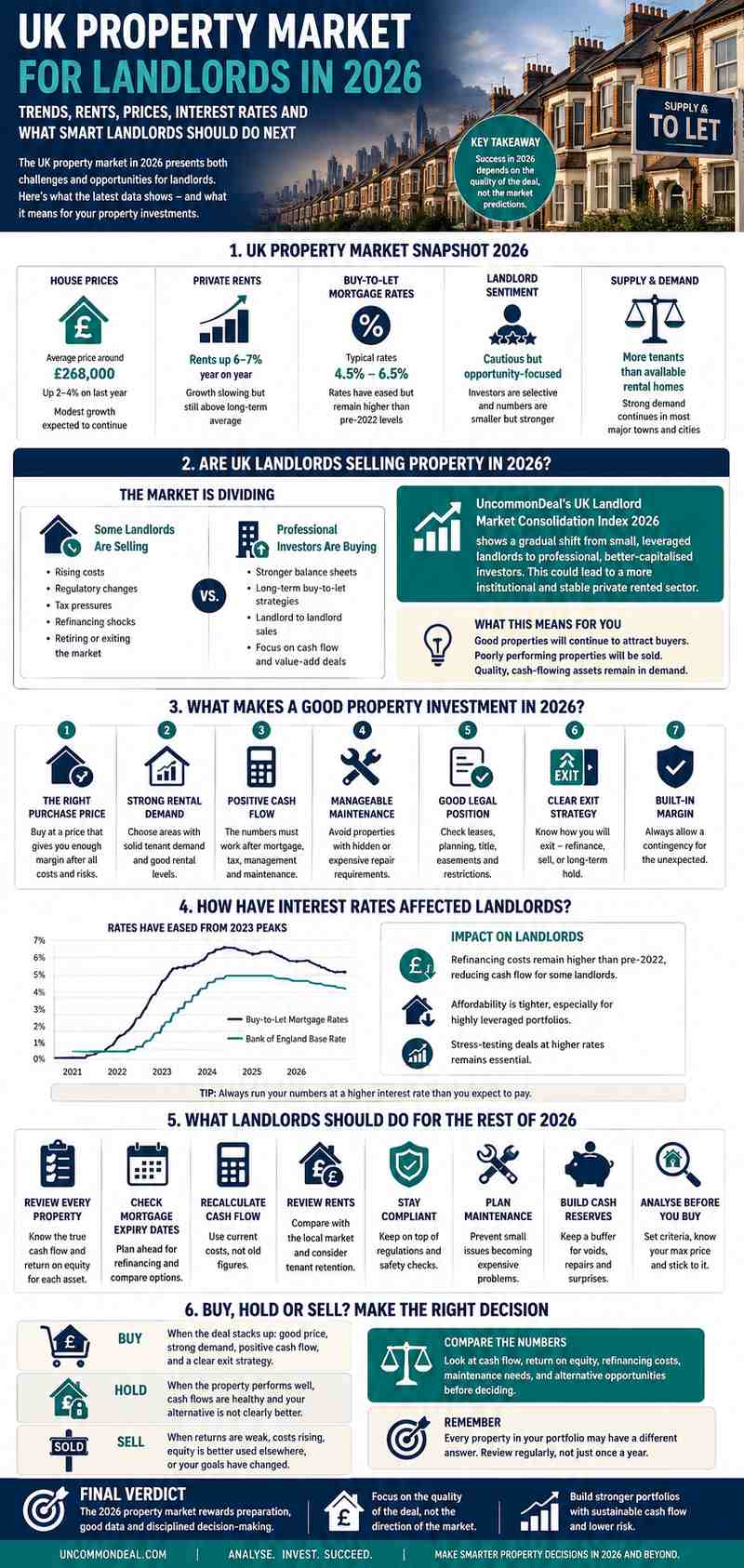
UK property market for landlords in 2026: key trends affecting rents, house prices, borrowing costs and property investment decisions.
How Have Interest Rates Affected Landlords in 2026?
Interest rates remain one of the most important factors affecting UK landlords in 2026 because they directly influence mortgage payments, refinancing decisions, cash flow and the price investors can afford to pay for new properties. Bank Rate stood at 3.75% in July 2026, lower than the 4.00% rate reached after the August 2025 reduction, but borrowing costs remain considerably more important to deal viability than they were during the era of very low interest rates.
For landlords, the key question is therefore not simply whether interest rates are falling. It is whether the mortgage available on a particular property allows the investment to produce sufficient cash flow and return after all other costs are included.
What Has Happened to the Bank of England Base Rate?
The Bank of England reduced Bank Rate several times from its previous peak of 5.25%. It fell to 4.00% in August 2025 and then to 3.75% in December 2025, where it remained following the July 2026 monetary policy decision.
This direction of travel has provided some relief for property investors compared with the higher-rate environment of previous years. However, Bank Rate and buy-to-let mortgage rates are not the same thing.
Mortgage lenders price products according to several factors, including expectations for future interest rates, swap rates, loan-to-value, borrower circumstances, rental coverage requirements and product fees. As a result, a reduction in Bank Rate does not necessarily translate into an equivalent reduction in the mortgage rate available to every landlord.
Why Mortgage Rates Matter So Much to Buy-to-Let Returns
For a highly leveraged landlord, relatively small differences in mortgage rates can materially change annual cash flow.
Consider a landlord purchasing a £200,000 buy-to-let property using a 75% loan-to-value interest-only mortgage.
The mortgage would be:
£200,000 × 75% = £150,000
The effect of different mortgage rates can be illustrated below:
| Mortgage Rate | Monthly Interest | Annual Interest |
|---|---|---|
| 3.5% | £437.50 | £5,250 |
| 4.0% | £500.00 | £6,000 |
| 4.5% | £562.50 | £6,750 |
| 5.0% | £625.00 | £7,500 |
| 5.5% | £687.50 | £8,250 |
Example assumes a £150,000 interest-only mortgage and excludes arrangement fees and other borrowing costs.
A landlord paying 5.5% rather than 3.5% on the same £150,000 mortgage would therefore incur approximately £3,000 more interest each year.
That difference goes directly to the economics of the investment.
A Higher Rent Does Not Necessarily Offset Higher Finance Costs
Suppose the same £200,000 property produces rent of £1,200 per month, or £14,400 per year.
Its headline gross rental yield would be:
Gross Rental Yield = Annual Rent ÷ Purchase Price × 100
£14,400 ÷ £200,000 × 100 = 7.2%
A 7.2% gross yield may initially look attractive. But gross yield does not account for mortgage interest.
At a 4.0% mortgage rate, annual interest on £150,000 would be £6,000, leaving £8,400 of rental income before management, maintenance, insurance, voids, compliance and tax.
At 5.5%, annual mortgage interest rises to £8,250, leaving only £6,150 before those same costs.
| 4.0% Mortgage | 5.5% Mortgage | |
|---|---|---|
| Annual rent | £14,400 | £14,400 |
| Mortgage interest | £6,000 | £8,250 |
| Rent remaining before other costs | £8,400 | £6,150 |
| Gross rental yield | 7.2% | 7.2% |
The property’s 7.2% gross yield has not changed, but the amount remaining after finance has fallen by £2,250 per year.
This demonstrates why headline rental yield alone is not enough to determine whether a buy-to-let property is a good investment.
Refinancing Can Expose Weak Properties in a Portfolio
Interest rates are particularly important for landlords approaching the end of an existing fixed-rate mortgage.
A property purchased or refinanced when borrowing was considerably cheaper may still generate the same rent—or even a higher rent—but produce substantially less cash flow after refinancing onto a more expensive product.
Landlords approaching refinancing should therefore recalculate the property’s performance using the actual mortgage options currently available, rather than assuming that historic financing costs will continue.
This can also help identify properties that are consuming too much equity for the return they generate. In some cases, refinancing may still make sense; in others, reducing borrowing, restructuring the portfolio or selling an underperforming asset may deserve consideration.
Investors Should Stress-Test Interest Rates Before Buying
New acquisitions should also be tested against less favourable financing assumptions.
If a deal only produces acceptable cash flow at the lowest mortgage rate currently available, there may be little margin for error.
A more robust analysis can ask:
- What happens if the mortgage rate is 1 percentage point higher?
- Can the property still cover its operating costs?
- What happens if rent does not increase?
- Is there sufficient cash flow to absorb maintenance or a void period?
- Would the investment still meet the investor’s required return?
This is particularly important for leveraged property investment because debt can increase returns when a deal performs well, but it can also magnify the effect of higher costs and weaker-than-expected income.
Investors purchasing through auctions should also understand how auction finance differs from a conventional buy-to-let mortgage, particularly where completion deadlines require funding to be arranged quickly.
UncommonDeal Analysis
Falling interest rates can improve the environment for landlords, but a lower Bank Rate should never be used as the reason for making an investment stack up. A strong property deal should be assessed using the finance that is realistically available today and should retain a reasonable margin of safety if borrowing costs change.
For this reason, investors should look beyond gross yield and calculate the property’s expected cash flow after mortgage interest, management, maintenance, insurance, voids, compliance and other recurring costs.
The more useful question is not simply “What is the rental yield?” but “What return does this property produce after the real cost of financing and operating it?”
That distinction is particularly important in the 2026 market.
What Is Happening to UK Rents in 2026?
UK private rents are still rising in 2026, but rental growth has slowed considerably from the stronger increases seen in previous years. The average UK private rent reached £1,393 per month in July 2026, £50 higher than a year earlier and equivalent to annual growth of 3.7%, according to the latest Office for National Statistics data.
For landlords, rising rents can support rental income, but national rent growth should not be interpreted as an automatic increase in profitability. Local demand, property type, financing costs and operating expenses remain critical to the performance of an individual investment.
Are UK Rents Still Rising in 2026?
Yes. Average private rents increased across England, Wales and Scotland in the 12 months to July 2026, although the pace of growth varied.
| Area | Average Monthly Rent | Annual Rent Growth |
|---|---|---|
| UK | £1,393 | 3.7% |
| England | £1,451 | 3.8% |
| Wales | £843 | 4.5% |
| Scotland | £1,016 | 1.7% |
| Northern Ireland* | £875 | 2.3% |
Latest Northern Ireland figures are for May 2026. ONS estimates are not directly comparable in every respect across all four UK countries because of differences in data collection.
The figures show that rents are continuing to increase, but the national picture needs context. UK annual rental growth stood at 5.9% in July 2025, compared with 3.7% in July 2026.
In other words, rents are higher, but the rate at which they are increasing has slowed.
This distinction matters when analysing a buy-to-let investment. An investor should be cautious about assuming that rapid historic rental growth will continue throughout the ownership period.
Where Are Rents Rising Fastest in England?
Regional differences are particularly important for property investors.
In July 2026, the North East recorded the highest annual private rent inflation of any English region at 6.3%, while the South East recorded the lowest at 2.9%. London recorded annual rental growth of 3.0%.
However, the areas experiencing the fastest percentage increases are not necessarily those with the highest rents.
Average monthly rent in London reached £2,317, compared with just £783 in the North East.
This creates an important distinction between rent level and rent growth.
A location can have relatively inexpensive rents but strong percentage growth, while another can have very high rents but slower growth. Neither measure on its own determines whether the area offers attractive property investment returns.
Property Size Also Makes a Difference
Rental values vary substantially according to property type and number of bedrooms.
In July 2026, the average UK monthly rent ranged from £1,132 for a one-bedroom property to £2,067 for a property with four or more bedrooms. Detached properties had an average monthly rent of £1,581, compared with £1,361 for flats and maisonettes.
For landlords, this reinforces why national average rents should be treated as market context rather than a valuation tool.
The achievable rent for an investment property should instead be established using comparable properties of a similar location, size, condition and property type.
Higher Rents Do Not Automatically Mean Higher Profits
One of the easiest mistakes to make when looking at rental-market statistics is to assume that increasing rents mean landlords are necessarily becoming more profitable.
Consider a simplified example.
A property producing £1,000 per month generates annual rent of:
£1,000 × 12 = £12,000
If the rent increases by 3.7%, annual rental income becomes approximately:
£12,444
That represents an additional £444 per year.
But if mortgage interest, insurance, maintenance, management or compliance costs increase by more than £444 during the same period, the landlord’s actual cash flow could still decline.
This is why rental growth should always be considered alongside the cost of owning the property.
Can Landlords Continue Increasing Rents?
Landlords should not assume that market-wide rental growth means every property can sustain the same increase.
The amount tenants are willing and able to pay is influenced by local incomes, competing rental properties, property condition and supply and demand within the specific market.
There is also a regulatory consideration in England following the Renters’ Rights Act reforms. Rent increases for assured periodic tenancies are subject to the statutory process, and landlords cannot simply treat national rental inflation as an automatic entitlement to increase an individual tenant’s rent.
We will examine those rules in more detail in the regulatory section of this article.
Why Local Rental Analysis Matters More Than the UK Average
The difference between 6.3% rental growth in the North East and 2.9% in the South East illustrates one of the central themes of the 2026 property market: national averages can conceal very different local conditions.
Even regional statistics can be too broad.
Two properties within the same town can produce different rental performance because of differences in transport links, schools, employment, property condition, bedroom count, tenant profile and local supply.
For an investor assessing a potential purchase, the relevant question is therefore not:
“What is happening to UK rents?”
but:
“What rent can this particular property realistically achieve in this particular local market?”
UncommonDeal Analysis
Continued rental growth is supportive for UK landlords, but slowing growth means investors should be increasingly cautious about using future rent increases to make a marginal property deal appear viable.
A strong buy-to-let investment should ideally work using a realistic assessment of the rent achievable today, rather than depending on aggressive assumptions about what the property might rent for several years from now.
The latest ONS figures also reinforce why UncommonDeal favours property-level analysis over national averages. A £1,393 UK average rent tells an investor something about the direction of the rental market, but it cannot tell them whether a £150,000 property generating £950 per month in Liverpool represents a better investment than a £300,000 property generating £1,600 elsewhere.
Purchase price, achievable rent, financing costs, operating expenses and local demand need to be analysed together.
That is ultimately what determines whether the rental income translates into an acceptable investment return.
Primary source: ONS — Private rent and house prices, UK: August 2026

Koye Beckley is a UK property investor and founder of UncommonDeal, with practical experience in buy-to-let, property auctions, refurbishment projects and investment deal analysis. Through UncommonDeal, he publishes property market research, property deal sourcing and compliance guidance, investment guides and data-driven analysis to help investors evaluate buy-to-let, BRRR, flip and auction opportunities.