
Best Ways Used by Smart UK Property Investors to Analyse Deals, and Returns
Successful UK property investing is rarely about finding the most deals — it is about analysing deals properly before committing capital. In a market shaped by interest rate changes, tighter lending, regulatory reform, and regional variation, smart investors rely on structured analysis rather than instinct or headline numbers.
Successful UK property investing is rarely about finding the most deals — it is about UK property deal analysis that properly assesses risk, returns, and exit viability before committing capital.
This article explains how experienced UK property investors analyse deals and returns, what metrics matter most, and how to avoid the common mistakes that lead to underperforming investments.
1. Starting With Market and Location Analysis
Smart property investors begin with location-specific analysis, not asking prices or advertised yields. This is true because, choosing the right location is often more important than finding the cheapest property, which is why many investors focus on emerging property growth areas in UK.
Rather than relying on national averages, they examine:
- Recent sold price data, not listings
- Local demand drivers such as employment, transport, and amenities
- Supply constraints, including planning restrictions and housing stock type
In the UK, property performance can vary significantly street by street. Understanding local liquidity — how easily a property can be sold or let — is essential before any financial modelling begins.
Recent sold price comparables were verified using HM Land Registry sold price data, ensuring realistic valuation assumptions.
2. Understanding True Purchase Costs
A common mistake among inexperienced investors is analysing returns based solely on the purchase price. Smart investors build a full acquisition cost model, including:
- Purchase price and Stamp Duty
- Legal, survey, and lender fees
- Auction fees (where applicable)
- Bridging or mortgage costs
- Refurbishment and contingency budgets
By modelling the total cost of ownership, investors gain a realistic view of how much capital is actually deployed and at risk.
This approach mirrors how smart investors analyse property deals, focusing on evidence rather than asking prices or headline yields.
3. Analysing Rental Income Realistically
Experienced investors treat rental assumptions with caution. Rather than using the highest advertised rent, they base projections on:
- Achieved rents from comparable properties
- Tenant affordability in the local area
- Property condition and specification
- Likely void periods and management costs
This ensures rental yield calculations are sustainable, not optimistic. In tighter affordability environments, realistic rent modelling often determines whether a deal works at all.
4. Evaluating Returns Beyond Gross Yield
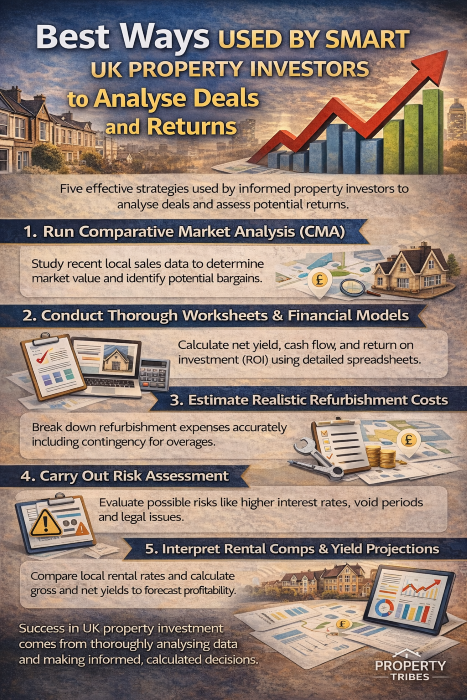
Smart investors go beyond simple gross yield calculations. Instead, they focus on net returns and cashflow, accounting for:
- Mortgage payments and interest
- Maintenance and management costs
- Insurance and compliance expenses
- Void allowances
Key metrics commonly assessed include:
- Net yield
- Cash-on-cash return
- Breakeven occupancy
- Sensitivity to interest rate changes
This approach reveals whether a property remains viable under different scenarios, not just best-case conditions.
5. Stress Testing the Deal
One of the defining traits of professional investors is stress testing.
Smart investors ask:
- What happens if interest rates rise?
- What if the property takes longer to let or sell?
- What if refurbishment costs overrun?
By modelling downside scenarios, investors identify weak points early and decide whether to renegotiate, restructure, or walk away. This discipline protects capital and prevents emotional decision-making.
Many investors choose independent property analysis to validate assumptions before proceeding or renegotiating.
6. Assessing Exit Strategies Early
Every smart analysis includes a clear exit strategy from the outset.
UK property investors typically assess:
- Resale value based on conservative comparables
- Refinance viability and lender criteria
- Long-term hold performance under regulation
Importantly, they consider exit liquidity — who the next buyer or tenant is likely to be, and at what price point. Deals without clear exits often carry hidden risk.
7. Accounting for Regulation and Compliance
Modern UK property investing requires regulatory awareness. Smart investors factor in:
- EPC requirements and upgrade costs
- Licensing and safety compliance
- Tenant rights and possession timelines
Ignoring regulation can materially impact returns, especially for buy-to-let and HMO strategies. Professional analysis includes both current and foreseeable regulatory costs.
8. Separating Data From Emotion
Perhaps the most overlooked aspect of deal analysis is emotional discipline.
Smart investors:
- Compare deals objectively using consistent criteria
- Avoid chasing “discounts” that don’t work on paper
- Walk away from deals that fail stress tests
This mindset ensures decisions are driven by evidence, not urgency or fear of missing out.
Why Proper Deal Analysis Matters More Than Ever
In today’s UK property market, margins are tighter and mistakes are more costly. Rising finance costs, regulatory reform, and affordability constraints mean that good analysis now matters more than sourcing volume.
Investors who consistently analyse deals using structured, data-driven methods are better positioned to:
- Protect cashflow
- Manage risk
- Build sustainable portfolios
- Adapt to changing market conditions
Final Thoughts
The best UK property investors do not rely on intuition or headline figures. They analyse deals methodically, model returns conservatively, and prepare for downside risk before committing capital.
By focusing on local evidence, realistic assumptions, full cost modelling, and stress testing, investors can make confident decisions — whether that means proceeding, renegotiating, or walking away.
In a market where optimism is no longer enough, clarity and discipline are the real competitive advantage.
Platforms like UncommonDeal focus on structured analysis to help investors make evidence-based decisions rather than speculative ones.

Koye Beckley is a UK property investor and founder of UncommonDeal, with practical experience in buy-to-let, property auctions, refurbishment projects and investment deal analysis. Through UncommonDeal, he publishes property market research, property deal sourcing and compliance guidance, investment guides and data-driven analysis to help investors evaluate buy-to-let, BRRR, flip and auction opportunities.
