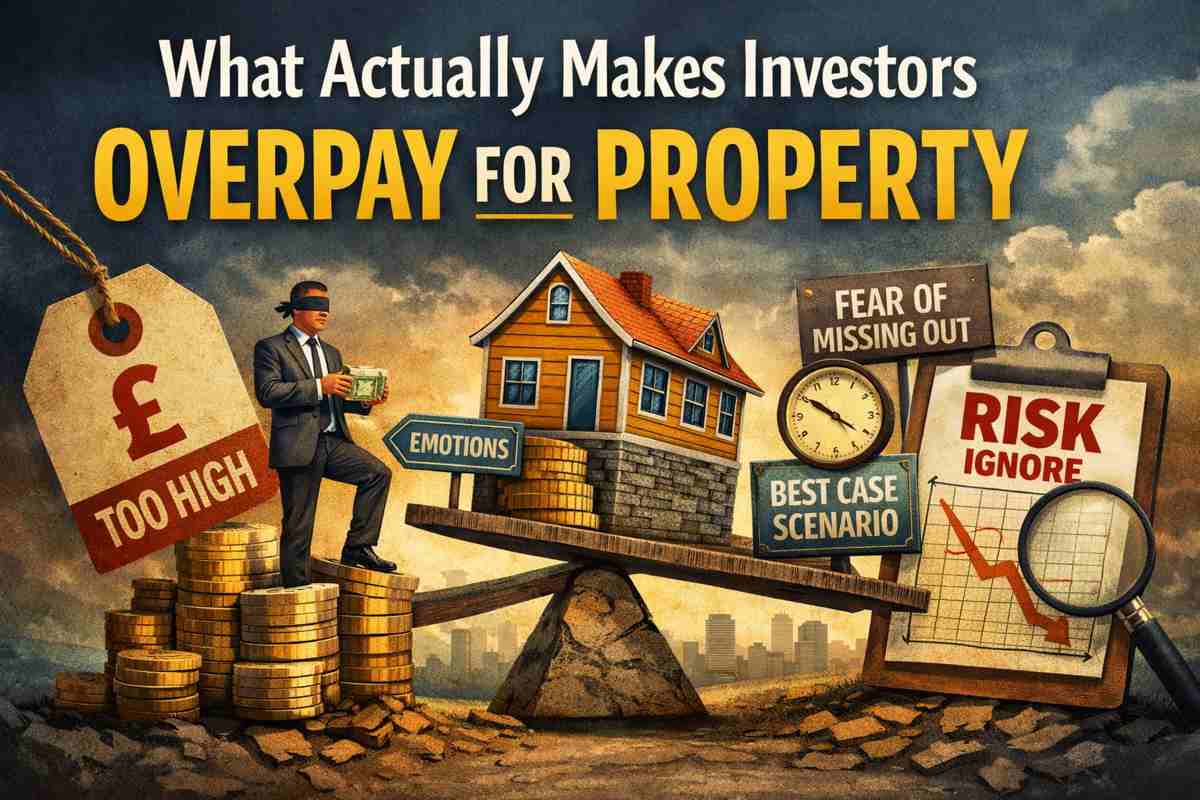
What Actually Makes Investors Overpay for Property
Most property investors do not believe they overpay.
They believe they negotiated well, bought below asking price, or secured a deal others missed. Many can point to spreadsheets, comparables, and “buffers” as proof they were careful.
And yet, over time, a large number of investors quietly discover that their returns are thinner than expected, their capital is stuck longer than planned, or their exit did not materialise the way the numbers suggested.
This is not because property is unpredictable.
It is because overpaying is rarely obvious at the moment it happens.
Overpaying in property does not usually look like recklessness. It looks like reasonableness under pressure.
What Overpaying Really Means in Property Investing
Overpaying in property investment means paying a price that the deal’s probable, risk-adjusted returns do not justify, even when the price looks reasonable on the surface.
In practical terms, an investor overpays when a deal only works under best-case assumptions rather than likely outcomes, when known risks are acknowledged but not priced into the purchase, or when margins disappear as soon as normal friction appears. Delays, cost overruns, valuation conservatism, and slower exits do not create overpayment; they reveal it.
Crucially, overpaying does not require paying above asking price or market value. An investor can buy below asking price, purchase off-market, or secure a property at auction and still overpay if the numbers rely on optimism rather than probability.
A simple way to frame it is this: an investor has overpaid if the price only makes sense when everything goes right.
In property investing, price is not just what you pay. It is what you pay relative to risk, exit certainty, and realistic outcomes. Most investors define overpaying as paying above market value, but that definition is incomplete and often misleading.
Overpaying is rarely a single pricing mistake. It is the result of a decision process that allows optimism to replace probability. When margin exists only in the best case, the price is already wrong.
Why Overpaying Feels Sensible at the Time
Overpaying does not triggers alarm bells because the human brain does not evaluate risk in isolation. Property decisions are made inside environments that quietly push investors toward commitment before price discipline has fully done its job.
Unlike shares or bonds, property requires effort before ownership. That effort creates attachment, and attachment distorts judgement.
By the time a price is agreed, the decision has often already been made psychologically.
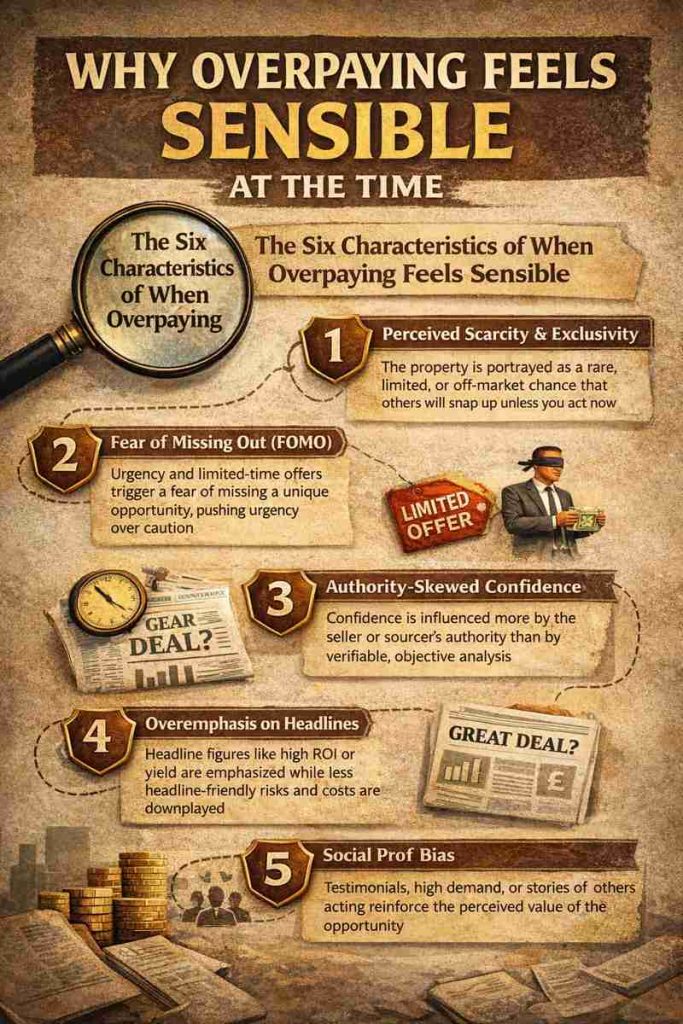
The Six Characteristics of When Overpaying Feels Sensible
Overpaying rarely triggers alarm bells because investors assess risk in context, not in isolation. Property decisions take place in environments that quietly encourage commitment before pricing discipline fully applies.
1. Commitment Is Created Before Money Changes Hands
Investors often invest time, effort, and attention long before committing capital. Viewings, analysis, conversations, and planning create a sense of ownership well before purchase. That early commitment makes walking away feel like a loss, even when no money has changed hands.
Property investing forces early commitment.
Before an offer is accepted, an investor may have already:
- Viewed the property multiple times
- Run spreadsheets and scenarios
- Spoken to agents, brokers, builders, or planners
- Imagined the finished asset and its outcome
None of these steps are neutral. Each one increases emotional investment.
The brain treats effort as ownership. Once effort is invested, walking away feels like loss, even when no money has been lost yet.
This is why investors often describe deals as “falling through” rather than “correctly rejected”.
2. Time Pressure Compresses Rational Thinking
Rational thinking requires time to compare evidence, question assumptions, and consider downside scenarios. When deadlines compress that time, investors default to speed and certainty, even when price discipline has not been fully tested.
In reality, agents, vendors, and auctions impose deadlines that shrink the time available for reflection. Under time pressure, investors prioritise decisiveness over accuracy. The question shifts from “Is this priced correctly?” to “Can I afford to hesitate?”
Time pressure is one of the most powerful tools in property pricing.
Agents use phrases like:
- “There’s another offer coming in”
- “The vendor wants a quick decision”
- “The auction is this week”
Auctions intensify this further by imposing fixed deadlines and public competition.
Under time pressure, the brain prioritises speed over accuracy. Instead of asking whether the price compensates for risk, investors ask whether they can afford to hesitate.
Hesitation starts to feel dangerous.
This is how prices creep upward without a conscious decision to overpay.
3. Sunk Costs Make Walking Away Feel Like Failure
Once investors spend money on legal packs, surveys, or fees, they often feel compelled to proceed. Sunk costs should not influence pricing decisions, but they create psychological pressure to continue so earlier effort does not feel wasted.
The logic sounds reasonable:
“I’ve already spent money, so I might as well continue.”
In reality, sunk costs should have no influence on pricing decisions. They are already gone.
But psychologically, sunk costs create a powerful urge to “recover” effort by completing the transaction. This turns earlier caution into later justification.
At that point, the goal shifts from buying well to avoiding the feeling that time and money were wasted.
4. Emotional Attachment Disguises Itself as Confidence
Familiarity with a deal creates comfort, and investors often mistake that comfort for certainty. As confidence grows, investors feel they understand the property deeply, even though the underlying risk profile remains unchanged and margins do not improve.
Of course, after multiple viewings and detailed analysis, familiarity sets in.
Familiarity creates comfort, and comfort is often mistaken for certainty.
Investors begin to feel they “know” the deal, even though nothing about the underlying risk has changed. That confidence makes higher prices feel safer than they are.
This is especially dangerous for experienced investors, who trust their instincts more than their process.
Experience does not remove bias. It can amplify it.
5. Fear of Missing Out Warps Risk Perception
When deals feel scarce or competitive, fear of missing out quickly outweighs concern about overpaying. Urgency rises, but the underlying value stays the same.
Property opportunities move slowly and demand significant effort, which makes them feel limited even when alternatives exist. That perceived scarcity heightens emotional pressure during decision-making.
Many investors overpay before analysis even begins because they misunderstand where most UK property deals actually come from, and assume scarcity or exclusivity where none exists.
As a deal begins to look workable, investors focus more on securing it than on testing the price. At that point, fear of missing out overtakes price discipline, and higher offers feel justified even though outcomes do not improve.
Investors tell themselves:
- “I might not see another one like this”
- “The market is competitive”
- “Sitting on cash is risky too”
These thoughts are not irrational. But when they influence price, they lead to overpayment.
Fear of missing out does not increase value. It only increases urgency.
6. The Critical Mental Shift That Causes Overpayment
The most dangerous characteristic appears when the investor’s mindset changes. Instead of evaluating whether the price is right, the investor begins justifying how the deal could work. At that point, assumptions are adjusted upward and risks are softened to defend the price.
In the light of, often without noticing, the investor’s internal question changes.
Instead of asking:
“Is this deal priced correctly for the risk?”
They begin asking:
“What needs to happen for this deal to work?”
That shift is subtle but decisive.
Once the goal becomes making the deal work, assumptions are adjusted upward, buffers are narrowed, and risks are mentally softened.
The price is no longer being tested. It is being defended.
That is the moment overpaying becomes likely.
Scenario: How a Sensible Investor Slowly Overpays
An investor views a property listed at £240,000. Comparable listings suggest values around £260,000 after refurbishment. Sold evidence supports closer to £245,000 to £250,000.
Initially, the investor decides the deal only works at £215,000.
After viewing, the agent mentions other interest. The investor spends time analysing layouts, speaks to a builder, and imagines the finished property.
A legal pack is reviewed. Time is invested.
The offer becomes £220,000. Then £225,000.
The investor justifies the increase by assuming a slightly higher exit, a smoother refurb, and a quicker sale.
Nothing dramatic has changed. No reckless decision has been made.
But the price is now supported by best-case assumptions rather than probable outcomes.
At that point, the investor has overpaid, even though the decision still feels careful.
Why Experience Does Not Protect Against This
Experienced investors often believe they are less susceptible to these pressures.
In reality, experience can increase confidence, and confidence can weaken discipline.
Familiarity with the process reduces perceived risk, even when the numbers do not justify it. Experienced investors are often better at rationalising decisions, which makes subtle overpayment easier, not harder.
The difference between long-term winners and underperformers is not experience alone.
It is the ability to recognise when confidence is replacing margin.
The Core Pattern Behind Most Overpayment
Overpayment almost always starts with the same pattern.
An investor identifies a deal that is close to working. Instead of adjusting the price downward, they adjust assumptions upward. Each assumption change feels small and reasonable in isolation.
The fastest way to avoid this is to pressure-test the real numbers before emotional commitment sets in, rather than adjusting assumptions to justify a price.
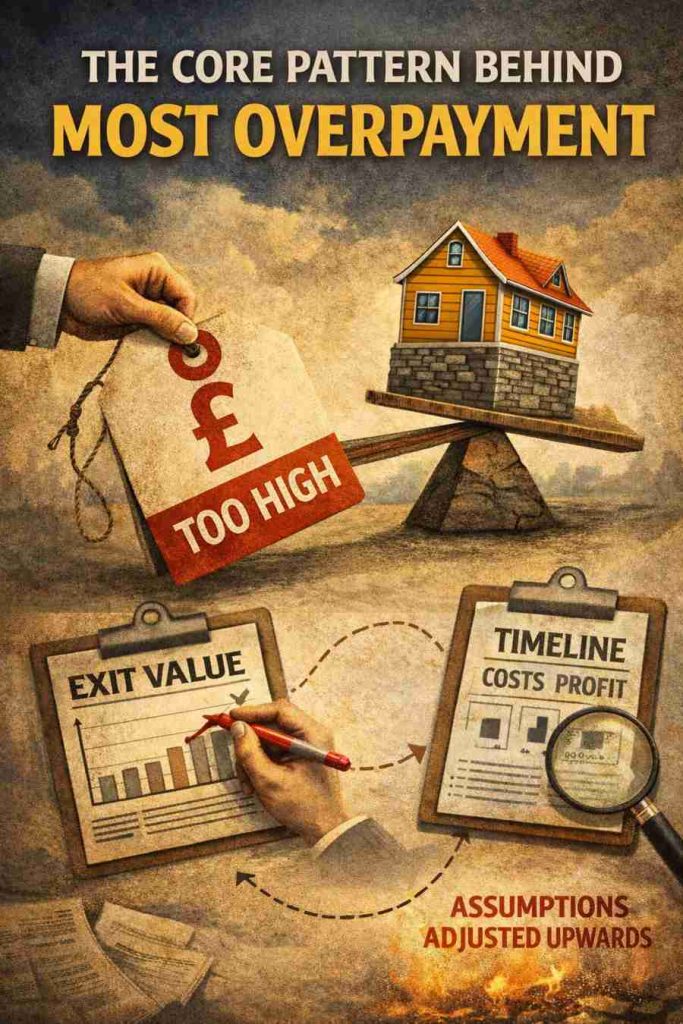
Pricing discipline erodes as investors assume marginal gains across several variables, from a higher GDV and quicker sale to cheaper refurbishment and a smooth refinance. Each assumption feels reasonable in isolation, but together they inflate the price beyond what the risk profile supports.
Individually, none of these feel reckless. Together, they inflate the price beyond what the risk profile supports.
This is how investors overpay without realising it.
Anchoring: How Asking Prices Quietly Inflate Offers
Asking prices and guide prices are among the strongest psychological anchors in property investing.
Even investors who believe they ignore asking prices are influenced by them. The first number seen establishes a mental range. Discounts from that number feel like savings, even when the underlying value does not support the price.
A property listed at £250,000 makes £230,000 feel conservative, even if £210,000 is the correct risk-adjusted figure based on sold evidence and exit conditions.
Asking prices are marketing tools. They reflect seller ambition and agent strategy, not investor margin or downside protection. When investors subconsciously treat discounts as validation, they overpay while believing they negotiated well.
Listings Are Not Evidence of Value
One of the most common analytical errors investors make is treating listings as valuation evidence.
In fact, many investors anchor their exit assumptions to listings instead of verified sold price data rather than listings, which quietly inflates GDV expectations and weakens pricing discipline.
Listings show what sellers hope to achieve, not what buyers have proven willing to pay. Properties still on the market are, by definition, unsold. They do not represent market-clearing prices.
Reliable valuation evidence comes from completed sales of similar properties in similar condition, sold within a relevant timeframe and to a comparable buyer pool.
When investors rely on listings instead of sold data, exit values creep upward. That inflation feeds directly into higher offers and thinner margins.
This mistake is particularly dangerous in slow or shifting markets, where listings lag reality.
Best-Case GDV Is Not Margin
Many investors overpay because they price deals using the highest achievable outcome rather than the most likely one. When best-case GDV becomes the justification for a purchase price, margin disappears the moment reality introduces friction.
Many investors understand Gross Development Value in theory but misuse it in practice.
They see a range of outcomes and choose the highest number, not because it is likely, but because it allows the deal to survive on paper.
This is not professional underwriting.
Professional investors underwrite based on outcomes they can reasonably expect to repeat, not on the ceiling of what might be achievable in perfect conditions.
When purchase prices are justified by best-case GDV rather than probable GDV, the investor is buying optimism, not margin. Optimism does not absorb delays, valuation conservatism, or market shifts.
Margin does.
Liquidity Is Part of Value
Value in property is not just about price, but about how easily that price can be realised. A property with limited buyer demand carries higher exit risk, and that risk must be reflected in what an investor is willing to pay.
Not all value is equal.
A property that can sell quickly to a broad buyer pool is fundamentally less risky than one that appeals only to a narrow segment. Many investors focus on headline price without considering liquidity.
Important questions often go unasked:
- Is this an owner-occupier product or investor stock?
- How sensitive is demand at this price point to interest rates?
- What is the typical time similar stock spends on the market?
- How deep is the buyer pool in weaker conditions?
Liquidity risk should be reflected in price. When it is not, investors overpay for assets that look fine on paper but are slow or difficult to exit.
The Hidden Costs That Inflate the Real Purchase Price
Many investors believe overpaying happens at purchase, but it often happens after completion. Hidden and underestimated costs quietly increase the real price paid, eroding margin long before the exit is reached.
Overpaying often hides in costs that appear after completion.
These are not rare or exceptional expenses. They are normal frictions that occur in real projects:
- Refurbishment overruns once walls are opened
- Finance extensions due to delays
- Void periods during tenant changeovers
- Service charge increases
- Professional fees that exceed estimates
- Council tax and utilities during empty periods
Each cost feels manageable on its own. Together, they raise the effective entry price of the asset.
If a deal only works in a frictionless scenario, it was overpriced from the start.
Risk Acknowledged but Not Priced
Most investors are aware of risk. Very few convert that risk into a pricing adjustment.
Issues such as short leases, title restrictions, planning uncertainty, non-standard construction, or regulatory exposure are often noted but not penalised financially.
Risk that is acknowledged but not priced does not disappear. It emerges later as:
- Reduced lending options
- Conservative valuations
- Slower exits
- Forced discounts
Risk without compensation is overpayment.
Issues like lease terms, title restrictions, or planning uncertainty are not just technical details but risks that should reduce the price, not be noted and ignored.
Auctions and the Mechanics of Overpaying
Auctions are efficient mechanisms for extracting overpayment.
They compress decision-making into short timeframes, combine public competition with sunk-cost psychology, and reward emotional escalation.
By the time bidding begins, investors have often invested hours reviewing legal packs and planning strategies. Walking away feels like failure, even when the numbers no longer justify the price.
At that point, the objective subtly shifts from buying well to winning.
Winning an auction does not mean you bought correctly.
Strategy Drift as a Justification Tool
Another common cause of overpayment is strategy drift.
An investor agrees a price based on one strategy, then mentally switches strategies to justify that price when margins weaken.
A flip becomes a rental.
A rental becomes a long-term hold.
A BRRR becomes a capital-growth play.
When strategy drift sets in, investors often fail to reassess whether holding actually improves the outcome, or simply delays recognising a pricing mistake.
Each shift preserves emotional comfort but dilutes returns. The purchase price was never aligned with the final strategy.
When strategy changes are used to defend pricing, overpayment has already occurred.
Confidence Is Not Evidence
Agents, sourcers, and builders often project certainty. This confidence is frequently mistaken for accuracy.
These parties are incentivised to proceed with the transaction. They do not carry long-term downside risk.
Confidence does not replace evidence. When investors rely on tone, assurance, or social proof instead of verified data, prices drift upward.
Overpayment becomes easier when responsibility feels shared.
Example: Buying Below Asking Price and Still Overpaying
An investor purchases a property for £170,000, below an asking price of £185,000. Comparable listings suggest values up to £210,000. Refurbishment is estimated at £30,000.
On paper, the deal appears tight but workable.
In reality, completed sales cluster closer to £195,000. Refurb costs rise modestly after strip-out. The final sale achieves an average market price, not the highest comparable.
The margin disappears.
The investor did not overpay relative to the asking price. They overpaid relative to probability.
Example: How Headline Yield Masks Income Risk
An investor approached UncommonDeal to review a buy-to-let opportunity in Dagenham, Essex that had been marketed with a strong headline yield by a property sourcer. On initial review, the figures appeared conservative and the purchase price felt safe relative to projected rent.
However, a deeper analysis revealed structural weaknesses in the income assumptions. The service charge was due to increase, mortgage stress testing materially reduced borrowing capacity, and realistic void periods had not been factored into the cashflow model.
Once these elements were accounted for, the projected income fell significantly below expectation. The deal did not fail because the purchase price was excessive in isolation, but because the stability of the income had been overstated.
In this case, the investor did not overpay on price alone. They overpaid by relying on optimistic assumptions about rental performance and cost stability.
This effect is amplified when sourced deals distort pricing expectations, especially where headline yields or exclusivity are used to justify thin margins.
Why Overpaying Compounds Over Time
One overpaid deal is painful. Repeated overpayment is destructive.
Small pricing errors accumulate into:
- Slower capital recycling
- Reduced borrowing capacity
- Higher stress during downturns
- Fewer strategic options
Portfolios rarely fail because of one catastrophic mistake. They fail because of slightly optimistic pricing repeated over many deals.
How Disciplined Investors Avoid Overpaying
Professional investors approach pricing differently. That is to say, they underwrite deals in the following manner:
- Underwrite from the exit backwards, using conservative assumptions.
- Stress-test every variable.
- Price risk explicitly.
- Walk away early when numbers do not stack up.
They understand that saying no is not inactivity. It is capital protection.
The best investors do not complete the most deals. They complete the fewest bad ones.
The Uncomfortable Truth About Overpaying
Overpaying is not a knowledge problem.
It is a process problem.
Property rewards discipline, patience, and margin. It punishes optimism disguised as analysis.
If your process makes it easy to say yes, you will overpay.
If your process makes it uncomfortable to proceed, you will survive.
That difference determines long-term outcomes.

Koye Beckley is a UK property investor and founder of UncommonDeal, with practical experience in buy-to-let, property auctions, refurbishment projects and investment deal analysis. Through UncommonDeal, he publishes property market research, property deal sourcing and compliance guidance, investment guides and data-driven analysis to help investors evaluate buy-to-let, BRRR, flip and auction opportunities.
