
When Property Sourced Deals Are Worth Paying For
Most UK property investors have heard the warnings: “Avoid sourcers”, “Most deals are overpriced”, “You’ll get burned”.
And honestly, those warnings exist for a reason.
A lot of sourced deals are just packaging, not value. You’re paying a fee to be introduced to something you could have found yourself, often with weak numbers, missing detail, or unrealistic assumptions.
But there’s also a truth that gets missed in the anti-sourcing narrative:
Sometimes, paying for a sourced deal is the smartest move you can make.
Not because the property sourcing fee is “worth it” in theory… but because the deal access, speed, risk reduction, or cashflow advantage is real.
This guide breaks down the five situations where sourced deals can genuinely make sense, and the tests you should run before paying a penny.
Additionally, you need a professional property deal sourcing agreement that protect you from bad sourcers.
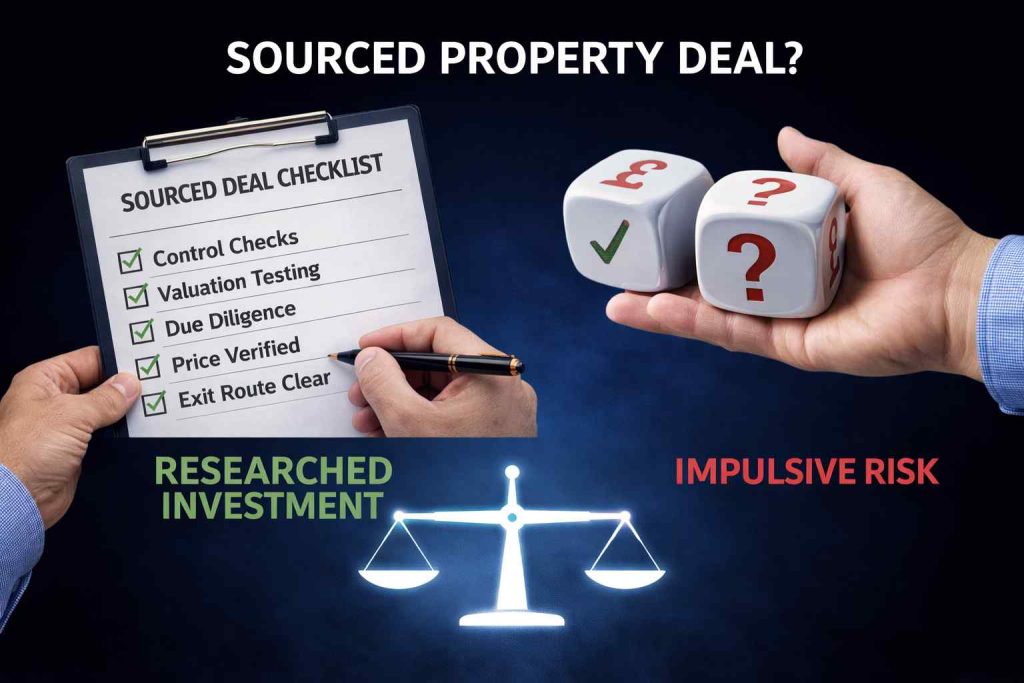
The 5 situations where it’s worth paying for a sourced deal
If you’re going to pay a sourcing fee, it should be because the deal gives you a genuine advantage you would not get by scrolling portals and calling agents yourself. In other words, the fee has to buy speed, access, reduced risk, or a better outcome, not just a nicely formatted PDF.
Investors looking for potential opportunities should also pay attention to landlords reducing their portfolios, as rental properties changing ownership can create another source of potential deals.
The situations below are the ones where paying can actually make commercial sense, as long as you verify the numbers and control the legal process like you would with any other purchase.
1) When the sourcer is giving you real access you cannot replicate quickly
Real access means you’re seeing the opportunity before the wider market does, with enough lead time to view, run numbers, and position yourself properly. In practice, that early visibility can be the difference between securing a discount and competing in a bidding war once the listing goes live.
But access only counts if it’s repeatable and defensible. If the “exclusive” deal disappears the moment you ask basic questions, or the seller contact and instructions are vague, it’s usually just a recycled listing with a fee attached.
This is the clearest case.
If a sourcer is consistently getting access to deals you would struggle to source yourself, the fee can be justified, because you’re not paying for the “idea”, you’re paying for access.
This usually happens in three ways:
-
- Off-market vendor relationships (genuine direct-to-vendor pipeline)
-
- Repeat agent relationships where stock gets filtered before hitting Rightmove
-
- Portfolio disposals where speed and discretion matter
What makes it worth paying
-
- You’re buying time and deal flow, not “information”
-
- You can deploy capital faster
-
- You reduce your own sourcing workload
What to verify
-
- Proof of exclusivity (not just “off market” as a label)
-
- How many investors saw it before you
-
- Whether the agent/vendor is real and contactable
If you can find the same property online in 2 minutes, it’s not access. It’s packaging.
Investors who prefer sourcing opportunities themselves may also benefit from reviewing the latest UK auction house performance rankings, which compare major operators based on success rates, investor suitability, fees and market reach.
2) When you need speed and the opportunity has a tight window
In a tight window, the sourcer’s real value is removing friction so you can move fast without guessing. If they’ve already clarified access, seller expectations, and the realistic deal timetable, you can spend your time making a decision, not chasing basic information.
Just remember: speed should never replace verification. The goal is to move quickly with control, not quickly with blind confidence. If urgency is being used to block questions or pressure payment, that’s not a “window”, that’s a warning sign.
Some of the best opportunities are time-sensitive:
-
- pre-auction negotiation
-
- price reductions that won’t last
-
- repossessions with fast exchange expectations
-
- probate stock where the family wants a quick, clean exit
In these cases, the cost of moving slowly can be far higher than the sourcer fee.
Example
If a property is discounted £25,000 below realistic value and your delay causes you to lose it, the “£3,000 sourcing fee” wasn’t your cost… your cost was the missed margin.
What makes it worth paying
-
- You get early notice and can act first
-
- The deal isn’t being shopped around for weeks
-
- The fee is small relative to the discount captured
What to verify
-
- Evidence of a time-sensitive driver (auction date, seller urgency, agent instructions)
-
- That the price is genuinely below local comparable sales
-
- That you can hit the timeline (solicitor readiness, finance readiness, viewing readiness)
Speed only helps if you can complete.
3) When the sourcer has de-risked the deal with real due diligence
If a sourcer has genuinely done the groundwork, you should feel the difference immediately: the deal comes with evidence, not excitement. It becomes a decision you can validate quickly, not a promise you have to “trust”.
The key is transparency. A proper pack should make it easier to say no as well as yes, because the risks are surfaced early instead of being hidden behind optimistic assumptions.
This one is rare, but powerful.
Most sourcers send:
-
- a Rightmove link
-
- a rent estimate
-
- a simple refurb guess
-
- a “great ROI” headline
That is not due diligence.
A sourcer is valuable when they reduce uncertainty.
That means proper work like:
-
- title documents reviewed
-
- planning history checked
-
- local comparables provided (not cherry-picked)
-
- exit value justified with realistic sales evidence
-
- refurb quotes supported with scope (not vibes)
-
- risk flags clearly stated upfront
What makes it worth paying
-
- You’re buying a partly de-risked deal, not a guess
-
- You reduce the chance of hidden legal/structural issues
-
- You improve your decision speed without gambling
What to verify
Ask for the pack before you pay anything:
-
- Land Registry title and plan
-
- TA6 / lease pack if applicable
-
- service charge and ground rent (if leasehold)
-
- planning history screenshot (or reference numbers)
-
- refurb schedule assumptions
-
- comps list with addresses and sale dates
If they can’t provide data, they haven’t de-risked anything.
4) When the deal fits a very specific strategy and the sourcing saves you months
Some investors aren’t looking for “a deal”. They’re looking for a particular asset type, in a particular micro-area, with a particular exit.
Examples:
-
- HMOs with compliant room sizes in licensing areas
-
- BRRR properties with refinance logic that actually works
-
- multi-unit blocks where titles are clean and lenders will accept
-
- commercial-to-resi with strong planning probability
-
- small developments where demand is proven
These are not easy to source casually.
If you are executing a narrow strategy and a sourcer consistently delivers assets that match your criteria, paying a fee can be rational.
What makes it worth paying
-
- Your criteria is difficult and time-heavy to source
-
- The fee buys you months of searching
-
- Deal flow consistency matters more than “cheap fee”
What to verify
-
- Evidence they’ve placed similar deals with other investors
-
- Strategy fit is real (not forced)
-
- Exit demand is proven (not assumed)
The best sourced deals are often the ones you would not have found without focus.
5) When the numbers are strong enough to survive being wrong
The goal isn’t to find a deal with perfect assumptions, it’s to find one that stays profitable even when reality disagrees with the spreadsheet. That usually means you’re buying with enough discount, margin, or cashflow strength that small errors don’t turn into big losses.
If a sourced deal only works in the “best case”, the sourcing fee just adds another weak point to the model.
This is the most underrated filter.
A sourced deal can be worth paying for even if it’s not perfect, if the margin is wide enough that errors won’t destroy the outcome.
Strong deals survive reality.
That means:
-
- the purchase price is low enough
-
- the refurb budget has contingency
-
- the exit value isn’t based on the best house on the street
-
- the rent works even with voids, maintenance, and compliance
-
- the finance costs don’t wipe out the return
A good sourced deal passes stress tests
-
- What happens if refurb costs rise by 15%?
-
- What happens if refinance is lower than expected?
-
- What happens if your rent is £100/month less than forecast?
-
- What happens if the sale takes 4 months longer?
If the deal collapses when you stress it slightly, it wasn’t a deal.
It was a spreadsheet illusion.
Once you’ve verified the inputs, run the deal through the Deal Stack-Up Calculator to stress-test cashflow, margin, and strategy fit before you pay for access.
The fast decision rule: when a sourced deal is NOT worth paying for
The quickest way to protect yourself is to treat the sourcing fee like any other cost line: it must be earned by measurable value. If you can’t clearly explain what you’re paying for in one sentence, you’re probably paying for marketing, not advantage.
Before you pay any sourcing fee, read the biggest deal sourcing traps UK investors fall into and check whether the “deal” is actually a margin or just packaging.
When a deal is fragile, unclear, or built on assumptions you can’t verify, the correct move is simple: don’t negotiate harder, just walk away.
Even if the sourcer seems “legit”, there are scenarios where paying is usually a mistake.
Avoid paying when:
-
- the deal is publicly listed and easy to find
-
- the fee is large relative to the margin
-
- the refurb assumption is vague
-
- the exit value is unsupported or too optimistic
-
- the rent figure ignores licensing, EPC, or demand reality
-
- the investor pack hides risk or avoids questions
A sourcer’s confidence isn’t evidence.
Your verification is.
What to check before you pay any sourcing fee (quick checklist)
Before you pay, you want enough clarity to confirm the deal is real, the assumptions are grounded, and you can actually execute the timeline. This checklist is designed to catch the common “looks good on paper” deals that fall apart the moment you start verifying.
To avoid buying based on optimism, follow this due diligence checklist to verify a sourced property deal and confirm the price, rent, refurb scope, and exit assumptions independently.
Here’s the clean, investor-grade checklist you should apply:
Deal reality checks
These checks confirm you’re buying a real opportunity, not a headline ROI built on best-case assumptions. If any of these basics are missing or vague, pause, because everything else downstream becomes guesswork.
-
- Purchase price confirmed by agent/vendor
-
- Comparable sales provided (addresses + dates)
-
- Rent backed by real demand and achieved lets
-
- Refurb scope explained, not guessed
Legal and compliance checks
This section is about spotting the issues that can block lending, delay completion, or create expensive surprises after you buy. A deal can look profitable, but if the legal and compliance foundations are weak, it becomes a time sink or a liability.
-
- Title reviewed for restrictions/charges
-
- Lease terms checked (if leasehold)
-
- Licensing requirements confirmed (if relevant)
-
- EPC risk understood (especially for rentals)
If the sourcer can’t show the title, lease terms, and restrictions clearly, use this legal due diligence checklist for UK property deals before you commit to anything.
Control checks
Control checks make sure you’re not being pushed into paying before you have proper access, clarity, and a workable path to exchange. If you can’t control the process, you can’t control the risk, and that’s when investors get trapped in bad terms.
-
- Viewing access confirmed
-
- Memorandum of Sale process clear
-
- Timeline realistic for your funding route
-
- Reservation fee terms written and fair
If they can’t support these basics, the fee is not justified.
How much should you pay for a sourced deal (UK)?
Think of the sourcing fee like a performance cost, not a fixed price tag you accept by default. The right amount depends on whether the sourcer has created a measurable advantage for you, or simply introduced you to a listing you could have found anyway.
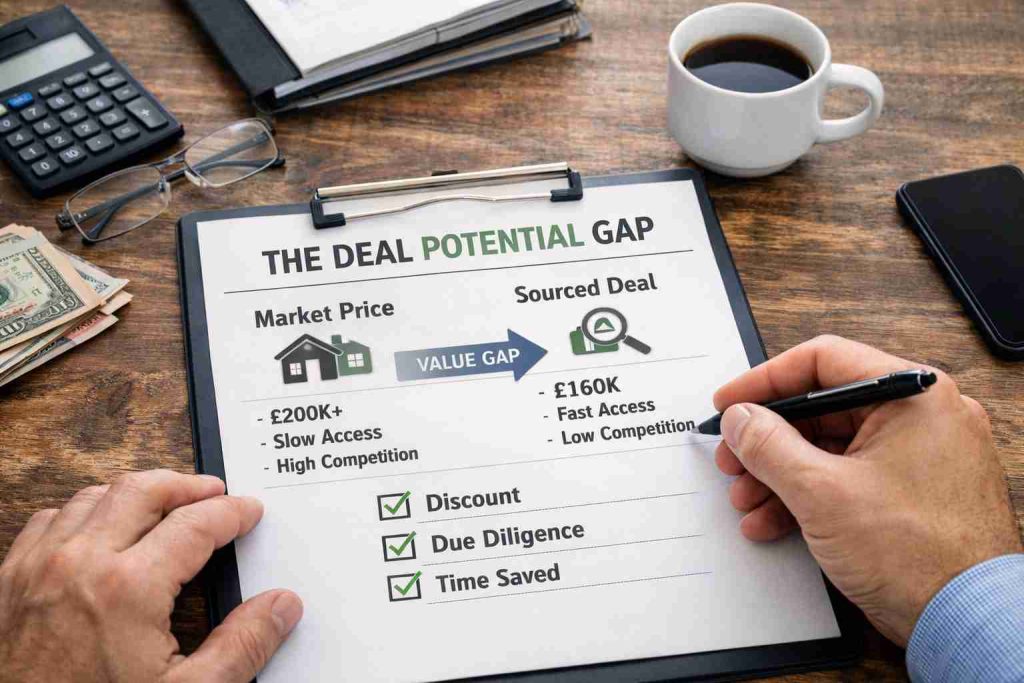
As a rule, the stronger the evidence, exclusivity, and speed-to-completion, the more defensible the fee becomes. If the value is vague or unproven, the fee should be close to zero.
There’s no universal “correct” amount, but here’s the rational way to think:
You are not paying for the property.
You are paying for the value gap created by the sourcer.
So the fee should be proportional to one of these:
-
- time saved to access a real opportunity
-
- risk reduced through verified due diligence
-
- margin created through true discounting
-
- speed advantage that wins the deal
A safe rule is:
If the deal does not clearly deliver value at least 3 to 5 times the fee, walk away.
If you pay £3,000, the deal should produce at least £9,000 to £15,000 of real advantage (discount captured, risk avoided, time saved, profit margin improved), otherwise you’re subsidising someone else’s marketing.
The smartest way to use sourcers (without getting burned)
The best investors don’t outsource judgement, they outsource legwork. You can let a sourcer bring opportunities to the table, but you should still run the same filters you’d apply if you found it yourself.
If you build your process this way, sourcing becomes a tool for speed and access, not a shortcut that quietly increases your risk.
If you want to use sourced deals properly, treat it like a pipeline, not a gamble.
Do this:
-
- Only pay for deals that fit your strategy
-
- Only pay after you’ve verified the numbers independently
-
- Only pay when the deal survives stress testing
-
- Only pay sourcers who provide proof, not hype
-
- Always keep control of solicitors, valuation logic, and exit assumptions
Sourcers are not the problem.
Weak verification is the problem.
FAQs: sourced property deals in the UK
These are the most common questions investors ask when they’re trying to decide whether sourcing is a smart shortcut or an expensive mistake. The answers below focus on practical decision-making, not theory, so you can spot the difference between a legitimate opportunity and a polished sales pitch.
Are sourced deals legal in the UK?
Yes, property sourcing itself is legal, but sourcers must operate correctly. The safest approach is to ensure they have proper terms, disclosures, and compliance processes, and that you verify everything independently.
Are sourced deals always overpriced?
No, but many are. Some sourcers build fees into the price, inflate GDV assumptions, or use unrealistic rent projections. The only way to know is to run your own numbers.
Should I ever pay a sourcer upfront?
Be cautious. If you pay upfront, you need clear written terms: what you get, refund conditions, timeline, and proof of access. Paying “just to view details” is often a red flag.
What is the biggest risk with sourced deals?
Buying based on trust instead of verification. The biggest losses usually come from hidden refurb costs, legal title issues, inflated end values, and deals that collapse under finance reality.
Are sourced deals legal in the UK?
Property sourcing is legal, but if someone is effectively introducing buyers and negotiating sales “on instruction”, they may fall under the Estate Agents Act 1979, so you should always verify how the sourcer operates and what they are actually being paid for.
Final thought: sourced deals can be smart, but only in the right situations
Paying for a sourced deal makes sense when the sourcer provides at least one of these:
-
- access you can’t easily replicate
-
- speed that wins time-sensitive opportunities
-
- real de-risking through due diligence
-
- precision matching for narrow strategies
-
- margins strong enough to survive reality
If none of those are true, don’t pay.
Because in that case, you’re not buying a deal.
You’re buying a story.

Koye Beckley is a UK property investor and founder of UncommonDeal, with practical experience in buy-to-let, property auctions, refurbishment projects and investment deal analysis. Through UncommonDeal, he publishes property market research, property deal sourcing and compliance guidance, investment guides and data-driven analysis to help investors evaluate buy-to-let, BRRR, flip and auction opportunities.
