
Why High Investor Demand Doesn’t Mean a Good Property Deal
There is an uncomfortable truth most investors only learn after a few painful mistakes: a good property deal is rarely the one everyone is fighting over.
High investor demand creates the illusion of safety. When dozens of buyers are circling the same property, it feels validated. The thinking is simple: if this many investors want it, it must be a good property deal. In reality, popularity often masks weak fundamentals rather than confirming strength.
After a proper deal analysis, good property deals are built on margin, resilience, and conservative assumptions. Popular deals, on the other hand, are usually built on familiarity. They look easy to understand, easy to explain, and easy to sell to the next person. That ease attracts attention, not quality.
This is where many investors go wrong. They mistake activity for opportunity. Viewings, offers, and “investor interest” become signals, while the numbers, financeability, regulatory exposure, and exit risks get pushed into the background. The deal feels alive, so it must be good.
But good property deals do not rely on momentum. They work quietly, even when demand cools. They still make sense when rents disappoint, finance tightens, or timelines slip. Popularity can disappear overnight. A good property deal does not.
Understanding this difference is one of the clearest lines between chasing deals and building a portfolio that actually lasts.

What is a good property deal
A good property deal is not a property that gets attention. It is a property that still works when you remove the hype, tighten the assumptions, and run the numbers like someone who actually plans to hold risk.
A good property deal has one core feature: it has enough margin to absorb reality. Reality is voids, repairs, slower timelines, higher mortgage rates, licensing costs, and buyers who negotiate harder on exit. If a deal only works in a perfect spreadsheet, it is not a good property deal. It is a fragile one.
Good property deals are built on margin, not hype
Margin is what is left after you account for real costs, not what is left after an agent’s rent estimate and a best-case refinance. A good property deal typically has margin in at least one of these places:
-
Purchase discount: you are buying below comparable value, not just below asking price.
-
Value add: a refurb or layout improvement that the market actually pays for, not a cosmetic story.
-
Income margin: rent that is supported by local demand and comps, with costs fully loaded.
-
Exit margin: more than one realistic exit, not a single “sell in 6 months” plan.
Hype is the opposite. Hype is when the deal relies on someone else paying more later, or when the only way the numbers work is by ignoring costs you will definitely face.
Good property deals survive conservative assumptions
A good property deal looks slightly boring when you underwrite it properly. That is a good sign.
Conservative assumptions mean you stress the things that normally break deals:
-
Rent: use a realistic figure, not the highest listing you can find.
-
Voids and arrears: assume some disruption, especially in higher churn areas.
-
Maintenance and compliance: budget as if you will actually do the job properly.
-
Interest rates: model higher rates or tougher stress tests, even if you plan a lower rate today.
-
Timeline: assume delays in refurb, letting, refinance, or sale.
If the deal still produces acceptable returns with those assumptions, you are looking at a good property deal. If it collapses as soon as you apply friction, then investor demand is not the issue. The structure of the deal is.
A Good property deal work even when demand cools
Investor demand is a mood. It changes with rate headlines, lender criteria, and market sentiment. A good property deal is designed to survive when the mood turns.
That usually means:
-
It is financeable by normal lenders, not just “cash buyers only.”
-
This has an exit that is not dependent on a booming market, such as rental stability or multiple buyer types.
-
It has room for negotiation on resale, because you did not buy at the ceiling.
-
The property not dependent on one strategy staying fashionable, such as overcrowded rent-to-rent claims or overbought micro-HMO models.
This is the practical difference between investors who build long-term portfolios and investors who stay stuck chasing “hot deals.” Good property deals do not need a crowd. They need margin, realism, and resilience.
Why investor demand is a poor indicator of good property deal
Investor demand feels reassuring, but it is one of the weakest signals you can rely on when assessing good property deals. Demand tells you where attention is. It does not tell you where margin, resilience, or downside protection sits.
Most investors are not analysing deeply. They are filtering quickly. That alone should make you cautious about using their behaviour as a quality benchmark.
High investor demand does not equal good property deals
When a property attracts heavy investor interest, it usually means one thing: it fits a familiar template.
Cheap price. Decent-looking headline yield. Simple strategy. Easy story.
That familiarity creates speed. Speed creates volume. Volume creates the illusion of validation.
But good property deals are not defined by how fast people move. They are defined by how well the deal performs once the noise disappears. Many high-demand deals stop working the moment you apply:
-
Realistic operating costs
-
Conservative rent assumptions
-
Finance stress testing
-
Regulatory or legal scrutiny
Investor demand rarely survives those tests. Good property deals are built to.
Investor demand reflects familiarity, not deal quality
Most investors chase what they already understand. That is human nature.
If a deal looks like every other buy-to-let, small HMO, or light refurb flip they have seen before, it attracts attention. Not because it is a good property deal, but because it feels safe.
This is why crowded strategies tend to produce thinner margins over time. As more investors pile in, prices rise, yields compress, and risks quietly increase. The deal still attracts demand, but the fundamentals weaken.
Good property deals often sit outside this comfort zone. They require more thinking, more due diligence, and more patience. As a result, fewer investors chase them.
Most investors chase the same non-good property deal
Most investors are not hunting for good property deals. They are hunting for deals that look easy to execute and easy to explain.
That creates a predictable crowding effect. Investors repeatedly pile into the same categories:
-
Headline-yield deals where the rent looks strong but the costs, voids, and compliance are underwritten badly.
-
“Below market value” claims where the discount disappears once you check sold comparables properly.
-
Light refurb flips where profit relies on a fast sale, perfect timeline, and no surprises.
-
Overfished strategies in the same postcodes, where competition has already compressed returns.
The problem is simple: when thousands of investors chase the same template, prices rise and margin shrinks. The deals still look popular, but they stop being good property deals because the numbers become fragile.
Good property deals tend to be the opposite. They are less obvious, harder to package in a one-line pitch, and they require proper underwriting and patience. That is exactly why fewer investors chase them, and why they often have more margin left in them when you find them.
Example: the popular deal vs the good property deal
Popular deal:
A two-bed terrace at auction priced cheaply, advertised at a strong gross yield. Dozens of investors book viewings. Bidding pushes the price up. Once costs, voids, compliance, and realistic rent are applied, the margin disappears. On exit, only investors are interested, and they all want a discount.
Good property deal:
A slightly tired property on a quiet street, priced fairly but with clear upside through layout improvement. Fewer viewings. Conservative rent assumptions. Financeable on standard terms. Multiple exits. No hype, but strong downside protection.
Investor demand chased the first deal. Analysis chose the second.
This is the key shift serious investors make: they stop asking what everyone wants and start asking what still works when enthusiasm fades.
The psychology that pulls investors away from a good property deal
Most investors do not lose money because they cannot analyse deals properly. They lose money because psychology quietly takes control before analysis is finished. Good property deals require patience and discomfort. Investor psychology pushes in the opposite direction.
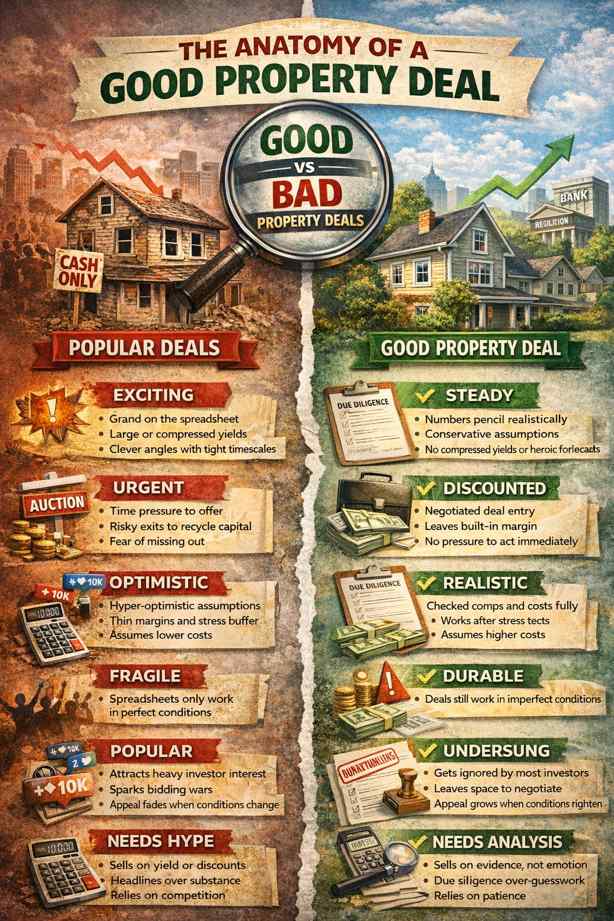
Why fear of missing out replaces analysis
Fear of missing out, or FOMO, shows up when a deal feels scarce. Viewings are full. Offers are flying in. Someone mentions they have already been outbid twice.
At that point, analysis starts to feel like a delay rather than a safeguard. Investors stop asking whether it is a good property deal and start asking whether they can move fast enough. Red flags get reframed as “things to sort later”. Margins get squeezed, but justified by speed.
Good property deals rarely trigger FOMO because they do not rely on urgency. They reward slow thinking, not fast action. When a deal feels like it will be gone if you stop to analyse it, that is usually a signal to pause, not rush.
How urgency language distracts from good property deals
Urgency is often manufactured. Phrases like:
-
“Multiple investor interest”
-
“Offers invited immediately”
-
“Won’t be around long”
-
“Priced to sell fast”
are designed to shift attention away from fundamentals. The focus moves from numbers to momentum.
Once urgency takes hold, investors stop asking hard questions about costs, financeability, regulation, and exit risk. The deal feels alive, so it must be good.
Good property deals do not need urgency language. They stand up to scrutiny without pressure. If a deal only works when you are rushed, it is not a good property deal.
Why herd behaviour creates crowded, fragile deals
Herd behaviour is what happens when investors use each other as validation. If many people are chasing the same deal, it feels safer to join them than to step aside.
The result is crowded entry points, thin margins, and deals that depend on continued enthusiasm to survive. These are fragile deals. When sentiment shifts, everyone tries to exit at once.
Good property deals tend to attract fewer followers. They feel less obvious. They require more thinking upfront. That lack of crowd is not a weakness. It is often the reason the margin is still there in the first place.
The types of deals that look popular but are not a good property deal
Some deals attract investor attention again and again, not because they are good property deals, but because they look good at first glance. They are easy to market, easy to explain, and easy to misunderstand. Once you run the numbers properly, the cracks appear.
Cheap headline price deals that are not good
Low purchase prices create instant excitement. A property listed at £85,000 in an area where houses sell for £120,000 looks like a bargain. Viewings fill up quickly. Investors feel they are buying “below market value”.
The problem is usually in what the headline price hides.
Example:
A terrace bought for £85,000 requires £25,000 of works. Legal, finance, and holding costs add another £10,000. All-in cost: £120,000. End value: £120,000 to £125,000.
There is no margin left. The deal was cheap, but it was never a good property deal. It relied on the headline price, not the all-in numbers.
Good property deals focus on total cost versus conservative end value, not just the sticker price.
High advertised yield deals that fail basic scrutiny
High yields pull investors in fast. A listing promising a 9 to 10 percent yield feels like strong income in a low-yield environment.
But advertised yields are often gross, optimistic, and incomplete.
Example:
A flat priced at £150,000 advertised at £1,100 per month rent shows a gross yield of nearly 9 percent. After management, maintenance, service charge of £2,500 per year, ground rent, insurance, voids, and compliance, net income drops sharply. Add mortgage stress testing and the deal barely covers costs.
Investor demand stays high because the yield looks attractive. The reality is that the margin is thin and fragile. A good property deal would still work after those costs are fully applied.
“Easy†strategies that rarely produce a good property deal
Investors are drawn to strategies that feel simple: light refurb flips, standard buy-to-lets, or small HMOs with minimal changes. These strategies are popular because they feel repeatable.
The issue is saturation.
Example:
A light refurb flip bought at £220,000, refurbished for £15,000, with an expected resale at £260,000. Once stamp duty, selling fees, finance costs, and delays are applied, the projected £25,000 profit shrinks to £5,000 or disappears entirely.
These strategies still attract demand because they are familiar. But familiarity does not equal profitability. Good property deals within these strategies still exist, but they are rare and require far tighter buying discipline than most investors apply.
Popularity makes these deals look safe. Proper analysis shows why many of them are not good property deals at all.
Why bad deals often attract more attention than good deals
At first glance, it seems illogical. If good property deals are stronger, safer, and more resilient, why do bad deals get more attention? The answer is not about intelligence. It is about simplicity, storytelling, and incentives.
Bad deals are easier to package. Good property deals are harder to explain.
Bad deals are easier to understand than good deals
Bad deals usually fit into a simple, familiar narrative. Buy cheap. Add value. Refinance or sell. Collect rent. The numbers are clean. The spreadsheet is short. The explanation takes thirty seconds.
Good property deals are messier. They involve trade-offs, longer timelines, and conservative assumptions. They require context. That makes them harder to sell in a pitch, even if they are stronger in reality.
Because most investors are scanning rather than studying, the simple story wins attention. The deeper story gets ignored.
Bad deals rely on assumptions, good property deals rely on evidence
Bad deals tend to work only if everything goes right. Rents must hit the top end. Refurbs must stay on budget. Timelines must be tight. Buyers must pay up on exit.
Those assumptions are often untested or copied from someone else’s deal.
Good property deals do the opposite. They rely on evidence: sold comparables, realistic rent data, lender criteria, actual cost history, and conservative exit values. When assumptions are used, they are deliberately pessimistic.
This difference matters. Assumptions make deals look good. Evidence makes deals survive reality.
Social-media-friendly deals vs genuinely good property deals
Social media rewards clarity, confidence, and speed. A deal that can be explained in a single post or short video gets attention, even if it is fragile underneath.
Good property deals rarely fit that format. They involve nuance, downside protection, and often boring numbers. Also, they do not create excitement. They create resilience.
This is why the most visible deals are often not the best ones. Visibility is not quality. Attention is not margin. The investors who build lasting portfolios learn to ignore what looks impressive online and focus on what still works when no one is watching.
The finance test that separates good property deals from bad ones
Finance is one of the most reliable filters in property investing. Lenders are not perfect, but they are conservative, regulated, and trained to spot risk. If a deal repeatedly fails the finance test, that is rarely an accident.
Good property deals tend to work with finance. Bad ones often rely on avoiding it.
Why good property deals remain financeable
A good property deal is usually financeable by mainstream lenders because it does not depend on edge-case assumptions. The construction is standard. The title is clean. The lease length, condition, and layout meet lending criteria.
More importantly, the numbers make sense under stress testing. Rental coverage works at higher rates. The exit value is defensible. The deal does not require a lender to believe a perfect story.
Financeability matters even if you plan to buy with cash. A good property deal keeps your exit pool wide. If a future buyer can get a mortgage, demand is broader and pricing is stronger.
Why lenders quietly reject non-good property deals
Lenders rarely say a deal is “bad”. They simply say no.
Rejections often come down to things investors overlook or downplay:
-
Short leases or defective titles
-
Non-standard construction
-
Poor layout or use class issues
-
Over-optimistic valuations
-
Income that fails stress tests
When multiple lenders reject the same deal, that is a signal. Good property deals may face scrutiny, but they usually pass. Bad deals get filtered out long before completion.
Why “cash buyers only†usually means it is not a good property deal
“Cash buyers only” is often framed as an opportunity. In reality, it usually means the deal has failed the finance test.
Example:
A flat priced at £140,000 is marketed as cash buyers only due to a 62-year lease. Extending the lease costs £25,000 plus fees. All-in cost rises to £170,000. Comparable flats with long leases sell for £175,000 to £180,000.
The margin is thin, the risk is high, and future buyers will face the same finance issues. The deal attracts cash interest, but it is not a good property deal. Finance did not miss it. Finance rejected it.
Regulation exposes weak deals
Regulation is one of the biggest reasons investor demand can mislead you. Demand tends to focus on what looks profitable today. Regulation tends to focus on what becomes a problem tomorrow. When rules tighten, weak deals get exposed fast, while good property deals simply absorb the change because they were built with reality in mind.
Licensing and compliance
Good property deals are underwritten with licensing and compliance requirements as a cost, not treated as an inconvenience to solve later.
That means you assume, up front, that you might need to deal with:
-
Selective licensing or additional licensing requirements
-
HMO licensing standards and ongoing inspections
-
Safety certificates and upgrade cycles
-
Minimum room sizes, amenity standards, fire safety, and management obligations
-
EPC and energy efficiency upgrades over time
-
Planning constraints and Article 4 pressure in some areas
-
Insurance, management, and documentation that is higher than a standard single let
A good property deal can carry these costs and still make sense. It does not rely on “it will probably be fine” or “I will sort it after completion”. It recognises that compliance is part of operating the asset, just like maintenance and voids.
If compliance costs wipe out the returns, it was never a good property deal. It was a deal that depended on ignoring obligations.
Why popular strategies face regulation first
Regulation tends to hit strategies that create visible pressure on communities, housing supply, or standards. That is why the most popular strategies often become the earliest targets.
Crowded strategies create patterns:
-
More complaints from neighbours and tenants
-
Frequent enforcement visits
-
More media scrutiny and political pressure
-
Councils looking for ways to raise standards or manage demand
So when an approach becomes widely used and visibly problematic, it attracts attention. That is not because every investor is doing something wrong. It is because scale brings scrutiny.
This is why a strategy being popular is not a safety signal. Popularity can be the reason it ends up regulated harder.
Good property deals do not depend on a strategy staying lightly regulated forever. They work even if compliance becomes stricter.
How regulation filters out marginal, non-good property deals
Regulation acts like a stress test that the market eventually runs whether you like it or not.
Marginal deals only work when everything is loose:
-
Lending
-
Enforcement
-
Standards
-
Cost assumptions
As soon as any part tightens, the numbers break.
That is how regulation filters out non-good property deals. The landlord who bought on thin margin finds themselves forced to spend money they did not budget for. Net income collapses. The exit gets harder. The deal becomes a headache. Investor demand disappears because the next buyer can see the same problem coming.
Good property deals, by contrast, survive tightening. They have margin and realistic costs. Additionally, they have an exit that is not dependent on avoidance. Regulation does not kill them. It simply proves they were solid in the first place.
The numbers that kill most supposed good property deals
Most deals do not fail because the idea was wrong. They fail because the numbers were shallow. On the surface, the spreadsheet works. Once real-world costs, delays, and exit friction are applied, the deal quietly collapses.
This is where many supposed good property deals reveal what they really are.
Costs investors underestimate
Investors tend to focus on the big numbers and ignore the slow leaks. Over time, those leaks drain returns.
Commonly underestimated costs include:
-
Maintenance and wear: not just initial works, but ongoing repairs that come with real tenants.
-
Voids and arrears: even in high-demand areas, income is not perfectly continuous.
-
Management and compliance administration: especially once portfolios grow or regulation tightens.
-
Service charges and ground rents: particularly on leasehold property, where increases are outside your control.
-
Insurance, utilities, and council tax during voids: costs that do not pause just because the tenant has left.
-
Finance friction: valuation shortfalls, product fees, and higher stress rates than expected.
A good property deal still works after these are fully loaded. A fragile one only works if they are ignored or minimised.
By stress-testing the deal, investors can block the leak.
Stress testing against scenarios
Stress testing is the difference between optimism and discipline.
Real good property deals are stress tested against scenarios that actually happen:
-
Higher interest rates
-
Slower lettings
-
Lower rents than forecast
-
Longer refurbs or delayed sales
-
Reduced valuations on refinance or exit
If a deal only works at today’s rate, today’s rent, and today’s sentiment, it is not a good property deal. It is a timing bet.
Good property deals produce acceptable outcomes across a range of conditions. They may not look exciting at peak performance, but they survive downturns. That is the trade-off serious investors accept.
How weak exits destroy otherwise popular deals
Exit strategy is where many popular deals fail silently.
A deal that only appeals to one buyer type is vulnerable. A deal that only works in a rising market is exposed. When demand cools, exits slow and prices soften.
Weak exits include:
-
Properties that only investors can buy, especially if yields have compressed
-
Assets with finance issues that limit the buyer pool
-
Deals priced at the top of the market with no buffer
-
Strategies that rely on selling quickly to recycle capital
Good property deals think about exit before entry. They assume negotiation, delays, and pressure on price. They leave room for that reality.
Popularity can hide exit risk for a while. The numbers never do.
How experienced investors identify good property deals early
Experienced investors rarely find good property deals by chasing what looks exciting. They find them by paying attention to what feels quietly workable when others lose interest. This shift usually comes after seeing how many popular deals fail in practice.
Good property deals feel boring at first
Good property deals often look underwhelming on first pass. The price is not dramatic. The yield is not headline-grabbing. The strategy does not promise fast wins.
That is because good property deals are built around downside protection, not excitement. They rely on sensible purchase prices, realistic rents, and conservative timelines. There is no urgency, no clever angle, and no rush.
To less experienced investors, that looks dull. To experienced ones, it looks safe.
Boring is often a signal that the deal does not rely on hype, perfect conditions, or rapid resale. It means the deal still works if things take longer or cost more than planned.
Good property deals attract fewer bidders
Fewer bidders is usually a feature, not a flaw.
Good property deals often require effort: deeper due diligence, better understanding of local values, or more complex analysis. That alone filters out a large portion of the market.
They also tend to be priced fairly rather than aggressively discounted. Without a dramatic headline angle, they do not trigger bidding wars. Investors scanning quickly move on.
This is why good property deals are often found where there is space to think. Less competition means more negotiating power, better terms, and margin that does not get bid away.
Good property deals often require more thinking upfront
Good property deals demand more work at the start. You need to check sold comparables properly, understand rental demand on the ground, assess compliance requirements, and model conservative scenarios.
That upfront effort replaces future surprises.
Bad deals feel easy early and painful later. Good property deals feel slow early and stable later. Experienced investors choose the second path because they understand that thinking is cheaper than fixing mistakes after completion.
This is how good property deals are identified early: not by speed, but by discipline, patience, and a willingness to walk away while others rush in.
Case study: popular deal vs good property deal
Looking at theory is useful, but the difference between popularity and quality becomes much clearer when you see it in real numbers. Below are two simplified case studies that reflect deals many investors see every week.
High-demand deal that was not a good property deal
The pitch:
A two-bed terrace listed at auction with a guide price of £95,000. Advertised rent of £900 per month. Multiple investor viewings booked within days. The agent described it as “ideal for investors”.
The reality:
-
Purchase price after bidding: £108,000
-
Stamp duty and legal fees: £6,000
-
Refurb required: £22,000
-
All-in cost: £136,000
Realistic rent after checking comparables: £825 per month.
After management, maintenance, voids, insurance, and compliance, net income was marginal. Mortgage stress testing failed with most lenders. The only realistic exit was selling to another investor.
Investor demand pushed the price up, but it also destroyed the margin. Once analysed properly, this was not a good property deal. It was a popular one.
Low-interest deal that became a good property deal
The pitch:
A tired three-bed semi listed at £185,000 on the open market. Few viewings. No urgency. The photos were uninspiring. Most investors ignored it.
The reality:
-
Negotiated purchase price: £170,000
-
Stamp duty and legal fees: £7,000
-
Refurb and layout improvement: £18,000
-
All-in cost: £195,000
Conservative end value based on sold comparables: £235,000.
Realistic rent: £1,050 per month.
The full deal breakdown was financeable on standard terms, worked at stressed rates, and had multiple exits: hold, refinance, or sell to owner-occupiers. It looked dull, but it was a good property deal.
What analysis revealed that demand hid
In the first case, demand masked risk. Competition removed margin and pushed investors into optimistic assumptions.
In the second case, lack of demand created space. Space allowed negotiation, conservative underwriting, and a deal that still worked when assumptions were tightened.
The lesson is simple: demand does not create good property deals. Analysis does.
Final verdict: good property deals are built, not chased
Investor demand is loud. It creates urgency, confidence, and the feeling that something important is happening. But noise is not information. Popularity does not make a deal strong, and competition does not make it safe.
Investor demand is noise. It reflects where attention is flowing, not where risk has been removed. It often amplifies the same fragile deals until the margin is gone and the downside is exposed.
Analysis is signal. It is slower, quieter, and far less exciting. But it is also what reveals whether a deal survives higher rates, tighter regulation, longer timelines, and tougher exits. Good property deals do not need applause. They need evidence.
Good property deals reward discipline, not speed. The investors who build durable portfolios are not the fastest to offer. Not only are the quickest to walk away, but also accept fewer deals in exchange for better ones. They choose resilience over excitement.
In the long run, chasing demand leads to crowded entry points and thin margins. Building good property deal strategy leads to flexibility, control, and outcomes that still work when enthusiasm fades.

Koye Beckley is a UK property investor and founder of UncommonDeal, with practical experience in buy-to-let, property auctions, refurbishment projects and investment deal analysis. Through UncommonDeal, he publishes property market research, property deal sourcing and compliance guidance, investment guides and data-driven analysis to help investors evaluate buy-to-let, BRRR, flip and auction opportunities.