
Short Lease Auction: When They’re Profitable vs Unfinanceable
At first glance, a short lease auction property can look like one of the biggest bargains in the UK property market. Flats with 60 or 70 years remaining on the lease often appear significantly cheaper than comparable properties with long leases. To buyers scanning auction catalogues, that price difference can seem like an obvious opportunity.
In reality, the discount usually exists for a reason. In many cases, the lower price reflects mortgage restrictions, lease extension costs, and the smaller pool of buyers willing or able to take on the risk. Once the remaining lease term drops below certain thresholds, lenders become more cautious, extension premiums increase, and resale demand can shrink.
Because of this, experienced investors rarely focus only on the guide price. Before bidding on a short lease property at auction, they analyse the remaining lease length, the estimated cost of extending the lease, whether statutory extension rights apply, and whether the property will be mortgageable after the lease issue is resolved. Without this analysis, what initially looks like a discounted deal can quickly become far more expensive than expected.
Less experienced buyers often make the opposite mistake. A property advertised well below the price of similar flats in the same area can create the impression of an undervalued deal, when in many cases the price simply reflects the financial and legal complexity of the short lease.
This guide explains how investors approach short lease auction opportunities more carefully. It will cover:
-
What a short lease property actually means in the UK
-
Why short leases appear frequently at auctions
-
When buying a short lease auction property can be profitable
-
When short leases become effectively unfinanceable
-
How investors analyse short lease deals before bidding
What Is a Short Lease Property?
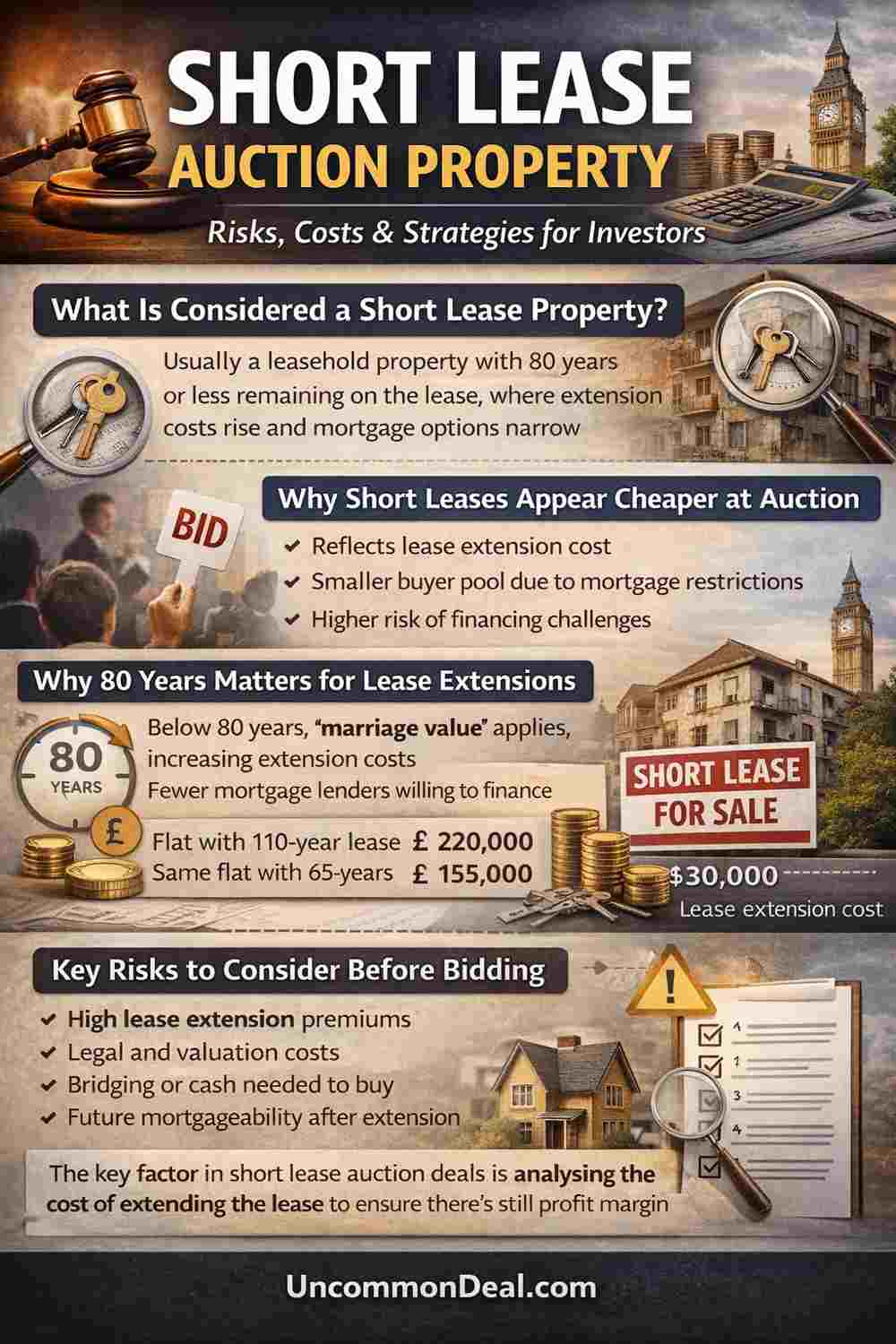
A short lease property is a leasehold property where the remaining lease term has fallen low enough to affect its value, mortgage availability, or resale demand. In the UK property market, a lease is commonly considered “short” when the remaining term approaches 80 years or less, because extension costs begin to increase significantly below this point.
What Counts as a Short Lease Property in the UK?
In the UK property market, the term short lease property generally refers to a leasehold property where the remaining lease term is low enough to affect value, mortgage availability, and future extension costs. While there is no single legal definition, investors and lenders typically begin to view leases as “short” once the remaining term approaches 80 years or less.
Understanding what qualifies as a short lease is important because lease length directly influences buyer demand, financing options, and long-term resale value.
Typical Lease Lengths in the UK Property Market
Most leasehold properties begin with relatively long lease terms. When a flat is first sold, the developer or freeholder usually grants a lease of 99 years, 125 years, or sometimes 999 years.
Over time, however, the lease gradually reduces. Many flats built in the 1980s, 1990s, or early 2000s may now have 70–85 years remaining on the lease. As the remaining term falls, buyers and lenders start paying closer attention to the potential cost of extending the lease.
For this reason, lease length becomes a critical factor in how the market values a property.
Why 80 Years Is the Critical Lease Threshold
The 80-year mark is widely regarded as the most important threshold for leasehold property in the UK.
Once a lease drops below 80 years:
-
Marriage value becomes part of the lease extension calculation
-
The cost of extending the lease increases significantly
-
Some mortgage lenders become more cautious about lending on the property
Because of these factors, many buyers aim to extend the lease before it falls below 80 years.
When a Lease Becomes “Very Shortâ€
Investors often classify lease length into rough categories to quickly assess risk and financing difficulty:
| Lease Length | Market View |
|---|---|
| 90+ years | Normal lease |
| 80–90 years | Early warning zone |
| 70–80 years | Short lease |
| 60–70 years | Very short lease |
| Under 60 years | Often unmortgageable |
The shorter the lease becomes, the smaller the buyer pool typically becomes. This is one reason short lease properties frequently appear in auction catalogues, where cash buyers and experienced investors are more active.
Why Short Lease Properties Appear Frequently at Auction
Short lease properties appear in auction catalogues far more often than many buyers realise. Investors who regularly analyse short leases property auctions often find that these properties attract a much smaller pool of buyers..
While auctions are commonly associated with repossessions, renovation projects, or unusual properties, they are also a common sales route for leasehold properties with declining lease terms.
This happens because short leases introduce complications that make the property harder to sell through the traditional estate agent market. As the remaining lease length drops, financing restrictions, buyer hesitation, and pricing uncertainty begin to affect the sale process.
Mortgage Restrictions Remove Many Buyers
One of the biggest reasons short lease properties end up at auction is mortgage availability. Most buyers in the UK rely on mortgage finance to purchase property, but lenders often impose minimum lease requirements.
When the remaining lease term falls into the 60–70 year range, many lenders become unwilling to provide mortgages. Even some buy-to-let lenders require a significantly longer lease term, particularly if the lease will fall further during the mortgage period.
As a result, a large portion of potential buyers are effectively removed from the market. Only cash buyers, bridging finance users, or experienced investors are typically able to consider these properties.
Sellers Use Auctions to Solve Liquidity Problems
Owners of short lease properties can struggle to sell through estate agents because many buyers initially show interest but later withdraw when financing becomes difficult.
Common issues include:
-
Buyers being unable to secure a mortgage
-
Lenders declining valuations due to short lease risk
Auctions provide an alternative route where sellers can access a pool of cash-ready buyers who understand more complex property situations.
Auction Pricing Reflects Risk, Not Opportunity
Short lease auction properties often appear significantly cheaper than similar properties with longer leases. However, this price difference rarely represents a simple bargain.
In many cases, the lower price reflects:
-
The cost of extending the lease
-
A smaller pool of eligible buyers
-
Financing challenges for future purchasers
For investors, the key question is not whether the property looks cheap, but whether the total cost of solving the lease problem still leaves room for profit.
Why Properties With Short Lease Looks Cheap?
One of the main reasons short lease properties attract attention at auction is the significant price gap between short leases and comparable long-lease properties. Much of this discount comes from the property devaluation caused by short leases as the remaining term falls.
At first glance, these discounts can make the property appear undervalued. However, in most cases the lower price reflects future financial obligations that the buyer will need to resolve, particularly the cost of extending the lease.
Understanding why short lease auction properties appear cheaper is essential for investors trying to separate genuine opportunities from deals that simply shift hidden costs to the buyer.
The infographic below summarises the main risks and cost factors investors should consider when analysing a short lease auction property.
The “Headline Discount” Effect
Auction listings often display prices that appear dramatically lower than similar properties in the same building or neighbourhood. When buyers compare the guide price with long-lease sales nearby, the difference can look like a clear bargain.
For example:
| Property Type | Value |
|---|---|
| Flat with 110-year lease | £220,000 |
| Same flat with 65-year lease | £150,000 |
At first glance, the £70,000 difference may appear to represent immediate equity. In reality, that gap usually reflects the estimated cost and complexity of extending the lease, along with the reduced buyer demand caused by financing restrictions.
Why Estate Agents Rarely Market Short Lease Deals
Estate agents typically prefer to market properties that attract the widest possible pool of buyers. Properties that qualify for standard mortgage lending are easier to sell because most buyers rely on financing.
Short lease properties create the opposite situation. If many buyers cannot obtain mortgages, the number of potential purchasers falls sharply. This reduces transaction certainty, which can make traditional sales slower and more unpredictable.
As a result, some sellers choose auctions instead.
Auction Buyers Often Misinterpret the Discount
Many inexperienced investors see the lower price and assume a simple formula:
“Short lease = cheap bargain.”
In practice, the discount usually reflects real financial liabilities, including lease extension premiums, professional fees, and the temporary difficulty of obtaining finance. The apparent bargain only becomes a genuine opportunity if the numbers still work after those costs are fully analysed.
When Buying Short Lease Property at Auction Can Be Profitable
A short lease property at auction is not automatically a bad investment. In fact, some investors actively look for these deals because the restricted buyer pool can create pricing inefficiencies. When fewer buyers are able to compete, experienced investors who understand lease extensions may be able to purchase the property at a meaningful discount.
However, profitability usually depends on whether the investor can accurately estimate the cost of fixing the lease problem and whether the property’s value after the extension still creates a margin.
When the Lease Extension Cost Is Fully Understood
One of the most important factors in evaluating a short lease auction property is the true cost of extending the lease. This usually includes more than just the premium paid to the freeholder.
Investors must consider several components, including:
-
The lease extension premium
-
Valuation and surveyor fees
-
Legal costs for both parties
-
Possible negotiation or tribunal costs
Without a realistic estimate of these costs, it becomes impossible to assess whether the deal is genuinely profitable.
When the Post-Extension Value Creates Margin
Profit usually exists when the combined purchase price and extension cost remain below the market value of comparable long-lease properties.
For example:
| Item | Amount |
|---|---|
| Purchase price | £140,000 |
| Lease extension cost | £25,000 |
| Total investment | £165,000 |
| Value after extension | £200,000 |
In this scenario, extending the lease unlocks additional value.
When the Buyer Can Use Cash or Bridging Finance
Because many short lease properties cannot be financed with standard mortgages, buyers often rely on cash purchases or bridging finance. Once the lease has been extended, the property may then become eligible for traditional mortgage lending, allowing the investor to refinance.
When Statutory Extension Rights Apply
Under UK leasehold law, qualifying leaseholders typically have the right to extend their lease by 90 years with the ground rent reduced to zero. This can significantly improve both the value and mortgageability of the property once the extension process is completed.
When a Short Lease Auction Property Becomes Unfinanceable
While some short lease auction properties can be profitable, others become extremely difficult to finance or resell. In these situations, the property may look cheap but ultimately becomes an unfinanceable deal that limits future buyer demand.
This is one of the biggest risks investors face when buying short lease property at auction. If the lease problem cannot be resolved easily, the buyer may struggle to refinance or sell the property later.
Very Short Leases Under 60 Years
As the remaining lease term falls below 60 years, mortgage availability becomes increasingly limited. Many lenders simply refuse to lend on properties with very short leases, particularly if the lease will fall even further during the mortgage term.
Because of this, the buyer pool shrinks dramatically. Properties with extremely short leases often attract only cash buyers or specialist investors, which can make resale much harder.
When Lease Extension Costs Exceed Expected Profit
Lease extension costs increase significantly as the lease term falls, particularly once it drops below the 80-year threshold where marriage value becomes payable.
In some cases, the premium required to extend the lease may be so high that it removes most of the potential profit. If the extension cost plus purchase price approaches or exceeds the value of comparable long-lease properties, the deal quickly stops making financial sense.
When Buyers Cannot Access Extension Rights Immediately
Another risk arises when the buyer cannot extend the lease straight away. In many situations, a leaseholder must own the property for two years before exercising statutory lease extension rights.
This delay can create problems for investors who intend to refinance quickly, especially if lenders remain unwilling to lend during that period.
When the Lease Contains Unusual Clauses
Some short leases contain clauses that make lenders particularly cautious. These may include escalating ground rents, restrictive covenants, or disputes with the freeholder. Issues like these can reduce lender confidence and make refinancing far more difficult.
Mortgage Lenders and Short Lease Property Restrictions in the UK
Mortgage lending plays a major role in determining the value and liquidity of a leasehold property. When a lease becomes too short, lenders begin to see the property as a higher risk asset, which can lead to stricter lending criteria or outright mortgage refusals.
Because most buyers rely on mortgage finance, these restrictions can significantly reduce demand for short lease properties, particularly for investors planning to hold the property as a buy-to-let investment property.
This is one of the key reasons many of them end up being sold through auctions rather than the traditional estate agent market.
Typical Minimum Lease Requirements
Most mortgage lenders impose minimum lease length requirements before they will approve a loan. Although criteria vary between lenders, many expect:
-
At least 70–85 years remaining on the lease at the time of purchase
-
A longer remaining lease term by the end of the mortgage period
For example, if a buyer is taking a 25-year mortgage, some lenders require the lease to have at least 30 years remaining after the mortgage ends. This means a property with a short lease may fail lender criteria even if the buyer is otherwise financially qualified.
Why Valuers Downvalue Short Lease Property
When a mortgage lender assesses a property, a surveyor or valuer reviews factors that affect its resale value. Lease length is one of the most important considerations.
A short lease can cause valuers to reduce their valuation because:
-
Future buyers may struggle to obtain mortgages
-
Lease extension costs will affect the property’s value
-
Demand for short lease property is typically lower
This can lead to mortgage applications being declined or loan amounts being reduced.
Why Many Auction Buyers Use Bridging Finance
Because traditional mortgages are often unavailable at purchase, many investors rely on cash purchases or short-term bridging finance to buy short lease auction properties.
Once the lease has been extended and the property becomes mortgageable again, the investor may then refinance with a standard buy-to-let mortgage.
Can You Mortgage a Short Lease Property in the UK?
In some cases it is possible to obtain a mortgage on a short lease property, but the options become more limited as the remaining lease term decreases. Mortgage lenders usually impose minimum lease requirements because the lease length affects both the property’s value and its future resale market.
Most lenders prefer the lease to have at least 70–85 years remaining at the time of purchase. In addition, many lenders require the lease to still have 25–30 years remaining after the mortgage term ends. If the lease is too short, the property may fail the lender’s criteria even if the buyer’s income and credit profile are strong.
For example, if a buyer applies for a 25-year mortgage, the lender may expect the lease to have at least 95–100 years remaining at the start of the loan. This ensures the property will still have a reasonable lease length if it needs to be sold before the mortgage is fully repaid.
As the lease length falls below 70 years, the number of lenders willing to provide mortgages usually drops sharply. Below 60 years, most mainstream lenders will refuse to lend entirely. At this stage, buyers typically rely on cash purchases or bridging finance until the lease can be extended.
For investors, the key issue is not simply whether a mortgage is available today. It is whether the property will become fully mortgageable after the lease is extended, because this determines the long-term resale value and refinancing options.
How Investors Analyse Short Lease Deals Before Bidding
Experienced investors rarely rely on the guide price when evaluating a short lease auction property. They also review the auction legal pack carefully to identify lease terms, restrictive covenants, and other legal risks before bidding.
By the same token, they focus on analysing the full financial structure of the deal before deciding whether to bid. The key objective is to determine whether the cost of solving the lease problem still leaves enough margin for profit.
This type of analysis helps investors avoid situations where a property looks cheap at auction but becomes expensive once the true costs are included.
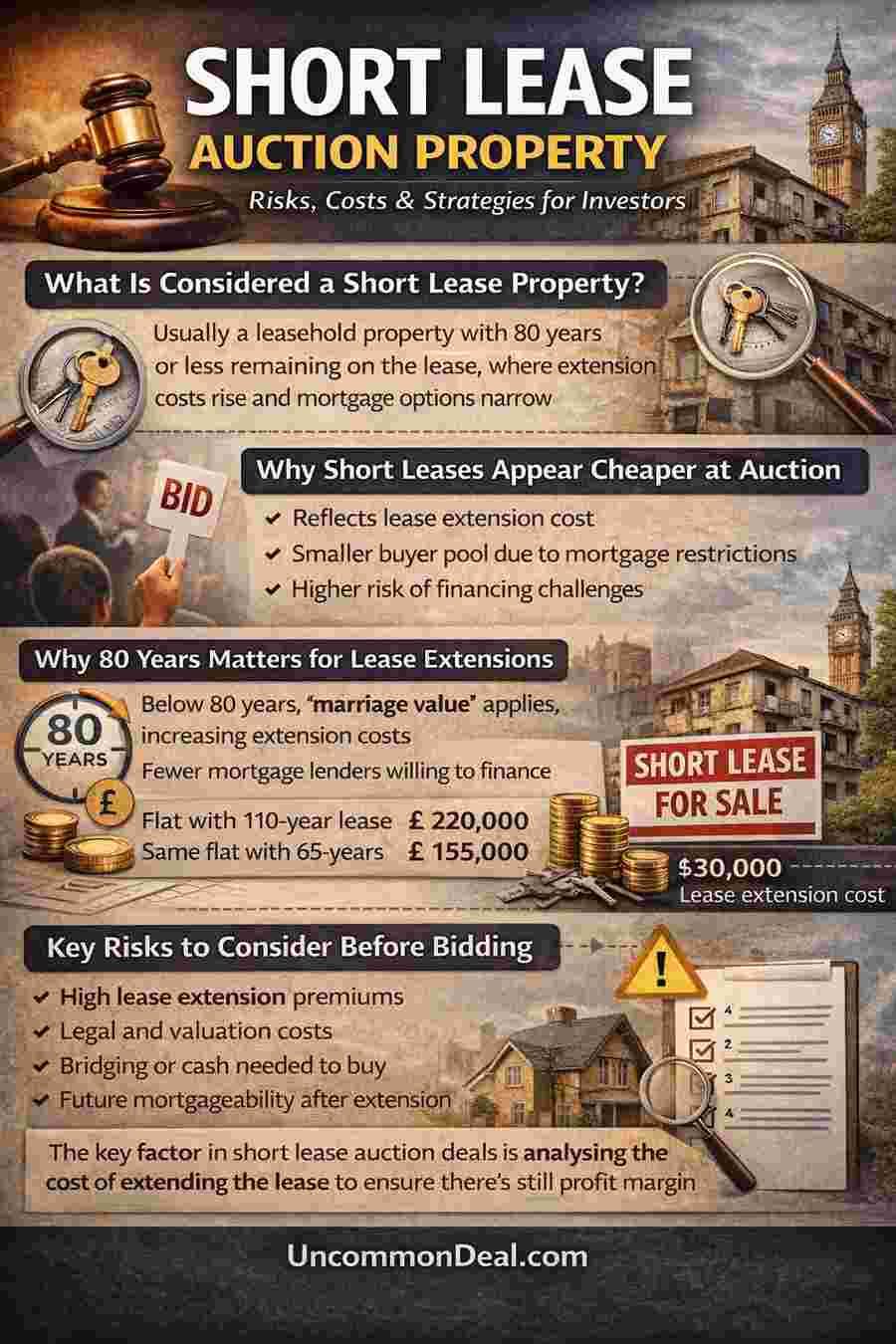
The infographic below summarises the key financial risks and cost factors investors should consider when analysing a short lease auction property.
Step 1: Estimate the Lease Extension Premium
The first step is estimating the lease extension premium, which is the payment made to the freeholder to extend the lease. This estimate depends on several factors, including:
-
Remaining lease length
-
Current property value
-
Ground rent terms
Investors often consult specialist valuers or use lease extension calculators to produce an approximate figure before the auction.
Step 2: Estimate the Post-Extension Market Value
Next, investors compare the property to similar flats in the same building or area with long leases. This helps establish the likely market value once the lease has been extended.
The goal is to understand what the property could realistically sell for after the lease issue has been resolved.
Step 3: Stress-Test Finance and Holding Costs
Short lease deals often involve additional costs beyond the purchase price and extension premium. Investors therefore stress-test the deal by including:
-
Auction fees
-
Legal costs
-
Bridging interest or financing costs
-
Valuation and survey fees
Including these costs helps produce a more realistic total project cost.
Step 4: Calculate the Maximum Auction Bid
Finally, investors calculate a maximum bid price before the auction begins. This ensures the deal still works financially after accounting for all costs and risks.
Once the bidding exceeds that number, disciplined investors simply stop bidding and walk away.
The Biggest Mistakes Investors Make with Short Lease Auction Deals
Short lease properties can create profitable opportunities, but they also produce some of the most common and costly mistakes in property auctions. Many investors focus on the discounted purchase price while overlooking the complexities that come with resolving a short lease.
Understanding these mistakes can help investors avoid deals that appear attractive initially but become financially difficult once the full costs and risks emerge.
Ignoring Marriage Value Below 80 Years
One of the most misunderstood aspects of leasehold property is marriage value. Once a lease falls below 80 years remaining, the lease extension calculation typically includes this additional component.
Marriage value represents the increase in property value created by extending the lease, and part of that increase becomes payable to the freeholder. As a result, extension costs can rise significantly once the lease passes the 80-year threshold.
Investors who ignore this factor often underestimate the total cost of resolving the lease problem.
Underestimating Lease Extension Costs
Another common mistake is assuming that the lease extension cost will be relatively small compared with the purchase discount. In reality, the total cost of extending a lease often includes more than just the premium.
Typical costs may include:
-
Lease extension premium
-
Surveyor or valuation fees
-
Legal costs for both parties
-
Potential negotiation or tribunal expenses
Failing to account for these additional costs can quickly remove the expected profit margin.
Investors must understand the full lease extension process before assuming a short lease property represents a bargain.
Assuming Mortgages Will Be Available Later
Some investors assume that they will be able to refinance the property easily after purchase. However, if the lease remains too short or lenders tighten their criteria, refinancing may not be possible immediately.
This can leave investors relying on more expensive short-term finance for longer than expected.
Buying Without Reviewing the Lease
Finally, some buyers fail to properly review the lease document itself. Certain leases contain unusual clauses, escalating ground rents, or restrictive covenants that can affect both financing and resale value.
Without reviewing the lease carefully, buyers may discover issues only after the purchase has already completed.
Short Lease Deals vs Standard Auction Properties
Not all auction properties carry the same level of complexity. While many auction listings involve refurbishment projects, repossessions, or unusual properties, short lease auction properties introduce an additional layer of financial and legal analysis.
The main difference is that a short lease does not simply affect the condition of the property. Instead, it affects mortgage availability, resale demand, and the long-term value of the asset.
Key Differences Between Standard Auction Deals and Short Lease Deals
| Factor | Standard Auction Property | Short Lease Auction Property |
|---|---|---|
| Mortgage availability | Often available after minor works | Frequently restricted or unavailable |
| Buyer pool | Larger group of buyers | Smaller pool of investors and cash buyers |
| Price volatility | More predictable | Greater uncertainty due to lease issues |
| Deal complexity | Moderate | High due to extension calculations |
| Exit strategy | Usually straightforward | Often depends on resolving the lease |
Because of these differences, investors typically treat short lease auction deals as specialised opportunities rather than standard purchases.
Why Short Lease Deals Require More Analysis
With a typical auction property, investors usually focus on factors such as refurbishment costs, local demand, and potential rental income. A short lease property requires an additional layer of analysis because the lease itself becomes part of the investment strategy.
The buyer must consider:
-
The cost and timing of extending the lease
-
Whether the property will become mortgageable after extension
-
How the lease length affects future resale value
This is why experienced investors often treat short lease properties as analysis-driven deals rather than simple discounted purchases.
Final Verdict: Short Lease Auction Property Is an Analysis Game
Short lease auction properties sit in a unique corner of the UK property market. They often appear cheaper than comparable flats with longer leases, which is why they attract attention from investors searching for undervalued deals. However, the lower price is rarely accidental. In most cases, it reflects lease extension costs, mortgage restrictions, and a smaller pool of eligible buyers.
For disciplined investors, these properties can sometimes present genuine opportunities. If the purchase price, lease extension cost, and associated fees remain well below the value of comparable long-lease properties, extending the lease can unlock additional value. In these situations, the short lease is not simply a problem to avoid but a structural issue that can be solved through careful analysis.
At the same time, short lease properties can also become some of the most misunderstood risks in property auctions. Buyers who focus only on the headline discount often underestimate extension costs, financing limitations, or the time required to resolve the lease issue. When these factors are ignored, a deal that initially looked attractive can quickly become difficult to refinance or resell.
Successful investors approach short lease auction property differently. Instead of asking whether the guide price looks cheap, they analyse the full structure of the deal, including:
-
The remaining lease length
-
The estimated lease extension premium
-
Legal and professional fees
-
Financing and holding costs
-
The property’s value after the lease is extended
In many cases, the difference between a profitable short lease deal and an unfinanceable trap comes down to one factor: whether the numbers were carefully analysed before the auction begins.
Frequently Asked Questions About Short Lease Auction Property
What is considered a short lease property in the UK?
A short lease property usually means a leasehold property with around 80 years or less remaining, where extension costs rise and mortgage options narrow.
Can you buy a short lease property at auction with a mortgage?
Sometimes, but many lenders require longer leases. Very short leases are often bought with cash or bridging finance.
Why are short lease properties cheaper at auction?
The discount usually reflects lease extension costs, lender restrictions, and a smaller buyer pool.
Why is the 80-year lease threshold important?
Below 80 years, marriage value usually applies, which increases the cost of extending the lease.
What should investors check before bidding?
Check the remaining lease, extension premium, legal costs, finance costs, and likely value after extension.

Koye Beckley is a UK property investor and founder of UncommonDeal, with practical experience in buy-to-let, property auctions, refurbishment projects and investment deal analysis. Through UncommonDeal, he publishes property market research, property deal sourcing and compliance guidance, investment guides and data-driven analysis to help investors evaluate buy-to-let, BRRR, flip and auction opportunities.